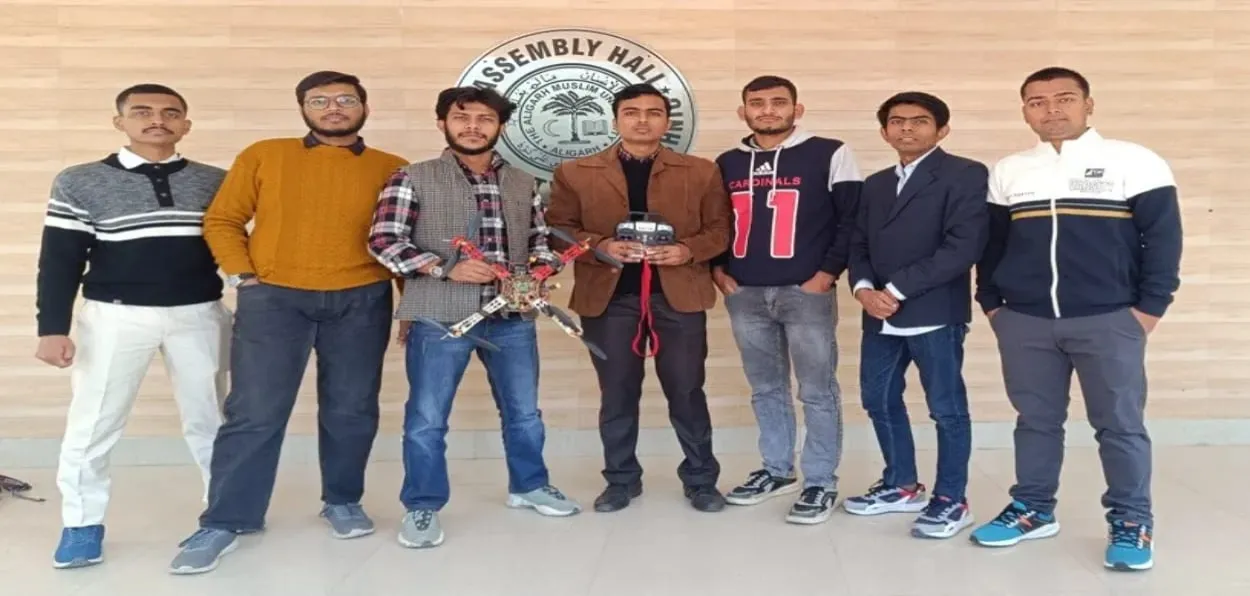
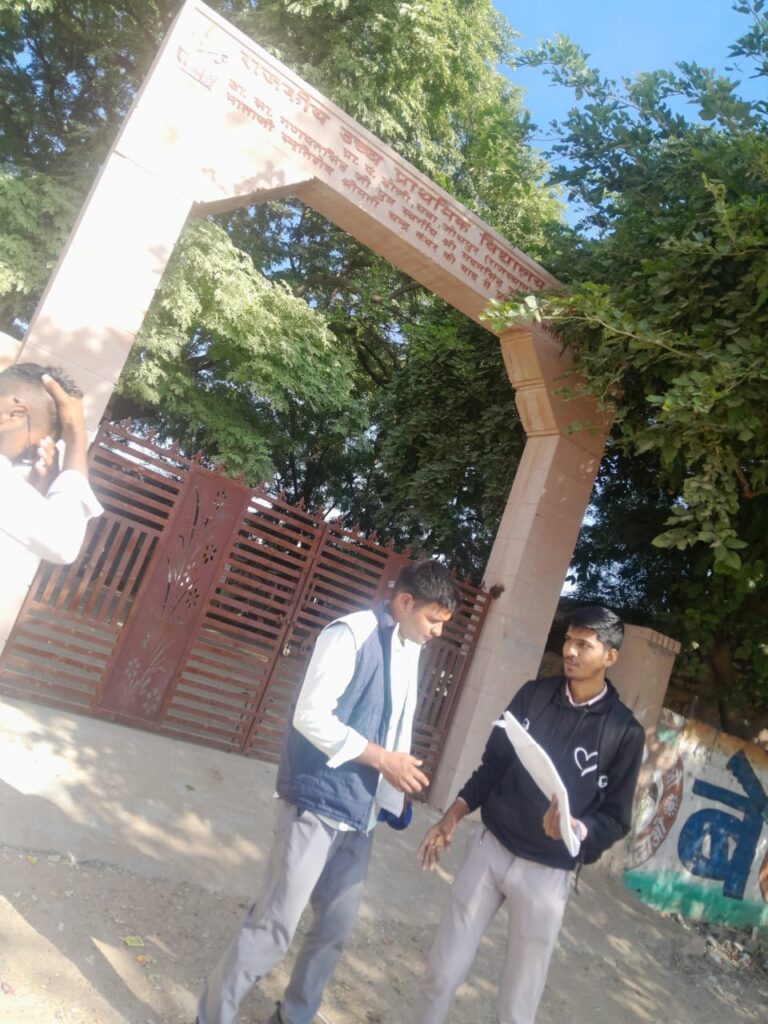
Students of AMU with their delivery drone prototype
Aligarh :
Showcasing creativity and technological ingenuity, a team of final-year students from the University Polytechnic, Faculty of Engineering and Technology, Aligarh Muslim University (AMU), has developed a Delivery Drone Prototype, a promising step towards autonomous aerial delivery systems.
Guided by former Principal of University Polytechnic, Prof. Arshad Umar and Dr. Tanveer Hasan, Associate Professor at the Polytechnic, the student team comprising Saubaan Ahmad Siddiqui, Ehtesham Ahmad, Shabab Khan, Ankit Tomar, Anas Khan, Muzaffar Hussain, and Omaan Ahmad Ansari successfully carried out six autonomous delivery missions within the university campus over a span of two months.
Equipped with real-time video streaming, autonomous navigation, gesture-controlled backup, and a custom dashboard to track flight data and delivery paths, the drone highlights the university’s commitment to hands-on, interdisciplinary learning.
This initiative is part of AMU’s larger vision to promote student-led innovation and applied research in emerging technologies. The project has received wide appreciation in academic circles for its relevance to real-world logistics, emergency response, and smart campus solutions.
Although this is a prototype for academic use, the team plans to enhance the system with AI-based object detection and an expanded operational range, reflecting the university’s emphasis on innovation-driven education and future-ready skills.
source: http://www.awazthevoice.in / Awaz, The Voice / Home> Stories / by Aasha Khosa, ATV / July 28th, 2025
During the peak of the Hijab controversy in Karnataka, fears grew that Muslim girls might abandon their studies.
To protect their education, Al Mamoor Women’s Charitable Trust took a bold step and established Victory First Grade College as a safe and inclusive space for students.
At a felicitation ceremony for top achievers, Mysore Educational, Social and Cultural Organisation (MESCO) president Abdul Qader Sait shared the college’s origin, saying the idea arose from the urgent need to ensure Muslim girls could study without disruption. “One could not stand by and watch talented young women lose their academic futures,” he said, recalling the Trust’s vision.
Al Mamoor Trust president Dr. Ulfat Fatima announced excellent exam results, stating that out of 15 BCA students, 13 secured distinction and 2 passed in first class, while in the B.Com stream, 7 achieved distinction and 2 passed in first class. She said the results proved the talent of students, the dedication of faculty, and the supportive environment. Mr. Sait honoured the late Prof. Muzaffar Asadi for guiding the college’s formation, noting that his advice and support were vital in turning the Trust’s vision into reality.
Al Mamoor Trust secretary and Sunpure Company owner Mrs. Salma Subhan urged parents to visit Victory College before admissions, stressing the importance of being satisfied with infrastructure, faculty, and standards. She also appealed to philanthropists to help expand opportunities for young women.
Victory College is now a model of empowerment, and its creation during the Hijab row shows the community’s proactive stand to protect young women’s education. With strong academic results and a growing reputation, the college aims to foster excellence, inclusivity, and empowerment. As applause filled the hall, the message was clear: Victory College’s mission is not only about marks but also about defending the right to education for those at risk of losing it.
source: http://www.radiancenews.com / Radiance News / Home> Latest News / by Mohamed Atherulla Shariff / August 13th, 2025
Tucked between the roaring waves of the Arabian Sea and the lush green canopy of the Western Ghats lies a jewel of a town – Bhatkal.
A place where coconut palms sway in the ocean breeze, where the call to prayer echoes through the valleys, and where the scent of cardamom-laced biryani mingles with the salty sea air. But beyond its scenic charm and poetic quietude, Bhatkal tells an inspiring story – a story of legacy, faith, culture, and a deep-rooted commitment to education.
Once a humble trading post frequented by Arab merchants, Bhatkal today is a dynamic blend of history and modernity. Its people, mostly of Arab descent, still carry the flame of their forefathers – traders who braved the seas, settled in distant lands, and left behind more than just wealth. They bequeathed a way of life, a sense of community, and a passion for learning that continues to flourish in remarkable ways.
Imagine waking up to a view where mist-kissed mountains tumble into spice-scented fields, only to meet a coastline where waves pound golden sands under the watchful gaze of age-old palms. That’s Bhatkal – not just a town, but a canvas painted with the green of the hills, the blue of the sea, and the gold of tradition. And amid this natural splendour, an educational movement has quietly taken root – transforming lives and reaffirming the town’s historic role as a cradle of knowledge and cultural resilience.
A Legacy Carried on the Tides
The story begins not just in Bhatkal, but far beyond – across the seas in the Gulf. Over the last five decades, thousands of Bhatkalis migrated to the UAE, Saudi Arabia, Oman, and Kuwait – carrying with them their culture, values, and a remarkable sense of unity. Wherever they went, they established Jamaats (community organisations), which became lifelines of cultural preservation and mutual support.
But by the 1990s, community elders noticed a worrying trend. Amid the glitz of Gulf jobs and the comfort of petro-dollar salaries, education was beginning to take a back seat. Young boys were dropping out after high school, opting to join the workforce early. The allure of quick earnings began to eclipse the pursuit of knowledge.
It was then that the Bhatkal Muslim Khaleej Council – an umbrella body of 11 Gulf-based Bhatkali Jamaats – decided to act.
The Birth of the Rabita Educational Award
The Council launched the Rabita Educational Award to rekindle academic ambition among Bhatkali youth. It wasn’t just about giving away medals or cash – it was about igniting pride, ambition, and a sense of purpose. The idea was simple: if we honour excellence, others will strive for it.
When the initiative began 30 years ago, the bar was modest. Students securing 65-70% were among the awardees. Yet even then, it was revolutionary. For the first time, young boys and girls felt seen and celebrated, and parents began to regard education as a shared community value.
Fast forward to today: Rabita Award winners score as high as 98% and above. This year, the difference between the topper and the runner-up was a mere 0.0375%. That’s not a gap – it’s a heartbeat.
This Year’s Celebration: A Festival of Learning
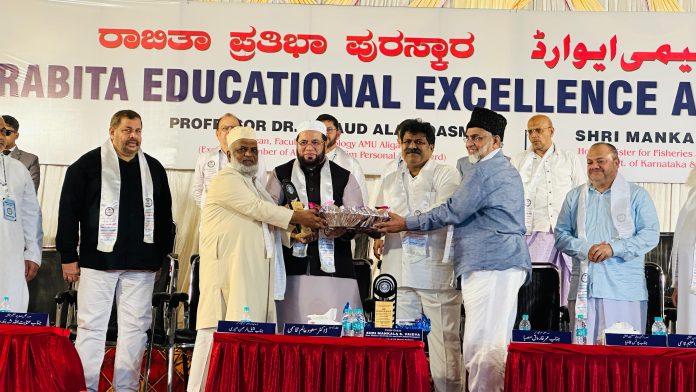
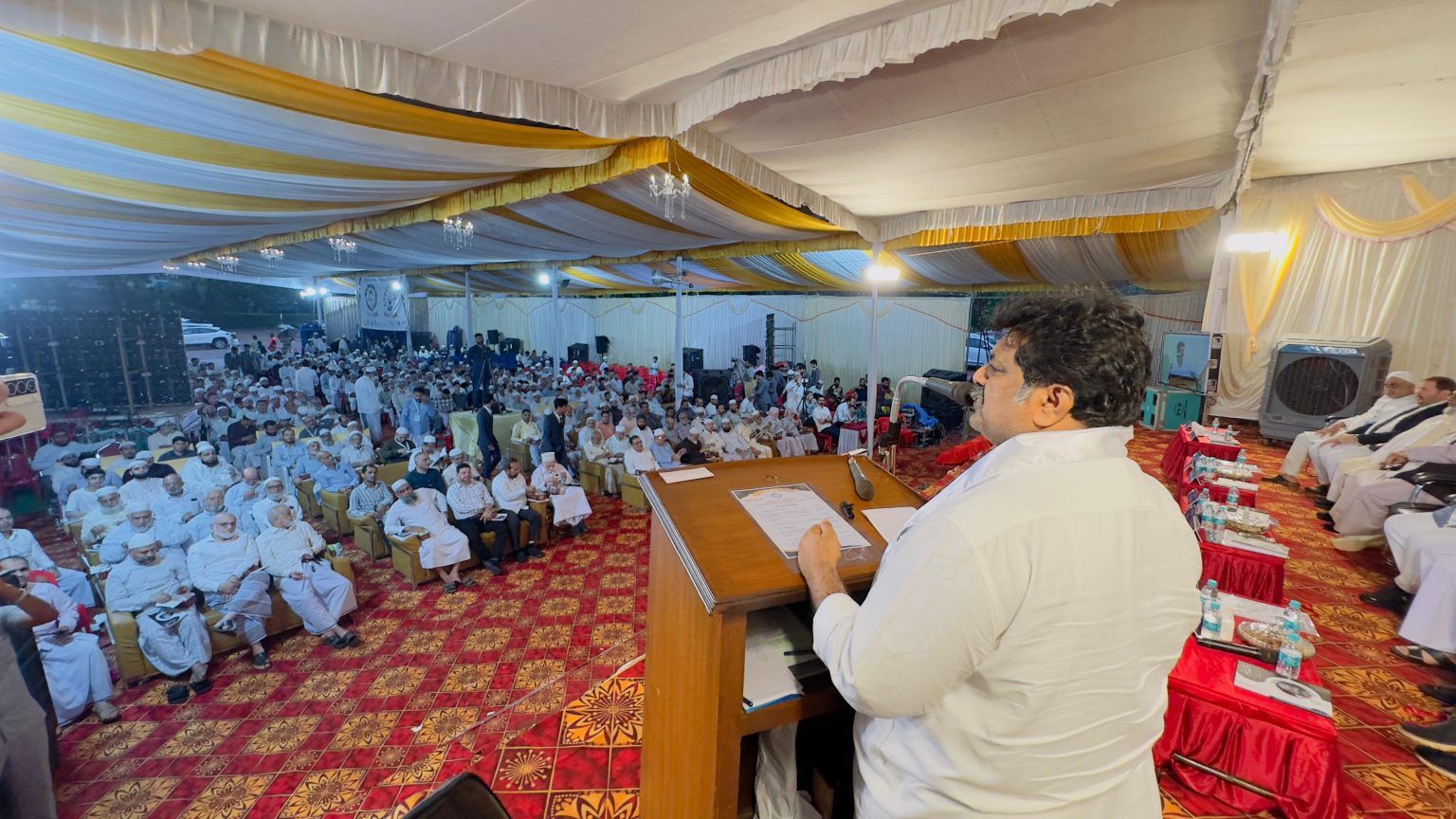
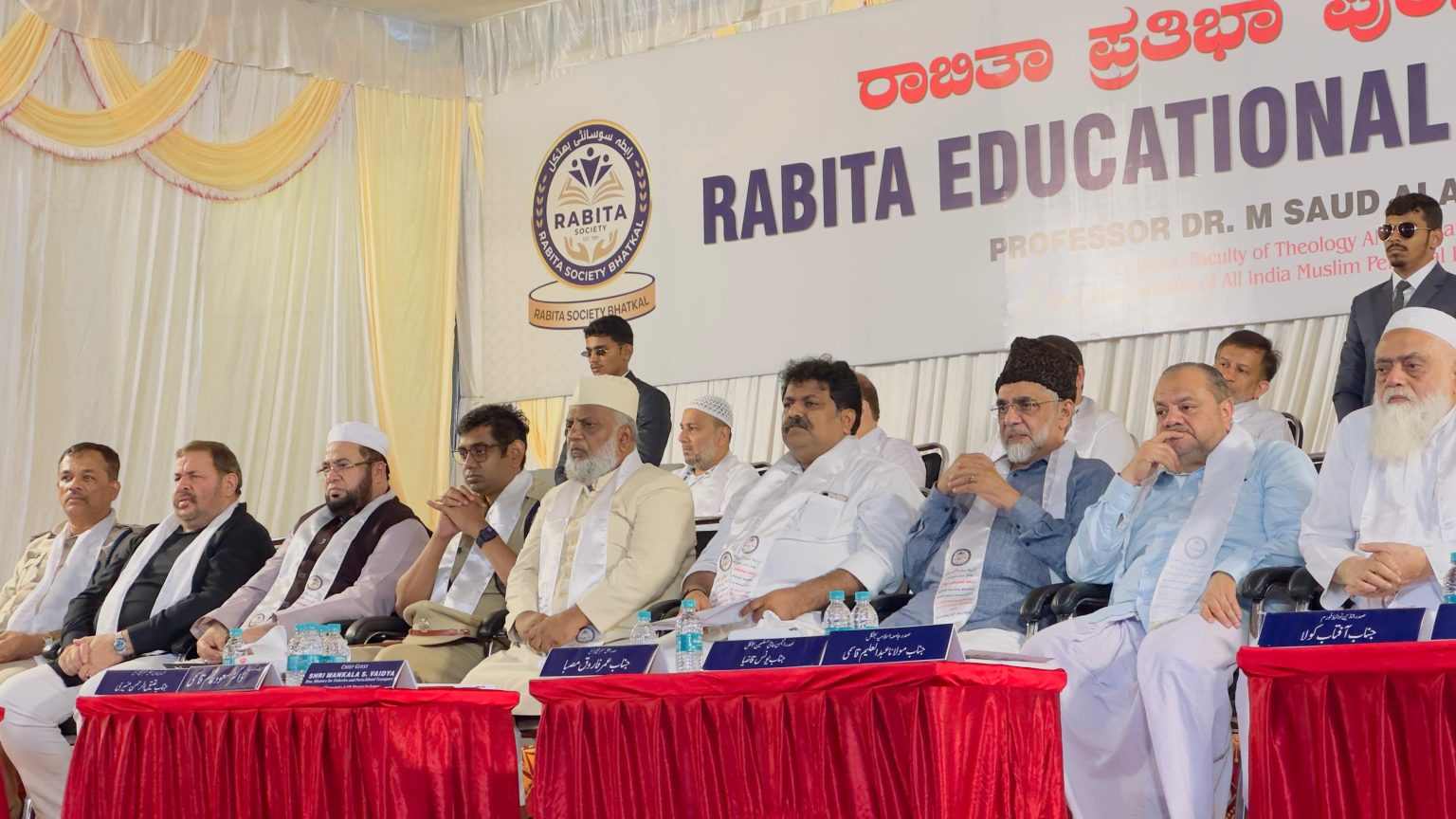
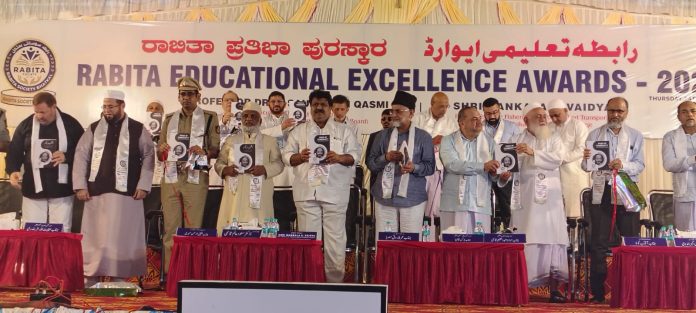
The 2025 Rabita Award Ceremony, held on 24th July at the sprawling grounds of Anjuman Islamiah Anglo-Urdu High School, was nothing short of majestic.
Even as rain poured steadily over the coastal town, the people of Bhatkal gathered in full strength. The makeshift auditorium overflowed with parents, teachers, and well-wishers – proving once again that no weather can dampen a community’s spirit when the cause is education. The stage, draped in the colours of Bhatkal’s spirit, welcomed an audience of thousands – parents, educators, students, and dignitaries.
Dr. Saud Alam Qasmi, a respected professor from Aligarh Muslim University and member of the All India Muslim Personal Law Board, addressed the gathering. His words resonated deeply:
“The United Nations declared education a basic human right in 1947. But 1,450 years ago, Islam declared: ‘Seeking knowledge is an obligation upon every Muslim man and woman.’”
His speech wove together spiritual insight and modern urgency, urging families to view education not as a luxury, but as both a sacred duty and a social necessity.
Joining him was Karnataka State Minister Mankal Vaidya, who praised Bhatkal’s educational institutions and pledged full support for establishing a medical college – recognising that Anjuman already offers nearly every other academic faculty.
More Than Medals: The Power of Encouragement
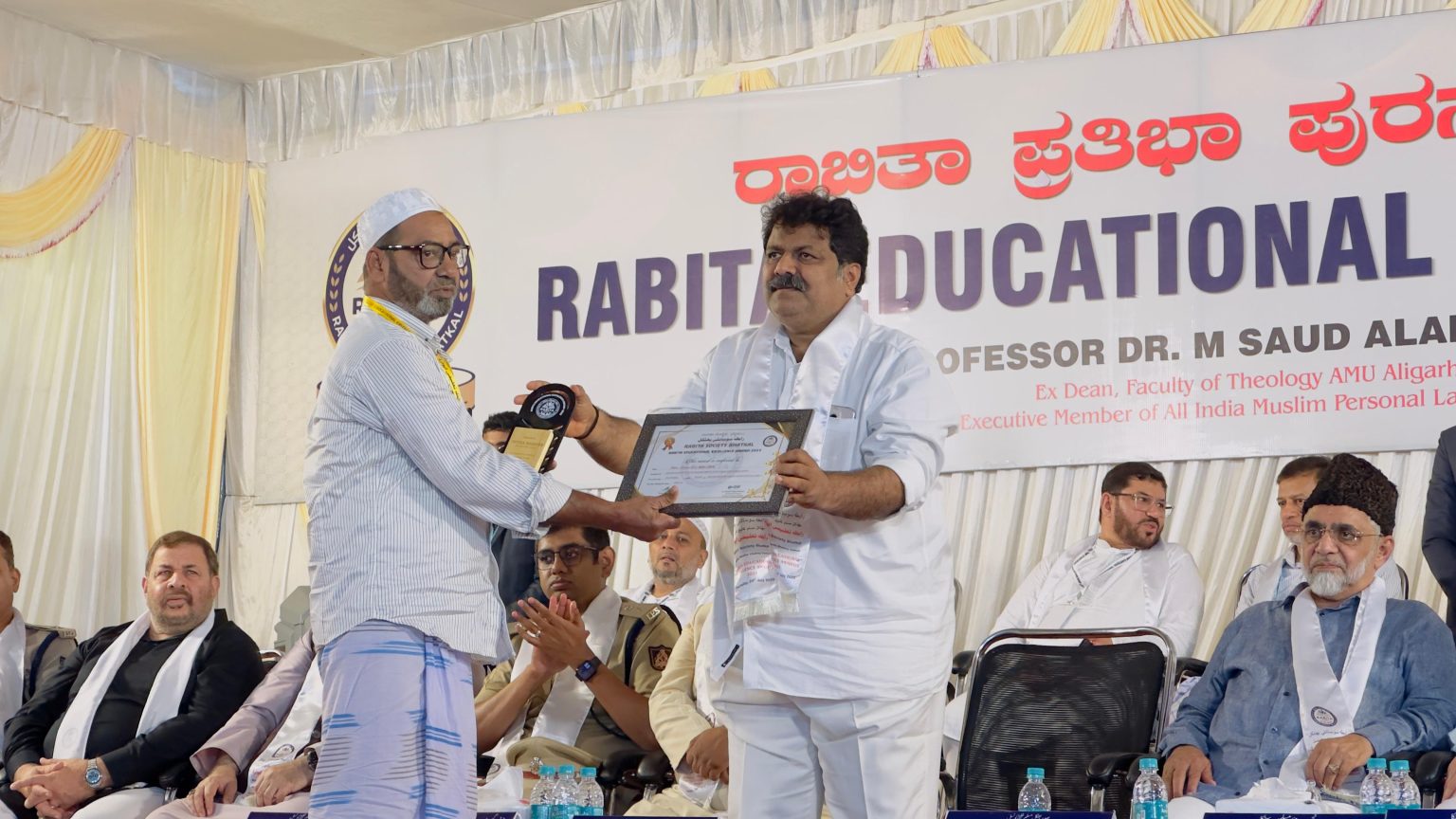
This year, 35 students across SSLC, PUC, and degree levels were honoured with gold medals and thoughtful gifts. Among them, female students once again outshone their peers, capturing two-thirds of the recognitions – a heartening sign of changing mindsets and growing gender parity in education.
The Best School Award continues to be named after Janab Usman Hassan, the legendary headmaster of Islamia Anglo High School, who worked tirelessly to promote education in Bhatkal. A pioneer in his own right, he laid the foundation for a culture of academic excellence that still echoes through the town’s institutions.
In a meaningful addition this year, the Best Teacher Award was named after Janab Syed Khaleelur Rahman Sahib, the very same visionary celebrated in the tribute volume “Iftikhar-e-Qaum Janab SM Khaleelur Rahman”. From his Gulf office in Dubai, he dreamt of uplifting his people through knowledge – and worked quietly but tirelessly to turn that vision into reality.
Though he now rests in the desert sands of Arabia, his legacy continues to bloom each year in the smiles and successes of the awardees he once imagined. Honouring him through the Best Teacher Award is both a tribute and a reminder that behind every great student is a teacher who believed in their potential.
This year’s recognitions reflected that enduring vision.
Ali Public School (Girls) received the Best School title, led by their standout student Hafsa Bint Hafeezullah, who scored an impressive 98.04%.
The Best Teacher honour went to Ms. Fatima Wida Siddiqui of Noonahal Central School, recognised for her outstanding dedication to education.
District toppers such as Shagufta Anjum (Urdu) and Bhoomika (English) were also felicitated, symbolising the inclusive spirit of academic celebration that the Rabita Awards embody.
Why This Model Deserves to Be Replicated
In an age when education is increasingly commodified, where coaching institutes manufacture toppers and commercial schools chase ranks, the Rabita model stands apart.
It is community-funded, value-driven, and inclusive. It celebrates the bright, uplifts the average, and motivates the struggling. It views education not merely as individual success, but as a shared legacy and a community responsibility.
The Rabita Award isn’t just a medal; it’s a signal fire – telling every child, “We see you. We believe in you. We’re with you.”
Imagine This in Every Town
What if every small town like Bhatkal decided to invest in its children this way?
What if the diaspora of Hyderabad, Azamgarh, Kutch, or Kolkata pooled their earnings not just for lavish marriages and luxury homes, but for educational dreams?
What if every community – regardless of faith, culture, or geography – told its youth: “We are proud of your academic journey. Keep going. We’re watching. We care.”
Communities that value knowledge rise. Those that don’t, perish slowly.
A Lesson from the Sea and the Ghats
Just like the waves of the Arabian Sea, education must be relentless – always pushing, always reshaping. And like the roots of the Western Ghats, it must be deep, nourishing generations, and anchoring identity against the floods of time.
Bhatkal is not just a place; it’s a model of what’s possible when community, culture, and commitment converge.
As the sun sets behind its palm-draped shores, one truth becomes clear:
Awards don’t just honour achievers. They create them.
Let This Be Your Takeaway
If you’re reading this in another town, another country, another community – know this: you too can start your Rabita. You too can plant the seeds of pride, perseverance, and purpose in your youth.
Start small. Honour the top three in your school. Involve your elders. Call the students to the stage. Clap for them. Gift them a medal. Take their picture. Tell the story. And do it again next year.
That’s how legacies begin.
And who knows? One day, someone may write about your town the way we write about Bhatkal – a place where the sea sings songs of learning, and the mountains stand tall in witness to dreams fulfilled.
source: http://www.radiancenews.com / Radiance News / Home> Education / by Mohammed Talha Siddi Bapa / July 26th, 2025
The Muslim girl from a modest middle-class family in the village’s Waja Mohalla tops Mumbai University with 87% in LLB
New Delhi :
In a proud moment for the Muslim community of Sopara, the ancient port and trade centre of Maharashtra, Benji Mehwish Abdul Rehman has etched her name in the annals of history as the first Muslim woman lawyer from the village. Her remarkable achievement includes topping Mumbai University with an outstanding 87% in the LLB examination is a testament to her relentless hard work and dedication.
Mehwish’s journey is not just about academic success but also about breaking social barriers. Coming from a modest middle-class family — her father, Abdul Rehman, works as an electrician — Mehwish’s path was filled with financial challenges. Yet, these hardships never dimmed her spirit or determination to succeed.
“I belong to the middle class. My father is an electrician, and I was aware of this from the beginning, so I always focused on studying hard. To make a unique identity in the society by working hard, that was my motto,” Mehwish told Clarion India over the phone. She recalled how financial struggles made her educational journey tough, but the unwavering support from her family helped her overcome every obstacle. During this time, many problems came up, but with the help of my family, I faced these problems with a smile. In this journey, my grandfather, grandmother and parents always stood by me like a rock. I secured the first position in every class.”
Her academic record speaks for itself: after passing her SSC in 2015 from Anjuman Khairul Islam Urdu High School, with 84%, she continued to shine with 80% in HSC from RB Harris Junior College and 84% in BCom from AE Kalsekar College in 2021. Clearing the bar examination from Viva College, Virar, with 87% (CGPA 9.2), she secured first position in both Mumbai University and Viva College.
Mehwish’s success carries extra significance as it comes from a community often overlooked and sidelined in mainstream narratives. Sopara, a village with deep historical roots, now celebrates this milestone that challenges the stereotypes around Muslim women and their place in education and professional fields.
Mehwish’s grandfather, Benji Rizwan Muhammad, a respected social activist in the region, played a vital role in guiding and encouraging her career choice. “The decision of which field to choose after graduation was difficult for me because all the courses were very expensive. In such a situation, by the grace of Allah Almighty, my grandfather guided me and encouraged me to become a lawyer,” she said.
She also credits the financial help from the Waja Mohalla Juma Masjid Trust and the Sidha Educational, Social and Cultural Organisation. “If these two trusts had not supported me financially by providing scholarships, this success would have been difficult,” she said gratefully.
Abdul Rehman, Mehwish’s father, expressed his pride: “My daughter is committed to discipline in her studies. We always encouraged her and provided her with whatever we could.” The support from the family, often the backbone for Muslim girls pursuing education, is a reminder that strong family encouragement can overcome societal pressures and economic difficulties.
Local social worker Zubair Ahmed Butke praised Mehwish’s achievement. “Mehwish has increased the glory of Sopara village and our Waja Mohalla by passing the bar exam. She is a role model for our community and shows that with hard work and determination, Muslim girls can reach great heights,” he said.
Mehwish now plans to practice law at Vasai Court and is preparing for her LLM. She also aspires to practice in the Bombay High Court, showing ambition that goes beyond personal success, reflecting a commitment to serve and uplift her community through the legal system.
Her story comes at a time when Indian Muslims, especially women, face various challenges related to education, economic opportunities, and social acceptance. Mehwish’s success is a beacon of hope, breaking through the barriers set by a society where many still hold biases and misunderstandings about Muslims, particularly Muslim women.
Her rise is a clear rebuttal to those who underestimate Indian Muslims or limit their potential by social or religious stereotypes. This achievement demands recognition and respect for the many silent struggles Muslim families endure in supporting their daughters’ education and professional dreams.
Community leaders and activists hope Mehwish’s story will inspire more families in Sopara and beyond to invest in girls’ education and help dismantle the barriers that have held back many Muslim girls. It also raises a call for greater institutional support to provide scholarships and opportunities to deserving students from minority communities.
Mehwish’s journey highlights a broader issue: while India prides itself on secularism and equal opportunity, the lived reality for many Muslims is often marked by discrimination and neglect. Success stories like hers push against this narrative and remind the nation of the rich talent and determination within Muslim communities waiting to be nurtured.
In contrast, some sections of the Hindu majority, especially in surrounding areas, have often failed to create an environment conducive to the educational and professional growth of Muslims. Many Muslim students face discrimination and a lack of resources, making achievements like Mehwish’s even more remarkable.
In conclusion, Mehwish’s story is not just her personal victory but a triumph for the entire Indian Muslim community. It sends a strong message that Muslim girls from modest backgrounds can break social barriers, excel academically, and contribute meaningfully to society when given support and opportunity.
Her rise deserves to be celebrated widely — as a beacon of hope and a clear example that when families and community come together to support girls’ education, the results can be extraordinary.
source: http://www.clarionindia.net / Clarion India / Home>Editor’s Pick> Indian Muslims> Women / by Mohammad bin Ismail / July 14th, 2025
Umar Sheikh’s determination and the school’s support have been vital to his academic achievements
New Delhi :
The Maharashtra State Examination Council’s recent 5th and 8th class scholarship exams witnessed remarkable achievements from students across the state. Among them, 954 students from the Brihanmumbai Municipal Corporation (BMC) schools secured places on the district merit list, with Muslim student Muhammad Umar Sheikh standing out as the top scorer in the 8th class scholarship exam with an impressive 72.79% marks.
This achievement is particularly significant given the exam’s difficulty and the fierce competition from students all over Maharashtra. The 8th class scholarship exam was held on February 9, drawing hundreds of participants. In the 5th class category, Ridhi Kamlesh Mishra from Vakola BMC Hindi Medium school topped with 79.19% marks.
Muhammad Umar Sheikh, a student of Deonar Colony MPS School No. 4 and currently in the ninth grade, secured 236 out of 300 marks, making him the highest scorer in all BMC schools for the 8th grade. This year, out of the 954 successful candidates, 536 were from the 5th grade and 418 from the 8th grade. This is a sharp increase compared to last year’s 405 students who cleared the exams.
Speaking to the media, Muhammad Umar’s father, Muhammad Saleem, shared the challenges their family has faced. “My son has been topping his class in mathematics and science since the beginning. He loves these subjects and has been very focused,” said Saleem. He added that Umar had also topped the 5th class scholarship exam.
Saleem narrated the difficulties faced by the family during the COVID pandemic. “Before COVID, my two children studied at DY Patil School in Nerul, Navi Mumbai. However, due to the loss of income during the pandemic, I could not pay their school fees, and the school stopped their studies. The school even refused to give their transfer certificates because of unpaid fees,” he explained.
With limited options, Saleem moved his family to Govindi in 2021 and struggled to find admission for his children. “It was not easy, but with persistence, I managed to get them admitted to a school here,” he said. Despite the hardships, Saleem is proud of his children’s resilience and achievements. “They are intelligent, and their performance at the new school has been excellent,” he remarked.
When asked about his son’s ambitions, Saleem said, “Umar wants to become a scientist. He has been saying this since the first grade, and with the way he is studying, I believe he will achieve it.”
The school’s principal and staff have expressed great pride in Muhammad Umar’s success. Principal Menal Chaudhary, along with teachers Uday, Ravi, Balu, Prateek, Nitin, and Smithia Madam, congratulated Umar and praised his dedication and hard work. “His success is a source of pride for the entire school,” they said.
This story highlights not only the academic excellence of Indian Muslim students in Mumbai’s government schools but also the obstacles faced by economically weaker families. It also reflects the support provided by committed teachers and principals who encourage students to reach their full potential.
Muhammad Umar Sheikh’s story serves as an inspiration for many young students facing financial hardships, demonstrating that determination and support can lead to success. His achievement, along with the rise in the number of successful students from BMC schools, reflects a positive change in the educational opportunities for Indian Muslim children, who often face social and economic challenges.
In a city known for its diversity, such stories emphasise the need to acknowledge and support the talents and ambitions of minority communities. This achievement sends a message to all that education is the key to overcoming barriers and achieving dreams, regardless of one’s background.
source: http://www.clarionindia.net / Clarion India / Home> Indian Muslims / by Clarion India / July 14th, 2025
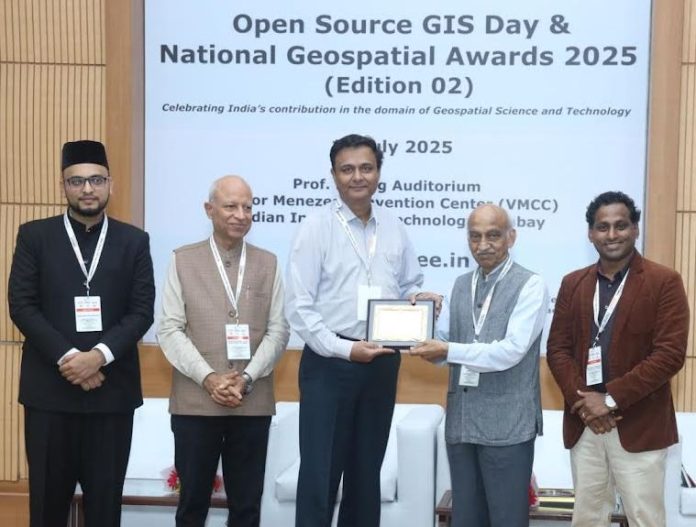
Prof Shahab Fazal of the Department of Geography, Aligarh Muslim University (AMU), has been conferred the prestigious National Geospatial Faculty Fellow Award at the Indian Institute of Technology (IIT) Bombay.
The award was presented in recognition of Prof Fazal’s significant contribution to advancing geospatial education through his textbooks and Massive Open Online Courses (MOOCs) on remote sensing and Geographic Information Systems (GIS). His work has played a vital role in popularising geospatial technologies and making them accessible to students across the country.
Padma Shri Prof Kiran Kumar, Former Chairman of the Indian Space Research Organisation (ISRO), presented the award during a special ceremony held at the Prof B. Nag Main Auditorium of IIT Bombay.
The award ceremony was a key highlight of the Open Source GIS Day Celebrations, organised by the FOSSEE GIS project of IIT Bombay. This initiative falls under the National Mission on Education through ICT (NMEICT), Ministry of Education, Government of India.
source: http://www.radiancenews.com / Radiance News / Home> Pride of the Nation> Awards> Latest News / by Radiance News Bureau / July 18th, 2025
Prof. Bilqis Bano to receive Lifetime Achievement Award, Dr. Raouf Khair to be honoured with Allama Iqbal Award.
New Delhi:
An important meeting of the Global Urdu Day Awards Committee (organised by the Global Urdu Day Organising Committee) was held under the chairmanship of senior journalist Jalaluddin at Daryaganj here.
The awards jury included Dr. Syed Ahmed Khan, Ashraf Ali Bastavi (Chief Editor, Asia Times, New Delhi), Suhail Anjum (former correspondent, Voice of America), and Javed Akhtar (Editor, D.W. Urdu, Germany, Delhi Bureau).
As per tradition, the awardees for the upcoming Global Urdu Day on 9 November 2025 have been selected.
The recipients are Prof. Bilqis Bano (Department of Biochemistry, Faculty of Life Sciences, Aligarh Muslim University) – Lifetime Achievement Award; Dr. Raouf Khair (Hyderabad) – Allama Muhammad Iqbal Award for Literature; Prof. Kauser Mazhari (Jamia Millia Islamia, New Delhi) – Mirza Ghalib Award for Poetry; Prof. Zehra Khatoon (Jamia Millia Islamia, New Delhi) – Maulana Ali Mian Award for Urdu-Persian Language; Dr. Aqeel Ahmad (Secretary, Ghalib Academy, New Delhi) – Maulana Abdul Majid Daryabadi Award for Language and Literature; K.L. Narang Saqi (New Delhi) – Kunwar Mahendra Singh Bedi Award for Literature; Yaseen Momin (Mumbai) – Qazi Mohammad Adeel Abbasi Award for Promotion of Urdu Language; Syeda Talat Nasreen (TN Bharti, New Delhi) – Noor Jahan Sarwat Award for Journalism; Syed Zubair (Muslim Mirror, New Delhi) – Maulana Usman Farqaleet Award for Journalism; Maulana Abdul Hameed Numani (New Delhi) – Maulana Sanaullah Amritsari Award for Column Writing; Abdul Mannan (Editor, Yojana Urdu, New Delhi) – Maulana Mohammad Muslim Award for Journalism; Jamshed Khan (Aaj Tak, New Delhi) – Ameen Sayani Award for Electronic Media; Saurabh Shukla (Red Manak, New Delhi) – Pandit Devnarayan Pandey Award for Journalism; Abid Anwar (UNI Urdu, New Delhi) – Mahfuzur Rahman Award for Journalism; Shohrat Ansari (Khalilabad, U.P.) – Imdad Sabri Award for Journalism; Hafeezur Rahman (Sharq Adeel, Marahra, Etah District, U.P.) – Ismail Merathi Award for Poetry; Mohammad Yamin Zaki (Editor, Hilal, Rampur) – Dr. Zakir Hussain Award for Children’s Literature; Farooq Ahmad (Doordarshan, Delhi) – Ilmat Yasin Award for Promotion of Urdu; Prof. Dr. Ziaur Rahman Siddiqui (Aligarh) – Mazharuddin Khan Award for Teaching; Master Iqbal Ahmad (Former Headmaster, Jamia Middle School, New Delhi) – Maqbool Ahmad Siddiqui Award for Best Teacher; Prof. Abdul Majid Mohammad Siddiq Siddiqui (Malegaon) – Maulana Azad Award for National Integration; Prof. Khalid Mubashshir (Jamia Millia Islamia, New Delhi) – Hafeez Merathi Award for Naat Poetry; Dr. Ibrahim Afsar (Meerut) – Naseeruddin Hashmi Award for Urdu Research; Dr. Azeer Ahmad (Islampur, West Bengal) – Maulvi Abdul Haq Award for Literature; Dr. Nihal Nazim (Moradabad) – Dr. Abul Faiz Usmani Award for Promotion of Literature; Dr. Abu Saad Asari (Jhanda Nagar, Nepal) – Indo-Nepal Friendship Award; and Hidayat Publications, New Delhi (Syed Abul A’la Subhani) – Munshi Naval Kishore Award for Publishing.
Dr. Syed Ahmed Khan, the convener of the Global Urdu Day Organising Committee, expressed hope that the selected awardees will continue to play a significant role in the promotion of the Urdu language.
source: http://www.radiancenews.com / Radiance News / Home> Pride of the Nation> Awards> Latest News / by Radiance News Bureau / July 15th, 2025
Kilakarai (Ramanathapuram District) / Chennai, TAMIL NADU :
Death of Dr. B.S. Abdur Rahman has not only shocked who knew his mission and lifelong works but also those who have benefited by his devotion and those who took inspirations from him. His untimely death has brought a vacuam in Indian educational scenario and it is almost impossible to be filled up in near future.
Indian Muslim Community has legacy of Sir Syed Ahmad Khan, the founder of the Aligarh Muslim University before it, Dr. B.S. Abdur Rahman has achieved almost that place and has become another inspirational figure.
Dr. B.S. Abdur Rahman was born in kilakarai falling under Ramanathapuram district of Tamilnadu state in 1927. Due to his works and philanthropist bent of mind, Dr. Rahman became a well known personality who devoted himself for the upliftment of the economically weaker sections and minorities through their educational empowerment. He did not lagged behind in providing good facilities of health care to the deprived sections of society.
B.S. Abdur Rahman, Vice Chairman of Emirates Trading Agency LLC and Associated Construction and Investments Co. LLC (ETA-ASCON), the Dubai-based $2 billion industrial behemoth, was a multi-faceted personality, much like the diamonds he dealt with when he began in humble business in Sri Lanka, over half a century ago.
Diamond merchant, industrialist, educationist, philanthropist, shipping magnate, generous contributor and enthusiastic participant in many other business and social activities he is a renaissance man whose outlook was Millennial. Meaning, while his values were classical, his thinking was forward looking.
Kilakarai, on the coast of Ramanathapuram district in Tamil Nadu, where Abdur Rahman (fondly known as Sena Aana) was born, is a town made famous in the region by his illustrious ancestor, Vallal Seethakathi.
The forbears of Abdur Rahman migrated to Kilakarai from Arabia in the 12th century. Kilakarai, which means East Coast in Tamil, was a flourishing port to which mearchants from the east and west came. A densely populated area, predominantly by Muslims, it owned its prosperity to them.
From centuries they traded with Sri Lanka (then known as Ceylon), dealing in pealing in pearls, gemstones and conches. Even today, many of them live in Sri Lanka or do business with the island. Abdur Rahman too began his career in Ceylon. Among the pearl traders of Kilakarai was Buhari Aalim. Abdur Rahman was his son.
Aalim was an expert in valuing precious stones and pearls. He would hold a gem between his right thumb and index finger and, looking at it against the sun, study the quality of the watermark within to judge the worth of the precious stone. He would be unfailingly correct.
Watching his father at work, the young Abdur Rahman was soon able to understand the nuances of the trade. This training and experience helped him to become one of the most successful merchants in the diamond trade in due course. When Abdur Rahman first went to Colombo, he was fifteen years old. He had with him just Indian Rupees 149. He worked as an errand boy for diamond merchants, carrying their diamonds and other gems from sellers to buyers and back. He was at the time staying with some traders from Kilakarai and neighbouring villages. They allowed him to stay with them without any payment, but he had, instead, to fetch tea them from a nearby hotel, clean the rooms and perform other menial tasks.
A lesser person perhaps would have thrown in the towel. But Abdur Rahman was made of sterner stuff. Before long, he used his persuasive skills to obtain gemstones from another merchant and began trading in them. In time he became a successful gem trader. The base that Abdur Rahman built in Ceylon was to help him in all his future activities.
He began visiting Belgium, then as now, a centre of the gem trade, the USA, South America and set up business in Penang, Malaysia, Chennai, Kolkata (then Calcutta), and then in Hong Kong. It was in Hong Kong that his business flourished. Incidentally, Abdur Rahman was the first person from Kilakarai to go to Hong Kong.
In Hong Kong he launched the Precious Trading Company in 1954. Later, his very special brainchild, the Amana Group of Hong Kong, was established. It was under its banner that the multinational company ETA-ASCON came into existence.
He was a firm believer in education and took upon himself the task of educationally empower the poor and the deprived. He established a wide network of educational institutions. In 1967, he founded Seethakathi Trust and in 1979, All India Islamic Foundation to achieve his target of serving the community and nation. He founded twelve educational institutions including an Engineering University, a woman’s college, an Arabic College two boys schools, 3 girls schools, a woman Nursing college, a Teacher Training College, B.Ed College for woman and 2 hospitals beside orphanages in rural and urban areas. His biggest achievement was founding a 60 bed Yousuf Zulaikha hospital at Kilakrai and a 150 bed Crescent hospital at Madurai. He did not lagged behind in providing comfort of life to most deprived orphanages and founded Al Momin orphanages for boys and girls at Ottapidram, Tanjore, Kilakarai and Thiruvithancode of Tamilnadu.
Dr. B.S. Abdur Rahman was farsighted man and knew the importance of administration. He was well aware that to uplift community, it is very necessary that Muslim youths join Indian Administrative Services and so he established Crescent IAS and Carriers Guidance Academy in 1994 beside an Islamic Studies & Cultural Centre at Chennai.
His social works span to wide area. Dr. B.S. Abdur Rahman founded B.S. Abdur Rahman Zakat Fund Foundation in 2007 which provides educational grants for students. Through this foundation, B.S. Abdur Rahmand has maintained magniticence of Zakat which may be called a pillar of Islam and which is an instrument for survival of poor Muslims. He 1017 Self Help Group (SHG) which became beneficial to 17093 deprived and helpless women. He also founded and managed various other trusts like Yousuf Zulaikha (1993) Chennai for education, health care and women empowerment. United Economic Forum in 1994 and Seethakathi NGO in 2002.
He also establish new milestones in business field.
He was founder Chairman of Dubai based ETA – Ascon – Star Group and was treated a renowned Indian entrepreneur in UAE. It may be known that the group has a turn over US$ 5.5 billion and employs 50,000 people. With his visionary zeal and entrepreneurial spirit.
B.S. Abdur Rahman has been the guiding force behind many companies in India, among which the most important is the Buhari Group the Indian Multinational. The prominent companies and establishments under Buhari Group include East Coast Construction Ltd. (ECCI) 50 years in the field of construction, Coal & Oil and many other automobile dealership companies.
In recognition of his services he received many awards also.
The Aligarh Muslim University Students Union conferred him life membership while Sathyabama University awarded Honorary Doctorate in recognition of his contribution to Women Education.
In fact Dr. B.S. Abdur Rahman had became an inspirational force to young generation during his own life time. There are very few people who climb the ladder of success and remember the down trodden sections of the society or do anything meaningful for them.
Whatever Dr. B.S. Abdur Rahman has done for the manginalised and deprived sections of society will be always not only remembered but will also be documented in social and educational history of India. The best tribute to Dr. B.S. Abdur Rahman will be to follow the path shown by him not only in business but other fields also.
-Dr. Jasim Mohammad / Author is Editor of The Aligarh Movement monthly
source: http://www.hastakshep.com / Hastakshep.com / Home> Uncategorized / by Dr Jasim Mohammad / March 29th, 2019
Maulana Azad University’s extensive survey of basic education and students’ enrolment in 30 villages of Jodhpur district as part of the Annual Status of Education Report (ASER)-2024 has found a notable increase in private school enrolment, and a sharp decline of children at age 3 who do not attend pre-school or early childhood education programmes.
However, the survey has found a continued challenge with learning outcomes, particularly in basic reading and arithmetic, meaning that while more children are going to school, many of them are still not learning at the expected level for their age and grade. The survey shows that children in primary classes often cannot solve basic arithmetic problems such as simple addition, subtraction, multiplication, or division.
Maulana Azad University, Jodhpur, is the first and the largest Muslim-run private higher educational institution in Rajasthan.
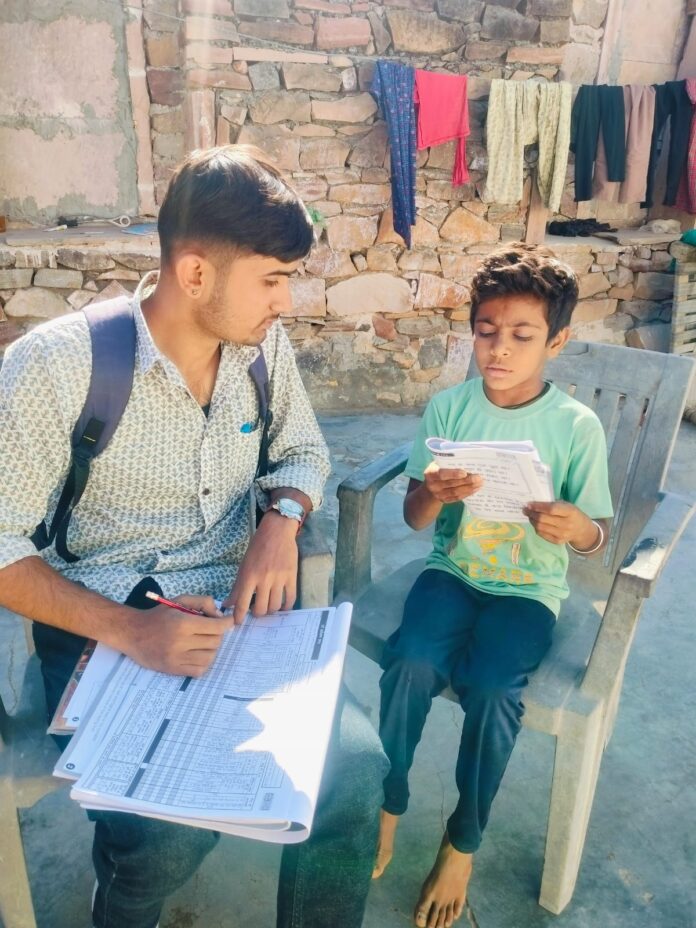
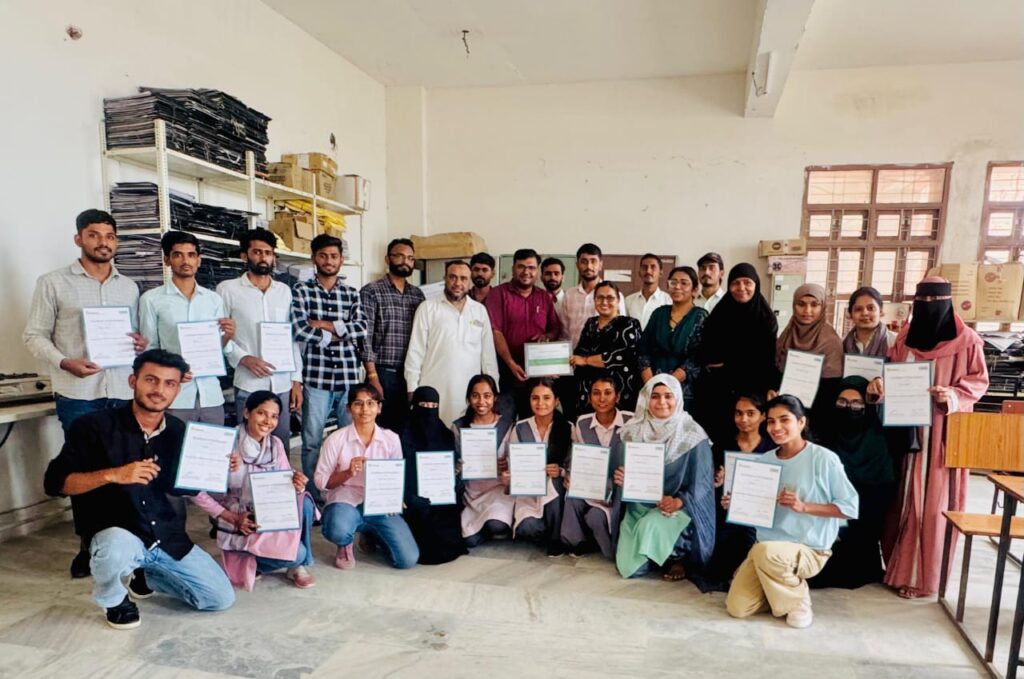
The survey was conducted by a total of 60 students of the university. The survey report was released by a non-governmental organisation, Pratham. The students who took part were drawn from the sixth semester and were felicitated at a function in the university here in the first week of July.
The Jodhpur-based university has already set up a Minorities Research Chair for conducting targeted studies and research on the issues, problems and challenges confronting the minority communities in Rajasthan, as part of its initiatives to generate new avenues. The research chair will make important recommendations after its studies.
Maulana Azad University was established by the Marwar Muslim Educational & Welfare Society (MMEWS) at Bujhawar village on the outskirts of Jodhpur in 2013. The institution of higher education is now imparting education to more than 15,000 students belonging to Muslim and other less privileged communities in multiple disciplines of study.
ASER Team Convener Raju Ram Bishnoi said the main points of conclusion of ASER-2024 were an increase in student and teacher attendance, use of smartphones among the youth, focus on pre-school enrolment, learning level challenges and gender gaps in enrolments for the subjects of science, technology, engineering and mathematics.
Bishnoi said the ASER-2024 survey in Jodhpur district assessed enrolment and basic reading and arithmetic abilities of children aged 3 to 16 years in the rural areas. The digital access and skills of children aged 14-16 years were also tested time, with smartphone-based tasks. At the national level, the survey was conducted in 17,997 villages in 605 districts and a total of 6.49 lakh children were reached.
The proportion of older children, in the age group of 15 to 16 years, not enrolled in school has been steadily declining in recent years. About 7% boys and girls of this age group are not enrolled in schools at present. Nationally, more than 90% of rural adolescents have access to a smartphone. About 70% of adolescents in this age group can perform basic digital tasks such as setting alarms, searching for information on the Internet, finding specific online content and sharing with others.
Dean of the university’s Education Department, Dr. Samina, said the ASER survey was switched in 2016 to an alternate year model, as part of which a “basic survey” is conducted every two years in the rural areas of all districts, with smaller surveys focusing on other age groups and regions in the intervening years.
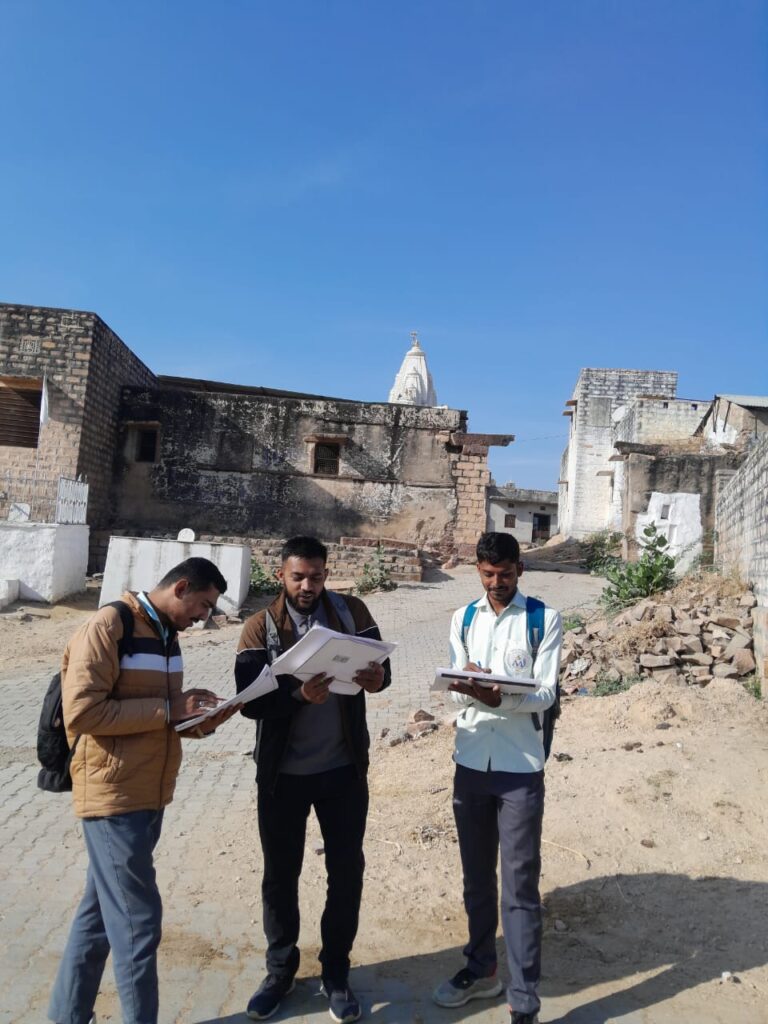
The villages covered in the extensive survey were situated in Bawari, Bhopalgarh, Bilara, Mandor, Luni, Osian, Bap, Phalodi, Balesar and Shergarh blocks of Jodhpur district.
Misbah Noor, a III year student of B.Sc., B.Ed. (combined) at Maulana Azad University, told India Tomorrow that she spent two days at Uchiyarda village in Mandor block to study the educational scenario. Misbah was given a certificate of participation for the survey report submitted by her.
Another student, Afzal Khan, said he went to Bilara block’s Pichiyak village for the survey, in which he recorded the efficiency levels of young children after interacting with them. Afzal is studying for B.Ed. (Urdu) in the university. The surveyors selected 20 houses in each village and tested the basic reading and arithmetic abilities of children aged between 5 and 16 years, besides testing digital literacy skills of adolescents between 14 and 16 years.
Mauala Azad University’s Chairperson and noted educationist Mohammed Atique said the university was willing to work with the government agencies and non-government organisations for works at the grassroots level for the benefit of future generations. Atique said all kinds of support, including financial, would be extended for such works.
University’s officiating Registrar Mohammed Amin, who has earlier worked with several international NGOs, said the ASER surveys had helped out the government, which had incorporated their recommendations in its educational programmes. “I have had the experience of working with ASER since 2010. Our university has made a significant contribution to the exercise with the active participation of students,” he said.
The MMEWS, established in 1929 during the pre-Independence era, runs as many as 330 educational, health and social institutions. Atique, 77, has been instrumental in easing the lives of more than 45,000 youths through these institutions working in varied fields of education, health care, community development, rural development, waste-to-wealth initiatives and skill development programmes during the last four decades.
The then ruler of Jodhpur princely state, Maharaja Umaid Singh, was the patron of MMEWS and had gifted a school named ‘Durbar Muslim School’ to the Society in 1936. The Rajasthan government allotted five acres of land to the MMEWS in 1978, on which the Maulana Abul Kalam Azad Muslim Senior Secondary School was constructed.
Since then, the MMEWS has established several institutions, including the Industrial Training Institute, Nursing College, Pharmacy College, B.Ed. College, Mai Khadija Hospital, Rahmatul-Lil-Alameen Blood Bank, Marwar Adarsh Gaushala and Bujhawar Veterinary Hospital. The MMEWS established the university in 2013 with the intention of providing higher education to the most deprived and marginalised sections of society.
The first president (Vice-Chancellor) of Maulana Azad University was the noted Islamic scholar from New Delhi, Akhtarul Wasey. The current president, Jameel Kazmi, hailing from Jaipur, has taken steps for interdisciplinary studies while maintaining the indigenous ethos and the spirit of plurality in the university’s functioning.
About 50,000 students have so far passed out from the MMEWS group of institutions and become doctors, engineers and business people and entered other professions as well. Some of them have also established nursing homes and clinics in remote rural areas, which are often ignored in the government’s development plans. Maulana Azad University has set the motto, “Gain Knowledge and Serve Mankind”, for itself.
source: http://www.indiatomorrow.net / India Tomorrow.net / Home> Education / by India Tomorrow Correspondent / July 13th, 2025
Indian envoy and AMU vice chancellor grace the occasion
The Aligarh Muslim University (AMU) alumni in Qatar, under the banner of AMUAAQ, celebrated the annual Sir Syed Day on December 27, 2024 at the Sheraton Grand Doha Resort & Convention Hotel.
Prof Naima Khatoon, the first female Vice-Chancellor of AMU, graced the occasion as the chief guest, while the Indian Ambassador to Qatar HE Vipul presided over the gala ceremony.
Other guests of honour included former Vice-Chancellor of AMU Prof Mohammad Gulrez, Moez Wajihuddin and Patron of AMUAAQ Sophia Bukhari. Mustafa M Hariyanawala, Yashir Nainar, Haroon Sataj Khan and Anwar Karim were special guests.
The programme began with the recitation of the Holy Quran, followed by a two-minute silence to mourn the passing of the former prime minister of India Dr Manmohan Singh.
Ghazala Yasmeen welcomed the guests, while Dr Ashna Nusrat and Dr Nayeem Aman conducted the programme as Masters of Ceremony. Dr Ashna Nusrat read a message of appreciation from the former Chancellor of AMU, Syedna Mufaddal Saifuddin, addressed to the members of the AMU Alumni Association Qatar.
President of AMUAAQ Dr Nadeem Zafar Jilani, in his address, paid rich tributes to Sir Syed Ahmed Khan. He recalled how Sir Syed travelled to England to study the British education system and established the MAO College based on the models of Oxford and Cambridge universities.
Prof Naima Khatoon spoke on the selected theme of the event, ‘One Team, One Dream’. She praised the unwavering love of alumni worldwide for their alma mater and its founder, Sir Syed Ahmed Khan.
Former Vice-Chancellor Prof Mohammad Gulrez delivered the keynote address on ‘Jobs and Career Opportunities in the 21st Century’.
HE Vipul congratulated Aligarians on the Founder’s Day celebrations and acknowledged the contribution of great visionary Sir Syed Ahmed Khan in nation building.
Other dignitaries who spoke on the occasion included Sophia Bukhari and Anwar Karim.
As in previous years, AMUAAQ presented five achievement awards to eminent personalities. The first award, for lifetime achievement in the field of education, was presented to Prof Naima Khatoon. The award for outstanding community service was given to Safeerurahman, while Haroon Sartaj Khan, President of the AMU Alumni Association Oman, was named Aligarian of the Year. The Media Personality of the Year award was presented to RJ Aafrin of Radio Mirchi. Additionally, Akhtar Mehdi of the renowned Mehdi Hasan Tailors received a lifetime achievement award for his sartorial excellence in crafting traditional sherwanis, which have attracted many celebrities and former heads of state to his shop in Aligarh.
Er Jawed Ahmad, chairman of AMUAAQ, announced the formation of a pan-GCC Federation of AMU Alumni Associations to unite and bring together all Aligarians residing in the GCC countries—Bahrain, Kuwait, Oman, Qatar, Saudi Arabia and the UAE.
Vice-President of AMUAAQ Faisal Naseem presented a vote of thanks to the sponsors, as well as the executive and advisory committee members of AMUAAQ.
Jawed Ahmad, chairman of AMUAAQ, proposed that the Vice-Chancellor Prof Naima Khatoon become the ex-officio patron of AMU alumni to strengthen AMUAAQ.
Another proposal regarding the establishment of an offshore AMU campus in Doha was also revisited. He further informed the audience that the AMUAAQ will sign MoUs with several companies to provide students with training and job opportunities.
AMU alumni from all walks of life attended the function with their families in large numbers. Many prominent residents of Doha were also present, including literary personalities such as Ateeq Anzer, Aziz Nabeel, Ahmad Ashfaq, Ashfaq Deshmukh, Wasi ul Haq Wasi, and Obaid Tahir, to name a few.
A raffle draw, sponsored by Malabar Gold, was held and won by Farhana, Imran, Kainat and Shoyeb.
An MoU was signed between AMUAAQ and Hind Guru Academy to support and guide NRI students during their stay in India.
In addition to thought-provoking speeches, the programme also featured an interactive ‘Kahoot Quiz’ on AMU and the Aligarh Movement.
Prizes were awarded to the top three winners, with Faisal Abdullah securing first place, Ayan as the first runner-up, and Ashfaque Deshmukh as the second runner-up. The quiz and IT support were expertly managed by Almas Ahmad.
Mementos and certificates were presented on behalf of AMUAAQ to the guests and notable achievers.
source: http://www.qatar-tribune.com / Qatar Tribune / Home> Nation / by Tribune News Network, Doha / January 02nd, 2025