Category Archives: Travel & Tourism

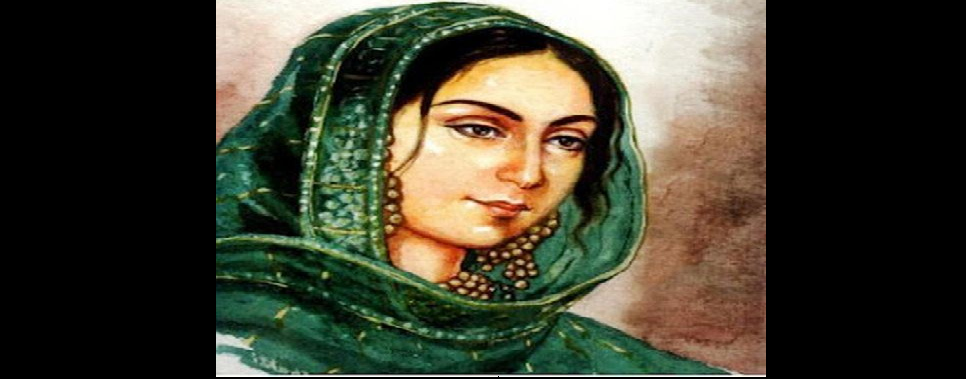
Begum Hazrat Mahal: The Pari Who Became a Revolutionary


BegumHazratMPOs01jun2016

Awadh(Lucknow), UTTAR PRADESH :

June, in particular is a good month to remember Begum Hazrat Mahal who led the first war of independence against the British in Lucknow. This Begum of Avadh had defied British forces of the East India Company in the great uprising of 1857.

She was one of the nine divorced women of Wajid Ali Shah, Lucknow’s last ruler.

“When the king left Lucknow on 13 March 1856 he took with him as well as his mother, three of his wives including Khas Mahal and Akhtar Mahal. An unknown number of wives were left behind in Lucknow as well as nine divorced women including Hazrat Mahal and her young son,” writes Rosie Llewellyn-Jones in The Last King in India.

Begum Hazrat Mahal took charge of the city despite her divorce from the king and her supporters included Raja Jailal Singh, a former Nizam of Azamgarh. It was Raja Jailal who fed support to the rebellion from the suburbs around Lucknow.

The other supporter defending Lucknow was Nana Sahib, a Maratha soldier and childhood friend of Rani Lakshmibai. Nana Sahib led the revolt against the British in Kanpur. Like Begum Hazrat Mahal he too retreated to Nepal after the British regained Lucknow in 1858.

Wajid Ali Shah was forced to leave Lucknow for exile in Calcutta, by the British. Lucknow was one of the most bitterly contested cities during this first war of independence against the British.

Between the exile of Wajid Ali Shah in March 1856 and the first war of independence in June 1857, Lucknow was defended by Begum Hazrat Mahal and she ruled as regent for 10 months. Her 12 year old son Birjis Qadr was crowned in the Baradari at Qaiserbagh, the palace built by his father.

After the British overpowered the freedom fighters, Begum Hazrat Mahal refused a pension and continued gorilla attacks on British military centers till November 1859. She spent the rest of her life in Kathmandu, Nepal and was buried there in 1879.

It may be recalled that fighting broke out at the end of June in 1857 against the British after soldiers mostly from the Avadh region heard that their mild mannered ruler was unceremoniously stripped of his throne and his kingdom by the British on grounds of mismanagement. Their first reaction was one of disbelief. Their second reaction was of anger. soldiers in different parts of north India took up arms and in Lucknow laid siege to the city’s British Residency where English and Anglo Indian inhabitants were hiding for four and a half months between July and November 1857.

But before Begum Hazrat Mahal transformed into a revolutionary she was a fairy. It may be recalled that apart from official wives and temporary wives there was yet another category of women, the pari or fairy who was often taken on as a temporary wife if the king found her pleasing and talented. The fairies were certainly an innovation of Wajid Ali Shah, poet prince and were recruited from the lower classes, including courtesans who lived mainly in Chowk, in the old city.

These women were not educated but after tuitions some of them acquired sophistication. Some fairies went on to become expert singers or dancers while others proved to be good for nothing.

Begum Hazrat Mahal’s maiden name was Muhammadi Khanum, and she was born in Faizabad. Her father was a slave called Umber owned by a Ghulam Hossein Ali Khan. Her mother was a Muslim mistress of Umber. A courtesan by profession, Muhammadi was taken into the royal harem after being sold by her parents.

She was later promoted to a fairy and was called Mahak Pari by the king. She became a begum after being accepted as a royal concubine of Wajid Ali Shah and the title Hazrat Mahal was given to her after the birth of their son, Birjis Qadr.

For some time Wajid Ali Shah was completely smitten by Hazrat Mahal. writing many poems for the dusky beauty.

Soon the king moved on to other women but in 1845 when he learned that Mahak Pari was pregnant, he immediately put her into purdah and gave her the title of Iftikhar-un-nisa or pride of all women.

Now this beautiful fairy, brave freedom fighter and pride of all women is immortalised in a documentary film directed by Mohiuddin Mirza and produced by the Films Division that was screened in the city by Lucknow Expressions Society in the presence of Kaukab Qadr Meerza, great grandson of Begum Hazrat Mahal and Manzilat Fatima, the warrior queen’s great great grand daughter.

“The aim is to never forget how the entire city had united under the leadership of Begum Hazrat Mahal to stand up against the British irrespective of religious and gender differences,” said an organiser of the event.

source: http://www.thecitizen.in / The Citizen / Home / by Mehru Jaffer / Monday – May 30th, 2016

Film on Begum brings Avadh’s queen to life

Lucknow:

It will be a royal evening for Lucknow coming Monday when in the company of the last Queen of Awadh, Begum Hazrat Mahal, the city will come face to face with its past. In the 137th death anniversary year of the Queen, an unsung hero of the first war of Independence of 1857, a documentary on her will be screened on May 30.

Claimed to be the first ever film on the Queen, the 26-minute documentary has been directed by national award-winning director Mohi-ud-Din Mirza. Commissioned by the Films Division, the film will be screened by the Lucknow Expressions Society along with the UP Tourism department. Prince Kaukab Qader Meerza, great grandson of the Queen, will also be coming to Lucknow from Kolkata for the day.

The screening comes with an aim to enlighten people about the sacrifices of the freedom fighter for the motherland. Documenting the history of Begum Hazrat Mahal as also including her direct descendants, it shows the Queen in her role as one of the first women revolutionaries in India’s independence struggle.

“It is for the first time that a film has been made on my great great grandmother who is someone that we have grown looking up to,” said Manzilat Khan, a direct descendant of King Wajid Ali Shah and Begum Hazrat Mahal. Khan will also be in the city on the day. It was after King Wajid Ali Shah was exiled to Matiaburj in Kolkata that the Queen fought valiantly against the British troops annexing Awadh, defeating them in Alambagh. She later took refuge in Nepal where she died on April 7, 1879.

“At the time when the independence of women was just a notion, she had a vision for the country’s freedom from the British. She chose to fight and take it on herself. Not many know about her struggle and the film will rightfully do that,” added Khan.

source: http://www.timesofindia.indiatimes.com / The Times of India / News Home> City> Lucknow / TNN / May 26th, 2016

SNACK TRACK – Meaty bites of goodness

Bengaluru, KARNATAKA :

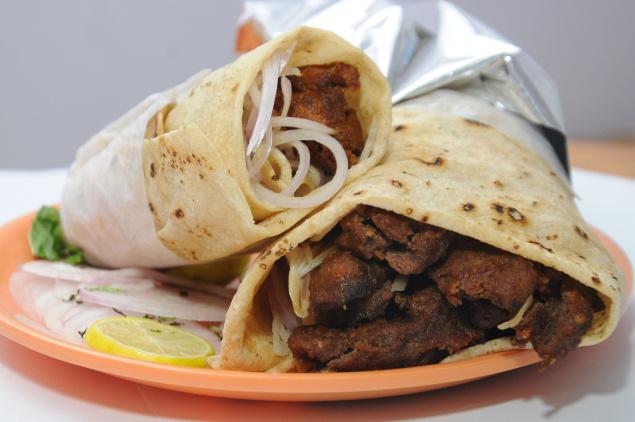
Fanoos' beef roll PHOTO: SUDHAKARA JAIN
Fanoos’ beef roll PHOTO: SUDHAKARA JAIN

The legendary beef sheekh kabab rolls of Fanoos is one of Bengaluru’s most sought-after rolls

The air sizzles with the smell of grilled meat, the heat from the tandoors is warm, yet not suffocating, and the crowd that has gathered remained calm, yet excited and hungry as they wait patiently to bite into goodness.

The roomali rotis are spread on clean, slick steel counters, the steaming hot meat piled onto them, the chopped onions and lime juice thrown in and the rolls are deftly wrapped in tissue paper and handed over to eager customers. Welcome to Fanoos – the destination for the one of Bengaluru’s tastiest rolls.

The bustling Johnson Market area in Richmond Town is the abode of one the city’s most spectacular roll joints.

The heavy traffic on the Hosur Road, the melee of people in the market area and the jostling crowds pouring in to buy their choicest rolls from the counters does not deter Bengaluru’s foodies from making sure they get what they come for – the legendary beef kabab rolls of Fanoos.

While the joint also serves chicken and mutton variants, it’s the beef rolls that are to die for. Coming in a range of sizes from the humble single roll to the enormous mogambo roll, Fanoos is the place meat lovers swear by.

What started in 1975 as a small footpath kabab joint by the late Ajaz Hussain is now a booming empire in Bengaluru. Taken over by his three sons after his death, Ajaz’s motto of serving only the finest for his extended family of customers is still kept strongly alive. Shakir Hussain and his two elder brothers firmly believe in keeping their father’s legacy alive and left their studies to keep the establishment running. “It was our dad who introduced the concept of sheek kababs from a recipe he modified from his mother. Even the terms like jumbo, mumbo, Rambo and sambo for the size of the rolls were coined by him. As the next generation, we brothers came up with the next size of rolls called mogambo,” says Shakir.

He adds: “It’s not just about food in Fanoos. We have many stories here. We have friends who come here to meet up after several years. It is also a place for lovers to meet. This is the perfect combination of food, friendship and fun with our extended family of customers.”

Musician James Prabhakar says he and his band spend their Sundays every week after practice at Fanoos. “It’s almost a tradition for us and our default buys here are the sheek kabab rolls. The green apple sodas from the Madeena Stores opposite to Fanoos are an added bonus that makes it a complete meal. Fanoos also serves as a place for us to catch up with friends and chill out amid the smell of sizzling, mouth-watering meat.”

The Iranian cuisine joint customised for Bengaluru also serves shawarmas, veg rolls and a variety of other flavours and even the popular Haleem during Ramzan, but nothing comes close to their beef sheek kabab rolls priced between Rs. 45 to Rs. 185 depending on size.

So what are you waiting for? Head over and dig in.

source: http://www.thehindu.com / The Hindu / Home> News> Cities> Bengaluru / by Allan Moses Rodricks / Bengaluru – May 30th, 2016

The waza from the Valley

Jammu & Kashmir :

BashirMPOs31may2016

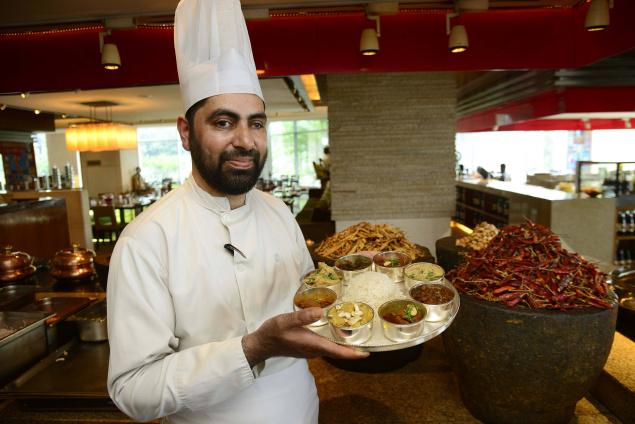
Bashir Ahmad Concha on how to dish out the traditional multi-course and meat-rich Kashmiri wazwan

Ask most visiting chefs about their tryst with South Indian flavours and they’d wax eloquent about their love for the crunch of a crispy dosa. But not waza (traditional Kashmiri chef) Bashir Ahmad Choncha. He’s more likely to scowl and say, “The flavours are too unfamiliar.” For, compared to our fluffy idlis, rich coconut chutney and spicy sambar, his familiar food — the spicy and salty lahbi kebab, rich curd-based nadru yakhni and melt-in-the-mouth minced mutton ball in creamy gushtaba — feels decidedly different. Yet, the wazwan is a treat for anyone curious about the possibilities of the unfamiliar.

The wazwan, considered the pride of Kashmiri cuisine, is rich, to say the least. It is made during special occasions, and traditionally served in a large plate that’s shared by four. Most dishes are curd-based and all of them are made with liberal amounts of ghee. To top it off, the spread is meat-heavy. Mutton, mostly, as most Kashmiri Muslims prefer that. The chef’s favourite is the tabak maaz, a mutton appetiser that’s deep fried in ghee. “What can I say? Most people in Kashmir are rich and they want to eat rich food too,” laughs waza Bashir, even as he insists that the ghee will only make one strong, not fat.

The most challenging dishes to make, he says, are the light and spicy rista and the heavy yogurt-based gushtaba, for which the meat needs to be pounded by hand for half an hour. The vegetables have a distinct flavour, as do the spices from the region. It is for this reason that the waza says he brought 400 kg of ingredients for the ten-day Kashmiri Wazwan food festival at Spice Haat, Hyatt Regency.

Waza Bashir learnt his culinary flair from his father, chef Noor Mohammad Choncha, by watching him cook eversince he was eight years old. “My father would have never allowed me to become a waza if he were alive. He never wanted me to come into the family business.” But when his father passed away, Bashir took over the kitchen at 25. For the last 20 years, he has been at the helm of things at ‘Concha Foods’, a restaurant in Srinagar and also, a manufacturing outfit that packages and exports spices from the valley. “There’s a big market for Kashmiri cuisine. Every month, 1,000 kg of tin-packed rista and gushtaba are exported to places around India, the United States and Gulf countries.”

His fame in the packaged food business soon saw him plate up flavours from the valley at food festivals in Bangalore, Pune, Chandigarh and other places.

However, he says, wazas taking the road is rare. Even though his father had close to 1,000 students, most of them have set up their own restaurants in Kashmir. “The wazwan is a big business in Kashmir. A typical Kashmiri indulges in the wazwan about once a week. One plate is priced at Rs. 2,500 even in a small shop. It’s a very exotic spread. So it’s very rare that people leave the valley to make wazwan.”

Kashmiri Food Festival at Spice Haat is open for dinner till May 29. There’s a Buffet is priced at Rs.1,550, vegetarian thali at Rs. 1,000 and non-vegetarian thali at Rs. 1,200, (exclusive of taxes), to choose from. For details, call 61001234.

source: http://www.thehindu.com / The Hindu / Home> Features> MetroPlus> Food / Raveena Joseph / May 23rd, 2016

The Quint: Vadodara Mosque Claims to House World’s Largest Quran


Published on May 23, 2016

The Juma Masjid in Vadodara houses a unique 250-year-old Quran. At six and a half feet long, and four and a half feet wide, members of the mosque trust claim it to be world’s largest Quran.

Handwritten by Mohammad Ghous nearly 250 years ago, two volumes of the Holy Quran were restored at the Jama Masjid in Vadodara in May

source: http://www.youtube.com

Mausoleum that Humayun never built

NEW DELHI :

HumayunMPOs04apr2016

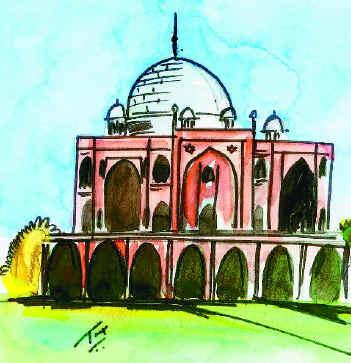
HUMAYUN’S TOMB, one of the 23 heritage sites in India, has come alive – at a cost of Rs.3 crore thanks to the Aga Khan – with dormant fountains playing again, old forgotten wells being redug and lights illuminating the mausoleum whose garden, in which tobacco was given till 1915, has been redesigned. Unlike many emperors, Humayun did not plan his own tomb for the simple reason that he did not expect to die so soon and suddenly at the age of 55, after a fall down the stairs of his library in the Purana Qila.

It was in response to the evening – maghrib – call for prayer on January 24, 1556 that Humayun got up from his seat on the terrace and hastily started descending the staircase. His robe got caught in his foot and he came tumbling down. He died two days later. What makes his death more tragic is the fact that the aazan had been given by one Miskin earlier than the scheduled time, disturbing the emperor who, as a keen astronomer, was scanning the heavens for the planet Venus.

The task of erecting a monument to his memory was left to Bega Begum or Haji Begum, his first wife, with monetary support from her stepson, Akbar. The mausoleum, whose architect was a Persian, Mirza Ghayak, was unique in the sense that it later served as the model for Shah Jahan to build the Taj Mahal. Besides, this, Humayun’s Tomb is also the last resting place of many of the emperor’s successors – princes and princesses – including Dara Shikoh, whose headless body was interred there after his execution on the orders of Aurangzeb.

Akbar was very fond of Haji Begum, though his love for Hamida Banu, his own mother, was naturally intense. It is interesting to note that the title of Mariam Makani was given by Akbar to his mother, because he regarded her as the epitome of innocence. And Mariam, as we know was the name of the mother of Christ of which the anglicised version is Mary. It shows the love and respect he had for her.

Humayun, following in the footsteps of his father, Babar, also had more than four wives. He was married to Bega Begum at an early age. Then Chand Bibi and Shad Bibi joined his harem. There were others too like Mah-Chehak Begum, Gunwar Bibi, Gul-Barg Barlas, Maywa-Jan and Shahnam Agha.

Hamida Banu was only 13 when Humayun saw her and fell in love at first sight. He was old enough to be her father but then love knows no bounds. Hamida was too young to respond and just giggled at the man who kept following her with his eyes. It was after his defeat at the hands of Sher Shah Suri that a dejected Humayun had gone to meet his half-brother Hindal at Lahore.

His meeting with Hamida took place at a dinner hosted by Hindal’s mother, Dildar Begum. The girl’s pretty face and liquid eyes attracted Humayun who had had a dream earlier in which a sufi saint, Zinda Pir, had predicted that the emperor would marry a girl from his tribe who would give birth to one of the greatest rulers of the world.

Hamida happened to be the great-granddaughter of the pir. But she refused to marry him. It was a very depressing experience for a man who had just lost an empire. What made it worse was that Hamida even declined to meet him again. But with the help of Hindal and Dildar Begum a number of meetings were arranged and the girl, finally realising the worth of the man who was courting her, gave her consent.

From there the story is a well-known one, Humayun was on the road again as Hindal, fearing an attract by Sher Shah, advised him to leave. It was in the desert of Sindh that he sought shelter with the Rana of Umarkot and it was there that Hamida gave birth to a son. When the Rana became hostile Humayun was a fugitive again, and leaving the infant with his wife and trusted followers, he fled to Persia.The journey back to Delhi was a long one, Bega Begum had been captured by Sher Shah after the Battle of Chausa while Chand Bibi and Shad Bibi had presumably been drowned.

Sher Shah treated Bega Begum with respect. As a matter of fact he is said to have ordered that “no Moghul woman is to be enslaved or killed but sent to Haji Begum’s pavilion.” That was in 1539. But it seems that Humayun did not like Bega Begum very much. His sister Gulbadan Begum records that on the eve of the Battle of Chausa the Begum had told the emperor that he was giving her a raw deal. This so infuriated Humayun that he asked her to make a written apology and also promise that she would never make similar complaints in future.

Haji Begum is supposed to have been left behind when Humayun fled after his second defeat at the hands of Sher Shah. But some say that she was escorted back to his court by Khawas Khan, a nobleman attached to the Afghan chief. Perhaps her only fault was that she was too domineering and Humayun’s other wives, and also concubines, resented this. But her love for Humayun was great because she was the one who supervised the building of her husband’s tomb. Not only that, she brought 300 Arabs from Mecca to pray for the emperor’s soul. And hence the name Arab-ki-Sarai for the enclosure near the tomb. Incidentally, the dome of Humayun’s tomb is modelled after the dome of Taimur’s mausoleum in Samarkand.

Haji Begum died in 1581 and was mourned by Akbar who escorted her body to Humayun’s mausoleum, where she was buried. Hamida Banu Begum died in 1603 and was laid to rest in a crypt in Humayun’s tomb, the emperor accompanying her body to Delhi from Agra. Two years later Akbar himself died but to his dying day he missed Mariam Makani who, though his mother, was less than 15 years older than him and could have easily passed off as his elder sister.

source: http://www.thehindu.com / The Hindu / Home> MetroPlus Delhi / Online Edition / Monday – April 28th, 2003
Shah Jahan’s birth anniversary celebrations to begin from tomorrow

Agra, UTTAR PRADESH :

Mughal emperor Shah Jahan’s Urs (birth anniversary) celebrations are to begin from May 3. This is the only time of the year when the graves of the royal couple at Taj Mahal are opened to the public. An 870m multi-colour chadar, representing different religions, will be laid on the grave of the emperor. Entry to the white marble mausoleum Taj Mahal will be free for three days.

While on May 3 and 4 tourists entry will be free from 2pm to sunset. On the last day, May 5, entry will be free throughout the day. This will be Shah Jahan’s 361st birth anniversary celebrations which will begin with the washing of the graves of the emperor and his queen Mumtaz Mahal.

Every year Khuddam-e-roza (traditional caretakers of the Taj) committee offers a long multi-colour chadar, representing different faiths of the country, at the grave during Urs. Last year it was 810 metre. And this has been increased to 870 metre this year and will be offered on May 5, last day of the event. The unique thing about this offering is that the chadar is made by stitching pieces of cloths presented to the committee by people from different religions on fulfillment of their wishes. Moreover, the chadar starts its journey every year from a religious site, be it a temple, church or mosque.

According to committee member it is the seventh generation which is offering the chadar at the Mughal emperor’s grave. The occasion of urs is chosen to spread message of communal harmony in the society.

Syed Munawwar Ali, president of Taj Mahal Masjid Intezamiya committee, said: “Following the age-old tradition, shehnai and qawwali sessions will be held on all the three days at the royal gate.”

A meeting of senior officials of CISF, UP police, district administration and Archaeological of Survey of India was held to discuss the arrangements made for the annual celebration.

source: http://www.timesofindia.indiatimes.com / The Times of India / News Home> City> Agra / TNN / May 02nd, 2016

Summer poses threat to rare manuscripts at Raza Library

Rampur(Bareilly), UTTAR PRADESH :

Rampur:

With no air conditioners, the approaching summer may spell doom for the thousands of rare and antique books of the famous Raza Library here.

The lab technicians have claimed that the precious books and manuscripts of the library may get damaged if the temperature soars in the coming months.

“The library had proposed a new building, with AC facilities, to preserve the books and Rs 20 crore was also sanctioned by the government,” said Himanshu Singh, spokesman of Raza Library.

But, governor Aziz Qureshi stopped it, he said. The state governor is also the chairman of Raza library board.

The library staff preserves the manuscripts manually and no high -tech support has been provided by the government. Speaking with TOI, Singh said, “Temperature between 18 and 24 degree Celsius is considered ideal for preservation of these documents and objects.”

The library is a treasure trove of rare documents and books. “Rare documents in different Indian languages written on palm leaves, more than 60 thousand published books in Indian and foreign languages.

There is also a Qur’an hand written by Hadhrat Ali on deer skin,” the spokesman said.

According to Singh, the library has also about 17 thousand rare documents in Arabic, Persian, Sanskrit, Urdu, Pushto, Hindi and Turkish etc as well as rare specimens of arts and paintings.

“Since the days of Nawabs, not much attention was paid nor was it needed in preserving these documents. But, because of changing weather conditions during the past few years temperatures in summers and winters are varying greatly because of which more care and suitable temperature is needed,” said, Naved Qaisar, research scholar at the library.

Former director of Raza Library, Muhammad Azizuddin Husain, had prepared a proposal for setting up a separate building for preserving the documents. Archaeological Survey of India’s (ASI) permission was also obtained. The ASI has also suggested that the height of this new building should be one metre less than the old building, the spokesman said.

source: http://www.timesofindia.indiatimes.com / The Times of India / News Home> City> Bareilly / by Nazar Abbas / TNN / April 09th, 2016

Thursday Nights at Delhi’s Nizamuddin Dargah Are All About the Magic of Qawwali

NEW DELHI :

Nizamuddin Dargah in Delhi is the dargah of one of the world’s most famous Sufi saints, Nizamuddin Auliya. Although any day is a good time to visit the dargah, the Thursday night qawwalis, steeped in Sufi devotional music and sung in an an electric atmosphere, should not be missed!

Hazrat Nizamuddin Dargah is renowned all over the country for the unique experience it offers – a chance to hear and enjoy Sufi music up close. The qawwali sessions on Thursday evenings are incredibly popular and people from all walks of life come in huge numbers to be swept up in the magic of the devotional soul-stirring music.

The dargah is located in the Nizamuddin area of Delhi, amidst narrow bylanes and rows and rows of hawkers selling knick-knacks.  It was featured in a number of Bollywood films including Rockstar (2011) , Delhi 6 (2009)  andBajrangi Bhaijaan (2015).

On Thursday nights, as the scent of rose petals mixes with the searing aroma of chargrilled kebabs, traders sell chaddars to devotees and incense holders send plumes into the air. The rest is music, and music only.

The Niazi Nizami Brothers at the Dargah

Source: YouTube

True to Sufi tradition, love for God is invoked in terms of romance through the music. The lyrics for qawwalis are usually simple, their meaning clear, and the artistes have plenty of room to improvise. The vocalists sit in the front with the harmonium player, the percussionists and the accompanying singers are at the back – there is a convergence of voices, a combined effort that is enchanting to the senses.

The dargah is named after Sheik Hazrat Nizamuddin Auliya (1236-1325). His grave and a hospice are situated here.

The saint was believed to be a Sufi mystic and was revered amongst the rich as well as the poor.

Pic: ibb.in
Pic: ibb.in

His teachings, his spirit, his contribution to the world and an unshakeable faith in God are celebrated with regular gatherings of people who pay their respects and hold on steadfastly to a tradition as old as time.

The dargah is visited by thousands of Muslims every week, and sees a fair share of Hindus, Christians and people from other religions too.

Source: Saad Akhtar / Flickr

Best time to go: The sessions take place twice every Thursday, once at 4:30 pm and the other at 6:15 pm. Go slightly early to explore and get a good spot! The dargah is open on all days – 6 am to 10 pm.

How to get there: The nearest metro station is Jawahar Lal Nehru Stadium.

Check out their website for more information.

source: http://www.thebetterindia.com / The Better India / Home> Culture> Delhi> Music / by TBI Team / May 03rd, 2016

Nawabi history to unfold on water screen at Husainabad

Lucknow, UTTAR PRADESH :

Lucknow :

Husainabad picture gallery pond is soon to become venue in the evening for a water screen show with fountains and laser lights depicting the history of the city since Nawab Asaf ud Daula’s arrival at Lucknow in 1775. As part of the beautification work around the Husainabad area, a water screen has been proposed with laser light multimedia projection against the backdrop of the red stoned picture gallery.

Blending technology with history, the multimedia projection will narrate story of the Nawabi era up to the British period and finally the modern Lucknow. Using laser lights projected on an aqua curtain comprising jets of water, the multimedia film would be of around 20 minutes.

“Lucknow will have a water screen show similar to what they have at Akshardham temples in Delhi and Gujarat and while mythological stories are there, the subject of the film here will be historic,” said Tracy, the consulting architect of the project.

With no visible structure in the background, the water screen creates a 3D effect with complete transparency, a fine spray of water jet allowing laser lights to form a graphic image. Apart from the water screen, a musical fountain with 72 effects of light and sound will also be beautifying the picture gallery pond.

Built by the third King of Awadh, Mohammad Ali Shah in 1839, the pond has been renovated with sandstones on the steps and both the zanana (for women) and mardana (for men) hamaam khana (enclosure for bathing and changing clothes) on either side of the pond have been restored to their original form with bricks.

source: http://www.timesofindia.indiatimes.com / The Times of India / News Home> City> Lucknow / Yusra Husain / TNN / May 03rd, 2016