Prof. Nizamuddin Khan receives the prestigious Bhoogol Vachaspati Award at Osmania University Hyderabad
Agra :
Prof. Nizamuddin Khan, former Chairman, Department of Geography, Aligarh Muslim University has been honoured with the prestigious Bhoogol Vachaspati Award, conferred on him by the National Association of Geographers, India (NAGI) at the inaugural function of Indian Geography Congress organised by the Department of Geography, Osmania University, Hyderabad.
The award recognises Prof Khan’s seminal contributions and services in promoting the cause of Geography in India.
Prof. Khan has had an illustrious teaching career spanning over thirty years with a special thrust on agricultural geography, livestock and rural marketing, livelihood generation, poverty reduction, sustainable development in rural regions and environmental studies.
source: http://www.radiancenews.com / Radiance News / Home> Awards> Focus / by Radiance News Bureau / January 01st, 2025
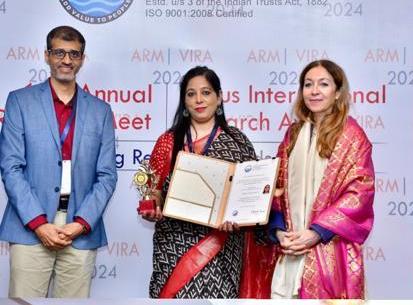
Dr Nishat Afroz receives the international award for research and innovation in medical sciences
Aligarh:
Dr Nishat Afroz, Professor, Department of Pathology, JN Medical College, Aligarh Muslim University (AMU) has been honoured with the award of “Distinguished Researcher in Histopathology” for her contribution and achievement in the discipline of Health and Medical Sciences by the Venus International Foundation.
The award was bestowed upon her at the 10th Annual Research Meet – ARM 2024 on the theme “Diverse Approach to Address Societal Challenges and Deliver Novel Solutions”, organised by the Centre for Research and Innovation – Venus International Foundation at Chennai.
Earlier, Dr Nishat Afroz attended the Pathology Conferences at Subharti Medical College Meerut, Narayana hospital & RN Tagore Medical College, Kolkata and SMS Medical College, Jaipur as guest speaker and workshop convener.
source: http://www.radiancenews.com / Radiance News / Home> Pride of the Nation. Awards> Focus / by Radiance News Bureau / December 12th, 2024
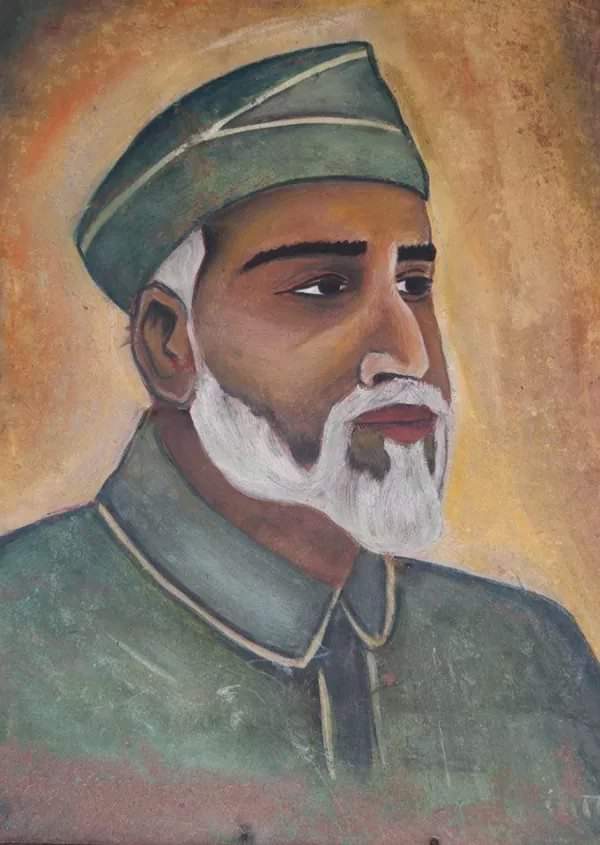
One of the most significant features of the rebellion of 1857-58 was that many scions of the former ruling houses took part in it. One such man was Khan Bahadur Khan (1860), a descendent of Hafiz Rehmat Khan (d. 1774). In this very blog of the Independence Week series, we will be throwing some light on Khan Bahadur Khan and his rebellion. How almost an eighty year old man kept the torch of rebellion against the Company in Bareilly burning.
Very little is known about the early life of Khan Bahadur Khan. It seems that having acquired traditional education in Arabic and Persian and Islamic learning; he joined the Company’s service, rising to the position of Sadar Amin (arbitrator or a native civil judge).
Upon retirement he continued to live at Bareilly where he enjoyed considerable status as grandson of the widely venerated Ruhela chief, Hafiz Rahmat Khan. In 1857 when the rebellion began, Khan Bahadur Khan was well over 82 years of age. During the rebellion, Bareilly became one of the important centers of the rebels under Khan Bahadur Khan’s leadership. In course of time, many rebel leaders came to Khan with a view to continue the struggle against the Company’s Government. A communal harmony was maintained in Bareilly despite the constant efforts of the Company to ignite the flame of hatred amongst the people through Bribery and inciting the Rajputs against Khan. This maintenance of harmony amongst the different classes of people in Bareilly is considered one of the major achievements of Khan despite the constant attack by the Company.
The old farmers of the region were affected badly because of the forceful sale of their lands by the British to suit a “capitalist” concept of property. This constant suppression led the uprising of 1816 when the company imposed the Chowkidari taxes. This uprising was soon crushed but it had led to a widespread range and discontent and people from all other regions came to Bareilly to join the uprising. The Rebellion of Bareilly was not just a religious war against the Company, it was due to the bitterness of those who had lost their lands and the anxiety of those who would be forced to lose them.
The rumors of trouble had started circulating in the region a couple of months before the actual revolt took place. The 18th Infantry Regiments and the 8th Irregular Cavalry were stationed at Bareilly. Of these the 8th Irregular Cavalry consisted almost entirely of Pathans. No European troops were stationed at Bareilly. The artillery branch which had in its ranks, as a subedar, Bakhat Khan, a disciple of Moulvi Sarfaraz Ali, the latter took a leading part in the Rebellion of 1857 and brought numerous Ulema of Delhi to call the struggle against the British as Jihad (holy war). It seems that the rebel sepoys were keen to raise Khan Bahadur Khan the Nawab of Bareilly as their leader but in the beginning he did not respond favourably to their overtures.
Ultimately on May 31, 1857. i.e. twenty-one days after the outbreak of the revolt in Meerut, Bareilly joined the rebellion. On 1 June under the guidance of Bakht Khan, concerted efforts were made by the rebels to persuade Khan Bahadur Khan to assume leadership. How Khan came to be persuaded by the rebels is evident from his own letter to the Governor General dated 14th February 1860 where he states that upon the deterioration in law and order, a deputation of the citizens of Bareilly headed by Syed Miyan Jan, Syed Faizullah, Miran Khan from Nau Mahla Mohalla, accompanied by several other persons and traders of the city approached him to take step to restore order. Syed Miran Jan at last prevailed upon him to move out of his residence.
Khan, now assuming leadership visited the city to restore order once again. He held a Darbar were prominent Hindu and Muslims were present. Like other rebel leaders, Khan Bahadur Khan also issued a proclamation addressed to all the Rajas and others, appealing to their zeal in defending religion. The main thrust of his proclamation was that the Indians’ religions (Hinduism and Islam) were in danger owing to the Company’s pro-Christian policy and attempts at Christianizing Indians. The proclamation also criticized some of the progressive measures taken by the Company’s Government such as the prohibition of Sati and widow- remarriage. The Bareilly proclamation was clearly an attempt to win the support of the Rajputs, a social group which practiced Sati and adoption, and so resented their suppression. The Bareilly proclamation also added that the Muslim leaders had to ban cow slaughter — a step considered of vital importance to maintain communal harmony. This was specially so when the majority of the rebel sepoys consisted of Hindus.
Khan Bahadur Khan was so keen to raise an efficient army that he did not burden the Rebel treasury with the pensions he had been receiving earlier from the Company.
The end of March 1858, Bareilly remained in the able control of Khan Bahadur. Despite a clear state resolution, the British policy, just to incite a division of the rebels assumed a new proportion on the cow slaughter issue. This time some Muslims mongers became active and insisted on slaughter on public places which was unacceptable to the Hindu sepoys. This led Khan hold a meeting of both the prominent Hindus and Muslims. It was attended by 12 Hindus and 20 Muslims. It was a tense atmosphere for obvious reasons and an axious and sad Khan Bahadur intervened saying “O Allah, why is so? Why is there so many squabble and blood-shed among the brothers, Hindus and Musalmans? The Hindus are my right hand and my right ear, because of their support and strength; I am able to sit on this seat. From today I declare that if any Muslim oppresses any Hindu or kills a cow at a forbidden place, he would be punished severely. Hindus and Muslims are the same. This ought to be the slogan of the two communities from this day”. In order to further strengthen the communal harmony, Muhammad flags by Hindus and Mahabiri flags by Muslims were hoisted in Bareilly and people were requested to gather under the respective flags to unite against the British. Khan himself visited different parts of the city to unite people and raised the slogans “Hindu and Muslims are one”, “Ram and Rahim are one”, and the people pledged to oust the British from this country.
One of the reasons for the long duration of the rebel regime at Bareilly was the British pre-occupation with the rebellion at other places. During this period Bareilly became a refuge for rebel leaders from far and near.
The movements of the rebel to and from Bareilly were very closely monitored by the British. The rebels lacked an efficient system of communication and the British on the other hand started communicating with Delhi, Agra, Nainital and Ambala and couriers with areas where they had no complete control. The rebels were fully aware of the danger that they had from the British Army and they made elaborate arrangements for guarding various ferry crossings. They also attempted to dislodge the Company officials from Nainital and other places, capturing Haldwani and Bhamauri (October 1857), and then Bundia on the high road between Haldwani and Bareilly. Their advance was checked by Colonel Mclausland at Baheri. The reverse was enough to persuade Khan Bahadur Khan to change the strategy. He instructed the rebel forces: “Don’t attempt to meet the regular column of the infidels, because they are superior to you in discipline and bandubast. and have big guns, but watch their movements. guard all the ghauts on the rivers, intercept their communication, stop their supplies, cut up their daks and posts, and keep constantly hanging about their camps; give them no rest”.
Though the company’s attempt to put the Rajputs against Khan in Bareilly had failed, they had succeeded in pitting the Rajputs of Dhatiganj in Bafaun against Khan, and Khan on the other hand had to take care of the Shia’s and the Sunni’s at this juncture.
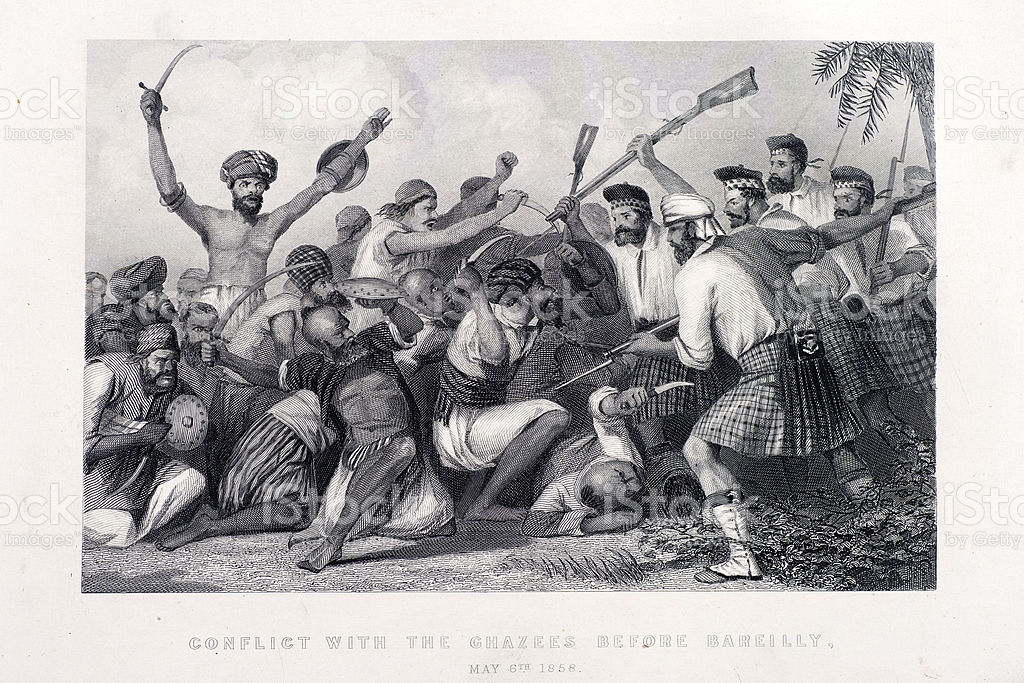
The British in Bareilly had caused an explosion with the help of their agents on 24th March 1858, killing 63 people. At the same time, the strength of the rebels were fast deteriorating due to the constant pressing forward of the company forces. They had recovered areas around Bareilly by the company troops, and the rebels were surrounded from all the sides. The company troops led by Brigadier General Jones surrounded Bareilly on 6th May. Khan Bahadur Khan had no option but to fight a pitched battle. He divided his troops into two lines. The first line was supported by the artillery commanding the bridge. The second comprising the Ghazis, defended the suburbs of the city. The British forces speedily broke the first line. They, however, had to face stiff resistance from the second line which displayed remarkable courage and determination against the enemy’s trained and organized forces. They resisted with such energy and boldness that Sir Colin Campbell was taken by surprise. To quote Russell “…a lot of Gazees got in pass the left of their right wing, attacked Walpole and Cameron, and wounded them……Sir Colin (Campbell) had a narrow escape… The Gazees were fine fellows, grizzly bearded elderly men for the most part, with green turbans and cummerbunds, and every one of them had a silver signet-ring, a long text of Koran engraved on it. They came on with their heads down below their shields, and their tulwars flashing as they whirled them over their heads, shouting, Deen! Deen! And dancing like mad men (6 May 1858)”. Sheer chivalry was, however, futile. The rebels lost the battle. Bareilly was occupied by the British forces on 7 May 1858.
“Conflict with the Ghazees before Bareilly, scence from the Indian Mutiny. Engraving from 1858, Engraver Unkown Photo by D Walker” / Source : https://www.istockphoto.com/vector/battle-at-bareilly-gm172740161-5022003
Having lost the battle, Khan Bahadur Khan took to flight. At this critical moment, the Kurmis around Bareilly provided shelter to the fugitives. From Bareilly, Khan Bahadur Khan moved towards Shahjahanpur with the intention of joining Ahmadullah Shah. Khan kept on moving and attacked the out skirts of Shahjahanpur on 12 June driving in all the pickets posted there.
He, however, could not join Ahmadullah Shah as the latter was treacherously killed by the Raja of Pawayan on 15th June. Ahmadullah Shah’s death left Khan Bahadur Khan alone. The British forces were at their heels. He took shelter in the Terai forest bordering Nepal. He wandered from place to place until Rana Jung Bahadur captured him, in December 1859, near Butwal. For some time he remained a prisoner of the Rana. Subsequently he was brought to Bareilly and confined in the Bareilly fort. He was charged with rebellion and inciting others to rebel and tried by a special Commission of enquiry. He was sentenced to death. He was hanged and laid to rest at the Bareilly Jail on 24 March 1860.
Reference/s :
Bareilly in 1857, Indian History Congress
source: http://www.sanelywritten.com / Sanely Written / Home> Freedom Fighters / by Sanely Written / August 10th, 2020
I first met Asad Rahmani in the late 1990s, when he was the director of the prestigious BNHS (Bombay Natural History Society), and did a few conservation-linked stories after talking to him. But I had been hearing a lot about him before that from my friend Rajat Bhargava, who had been mentored by Rahmani at AMU (Aligarh Muslim University), and would sing his praises day in and out. Rahmani encouraged Rajat to do research on the Finn’s Baya and later on the Green Munia.
It was Rajat who alerted me about Dr Rahmani’s memoirs Living with Birds. I owe him thanks because it is a captivating read – not only is it a fascinating personal history of an unusual man and the milieu he grew up in, but also packs in so much about conservation, the importance of science, birds, their habitat and the challenges they faced. Through Rahmani’s birding trips, the reader also gets to armchair travel to a great many places from Kashmir to Lakshadweep.
In wildlife circles, Rahmani is synonymous with the endangered Great Indian Bustard, a bird for which he undertook a padayatra. His love for bustards even took him abroad to Morocco and later to Saudi Arabia, where as an expert he was called to see if he could be part of a team to find the Arabian bustard, which had been declared extinct in 1977.
Idyllic childhood
The early part of the book is devoted to his childhood, which sounds idyllic, growing up as he did in large homes in several UP towns ranging from Meerut, Rampur, Badaun, and Saharanpur as his father was a district judge.
His early days reminds you of Gerald Durrell’s My Family and Other Animals, what with six siblings, two German Shepherds, a mountain goat (the Himalayan goral), parakeet, fish, poultry, toads, larvae that turn into dragonflies, and many more. Rahmani had his nose buried in books or spent time observing the natural world and doing accidental experiments. For instance, he rescued a peahen’s eggs and placed them under a domestic hen and the confusion that ensued when the pea-chicks hatched and mama hen had a hard time is really funny.
From a young age Rahmani could stand up to authority, and make his own decisions — evident when he refused to accompany his family when they were invited to dinner at the Nawab of Rampur’s palace (his Left-leaning sensibility was offended), or when he stood his ground against his father who wanted him to study engineering and even wasted a year, before being allowed to take up biology, or the way he took on a warden at AMU for shooting a peacock. An atheist, he also went through a hippie phase (minus the drugs) when the movement was at its peak in India.
The conservation work
If the childhood chapters are fascinating the meat of the book – Rahmani’s conservation work on birds and their habitats – is pure gold. You get a ringside view of the discussions and exchanges between him and stalwarts like JC Daniels, Dr Salim Ali and many others. Rahmani is generous in the way he highlights the works of several conservationists, and also affectionately his students. Yes, Rajat figures and I chuckled to see Rahmani did not spare some of his exasperating habits. His admiration for Indira Gandhi also shines through as he highlights how no other PM was as concerned about wildlife as her.
You get a whole bunch of fascinating information on the Floricans (the Lesser and the Bengal), the swiftlet, the hornbill, etc. The chapter on the vulture crisis especially resonated with me as I remember the huge discussions when the raptors declined in Delhi and surrounding areas.
Parallely, you get a picture of the big events in India. The way Rahmani links the events, the fear of Skylab falling, the solar eclipse of 1980 when everyone fearfully stayed indoors while he himself went into the field to see how birds responded to the eclipse is compelling. When Indira Gandhi was assassinated, Rahmani and Salim Ali were in Nannaj, chasing the Great Indian Bustard where news reached them, and he describes the anguish that Salim Ali felt very movingly.
A word about the publishers is in order. This book is published jointly by Juggernaut and Indian Pitta, India’s first dedicated book imprint for bird and nature lovers and conservationists. The deft touch of Anita Mani, the founder of Indian Pitta is evident. While this book will enthral bird lovers, there is much in it to fascinate the general reader too.
Title: Living with Birds: The memoir of One of India’s Greatest Ornithologists / Author: Asad Rahmani / Publisher: Juggernaut/ Indian Pitta / Price: ₹599
source: http://www.thehindubusinessline.com / Business Line, The Hindu / HOme> Books> Book Review / by Chitra Narayanan / December 01st, 2024
Prof. (Dr.) Mohammad Rihan, a senior faculty member of AMU, has been appointed Chairperson of BIS Solar Energy Panel
Aligarh:
In a significant development for India’s renewable energy sector, Prof. (Dr.) Mohammad Rihan, a senior faculty member of Aligarh Muslim University (AMU), has been appointed as the Chairperson of the Solar Photovoltaic Energy Systems Sectional Committee (ETD 28) under the Bureau of Indian Standards (BIS).
Prof. Rihan, who previously served as the Member In-charge of Electricity at AMU, is currently on deputation as the Director General of the National Institute of Solar Energy (NISE), an autonomous body under the Ministry of New and Renewable Energy. His appointment is expected to bolster India’s efforts in standardising and advancing solar energy technologies.
The ETD 28 Committee, operating under the Electrotechnical Division Council of BIS, is tasked with developing national standards for photovoltaic systems, encompassing everything from solar energy conversion to electrical system integration. Prof. Rihan’s leadership is anticipated to play a pivotal role in ensuring the reliability, efficiency, and sustainability of India’s solar energy initiatives.
Prof. Rihan’s distinguished career includes roles as Vice Chairperson of the ExCom IEEE UP Section and the IET Delhi Local Network. He has also contributed as a Visiting Scientist at NISE. With his expertise, Prof. Rihan is expected to drive innovation and accelerate India’s transition towards a renewable energy future.
This appointment highlights the growing recognition of academic contributions to India’s renewable energy mission and reinforces AMU’s reputation as a hub of academic excellence in science and technology.
source: http://www.radiancenews.com / Radiance News / Home> Education> Focus> Science & Technology / by Radiance News Bureau / December 07th, 2024
Anam Rais Khan is the first female and first ever Muslim from Aligarh Muslim University to qualify the prestigious Delhi Judicial Services Examination 2018, securing 71st rank to become a judge in Delhi.
She completed her B.A.LL.B (Hons) from AMU in 2015 and did LLM from National Law University Delhi in 2016. She was the University Gold Medalist and also received Gold Medal in Constitutional Law. Socially active on campus, she organised several legal literacy awareness programs, donation camps and environment campaigns.
She qualified UGC NET and got enrolled with Bar Council of Delhi in 2017. Then she moved to Australia with her husband, who is a software engineer at TCS, and started working at a reputed Immigration consultancy firm in Sydney. But her strong desire for competing judicial services exams was always there and she kept preparing for it for around 1.5 years and then gave it a shot in January 2019 and cleared the most coveted judicial services exam of India at the young age of 26.
Her husband, Adil Khan always stood by her, supported her and encouraged her, come what may. Her father, A.R. Khan, Retired Station Superintendent in Indian Railways always wanted to see her daughter adorn this respectable post, and Rahul Yadav, her mentor at Rahul’s IAS Coaching, guided her throughout the journey.
She also thanks her mother Prof. Samina Khan and sister Alvina Khan and her in-laws for being so supportive always. Anam says she always wanted to be a judge because being a judge gives one the power and also the responsibility to correct so many injustices in society. She says now she will be able to contribute to the evolution of law, serve the nation, and become a better student of law and at the end of the day sleep with a clear conscience by making a difference in the society.
Her advice to the aspiring candidates would be not to become bookworms and try to think out of the box.
source: http://www.radiancenews.com / Radiance News / Home> Latest News > Markers of Excellence / by Radiance News Bureau / October 03rd, 2024
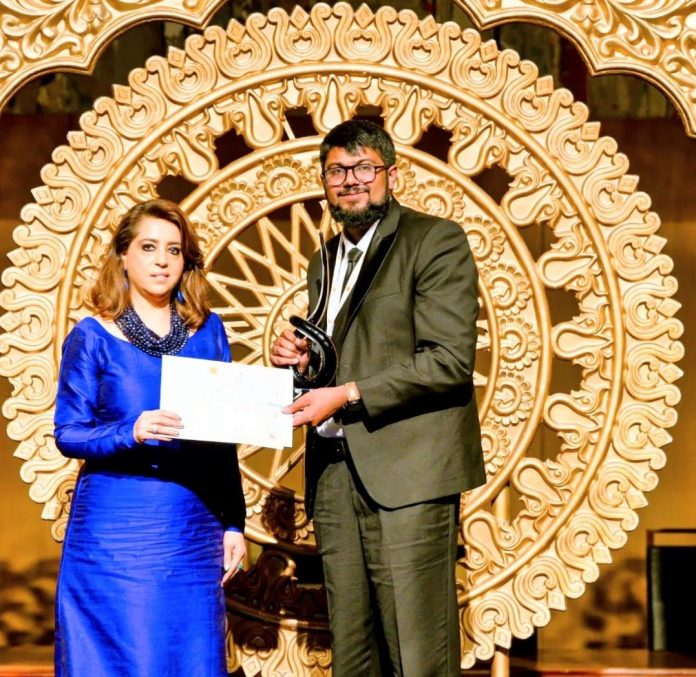
Aamir Qutub, an India-born entrepreneur and CEO of Australian IT multinational Enterprise Monkey, has been awarded the 2024 India Australia Business and Community Alliance (IABCA) Young Professional of the Year Award. The accolade recognizes his exceptional contributions to entrepreneurship and social service in Australia.
Upon receiving the award, Qutub expressed his gratitude in a conversation with Radiance from Australia. “More than a decade ago, when I left my hometown for Australia, I never imagined standing in the grand Parliament Hall, receiving an international award in the presence of the Prime Minister. I am deeply humbled and honored to have received the 2024 IABCA Young Professional of the Year Award.”
Reflecting on his journey, Aamir shared, “This recognition is not just about my individual efforts but highlights the power of community support. From my early days in India to establishing myself in Australia, the backing of people around me has been crucial. This award is for my work as a founder and CEO, where we have created jobs and contributed to the local economy. Our initiative, Angel Next Door, played a key role in helping over 100,000 Australians during the COVID-19 crisis.”
Aamir also offered advice to emerging entrepreneurs in India, encouraging them to pursue their dreams, regardless of their background.
“I come from a middle-class family in a small Tier 3 city, but I dared to dream big. The journey was not easy, but persistence, adaptability, and continuous learning made it possible. Your background does not define your future – your determination does. Every small step you take today contributes to tomorrow’s success,” he said.
Reflecting on his journey, Aamir acknowledged the many people and institutions that played a role in his success.
“From the regional city of Aligarh and the nurturing environment at AMU, where I laid my foundation, to the vibrant city of Geelong, where Deakin University provided me with a platform to grow – this journey has been shaped by countless hands and hearts,” he added.
A proud alumnus of AMU, Aamir has received numerous accolades, including being a finalist for the Australian Young Business Leader Award. He was the youngest General Manager of ICT Geelong and also served as Digital Manager for Australian Sports Tech Network. In the early stages of his career, Aamir worked as a cleaner during the day and a newspaper delivery boy at night to fund his startup. He has also demonstrated his commitment to social causes by spending a night on the streets with other CEOs to experience the life of homelessness, raising awareness for Australians without shelter.
Aamir’s professional journey began with Honda Cars India as a Production Manager before he co-founded the Stand India Foundation, a not-for-profit social venture. He holds an MBA in Information Management from Deakin University and a Bachelor’s in Mechanical Engineering from AMU, where he served as General Secretary of the AMU Students’ Union.
source: http://www.radiancenews.com / Radiance News / Home> Pride of the Nation> Award> Markers of Excellence> Latest News / by Radiance News Bureau / October 07th, 2024
This is just not another memoir of a politician happily or unhappily bounds to look back; the author, instead, talks like a grandmother narrating a story of post-independent India somewhat interlinked with the Congress.
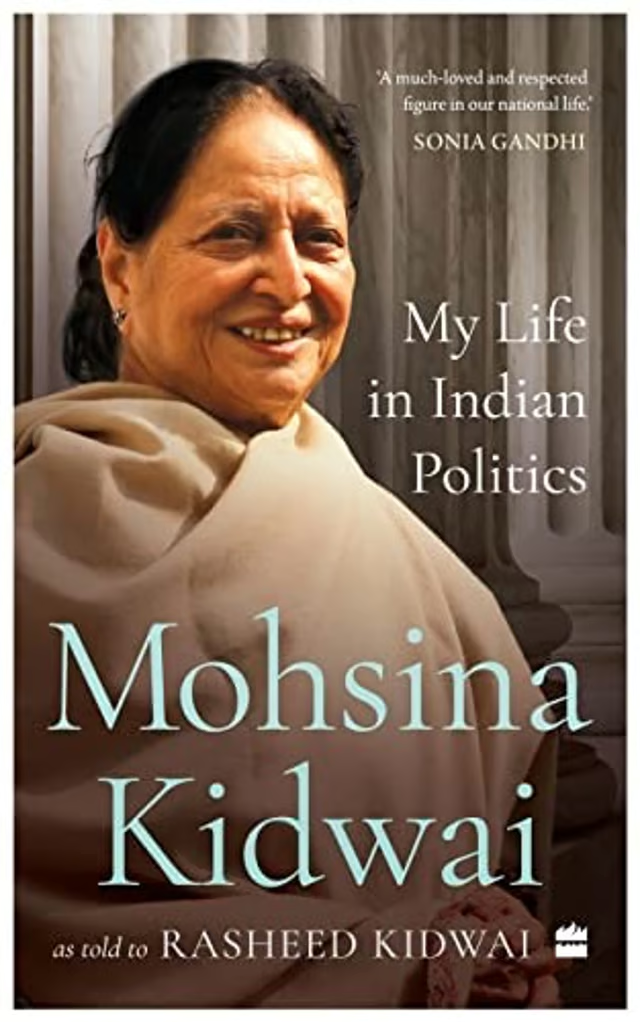
Mohsina Kidwai, author of the book ‘My Life in Indian Politics’
Book Review: Non-fiction (Memoir)/2022; My Life in Indian Politics by Mohsina Kidwai (As told to Rasheed Kidwai); HarperCollins, 300pp (Hardback)
Indian politics is a sort of ‘wonder’ and its unique existential positioning can’t be imagined without people behind its ups and downs. Reading the memoirs, especially of those who served in public life for long, is amongst the rewarding pastimes of a reader. I read Mohsina Kidwai’s memoir as a manuscript, and of course, I reread it even more carefully in its print version. Here is a candid account of a prominent political figure of India who dispels the stereotyped traditional notions that are usually expected to be self-centred and being extra boastful in the first person narrative.
Mohsina Kidwai has been in public life as a member of the Indian National Congress for over six decades. A cabinet minister in several successive central governments and a senior office-holder in the Congress, she has had a ringside view of Indian politics for almost the entire span of independent India’s existence. She has witnessed, and been a participant in, the tenures of prime ministers from Jawaharlal Nehru to Indira Gandhi and Rajiv Gandhi, and was a member of parliament until 2016, one of only twenty Muslim women to have been elected to the Lok Sabha since 1951. She has had a prolific track record that can’t be compared with her fellow women politicians, more so, from the Muslim community.
My Life in Indian Politics by Mohsina Kidwai
The book reflects well on her long and eventful life in politics and covers quite skilfully her contributions to public life, and also succeeds in providing an honest appraisal of the turn in fortunes of the political party she has remained a loyal member of over the decades. The author along with co-author and senior journalist Rasheed Kidwai, endow the readers with rare glimpses to homes, lives and hurly-burly of election campaigns from bygone era when Congress dominated the political landscape at centre and in the states.
One such memorable one was the Azamgarh bypoll in 1978, which Mohsina Kidwai won as Uttar Pradesh Congress Chief, and which signalled a revival of the Congress’s fortune after its spectacular defeat in the post-Emergency general elections of 1977. The book’s cover informs you and inside, the details and rich and beautifully presented.
We get to see little known facts about India’s Prime Ministers Pandit Jawaharlal Nehru, Lal Bahadur Shastri, Indira Gandhi, Rajiv Gandhi and P V Narsimha Rao. Similarly, she is forthright in accepting that her move to join the breakaway Tiwari Congress in 1995 was a mistake.
Here is a quick recap of a few of them:
Mohsina Kidwai talks about an incident which happened when Lal Bahadur Shastri had visited Barabanki sometime in the early 1950s. “A few years after marriage, I saw Shastriji, who had come to meet my father-in-law. Jameel ur Rahman Kidwai Saab had stood for elections and Shastriji was canvassing for him. Shastriji was a simple man. Our domestic help, who did not recognize him, asked him where he was from. Shastriji, by then already a Union minister, replied that he had come in connection with the election and wished to meet Jameel Saab.
“He will return home in the evening,” the domestic help told Shastriji and asked him to wait. Shastriji waited. The servant served him tea.
In the evening, when my father-in-law returned, he saw Shastriji waiting.
A little embarrassed, my father-in-law scolded the servant for not informing him about the guest. After that Shastriji became a member of our extended family.” Some rarest accounts on Indira Gandhi:
“Indiraji was extremely caring and attentive. I can go on talking about many instances. Sometime after the 1977 Lok Sabha polls when Indira ji was in opposition, she planned to visit Badrinath for puja. I and Narayan Dutt Tiwari and I accompanied her. It was an October month. We were told that puja starts at 4 am. Asking us to wait, she went to the temple for Puja. We were to start at 6 am on the return journey to New Delhi. At 5 am, Indiraji returned from the temple and checked whether all the vehicles of our convoy were ready. The pundit of the temple offered us breakfast. When we were having breakfast, the drivers were heating the engines of their respective vehicles. I told Indiraji, we had breakfast but poor drivers must be hungry. They have not even had tea as they were busy heating vehicle engines. I suggested we stop at the first tea shop in return for the drivers to have tea. She agreed.
Indiraji had the habit of carrying some snacks with her in a basket during travel. After a while I saw her taking out some biscuits from the basket kept beneath her seat. She tore the biscuits in four pieces and asked the driver to pick the pieces one by one from her hand while driving. She extended her hand carrying biscuit pieces and the driver did what he was told to do. Indiraji used to enjoy such affection and spontaneous display of it that it often stunned me and used to fill my heart with admiration and pride for my leader.”
“Indiraji could also sense what people around her were feeling. Once we were traveling by an overnight train to Gorakhpur and I suddenly realised I was alone with the Prime Minister in the first-class coupe. She sensed that I was a little uncomfortable and directed me to turn my face towards the wall and go off to sleep,” adds the author.
Undeniably, the book is written with honesty and simplicity, and should be better known as a work to assess an entire era in Indian politics. This is just not another memoir of a politician happily or unhappily bound to look back. She, instead, talks like a grandmother narrating a story of post-independent India somewhat interlinked with the Congress. The book is essential reading for anyone interested in knowing India, its democracy and the foundational stories of a remarkable journey.
(The author is a policy professional, columnist and writer with a special focus on South Asia. Views expressed are personal.)
source: http://www.outlook.com / Outlookindia.com / Home> Culture & Society> Book Review / by Atul K Thakur / January 07th, 2023
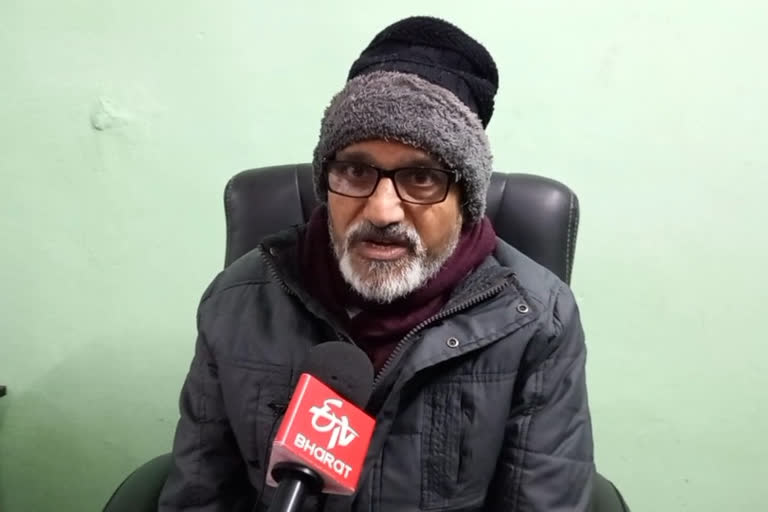
‘Patent Man of India’ Prof Shamshad Ali so far bagged seven patents for his multifarious innovations. The professor of engineering at Aligarh Muslim University’s polytechnic is differently abled and keeps underscoring the need for innovation to achieve progress.
Professor of engineering Shamshad Ali at AMU
Aligarh:
Shamshad Ali, a professor of engineering at the polytechnic college of Aligarh Muslim University (AMU) has become popularly known as Patent Man of India for his multifarious innovations. Prof Shamshad Ali, who after taking classes keeps busy with his inventions, has over seven patents to his credit till now, granted by the Patent Office, Government of India, Delhi.
This differently-abled professor never loses heart and always strives for excellence. Be it teaching students or discovering something new, this physically challenged person’s hard work has become a source of inspiration for other teachers and innovators. Prof Shamshad Ali was granted three patents in 2022 alone.
The professor underscores the need for innovation to achieve progress. In his appeal to students and teaching faculty in the AMU, he said, “Innovation plays an important role in upping the university’s ranking. Discovering new things helps teachers and students. So they should keep on doing new research. I have bagged seven patents so far and two more patents will be granted soon.”
“When someone discovers new things. Then the innovator is supposed to apply and submit application online to Delhi patent office. Thereafter an exam is conducted. If you pass the test, they will grant you patent. If not, then you will have to work on it again. It all depends upon the examiner,” said Prof Shamshad.
source: http://www.etvbharat.in / ETV Bharat / Home> ETV Bharat> Bharat / January 07th, 2023
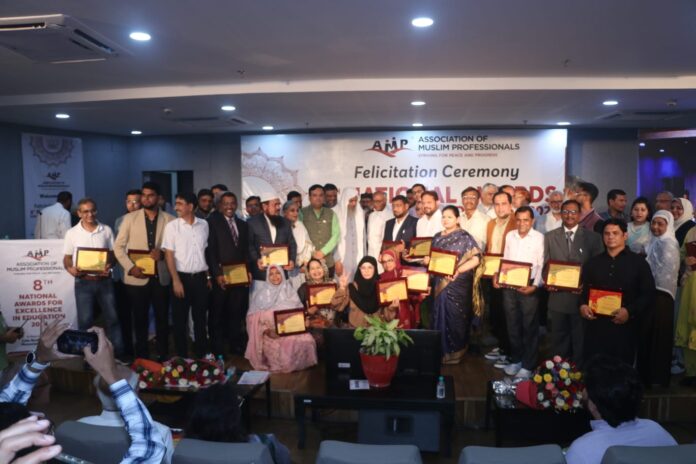
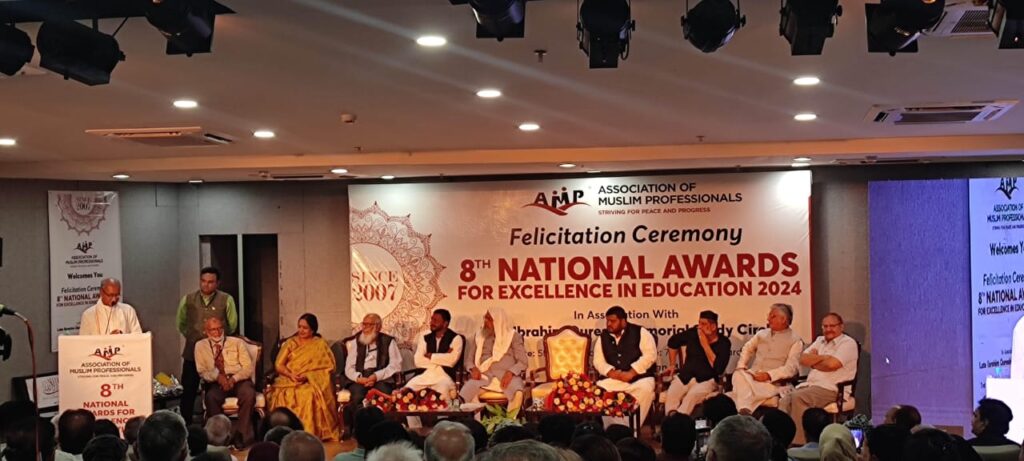
On Teachers’ Day, over 150 educators from around the world were celebrated with the 8th AMP National Award for Excellence in Education 2024 at a distinguished ceremony held at Ravindra Bhawan in Bhopal.
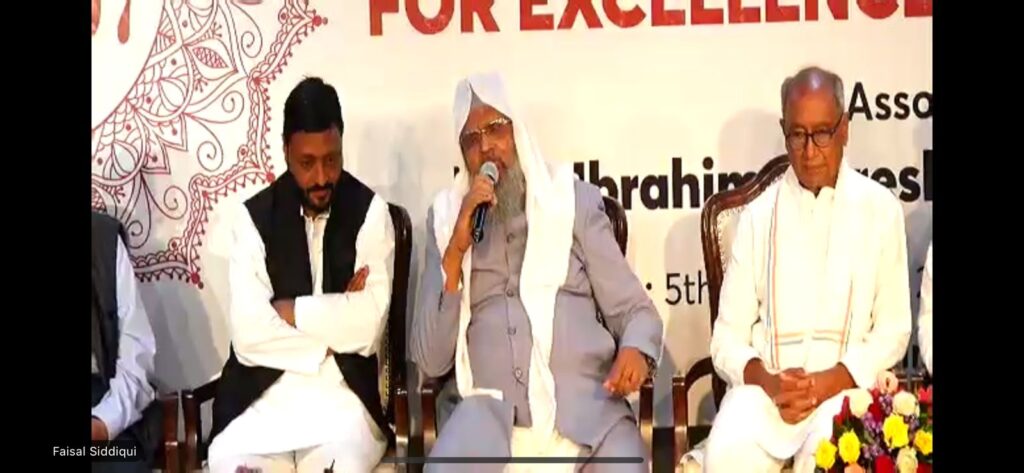
The event was presided over by Bhopal Shahar Qazi Maulana Syed Mushtaq Ali Nadvi, with former Madhya Pradesh Chief Minister and current Rajya Sabha Member Digvijay Singh serving as the Chief Guest.
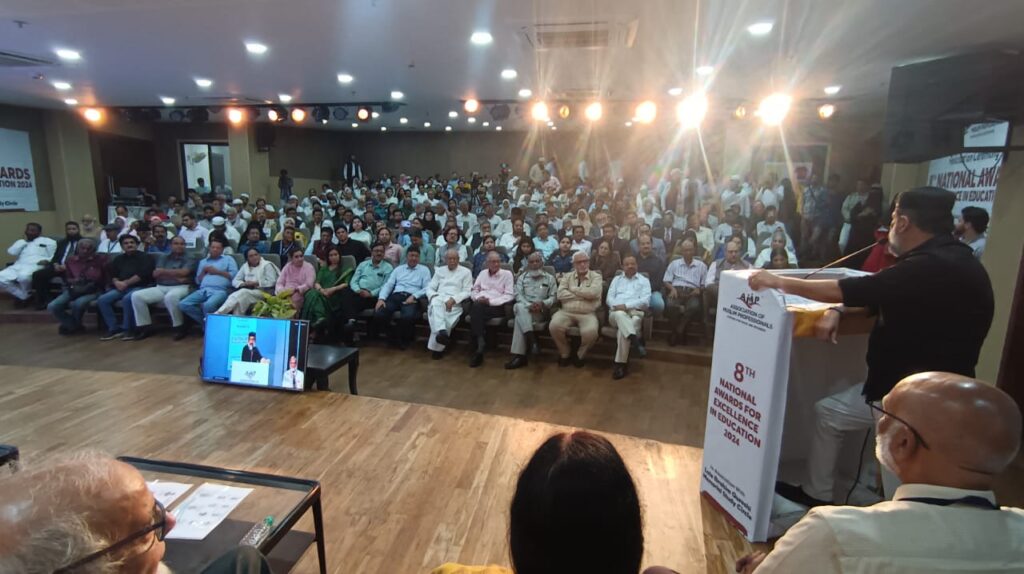
The ceremony drew attendees from various educational backgrounds, including award recipients who were present in person, special guests, AMP members and volunteers, and members of the academic community. Many other winners participated virtually, and the event was widely followed on social media.
In his address, Bhopal Shahar Qazi Maulana Syed Mushtaq Ali emphasized the profound role of teachers, citing a saying of Prophet Muhammad (PBUH): “I have been sent only as a teacher to you.” He highlighted the Prophet’s impact through education and quoted Allama Iqbal, who praised the fertile soil of Hindustan for nurturing good deeds. The Qazi reminded attendees of the honor and responsibility of being a teacher, suggesting that a dedicated educator can approach the level of Prophets.
Bhopal Shahar Qazi Syed Mushtaq Ali speaking on the occasion, with senior Congress leader and former chief minister of Madhya Pradesh Digvijay Singh on his right.
Digvijay Singh commended the AMP initiative for uniting Muslim professionals to contribute positively to society. He stressed the importance of prioritizing education and healthcare for national progress. Singh noted the underrepresentation of Muslims in government jobs compared to SC/ST categories and highlighted the need for increased professional education within the Muslim community.
Senior Congress leader and former chief minister of Madhya Pradesh Digvijay Singhspeaking on the occasion.
Singh also criticized the state of the education system, pointing to corruption and the prevalence of contract-based teaching positions, which he argued undermine the quality of education. He lamented the shortage of permanent teaching positions and the poor condition of many government schools.
A view of the audience
Prof. Furqan Qamar, former Vice Chancellor of the University of Rajasthan and Central University of Himachal Pradesh, delivered a keynote address advocating for increased participation in higher education and greater public investment to make education more accessible, particularly for rural populations, women, and landless laborers.
Dr. Usha Khare, a National Teacher Awardee and recently retired Principal of Jahangirabad Girls Government School in Bhopal, shared her inspiring journey of advocating for girls’ education in impoverished neighborhoods. She revealed that she donated her prize money from the Kaun Banega Crorepati show to her school and left significant assets upon her retirement.
The awards were presented in seven categories: Primary and Secondary Teachers, College and University Teachers, Principals/Heads of Institutions, Islamic Education (Arabic/Fiqh/Islamic Studies), Educational Institutions, Lifetime Achievement Awards, and the Late Ibrahim Qureshi Memorial Award. Prof. Furqan Qamar was honored with the Ibrahim Qureshi Memorial Award for his exceptional contributions to education.
Lifetime Achievement Awards were given to:
Hazrat Maulana Sayyed Muhammad Aqil, Shaikh-ul-Hadith, Mazahir-ul-Uloom, Saharanpur, UP
Jamaluddin Ahmad Khan, Former Lecturer, Halim Musim Inter College, Kanpur, UP
Sharifa A. Azeez, Correspondent, Crescent Matriculation H.Sec. School, Chennai, TN
Sheila Lawrence, Former Headmistress, Lucknow Christian College, Lucknow, UP
Additionally, 78 educators received Special Jury Awards in various categories, and 50 “My Favourite Teacher” Awards were presented based on votes from students and parents nationwide.
In Bhopal, local awardees included:
*Bushra Parveen, Oakwoods School (Primary & Secondary)
*Dr. Shazia Ali, Campion School (Primary & Secondary)
*Dr. Mohammad Athar, Institute of Excellence (Higher Education)
*Dr. M. M. Malik, MANIT (Higher Education)
*Dr. Sana Khan, Azim Premji University (Higher Education)
*Dr. Siraj Ahmed, MANIT (Higher Education)
*Prof. Dr. Ghayur Alam, National Law University (Higher Education)
*Prof. Asma Rizwan, People’s University (Higher Education)
*Dr. Abid Husain Saify, All Saints’ College of Technology (Higher Education)
*Dr. Faiqa Saulat, Trailblazer International School (Principal/Head)
*Ms. Nikhat Ara, A.U. School (Principal/Head)
The ceremony was also graced by Guests of Honour including MLAs Arif Masood and Atif Arif Aqueel, and Mohammad Wazir Ansari IPS (R), Former DGP – Chhattisgarh. They praised AMP’s significant achievements in education and employment over the past 17 years and commended the thorough selection process and professional execution of the event.
Farooq Siddiqui, Head of the AMP National Coordination Team, hosted the event, reflecting on AMP’s growth from modest beginnings to its present reach across over 200 cities and many countries worldwide.
Kalim Akhtar, Zonal Head – Central India, AMP NGO Connect, presented an English translation of the Holy Qur’an to Digvijay Singh, who accepted it with reverence.
Sajid Qureshi, Acting President of the Ibrahim Qureshi Memorial Study Circle, thanked AMP for their support in organizing the event, and Rafat Iqbal Farooqi, State Head – AMP Madhya Pradesh, offered the vote of thanks to all attendees and the Bhopal Chapter team for their hard work in making the event a success.
source: http://www.indiatomorrow.net / India Tomorrow / Home> Education / by Pervez Bari / September 09th, 2024