Tag Archives: Muslim Poets of Uttar Pradesh

Zubair Rizvi lived and died glorifying Urdu language

Amroha, UTTAR PRADESH :
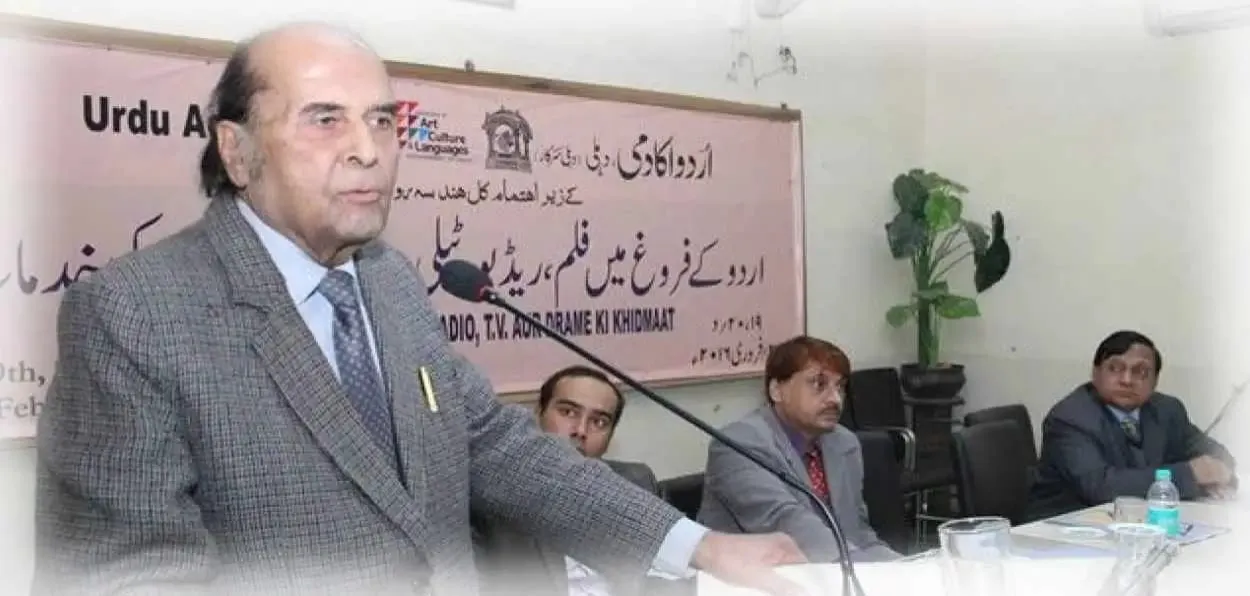
Zubair Rizvi speaking at a function of Urdu Academy

It was February 21, 2016. A seminar on Urdu was in progress in the Qamar Rais Hall of Delhi Urdu Academy of Delhi. The president of the Urdu Academy Zubair Rizvi rose to speak. He apologized for becoming emotional and said it was difficult for him to speak. Zubair Rizvi had been heading the Academy for 30 years and the audiences too it as the idiosyncrasy of a reputed poet. He left his speech midway and walked slowly to his chair and sat down in it. Rakim Numan, the chief guest, who was seated close to him found him feeling uneasy. He rose and rushed towards Zubair’s seat. Before he could pour water from his bottle to the doyen of Urdu litterateur, he had collapsed.

Majid Deobandi, vice chairman of the Academy immediately ran towards Zubair. People lifted him and rushed him to the hospital. A few minutes later Zubair Rizvi was declared dead.

The gem of a litterateur from Amroha, Uttar Pradesh, died working till his last breath and amidst fans and admirers. He was laid to rest the same day in his ancestral cemetery in Amroha.
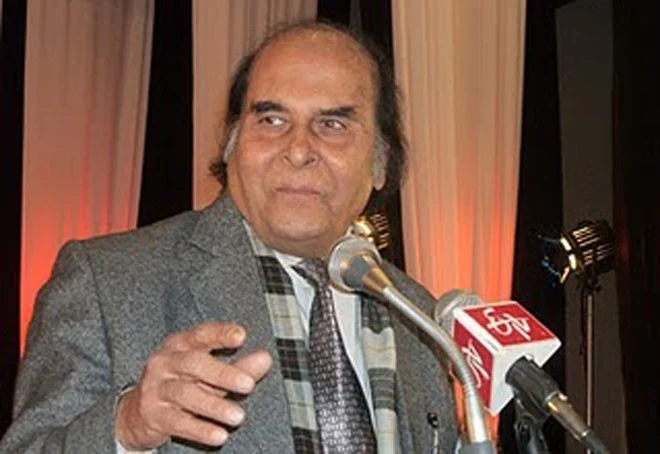
Zubair Rizvi

Zubair Rizvi was a writer par excellence. He was also the best scholar with an awakened consciousness about the literary heritage of Urdu. As a popular poet, he enjoyed adulation and cherished admirers. He made his mark as a successful poet in mushairas all over the world including India Pakistan, Canada, etc., and introduced a new tone to contemporary poetry. He was also a successful broadcaster and a staunch intellectual critic. During his days with the All India Radio, he was posted as Station Director of the Rampur station for some time.

One of his famous poems, Yeh Hai Mera Hindustan, which he read with gusto at many a Mushaira, not only gained great popularity among Urdu lovers but was also included in many textbooks.

Zubair Rizvi was born on April 15, 1935, in a scholarly family in Amroha, Uttar Pradesh; the atmosphere in his family was filled with religious and spiritual fragrances. His father Muhammad Rizvi and his mother Fahmida Rizvi were famous religious and scholarly figures.

A distinguished poet, Zubair donned many hats in his prismatic career: Broadcaster; Secretary, Urdu academy; Lecturer, Mass communication; Jury for AIR, Writer, and Magazine composer.

He began his career at the famed Hamdard Dawa-Khana, followed by a position as an interviewer, scriptwriter, and interviewer at AlR, Delhi where he interviewed celebrities such as Amitabh Bachchan, Dharmendra, Lata Mangeshkar, and Dilip Kumar.

He rose to the position of Director of Sports at AIR.
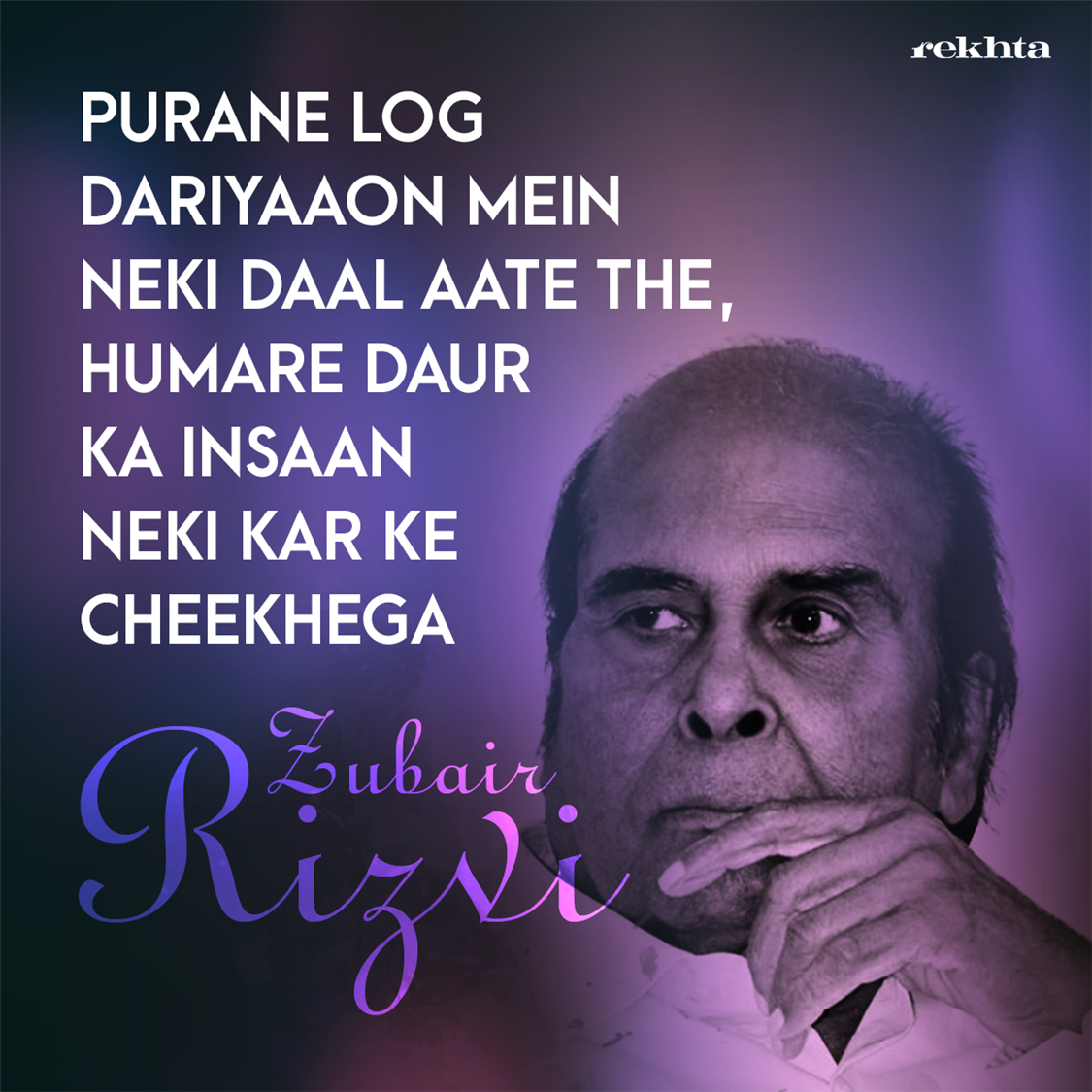
A sher of Zubair Rizvi 

A postgraduate of the Delhi University, Zubair Razvi, joined Urdu Academy, Delhi as Secretary after 30 years of service at All India Radio. He was the director of the Urdu Academy for two years, and during this time he did an incredible job of promoting and helping Urdu lovers learn the language. He held seminars on popular topics such as The Role of Urdu in Bollywood which was attended by Yash Chopra, Gulzar, and Farooq Shaikh to name a few.

He was appointed a member of many jury committees for script selection and also appointed as a guest lecturer in the Department of Mass Communication at Jamia Milia Islamia Delhi.

His journey as a poet started from Hyderabad at a very early stage; around the 1950s. He had the chance to share the stage with then-famed poets like Kaifi Azmi and Ali Sardar Jafri. Soon, he made a place for himself as an Urdu Poet. Be it critics or less-informed audiences, Zubair Rizvi is regarded very highly by both as an Urdu poet, writer, and a significant contributor to Urdu Literature.
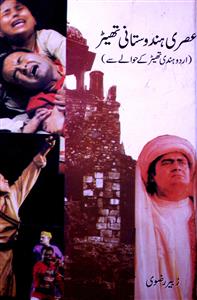
Cover of one of Zubair Rizvi’s books

In verse, he mainly tried his hand at Ghazal, Nazm, and Geet. He has over 17 books to his credit, some of the more important ones among these include, Lahar Lahar Nadiya Gahri (Collection of Poems), Khisht-e-Deewar, Musafat-e-Shab, Purani Baat Hai, Dhoop Ka Saibaan, Ungliyaan Figaar Apni, etc.

Two books have been written on his life and work and he has compiled and edited 24 books.

His remarkable contribution to the field of literature can be fathomed by the breadth of awards he amassed during his lifetime. These included: The All India Radio New Delhi- External Services Division Award; Sant Gyaneshwar National Award for the year 2009 by Maharashtra Urdu Sahitya Academy; All India Mushaira Award of Honor S.C.D. Govt College SAHIR Memorial Society Ludhiana (2002); Urdu Academy Delhi Award for Ghalib Aur Funoon-e-Lateefa; Consulate General Of India, Jeddah, Saudia Arabia- Certificate of Appreciation; Certificate for Sufi Studies-Maharaja Ranjit Singh Police Academy (2001); Karnataka Urdu Academy, Bangalore; Urdu Academy at Delhi Secretariat presented an award to his book Sang-E-Sada; Uttar Pradesh Urdu Academy, Lucknow Award for Sang-E-Sada (2014); National Council for Promotion of Urdu Language -World URDU Conference (2016).

As a poet, his beyond-the-borders following can be gauged by the different mix of mediums that his works have featured. A few of these special features include: Door Darshan Serial “Khali Haath”, written by Dr. Harikrishna Devsare, had Zubair Rizvi’s lyrics. In five Indian states, the NCERT Urdu curriculum has selected Zubair Razvi’s iconic patriotic song” Yeh hai Mera Hindustan, Mere Sapnon Ka Jahan Is Se Pyaar Mujhko” for school textbooks. He was also quite famous for his recitals and was invited to Mushairas in Asia, Canada, Europe, and especially America where he once performed in 15 different states in one tour.

Zubair Rizvi’s passion for Urdu was undying, and to spread this language of love to lands far and wide, he started the famous magazine Zehn-e-Jadid – Bari Zaban Ka Zinda Risala, which is now being published and edited by his wife Jamshed Jahan.

source: http://www.awazthevoice.in / Awaz, The Voice / Home> Stories / by Siraj Naqvi / December 12th, 2023
For Iqbal, simplicity is the way

Budhana Town (Muzzaffarnagar) / Meerut, UTTAR PRADESH / NEW DELHI:

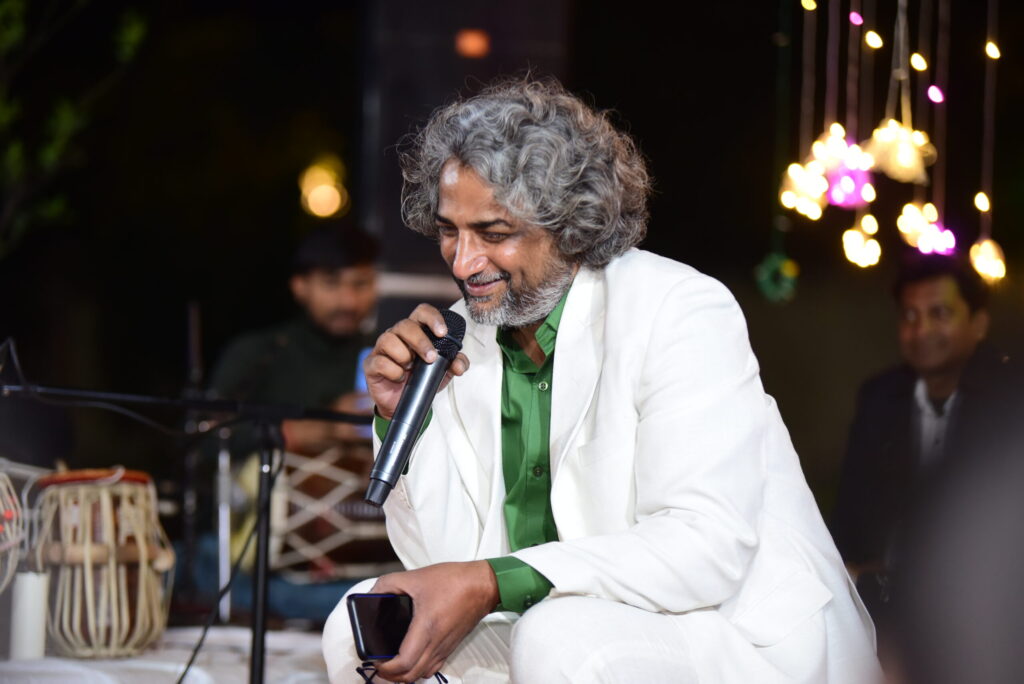
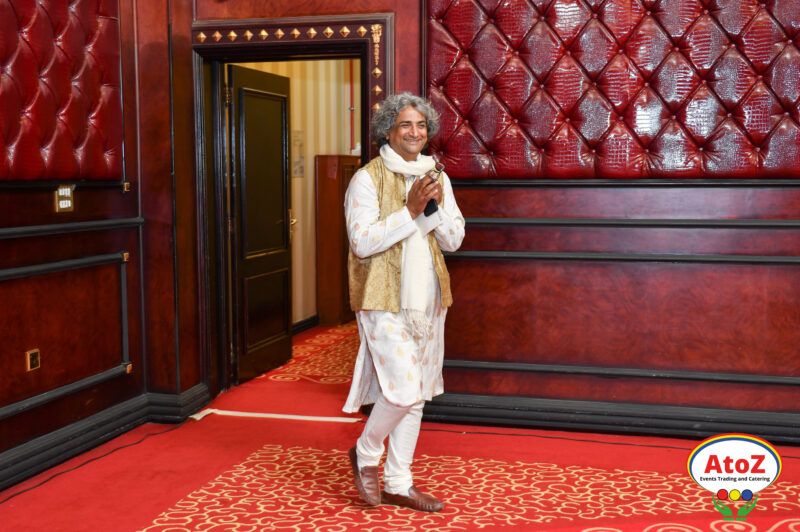
Poet Azhar Iqbal has gained prominence due to his use of simple Urdu language mixed with Hindi and his reach on social media.


QUICK RISE:

Azhar Iqbal has suddenly risen to fame in the last two years

Saying Urdu/Hindi couplets (shayri) in the language of the common man and usage of social media has raised Delhi’s Azhar Iqbal to a level he had never imagined.

The famous saying bhagwaan jab deta to chhappad phaad ke deta hai (when God decides to bestow His bounty, He showers it all) seems to have come true for Delhi’s Urdu poet (shayar), Azhar Iqbal. 

He suddenly rose to fame in the last two years. He is seen in almost all domestic as well as prestigious mushairas (poetry sessions) in Europe, Middle East and Dubai. The limelight-hungry, from literary to television world, have suddenly started showing a sense of belonging to him and their pictures together adorn several social media accounts. 

Those who had not even known him remotely, have started commenting on his posts, expecting few seconds of a shared fame! His recent claim to fame is his presence at the famous Kapil Sharma Show on Sony LIV television.

The shayar has to thank two factors that worked wonders for him, social media and couplets he wrote in simple Urdu projecting relatable truths of peoples’ life. 

For instance, Ghutan si hone lagi uske paas jaate hue, main khud se rooth gaya hoon usey manate hue or Parindo ko shajar acchha laga hai, Bohot din baad ghar acchha lagta hai, Gale main hai teri bahon ka ghera, Ye bike ka safar acchha laga hai.

Iqbal is not new to shayri but to the fame. The 45-year-old is yet to sink it in. 

He admits, “Social media’s wide reach is a magical reality. My seniors and buzurg shayars (experienced poets) would not have imagined reaching that far globally with their genius. I don’t think I do shayri as well as them. But I wouldn’t mind taking credit for the fact that I do shayri that common man understands. From students to youth, females to those battling crises of various kinds in their daily grind.”

Substance too

It not just the miracle of social media but a life of hard work, interest in shayri, taleem-o-tehzeeb and patience that Azhar’s poetry is made of. He isn’t a product of an aristocratic school or family either. Azhar, one among 11 siblings, is a father of two, and homemaker wife. His father, a literary person and an avid Urdu reader, had a tea shop in Meerut where he would go to help him in his holidays as a child and in his youth.

A fertile background plays the most significant role in the making of a poet. Azhar is no exception. Remarkably, in western UP, educated people in small towns like Budhana, Kairana, Gango, Jhinjhana, Nakod among others had immense affinity with literature and religion – adab and deen.  Women would always find time to read good novels during the day and even narrate them to their children and siblings. Menfolk would find catharsis in nashist or baithak (poetic gatherings) almost every evening. 

Azhar comes from Budhana town in Muzaffarnagar where such novel narrations and nashisht were regular. 

“We were surrounded by these adab-loving people, qawwals and their mehfils (gatherings). The zauq (interest) for shayri was getting into the system automatically.” 

Here, senior shayars would say a couplet and ask young boys to write the next on that analogy. The teenagers would spend much of their time in reading good poets and evolve themselves to do the task. 

Azhar recalls famous shayar Dushyant Kumar’s sher (couplet) which was given to him for an analogy to create his own.

Vo mutmayeen hai ke paththar pighal nahi sakta, Main intezar main hoon awaz main asar ke liye.

(They are certain that the stone cannot melt away, Restless yet I am, for a voice to hold sway.)

Azhar could create one in bahar (rhythm). And it went like this 

Vo phool banke mere pass hi mehakta raha,

Main sochta hi raha apne humsafar ke liye.

(It lingered like the scent of a flower beside me, Yet, I longed for my companion to be.)

This was his first couplet that showed his poetic pen at 13.

Alongside writing ghazals and studying, Azhar would help his father run his tea shop. In late 90s, to help the family financially, he joined as lab assistant at Noida, on a salary of Rs 3,000. He would go to the mushairas by spending from his own pocket. 

“The mushairas wouldn’t pay young poets like me during those days.” 

By 2013, he met famous dastango Mehmood Farooqui and soon wrote the poetic part of his classic dastans. 

“I also used to host some of his dastan shows and mushairas at Delhi’s India Habitat Centre — a favourite haunt for arts and literary luminaries. 

“The visits helped me expand my circle and meet geniuses in the creative arts.” 

FAME: 

Iqbal also featured in the Kapil Sharma show and often gets thronged at airports

The Almighty answered

Around the first Covid lockdown, Azhar got an invitation to go to Bahrain. “That was my first foreign trip. But the lockdown spoiled it. In pain, I complained to Allah that this was my first such prestigious trip and l can’t even go. As if Allah was free then. He heard me so well that I never looked back after that. It happened like that.

“Someone picked up a sher from one of my old videos and posted it on his Youtube channel. Within no time, it received 50 million views. Soon, people started finding my other ashaar (couplets), and did the same. Some 10 to 12 such couplets got so popular that billions of people watched them and I became famous instantly.”

The fame helped the poet not only with offers of mushairas at domestic but also international levels, and to preside over them too. Prestigious spaces like Sahitya Akademi, Sangeet Natak Akademi also started inviting him to host programmes.

The icing on the cake was an invitation from Kapil Sharma show which is viewed by crores of people. It changed his life completely. The mushaira venues have often got him standing ovation for long.

“Now at times it takes me over an hour to reach the venue as people gather for autographs at the airports. I often get shockingly surprised and think, ‘they have come for me?’”

Shared language

A creative person is known for diversifying, without which he risks his pen to boredom.

Azhar also decided to be a bit more creative and mix Urdu-Hindi to say couplets that would emanate fragrance of a shared co-existence.

Though use of Hindi words in Urdu shayri and Urdu words in Hindi kavita is not new but his initiative of a different kind was lapped up by “both Left and Right ideologists”. One of these goes as:

Maroosthal se jaise jungle ho gaye hain,

Tera sanidhya pa kar, hum mukammal ho gaye hain.

(With your proximity, I am metamorphosed from a desert to green) or

Nadi ke shaant tut par baith kar mann,

Teri yadain visarjan kar raha hai;

Bohot din ho gaye hain tumse bichhde,

Tumhe milne ko ab mann kar raha hai.

(On the silent banks of a river, immersing your memories; long alienated, my heart is aching to meet you).

The poet credits it to the gap that came after Dushyant Kumar’s demise in 1975 at a young age of 42.

“There was a gap in the Hindi poetic arena after Dushyantji. Most were doing lateefebazi (frivolity). Geet and nazm had suffered in the hands of mediocre writers. So, I decided to experiment the mix and it worked out, again, thanks to the social media.”

Breaking monopoly of seniors

Most creative domains have some authoritative forces who wouldn’t let their juniors grow, unless they belonged to their coterie. The world of shayri isn’t an exception. Some senior poets and known lyricists who are also a part of the film world, often started dominating the biggest mushairas.

“If you see the mushairas before 2000, you will notice that same 20-odd shayars would be seen in all mushairas in the country or even abroad. Aik poora giroh thaa jo kisi ko aage aane hi nahi deta thaa. (There was a gang of senior shayars who wouldn’t let any newcomer break their monopoly).”

The social media boom, however, did the needful, especially during Covid and subsequent lockdowns.

Those who were not in any reckoning, started making small videos of their own couplets, or other Youtubers would select couplets of any shayar and upload them for hits. This slowly opened vistas for several hidden talents. Azhar is one of them.

“If you scroll through social media, every second video is about a new shayar or his shayri uploaded by someone to get hits on his Youtube channel. The seniors who once ruled the game, have no role to play in promoting them.”

However, like any pros and cons of a boom, excessive use of social media also popularised mediocrity and exposed the difference between the great poets and weak writers, the originals and copy cats.

The “husn-parast” (esthete) Azhar is a new age craze for the generation which is turning towards simple shayri to understand the heavier later. “I think I have done my job if any youth has started taking interest in reading and creating couplets in simple Urdu.”

And one couldn’t agree more.

(The writer is Delhi-based senior journalist, co-author of ‘Muslims in Media’, poet, an art and music curator.)

source: http://www.thepatriot.in / The Patriot / Home> Profile / by Rana Siddiqui Zaman / August 12th, 2024