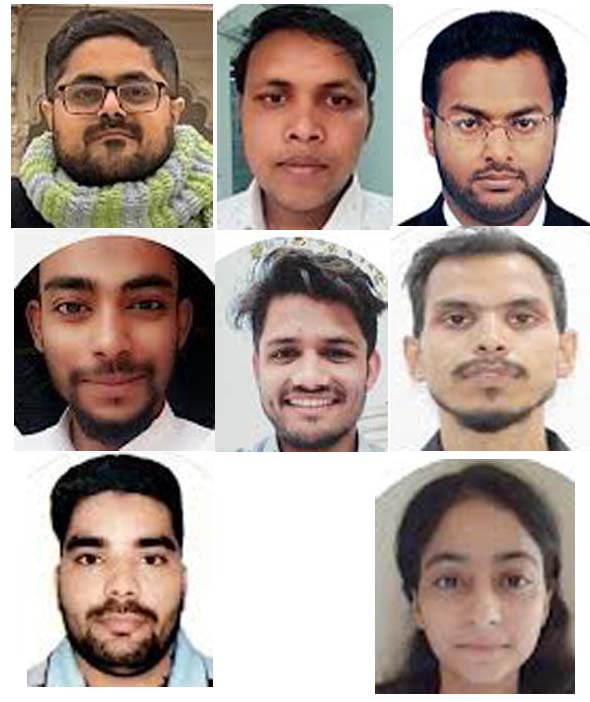
Muzaffarnagar and Adilabad, two districts in India, are celebrating the remarkable achievement of their Muslim scientists who contributed significantly to the success of the Chandrayaan 3 mission. The successful landing of Chandrayaan 3 on the Moon’s south pole has ignited a sense of festivity and pride in both regions.
Areeb Ahmed, an ISRO scientist hailing from Khatoli, Muzaffarnagar, emerged as a central figure in this achievement. As a key member of the Chandrayaan-3 team, Areeb Ahmad played an instrumental role from the mission’s launch to its successful landing. The celebrations in Muzaffarnagar included fireworks and heartfelt congratulations to the Areeb family.
The success story extends to Adilabad, where scientist Sheikh Muzammil Ali, originally from Kaghaz Nagar, shone as a valuable contributor to the Chandrayaan 3 mission. His involvement in the ISRO team that achieved the lunar landing brought immense pride to the Muslims of Telangana. Sheikh Makhdoom Ali, Sheikh Muzammil Ali’s father, expressed his joy and gratitude for his son’s accomplishment, viewing it as a divine blessing and a moment of national pride.
Sheikh Muzammil Ali’s educational journey showcased dedication and determination. After completing his education from various esteemed institutions, he cleared the ISRO exam in 2016, leading to his appointment as a “Scientist Group Gazetted Officer” in 2017. His father’s unwavering support, despite a modest salary, served as an example of the importance of higher education for Muslim parents aspiring to empower their children.
The accomplishments of Areeb Ahmed and Sheikh Muzammil Ali underscore the significance of providing quality education to young Muslims and encouraging them to pursue careers in cutting-edge fields. Their contributions not only contribute to India’s scientific progress but also inspire others to strive for excellence irrespective of adversity.
source: http://www.munsifdaily.com / The Munsif Daily / Home> News> Regional> Telangana / posted by Rasia Hashmi / August 24th, 2023
Ahmad’s book, Caste and Social Stratification Among Muslims in India, is celebrated as pioneering work in the field.
Imtiaz Ahmad (1940-2023). Photo: Twitter/@syedurahman
New Delhi:
Imtiaz Ahmad, renowned scholar who taught political sociology at the Jawaharlal Nehru University in India, has died. He was 83.
Ahmad’s book, Caste and Social Stratification Among Muslims in India, is celebrated as pioneering work in the field.
Ahmad got his BA and MA degrees from the Lucknow University in 1958 and 1960 respectively. He started as a senior research analyst at the Institute of Economic Growth at the Delhi University in 1964 and two years later, became a lecturer in sociology in the same university.
After three years as visiting professor of anthropology at the University of Missouri in the US, Ahmad joined JNU as associate professor in political sociology in 1972. He became a professor in the department in 1983 and taught there for three decades.
Among his numerous publications are those which throw light on Muslim empowerment, minority rights, the role of education among Muslims, how Islamic ideologies mesh with social realities, how Muslim women are studied in India and communalism.
Ahmad also wrote critically on the Gujarat riots of 2002 in particular and communal politics in general. His work has been lauded as having shed light on the composite culture of India.
source: http://www.thewire.in / The Wire / Home> Education> Society / by The Wire Staff / June 19th, 2023
The AMU student, Sami Saud, said that by capturing ECG readings remotely, the device wirelessly transmits the data to a cloud-based platform.
Aligarh:
In a novel development, Sami Saud, a final-year M.Tech. student at the Department of Computer Engineering, Aligarh Muslim University (AMU) has developed a portable single lead ECG device as a part of his dissertation.
Sami, who is working on his dissertation under the supervision of Prof. M. Sarosh Umar, worked on the device in collaboration with the industry expert, Arif Shouqi from Google.
He said that the device promises to transform the landscape of remote cardiac healthcare with accuracy records, boasting an awe-inspiring 99 per cent precision compared to traditional medical-grade ECG machines.
“The gadget demonstrates the immense potential of computer engineering in tackling real-world challenges and the functionality of this groundbreaking device is both ingenious and straightforward,” he said.
Sami said that by capturing ECG readings remotely, the device wirelessly transmits the data to a cloud-based platform. On this digital frontier, advanced machine learning algorithms work tirelessly to classify heart conditions and predict the likelihood of heart attacks based on the acquired data. Early detection and proactive management of cardiac issues are now within reach.
Sleek, Portable Design
The portable ECG device embodies usability and convenience, and with its sleek and portable design, it adapts seamlessly to any healthcare environment, making it a versatile asset for hospitals and home monitoring. Through the wireless Bluetooth connectivity, users can access their ECG results in real-time on their mobile or laptop devices. Sustainability and cost-effectiveness have been embedded into the very fabric of this groundbreaking invention.
The device’s rechargeable capability eliminates the need for wasteful disposable batteries, while its impressive 9-day battery life ensures extended usage without constant recharging.
This achievement underscores the transformative power of computer engineering in addressing critical challenges in the medical domain.
Sami’s father, Saud Saghir, is also an alumnus of Aligarh Muslim University.
source: http://www.ummid.com / Ummid.com / Home> Science & Technology / by IANS / June 13th, 2023
Irfan, who aspires to be a Sanskrit teacher, is the only Muslim among the top 20 scores in the classes 10 and 12.
Mohammed Irfan, the UP Sanskrit board exam topper.
Mohammad Irfan, the 17-year-old son of a farm daily wage labourer Salauddin in Uttar Pradesh’s Chandauli district, has scored 82.71% in the Uttar Pradesh Madhyamik Sanskrit Shiksha Parishad Board’s Uttar Madhyama-II (class 12) examinations.
The board requires Sanskrit language and literature as two compulsory subjects, along with other subjects.
Irfan, who aspires to be a Sanskrit teacher, is the only Muslim among the top 20 scores in classes 10 and 12.
The boy reportedly got admitted to the Sampurnanand Sanskrit Government School because that is the only school his father could afford to send him to. Salauddin earns a mere Rs 300 per day and the school charged Rs 400-500 as an annual fee.
Irfan comes from a devout Muslim family and his father said that they have never stopped the kid from achieving his dreams.
“In junior classes ‘Sanskrit’ was a compulsory subject and it was from there that he developed a liking for the language. He now plans to do Shastri (equivalent to BA) and Acharya (equivalent to MA) and will then look for a job as a Sanskrit teacher,” he said, speaking to The New Indian Express.
Irfan on language- religion connection
“I’m not sure why people associate a language with a religion. A Hindu can be extremely good at learning Urdu, while a Muslim can be very good at studying Sanskrit. I am a graduate who understands the value of education,” Irfan said, addressing media on the question of people connecting certain languages with some religions.
source: http://www.siasat.com / The Siasat Daily / Home> News> India / by News Desk / May 06th, 2023
Mahelaka Abrar, a second year, BA LLB student won the essay writing competition on ‘New Education Policy: Boon or Bane’ organised by the Faculty of Law, Aligarh Muslim University (AMU) to observe the National Education Day.
She was felicitated by Prof M Shakeel Ahmed Samdani, Dean, Faculty of Law.
source: http://www.indiaeducationdiary.in / India Education Diary / Home> Competition / December 01st, 2020
Jilani died during treatment at Lucknow’s Nishat Hospital in Qaiserbagh and is survived by daughter Maria Rehan, sons Najafzafar Jilani and Anaszafar Jilani, and wife Azra Jilani. The family resides in Qaiserbagh. Jilani was buried at the Qaiserbagh graveyard late Wednesday evening.
All India Muslim Personal Law Board (AIMPLB) secretary and senior advocate died at a Lucknow hospital on Wednesday after a prolonged illness followed by a fall in May 2021 during which he suffered brain haemorrhage. He was 73.
Jilani, a former Additional Advocate General for Uttar Pradesh, was the convenor of the Babri Masjid Action Committee and had argued in the Ram Janmabhoomi case in different courts over decades.
Jilani died during treatment at Lucknow’s Nishat Hospital in Qaiserbagh and is survived by daughter Maria Rehan, sons Najafzafar Jilani and Anaszafar Jilani, and wife Azra Jilani. The family resides in Qaiserbagh. Jilani was buried at the Qaiserbagh graveyard late Wednesday evening.
“He had multiple health issues for which he was being treated. He had a urinary tract infection which had spread to his lungs. His kidney and brain were also affected. All these issues started after he fell in May 2021 and suffered brain haemorrhage,” said a family member.
Jilani, a native of Malihabad town, was among the decorated alumnus of Aligarh Muslim University, from where he got his law degree.
He will be remembered for his soft-spoken nature and his in-depth knowledge of law, said his colleagues and peers.
Senior advocate SFA Naqvi said, “He was among the most soft-spoken and kind-hearted people I knew. There was a grace about him which is hard to put in words. But his arguments were never soft in court, and he had the law on his fingertips. We have lost a pioneer in law, and he will be missed.”
“During his time as the Additional Advocate General, even when I was arguing against him, he forgot all about it once we were outside the court. Then, we would go back to being friends. He always kept what happened in court to the courtroom only,” added Naqvi.
After the Supreme Court verdict in the Ram Janmabhoomi case in November 2019, Jilani had remarked, “The judgement has just been pronounced, it says a lot of things about the Constitution and about secularism. We are very dissatisfied with this judgement. Article 142 does not let you do this.”
After a special CBI court on September 30, 2020 acquitted all 32 surviving accused in the Babri Masjid demolition case, citing lack of evidence, Jilani had told The Indian Express , “The verdict is wrong. It is against the law and evidence (in the case). It is an erroneous judgement. However, a judgement is a judgement. We will avail the remedy available. The remedy is with the High Court. It has the power to reverse the judgement and we will go to the High Court.”
Advocate Rakesh Chaudhary, former president of the Oudh Bar Association, Allahabad High Court, said that Jilani had a great equation with everyone in the court. “He was a very helpful person, who never took anything personally. He had great sportsmanlike spirit,” said the lawyer.
Sarah Haque, a Delhi-based lawyer who worked alongside Jilani on the Babri Masjid case before the Supreme Court, said he was one of the kindest and most respected members of the Bar. “His demise is a huge loss to the legal fraternity. He was extremely passionate in his craft and made commendable efforts towards the pursuit of justice,” she said. “His attention and commitment to the Babri matter was laudable and he will be remembered forever.”
source: http://www.indianexpress.com / The Indian Express / Home> News> India / by Asad Rehman, Lucknow / May 18th, 2023
Mohd Aryaan Tariq jointly shares the first rank with four others in ISC. ( Photo courtesy HT )
In the results announced yesterday, a total of 98,505 students participated in the Council for Indian School Certificate Examinations 2023.
Of them, five students shared the top most rank with all scoring 99.75% marks.
Mohd Aryaan Tariq, Montessori Inter College, Rajajipuram, Lucknow is one of the top most scorers in the examination.
Riyya Aggarwal (Guwahati), Ipsita Bhattacharya (Thane), Shubham Kumar Aggarwal (Bhaktinagar) and Manya Gupta (Kolkata) are the other ones.
Tariq informed media that he regularly spent four hours daily for his studies. He remained cut off from social media to focus on his academic preparation.
He scored perfect 100 in chemistry, physical education and biology and hauled 99 out of 100 each in English and biotechnology.
Congratulations to all the successful students and good luck to those who couldn’t do better this time.
source: http://www.muslimmirror.com / Muslim Mirror / Home> Indian Muslim> Positive Story / by Muslim Mirror / May 15th, 2023
In a big breakthrough in the field of cancer prevention, Dr Hifzur Rahman Siddique, Department of Zoology, Aligarh Muslim University, in coordination with Dr. Keigo Machida, University of South California, USA, has discovered a common mechanism that activates disruption of a single RNA binding protein, MSI-2 binding to mRNAs of the cancer-causing proteins and significantly reduces the synthesis and accumulation of these proteins, reducing HCV infection and proliferation. The single RNA binding protein (named MSI-2) helps to accumulate multiple cancer-causing proteins in patients and helps to proliferate Hepatitis C Virus to promote liver cancer.
Dr. Siddique and the team who have identified this protein by analyzing the liver tissues of 374 liver cancer patients, said, “As we know, alcohol and cholesterol-rich high-fat diet and hepatitis infection promotes cancer initiation, but the exact molecular mechanism is unknown. In this research work, we have discovered that MSI-2 protein helps to accumulate multiple cancer-causing proteins and supports HCV proliferation to aggravate the disease.”
Dr Siddique said that Liver hyperplasia is also reduced in the animal model predisposed to viral infection fed with alcohol mixed cholesterol-rich high-fat diet. This is a very exciting discovery and could serve as a potential therapeutic target for the drug design and give direction to the management strategy for this deadly disease.
“The study has been recently published in Cell Death Discovery (April 2023, available at www.nature.com/cddiscovery),” he added.
Dr Siddique and his team had earlier discovered the molecular pathway that promotes the abnormal division of Cancer Stem Cells that are responsible for cancer therapy failure and Cancer reappearance/recurrence. Their study was then published in the prestigious journal Nature Communications 11 (2020) and found a place in different national and international dailies.
He said that the liver is considered the powerhouse of the body and due to the change in lifestyle, chronic alcohol consumption, high-fat diet, and hepatitis virus infection, the incidence of liver cancer is increasing fast. More than 350 million people are currently infected with hepatitis viruses, out of which 70 million are infected with Hepatitis C. It is estimated that approximately 40 million people are chronically infected with Hepatitis B and 6-12 million people with Hepatitis C. The situation worsens when Hepatitis infection occurs in an alcoholic person.
He said that the discovery is significant in the treatment of liver cancer as blocking the identified protein has an immense effect on liver cancer in the animal model and also stops the accumulation of the number of human cancer-causing proteins, the proliferation of hepatitis viruses and improving recovery.
Dr Siddique has been working on Cancer Stem Cells for a decade and has established a dedicated lab to initiate pioneer research on Cancer Stem Cells at AMU with a team of 10 researchers and collaborators from the USA, Russia, China, the UK, India, etc.
Recently, he got a Patent for his herbal formulation to prevent liver cancer and expecting some extramural grant from the Government of India for further clinical research.
source: http://www.amu.ac.in / Aligarh Muslim University – AMU / Home> AMU News / by Public Relations Office / May 01st, 2023
Guru Dutt’s masterpiece ‘Pyaasa’ (1957), just before its soulful dirge on relationships, shows two poets reciting ‘shers’.
The elder one later also politely reprimands a guest for his snide remark at the “servant” (Dutt), who had begun humming “Jaane woh kaise log the..”, declaring: “Mian, shayri koi daulat-mando ke jagir thodi hai”. Though unnamed, his appearance, sher, and comment were enough to identify him.
Urdu Poetry and Social Reach
The unnamed actor was representing Ali Sikandar ‘Jigar Moradabadi’, who, in his heyday, was so known by his persona – an intense gaze but an air of absent-mindedness too, groomed beard but slightly unkempt long hair, traditional garb and courtly behaviour, as well as poetry, that he could be shown without being named.
‘Jigar’ is seen as the last standard-bearer of the classical ghazal, or the ghazal’s classical tradition, but was rather a ‘bridge’, between its highpoint in the mid-19th century and its transition to the 20th century and beyond.
He was also a connecting link between Urdu poetry and its widening social reach as the dialogue the character utters shows – and is followed by him encouraging Dutt to continue:
“Tum kuch keh rahe the, barkhurdar. Chup kyun ho gaye. Kaho, kaho..”
Jigar Moradabadi – Real Life
This was true in real life too – a young Jigar took instruction from Nawab Mirza Khan ‘Dagh Dehlvi’ – who had participated in mushairas with Ghalib and Zauq – and himself later, mentored poets like Asrar-ul-Hasan Khan ‘Majrooh Sultanpuri’, Jan Nisar Akhtar, and others.
And then like many contemporaries, he did not write for films, yet his work willy-nilly figured in them. While “Kaam aakhir jazba-e-beikhtiyar aa hi gaya/Dil kuch is surat se tadpa unko pyaar aa hi gaya” was used in ‘Pyaasa’, in ‘Daag’ (1952), the Hasrat Jaipuri-written “Ham dard ke maaron ka, itna hi fasana hai/Peene ko sharaab-e-gam, dil gam ka nishana hai” seemed inspired by his “Ham ishq ke maaron ka itna hi fasana hai/Rone ko nahi koi hasne ko zamana hai”.
Then, ‘Be-Raham’ (1980) used this sher – along with most of its ghazal which begins: “Ik lafz-e-mohabbat ka adna yeh fasana hai/Simte to dil-e-aashiq phaile to zamaana hai”. Another master sher in this is “Yeh ishq nahi aasan itna hi samajh lijiye/Ek aag ka darya hai aur dub ke jaana hai.”
Before that, Shyam Benegal’s ‘Junoon’ (1979), the 1857 drama starring Shashi Kapoor, used his ghazal, “Ishq ne todi sar par qayamat.”
How Jigar’s Prime Couplets became popular in films?
But, the prime example was how the prime couplet of ‘Jigar’ became most known to film buffs after actor Raj Kumar made it a dialogue, delivered in his bombastic, drawling style: “Ham ko mita sake yeh zamaane mein dam nahi/Ham se zamana khud hai zamaane se ham nahi.”
Born in April 1890 in Moradabad, ‘Jigar’ was the son of Syed Ali Nazar, who worked in the Law Department and was inclined to poetry too, being a disciple of Khwaja ‘Wazir Lakhnavi’.
After elementary education, including in English, he worked as a salesman for a local spectacles dealer. Later, he turned to poetry full-time, settling in the town of Gonda, where he found in noted poet Asghar Hussain ‘Asghar Gondvi’ a mentor of sorts. He was a familiar face in mushairas all over the country till the mid-1950s, when he began slightly distancing himself from shayri, ahead of his death in September 1960.
‘Jigar’, as mentioned, was a paladin of the classical tradition, and as such, his shayri usually dwelt on love and other facets of the human condition. As he said:
“Un ka jo farz hai vo ahl-e-siyasat jaane/Mera paigham hai mohabbat jahan tak pahunche.”
Yet, while he used the usual tropes associated with the topic, he imparted his own stamp on them with his own stylistic variations.
One of these was paradox. Take:
“Atish-e-ishq woh jahannum hai/Jis mein firdaus ke nazaare hai”, or “Kamaal-e-tishnagi hi se bujha lete hai pyaas apni/Isi tapte huye sahra ko ham darya samajhte hai”, or even “Mohabbat mein yeh kya maqam aa rahe hai/Ki manzil pe hai aur chale jaa rahe hai” and “Usi ko kehte hai jannat usi ko dozakh bhi/Woh zindagi jo haseenon ke darmiya guzre”.
“Abad agar dil na ho to barbad kijiye/Gulshan na ban sake to bayaban banaiye” is another example.
Then, ‘Jigar’ frequently resorted to some deft wordplay and situations: “Tere jamaal ki tasveer khinch doon lekin/Zabaan mein aankh nahi aankh mein zabaan nahi”, “Suna hai hashr mein aankh use be-parda dekhegi/Mujhe dar hai na tauheen-e-jamal-e-yaar ho jaaye”, and “Aghaaz-e-mohabbat ka anjaam bas itna hai/Jab dil mein tamanna thi ab dil hi tamanna hai.”
Vivid imagery was another strength: “Baithe huye raqeeb hai dilbar ke aas-paas/Kaaton ka hai hujum gul-e-tar ke aas-paas” and “Har taraf chaa gaye paigham-e-mohabbat ban kar/Mujh se achhi rahi qismat mere afsanon ki.”
And ‘Jigar’ could use rhetorical devices, like repetition to good effect, as in: “Dil hai kadmon par kisi ke sar jhuka ho ya na ho/Bandagi to apni fitrat hai Khuda ho ya na ho”, “Kabhi un mad-bhari aankho se piya tha ik jaam/Aaj tak hosh nahi, hosh nahi, hosh nai” and sometimes, alliteration: “Hai re majbooriyan mahroomiyan nakaamiyan/Ishq aakhi ishq hai tum kya karo ham kya karen.”
At other times, he could be engagingly simple: “Garche ahl-e-sharab hain ham log/Yeh na samjho kharab hain ham log”, or “Pehle sharab zeesht thi ab zeesht hai sharab/Koi pila raha hai piye ja raha hoon main.”
And a philosophical outlook can always be discerned. It may be active like: “Kya husn ne samjha hai kya ishq ne jaana hai/Ham khaak-nashinon ki thokar mein zamana hai” and “Apna zamana aap banate hai ahl-e-dil/Ham vo nahi jin ko zamana bana gaya”, or a bit resigned: “Jo un pe guzarti hai kis ne use jaana hai/Apni hi musibat hai apna hi fasaana hai”, “Maut kya ek lafz-e-bemaani/Jisko mara hayat ne maara”, and “Yeh misraa kaash naqsh-e-har-dar-o-deewar ho jaaye/Jise jina ho marne ke liye taiyar ho jaaye.”
There is much more to enjoy in the extensive corpus of ‘Jigar’, whose own epitaph could be: “Hami hab na honge to kya rang-e-mahfil/Kise dekh kar aap sharmaiyega.”
source: http://www.ummid.com / Ummid.com / Home> International / by Vikas Datta / IANS / April 16th, 2023
The first Muslim judge of a high court in colonial times, Syed Mahmood’s professional conduct offers a counterpoint to the declining standards in Indian judiciary.
WHEN Justice Abdul Nazeer addressed the 16th national council meeting of the RSS-affiliated Akhil Bharatiya Adhivakta Parishad at Hyderabad last December, he said, “Great lawyers and judges are not born but made by proper education and great legal traditions, as were Manu, Kautilya, Katyayana, Brihaspati, Narada, Parashar, Yajnavalkya, and other legal giants of ancient India.” In the symposium on “Decolonisation of the Indian Legal System”, Justice Nazeer also said the “continued neglect of their great knowledge and adherence to the alien colonial legal system is detrimental to the goals of our Constitution and against our national interests…”.
Perhaps Justice Nazeer should have also recalled 19th-century jurist Justice Syed Mahmood (1850-1903). A pioneer in bold assertions against the colonial judiciary, he produced incisive legal commentaries that reflect an audacious dissenter’s point of view. Writing in an Urdu newspaper, his father, Sir Syed Ahmed Khan, narrates Mahmood’s resignation from the Allahabad High Court in 1893 to “protect the self-respect of Indians against the racism of British judges”.
In that era, conceptions of nationhood were still evolving in India. Indian judges would not muster the courage to contest the racism of the imperial power or fellow European judges. But Mahmood did, in intrepid ways. Khan founded the Mohammedan Anglo-Oriental (MAO) College at Aligarh in 1877 and figures prominently but contentiously, stereotyped as a British loyalist and separatist in debates on contemporary nationalism. Mahmood supported his father’s modern education project, but unfortunately, his contributions are largely ignored by historians and the legal fraternity.
By 1920, MAO College, now Aligarh Muslim University, was the most prominent residential university in the country. Its history department has been a premier centre for advanced studies for a half-century. In 1889, primarily on Syed Mahmood’s initiative and his gifts in terms of books, journals and cash, AMU established a law department. Yet, he was neglected in its research. Only in 1973, seven years after the centenary of the Allahabad High Court, the Aligarh Law Journal brought out Mahmood’s contributions, and legal scholars reflected on his high calibre as a lawyer and judge.
The good news is, in 2004, Alan M. Guenther did his doctoral thesis on Mahmood at McGill University, Canada, which is available online for the public to access. His meticulous and well-researched account touches almost every aspect of Mahmood’s public life. Guenther also published an extended essay in 2011on Mahmood’s views on English education in 19th-century India. (In 1895, Mahmood had written a book on the theme for his speeches at the Educational Conference.)
In 1965, Asaf Ali Asghar Fyzee (1899-1981) complained, “Syed Mahmood’s contributions to the transformation of Muslim law in India have been largely neglected by historians and survive primarily as footnotes in legal texts on Muslim law.” Guenther, too, observes, “…overshadowed by the life and writings of his illustrious father, Ahmad Khan, his legacy has not received the attention it deserves. A large part of his father’s achievements in the reform of education, in fact, would not have been possible without the assistance of Syed Mahmood. But when he reached the age at which his father had made his most significant achievements, [Mahmood] had his life cut short.”
Mahmood had laid out his life plans clearly. S. Khalid Rashid, writing in 1973, reports that Mahmood decided early on that, like his ancestors, he would devote the first third of his life to educating himself, the second to earn a living, and the last to “retired study, authorship and devotion to matters of public utility”. But Guenther writes about how Mahmood’s health had deteriorated through alcohol abuse and disease. He died before he turned 53, broken by forced retirement, estranged from his father (who had died five years previously), stripped of responsibilities at the college he had helped found, separated from wife and son, and in poverty. He was selling personal items to repay debts. “His father’s numerous writings and letters are still republished, but Syed Mahmood’s contributions to Muslim thought are hidden in bound volumes of the Indian Law Reports and brittle files of government correspondence,” Guenther writes.
One aspect of Mahmood’s last years is captured by Prof. Iftikhar Alam Khan’s Urdu books, Sir Syed: Daroon-e-Khana (2006, 2020) and the recent Rufaqa-e-Sir Syed: Rafaqat, Raqabat wa Iqtidar Ki Kashmakash. These accounts expose the smear campaigns of the three companion successors of Sir Syed—Samiullah, Mohsin-ul-Mulk and Viqar-ul-Mulk—against Syed Mahmood as they vied for the secretary’s post at MAO College. Often European members of MAO College conspired with them. Exploiting his weaknesses and eccentricities, they ousted him to get a hold over college affairs, compounding his hurt during his tragic final years.
SYED MAHMOOD’S ROLE IN SIR SYED’S EDUCATIONAL ENTERPRISE
Having returned to India in 1872 after studying in England, Mahmood took time out of his budding legal career to assist his father’s reform work, particularly setting up MAO College. He prepared a detailed plan along the lines of his experiences in Cambridge. His specific aim, explained in February 1872, was to produce future leaders of India through an educational institution whose residential nature would be “as indispensable an education as the course of study itself”. The aim was to create a society of students and teachers quite different from the rest of society.
He travelled with his father to Punjab in 1873 and spoke at a rally to promote the project. In 1889, Sir Syed introduced a motion to nominate Mahmood as joint secretary of the board of trustees of MAO College by highlighting his assistance despite the opposition he faced. In particular, he considered his son’s influence the primary factor that persuaded European professors to come to India and teach there.
European staff members confirmed this around six years later when there was renewed opposition to Mahmood continuing as joint secretary. The principal, Theodore Beck (1859-1899), testified, “Syed Ahmad….acknowledged his reliance on Syed Mahmood for advice in all matters, and his imprint could be noted in the correspondence relating to the school. He declared his firm conviction that Syed Mahmood was the one person who shared his vision for the college, and apart from him, no one would be able to administer the school in keeping with that vision.” However, Samiullah (1834-1908) disagreed with Sir Syed on this count. As a result, a tussle for power began in the college management. The power-play could explain why AMU felt inhibited in bringing out a biography of Mahmood, a research gap that Guenther’s doctoral thesis fills. He has extensively relied on important correspondences of Mahmood preserved in the London India Office (British) Library.
SYED MAHMOOD’S TRYST WITH MUSLIM LAW
Mahmood is a forgotten pioneer of the transformation of Muslim law in modern South Asia. In 1882, at just 32, he became the first Muslim judge of the high courts in British India. He delivered numerous landmark decisions that shaped Muslim law, the law in general, and its administration.
Earlier, he blazed a trail his younger contemporaries followed in their judicial roles in British India. He was one of the first Indian Muslims to study in England and train in the English system of jurisprudence, the first Indian to enrol as a barrister in the High Court of Judicature at Allahabad in 1872, the first appointed as a district judge in the restructured judicial system of Awadh in 1879 and the first Indian assigned as a puisne judge to the High Court at Allahabad. He was the first Muslim in any High Court of India. He cleared a path for Indian Muslims to participate in administering justice in India. But his contribution is not limited to creamy career opportunities for Muslim youngsters. His lasting legacy is how Muslim law is perceived and administered in South Asia today.
CHAMPION OF ACCESSIBLE JUSTICE
An abiding concern of Mahmood was the cost of administration of justice. Court procedures were lengthy and expensive, and the “mass of law” was complicated. Distance from courts was another concern, for which he proposed a network of village courts for “on-the-spot” adjudication. He sought to make justice accessible through unpaid tribunals and honorary munsifs. He prepared a comprehensive draft for this, Guenther informs.
Furthermore, he attacked the [racial] mindset and court fees and stamp duties on legal documents. He ruled in August 1884 and February 1885 that “…if justice costs the same amount [to the] rich and poor, it follows that the rich man will be able to purchase it, whilst the poor man will not.” He declared, more than once, that British judges in India were too quick to find fraud.
In a speech at the Allahabad Bar in April 1885, Mahmood raised the language issue in judicial transactions, saying laws should be in languages intelligible to the masses. He insisted on the vernacular in arguments, pleadings and justice delivery and translated verdicts so that people unfamiliar with English could rest assured that judgments are reasoned. Of course, the issue of judicial language continues to be debated, and for this, acknowledgement is due to Mahmood.
AN INDIAN DISSENTER IN THE HIGH NOON OF BRITISH COLONIALISM
Mahmood is known most for outstanding dissenting judgements. In volume 2 of his 2021 book, Discordant Notes, Justice (retd.) Rohinton F. Nariman writes that Mahmood was known for detailed judgments, some of which stand out for thoroughness and fearless language. Mahmood would refer to the original Sanskrit versions when ruling on Hindu laws and the Arabic texts for Muslim laws, rather than using interpretations of the relevant texts.
From the 1860s to 1880s, during the codification of laws, he sought limits on importing British laws and protested that the local context was getting overlooked. His concern was not just the laws but their efficacy and adaptability within India’s cultural diversity.
Guenther observes, “…throughout his life, he identified himself as a Muslim as well as an Indian and a subject of the British crown, and that he was actively involved in the education and improvement of the Indian Muslim community. At the same time, Mahmood… [made] efforts to promote harmony between people of diverse backgrounds, and…[supported] initiatives that improved the situation of all Indians, regardless of religious affiliation…”
An anecdote from Altaf Hali’s Hayat-e-Javed (1901), cited by Shamsur Rahman Faruqi (2006), is worth sharing. “Contrary to the culture of sycophancy and genuflecting before the English colonial authority….Syed Ahmad Khan and his high-profile and brilliant son Syed Mahmud strived to conduct themselves as if they were equal to the English….Syed Ahmad Khan had stayed away from the [1867 Agra] Durbar because Indians had been given seats inferior to the English. A medal was to be conferred on Syed Ahmad Khan at that Durbar. Williams, the then Commissioner of Meerut, was later deputed to present the award to Syed Ahmad Khan at Aligarh railway station. Willams broke protocol and showed his anger at having to do the task under duress and said that government orders bound him, or he wouldn’t be presenting the medal to Syed Ahmad Khan. Syed Ahmad Khan accepted the medal, saying he wouldn’t have taken the award, except that he too was bound by government orders.”
Indian democracy is an outcome of anti-colonial nationalism, and dissent is its core component: Mahmood’s dissent contributed to nationalism in his time. In 2022, the V-Dem Institute described India as an electoral autocracy where dissent is being criminalised, and the judiciary is failing to contain the majoritarian upsurge. Mahmood’s professional conduct is an encouraging counterpoint to the degeneration in the Indian judiciary.
WHAT DID MAHMOOD THINK OF THE INDIAN NATIONAL CONGRESS?
According to Guenther, though Mahmood never joined the Congress, he was “equally aloof” from the anti-Congress propaganda his father indulged in. “…a rare catholicity characterised his views on most of the controversial questions,” he writes. He adds, “His acceptance among the Hindus [elites] generally was demonstrated by the fact that they tried to send him as their representative to the Imperial Legislative Council, though he never received that appointment.”
Nonetheless, like his father, Mahmood harboured class and regional prejudices. Guenther reveals an article Mahmood wrote in The Pioneer on 4 September 1875, suggesting the government must strive to with the sympathies of the “higher classes of natives”. When challenged to defend his position by “Another Native” in the same newspaper two weeks later, Mahmood responded that people in Punjab and the North-western Provinces [now Uttar Pradesh] were, historically speaking, of “much greater political significance” than those of Lower Bengal. Gunther cites his write-up: “…any educational system that succeeded in ‘attracting the Bengalee and fail(ed) to exercise any influence upon the higher classes of the Rajpoot, the Sikh, and the Mussulman’ must be regarded as a failure.”
Considering the socio-regional composition of top functionaries of AMU, even impartial insiders would testify that it still harbours regional and sub-regional prejudices. The Sir Syed Academy is releasing many publications during the ongoing centenary celebration of AMU. Publishing Guenther’s dissertation may be a fitting tribute to Mahmood, who must be regarded as a prominent co-founder of MAO College.
Mohammad Sajjad teaches modern and contemporary Indian History at Aligarh Muslim University. Md. Zeeshan Ahmad is a lawyer based in Delhi. The views are personal.
First published by Newsclick.
source: http://www.theleaflet.in / The Leaflet / Home> History / by Mohammad Sajjad and Zeeshan Ahmad / April 01st, 2022