Bengaluru, KARNATAKA :
The Foundation has set a target of spending ₹4,000 crore over the next five years to build and operate a 1,000-bed charitable super-speciality and multi-organ transplant hospital in Bengaluru.
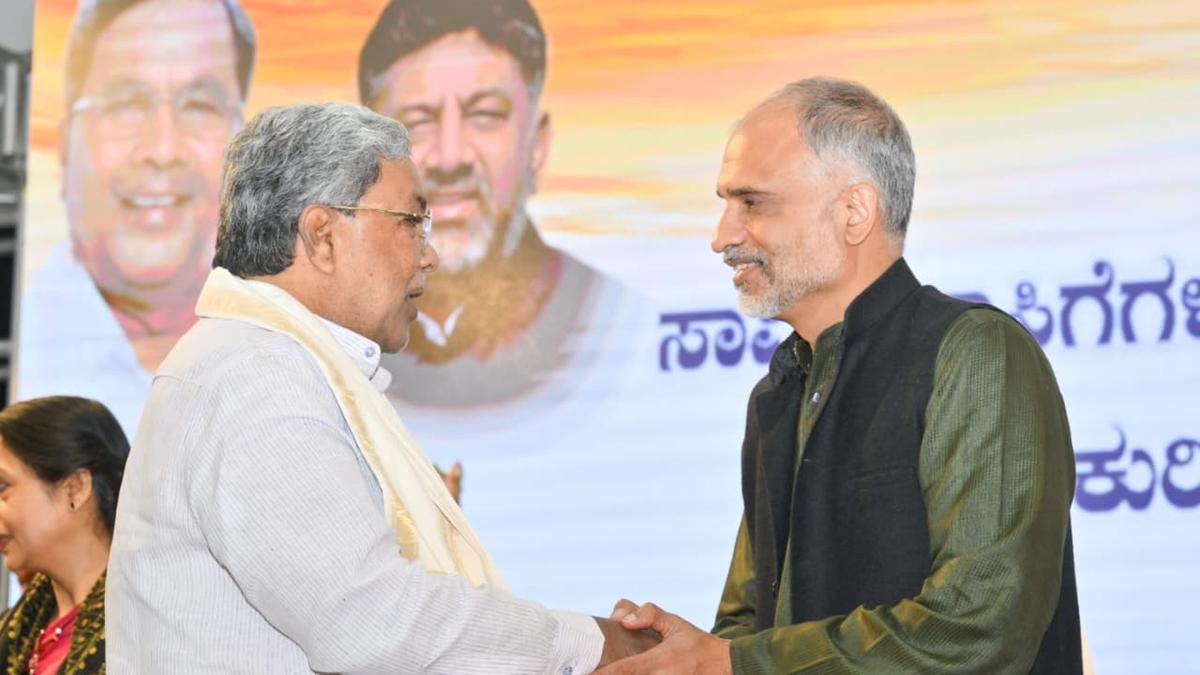
Chief Minister Siddaramaiah with Anurag Beharm, CEO, Azim Premji Foundation, at a ceremony in Bengaluru on Saturday. | Photo Credit: SPECIAL ARRANGEMENT
Chief Minister Siddaramaiah said the Azim Premji Foundation has set a target of spending ₹4,000 crore over the next five years to build and operate a new 1,000-bed charitable super-speciality and multi-organ transplant hospital in Bengaluru.
The hospital will come up on 10 acres within the Rajiv Gandhi Institute of Chest Diseases campus in Bengaluru, which the government has agreed to lease to the Foundation for 99 years, he announced on Saturday after the Medical Education Department and the Foundation signed a Memorandum of Understanding (MoU) for the construction and management of the facility.
Mr. Siddaramaiah said the State was grateful to the Foundation and to Azim Premji ‘for undertaking this noble initiative’, and for deciding to run the facility free of cost. The Foundation will invest ₹1,000 crore on building the hospital and more over the years to run the facility, he said.
Over the last 25 years, the Foundation has supported teacher training, contributed ₹1,500 crore to the government’s egg distribution scheme in schools in 2024, and extended annual scholarships of ₹30,000 each to students from government colleges under the Deepika scheme, the Chief Minister added.
Public systems key
Anurag Behar, CEO, Azim Premji Foundation, emphasised the importance of strengthening public systems, saying private initiatives cannot compensate for weak public infrastructure.
“The foundation believes that public systems are central to a good society. Our commitment is to work with the government to strengthen them,” he said, pointing out that healthcare begins with ASHA workers, primary health centres, and preventive work in communities. “Hospitals are critical, but the first goal must be to prevent people from falling ill,” he said.
Mr. Behar praised Karnataka as ‘one of the three most proactive States’ the Foundation works with. He noted that the Foundation’s 25-year engagement in Karnataka has shown progress most visibly in grassroots work in, among other places, Surpur and Sindagi.
Transplant hub
Medical Education Minister Sharan Prakash R. Patil said the proposed hospital will provide transplant services across multiple organs, with 70% of procedures free of cost and the remaining 30% at minimal rates on the lines of the autonomous Sri Jayadeva Institute of Cardiovascular Sciences and Research and the Kidwai Memorial Institute of Oncology.
He said more than 5,000 patients in Karnataka are currently awaiting kidney transplant, and over 1,000 require liver transplant.
Dr. Patil added that the project aligns with the government’s larger roadmap to strengthen tertiary healthcare. “We have set a target of establishing one medical college, one super-speciality hospital, one trauma centre, and one cancer hospital in every district,” he said.
At present, Karnataka has 22 government medical colleges, 10 super-speciality hospitals, eight trauma centres, and eight cancer centres, and is ‘halfway through’ with the plan. He said the State intends to transition towards a universal health coverage model, as in the UK, in the coming decade.
This article has been updated to rectify a factual error
source: http://www.thehindu.com / The Hindu / Home> News> India>Karnataka / by The Hindu Bureau / January 18th, 2026