Category Archives: Uniquely Indian Muslim HISTORICAL RECORDS – Sufi Shrines, Dargahs, Tombs, Mughal Mausoleums (wef. December 07th, 2024)

Why We Need a Book About Muslims Who Fought for India’s Freedom

Mumbai, INDIA :

Can a stable and just democracy flourish on foundations of wilful amnesia and erasure?
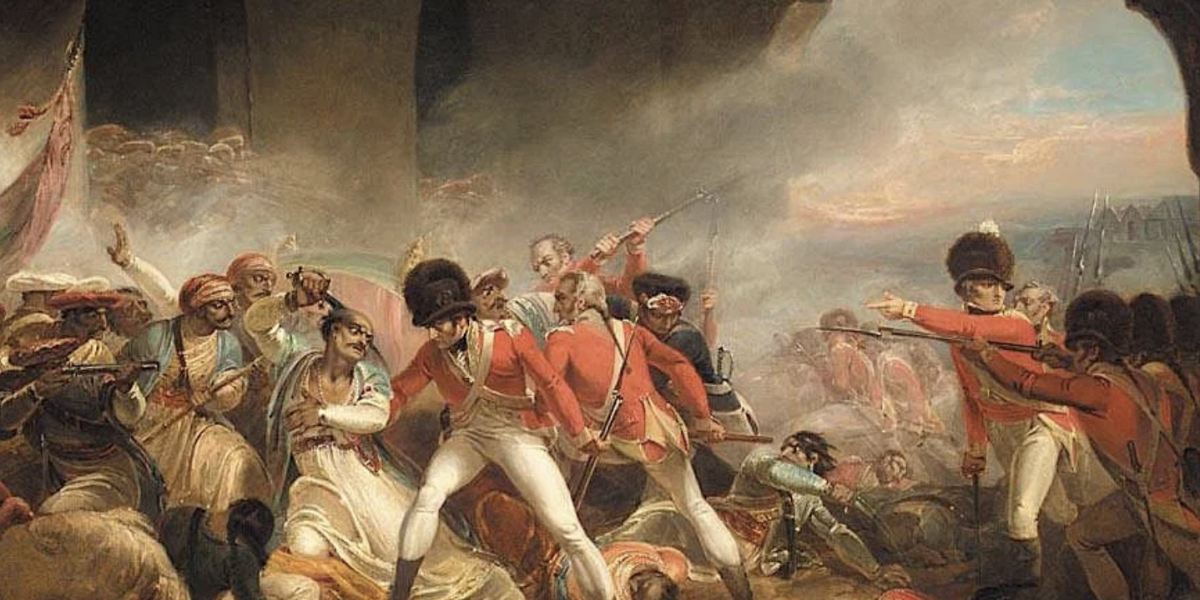
A c. 1800 painting showing the last stand of Tipu Sultan, ruler of Mysore in 1799 at the end of the Anglo-Mysore Wars with the East India Company. Photo: Henry Singleton/Public domain.

Many will ask why a book about Muslims who fought for India’s freedom? There’s no answer to such questions except another question. Had we been better memory keepers as a nation, could we have avoided the peak disinformation and stupidity which normalises reviling ordinary Muslims as outsiders, infiltrator and insurgents? 

Muslim Freedom Fighters of India is a two-volume biographical compilation by Salim Khan on less-known, mostly forgotten and hardly known Muslim figures. The books aim to clear the fog around Muslim freedom fighters whose names are heard of without them being extensively known and this requires us to understand why this fog exists. Written in an extremely readable and accessible format, these biographical accounts embed the historical figures in the context of their times, responding to unprecedented events with foresight, clarity and conviction that sealed their fate and shaped and the nation’s destiny.

 Whether we are reading about Generals of 1857 – Bakht Khan and Khan Bahadur Khan – or the Cambridge-educated Rampur scion Mohammad Ali Juahar of Khilafat moment and his fiery mother Bi Amma, the larger questions seething beneath the stories keep rising to surface. Who does a society and nation choose to remember and celebrate? Whose memories are deemed worthy of preserving? History is always shaped by those who control archives, narratives and memorialisation and hence memory. 

Reading about Tipu’s dazzling reign through the three Anglo Mysore wars where he proved superior to British forces, I was reminded of the controversy sparked by the late Girish Karnad’s suggestion of naming the Bengaluru airport after Tipu Sultan. Karnad had said, “It is true that Tipu Sultan was not born in Bengaluru, but he was a son of this soil and a freedom fighter. Had Tipu been a Hindu, he would have achieved the status of Shivaji, and the airport would have been named after him.” I recalled Karnad because his play Dreams of Tipu Sultan echoes the same theme that this two-volume tribute to erased, obscured and deliberately unremembered historical figures echoes: that when politics lays down who should be forgotten, remembering the erased becomes a duty, an affirmation and a political act. 

It is important to clarify that this is not a compilation of eulogies but well-researched fact based account of people who had the uncommon clarity to resist colonial domination even before the nationalistic narratives took shape. That they happened to be Muslims is important today because of the distortions that have obscured and erased them. But back then when they fought and resisted, they were simply rallying for the cause of their soil and their watan. From the earliest times they understood that freedom from foreign domination required Hindus and Muslims to put up a united front as in the war of 1857, the Khilafat movement, and the period between 1919 and 1924. Back then too, traitors cut across religious lines – Jagat Seth, Mir Jafar, and Ilahi Baksh.
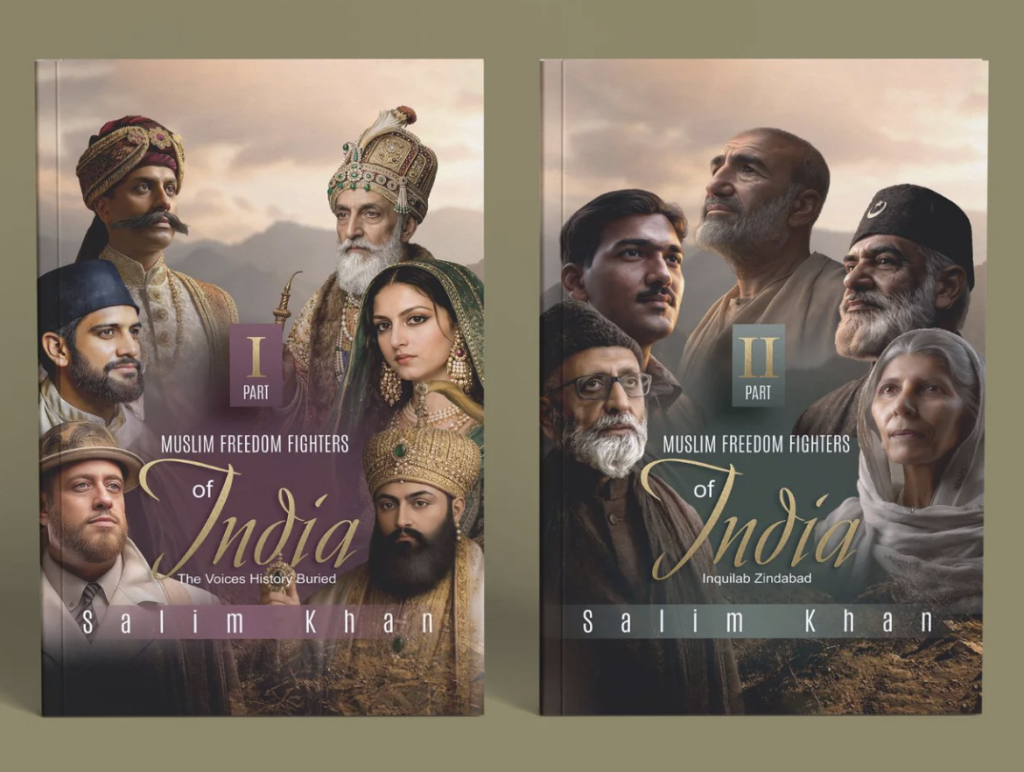
Muslim Freedom Fighters of India: Part 1 and Part 2’, Salim Khan, Qalam Aur Kaagaz Books.

From Siraj ud Daulah to Tipu to Shahzada Firoz Shah, the book shows how the fog around these personalities is not accidental but meticulously designed – initially by the colonial mind, then picked up by early nationalists and woven into simplistic narratives. The macabre dance of history further stifled Muslim voices. Cataclysmic events like the ‘end’ of the Mughal Dynasty in 1857 and the Partition in 1947 sundered clans, erased family histories, legacies crumbled with no one is around to defend and uphold them. Today, even people who don’t know history have heard of Lakshmi Bai, but many who read history may not have heard about Shahzada Firoz Shah, the Mughal Emperor’s grandson who in August 1857, led a band of armed soldiers to rally the rebels in Rohilkhand and Malwa and who fought alongside Tatia Tope and called for a united Hindu-Muslim front against the Company. 

The British understood the dangerous potential of popular memory and subverted any potential for memorialisation of hugely influential figures. No one knows if Shahzada Firoz died in battle or escaped to West Asia. The Maulavi Ahmadulla of Faizabad whose authority and fearlessness scared the British so much that they kept a reward on his head, was likewise interred in an unmarked grave. Knowing that even his memory could become a node to unite the rebels, the British saw to it that no commemoration was permitted or possible. Zafar, the last Mughal was exiled to Rangoon for the same reasons.

In her book, India, 5,000 years of history on the subcontinent, Audrey Truschke, elucidates how Muslim rulers like Nawab Siraj ud Daulah and Tipu Sultan to Zafar felt a responsibility for their subjects no matter what their religion. For example, Siraj ud Daulah actively intervened in times of famines and drought in Bengal. But after the British took over they did nothing to alleviate human suffering, so that 20% of Bengal’s population died in the famine of 1768 and the small-pox epidemic of 1769-70 following it. This had never happened during earlier episodes of failed harvests. Truschke says, British historians initiated the custom of categorising Indian rulers as tyrannical, effete and incompetent, reducing them to their religion and writing in terms of Hindu rulers and Muslim rulers. The British needed to demonise Muslim rulers who were their immediate predecessors in subcontinent so that they might look good by comparison, Truschke notes. It was a part of the colonial propaganda.

Another pattern Salim Khan’s compilation brings out is that from mid-18th century onwards, the first responders and the most committed crusaders resisting colonial domination – the kings, queens, princes, preachers, noblemen – were Muslims. Not only because the British had wrested from them the power they had wielded for centuries (howsoever fragmented or diluted it may have become); but also, because they were looked upon as leaders. In Awadh, for example, the Shia elite took it as their moral-ethical duty (see Chapter 7, volume I: Shia Ullema and Noblemen of Awadh

Even in the 20th century, Muslim freedom fighters like Hasrat Mohani of the Inquilaab Zindabad fame and Asfaqullah Khan of the Kakori conspiracy who was an icon for Bhagat Singh, remain in the shadows, seen only in a hazy half-light. Were their contributions any less or only less remembered? One of the most important projects post-Independence should have been to restore memory and affirmation to those whom the British put on the wrong side of history, no matter what their religion or caste. But we know this is not what happened.

Since the arrival of the political controversy over Tipu Sultan, we have entered in an era of deliberate distortion of history. The larger question that these accounts refrain from asking but that jumps to any thinking person’s mind is this: can a stable and just democracy flourish on foundations of wilful amnesia and erasure? Should the memory of Muslim freedom fighters be kept only by the Muslims? The heritage and memory of Indian Muslims needs to be reclaimed by them. But equally, these volumes are required reading for the casually miseducated, hopelessly disinformed or simply ignorant Hindus who have been stupefied into denying and distorting their composite history.

Varsha Tiwary is a Delhi-based writer and translator. She has recently published 1990, Aramganj a translation of the best-selling Hindi novel Rambhakt Rangbaz.
Tipu Sultan Martyr’s Day observed

Srirangapatna (Mysuru District), KARNATAKA :

MLA pays homage at Tipu Tomb, releases Urus Shariff invitation

Mysore/Mysuru:

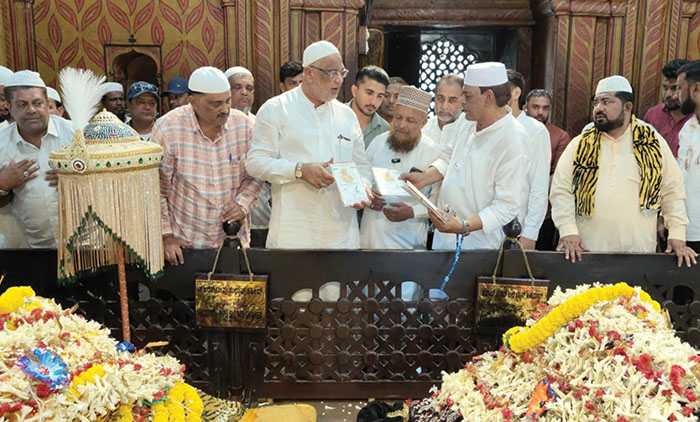
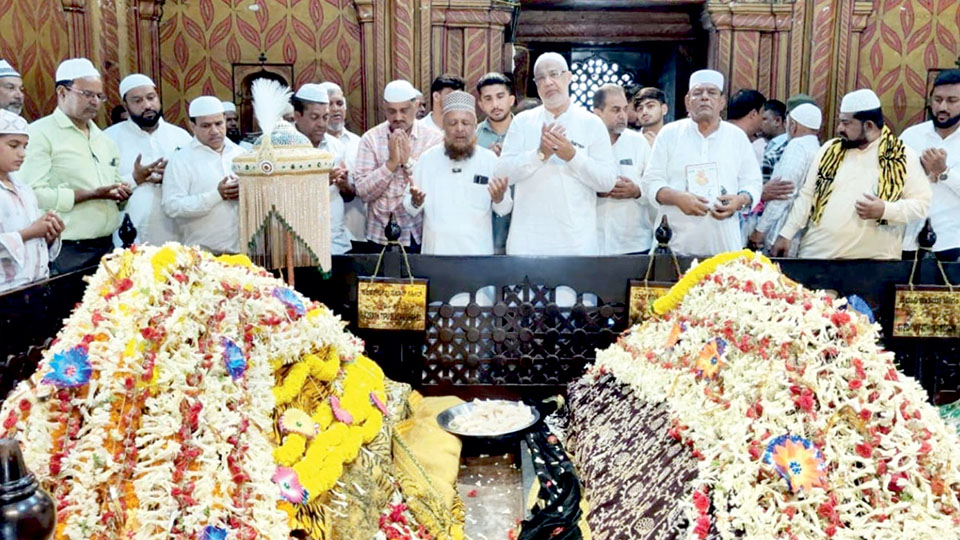
MLA Tanveer Sait, along with several others observed Tipu Sultan Martyr’s Day at a Fatha Khawni programme organised by Hazarath Tipu Sultan Shaheed Welfare and Urus Committee Secretary Afroz Pasha at Tipu Tomb (Gumbaz), Ganjam in Srirangapatna recently.

Hazarath Moulana Syed Inayathur Rehaman Razvi Saheb, Khateeb-o-Imam of Masjid Aqsa, Tipu Tomb, performed Fatha Khawni while Afroz Pasha and MLA Tanveer Sait spread the Flower Mat (Chadar) on the tombs of Tipu Sultan Shrine and his parents. Moulana Mohd. Inayath Ur Rehaman Razvi read Duwa supplications for the welfare of all.

Afroz Pasha distributed sweets (Tabruk) and felicitated the MLA by offering shawls.

Invitation, posters released

On the occasion, MLA Sait released the invitation and publicity posters of the 234th Annual Sandal Urus Shariff of Hazarath Tipu Sultan Shaheed.

The annual Sandal Urus Shariff will be celebrated on May 16 in city during which a public meeting will be held and a procession will be taken out. 

Industrialist M.F. Jamsheed, Senior Congress leader Syed Iqbal, Waseem, Radiulla Khan, Member of the College Development Council of    Government Girls’ Pre-University College Khwaja Mohammed Musheer Chishti, Syed Younus, Majeed Ahmed, Afroz  Khan and a host of devotees were present.

source: http://www.starofmysore.com / Star of Mysore / Home>News / May 08th, 2026

Urs-e-Sharieff of Hazarath Tipu Sultan Shaheed on May 16, 17

Srirangapatna, KARNATAKA :

The 234th Urs-e-Sharieff of Hazarath Tipu Sultan Shaheed, organised by Hazrath Tipu Sultan Shaheed Wakf Estate, Ganjam in Srirangapatna, will be held on May 16 and 17 at Gumbad-e-Shahi at Ganjam in Srirangapatna.

The Sandal procession will commence from Masjid-e-Ala in Srirangapatna at 3 pm on May 16 and will reach Gumbad-e-Shahi at 5 pm.

Special programmes will be held from 7 pm at Gumbad and will continue the whole night till next morning.

For details, contact Hazarath Tipu Sultan Shaheed Wakf Estate on Ph: 08236-252786 or Mob: 97390-58786, according to a press release.

source: http://www.starofmysore.com / Star of Mysore / Home>In Briefs / May 05th, 2026

Delhiwale: The ultimate Mughal souvenir

DELHI :

The marble throne of Bahadur Shah Zafar, the last Mughal emperor, symbolizes a collapsed dynasty, now housed in a museum near Humayun’s Tomb in Delhi.

Delhiwale: The ultimate Mughal souvenir

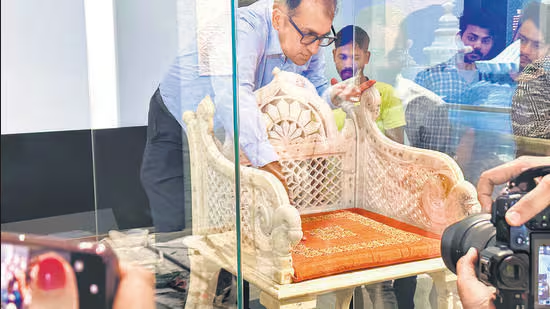
Behold this marble throne. Preserved inside a glass case at the Humayun World Heritage Site Museum in Delhi, it was once the stately seat of Bahadur Shah Zafar. As the last Mughal sovereign, the poet-king is likely to have sat on this throne while reflecting on the dissolution of his 300-year-old dynasty. The throne is, in fact, less ostentatious than the throne-like sofas found in the drawing rooms of Delhi’s wealthy today. Yet it is far more elegant. The armrests are supported on latticework, and faint flecks of colour cling to the marble like the last glimmers of extinguished stars. The fragile-seeming relic assumes truly epic proportions as the viewer connects it to the legend of a collapsed empire whose layered legacy continues to resonate in our republic (vividly chronicled in this newspaper yesterday).

The Mughals spanned over 18 rulers. Their kissa-kahani began 500 years ago in 1526, when Babur defeated Delhi Sultan Ibrahim Lodi in a field 80 kilometres from Delhi. Soon after, Babur entered the city and visited the shrine of the mystic Hazrat Nizamuddin Auliya. At that time, nobody would have guessed that this pilgrimage would recur across generations of Mughals, binding them to the city’s sacred, grave-dotted topography.

Truth be told, Delhi surpasses the dynasty’s other great centres, Agra and Lahore. Shahjahan may have built the immortal Taj in Agra, but his creation of Old Delhi throbs more with real life. For Delhi’s pre-eminence in Mughal India, we must first credit Babur’s son, Humayun, who established his capital, Dinpanah—today’s Purana Qila—near the shrine of Hazrat Nizamuddin. His son Akbar later built Humayun’s mausoleum close to the same shrine.

Over time, Humayun’s Tomb came to be known as the “dormitory of the Mughals.” This 16th-century complex contains 160 graves of kings, princes, and princesses, representing a broad cross-section of the dynasty. Seven Mughal emperors are buried here: Humayun, Azam Shah, Jahandar Shah, Farrukhsiyar, Rafi ud-Darajat, Rafi ud-Daulah, and Alamgir II. It was here, at Humayun’s Tomb, that Bahadur Shah Zafar took refuge after the collapse of the 1857 uprising against the British. He was captured at this very site, marking the end of the Mughal Empire.

The aforementioned museum, which houses Zafar’s throne, is across the road from Humayun’s Tomb. In the lead-up to its inauguration two years ago, a significant moment was the installation of the throne, personally overseen by museum curator Ratish Nanda—see photo. A conservation architect, Nanda had earlier helped restore the garden around the first Mughal emperor’s tomb in Kabul.

As for the last Mughal, the unfortunate Zafar had intended to be buried in Delhi, but the British exiled him to Rangoon, where he was finally laid to rest. As a consolation, his ill-fated throne may be seen as a symbolic substitute for his Delhi tomb. Indeed, as the tomb of his dynasty itself.

source: http://www.hindustantimes.com / Hindustan Times / Home / by HT Correspondent / May 04th, 2026

India’s Second Oldest Farman to Get Digitised as Part of GBM

TELANGANA :

Dr Zareena Parveen, director, State Archives, and coordinator of the Cluster Centre, GBM, explained that the survey has identified 1,95,935 manuscripts, including those of the Telangana Archives, and a total of 29,871 images of 130 manuscripts had been uploaded till May 2.

“The handmade paper used for the farman is a rare example showcasing the royal practices of the time,” M.A. Raqeeb, assistant director, Telangana Archives, told Deccan Chronicle. (Image: X)

Hyderabad:

A royal farman, said to be the second oldest in India — issued by Sultan Feroz Shah Bahmani (1397–1422) in 1406 — will be among close to two lakh manuscripts identified as part of the survey by the Gyan Bharatam Mission (GBM) in Telangana. The GBM is a national initiative by the Union culture ministry to unearth, preserve and digitise India’s massive manuscript heritage.

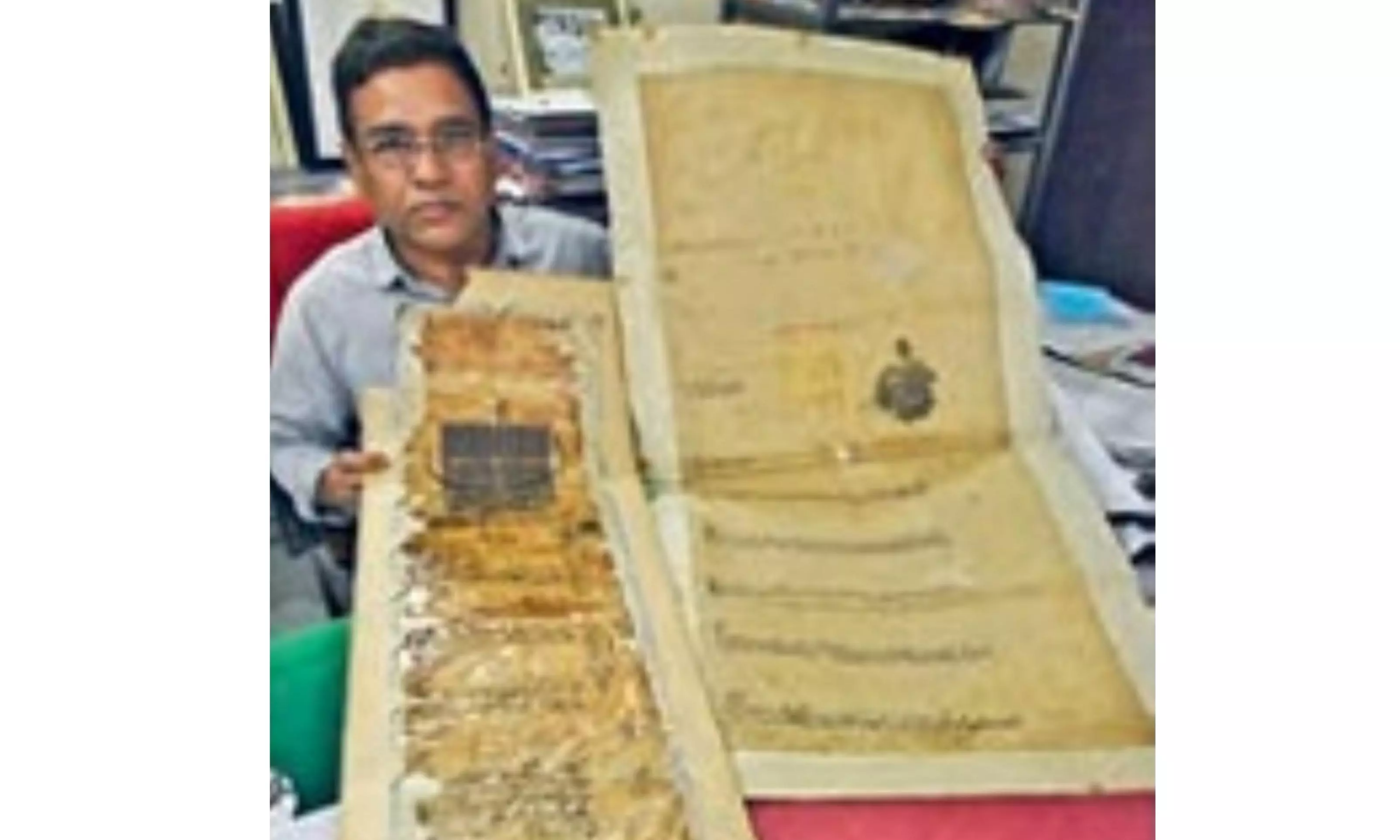
This decree on Persian‑style handmade paper is 33 x 10 inches in size, with ink and royal‑seal authentication. The document was issued from Gulbarga, which was the seat of power for the Bahmanis before it was shifted to Bidar. The decree grants land as inam to Muhammed Ahmed, Qazi of Kalyani, and bears the distinctive tughra (monogram) and the Bahmani royal seal.

“The handmade paper used for the farman is a rare example showcasing the royal practices of the time,” M.A. Raqeeb, assistant director, Telangana Archives, told Deccan Chronicle.

Another well‑preserved royal farman is of Emperor Shah Alam II, issued in 1773 AD, appointing Maharaja Narayan Rao Bahadur as official caretaker of the riverbank near Allahabad. Believed to be part of preparations for the Kumbh Mela, the emperor issued clear instructions to officials not to levy fees.

“All expenses for maintaining the site and facilitating the pilgrims’ rituals are to be borne entirely by the Mughal government,” the decree says.

According to the decree, Hindu pilgrims (yatris) arriving from across the subcontinent — especially from Gujarat and Maharashtra — must be allowed to take the sacred bath and holy dip for spiritual purification without any fee or levy. The directive is to be strictly implemented and communicated to the commissioner of police and all present and future officers for perpetual observance.

“This farman illustrates the Later Mughal policy of imperial patronage toward diverse religious practices and underscores the state’s responsibility for safeguarding pilgrimage routes and sacred bathing ghats,” Raqeeb explained.

The cluster centre at the State Archives has identified and completed surveys of 17 institutions and individuals, while surveys for another 42 are underway. It has so far scanned 57,842 documents and exported 29,871 images.

Dr Zareena Parveen, director, State Archives, and coordinator of the Cluster Centre, GBM, explained that the survey has identified 1,95,935 manuscripts, including those of the Telangana Archives, and a total of 29,871 images of 130 manuscripts had been uploaded till May 2.

“At the State Archives alone we have over 1.8 lakh manuscripts, including 668 in book form, 155,000 paper items and 25,000 private collections (paper). Most of these are in Old Persian (Shikista) and cover varied subjects, including graphic pictures of Mansabdari, revenue and military systems of the Mughals in the Deccan region (South India),” Dr Parveen director explained.

source: http://www.deccanchronicle.com / Deccan Chronicle / Home> Southern States> Telangana / by Md Nizamuddin / May 03rd, 2026

Visiting Lord Ayyappa’s Muslim friend Vavar during the Sabrimala pilgrimage

Sabarimala (Pathanamthitta District), KERALA :

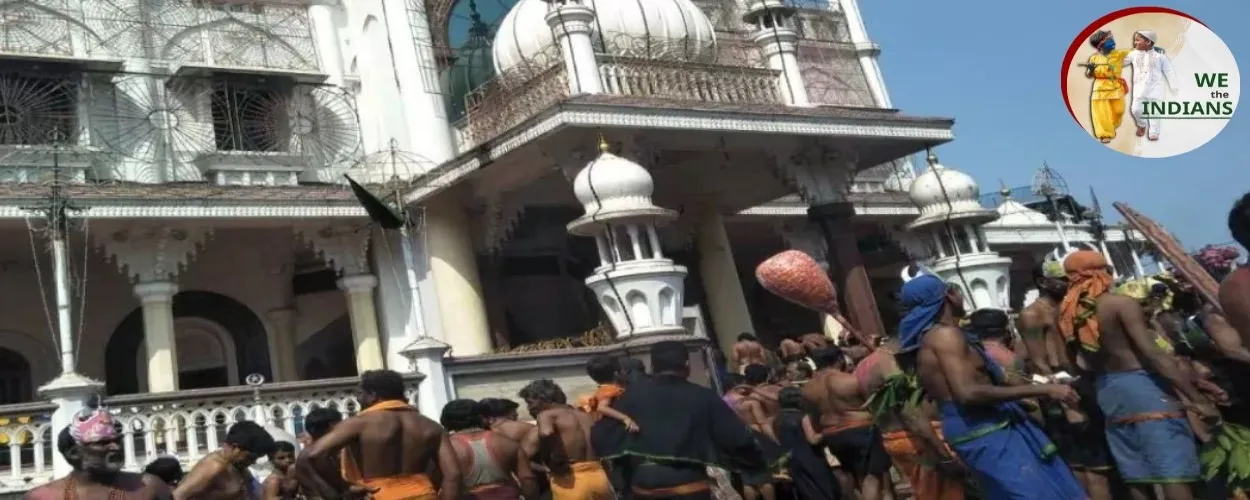
Pilgrims on way to Ayyappa shrine in Sabrimala at Vavar mosque, Erumeli, Kerala

I had waited to go to Sabarimala, a hilltop shrine dedicated to Lord Ayyappa in Kerala’s Pathanamthitta district, for a long time. Lord Ayyappa, the deity of truth and righteousness, is described as the son of Shiva and Mohini (the female avatar of Vishnu). He was said to have been adopted by the local king of Pandalam.

Ungorgettable Experiences

As a youngman, Ayyappa abdicated the crown and renounced the palace to vanish into the forests of Sabarimala to live a celibate and ascetic life. It’s in deference to Ayyapa’s celibacy that women are not allowed there till they turn 55.

After a 41-day mandatory fast, I joined my sister and her husband for the pilgrimage. The pilgrims wear black clothes and carry a bundle containing a couple of coconuts filled with ghee and other offerings for the deity.

We carried the bundle on our heads at the start of the four-kilometre uphill trek. We were not supposed to remove it before reaching the shrine.

At the crack of dawn, after breaking coconuts at the local shrine to ward off all obstacles, we left for the shrine.I was thrilled at the thought of visiting some of my favourite temples and shrines on the route, some of which I had only heard of but never visited.

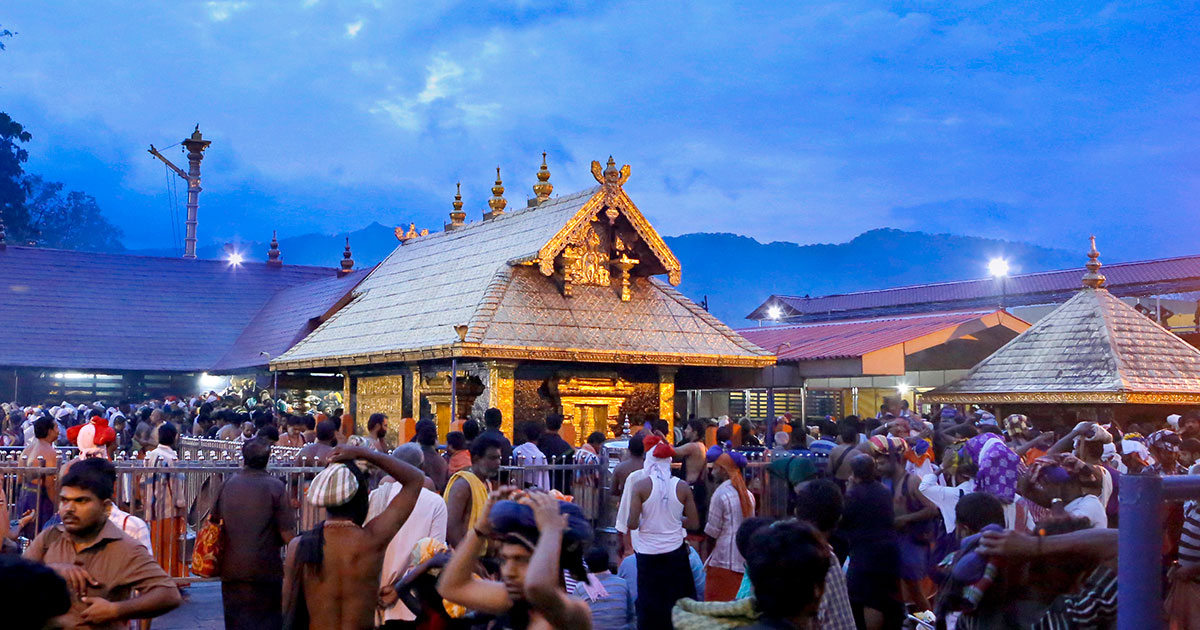
Lord Ayyapa temple at Sabrimala

Holding our heavy bundles (kettu) on our heads, we stopped at Chottanikakara, Vaikom, and Ettumanoor shrines.

Soon we were at Erumeli. According to legend, Ayyappa defeated the demoness Mahishi (sister of Mahishasura) here. The name Erumeli is comes from Eruma-kolli—“the place where the buffalo-demon was slain.”

At Erumeli, the road streamed with pilgrims, mostly men and children, all clad in black. They had bright colours smeared on their faces, held colourful feather arrows, and danced to drum beats as part of a ceremonial dance called Petta thullal to mark the victory of the warrior Ayyappa over enemies and bandits. 

We too swayed lightly, trying to shake off our inhibition-clad egos.   

Holding arrows, wild leaves, and smeared in bright colours, we walked towards a temple there dedicated to a deity called Shastha. Shastha is an ancient protective warrior deity worshipped in Kerala even before the incarnation of Ayyappa. Ayyappa is considered a modern avatar of Sastha and is now almost synonymous with Sastha.

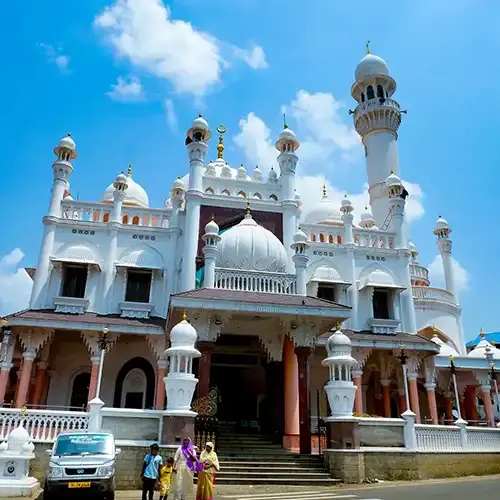
Vavar Juma Mosque, Erumeli

As we walked towards the temple, I was surprised. Were we at the threshold of a temple or a mosque? I saw taps for the ritual cleansing ceremony (wuzu) and a handful of Muslims saying namaz through the glass windows. It was a mosque.

We lined up respectfully outside the mosque. It was Vavar Palli (Vavar mosque), my brother-in-law explained. 

Vavar was a close associate of Ayyappa. Their friendship is celebrated in folklore and devotional movies. Vavar was a Muslim, and thus the story gets significant.

“Vavar Swami may have worshipped at the mosque. That is why he is associated with the mosque,” Nasruddin Musaliyar, who traces his lineage from Vavar, explained to me when I spoke to him a few days later.

I felt pure joy at seeing Hindus offering respect outside a mosque and making offerings before worshipping the Shastha temple. After breaking a coconut at the Shastha temple, we began our long trek towards the Ayyappa shrine on Sabarimala.

It took us four or five hours, followed by a long five-hour wait in the crowd. Anyway, we had darshan in the morning. When we came out of the temple, another surprise awaited.

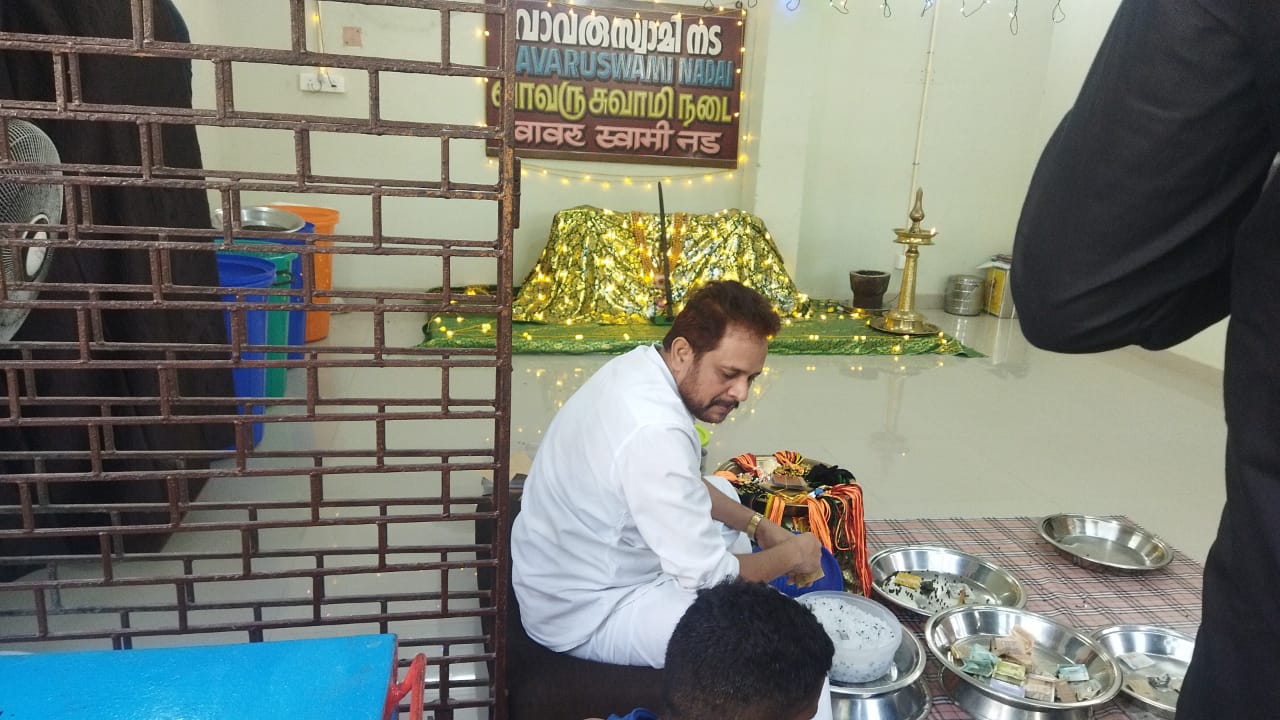
The shrine dedicated to Vavar Swamy

I found myself standing outside a small shrine just outside the Ayyappa temple. It was like a dargah, but I was told that it was called Vavarpadi, or the threshold of Vavar, a memorial to Ayyappa’s friend.

Pilgrims stopped to offer prayers and accept prasad of sugar candy and pepper. The man giving the prasadam said he was a descendant of Vavar and managed his tomb. He gave me his father’s number and asked me to speak to him for details about the shrine.

Nasruddin Musaliyar said that Vavar was part of a group of Arab settlers who were close to Lord Ayyappa.”This shows that the highest authority at that time accepted Vavar despite his different faith or origin,” Musaliyar said.

“Vavar Swami’s tomb and a mosque at Erumeli, where Vavar is said to have prayed, just cry out loud to us today that two faiths can co-exist and respect each other. All religions believe that there is one God. And that almighty wants to tell us that Hindus, Christians, and Muslims can co-exist in harmony,” he added.

Emotions well up as Mursliyar says that neither Ayyappa nor Vavar had asked anyone to build shrines and pray to them. These shrines represent the principle that they did not see any difference between man and man.

Author (left) with her sister and brother-in-law on the way to Sabrimala

Shrines and differences are man-made. “The Muslims don’t worship at Vavars shrine as they believe only in Allah,” he said.

There is no evidence that Vavar was buried there, though the royal records claim so. This shrine is symbolic, he says.

Ayyappa is believed to have renounced the throne, family, and palace to live as an ascetic in Sabarimala’s forests and merged with Sastha. He loved and honoured Vavar, expecting his devotees to do the same. In these times of religious tensions, such traditions continue thanks to a deity who rejected differences of caste and religion and loved everyone as human beings.

After darshan at Sabarimala, pilgrims feel lightheaded as they have all offered their heavy burdens at the shrine.

Perhaps they have removed something else also besides the kettu —the thought of differences itself.

They go as Hindus to worship a Hindu god but return feeling more than just a Hindu…a more complete human being, who embraces all differences.

source: http://www.awazthevoice.in / Awaz, The Voice / Home> Stories / by Sreelatha Menon / December 29th, 2025

Mystery still shrouds ‘Saath Kabra’

Vijayapura, KARNATAKA :

This haunting historical site in Vijayapura deserves better conservation efforts from Archaeological Survey of India as well as deeper research from historians to understand the legends swirling around the monument.

Saath Kabra, the cluster of 63 tombs, in Vijayapura (Photo | Express)

Vijayapura :

Far from being just another tourist destination, ‘Saath Kabra’ in Vijayapura stands out as one of the most haunting historical sites in the region. Often described as a silent witness to a tragic past, ‘Saath Kabra’ is a cluster of 63 tombs arranged on a raised black stone platform, that has generated legends, scholarly debate and enduring curiosity.

The most widespread legend surrounding ‘Saath Kabra’ is linked to the period of Ali Adil Shah II of the Bijapur Sultanate, who is also credited with commissioning the unfinished ‘Bara Kaman’ monument. During his reign, the Bijapur Empire faced a serious challenge from the Maratha leader Chhatrapati Shivaji. To counter this threat, Ali Adil Shah appointed his powerful general Afzal Khan to confront Shivaji.

Afzal Khan, originally from Afghanistan, was known as a formidable warrior. Historical narratives also describe him as deeply superstitious, placing great faith in astrology and spiritual predictions. In 1659, before leaving to face Shivaji, Afzal Khan is believed to have consulted a Sufi Pir, who foretold that he would not return from the campaign. According to local legend, this prophecy deeply disturbed him.

Folklore claims that Afzal Khan, fearing defeat and dishonour, killed more than 60 of his wives by pushing them into a well and later constructed tombs at the site. The alleged motive was to prevent them from remarrying or falling into the hands of enemies and facing humiliation or violence in the event of his death. This story has long been used to explain the existence of the mass graves at ‘Saath Kabra.’

The cenotaph of Afzal Khan

Afzal Khan later travelled to Pratapgarh in the present-day Maharashtra to confront Shivaji. Instead of a direct battlefield encounter, negotiations were arranged. Historical records state that Afzal Khan planned to assassinate Shivaji during a peace meeting. Shivaji, aware of the plot, took defensive measures by wearing armour and concealing iron tiger claws on his fingers. During a traditional embrace, Afzal Khan attempted to overpower Shivaji, but failed. Shivaji retaliated and killed Afzal Khan. Afzal Khan’s body was subsequently buried at the foothills of Pratapgarh Fort.

There is no evidence to support the claim that Afzal Khan murdered his wives or that ‘Saath Kabra’ is their burial site. Vijayapura-based historians Abdul Gani Imaratwale and Krishna Kolhara Kulkarni dismissed the popular narrative as baseless, stating that no credible historical text mentions such an act by Afzal Khan. They emphasised that, in the absence of documentary evidence, the story must be treated as legend rather than history, and that research is required to determine the true origins of the graves.

Dr Imaratwale likes to call the 60 women as ‘half-wives’ as though they were not legally wedded wives, however they enjoyed almost the same privileges that of wives. He said that Khan had four legally wedded wives.

Dr Imaratwale says that such women were accorded considerable respect and were not buried in public graveyards. Separate land was often chosen for their burial, which could explain the clustered graves at ‘Saath Kabra.’

Dr Imaratwale says that it is not credible that a general, who commanded an army of around 40,000 soldiers, would be so fearful of his enemy that he would drown his women one by one in an open well.

Dr Imaratwale suggests alternative possibilities. He said the deaths could have occurred due to mass poisoning or as a result of an accident, such as the collapse of a large structure where the women may have been residing. However, he acknowledged that no information is available to establish the exact cause.

The historians say there is no clear record to confirm whether the women died while Afzal Khan was in Bijapur or during his military campaign. They believe it is more likely that their deaths occurred when Afzal Khan was fighting in Maharashtra. Afzal Khan himself died there, and his body was never brought back to Bijapur. As a result, his cenotaph exists in Vijayapura, built in accordance with his wish to be buried there, a wish that ultimately remained unfulfilled.

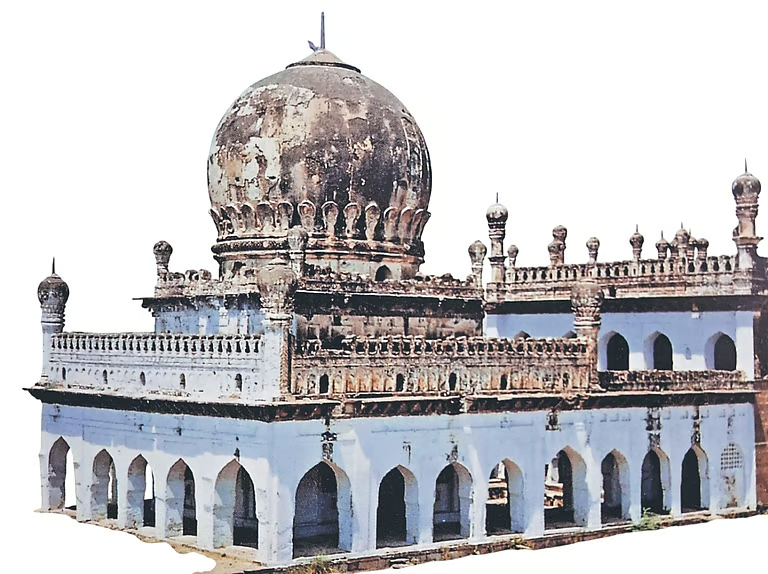
Tourists largely confine their visits to prominent landmarks such as the Gol Gumbaz, Bara Kaman and Ibrahim Roza while dozens of other monuments remain overlooked. Located in Navarasapur on the outskirts of the city, ‘Saath Kabra’ is difficult to access. The site includes 63 black stone tombs, an ancient well now filled with silt. Many tombstones are broken or missing, and the entire complex is in a dilapidated state. Poor road connectivity, lack of signboards and absence of maintenance have further contributed to its neglect, with little effort made by the tourism department or the Archaeological Survey of India to promote or preserve the site.

Owing to its eerie atmosphere and disturbing legends, local residents often avoid the monument. Whether it represents a misunderstood burial site, a tragic episode lost to time, or folklore layered over fragments of history, ‘Saath Kabra’remains one of Vijayapura’s most enigmatic monuments, underscoring the urgent need for serious research, preservation and historical clarity.

source: http://www.newindianexpress.com / The New Indian Express / Home> Bengaluru / by Firoz Rozindar / February 08th, 2026


An exhibition at DAG and a new book give us a ringside view of the historic Delhi durbars

DELHI :

Curated by noted historians Rana Safvi and Swapna Liddle, DAG also launched a book, Delhi Durbar: Empire, Display and the Possession of History, co-authored by the duo.

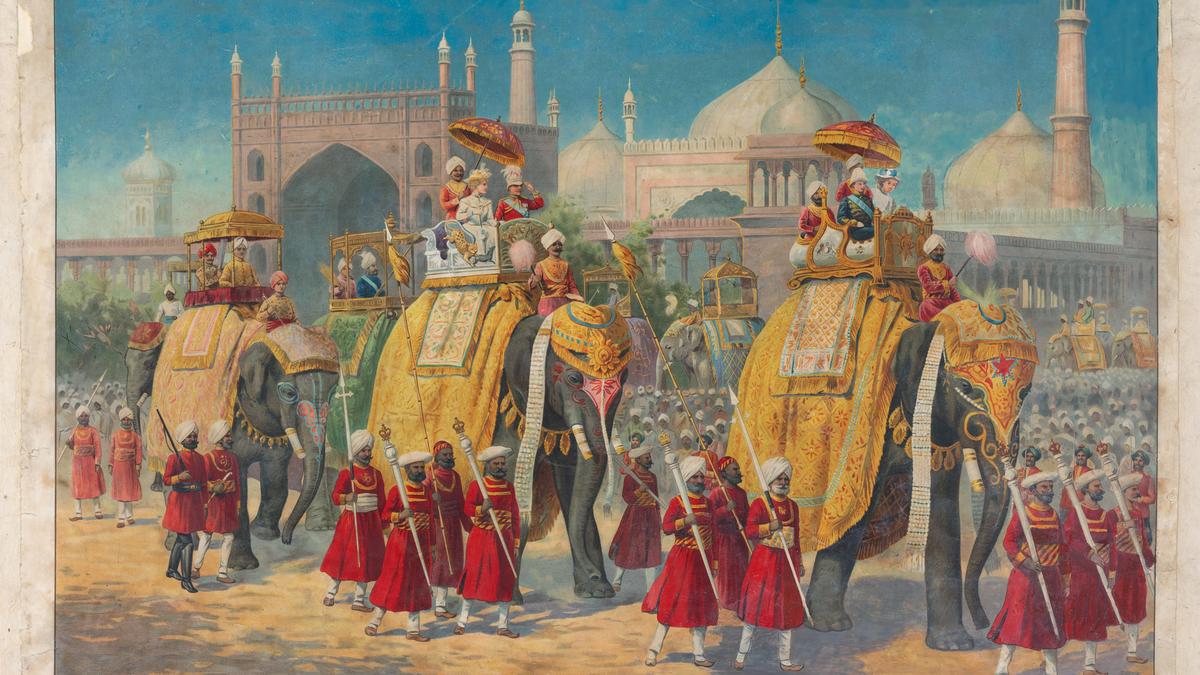
  The Imperial Durbar (1903) | Photo Credit: Special Arrangement

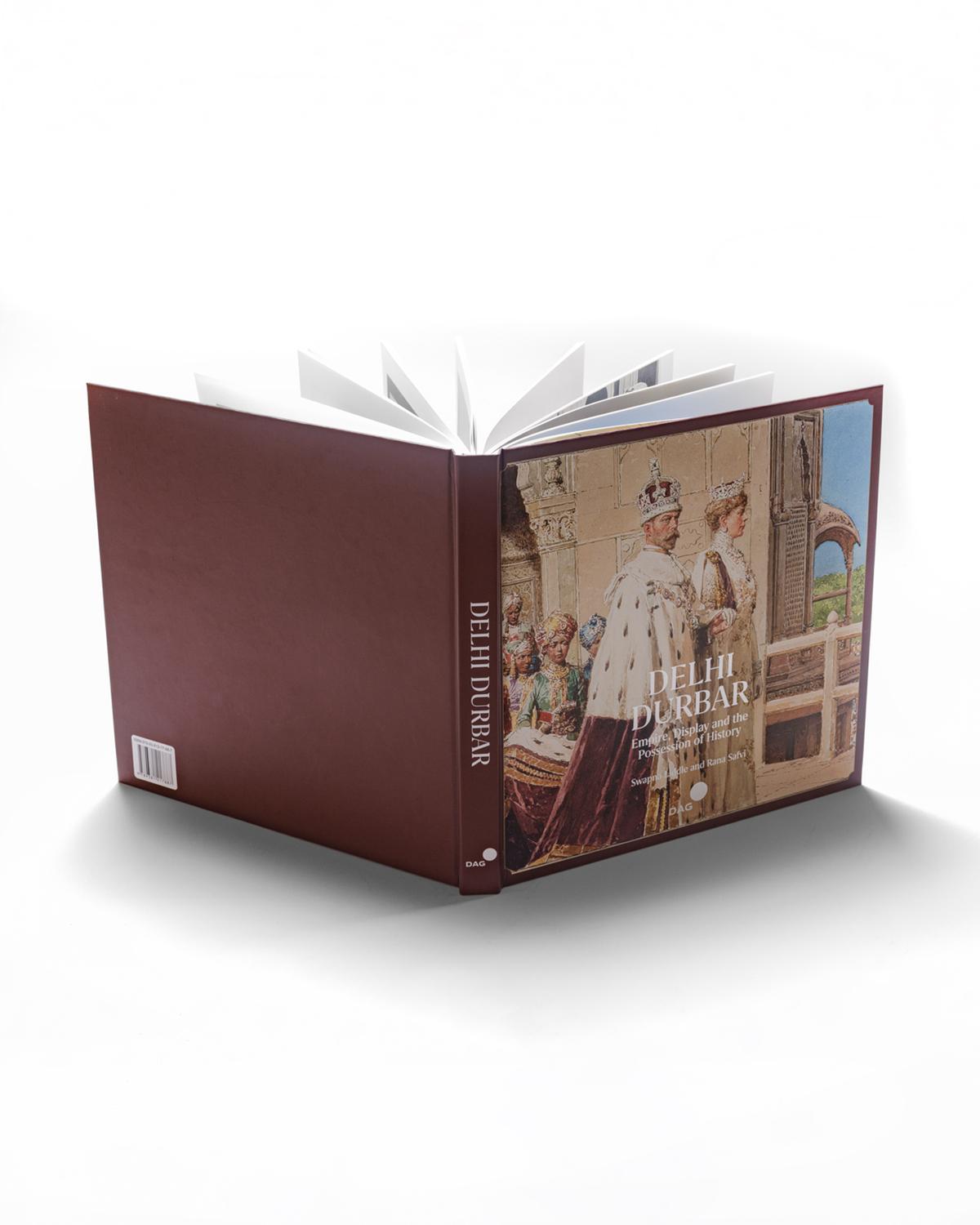
In an important contribution to a facet of Delhi’s rich history, DAG is hosting an exhibition drawn from its archives of the city’s resplendent durbars. Curated by noted historians Rana Safvi and Swapna Liddle, DAG also launched a book, Delhi Durbar: Empire, Display and the Possession of History, co-authored by the duo.

“The British Delhi Durbars have been the subject of much recent scholarly study and re-evaluation,” writes Ashish Anand, the CEO and managing director of DAG. “The objects in this exhibition bring them materially present, through works by some of the leading artists and photographers of the period.” The essays give readers an insight into the city that was. We also get rare visuals of Delhi, its monuments, and its three durbars — all of which were landmarks in British-ruled India.

Safvi speaks to Magazine about the project. Excerpts:

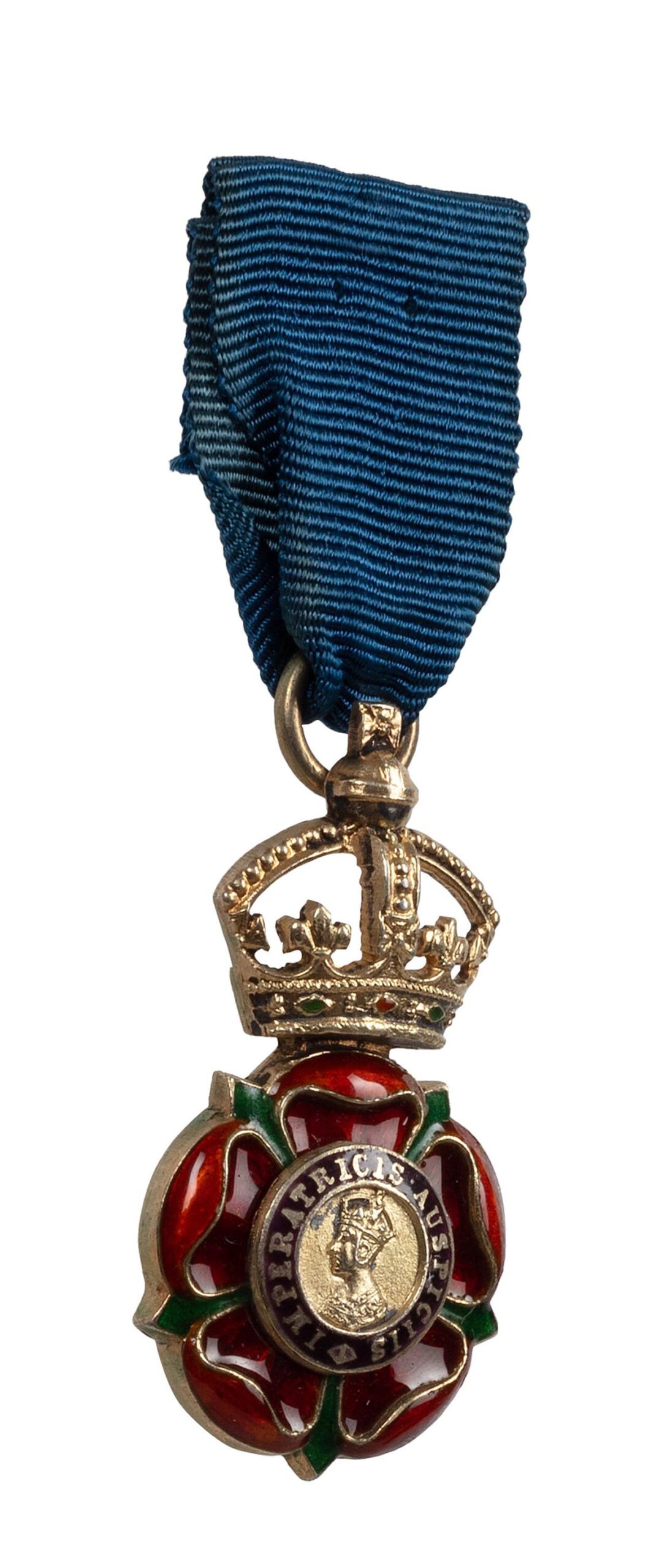
Companion of the Most Eminent Order of the Indian Empire | Photo Credit: Special Arrangement

Question: Can you shed some light on the DAG project?

Answer: This exhibition was conceived by Giles Tillotson, senior vice president – exhibitions at DAG. It is the first exhibition that has been drawn from the DAG archives.

Q: With all the attention on the Central Vista project and the new Parliament, how important is it to revisit Delhi’s history?

A: Every ruler negotiates his/ her idea of kingship. If we read the history of Delhi, kings starting with the Tomara dynasty built cities and citadels to perpetuate their memory. While the Mughal city of Shahjahanabad played a pivotal role in the three Delhi durbars, the last one saw King George announce the shifting of the British capital from Calcutta to Delhi. He also laid the foundation for a new city. This is known today as Lutyens’ Delhi.

Q: The book talks of three durbars. How different were each?

A: While all three durbars were unique, there was a thread of continuity. They were all held in the Coronation Park in Delhi and close to the Ridge where the British had fought the Indian forces in the Uprising of 1857. [They] appropriated some Mughal symbols in a bid for continuity and so that Indians could relate to them.

The first durbar, held just 20 years after the Uprising, was called the Imperial Assemblage and was meant to announce the assumption of the title of Kaiser-e-Hind by Queen Victoria with pomp and splendour. It was also meant to legitimise and popularise British rule, using many of the idioms of the Mughal empire, including the word ‘durbar’, which Indians were familiar with.

The second, held in 1903, was to celebrate the coronation of King Edward VII. This durbar envisaged by the viceroy Lord Curzon was a grandiose event with the viceroy and 48 Indian princes riding on elephants through the city in a ceremonial procession. An art exhibition was conceived by Lord Curzon, in his own words, to ‘show that India can still imagine and create, and do’.

The third durbar of 1911 was the first in which the British monarch himself was present with his consort Queen Mary. It announced the reversal of the highly unpopular partition of Bengal and was also used to announce the shifting of the imperial capital in India from Calcutta to Delhi.

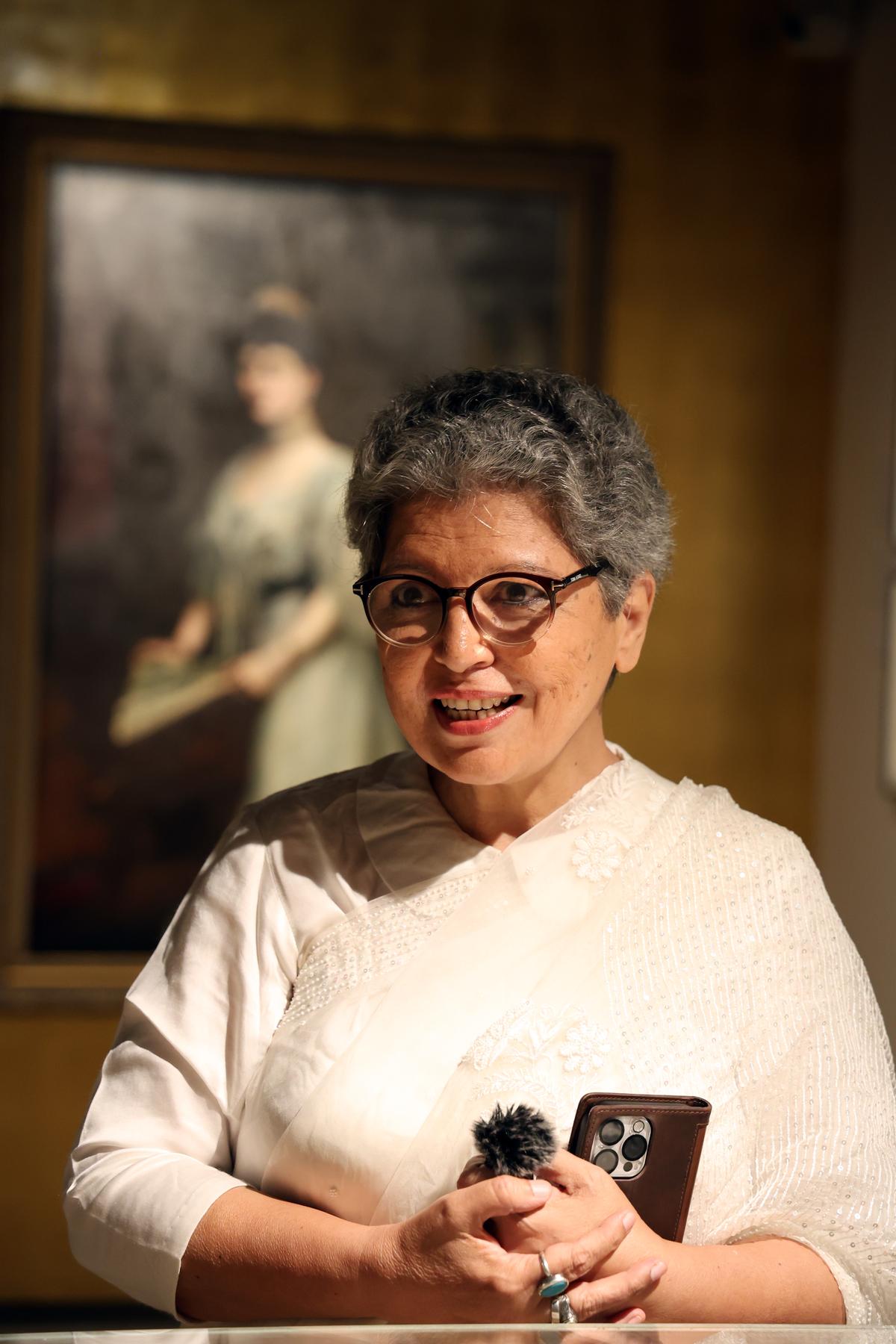
Historian Rana Safvi  | Photo Credit: Special Arrangement

Q: The historic Jama Masjid was under British occupation for almost five years after the Uprising of 1857. Why and how did it become a vantage point for the durbar in 1903?

A: After the fall of Delhi, Jama Masjid was confiscated by the British; it was used as a mess and horses were tied along its corridors. In 1862, it was returned to Muslims for worship. The Jama Masjid has always been a symbol of Mughal magnificence and of Muslim togetherness.

Q: Can you elaborate on the demolition of Masjid Akbarabadi during the Uprising? It doesn’t always find a place in our textbooks…

A: When the city of Shahjahanabadwas being built, members of royalty as well as nobility were encouraged to build and add to it. Three mosques were built by three wives of Mughal emperor Shah Jahan. Fatehpuri Begum built the Fatehpuri mosque, Sirhindi Begum the Sirhindi mosque and Akbarabadi Begum the Akbarabadi mosque.

After the fall of Delhi, when the British army was victorious, the city and its people were punished for their ‘rebellion’. While many notables of Shahjahanabadwere killed or driven out of the city, the monuments and buildings were taken over. Fatehpuri mosque’s compound and galleries were auctioned and bought by Lala Chunnamal Ki Haveli and Akbarabadi Masjid was demolished. There is a beautiful description of Akbarabadi mosque in Syed Ahmed Khan’s Asar-us-Sanadid.

Delhi Durbar: Empire, Display and the Possession of History | Photo Credit: Special Arrangement

Q: Does the Coronation Durbar of 1911 mean the British had accepted the primary place of Delhi in India’s history?

A: Delhi’s importance can be seen from the fact that all three durbars were held here. Delhi was associated with Indraprastha, the legendary capital of the Pandavas, and was the city from where the Tomaras, Delhi Sultans and the Mughals ruled. Delhi’s grand history and traditions were used in the durbars. In the 1911 durbar, King-Emperor George V and Queen Mary even gave a jharokha darshan from the Red Fort’s Musamman Burj to Indians in the Mughal tradition.

ziya.salam@thehindu.co.in

source: http://www.thehindu.com / The Hindu / Home> Entertainment> Art / by Zia Us Salam / September 29th, 2023

Legendary Mughal mosque unearthed in Delhi

DELHI :

Archeological Survey of India says the monument, which residents claim is the Akbarabadi Mosque demolished by the British in 1857, is definitely a ‘contemporary’ of the 17th century Red Fort.

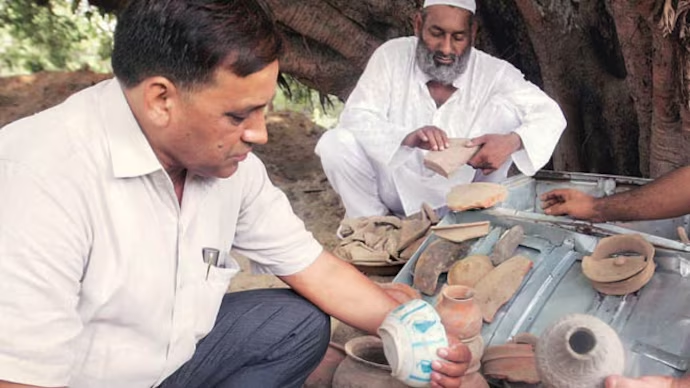
Archaeologist D.N. Dimri(l) shows the artefacts unearthed from the site at Matia Mahal, Old Delhi.

Remains of a historical monument, unearthed a few steps from Jama Masjid, belong to the golden age of Mughal Empire.

Archeological Survey of India said the monument, which residents claim is the Akbarabadi Mosque demolished by the British in 1857, is definitely a “contemporary” of the 17th century Red Fort, though whether it was a mosque or not will be known only after a detailed survey of the area.

The site in Matia Mahal, near Daryaganj, has been drawing visitors in hordes since the past three weeks after the first proofs of the historical structure – pottery and carved stones – were discovered in the area.

On Wednesday, a 10 metre wide wall was discovered a few feet under the ground. Residents claimed the wall was a part of the boundary of the main prayer enclosure, supposed to be about 85 metre wide.

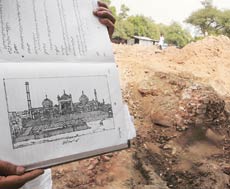
A sketch of the lost Akbarabadi Mosque. ASI officials said the discovery of the site is “indeed remarkable”.

“What we have here is a structure definitely of the time of the Red Fort. It is important due to its proximity both to the Jama Masjid and the Red Fort. The articles discovered from the site – Chinese porcelain, glaze pottery – belong to the period of the Mughals. What the structure exactly is will be known only after detailed survey,” superintending archaeologist Dr D.N. Dimri said.

But residents are confident that evidence of the structure being a mosque is present in the archives.

“We have maps clearly showing the structure of the Akbarabadi mosque in a book authored by the great scholar Sir Syed Ahmad Khan. There are illustrations of the mosque in the development plan of this area, issued by the Delhi government,” Matia Mahal MLA Shoaib Iqbal said.

source: http://www.indiatoday.in / India Today / Home> News> India> North / by Mail Today Bureau / published by AtMigration / July 07th, 2012

How Taj Mahal and Aligarh’s Jama Masjid – Built 250 Years Apart – Share a Calligrapher

Agra / Aligarh, UTTAR PRADESH :

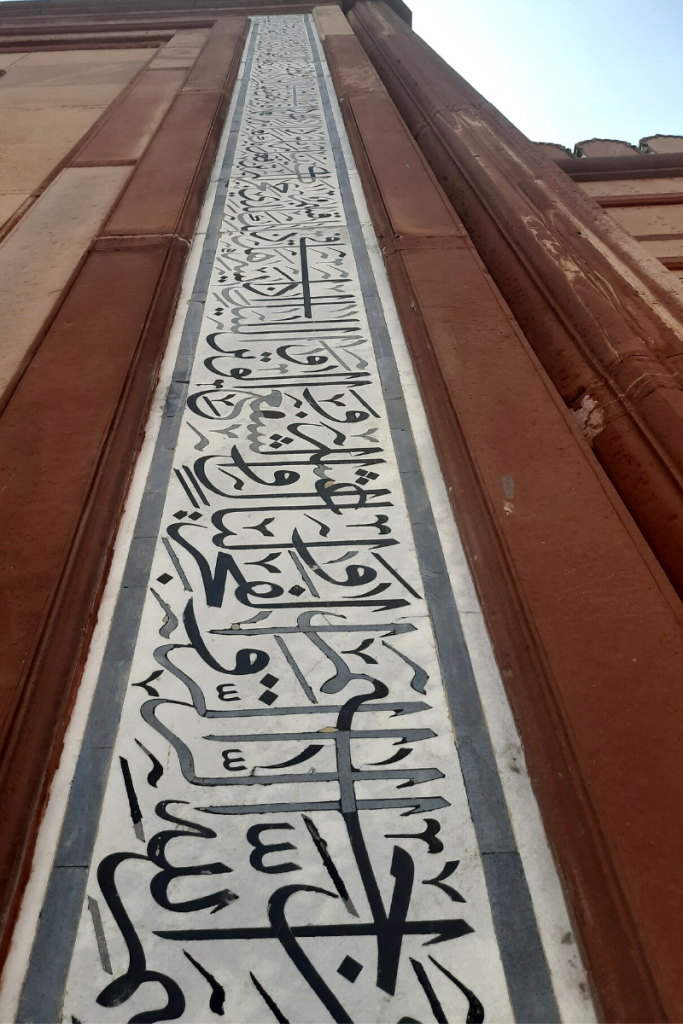
The imposing walls of both the Taj Mahal and Aligarh Muslim University’s Jama Masjid have Quranic verses crafted onto white marbles in black paint.

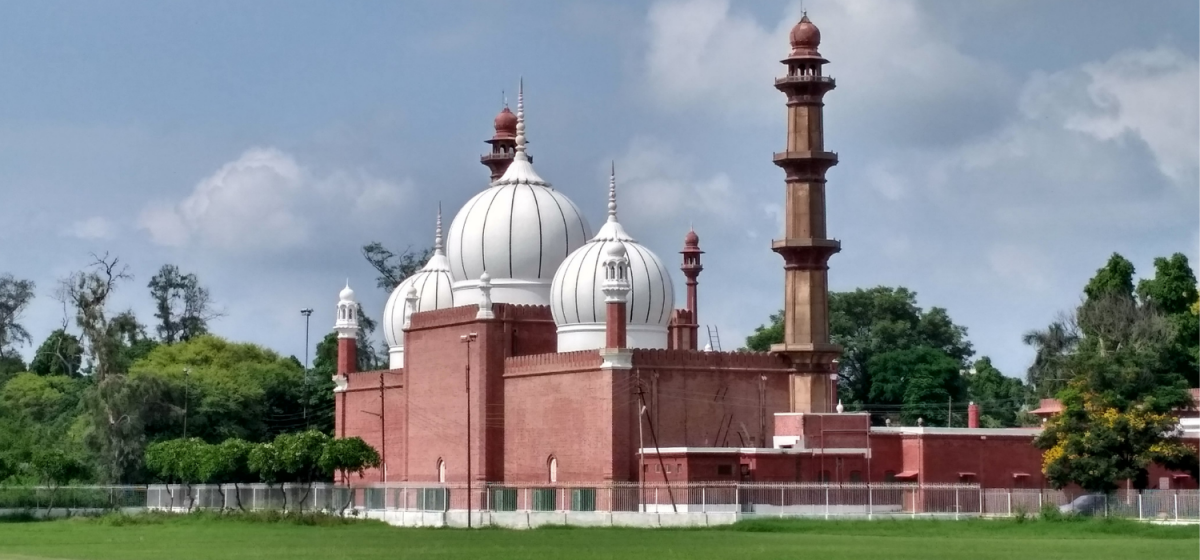
Jama Masjid on Aligarh Muslim University campus. Photo: Author provided.

Constructed nearly 250 years apart, the Taj Mahal in Agra and Jama Masjid at the Aligarh Muslim University (AMU) have an interesting connection.

The construction of the Taj Mahal began in 1632 and was completed in 1653, while the construction of Jama Masjid at AMU began in 1879 and was completed in 1915.

While the Taj Mahal, which is the tomb of Mughal emperor Shahjahan and his wife Mumtaz Mahal, attracts millions of visitors every year, AMU’s Jama Masjid is the main mosque of the university. AMU’s Jama Masjid is, perhaps, the last enduring symbol of the Mughals, constructed when the Mughals lost their kingdom during British rule.

A surprising connection

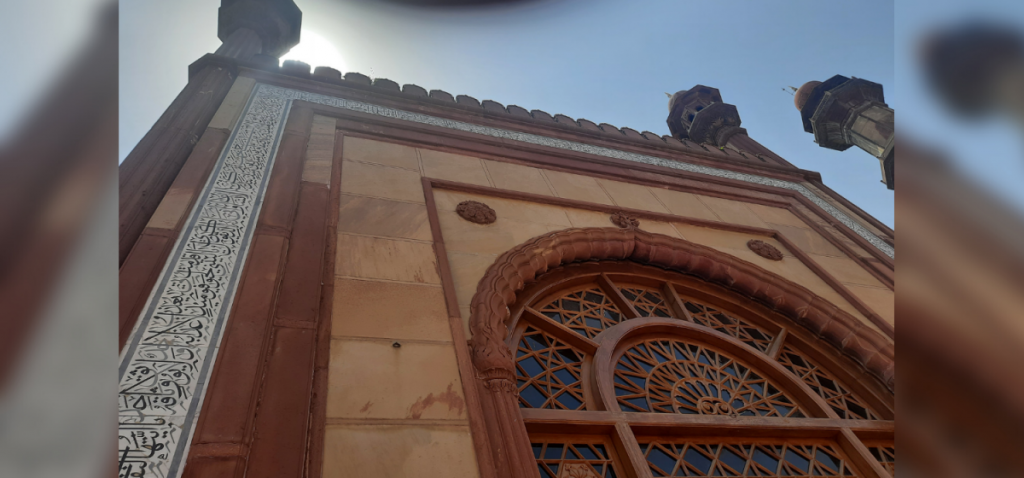
As one enters the Taj Mahal, beautiful calligraphy adorns all four corners. Several verses from the Holy Quran crafted in black calligraphy on white marble can be seen. This is a unique form of calligraphy, and expert artisans from Persia were involved in creating it. Similar calligraphy can be seem inscribed at the tomb of Mughal King Akbar at Sikandra, Agra, and also at the AMU Jama Masjid.

A closer look at the white marble with Quranic verses in black colour adorning the walls of Jama Masjid in Aligarh Muslim University. Photo: Special arrangement.

In fact, it is believed that the artisan responsible for the calligraphy at the Taj Mahal also brought his expertise to AMU’s Jama Masjid.

Since there is a difference of nearly 250 years between the construction of both architectural wonders, it is interesting to study how this was possible.

During Shah Jahan’s regime, several buildings were constructed, including the Taj Mahal and Delhi’s historic Jama Masjid. The calligraphist used was the same.

Professor Nadeem Ali Rezavi of the Centre of Advanced Studies, Department of History, Aligarh Muslim University, says that the master calligraphist in most of the buildings constructed during Shah Jahan’s regime is the same person.

“His name was Abdul Haq, and later due to his craftsmanship, his rank was elevated. He was given the title of Amanat Khan. In fact, he even signed the bands on this calligraphy with dates,” says Rezavi.

Still, there is a gap of over two centuries between these two buildings, Taj Mahal and AMU’s Jama Masjid.

The connection between the two monuments becomes clear with the involvement of Akbarabadi, one of Shah Jahan’s queens. Her original name was Aiza-un-Nisa. She, in 1650, commissioned the construction of a mosque situated in Daryaganj, Delhi, during the same period. In that mosque, Quranic calligraphy was done by the same artisan in black paint on white marble. This was around the same time as when the Taj Mahal was built.

After nearly two centuries, the Daryaganj mosque was demolished by the Britishers following the 1857 revolt. This was when Britishers gained control over the Red Fort, and the last Mughal emperor Bahadur Shah Zafar was sent in exile to Rangoon. They destroyed many buildings which were supposed to have harboured the rebels. At the site of the destroyed Akbarabadi Mosque, a park was developed and came to be known as Edward Park in 1911, which is now called Subhash Park.

During the same period, Sir Syed Ahmed Khan, the founder of the Mohammadan Anglo Oriental College (which later became AMU) felt the oppression against Muslims after the revolt. He nurtured the idea of setting up an educational institution to try and uplift the community.

A visionary man, Sir Syed had the taste for collecting things, particularly artefacts which had archaeological and historical importance. He was aware of the demolition of the Akbarabadi Mosque in Delhi.

As per the AMU Gazette, the scraps generated at the demolished Akbarabadi mosque were sold to a dealer and later purchased by Sahabzada Suleman Jah Bahadur. These remains were thus sold after over 200 years. These were presented to Sir Syed Ahmed Khan, who planned to use them in the Jama Masjid of the educational institution.

A closer look at the white marble with Quranic verses in black colour adorning the walls of Jama Masjid in Aligarh Muslim University. Photo: Special arrangement.

The white marbles with black calligraphy now present in the Jama Masjid of AMU depict Surah Fajr from the Holy Quran. Thus centuries apart, the two buildings carry the work of the same artisan.

“Even if you compare, it is the same thing and the only difference is in the scale. The artisans are the same who have shown their skills in the construction of the Taj Mahal,” says Prof. Rezavi.

Thus AMU’s Jama Masjid is, perhaps, the last enduring symbol of the Mughals, constructed when the Mughals lost their kingdom during the British rule. On the other hand, the domes of AMU’s Jama Masjid employed techniques of the Mughal era: they are “true domes” as they were built using lime mortar and vousseurs (wedge cornered stones/bricks).

“It is a brick structure, guava-shaped, carrying white marble with black stripes. This is the last true dome. After this, the particular technology faded out, and the buildings constructed after them have concrete domes,” said Rezavi.

Later, in 2016, AMU authorities began the conservation of the Jama Masjid. Now revived at the cost of Rs 90 lakh, the Jama Masjid has a Hauz in the courtyard, three domes, seven arches and two lofty minarets cornered by a Cricket Pavilion at its rear end. Sir Syed, the founder of the institution, was also buried in the same compound.

Faisal Fareed is a senior Lucknow-based journalist. 

This article went live on June fifth, two thousand twenty one, at zero minutes past seven in the morning.

source: http://www.thewire.in / The Wire / Home> History / by Faisal Fareed / June 05th, 2021