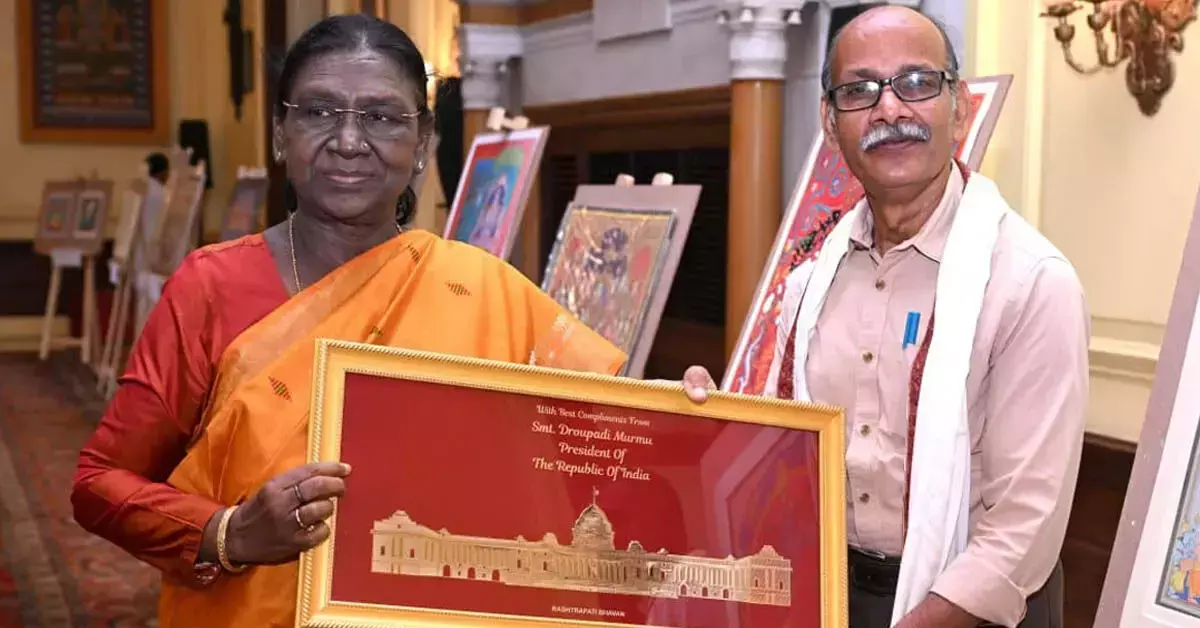
Renowned miniature painter Kamal Ahmed Malekoppa, a native of Gadag district and currently residing in Karkala, was honoured by President Droupadi Murmu after participating in the Artist-in-Residence programme held at Rashtrapati Bhavan in New Delhi.
The 10-day programme brought together 12 artists from across India, representing traditional art forms such as Banaras mural, Thangka, Nayak, Kerala mural, Basohli, Surpur and Mysuru styles.
Kamal Ahmed has been practising miniature painting for nearly three decades. He has drawn inspiration from the Vijayanagara Garudadri style and has developed a distinctive style of his own.
As part of the programme, he created an artwork at Rashtrapati Bhavan and displayed two artworks in total. One of the works was based on stories from the Panchatantra.
President Droupadi Murmu interacted with the participating artists and viewed their works. She appreciated their contribution towards preserving India’s traditional art forms and passing them on to future generations.
The Artist-in-Residence programme was organised to celebrate India’s artistic heritage and promote traditional art forms while strengthening the country’s cultural identity. Malekoppa’s selection has also brought national recognition to the Vijayanagara Garudadri-inspired painting tradition.
Kamal Ahmed previously worked as an art teacher for 18 years at Government High School in Shivapura, Hebri taluk, Udupi district. His artworks are displayed on the walls of government office buildings in Hebri and at various institutions.
Speaking about his selection for the programme, Malekoppa expressed happiness at getting the opportunity to participate in the prestigious event at Rashtrapati Bhavan. He described the experience as an unforgettable moment in his life and said the recognition had brought national attention to the Vijayanagara Garudadri-inspired painting style and its place in India’s artistic heritage.
source: http://www.english.varthabharati.in / Vartha Bharati / Home> Karavali / by Vartha Bharati / August 20th, 2026
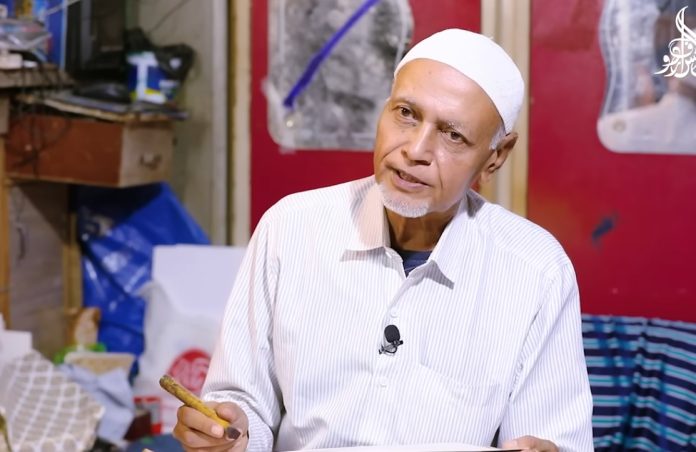
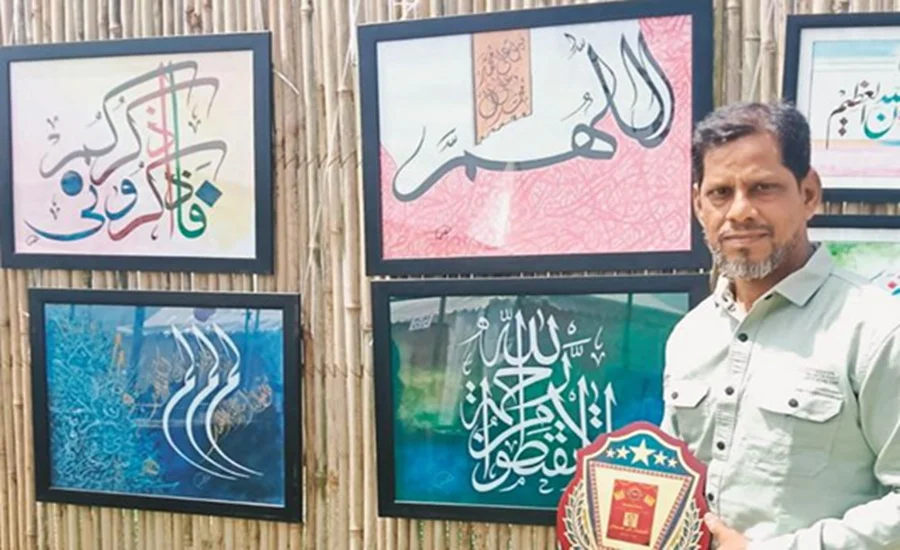
A calligrapher has turned his devotion into a lifelong artistic mission by writing the name of Prophet Muhammad (pbuh) more than 2400 times in distinct styles, expressing deep love through the art of calligraphy.
Known as Gul Ayyubi, the artist began this journey in 2014 after the passing of his mother. He started writing the Prophet’s name daily with the intention of sending spiritual reward to his parents. Each design was shared as an image, encouraging viewers to recite Durood upon seeing it.
Over the years, this effort grew into a sustained practice. Gul Ayyubi focused on ensuring that every piece remained unique. He worked across multiple calligraphic styles including Nastaliq, Diwani, and Persian scripts. He avoided preliminary sketches and wrote directly with pen and ink, relying on instinct and experience.
He explained that each composition begins with the first letter, after which ideas develop step by step. He said the repetition of a single name brings new creative challenges, as each version must differ in form while retaining clarity and beauty.
In addition to writing the name Muhammad (pbuh), he also created designs combining the names of Allah and Mustafa in innovative forms. These works reflect both artistic experimentation and spiritual intent.
Gul Ayyubi said he believes divine support guides his work. He recalled unusual experiences during this journey, including improvements in his health and vision. He also shared that he had a dream in which he saw the Prophet, an experience that strengthened his commitment.
Despite limited financial resources, he continues his work with dedication. He spends his earnings on basic materials such as paper, ink, and pens. He said access to better tools would help preserve his work for future generations and present it at a wider level.
His work has drawn attention from those who value both art and faith. Viewers often describe a sense of spiritual connection when they see his calligraphy.
Gul Ayyubi said he intends to continue this effort for the rest of his life. For him, each piece serves as both an artistic creation and an act of devotion, connecting creativity with faith in a direct and personal way.
source: http://www.radiancenews.com / Radiance News / Home> Latest News> Pride of the Nation> Markers of Excellence> Report / by Radiance News Bureau / May 22nd, 2026
The marble throne of Bahadur Shah Zafar, the last Mughal emperor, symbolizes a collapsed dynasty, now housed in a museum near Humayun’s Tomb in Delhi.
Delhiwale: The ultimate Mughal souvenir
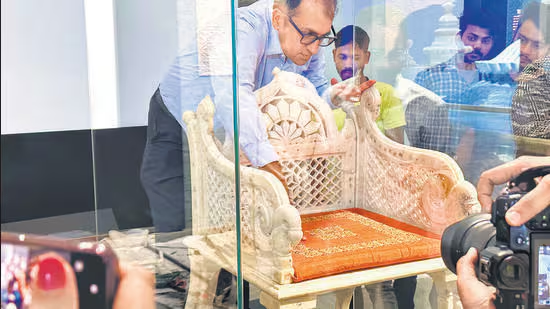
Behold this marble throne. Preserved inside a glass case at the Humayun World Heritage Site Museum in Delhi, it was once the stately seat of Bahadur Shah Zafar. As the last Mughal sovereign, the poet-king is likely to have sat on this throne while reflecting on the dissolution of his 300-year-old dynasty. The throne is, in fact, less ostentatious than the throne-like sofas found in the drawing rooms of Delhi’s wealthy today. Yet it is far more elegant. The armrests are supported on latticework, and faint flecks of colour cling to the marble like the last glimmers of extinguished stars. The fragile-seeming relic assumes truly epic proportions as the viewer connects it to the legend of a collapsed empire whose layered legacy continues to resonate in our republic (vividly chronicled in this newspaper yesterday).
The Mughals spanned over 18 rulers. Their kissa-kahani began 500 years ago in 1526, when Babur defeated Delhi Sultan Ibrahim Lodi in a field 80 kilometres from Delhi. Soon after, Babur entered the city and visited the shrine of the mystic Hazrat Nizamuddin Auliya. At that time, nobody would have guessed that this pilgrimage would recur across generations of Mughals, binding them to the city’s sacred, grave-dotted topography.
Truth be told, Delhi surpasses the dynasty’s other great centres, Agra and Lahore. Shahjahan may have built the immortal Taj in Agra, but his creation of Old Delhi throbs more with real life. For Delhi’s pre-eminence in Mughal India, we must first credit Babur’s son, Humayun, who established his capital, Dinpanah—today’s Purana Qila—near the shrine of Hazrat Nizamuddin. His son Akbar later built Humayun’s mausoleum close to the same shrine.
Over time, Humayun’s Tomb came to be known as the “dormitory of the Mughals.” This 16th-century complex contains 160 graves of kings, princes, and princesses, representing a broad cross-section of the dynasty. Seven Mughal emperors are buried here: Humayun, Azam Shah, Jahandar Shah, Farrukhsiyar, Rafi ud-Darajat, Rafi ud-Daulah, and Alamgir II. It was here, at Humayun’s Tomb, that Bahadur Shah Zafar took refuge after the collapse of the 1857 uprising against the British. He was captured at this very site, marking the end of the Mughal Empire.
The aforementioned museum, which houses Zafar’s throne, is across the road from Humayun’s Tomb. In the lead-up to its inauguration two years ago, a significant moment was the installation of the throne, personally overseen by museum curator Ratish Nanda—see photo. A conservation architect, Nanda had earlier helped restore the garden around the first Mughal emperor’s tomb in Kabul.
As for the last Mughal, the unfortunate Zafar had intended to be buried in Delhi, but the British exiled him to Rangoon, where he was finally laid to rest. As a consolation, his ill-fated throne may be seen as a symbolic substitute for his Delhi tomb. Indeed, as the tomb of his dynasty itself.
source: http://www.hindustantimes.com / Hindustan Times / Home / by HT Correspondent / May 04th, 2026
Dr Zareena Parveen, director, State Archives, and coordinator of the Cluster Centre, GBM, explained that the survey has identified 1,95,935 manuscripts, including those of the Telangana Archives, and a total of 29,871 images of 130 manuscripts had been uploaded till May 2.
“The handmade paper used for the farman is a rare example showcasing the royal practices of the time,” M.A. Raqeeb, assistant director, Telangana Archives, told Deccan Chronicle. (Image: X)
Hyderabad:
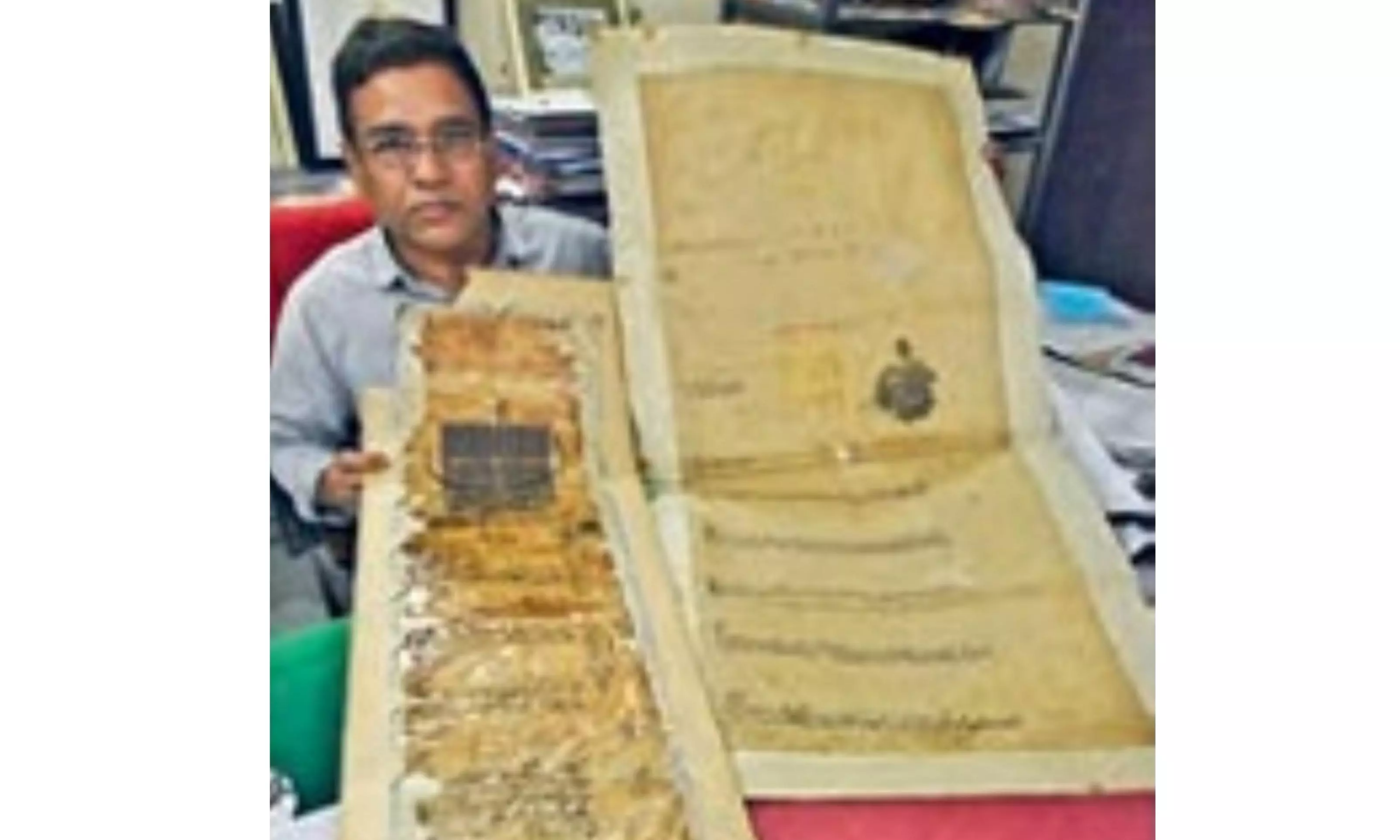
A royal farman, said to be the second oldest in India — issued by Sultan Feroz Shah Bahmani (1397–1422) in 1406 — will be among close to two lakh manuscripts identified as part of the survey by the Gyan Bharatam Mission (GBM) in Telangana. The GBM is a national initiative by the Union culture ministry to unearth, preserve and digitise India’s massive manuscript heritage.
This decree on Persian‑style handmade paper is 33 x 10 inches in size, with ink and royal‑seal authentication. The document was issued from Gulbarga, which was the seat of power for the Bahmanis before it was shifted to Bidar. The decree grants land as inam to Muhammed Ahmed, Qazi of Kalyani, and bears the distinctive tughra (monogram) and the Bahmani royal seal.
“The handmade paper used for the farman is a rare example showcasing the royal practices of the time,” M.A. Raqeeb, assistant director, Telangana Archives, told Deccan Chronicle.
Another well‑preserved royal farman is of Emperor Shah Alam II, issued in 1773 AD, appointing Maharaja Narayan Rao Bahadur as official caretaker of the riverbank near Allahabad. Believed to be part of preparations for the Kumbh Mela, the emperor issued clear instructions to officials not to levy fees.
“All expenses for maintaining the site and facilitating the pilgrims’ rituals are to be borne entirely by the Mughal government,” the decree says.
According to the decree, Hindu pilgrims (yatris) arriving from across the subcontinent — especially from Gujarat and Maharashtra — must be allowed to take the sacred bath and holy dip for spiritual purification without any fee or levy. The directive is to be strictly implemented and communicated to the commissioner of police and all present and future officers for perpetual observance.
“This farman illustrates the Later Mughal policy of imperial patronage toward diverse religious practices and underscores the state’s responsibility for safeguarding pilgrimage routes and sacred bathing ghats,” Raqeeb explained.
The cluster centre at the State Archives has identified and completed surveys of 17 institutions and individuals, while surveys for another 42 are underway. It has so far scanned 57,842 documents and exported 29,871 images.
Dr Zareena Parveen, director, State Archives, and coordinator of the Cluster Centre, GBM, explained that the survey has identified 1,95,935 manuscripts, including those of the Telangana Archives, and a total of 29,871 images of 130 manuscripts had been uploaded till May 2.
“At the State Archives alone we have over 1.8 lakh manuscripts, including 668 in book form, 155,000 paper items and 25,000 private collections (paper). Most of these are in Old Persian (Shikista) and cover varied subjects, including graphic pictures of Mansabdari, revenue and military systems of the Mughals in the Deccan region (South India),” Dr Parveen director explained.
source: http://www.deccanchronicle.com / Deccan Chronicle / Home> Southern States> Telangana / by Md Nizamuddin / May 03rd, 2026
The two-day exhibition brought together artists from several countries; Momin was selected for the upcoming international exhibition in Norway
Bhiwandi :
A young calligrapher from Bhiwandi has brought pride to his city after gaining special recognition at an international Qur’anic calligraphy exhibition in Delhi held recently.
The two-day (March 28-29) exhibition aimed to connect the younger generation with the art of calligraphy and spread the universal message of the Holy Qur’an in a beautiful and meaningful way. The event saw participation from artists and representatives from countries including Switzerland, France, Turkey, Saudi Arabia and the United Arab Emirates, making it a truly global platform.
Among the selected participants from across India, only ten prominent calligraphers were chosen to showcase their work. Mansab Momin, also known as Mansab Art, was one of them. His inclusion in the exhibition was seen as a recognition of his skill and dedication to the art.
Momin’s Qur’anic designs and calligraphy pieces drew strong attention from visitors. People who attended the exhibition closely observed his work and appreciated the detail and balance in his writing.
During the event, Momin also conducted a live workshop which became a major attraction. He created calligraphy on canvas in front of the audience and wrote names and phrases on the spot for hundreds of visitors.
Speaking about his experience, Momin said, “Calligraphy is part of our rich cultural and religious heritage. It is important that we pass this art on to the next generation.” He added, “I will continue my efforts to teach and promote this art, and I plan to restart calligraphy training classes soon.”
Organisers of the exhibition were also impressed by his performance. Due to his strong command over the art, Momin has been selected to participate in an upcoming international calligraphy exhibition in Norway.
One of the organisers said, “His work reflects deep understanding and control. The response from the audience shows how powerful this art form can be.”
The exhibition was held under the supervision of noted calligrapher Gauri Yusuf Hussain from Gujarat. It was seen as an important step in promoting calligraphy and introducing it to a wider global audience.
Momin’s achievement is being seen as a matter of pride not only for him but also for the people of Bhiwandi, as his work continues to carry forward a meaningful artistic and spiritual tradition.
source: http://www.clarionindia.net / Clarion India / Home> Editor’s Pick>India>Indian Muslims / by Team Clarion / April 16th, 2026
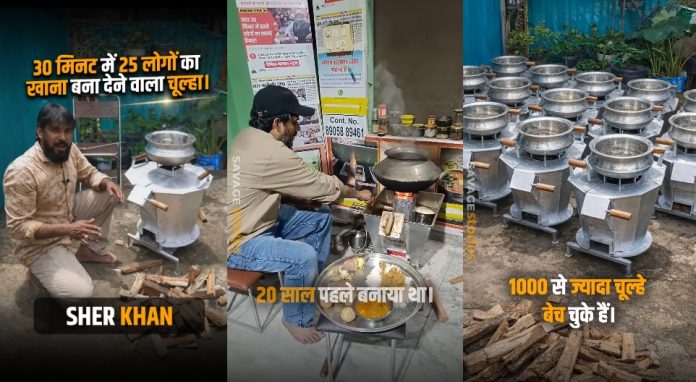
Mohammad Sher Khan, a Muslim iron craftsman from Udaipur, Rajasthan, has drawn attention for his innovative Vishwaguru Chulha, a stove designed to cook meals for 25 people within 30 minutes while reducing fuel use and smoke.
Khan, a class 8 dropout, spent 27 years refining the design after observing women spending long hours cooking multiple dishes using large amounts of firewood. His aim was to reduce cooking time and ease the burden on households. He patented the stove in 2017 after testing it in homes and dhabas. More than 10,000 units have been sold.
The stove features a three layer system. The top section bakes items like rotis and bread. The middle section handles frying. The bottom section boils dal and other dishes. This design allows users to prepare multiple items at the same time.
Khan states that the chulha uses around 2 kilograms of firewood compared to nearly 10 kilograms in traditional methods. The design also reduces smoke, improving working conditions in kitchens.
Demand has increased due to disruptions in LPG supply linked to global tensions affecting key shipping routes. Many households and small eateries face rising costs and supply delays. The Vishwaguru Chulha offers an alternative priced at around Rs 10,000.
The innovation highlights how local solutions address everyday challenges. Khan plans to expand reach across homes, eateries, and small businesses, offering a practical option for efficient cooking.
source: http://www.radiancenews.com / Radiance News / Home> Latest News> Markers of Excellence> Personality> Report / by Radiance News Bureau / March 30th, 2026
Amid our fast-paced lives, there exists a remarkable group of individuals who believe in slow, steady, and consistent efforts to create meaningful change.
These individuals are known as changemakers—people who quietly dedicate themselves to bettering society, far from the spotlight and the noise of daily routine.
They don’t seek fame or recognition. Instead, they focus on making a positive impact in their communities. Often unheard of, these changemakers influence others through their actions, values, and vision for a better world.
Awaz–The Voice is proud to launch a special series starting this Sunday, spotlighting Indian Muslim changemakers of India.
Through their inspiring stories, we aim to shine a light on individuals whose work exemplifies compassion, dedication, and innovation.
Our editorial team has carefully selected these changemakers based on several parameters, including the authenticity of their efforts and the tangible impact they have made.
These are everyday heroes who are addressing pressing social, environmental, and economic challenges—often with limited resources but unwavering commitment.
They are improving access to education, healthcare, and sanitation; they are empowering women, protecting the environment, and uplifting their communities—all without expecting any rewards or recognition. For them, the satisfaction of doing good is reward enough.
Their actions may seem small, but their impact is profound. As the saying goes, “Every drop counts in making an ocean.” Each changemaker is a vital part of the wave of progress that is quietly transforming India.
One of our key criteria in identifying these individuals was whether they are creating tangible change or inspiring others to become changemakers themselves. For us, a changemaker is someone who brings positivity into the world through innovative solutions, leadership, and a commitment to improving lives and systems.
In a world that often celebrates loud success, we believe it’s important to pause and acknowledge those who uphold the highest ideals of humanity. These changemakers serve as a moral compass, reminding us of our own responsibilities to society and to one another.
We begin our series with changemakers from Uttar Pradesh, featuring stories like that of Capt. Saria Abbasi, who dreamt of joining the Indian Armed Forces from a young age. After earning her engineering degree and receiving multiple job offers, she chose instead to follow her dream and joined the Indian Army—becoming a role model for countless Muslim women aspiring to serve the nation. She has done challenging missions like serving at Indo-China border post at Tawang in October 2021.
Rubina Rashid Ali, who lives in Aligarh Muslim University’s campus has become a champion for women earning their livelihood out of applique (ornamental needlework in which pieces of fabric are sewn or stuck). She has stood up for them to ensure that these women from poor backgrounds get the wages they deserve.
The changemakers of India
Dr Farha Usmani, a medical practitioner who hails from Aligarh, went to US to pursue her career in the United Nations Population Fund in 2007. Leaving behind her family was a tough call for her. She is the only Muslim woman to have risen to the position of director in the UNFPA. Today, she is making world policies for women’s health and rights. She is the Vice President of SAFAR, an organization that is responsible for the overall advancement and rights of minority and marginalized women and girls in India.
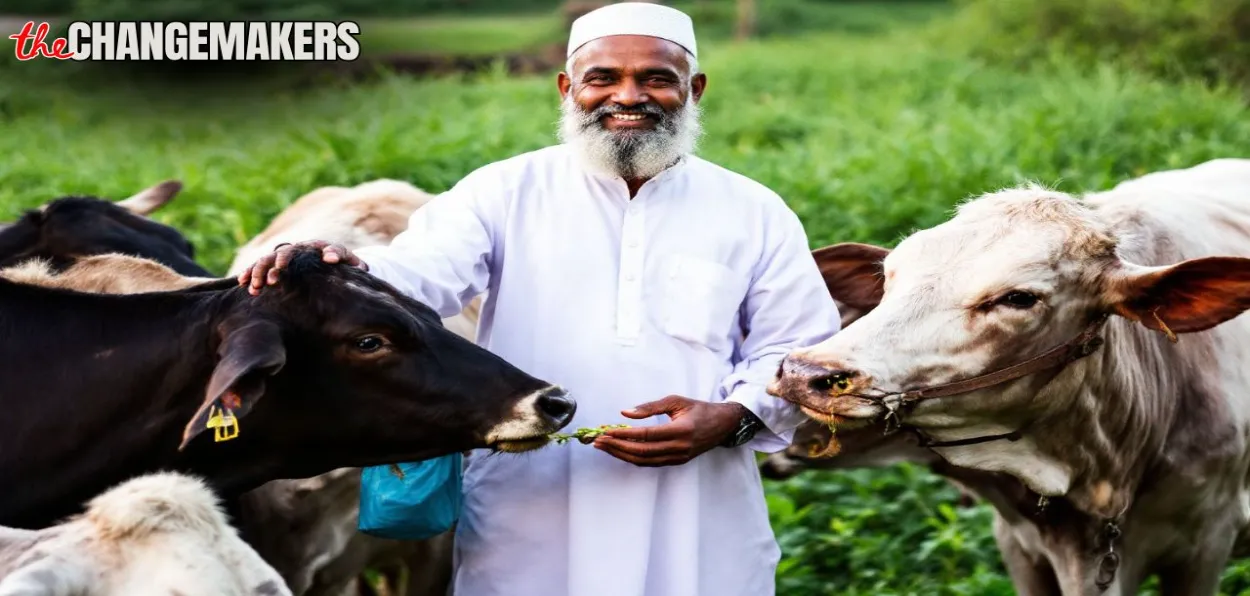
Another inspiring figure is Babban Mian, a businessman who runs a large gaushala (cow shelter) in Bulandshahar, caring for hundreds of cows. Inspired by his late mother’s deep affection for animals, Babban Mian’s work also challenges stereotypes and promotes harmony by offering a different perspective on the Muslim community’s relationship with animal care.
Some of the changemakers will remind you of characters straight from Indian folklore and vernacular literature. People who have been nurtured by Indian civilizational values of compassion and selflessness.
Through these stories and many more, we hope to inspire our readers and celebrate the quiet revolution being led by changemakers who are shaping a better, more inclusive India.
We’d love to hear your thoughts on this series. Write to us at input@awazthevoice.in or engage with us on our social media platforms.
The author is the Editor-in-Chief of Awaz-the Voice portal
source: http://www.awazthevoice.in / Awaz, The Voice / Home> Stories / by Atir Khan, Editor-in-Chief, Awaz-the Voice portal / May 22nd, 2025
Belonging to a conservative Muslim family, it was hard for Fatima Ahmed to break the shackles but she made sure to follow her dreams and do all that she ever wanted. From travelling the world to living like a “gypsy” and creating her very own niche in the world of art, Ahmed has lived her life on her terms. Read about this feisty and inspiring artist.
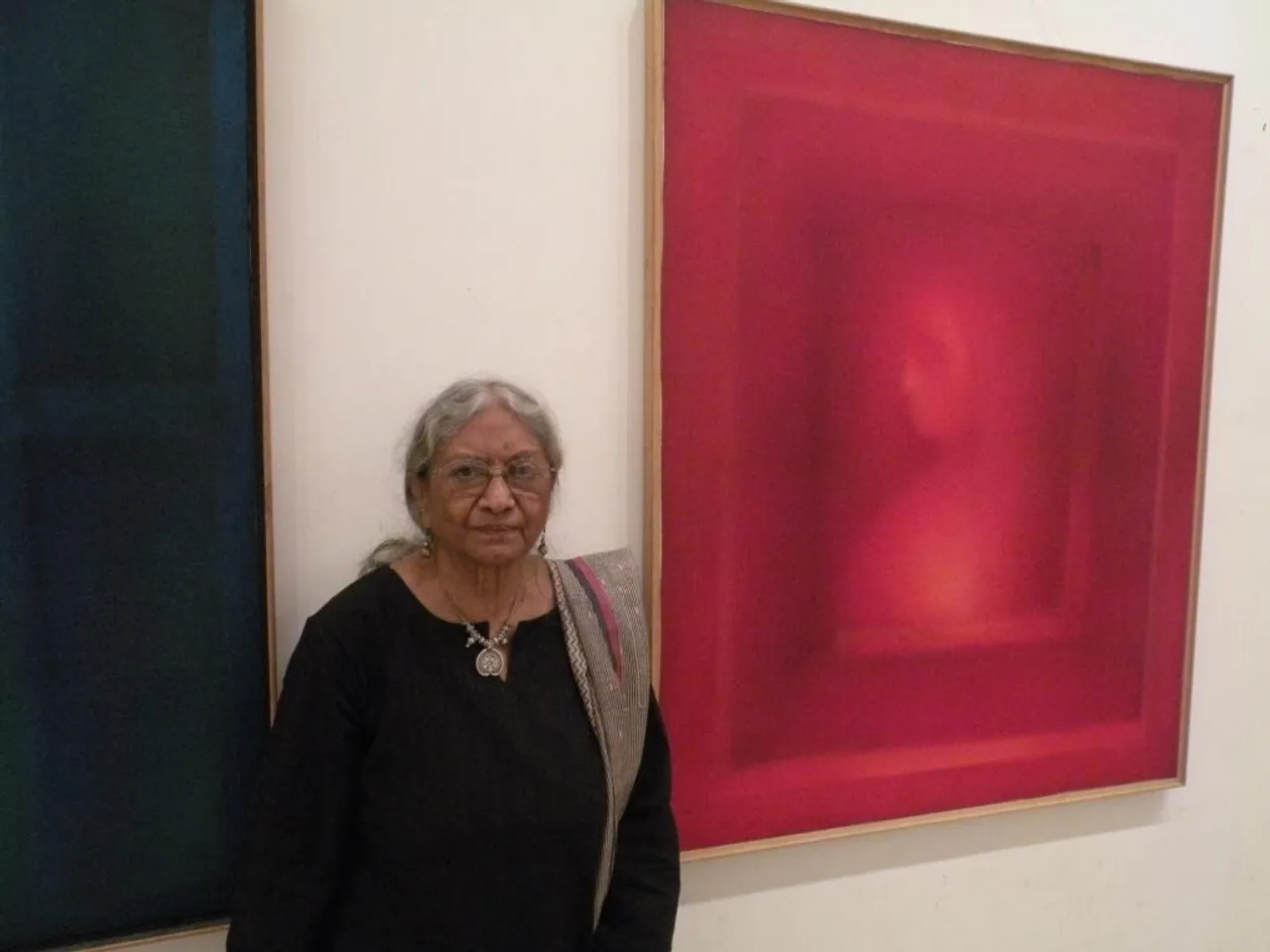
Legendary rebel artist and writer Fatima Ahmed, who is nearing 80, is a picture of contrasts. While she is fun-loving and full of life, her paintings are still and silent. (Credit: Surekha Kadapa- Bose\WFS)
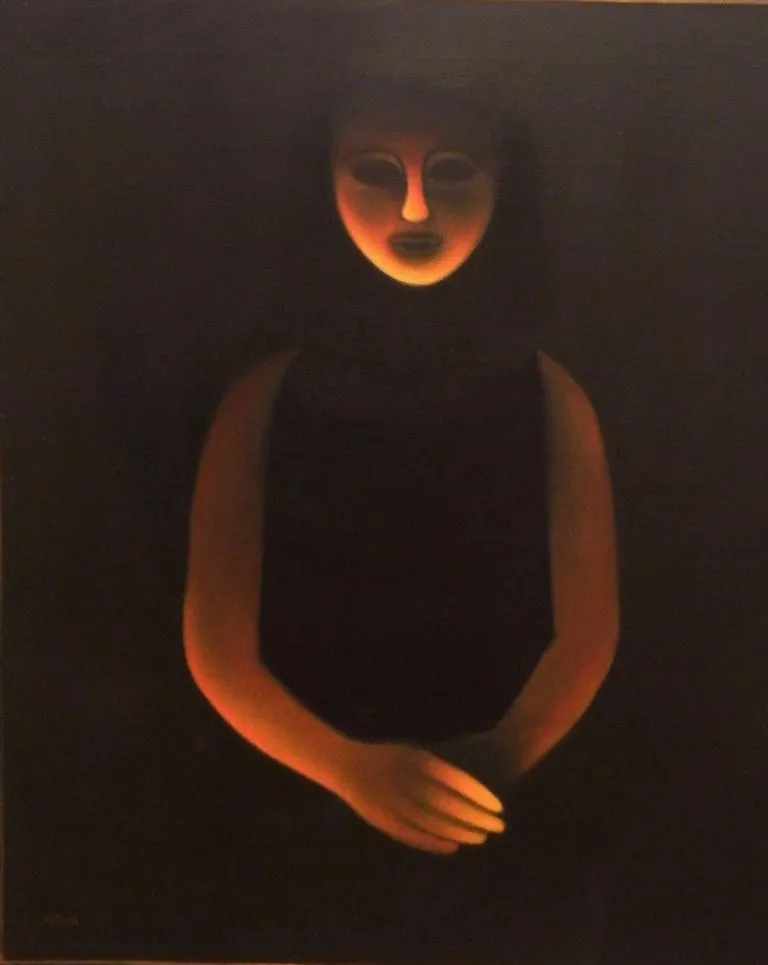
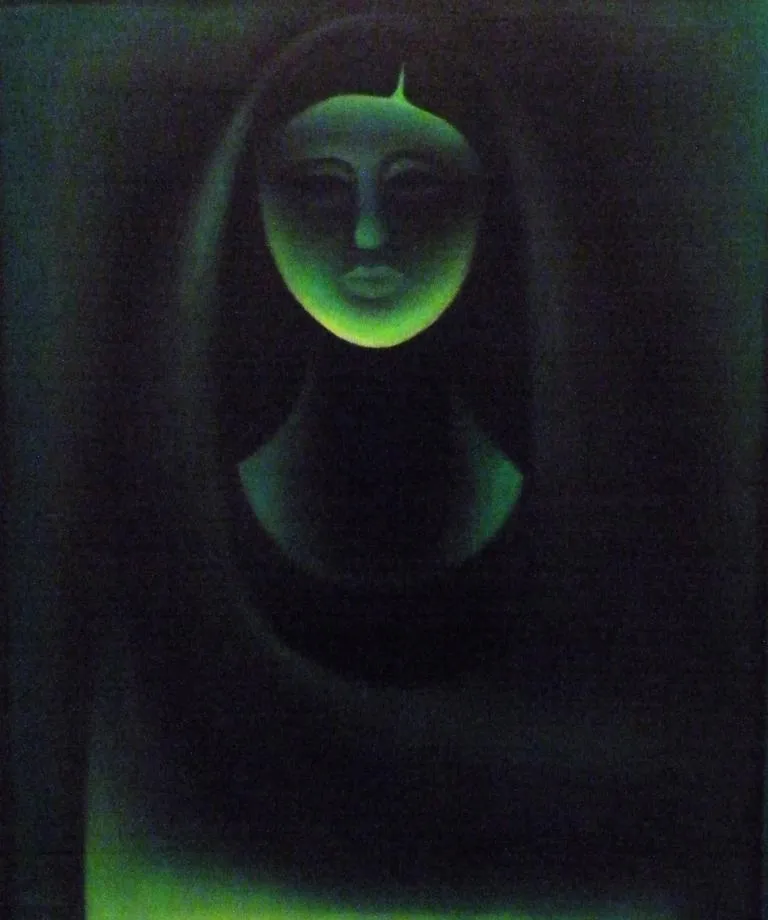
‘If only silence could speak’ goes the adage. Well, here silence does speak – and how! Soft, hazy, elusive images of women gaze steadily from the confines of their canvas making the much-mesmerised onlooker feel as though they would simply vanish if s/he so much as blinked. The women in red, pink, beige oil paints look ethereal, delicate and yet they convey power, strength – much like the woman who has created them.
“Space and light are very important to any work of art, especially paintings,” explains legendary rebel artist and writer Fatima Ahmed, whose latest oil canvases were on display in Mumbai recently. She continues, “In life, there has to be some mystery. Everything shouldn’t be very obvious and spoken out loud. In my works I don’t like clutter, loud colours or screaming. I like my paintings to be as subtle as a whisper.”
“Let me start by saying I simply love to eat the crisp crust of a samosa,” she says, with twinkle in her eyes, before adding, “Now as far as the silence in my work is concerned, throughout my life I have been more of an observer. I was a recluse during my childhood as I didn’t have anyone to share my thoughts and feelings with. I was a rebel for everyone around me and way back in the middle of last century it wasn’t a good sign.”
Coming from a conservative Muslim family in Hyderabad, Ahmed never really fit in because she was a free spirit who believed in equality. Her father was a Collector under Nizam Osman Ali Khan, Asif Jah VII, the last Nizam of Hyderabad.
In her joint family, daughters were married off in their early teens within the extended family. Moreover, as the Ahmed family was very highly placed within the Nizam’s palace, its members, too, were treated as royalty, which was never acceptable to her.
“I just couldn’t tolerate treating those employed in our household as slaves. Besides, women in that era didn’t have any say in any sphere of life and were forced to blindly follow all the dictates of men without questioning them. I certainly wasn’t going to do that,” she says emphatically, her voice betraying the anger she still feels towards the strict patriarchal rules they were made to adhere to in that period.
The women in red, pink, beige oil paints look ethereal, delicate and yet they convey power, strength. (Credit: Surekha Kadapa-Bose\WFS)
So Ahmed grew up with vivid visions of freeing everyone who was treated as a lesser human being. “Quite unknowingly, I was influenced by socialism,” she remarks. And at that age she had also made up her mind that she would rather die than marry one of her cousins. According to her, the one good thing her father did was to enrol her in the Government Mahaboobia Girls School, the foremost learning institution at that time. “Our teachers taught us out of syllabus and gave us the freedom to think. I didn’t like Hyderabad then but I loved my school,” says the artist, who is nearing 80.
It was there that she developed a deep love for drawing, painting and the classical Indian dance form Kathak, all of which she learnt without the approval of the family elders. The dance classes came to an end as soon as her father came to know.
“Unfortunately, my mother had a stroke at the time. And though I did have a large family of sisters, brothers, cousins and aunts, I could never really converse with any of them or share my true feelings,” she elaborates.
After school, as Ahmed refused marriage outright, she was grudgingly allowed to join college. But there again she met with another hurdle. She wasn’t interested in any of the usual subjects of science and wanted to join College of Fine Arts, which, of course, wasn’t permitted. So she found a way to get in. Mischievously she narrates, “I forged my father’s signature on the application form but the principal detected my lie and quizzed me. When he understood that I was really interested in the arts and saw a painting I had done of a litter of puppies, he relented.”
The demise of her parents made her leave home and Hyderabad for good. “I certainly didn’t want to stay back and be bossed around by my brothers and other family members,” she says about her escape to Bombay in early 1960s.
Admitting that the Hyderabad of today has changed considerably, the ageing artist nonetheless doesn’t think there is much difference still in the way girls from poor Muslim families are treated, “While girls from well-to-do homes get an education, are fashionable, go abroad, mingle with the rest of the world, this is not true of the low income Muslim families. They still live in a very male dominated society and this is not only restricted to Hyderabad or India but all over the world.”
Her arrival in Bombay and the “gypsy lifestyle” she led for the next two decades saw her engage closely with the world of art and writing. “I really didn’t exploit the kind of opportunities that came my way. I just took life one day at a time by living it on my own terms,” recalls Ahmed especially referring to her two-year stint in London where she painted, went through a financial crisis and then discovered spiritualism.
Fatima Ahmed, whose latest works were part of a recent exhibition, ‘If only silence could speak’, likes her paintings to be as subtle as a whisper. (Credit: Surekha Kadapa- Bose\WFS)
Despite those struggles, great success has come to her. She has held innumerable exhibitions in Mumbai, Delhi, Chennai, Hyderabad, Bhopal, London, Mauritius, Dubai, Hong Kong, Russia and South Africa, among many other places. Her works have been auctioned by Christies and are part of several private collections and state galleries, including the National Gallery of Modern Art (NGMA) in Delhi, Birla Art Akademi, Kolkata, the Stuttgart State Library and Masanori Fukuoka Museum in Japan.
What or who has influenced her art over the years? Initially, Ahmed says she was influenced by Gauguin, Cezanne, Van Gogh and Modigliani. But she consciously stayed away from those influences, as she felt “there was no fun in copying others”, and developed her own style.
Once she got back from London to Mumbai she caught up with many of her journalist friends. One of them was late Khushwant Singh, with whom she argued, fought and enjoyed interacting. It was he who encouraged her to get into writing. She started by translating works of Ismat Chugtai, Saadat Hassan Manto, Kaifi Azmi and other Urdu literary greats into English. This paved the way for to her write the semi-autobiographical, ‘In Haleema’s Words’. It was on one of her reporting assignments that she visited the Rajneesh Ashram in Pune, which has become her permanent home now.
Personally, Ahmed may be less of a rebel these days but her works more than make up – though still and silent they exude the quiet strength of women.
Written by Surekha Kadapa-Bose for Women’s Feature Service (WFS) and republished here in arrangement with WFS.
source: http://www.thebetterindia.com / The Better India / Home> Art / by Surekha Kadapa-Bose / December 14th, 2014
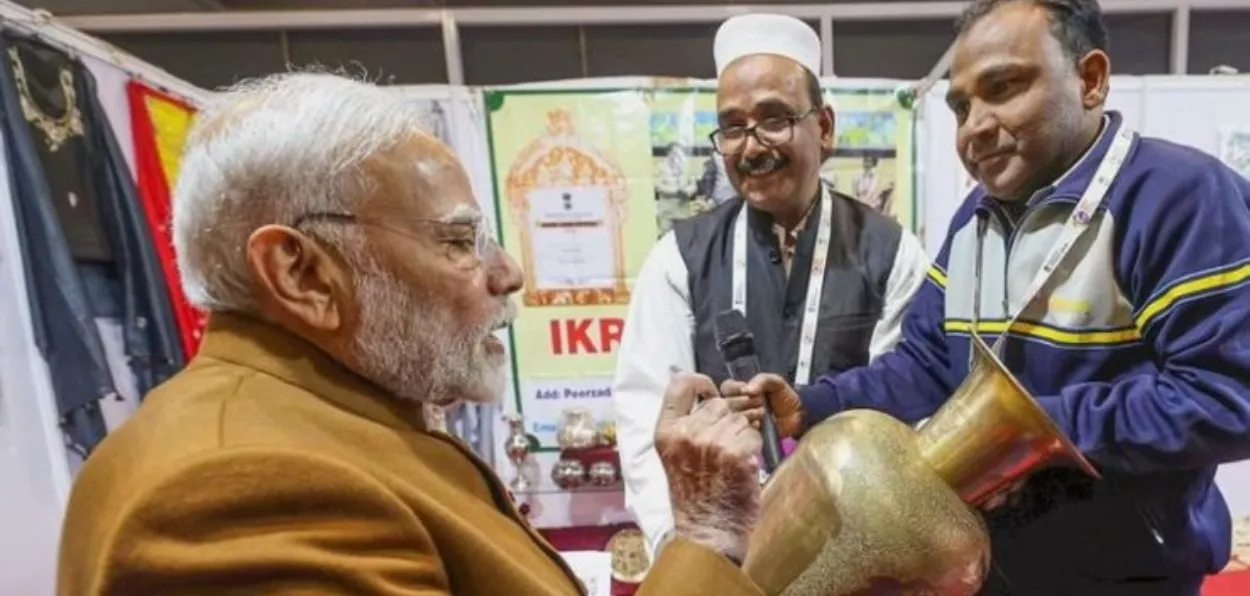
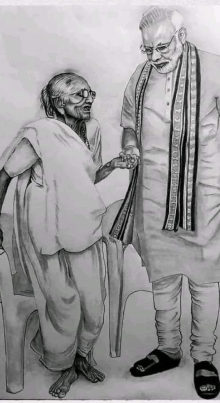
Ikram Hussain (wearing a cap) with Prime Minister Narendra Modi at Bharat Mandapam, New Delhi
Ikram Hussain was 15 years old when the manager of the Eidgah Gurdwara in Moradabad, UP, asked him to engrave his mother’s name on an aluminium plate. The young boy had never gone to school but had picked up the skill of metal carving from his father. The young boy felt embarrassed and told the manager that he must write the name for him since he was illiterate.
He engraved the name beautifully onto the plate and received Rs 10 for this work. This amount gave him confidence, and he decided to pursue his work seriously.
Today, Ikram Hussain, 61, from Moradabad, Uttar Pradesh, is a national award winner. None other than Prime Minister Narendra Modi praised him for his art.
One of the glorious moments of his life was when Prime Minister Narendra Modi was impressed and moved by his beautiful carvings at the The 12th Grameen Bharat Mahotsav at Bharat Mandapam, New Delhi last year.
Ikram was carving a piece depicting Prime Minister with his late mother on a 3-feet brass jar. Prime Minister intently watched his carvings and patted him for his work and dedication. He displayed this work at the festival.
Moradabad, known as the “Brass City,” is renowned for its exquisite brass artefacts. Ikram Hussain says he could not study due to financial constraints at home. However, he never lost hope.
At a young age, he began assisting his grandfather and father in their brass engraving work. His father, Haji Abdul Hamid, and his uncle, Razak Medal winner Haji Ghulam Nabi, were well-known brass engravers in Moradabad. Ikram started learning this art at the tender age of seven.
Even today, his eyes well up with tears when asked why he couldn’t complete his studies. He explains that his family’s financial situation was extremely precarious. To help support the family, he had to leave school and start working.
The family worked day and night, yet they could barely earn five to seven rupees a week. Even that amount was hard to come by those days. Despite this, Ikram never let his circumstances become a weakness.
While working, he meticulously learned the intricacies of engraving. His hard work and dedication resulted in him gradually mastering the art of working with brass to the point where he could accurately engrave the likeness of any person’s face.
His engravings display emotion, depth, and lifelike detail. This is why his art has equally impressed people from all communities—Hindus, Muslims, Sikhs, and Christians alike.
#VIRAL | मुरादाबाद, जो अपनी पीतल की कला और हस्तशिल्प के लिए पूरी दुनिया में प्रसिद्ध है, ने अनेक प्रतिभाशाली शिल्पकारों को जन्म दिया है। इन सभी में एक नाम विशेष रूप से उभर कर आता है—इकराम हुसैन। 61 वर्षीय इकराम हुसैन ने अपने जीवन की कठिनाइयों और संघर्षों के बावजूद पीतल की नक्काशी… pic.twitter.com/1Jvxm3iWTt
His hard work paid off, and in 2004, he received an award from the Uttar Pradesh government for his outstanding carving skills. He also received a cash prize of 5,000 rupees.
At that time, five thousand rupees was a considerable sum of money. Ikram recounts that when he went to deposit the check at the bank, the bank manager even offered him tea. This recognition was like a dream come true for him. There was an atmosphere of joy in his family, and his morale was boosted manifold.
Today, Ikram Hussain is recipient of honours and awards from various parts of the country.
He runs his company, which he started with a bank loan. This craftsman, who once earned just five rupees a week, is now providing jobs and training to many.
Ikram Hussain’s story is not just a success story of a craftsman, but an example of struggle, perseverance, and self-confidence. He proved that with determination and hard work, a lack of formal education cannot be an obstacle to success.
The master craftsman is recognised throughout the country for his art and social message. The demand for his brass products is high, and his business is worth millions.
The Bihar government has hired him to train the artisans. He trained more than 400 artisans at the Upendra Maharathi Shilp Anudan Sansthan.
Ikram Hussain inherited his passion for this art form, as his father also trained people in the same craft. His exceptional carvings have earned him a place in the Guinness Book of World Records.
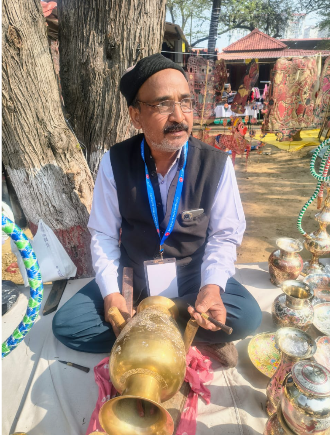
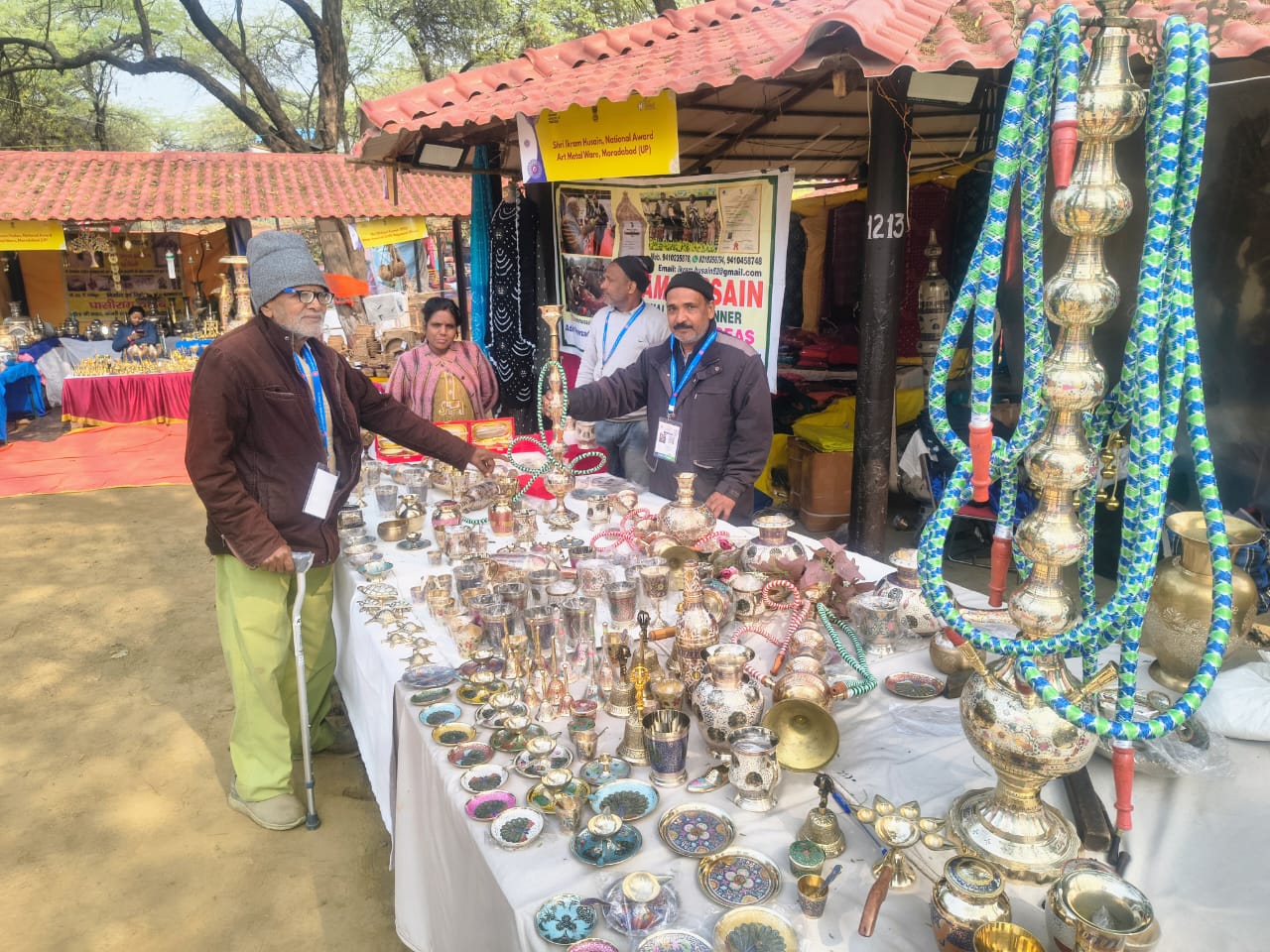
Ikram Hussain at his stall at the Surajkund Festival
Craftsman Ikram Hussain has conveyed a message of communal harmony by engraving symbols of Hindu, Muslim, Sikh, and Christian religions on his brass products.
He was honoured with a National Award in 2022 for his art and for promoting brotherhood in society.
Ikram Hussain believes that all religions are part of the same family and that we should rise above caste and creed to strengthen love and brotherhood. “We are all flowers of the same branch, only our colours are different. We should promote love and brotherhood, not hatred.”
His carving of the Ram Temple on a vase and his work on a 40-inch vase at the Golden Temple can be seen up close at the Lucknow Museum.
He has received numerous awards, including the State Award Second from Uttar Pradesh, the Bhim Rao Ambedkar Award, the Dr Ram Manohar Lohia State Award, the National Award Second from Union Minister Piyush Goyal, two honours from the Assam government, and an honour from the Prime Minister.
Overall, he has received 20 national and international awards. His work and contributions have also earned him a place in the Guinness Book of World Records.
source: http://www.awazthevoice.in / Awaz, The Voice / Home> Stories / by Dayaram Vashisth / February 05th, 2026
Tragically, Munawar Ali Khan Sahib died at the peak of his career, at the age of 59 in Kolkata in 1989.
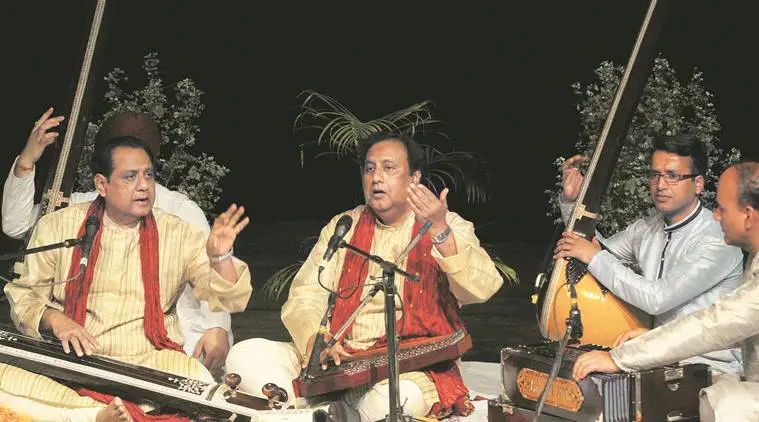
Artistes perform at Tagore Theatre in Sector 18, Chandigarh, on Saturday. Express
Triveni Sangeet Sabha paid a homage to late Ustad Munawar Ali Khan of Kasur Patiala Gharana on Sunday evening at Tagore Theatre. An audio-visual presentation on Ustad Munawar Ali by Niharika Popli was projected. This was followed by vocal recitals by Ustad sahib’s son Raza Ali Khan and his two nephews Ustad Mazar AlI and Awaad Ali Khan. Chandigarh-based Primila Puri, his disciple, also sang.
Ustad Munawar Ali Khan was born in 1930 in Lahore. He was the son of the legendry maestro Padmabhushan Ustad Bade Ghulam Ali Khan and trained under his father and his uncle Ustad Barkat Ali Khan. Munawar Ali Khan had a full-throated, powerful voice with open aakar, which adapted itself to different styles of bandishes like khayal, thumri, dadra and after his father’s death in 1968, he became a worthy representative and the ‘Khalifa’ of the Kasur Patiala Gharana. He created many khyals, thumris, geets and ghazals and sang brilliantly difficult ragas of his gharana and also created a new raga named Malini Basant.
Tragically, Munawar Ali Khan Sahib died at the peak of his career, at the age of 59 in Kolkata in 1989. The Kasur Patiala legacy is now carried on by his son Raza Ali Khan and his nephews Jawaad Ali Khan, Mazhar Ali Khan and Naqi Ali Khan.
source: http://www.indianexpress.com / The Indian Express / Home> News> Cities> Chandigarh / by Express News Service / March 18th, 2018