Category Archives: Books (incl.Biographies – w.e.f.01 jan 2018 )

Why We Need a Book About Muslims Who Fought for India’s Freedom

Mumbai, INDIA :

Can a stable and just democracy flourish on foundations of wilful amnesia and erasure?

A c. 1800 painting showing the last stand of Tipu Sultan, ruler of Mysore in 1799 at the end of the Anglo-Mysore Wars with the East India Company. Photo: Henry Singleton/Public domain.

Many will ask why a book about Muslims who fought for India’s freedom? There’s no answer to such questions except another question. Had we been better memory keepers as a nation, could we have avoided the peak disinformation and stupidity which normalises reviling ordinary Muslims as outsiders, infiltrator and insurgents? 

Muslim Freedom Fighters of India is a two-volume biographical compilation by Salim Khan on less-known, mostly forgotten and hardly known Muslim figures. The books aim to clear the fog around Muslim freedom fighters whose names are heard of without them being extensively known and this requires us to understand why this fog exists. Written in an extremely readable and accessible format, these biographical accounts embed the historical figures in the context of their times, responding to unprecedented events with foresight, clarity and conviction that sealed their fate and shaped and the nation’s destiny.

 Whether we are reading about Generals of 1857 – Bakht Khan and Khan Bahadur Khan – or the Cambridge-educated Rampur scion Mohammad Ali Juahar of Khilafat moment and his fiery mother Bi Amma, the larger questions seething beneath the stories keep rising to surface. Who does a society and nation choose to remember and celebrate? Whose memories are deemed worthy of preserving? History is always shaped by those who control archives, narratives and memorialisation and hence memory. 

Reading about Tipu’s dazzling reign through the three Anglo Mysore wars where he proved superior to British forces, I was reminded of the controversy sparked by the late Girish Karnad’s suggestion of naming the Bengaluru airport after Tipu Sultan. Karnad had said, “It is true that Tipu Sultan was not born in Bengaluru, but he was a son of this soil and a freedom fighter. Had Tipu been a Hindu, he would have achieved the status of Shivaji, and the airport would have been named after him.” I recalled Karnad because his play Dreams of Tipu Sultan echoes the same theme that this two-volume tribute to erased, obscured and deliberately unremembered historical figures echoes: that when politics lays down who should be forgotten, remembering the erased becomes a duty, an affirmation and a political act. 

It is important to clarify that this is not a compilation of eulogies but well-researched fact based account of people who had the uncommon clarity to resist colonial domination even before the nationalistic narratives took shape. That they happened to be Muslims is important today because of the distortions that have obscured and erased them. But back then when they fought and resisted, they were simply rallying for the cause of their soil and their watan. From the earliest times they understood that freedom from foreign domination required Hindus and Muslims to put up a united front as in the war of 1857, the Khilafat movement, and the period between 1919 and 1924. Back then too, traitors cut across religious lines – Jagat Seth, Mir Jafar, and Ilahi Baksh.

Muslim Freedom Fighters of India: Part 1 and Part 2’, Salim Khan, Qalam Aur Kaagaz Books.

From Siraj ud Daulah to Tipu to Shahzada Firoz Shah, the book shows how the fog around these personalities is not accidental but meticulously designed – initially by the colonial mind, then picked up by early nationalists and woven into simplistic narratives. The macabre dance of history further stifled Muslim voices. Cataclysmic events like the ‘end’ of the Mughal Dynasty in 1857 and the Partition in 1947 sundered clans, erased family histories, legacies crumbled with no one is around to defend and uphold them. Today, even people who don’t know history have heard of Lakshmi Bai, but many who read history may not have heard about Shahzada Firoz Shah, the Mughal Emperor’s grandson who in August 1857, led a band of armed soldiers to rally the rebels in Rohilkhand and Malwa and who fought alongside Tatia Tope and called for a united Hindu-Muslim front against the Company. 

The British understood the dangerous potential of popular memory and subverted any potential for memorialisation of hugely influential figures. No one knows if Shahzada Firoz died in battle or escaped to West Asia. The Maulavi Ahmadulla of Faizabad whose authority and fearlessness scared the British so much that they kept a reward on his head, was likewise interred in an unmarked grave. Knowing that even his memory could become a node to unite the rebels, the British saw to it that no commemoration was permitted or possible. Zafar, the last Mughal was exiled to Rangoon for the same reasons.

In her book, India, 5,000 years of history on the subcontinent, Audrey Truschke, elucidates how Muslim rulers like Nawab Siraj ud Daulah and Tipu Sultan to Zafar felt a responsibility for their subjects no matter what their religion. For example, Siraj ud Daulah actively intervened in times of famines and drought in Bengal. But after the British took over they did nothing to alleviate human suffering, so that 20% of Bengal’s population died in the famine of 1768 and the small-pox epidemic of 1769-70 following it. This had never happened during earlier episodes of failed harvests. Truschke says, British historians initiated the custom of categorising Indian rulers as tyrannical, effete and incompetent, reducing them to their religion and writing in terms of Hindu rulers and Muslim rulers. The British needed to demonise Muslim rulers who were their immediate predecessors in subcontinent so that they might look good by comparison, Truschke notes. It was a part of the colonial propaganda.

Another pattern Salim Khan’s compilation brings out is that from mid-18th century onwards, the first responders and the most committed crusaders resisting colonial domination – the kings, queens, princes, preachers, noblemen – were Muslims. Not only because the British had wrested from them the power they had wielded for centuries (howsoever fragmented or diluted it may have become); but also, because they were looked upon as leaders. In Awadh, for example, the Shia elite took it as their moral-ethical duty (see Chapter 7, volume I: Shia Ullema and Noblemen of Awadh

Even in the 20th century, Muslim freedom fighters like Hasrat Mohani of the Inquilaab Zindabad fame and Asfaqullah Khan of the Kakori conspiracy who was an icon for Bhagat Singh, remain in the shadows, seen only in a hazy half-light. Were their contributions any less or only less remembered? One of the most important projects post-Independence should have been to restore memory and affirmation to those whom the British put on the wrong side of history, no matter what their religion or caste. But we know this is not what happened.

Since the arrival of the political controversy over Tipu Sultan, we have entered in an era of deliberate distortion of history. The larger question that these accounts refrain from asking but that jumps to any thinking person’s mind is this: can a stable and just democracy flourish on foundations of wilful amnesia and erasure? Should the memory of Muslim freedom fighters be kept only by the Muslims? The heritage and memory of Indian Muslims needs to be reclaimed by them. But equally, these volumes are required reading for the casually miseducated, hopelessly disinformed or simply ignorant Hindus who have been stupefied into denying and distorting their composite history.

Varsha Tiwary is a Delhi-based writer and translator. She has recently published 1990, Aramganj a translation of the best-selling Hindi novel Rambhakt Rangbaz.

Remembering Asaf Ali: A Forgotten Hero of the Freedom Struggle

Seohar Town (Bijnor District), BRITISH INDIA / NEW DELHI :

For too long, a handful of names have dominated the history of the years leading up to 1947 with Gandhi, Nehru, Jinnah, Patel being the most-often cited.

Pandit Jawaharlal Nehru and others at Governor-General‘s Dussehra reception held at Government House, New Delhi on September 29,1949. At extreme left is Asaf Ali, the then Governor of Orrisa. Edited via Canva. Photo: Photo Division, Govt. of India

For several years I worked in a publishing company situated on the bustling Asaf Ali Road, a road that serves as a cordon sanitaire between the squalor of Old Delhi and the (relative) order of New Delhi. Once an important business hub, by the time I went to work there in the late 1980s, this long stretch of colonnaded corridors with a warren of densely-packed offices wore an unmistakably grubby, down-at-heel look. At the head of the road, stood the statue of Asaf Ali in a derelict enclosure near Delhi Gate (or Dilli Gate as the locals pronounced it). The dark statue, generously speckled with startlingly white droppings from the many pigeons that frequent this neighbourhood, looked forlorn, especially so with the shervani-clad, bespectacled figure standing with hands clasped in a peculiarly supplicatory posture.

TCA Raghavan, Circles of Freedom: Friendship, Love and Loyalty in the National Freedom Struggle,
Juggernaut (2024)

I must confess that in the four years I worked at Asaf Ali Road and passed this statue twice a day, morning and evening, it evoked no curiosity in me and I knew virtually nothing about Asaf Ali. Perhaps, his wife Aruna Asaf Ali’s name seemed more familiar given that she was still alive and active. I suspect I was not alone in this. For most people in Delhi, Asaf Ali is a forgotten footnote from long-ago history lessons, one of the many ‘obscure’ people who were part of the national freedom struggle. If the situation is so dismal in Delhi, where he had lived and worked, a city that had been home to his ancestors, I suspect it can only be worse in the rest of the country.

In writing Circles of Freedom: Friendship, Love and Loyalty in the National Freedom Struggle, TCA Raghavan corrects an old wrong. For far too long the tall poppies of the freedom movement have overshadowed the countless others who devoted their entire lives to the cause of independence and struggle against colonial rule. For too long, a handful of names have dominated the history of the years leading up to 1947 with Gandhi, Nehru, Jinnah, Patel being the most-often cited.

Over the past decade, with history being rewritten by new, dominant players, new names are being invoked and icons fashioned from often slender resources. In this unseemly clamour for space and recognition, some names have almost slipped through the crevices of the popular imagination, neglected and overlooked by the professional historian or, at best, relegated to the lowest rungs in a carefully crafted hierarchy of heroes. A park or a road named after the lesser-known evokes neither curiosity nor interest in their lives and the place they occupied in the shaping of a young nation. Asaf Ali (1888-1953) is one such person.

Raghavan’s book, however, is not a straightforward biography for it is not about Asaf (as the author calls him) alone. Instead, he chooses to tell his story through five protagonists who were inextricably tied by the threads of friendship and solidarity: Asaf Ali, Sarojini Naidu, Syud Hossain, Syed Mahmud and Aruna Asaf Ali. While Aruna enters this narrative quite late when she marries the much older Asaf, the other four meet in England just before the Great War where the three men have gone to study and Naidu, recuperating from an illness, is the erudite diva, eloquent poet, ardent nationalist and a veritable magnet for impressionable young men dreaming impossible dreams.

Over the next four decades, they meet, write long letters to each other, take a lively interest in each others’ lives and careers but ‘what gave meaning to their lives,’ as Raghavan notes in his conclusion, ‘was the great enterprise they chose to become part of’. And so it was the freedom struggle that not just formed the core of their relationship but also, in effect, shaped their lives. Were it not for this one singular, overwhelming zeal to seek freedom for their country, they could very well have lived other lives: Naidu would have remained a dulcet-voiced poet, both Asaf and Mahmud successful and wealthy barristers, Hossain a journalist and Aruna a do-gooder with no special qualifications. But such were the exigencies of the times that all five were caught up in different ways and different degrees with the national freedom struggle and that singular ‘great fight’ defined their lives.

With three extremely well-received books behind him – Attendant Lords: Bairam Khan and Abdur Rahim – Courtiers and Poets in Mughal India, The People Next Door: The Curious History of India’s Relations with Pakistan and History Men: Jadunath Sarkar, G. S. Sardesai, Raghivir Sinh and Their Quest For India’s Past – Raghavan, a former diplomat, can recreate history with the aplomb of a master story-teller and the meticulousness of a professional historian. Here, he weaves the events of the tumultuous years leading up to Independence with the lives of his five principal characters, keeping Asaf at the centre of his concern. Through Asaf, he teases out the nuances and dilemmas of the moderate Muslims in India who refused to be enamoured by the lures and promises of the Muslim League and remained steadfast in their devotion to the Congress and, by extension, Nehru. 

The extreme deference that the nationalist Muslim leaders displayed towards Nehru is noted; each time a Muslim leader attempted to bring the ‘communal problem’ to Nehru’s notice, the latter would brush aside these concerns by saying, ‘The real problem is a political problem – the conflict between an advanced organisation like the Congress and a politically reactionary organisation like the League.’ Concerns of leaders such as Asaf who believed ‘self determination was preferable to a union that was forced’ were disregarded. Mindful of the suspicion that Muslim leaders within the Congress evoked amongst their colleagues, Raghavan notes, ‘Because he was a Muslim, the impression among some was that he was a fifth columnist for the League’. The coming of independence didn’t make it any easier for those Muslims who chose to stay on in India. Nationalism increasingly began to mean thinking and living in the Congress way and none other. Those who lived or thought another way came to be regarded as anti-national, a phenomena we see repeated in the New India that is Bharat, except that it is the ruling Bharatiya Janata Party that has replaced the ideological hegemony of the Congress.

Different readers will possibly take different things from this book: the broad brush strokes that delineate milestone moments from modern Indian history, Gandhi’s irresistible call to Quit India, the unfurling of the national flag at Gowalia Tank by a young Aruna that catapults her to national fame, the detailed account of jail-life for a group of high-profile, political prisoners inside the Ahmadnagar fortress, a meticulous dove-tailing of accounts from different sources and disparate perspectives to create a bright, colourful and immensely readable patchwork quilt of modern Indian history, and much else in this engrossing book.

I, however, was left with an ineffable sadness and a sense that the more things change, they remain the same – at least for India’s Muslims. Despite his many sterling qualities of heart and mind, despite a fine legal education, Asaf neither made a mark as a lawyer or a politician. Though seemingly destined for greatness, having aided fate by preparing himself assiduously for a life devoted to the larger good, Asaf never quite scaled the heights he aspired to. The few successes that came his way, such as a seat in the Constituent Assembly (from Delhi) or fighting high-profile cases such as those of Bhagat Singh or Shaikh Abdullah, were marred by controversy or a smaller share in the limelight than he felt he deserved. The mantle of statesmanship that should have fallen on him with the passing of Dr Ansari and Hakim Ajmal Khan, both national leaders from Delhi like him, and a seat at the high table that should have been offered to him as a veteran Muslim leader, did not happen.

Given the price paid by far taller leaders in the Congress – such as C. Rajagopalachari and Bhulabhai Desai – for showing initiative and thus offending the party high command, shows the extent to which the Congress, not unlike the League, was becoming a personality-dominated organisation. Asaf’s case was compounded – to use a modern expression – by the optics; his timorousness, his ‘going to pieces’ fretting with worry over his wife during his long years of incarceration, his marital woes, the shadow of mistrust and suspicion that clung to him all his life combined to create a persona that failed to inspire confidence.

For all his loyalty to Nehru, Asaf was not chosen for any cabinet position or placed on any important committee. Instead, he was sent as Ambassador to Washington, brought back to serve as Governor of Orissa and then sent again as Ambassador to Sweden where he died barely a few months into his tenure.

Just as being a moderate Muslim defined Asaf’s public persona, so did his marriage to Aruna. From a political novice she rapidly transformed into a stormy petrel causing immense anxiety, consternation and eventually a sadness in her husband. Raghavan is to be credited for staying steadfastly away from prurient gossip and portraying the changing contours of the marriage objectively: ‘… in fact the relationship had started changing quite early in the marriage and here Aruna’s own political journey was the driving factor.’ Reading between the lines of Raghavan’s carefully crafted text, one picks up the whiff of misogyny in the higher echelons of our national leadership. While acknowledging Aruna’s bravery and patriotism, Gandhi saw her as a ‘perpetual rebel’ and Nehru went so far as to call her ‘hysterical’ on one occasion – something Aruna never forgot.

Incidentally, Gandhi, who was vehemently opposed to inter-religious marriages and had opposed his son Manilal’s relationship with Fatima (a Gujarati Muslim) and Hossain’s alliance with Nehru’s sister Sarup Rani (later known as Vijay Lakshmi Pandit), endorsed Asaf’s marriage to Aruna. Read Circles of Friendship to find out why.

Rakshanda Jalil is a Delhi-based writer, translator and researcher. 

source: http://www.thewire.in / The Wire / Home> Books / by Rakshanda Jalil / August 29th, 2024

Book on Dr. Abdul Jalil Faridi Launched in presence of Prominent Personalities

NEW DELHI :

An impressive book launch ceremony was held at Constitution Club here to mark the release of a new book titled ”ڈاکٹر عبد الجلیل فریدی: قائدِ ملت، مسیحائے قوم“ “Dr. Abdul Jalil Faridi: Leader of the Community, Healer of the Nation,” compiled by senior journalist and author Masoom Moradabadi. The event was organized in collaboration with the Indian Muslims for Civil Rights.

The function was presided over by former Member of Parliament Mohammad Adeeb, while former Lieutenant Governor of Delhi Najeeb Jung attended as the chief guest. The book was formally released by Zafarul Islam Khan, President of the All India Muslim Majlis-e-Mushawarat, along with other distinguished dignitaries.

Among the guests of honour were former Chief Information Commissioner Wajahat Habibullah, former Chief Justice of Patna High Court Justice Iqbal Ahmed Ansari, Member of Parliament Maulana Mohibbullah Nadvi, Padma Shri awardee Akhtarul Wasey, and Dr. S. Farooq. The programme commenced with a recitation from the Holy Quran by Maulana Mohibbullah Nadvi.

Conducting the proceedings, Masoom Moradabadi noted that biographical writing has long been his passion and that he has authored sketches of hundreds of personalities. He explained that while substantial material on Dr. Faridi already existed, the book aims to present fresh insights by drawing upon extensive research conducted across multiple libraries. The work brings together Dr. Faridi’s speeches, writings, and ideas, including an Urdu translation of his historic address delivered at the National Integration Council.

Moradabadi highlighted that nearly 150 pages of the book are devoted to a comprehensive account of Dr. Faridi’s vision, mission, struggles, and contributions.

Speaking on the occasion, Zafarul Islam Khan recalled that during his childhood, Dr. Faridi was widely regarded as one of India’s foremost specialists in tuberculosis, who dedicated his life to the service of the nation and the community. Referring to the early days of the Majlis-e-Mushawarat, he noted Dr. Faridi’s prominent role and his consistent advocacy for strengthening the collective position of Muslims as a community.

In his address, Najeeb Jung reflected on the challenges faced by Muslim leadership in post-Independence India, stating that their political dependence on the ruling establishment often constrained their ability to speak freely. He observed that while leaders engaged with riot-affected areas and participated in various commissions, they struggled to effectively articulate community concerns. According to Jung, Dr. Faridi recognized this gap and stressed the need for an independent organization capable of engaging the government without fear.

In his presidential remarks, Mohammad Adeeb stated that independent India has yet to witness a leader of Dr. Faridi’s stature. He expressed regret that such a significant figure has largely been forgotten and congratulated Masoom Moradabadi for compiling the book, expressing hope that it would usher in a renewed interest in the life and legacy of Dr. Faridi.

Prof. Akhtarul Wasey shared his personal experiences of learning directly from Dr. Faridi, emphasizing that he taught the importance of presenting Muslim concerns as national issues rather than sectional ones.

Other speakers, including Justice Iqbal Ahmed Ansari, Wajahat Habibullah, and Dr. S. Farooq, also shared their views. The event was attended by several prominent personalities, including M. Afzal, Qurban Ali, Saleem Qidwai, Khalid Siddiqui, Shabih Ahmad, Imran Qidwai, Dr. Zaheer Ahmad, Prof. Mohsin Usmani, Prof. Khalid Mahmood, and Dr. Syed Ahmad Khan, among others.

source: http://www.theindianawaaz.com / The Indian Awaaz / Home> Books> Qaumi Awaaz /by Staff Reporter, Indian Awaaz / April 13th, 2026

Islamic Scholar Syed Iqbal Zaheer Passes Away

Hyderabad / Bengaluru, KARNATAKA :

Renowned Islamic scholar, writer, and editor Syed Iqbal Zaheer passed away on Thursday, April 2, 2026, in the United Arab Emirates.

He was widely regarded as a significant contemporary voice in Islamic scholarship, known for his extensive writings, intellectual depth, and commitment to presenting Islam in an accessible yet authentic manner. His passing marks the end of a decades-long contribution to Islamic literature, education, and thought.

Born in 1944 in Hyderabad, India, Syed Iqbal Zaheer was trained as an engineer but went on to establish himself as a prolific author and researcher in Islamic studies. Over the years, he became particularly known for his ability to bridge classical Islamic scholarship with modern intellectual inquiry.

Among his most notable works is Tafsir Ishraq al-Ma‘ani, a fourteen-volume English commentary on the Qur’an, considered one of the most comprehensive original English tafsir works. He was also the author of An Educational Encyclopedia of Islam, a widely regarded reference work aimed at making Islamic knowledge accessible to both adults and children.

In addition to his books, he served for over three decades as the editor of Young Muslim Digest, an English-language Islamic monthly that reached readers across several countries. More than just a magazine, it became a formative intellectual space for generations of young Muslims, many of whom encountered Islamic thought, identity, and contemporary issues through its pages. Its widely read “Letters to the Editor” section, in particular, stood out for its candid, thoughtful, and often deeply nuanced responses, addressing complex personal and theological questions with clarity and balance. Through his editorials, Syed Iqbal Zaheer demonstrated remarkable intellectual depth, engaging with modern challenges while remaining firmly rooted in classical scholarship. For many readers, the magazine was not merely informative but transformative.

Despite his influence, Syed Iqbal Zaheer was known for maintaining a low public profile. He rarely appeared in public or media, preferring to focus on writing, research, and teaching. Those who knew him often highlighted his humility and his emphasis on sincerity in seeking knowledge.

Throughout his life, he remained dedicated to the study of the Qur’an, Arabic language, and Islamic sciences, encouraging generations of readers to pursue knowledge with depth and discipline.

His death has prompted an outpouring of condolences from students, readers, and members of the wider Muslim community, many of whom credit his works for shaping their understanding of Islam.

Syed Iqbal Zaheer is survived by his family and leaves behind a rich intellectual legacy that continues to benefit readers around the world.

To explore his life and legacy in detail, read: In Pursuit of Knowledge: The Life and Works of Syed Iqbal Zaheer

source: http://www.thecognate.com / The Cognate / Home> News / by Shaik Zakeer Hussain / April 02nd, 2026

From the Small Town of Bijnor in Uttar Pradesh to Global Intellectual Currents

INDIA :

Megan Eaton Robb’s book Print & the Urdu Public chronicles the history of Muslims, newspapers and urban life in colonial India

ONE of my friends, Afroz Alam Saahil, who works on such varied topics like Muhammad Ali Jauhar, Palestine, and Hamdard, recently rang me up from Turkey and asked me if I could recommend a book that would give him an understanding of the current work being done in relation to Urdu. His question put me in a dilemma: which book should I recommend? Eventually, I turned to Google and came across a remarkable book. After a cursory glance, I realised that it was truly a valuable book. It evoked a lot of interest in me and I started reading it thoroughly. I was so enchanted that I could not put it down until I had consumed all of it.

It is surprising that the book’s author did not come from any of the South Asian countries; Megan Eaton Robb was, in fact, raised in Europe and received her entire education in the United States. Urdu has not been her mother tongue, nor did she grow up in the streets and alleys of Bijnor, Lucknow, Delhi, Lahore or Karachi. Yet she took on a subject that our own historians, writers, and journalists had either overlooked or only addressed superficially. Megan, however, approached it with such depth, scholarly rigour, and logical precision that while reading her book, I repeatedly felt that this was not an external voice but one that spoke from within. Failing to acknowledge her work would certainly be an injustice. She deserves the gratitude of the entire Urdu-speaking world for this monumental work.

The book’s contents include: Preface; Introduction, “A Public Is a Place and Time: Dimensions of an Urdu Public Sphere”; Chapter 1: “Putting the Public House of Madīnah on the Muslim Map”; Chapter 2: “Back to the Future Qasbah: The Timescape of Bijnor”; Chapter 3: “Urdu Lithography as a Muslim Technology”; Chapter 4: “Viewing the Map of Europe through the Lens of Islam”; Chapter 5: “Provincialising Policies through the Urdu Public”; Conclusion: “The Public as a Timescape”; Transliteration and Citation Method; Appendix I: General Glossary; Appendix II: Proposal for Qualifications for Electors in Bijnor, 1913; Appendix III: Editors and Journalists of Madīnah, 1912–1948; Appendix IV: Spring Season; Bibliography; and Index.

All of this is based on a study of more than a thousand issues of Madīnah newspaper, local records from Bijnor, English reports, and a comparative analysis of other Urdu newspapers. In brief, if one were to sum up this book, it can be said that Megan Eaton Robb’s Print & The Urdu Public: Muslims, Newspapers, and Urban Life in Colonial India (Oxford University Press, 2021) is a milestone in the study of modern South Asian history, media studies, Muslim politics, and print culture.

This book does not merely recount the history of Bijnor’s famous newspaper Madīnah, but also demonstrates that the collective consciousness, political awareness, and global Islamic imagination that emerged among Indian Muslims in the early 20th century were rooted more deeply in the printing presses of small towns rather than in the major cities of Delhi, Lucknow, Aligarh, or Lahore. These towns included Bijnor, Mau, Azamgarh, Gaya, Patna, and others.

Challenging the Stereotype

The book challenges the assumption that modern Muslim political consciousness and public debate were shaped solely by large cities and the elite. Instead, it shows that the small-town elite, owing to their geographical isolation and historical continuity, created a narrative that was not only local but also global in scope, grounded in the past while looking towards the future.

The author’s central argument is that to understand the Urdu public, we must move beyond the conventional notion of geographical centrality and recognise that real power often lay at the margins. Why did a newspaper originating in a remote town gain such widespread popularity across North India and Punjab? In answering this question, Megan Robb presents not only an outstanding historical study but also a new theoretical framework, which she calls the “timescape”, the interrelation of time and space.

The book opens with an intriguing story. In 1912, Muhammad Majid Hasan, belonging to a middle-class family of Bijnor, sold his wife’s jewellery to establish the newspaper Madīnah. He was neither from a prominent family nor an alumnus of well-known institutions such as Aligarh or Deoband. Yet, within just a few years, his newspaper reached every corner of North India and Punjab. No one could have imagined that Madīnah would one day become the most widely read Urdu newspaper in North India, eagerly awaited even by readers in Lahore, Delhi, and Lucknow. The extraordinary success of Madīnah was a sign that, in colonial India, public understanding was no longer confined to major cities but had extended to towns and villages as well. Megan Robb takes this trend as her subject and demonstrates how small-town print media provincialised national and global politics while also bringing provincial issues to national and international attention.

Among the editors of Madīnah were some of the most renowned and distinguished personalities of the Indian subcontinent, including Maulvi Syed Nūr ul-Ḥasan Żahīn Karatpūrī, Syed Muḥammad Lā’iq Ḥussain Qavī “Zamurrud-raqam” Amrohavī, M. Āghā Rafīq Bulandshahrī, Maulānā Maz̤har ud-Dīn Sherkoṭī, Maulānā Amīn Aḥsan Iṣlāḥī, Maulānā Badrul Ḥasan “Jalālī”, Maulvi Nūr ul-Raḥmān (BA), Muḥammad Aḥsan Morādābādī, Maulānā Naṣrullah Khān “Āzīz”, Ḥamīd Ḥasan “Fak̲h̲r” Bijnorī, M. Shabbīr Beg, Maulānā Ḥāmidul Anṣārī “Ghāzī”, and Abū Sa‘īd “Bazmī”. Other prominent contributors included such towering figures as Maulānā Syed Abū al-A‘lā Maudūdī, Qāżī Muḥammad ‘Adīl “Abāṣī”, Maulānā Muḥammad Uṣmān Fāreqleet, Maulvi Shabīr ul-Raḥmān Chāndpūrī, “Māhir” ul-Qādrī, Qādūs Ṣāḥibā’ī, and Maulānā Shaukat ‘Alī. Upon closer examination, these names do not merely represent the leading writers and journalists of their time; rather, they played an extraordinarily prominent role in the overall intellectual and academic awakening of the 20th-century subcontinent, and their influence can still be felt today in the intellectual history of Muslims. This book also presents a brief introduction to each of them.

The first chapter of the book serves as its foundation, detailing the birth of Madīnah, the history of its owners and editors, and how Urdu became part of the public sphere within a small-town context. This chapter focuses on the book’s central theme: giving precedence to towns rather than cities. Here, the author presents Bijnor as a place that, rather than the urban elite, played a key role in the construction of Muslim identity.

The author’s most significant and original concept is that of time and space. She argues that it is not merely a place but also a period. Historically, the town of Bijnor was close to Mughal Delhi, and its elite families traced their lineage to the Mughal court. Yet, in the early 20th century, due to the lack of railways and modern roads, it had become relatively isolated and secluded. This duality, proximity to the past and distance in the present, granted Madīnah a degree of independence unavailable to the major institutions of Aligarh, Deoband, or Lucknow. Consequently, Madīnah was neither subject to governmental pressure nor entangled in sectarian politics, nor was it captive to the splendour of the nobility. It produced an independent voice that preserved elite traditions while directly engaging with modern political questions.

Treating the Time

The most important part of the book is the second chapter: here the author demonstrates that Bijnor was not a town confined by the past but rather a space that did not perceive time linearly; instead, it treated time as cyclical, flowing, and creatively intertwined, a dynamic perspective. The townspeople considered themselves heirs to the declining elite of Delhi, yet they were not afraid of modernity. As a result, their experience of time encompassed past, present, and future simultaneously. This concept challenges the theoretical frameworks of European thinkers such as Habermas, Anderson, and Warner, who view public spheres in a linear progression of time. In contrast, the Urdu public sphere demonstrates a fusion of time and space: a reader of Madīnah, sitting in Bijnor, would contemplate the fate of the caliphate in Istanbul, mourn the decline of Delhi, and perceive past battles as a continuous part of the present.

The clearest illustration of this worldview is that the Balkan War of 1912 was described as a “Crusade,” the British attack of 1915 was linked to “Karbala,” and the abolition of the caliphate in 1924 was interpreted as a repetition of the fall of Baghdad. It was as if the pen of Bijnor was engaging in a direct dialogue with Jerusalem 700 years earlier and centuries of Islamic history. This insight leads the author to conclude that the true Urdu public sphere was not formed in major cities but in seemingly insignificant yet historically conscious towns like Bijnor, where there were neither railways nor great institutions, but where history itself was the real source of power. It was this historical consciousness that gave the small town a voice, which eventually became the intellectual heartbeat of the 20th-century Muslim India.

The third chapter is perhaps the most unique and captivating part of the book, where the author designates “Urdu lithography” as a “Muslim technology.” Printing is generally considered a neutral technique, but Megan Robb demonstrates that for Urdu speakers, particularly Muslims, lithography was not merely a method of printing but a cultural and political act. Since lithography allowed the Nastaʿlīq script to be printed in all its beauty and fluidity, it was seen as a means of preserving Islamic calligraphy. Madīnah perfected this technique to such an extent that by the 1930s it was regarded as the most beautifully printed newspaper in North India. This beauty was not merely aesthetic but also an expression of identity; it reflected the recognition, culture, and temperament of the elite. Through the lens of material history, the author demonstrates that technology is never neutral but always carries with it an element of identity.

Global Community

The fourth chapter covers the journey from the Balkan Wars to the Khilafat Movement and demonstrates how a small-town newspaper brought Indian Muslims into the broader global Muslim community. During the Balkan Wars of 1912–13, Madīnah presented the defeat of Turkey as an Islamic tragedy, and even in a small town like Bijnor, millions of rupees were collected in support of the caliphate. This was not a mere coincidence; it was rooted in the newspaper’s sustained efforts to teach its readers to view the map of Europe from an Islamic perspective. It was during this period that Indian Muslims for the first time began to perceive themselves as part of a larger unity with Turkey, Iran, the Arab World, and Central Asia. Madīnah nurtured this consciousness so deeply at the small-town level that the Khilafat Movement ceased to be the preserve of urban elites and spread effectively to villages and towns.

The most striking revelation of the book concerns the period after 1937. As the Muslim League was rapidly emerging and the demand for Pakistan was gaining momentum, Madīnah strongly opposed the League. It not only rejected the Lahore Resolution of 1940 but also described the demand for Pakistan as an “elite conspiracy,” consistently supporting figures such as Maulana Abul Kalam Azad, Dr Mukhtar Ahmed Ansari, Hussain Ahmed Madani, and Congress-aligned Muslims. This stance was completely at odds with the major newspapers of Aligarh, Lahore, and Delhi. Megan Robb demonstrates that in the 1940s, not all Muslims supported the idea of Pakistan; a significant number preferred to remain in a united India, representing the small-town elite. Madīnah was the most prominent voice of this alternative perspective.

Past, Present and Future

The author’s most significant theoretical contribution is the concept of the “timescape,” which she elaborates in detail in the final chapter of the book. According to her, to understand the Urdu public, one must view three layers of time together: the past, reflecting historical proximity to Mughal Delhi; the present, representing the geographical isolation of the colonial period; and the future, embodying the dreams of independence and the possibility of partition. Madīnah combined these three temporal dimensions to create a new Islamic, small-town perspective that was neither entirely colonial, nor nationalist, nor sectarian. It constituted an intellectual and cultural framework that preserved tradition while remaining in dialogue with the modern world, a form of identity connected to the veins of the past and in harmony with the horizon of the future, uniting the historical, social, and cultural dimensions of the Urdu public into a novel intellectual landscape.

Non-sectarian Elite Muslim Voice

One of the book’s greatest strengths is that the author meticulously studied nearly every issue of Madīnah and consulted rare material from the British Library, the National Archives of India, the Uttar Pradesh State Archives, the Rampur Raza Library, and private collections in Bijnor. Another remarkable feature is her detailed and outstanding discussion of lithography and the material history of print, which highlights the artistic, cultural, and historical dimensions of printing. The third strength lies in presenting the town not merely as a nostalgic centre of a declining elite but as an active site of political and intellectual engagement. The fourth and most significant strength is that, beyond the binary divide of the Muslim League and the Congress, the book foregrounds a third, small-town, non-sectarian elite Muslim voice, which not only illuminates historical realities but also captures the complex social and cultural dimensions of the Urdu public.

The book also throws up some critical questions. For example, very little attention is given to Madīnah’s relations with Deoband, Nadwatul Ulama, the Farangi Mahal, or the Ahmadiyya; was Madīnah truly as independent as the author claims? Furthermore, the role of women is almost entirely absent from the book; was the small-town public sphere really limited to men? Thirdly, only a few lines are devoted to Madīnah’s history after 1947, was this omission deliberate? And fourthly, at times, the concept of the “timescape” becomes so abstract that it is difficult for the general reader to fully grasp.

Nevertheless, these few critical questions do not diminish the book’s greatness or importance. It helps us to reconsider the political, intellectual, and cultural history of 20th-century Indian Muslims. The book demonstrates that to properly understand the Khilafat Movement, the formation of Muslim identity, opposition to Pakistan, and the aesthetics of Urdu print, one must turn attention to the towns, and newspapers like Madīnah clearly show that the margins often act as the centre.

Megan Eaton Robb deserves the gratitude of the Urdu-speaking world. This book should be read by every student, researcher, and reader who wishes to understand how modern Indian Muslims emerged, where their voices originated, and how they navigated the tension between tradition and modernity. A prompt Urdu translation is essential so that Urdu readers can directly benefit from this remarkable work.

——–

Mohammad Alamullah is an author and journalist, writing columns, poems, travelogues, and stories. He received his education from Jamia Millia Islamia, Delhi, and Swansea University, UK. He has to his credit several books including Muslim Majlis Mushawarat: Aik Mukhtasar Tareekh, Kaghaz Se Screen Tak, andIran Mein Kuch Din.

source: http://www.clarionindia.net / Clarion India / Home> Opinio / by Mohammad Alamullah / December 04th, 2025

A non-violent Muslim superhero in a violent world: In conversation with Falah Faisal, creator of Musalman

Bengaluru, KARNATAKA :

A non-violent Muslim superhero in a violent world: In conversation with Falah Faisal, creator of Musalman

In an increasingly polarised media landscape, Musalman has emerged as a work that blends satire, journalism, and modern mythology. Created by Bangalore-based comic book writer and stand-up comic Falah Faisal, the series has now taken a definitive step into print with the launch of its Graphic Novel in March 2026. Published by Yoda Press, the book carries forward a project that began in 2017 and has since grown into a sharp form of political commentary, using humour and cinematic visual storytelling to question dominant narratives and imagine a way forward.

The Musalman Universe, as described on its official website, is a satirical superhero world built around a non-violent, skullcape-wearing hero navigating a nation marked by Islamophobia and everyday absurdities. At its center is Musalman, a cricketer-turned-superhero who chooses reason and dialogue over violence, reframing what heroism looks like.

The world around him expands through a range of disruptive characters: Starwoman, an astronaut fused with the spirit of David Bowie after a space accident, whose connection to Musalman is rooted in childhood; Musalman X, emerging from Chicago and inspired by Malcolm X, who imagines a global network of Muslim superheroes; Begum Badass, a burqa-clad vigilante shaped by personal loss who turns to martial skill and deception in pursuit of justice; and Falahdeen, also known as Harami No. 1, a stoner anti-hero who discovers a genie in his bong and operates as a chaotic, irreverent counterforce within the narrative. Presiding over this world is Taana Shah, the dictatorial ruler of Antim Pradesh, driven by a prophecy that foretells his downfall at Musalman’s hands, making him not just an antagonist, but a figure shaped by fear, control, and the inevitability of fate.

To understand when Musalman stopped being just an idea and became a necessity, Falah Faisal traces its origins back to September 11, 2017. “At the time, it was sporadic, something I returned to occasionally. That urgency only emerged later, during the CAA protests, when the political climate sharpened my awareness of who was suffering, who was being oppressed, and what was at stake. When the protests gave way to lockdown and people were confined indoors, the need for expression only intensified. It was then that Musalman became essential.”

The way he approaches comics cannot be separated from his filmmaking background. Musalman, in his mind, was always a film first. Like Martin Scorsese suggests about cinema, learning comes from watching and absorbing how stories are constructed. For him, comics operate similarly. Each narrative plays out as moving images in his head, broken down frame by frame, with transitions that often feel distinctly cinematic. The question of whether Musalman is a political act is, for him, inseparable from another: it is also a form of journalism. Having studied and practiced journalism, he now sees the comic as an alternative to mainstream avenues that feel increasingly closed. Drawing from Hunter S. Thompson, he treats it as Gonzo Journalism, documenting reality through fiction, where truth can sometimes emerge more sharply than through facts alone. Humour, then, becomes more than a tool; it becomes survival. In a climate where one can feel constantly targeted, laughter functions as a form of resistance. Refusing to take oppressive forces seriously and laughing in their faces is, for him, a form of rebellion.

If there is one thing he refuses to do, it is censor himself. “The work must be put out exactly as I see it, without dilution or fear,” he says. At the same time, he is conscious of the conversations the comic might provoke, especially among those who disagree with it. “Art, for me, should function as a bridge.” Falah’s influences remain foundational. He puts it,“If the character’s beginnings lay in satire or something closer to irreverent humour, they were shaped early on by influences like South Park. Over time, however, the work evolved into something more pointed, a form of political commentary that reacts to the world in real time. It became a way of interpreting reality and imagining a way forward through it. It remains satire, but also, in his words, a vision for a better world. Alan Moore’s Watchmen and V for Vendetta shaped my understanding of flawed heroes and enduring ideas. Early works borrowed from these influences before evolving into something more personal. Drawing on Grant Morrison’s idea that there is no “us and them,” only “us,” I hope readers begin to question what they have been told, particularly by mass media. The contradictions are already there in everyday life; the work simply brings them into focus.” 

But can satire still function when reality itself feels absurd? He acknowledges the difficulty. He observes,“Sometimes the fictionalised versions of real figures behave more sensibly in his comics than their real-world counterparts, such as his character Arnab Cowswamy, drawn from the TV anchor whose on-screen histrionics are legendary. In that sense, the comic becomes a way of restoring coherence to an increasingly chaotic reality.” Humour remains central, not just for commentary, but for connection. It softens difficult truths, makes them easier to engage with, and, at a personal level, “helps stay sane”, he says. Yet he is aware that humour can also be risky. Anything that speaks truth to power, especially in a political context, carries consequences. And still, he insists, that risk is necessary.

The Musalman character itself is designed to challenge expectations. He explains, “Musalman is non-violent, choosing humour and dialogue over confrontation. Even his origin complicates identity, as he is revealed to be a descendant of Ram, embodying both Hindu and Muslim lineages. In doing so, the character questions the idea of fixed identities and counters narratives that frame communities as outsiders.” When it comes to building characters, especially in a genre as saturated as superhero fiction, he sees limitations as well as possibilities. Most powers, he believes, have already been explored over the past century, which is why many of his characters are amalgamations of existing archetypes. “Musalman himself carries shades of Superman, but the real innovation lies elsewhere. The villains are not just individuals but representations of systems and ideas. Drawing from mythology and real life ensures they remain complex rather than caricatured. Figures like Taana Shah embody authoritarian ideologies, while characters like Chairman Maose critique corporate entities such as The Walt Disney Company and Marvel Cinematic Universe. Together, they map a world shaped by both political and corporate power,” he adds.

Is Musalman a person or a symbol? “For me, Musalman is an idea, and ideas are bulletproof. Even if the creator were silenced, the character could endure. I imagine him as a beacon, a lighthouse for those who feel alienated, offering a sense of belonging”, says Falah. For Musalman himself, the greatest fear is not defeat but ineffectiveness, the inability to intervene in real-world crises. Falah explains, “This tension feeds into a larger ambition: the creation of a modern mythology. Influenced by Joseph Campbell and The Hero with a Thousand Faces, I seek to bring together elements from multiple traditions, Hinduism, Islam, Christianity, and Judaism, into a shared narrative. The aim is not to erase differences but to reveal the common ground that already exists between them.” His storytelling process reflects this approach. To him each story is part of a jigsaw puzzle he’s putting together piece by piece, and only he sees the larger picture. Once finished, you’d have to step back to marvel at how it all came together.

Despite its possibilities, he observes that comics are undervalued in India. Yet their strengths, he argues, are unique. As he puts it, “unlike film, comics allow the reader to control time, to linger, revisit, and interpret at their own pace. They also enable expansive storytelling without the constraints of budget.” Even without financial limitations, he would continue working in comics, seeing them as the foundation of visual storytelling.

That visual freedom is realised through his collaboration with his illustrator. The collaboration with his illustrator, Spud, began in November 2019 at a meetup for illustrators and comic writers in Bangalore organised by Sumit Kumar from Bakermax. As introductions went around, he mentioned that he created Musalman, prompting a loud laugh from across the room. Curious, he later sought Spud out and, after seeing his sketchbooks filled with detailed drawings, felt an immediate fit. What followed has been a close collaboration, with Spud’s visual interpretations not only shaping the comic but also pushing the writing to evolve. Over time, the partnership became one of mutual growth.

In the world of Musalman, there’s a character who carries the creator’s name, Falahdeen. For Falah Faisal, Falahdeen operates as a counterpoint to Musalman. If Musalman represents the superego, Falahdeen embodies the id—the space of impulse, desire, and immediate gratification. He draws from his own inner world, shaping the character out of his deepest anxieties and desires, but allowing those instincts to play out more freely. “In the story, he finds a genie and wastes his first two wishes on Everlasting Joints. For the third, he’s given a trial period where he can wish for anything and undo it if he wants. But the genie always gives him the worst possible version of whatever he wishes for. If he becomes a rockstar, his music antagonises the right wing and they come after him. If he legalises weed, it leads to corporate control and manipulation. It’s always the worst version of the desire,” he says, describing the character as one that exists in the tension between impulse and consequence. Over time, however, he adds that he has begun to approach Falahdeen with a certain softness, allowing the character a more compassionate arc.

Audience responses have continually reshaped his understanding of the work. From a nine-year-old who painted a Musalman’s Meem symbol on his T-shirt to meet him, to older readers who have followed the series from the beginning, the range has been unexpected. His work has resonated across generations. This also raises the question of responsibility. “In a deeply polarised world, I hope Musalman can reflect a more inclusive past, one where communities coexisted more fluidly, and offer that vision to younger readers,” he says.

Musalman, for Falah Faisal, remains an ongoing inquiry. When asked about his idea of success, he moves away from conventional metrics. “It is not measured in likes, shares, or sales, but in those rare moments when fiction seems to echo reality, when ideas spill beyond the page and into the world. Success might also take the form of a feature film adaptation or the possibility of influencing real political change. Ultimately, it lies in endurance, in the idea continuing to exist, resonate, and shape the world in small, unexpected ways,” he concludes.

source: http://www.maktoobmedia.com / Maktoob Media / Home> Literature> Bookshelf> Features / by Ashika N / April 09th, 2026

A Story About Indian Muslims That Doesn’t Begin in Violence and End in Suffering

GUJARAT / INDIA :

Sanderien Verstappen’s ‘New Lives in Anand’ shows us how new lives and connections are made by communities who have deep ties to a region and a way of life that cannot be reduced to the word ‘Muslim.’

Photo: Superfast1111/CC BY-SA 3.0

In 2005, I was back in Ahmedabad collecting stories of Hindus, Muslims and Dalits living beside each other in the eastern part of the city in a neighbourhood called Vatva. I had worked as a volunteer in the Qutb-e-Alam dargah relief camp in Vatva in the aftermath of the 2002 pogrom. Vatva lacked basic infrastructure – the sewers were overflowing with garbage, the roads were broken, and the air was pungent with chemicals from local industries. The area had a sizeable population of Muslims who often lived beside Hindus and Dalits.

As part of my research, I met a lower-level bureaucrat at the Ahmedabad Municipal Corporation (AMC) to learn more about the history of the neighbourhood. Opening large survey maps of the area, he was puzzled by my interest in Vatva. “It was a bad area,” he said, an expression and attitude that accompanied discussions of Muslim-majority neighbourhoods in Ahmedabad far beyond the corporation offices.

Sandrien Verstappen’s wonderful new book New Lives in Anand tells us that the story of Gujarati Muslims does not end with violence and displacement. Verstappen focuses on the attempts of one Muslim community, the Charotar Sunni Vohras in Anand, to make a new life in the aftermath of state-sanctioned public violence in 2002. Violence that forced many Muslims to flee Hindu-majority villages and seek safety in Anand.

Sanderien Verstappen New Lives in Anand , University of Washington Press, 2022

By focusing on the attempts of the Vohra community to make a meaningful life, secure marriages, do business, and “bring the community together,” we get a glimpse of a world where Muslims are not permanent outsiders in Gujarat but essential to the creation of a region through their embeddedness in Charotar’s fertile agricultural economy. By telling the story of Gujarati Muslims through the prism of a specific region, Verstappen can describe their similarity with local Hindus, like the Patidar community. The lens of region, not religion, allow us to see the flimsiness of the idea of a homogenous Muslim community that is being served all day in contemporary India.

A board member of the Charotar Sunni Vohra community jokingly refers to Anand as a “Mecca of Vohras” and yet the joke is serious because it is a reminder to readers that despite the best efforts of Hindu supremacists in India to portray Muslims as foreigners in Gujarat (and India), Indian Muslims are building spaces that are safe for them; spaces that cannot be reduced to suffering and marginalisation but open new opportunities for middle-class Muslims.

But why Anand? The book begins with the exodus of Muslims from Hindu-majority rural areas to urban centres like Anand after the 2002 pogrom. We learn that the pogrom has left no one untouched. It has instilled a fear even in places where there was no violence. Because, as Verstappen writes, “the fact that that there has not been any large-scale violence in Gujarat since 2002 is not considered an indication that peace has been restored and the violence is over.” However, the Vohra community’s successful attempt at building a hub in Anand through ‘regional belonging’ (the fact that they are from the Charotar region) must be seen in the light of the fact that they are a wealthy and powerful community amongst Muslims in Gujarat.

The book describes how, despite the setback of the Partition, the Vohra community organised itself through history writing, associations (such as Charotar Sunni Vahora Young Men’s Association in Bombay in 1936), and community halls and overseas organisations in the UK, US and Canada. Significantly, the Vohra community narrates it past as emerging from local Hindus who converted to Islam and therefore showing their links with local Hindu groups like the Patidar community in Gujarat.

Sandrien Verstappen.

Verstappen’s account of how the Vohras tell their history, manage their lives, and make claims of belonging in Gujarat is a powerful reminder of the importance of local ancestry, village-based marriage circles, and agricultural practices in the making of a community. What joins the Muslim Vohra community with their Hindu neighbours is as important as what separates them. And yet despite the valiant efforts of the Vohra community to build Anand as ‘hub’ for prosperity, the ongoing movement of Muslims from Hindu-majority villages and Hindus from Muslim-majority areas is a deeply troubling phenomenon that is not limited to Anand and should worry us all.

Anti-Muslim violence has created a vicious cycle which justifies segregation and the making of Hindu/Muslim majority neighbourhoods in the name of ‘peace.’ But this is not peace but apartheid. And it has significant effects on the well-being of those who live in Muslim-majority spaces. For instance, a resident of Gamdi in Anand says that “the municipality is only maintaining the roads in places where Hindus live.”

So regardless of communities perceive themselves, religiously segregated neighbourhoods can lead to the situation where certain areas are deliberately neglected by the government simply because they are inhabited by minorities. Segregated areas help politicians to clearly mark spaces that did not vote for them and then punish them. Even though Verstappen is keen to show that Vohras are part of a wider form of urbanisation in India and are not moving to Anand only because of safety but also to rise up the social ladder, I feel that state-sanctioned segregation cannot be understood through only a regional lens. Here the regional lens can be a limitation rather than an aid to understanding minoritisation.

The process of segregating and isolating Muslims in India within specific neighbourhoods is now a national issue and is connected to the second-class status accorded to Muslims beyond Gujarat. Having seen this process unfold in Gujarat over the last two decades, I cannot fail but notice that residential segregation is part of a larger fabric that creates the infrastructure for segregated laws, segregated schools, and segregated life. In some situations, like the current rise of Hindu supremacy in India, it is liable to become the bedrock for the unequal and unfair treatment of minorities.

Verstappen also tracks the transnational links of the Vohras, who like other Gujaratis overseas, send remittances home, invest in real estate, and support charitable organisations. In this way, the community uses the opportunities opened up by the overseas citizenship scheme and contributes to the development of Anand as a ‘hub’. Here, again, I am reminded of the recent violence in Leicester that shows that the domestic politics based on the false and pernicious idea that Hindus and Muslims belong to separate worlds and are forever at war may be spreading to the diaspora, which can have significant effects on the Vohra community in general.

In sum, Verstappen’s book is important because it tried to tell new stories about Indian Muslims, a story that does not begin with violence and end in suffering but shows us how a particular community, in a particular region is transforming displacement and segregation in the aftermath of anti-minority violence into the making of a ‘hub’ – a space for mobility, a space for aspirational middle-class Muslims to access Hindu spaces, a space to forge an identity that is not a prison. A story of the making of an aspirational Muslim middle-class that cannot be reduced to victimhood.  In other words, the book shows us how new lives and connections are made by communities who have deep ties to a region and a way of life that cannot be reduced to the word ‘Muslim.’

Moyukh Chatterjee is a Visiting Scholar at the University of Edinburgh and is the author of the forthcoming book, Composing Violence: The Limits of Exposure and the Making of Minorities, Duke University Press (2023).

source: http://www.thewire.in / The Wire / Home> English> Books / by Moyukh Chatterjee / January 27th, 2023

Book: Opinions, Welcome and Unwelcome: Impressions of an Edit Page Editor

Bhairopur Dargah Village (Azamgarh District), UTTAR PRADESH / DELHI :

Book: Opinions, Welcome and Unwelcome: Impressions of an Edit Page Editor

Author: Syed Nooruzzaman

Publisher: The New Thinker Media Trust, New Delhi

Pages: Pages: 241 (XV + 226)

Price: ₹450

Reviewed by Dr. Abhay Kumar

Syed Nooruzzaman is a senior journalist with nearly four decades of experience in the field. Although he spent the greater part of his professional life at The Tribune, where he served in various capacities – from Sub-Editor to Assistant Editor – for more than three decades, his early journalistic training was at Radiance Viewsweekly. It is heartening that after his retirement he has published his memoir, in which he reflects on his journey of acquiring education, honing his writing skills, and eventually establishing himself as a seasoned journalist and accomplished writer.

The memoir begins with an account of his early life in his native village, Bhairopur Dargah, in Azamgarh district. It then moves on to narrate his years of struggle in New Delhi, where he went for higher education, and finally his long and productive innings at the office of The Tribune in Chandigarh. Through the story of his own life journey, the 73-year-old journalist offers many valuable lessons for aspiring journalists. The importance of the book lies in the fact that it presents the inspiring story of an ordinary person with limited resources who nevertheless strives, through perseverance and dedication, to become an accomplished journalist.

As the memoir shows, Syed Nooruzzaman remained deeply committed, from his early days, to improving the craft of writing throughout his career. It is therefore not surprising that his passion for reading and writing has continued even after retirement. The publication of this memoir stands as a testimony not only to his enduring intellectual engagement but also to his ability to write lucid prose and communicate his ideas in a clear, concise, and effective manner.

From his early days, the veteran journalist came to believe that language skills and effective communication are essential for success in the field of journalism. As he puts it forcefully, “There is no replacement for language skills…”. Among the languages he encountered, he was particularly inclined towards English, as he believed that “English was the best vehicle for socio-economic development”. At another point, he remarks: “English was my favourite subject.” His life does not fit the communal stereotype that Muslims are “averse to studying the English language” and are themselves responsible for their alleged “backwardness.”

Besides language skills, he also underscores the importance of a journalist having “an inquisitive mind” and the inclination to keep “asking questions in any situation.” With the rise of right-wing forces in Indian politics, the mainstream media, in the eyes of marginalised communities and the weaker sections of society, appears more willing to peddle the official narrative than to speak truth to power. Such a tendency existed in the past as well, but it seems to be more visible today than in earlier times. It is here that the significance of Syed Nooruzzaman’s advice becomes particularly evident.

The veteran journalist also spells out the reason why he chose the field of journalism over anything else: “I fully realised that the journey was worth undertaking as it provided opportunities to fight for injustice done to people by those in authority.”

To put it simply, the advice he offers to budding journalists, drawn from his long career in journalism, is to develop strong writing skills, never be afraid to ask questions of those in power, and use the platform of journalism to fight against injustice.

Apart from offering suggestions to budding journalists, the memoir also makes brief references to the wider political situation in the country during the 1970s, the 1980s, and the 1990s, when he was active as a journalist. However, the memoir could have benefited from a more detailed and in-depth discussion of these issues. Since the author, as he himself mentions several times in the book, was at the helm of the edit page, readers’ understanding might have been enriched further had he engaged more deeply with the larger political, social, and economic context of the country. Was it because the senior journalist wished to maintain his “neutrality”? But can one afford not to take a stand when injustice is being done?

One possible reason for this omission is that the memoir under review devotes considerable attention to the details of the author’s personal life. There is nothing wrong with discussing personal aspects in a memoir, but care should be taken to bring into the public domain only those personal details that have a wider public relevance.

For instance, the senior journalist spends considerable space at several places describing how he cleared various tests in order to secure a job. Similarly, he repeatedly mentions that he handled the important responsibility of the edit page and wrote editorials. However, more substantive issues – such as what he actually wrote, how he wrote it, what he wished to write but could not, what the social composition of the newsroom was, and what kinds of conflicts of interest or internal politics existed within the editorial team – remain largely unexplored.

While his treatment of the Punjab crisis is very brief – despite the fact that he worked and lived through those troubled and critical times – his analysis of the events is not particularly critical. Either he has largely ignored the subject, or when he does briefly mention it, he fails to offer any alternative framework beyond reiterating the larger State’s narrative.

It is to be noted that the author belongs to a minority community, and he might have been expected – perhaps more than many others – to show greater sensitivity to the issues faced by other minorities. However, the memoir does not quite live up to that expectation, and its tone often appears to be shaped by the official “nationalist” discourse.

Besides this, the veteran journalist has failed to engage with several major events of his time, such as the demolition of the Babri Masjid, the process of Globalisation, and the people’s protests against the new economic policy, despite the fact that he is a scholar of economics. More surprisingly, there is no mention of the Gujarat violence of 2002 in his memoir. Similarly, the State’s crackdown on marginalised castes and communities, and their struggles, are largely absent from the book. He briefly mentions the police encounter in Batla House in 2008, but does not analyse it in any substantive manner.

One of the debatable aspects of the memoir is the author’s claim that discrimination and hate politics were largely absent in earlier times: “There was no hate politics practised in the country” (p. 54). At another place, he states, “Those were different times. People did not like or dislike you because of your religious belief” (p. 65). While opinions may differ regarding the extent of discrimination today and in earlier periods, to deny its existence altogether is sociologically untenable. If discrimination had not existed, Muslims, Dalits, Adivasis, and Backward Castes would have been adequately represented in the media. Even today, while a Dalit and an Adivasi have risen to become the President of India – the highest constitutional office in the country – no one from these communities has become the editor-in-chief of a leading mainstream newspaper. What accounts for this absence?

While the veteran journalist denies the existence of discrimination in the past, his own narration of an incident appears to contradict this position. In the early part of the memoir, he recounts that when he met Indira Gandhi for an interview in the post-Emergency period, she referred to Radiance Viewsweekly as a “fundamentalist paper” (p. 50) and even asked him why he was working there. Such remarks themselves reflect the existence of certain prejudices against minority communities and other weaker sections within public institutions, including the media.

These facts suggest that the memoir under review could have benefited from a deeper engagement with some of the more complex issues surrounding journalism. For instance, the author briefly hints at the existence of power centres within the newsroom and editorial department but does not elaborate on them. A more detailed discussion of internal dynamics, the social composition of the media, and the gatekeeping mechanisms that shape entry and advancement in journalism would have added greater analytical depth. Similarly, the memoir might have explored how communal narratives are constructed within sections of the media and how the social profile of the Muslim community affects its representation in mainstream journalism. Given his background in economics, the author could also have devoted chapters to the political economy of the media.

The memoir would perhaps have been richer had the author devoted more space to discussing his own writings on major themes. This could have given readers a window into his times. While he mentions interviewing several high-profile leaders, including Indira Gandhi, he does not discuss the content of these interviews at all. Similarly, he has not elaborated on what he wrote over the years, how he wrote it, and what he was not allowed to write. One might expect that a senior journalist like Syed Nooruzzaman would have a wealth of stories and experiences to share with readers in the fields of media and politics. Such an in-depth and analytical discussion of his era and his critical writings would benefit journalists, researchers, historians, and readers alike. Can we hope for the inclusion of these discussions in the next edition of the memoir?

[Dr. Abhay Kumar is the author of the recently published book Muslim Personal Law: Definitions, Sources and Contestations (Manohar, 2026). Email: debatingissues@gmail.com]

source: http://www.indiatomorrow.net / India Tomorrow / Home> Education / by Dr Abhay Kumar / March 31st, 2026

The Rajas who shaped Indian history: The legacy of Prof Mahmudabad’s family

UTTAR PRADESH :

The family of Ali Khan Mahmudabad, the Ashoka University professor whose social media post on Operation Sindoor set off a storm, footprint on Indian history stretches back to the medieval period.

 Prof Ali Khan Mahmudabad, his father Raja Mohd Amir Mohd Khan (centre) and brother Rajkumar Amir Hasan Khan. Image courtesy: Mahmudabad Estate

The Supreme Court on March 16 closed the case against Prof Ali Khan Mahmudabad, the Ashoka University historian and columnist, after the Haryana government declined to grant sanction for his prosecution for his social media post on Operation Sindoor, a decision the court had itself nudged the state towards in an earlier order. 

A Division Bench comprising Chief Justice of India (CJI) Suryakant and Justice Joymalya Bagchi had, in its order of January 6, asked the Haryana government to consider refusing sanction as a “one-time magnanimity.” The state obliged, bringing to an end a case that had drawn global attention to questions of free speech and academic freedom in India. 

The matter had originated in a social media post made by Prof Mahmudabad in connection with Operation Sindoor of 2025. It snowballed rapidly after he received summons from the Haryana State Women’s Commission on May 12, 2025. The Supreme Court had granted him interim bail on May 21. 

The man behind the case

Prof Mahmudabad holds a doctorate and a master’s degree from the University of Cambridge and teaches history and political science at Ashoka University. Also known by his courtesy title “Raja of Mahmudabad,” he is the latest in a long and storied line – a family whose footprint on Indian history stretches back to the medieval period. 

During the Nawabi rule in Awadh and later under the British, the Rajas of Mahmudabad were among the largest Taluqdars, or feudal landholders, of the region, controlling over 400 villages and extensive urban properties across Lucknow, Sitapur, Lakhimpur Kheri and Nainital. 

The family’s most visible legacy is the Mahmudabad Fort in Sitapur, a 19th century structure built in the Indo-Saracenic style that counts among the largest private residences in the world. It has hosted royalty, diplomats, political leaders and intellectuals from across the globe. Its library holds thousands of rare books and manuscripts in English, Hindi, Urdu, Sanskrit, Persian and Arabic – including handwritten copies of the Quran, the Bhagavad Gita and the Mahabharata, some dating to the 16th century. 

Mahmudabad Fort. Image courtesy: Mahmudabad Estate

The fort’s kitchens, too, have kept alive culinary traditions that have largely disappeared elsewhere. The original mud fort on the site was set ablaze by the British during the Revolt of 1857 and later rebuilt. 

The family’s syncretic character runs deep. Its charitable endowments include temples, one gifted to the Udasin Sect founded by Sri Chand, son of Guru Nanak, replicas of the Muslim shrines of Najaf and Karbala in Iraq and a caravanserai built to shelter travellers. 

Revolt of 1857 and after

The family’s political legacy is equally significant. During the Revolt of 1857, Muqim-ud-Daula Raja Nawab Ali Khan commanded several thousand rebel troops before being killed by British forces – the same forces that burned down his 16th century fort. His role has been documented in historical accounts of the period and in the Urdu novel “Aghaz-e-Sahar” by Khan Mahbub Tarzi, translated into English by Prof Mahmudabad himself under the title “The Break of Dawn.” 

His son, Amir-ud-Daula Raja Sir Mohammad Amir Hasan Khan, served on the Legislative Council of the Lieutenant Governor of the North Western Provinces. Lucknow’s Amir-ud-Daula Public Library and Amir-ud-Daula Islamia Degree College are named after him. 

Amir-ud-Daula Raja Sir Mohd Amir Hasan Khan. Image courtesy: Mahmudabad Estate

His son, Prof Mahmudabad’s great-grandfather Maharaja Sir Mohammad Ali Mohammad Khan was a pioneer of education who played a central role in establishing both Lucknow University and the Aligarh Muslim University, serving as the latter’s first Vice-Chancellor from 1920 to 1923. A residential hostel, Mahmudabad House, in Aligarh Muslim University’s Sir Shah Sulaiman Hall is named after him. He also served as the Home Member of the Governor of UP’s Executive Council.

Mahmudabad House in Lucknow. Image courtesy: Mahmudabad Estate

A close friend of Motilal Nehru, he was instrumental in the signing of the Lucknow Pact of 1916 and served on the Imperial Legislative Council, the Council of State and the United Provinces Legislative Council. Lucknow’s Butler Palace, named after former UP Governor Sir Spencer Harcourt Butler, was built by him. 

Maharaja Sir Mohammad Ali Mohammad Khan

Prof Mahmudabad’s father, Raja Mohammad Amir Mohammad Khan, was also a Cambridge graduate and an occasional professor of astrophysics at Imperial College London and the Institute of Astronomy at Cambridge. He was elected twice to the UP Legislative Assembly on a Congress ticket, in 1985 and 1989. 

When he passed away in October 2023, thousands joined his funeral procession across religious lines, and schools, markets and commercial establishments across the area shut down in mourning. 

A vindication, and a reminder

Prof Mahmudabad’s Lucknow home, Mahmudabad House – part of the historic Qaiserbagh Palace complex – continues to serve as a gathering place for intellectual and cultural exchange, much as the family’s spaces have for centuries. 

The closure of his case, then, is more than a personal reprieve. Coming at a time of heightened scrutiny over free expression in India, it is being seen as a reaffirmation, however fragile, of the right to speak, question and dissent. 

(Aman Alam is a student Barrister at the University of London and an Advocate in the
Supreme Court. He has been a former Law Clerk-cum-Research Associate to a Supreme Court judge. He is also a Fellow of the Royal Asiatic Society of Great Britain and Ireland)

source: http://www.siasat.com / The Siasat Daily / Home> Featured News / by Aman Alam, Guest Contributor March 27th, 2026

The Inspirational Journey of Shabbir Ahmad Ansari Unveiled in ‘Mandal Nama’

Mumbai, MAHARASHTRA :

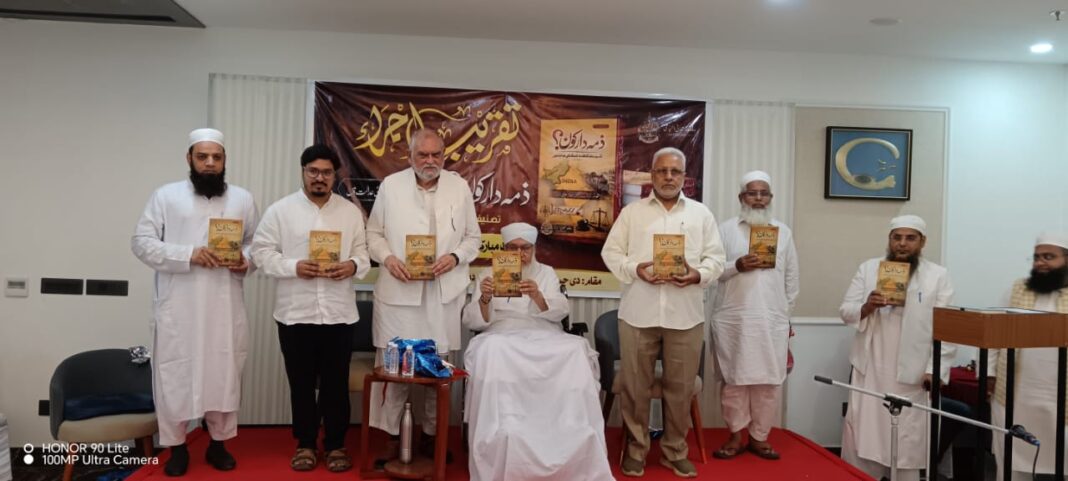
The July 6th 2024, witnessed a gala release of the prestigious book “Mandal Nama” (Urdu version) at Mumbai’s historic Khilafat House. It is a non-fiction autobiography covering the life and inspirational journey of long-time social activist – Shabbir Ahmad Ansari – the founding President of the All India Muslim OBC Organization. This significant event drew many distinguished guests from within Maharashtra and beyond, each bringing their unique perspective and reverence for the work and life of Shabbir Sahab.

The 200-page paperback book was originally compiled in Marathi by Dilip Waghmare and translated in Urdu by Malik Akbar. It is a book on a living legend who has been a standing hero from zero by his perseverance, commitment and hardworking against all odds.

Among the dignitaries were Dr. Zahir Kazi, President of Anjuman-I-Islam and Padma Shri awardee; veteran journalist and Maharashtra MLC Kapil Patil, Mohammad Wajihuddin, Senior Assistant Editor of The Times of India, Mumbai; Sarfaraz Arzoo, Editor of Hindustan Urdu newspaper; Maulana Mahmood Daryabadi, general secretary of All India Ulama Council; Maulana Mohammad Burhanuddin Qasmi, Director of Markazul Ma’arif Education and Research Centre and Editor of Eastern Crescent along with so many others, especially, OBC leaders and activists from across India. The hall at Khilafat House, Byculla, Mumbai was at its full capacity with academia, journalists and social activists who came together to appreciate and recognise the marvelous contribution made by Shabir Ahmad Ansari for Muslim OBCs and this Nation. These luminaries who are highly respected personalities in their fields of work, graced the occasion and shared their invaluable insights on the book and the remarkable struggles of Shabbir Sahab.

The speakers highlighted the importance of Shabbir Sahab’s mission, emphasizing how he tirelessly worked day in and day out for the community, enduring numerous challenges along the way. They stressed that if this mission is not carried forward, it risks being buried with Shabbir Ansari himself. Shabbir Ahmad Ansari is not merely a name; he represents an Anjuman and a revolution. Despite facing various adversities and betrayals, he persevered and continued to advance his cause.

The event also acknowledged the crucial support provided to Muslim OBC Movement by MLC Kapil Patil and Dilip Kumar, two personalities instrumental in Shabbir Sahab’s mission. They stood by him unwaveringly, enabling him to confront politicians and overcome deceit from within his own ranks.

“Shabbir Bhai’s steadfastness led to a moment where even politicians had to concede to his demands and paved ways for Muslim OBC Reservation in Maharashtra,” echoed by almost all speakers..

“Mandal Nama” is not just a book; it is a testament to Shabbir Ahmad Ansari’s enduring legacy and a call to action for future generations to uphold and advance his mission. This is a book for all fiction and non-fiction readers. A story of a man who stood alone for a greater social cause, struggled and succeeded in his lifetime. “Shabbir Ahmad Ansari and Muslim OBC movement in Maharashtra is so fascinating-story in academic perspective that it should be a research topic in a Central University in India” opined by Maulana Burhanuddin Qasmi.

source: http://www.easterncrescent.net / Eastern Crescent / Home> Book Review> EC Exclusive / by Mohammad Toukir Rahman / July 07th, 2024