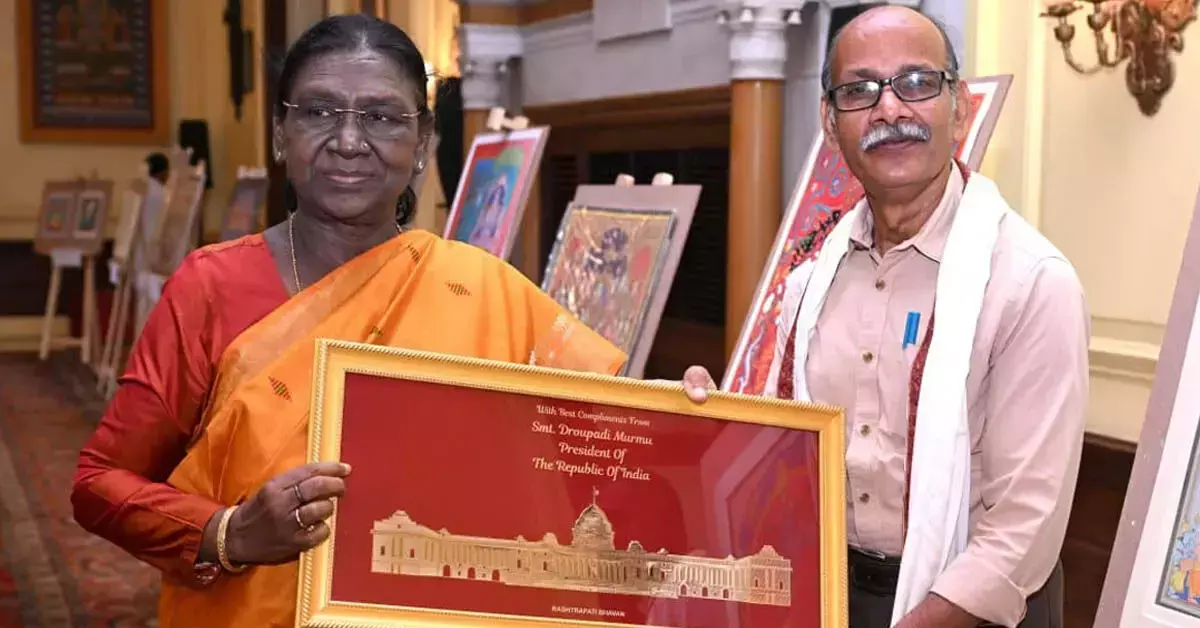
Renowned miniature painter Kamal Ahmed Malekoppa, a native of Gadag district and currently residing in Karkala, was honoured by President Droupadi Murmu after participating in the Artist-in-Residence programme held at Rashtrapati Bhavan in New Delhi.
The 10-day programme brought together 12 artists from across India, representing traditional art forms such as Banaras mural, Thangka, Nayak, Kerala mural, Basohli, Surpur and Mysuru styles.
Kamal Ahmed has been practising miniature painting for nearly three decades. He has drawn inspiration from the Vijayanagara Garudadri style and has developed a distinctive style of his own.
As part of the programme, he created an artwork at Rashtrapati Bhavan and displayed two artworks in total. One of the works was based on stories from the Panchatantra.
President Droupadi Murmu interacted with the participating artists and viewed their works. She appreciated their contribution towards preserving India’s traditional art forms and passing them on to future generations.
The Artist-in-Residence programme was organised to celebrate India’s artistic heritage and promote traditional art forms while strengthening the country’s cultural identity. Malekoppa’s selection has also brought national recognition to the Vijayanagara Garudadri-inspired painting tradition.
Kamal Ahmed previously worked as an art teacher for 18 years at Government High School in Shivapura, Hebri taluk, Udupi district. His artworks are displayed on the walls of government office buildings in Hebri and at various institutions.
Speaking about his selection for the programme, Malekoppa expressed happiness at getting the opportunity to participate in the prestigious event at Rashtrapati Bhavan. He described the experience as an unforgettable moment in his life and said the recognition had brought national attention to the Vijayanagara Garudadri-inspired painting style and its place in India’s artistic heritage.
source: http://www.english.varthabharati.in / Vartha Bharati / Home> Karavali / by Vartha Bharati / August 20th, 2026
Beyond the Classroom: Honouring the literary soul and dedicated leadership of Headmaster Sheikh Kareemullah on his retirement, May 31, 2026
In the rural classrooms of Palnadu, a quiet revolution has been unfolding for decades. It did not begin with protests or speeches, but with the cadence of Vemana’s poems and the relentless commitment of a man who believed the classroom was a laboratory for democracy. As Sheikh Kareemullah, a senior educator and luminary of contemporary Telugu literature, hangs up his boots as a Headmaster this May 31, his legacy remains etched not in the service records of the state, but in the social consciousness of a generation.
For Kareemullah, teaching was never a mechanical transfer of curriculum. His tenure, particularly in the village of Enugupalem, became legendary. When news of his transfer broke, the village didn’t just file a grievance; two tractor-loads of residents reportedly arrived at the district office, demanding his retention.
It was a rare instance where the bureaucracy bowed to the pedagogical impact of an individual. Kareemullah had transformed his classroom into a crucible for critical thought, teaching children the nuances of pluralism, equality, and the weight of historical justice. He did not just teach the future; he nurtured it.
If teaching was his primary vocation, literature was his chosen battlefield. Kareemullah’s evolution as a writer is a mirror to the anxieties of the era. As communal tensions and social polarisation grew, his poetry shifted from traditional progressive themes to a sharper, more visceral exploration of identity.
His poem ‘Naa Raktham Kaaru Chauka’ (My Blood is Cheap) became more than a verse; it became a rallying cry for dignity. His long poem, ‘Saibu’, remains a seminal text in the Telugu literature, articulating the Muslim experience in India with a defiance that was both unapologetic and profoundly human.
Perhaps his most significant contribution to the literary canon is the introduction of the ‘Ababeel’, a poetic form inspired by Qur’anic allegory. By using the metaphor of small birds confronting overwhelming might, Kareemullah demonstrated that brevity could harbour immense political weight. The form took root, inspiring a new wave of younger poets to find their voices, and transforming what began as a creative experiment into a full-fledged literary movement.
Through the establishment of ‘Murasam’, Kareemullah created a vital space for Muslim writers to find a common ground, turning a literary collective into a school of critical thinking.
Throughout his career, Kareemullah has been the recipient of numerous honours, including the ‘Janmabhoomi Best Teacher’ award and the ‘Adarsha Guru Brahma’ title. Yet, to those who know him, these awards are mere footnotes.
His true achievement lies in his ability to bridge the gap between the teacher’s desk and the poet’s podium. His work, now part of university curricula, continues to be subjected to the rigorous academic scrutiny that defines a classic. He has navigated the complexities of domestic politics, critiqued imperialism, and remained a staunch defender of humanism.
As he steps into retirement, Kareemullah leaves behind a roadmap for the modern intellectual: to remain a teacher when the world is in chaos, and a poet when the world has lost its words. He remains not just a chronicler of his times, but an architect of the resistance against the silencing of voices.
[The writer is a journalist based in Hyderabad.]
source: http://www.radiancenews.com / Radiance News/ Home> Features>Focus / by Md. Mujahid / May 31st, 2026
Legendary Urdu poet. a Padma Shri awardee, Dr Bashir Badr, known for his expressive and evocative ‘shayri’ passed away in Bhopal on Thursday afternoon, leaving behind a rich literary legacy that spanned decades. He was 91.
He breathed his last at around 12 noon at the age of 91.
According to family members, Badr had been suffering from dementia for a long time, a condition that gradually eroded his memory and left him unable to recognise even close acquaintances. His health had been deteriorating steadily in recent months, and despite medical care, his condition worsened until his demise.
His mortal remains were laid to rest at the Bada Bagh Cemetery in Bhopal in the evening on Thursday.
His passing marks the end of an era in Urdu poetry, as Badr was celebrated for his evocative verses, like “”Ujale apni yaadon ke hamare saath rahne do/Na jaane kis gali mein zindagi ki shaam ho jaaye“, or “Kai sitaron ko main jaanta hoon bachapan se/Kahin bhi jaaun mere saath saath chalte hai”, or “Sar jhukaoge to patthar devtaa ho jaayega/Itna mat chaaho use wo bewafa ho jaayegaa“, “Khuda ham ko aisi khudaai na de/Ki apne siva kuch dikhai na de”, Kuch to majbooriyan rahi hongi/Yun koi bewafa nahi hota”, and many more, that captured the complexities of love, longing, and human emotion with unmatched simplicity and depth.
His literary journey was not only prolific but also profoundly inspiring, influencing generations of readers and writers alike. A familiar figure in ‘mushairas’ across India, he was much admired for the art with which he not only recited his sparkling couplets, but frequently elaborated on their creation and his inspiration.
Born in 1935, Bashir Badr rose to prominence in the post-Independence period, becoming one of the most widely read and quoted poets in contemporary Urdu literature. His ghazals, often laced with poignant reflections on life and relationships, earned him admiration across India and beyond. He was known for bridging the gap between classical traditions and modern sensibilities, making Urdu poetry accessible to a broader audience.
His couplets, frequently shared in everyday conversations and on social platforms, remain etched in public memory. Despite his illness in later years, Badr’s contributions continued to resonate, reminding admirers of the enduring power of words. He once wrote: “Ham bhi darya hain hamen apna hunar maaluum hai/Jis taraf bhi chal padenge raasta ho jaayega”.
His decline due to dementia was a painful chapter, as the poet who once illuminated minds with his verses gradually lost his own connection to memory and recognition. Yet, his work stands as a testament to resilience and creativity, ensuring that his voice will echo long after his departure.
As the literary community mourns his loss, tributes are pouring in from writers, scholars, and admirers who regard him as a towering figure in Urdu poetry. Dr Bashir Badr’s death leaves a void that cannot be filled, but his words will continue to inspire and console countless hearts.
As he wrote: “Musafir hai ham bhi musafir ho tum bhi/Kisi mod pe phir mulaqaat hogi“. — IANS
source: http://www.clarionindia.net / Clarion India / Home> Editor’s Pick>India> Indian Muslims / by Clarion India / May 29th, 2026
Young writer, academician, and social commentator Faheem Ul Islam from Achan, Pulwama, has been honoured with the prestigious Rashtra Ratna Sahitya Puraskar 2026 by the Indian Literature and Arts Society for his remarkable contribution to literature and society.
Faheem Ul Islam, who holds academic qualifications from Aligarh Muslim University (AMU), has gained recognition for his literary works focusing on youth, society, education, and contemporary challenges. His writings reflect social awareness, intellectual depth, and a strong commitment towards positive change.
Apart from literature, he has also remained actively involved in educational and youth initiatives, media programs, and social awareness campaigns. His contribution as a writer, columnist, television host, and mentor has earned appreciation from various sections of society.
The award recognises his dedication to promoting literature and inspiring young minds through meaningful writing and public engagement. People from different walks of life have congratulated Faheem Ul Islam on this significant achievement and wished him continued success in his literary journey.
source: http://www.kashmirvision.in / Kashmir Vision / Home / by KV News / May 21st,2026
The book reads more like a collection of anecdotes
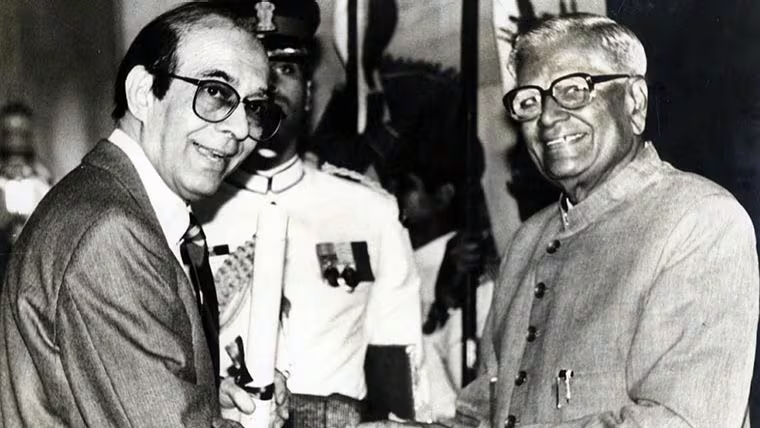
Nation’s pride: Talat Mahmood receiving Padma Bhushan from president R. Venkataraman in 1992 | P. Musthafa
To encapsulate the life of a man often described the ‘King of Ghazals’, though he was much more than that, is no easy task. Just for attempting that, Sahar Zaman deserves applause.
” Mahmood’s musical life was a rich amalgamation of traditions and languages “
Talat Mahmood, born in Lucknow and trained at what was then the Marris College of Music (now Bhatkhande Sanskriti Vishwavidyalaya) was a singer unlike any other. His natural velvet voice bore a slight quiver. It is a quiver which singers take years to cultivate. Musically termed vibrato, this quick and subtle change of voice between notes which are pitched very closely conveys emotions more powerfully than lyrics. When used without dedicated cultivation, a vibrato sounds contrived and the unevenness of breath can be made out by the trained ear; but when it comes naturally, it is as smooth as the wax and wane of emotion. Yet, in his early years in Mumbai, Mahmood strove to hide this unique quality, attempting often to sing in the nasal tones of his idol K.L. Saigal. This would not last long as Anil Biswas, a composer he had worked with for long, angrily walked out of a recording studio asking Mahmood to return only when the real Talat was found.
Ghazals came first to Mahmood because of his affinity with Urdu, and also because of the cultural bearings at home. His father, Manzoor Mahmood, who was a member of the Indian Medical Mission to Ottoman, would often sing to pep up his fellow travellers, while his sisters were flawless renderers of the nath (songs in praise of the Prophet), and his elder brother, Kamal, too, had a rich singing voice. While everyone in the family had strong voices with good throws, Mahmood’s was tuned differently. It was far gentler, almost like a dewdrop caressing a rosebud. It was the kind of voice that could dull the impact of the unkindest of blows. In the 2022 release Gangubai Kathiawadi, for instance, when the lead character learns of being sold to a brothel by her boyfriend, there is a snippet of a song that plays in the background. Mahmood’s voice is like a gentle nuzzle that softens the harsh truth.
Pathos was the most marked emotion of Mahmood’s voice. It was the embodiment of a disembodied, deep sadness. No wonder then that ‘Tragedy King’Dilip Kumar spoke of him as the ‘true musical speaker of my soul’.
Mahmood’s musical life was a rich amalgamation of traditions and languages. Under the name Tapan Kumar, he was a leading voice of the modern Bengal Music movement in which lyrics became as important as the music. He sang in 16 languages including Malayalam, Tamil and Kannada. And while you can close your eyes and imagine him most readily as a dejected Dilip Kumar pictured behind gauzy, fluttering curtains singing ‘Shaam-e-Gham ki qasam’ (On the promise of this sadness soaked evening), close them for some more time and you will just as easily picture him as a boyish Raj Kapoor singing ‘Main dil hun ek armaan bhara’ (I am a heart full of desires), a song that lends itself most readily to the waltz.
As a singer he had many firsts to his name, including being the pioneer of world tours. His pleasant face (which incidentally is also the meaning of Talat) made him a singing-actor and he also dabbled in composition. To audiences in the USA, he was introduced as the Frank Sinatra of India. He became a recognised voice, courtesy All India Radio, at just the age of 16. The book records a delightful incident in which the young Mahmood was accosted by a group of girls in Lucknow to sing as he cycled his way to his music college. Among that gaggle of fans was Qurratulain Hyder, who would go on to become a famed Urdu writer.
He was also a man deeply devoted to the larger cause of his art. He raised his voice for the payment of royalties to singers and also became a part of programmes to raise funds for senior, out-of-work artists. He joyfully gave away songs to Mukesh when he was going through a rough patch. His delight in singing for troops and in encouraging new talent all made him a perfect gentleman, a word often used in the book to describe him.
Biographies can never be divorced from the times that their subjects lived in. Thus, we read in bits about the decline of the film industry in Kolkata after the partition of Bengal, the government’s press for the Bhoodan movement, for which Mahmood sang; the start of recordings in sound-proof rooms; the introduction of multi-instrument orchestra for playback singing; and the rise of version songs. We also read of how the Partition tore apart Mahmood’s family. In a particularly poignant recollection, his father asked his elder son who would water the plants in the courtyard if he left for Pakistan (he did anyway).
The book at places digresses from a linear telling of Mahmood’s story and moves to talking about other stars of the time. This could appear jarring to some, but it is perhaps inevitable given that Mahmood’s journey was intertwined with those of others. One example being that of the actor Shyam, whose death resulting from an accident on a film set is talked about in some detail, to later merge it with the fact that his last three songs, sung by Mahmood, became ‘locked’in his voice.
If you are looking for a book which offers an undeviating narrative of Mahmood’s life, this perhaps is not it. This book reads more like a collection of anecdotes―some known, some not so well known. His gentleness is a quality emphasised throughout the book. He earned it perhaps from spending his formative years with his paternal aunt Mahlaqa Begum. We also come to know that he was a keeper of his words―both to friends and the girlfriend he left in Kolkata.
To those who have known the music of Mahmood, this book is a ready reckoner of his songs and will send you to listen to those you have loved and search for those you have forgotten. To those who do not know the music of Mahmood, take this as a befitting introduction to a singing genius. To do both in under 500 pages, in easy language, peppered with countless photos of the handsome Mahmood, is Zaman’s biggest achievement.
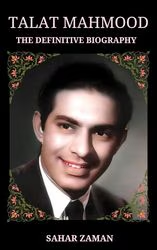
TALAT MAHMOOD: THE DEFINITIVE BIOGRAPHY / Author:Sahar Zaman / Pages: 480
source: http://www.theweek.in / The Week / Home> TheWeek / by Puja Awasthi / February 11th, 2024
MLA pays homage at Tipu Tomb, releases Urus Shariff invitation
Mysore/Mysuru:
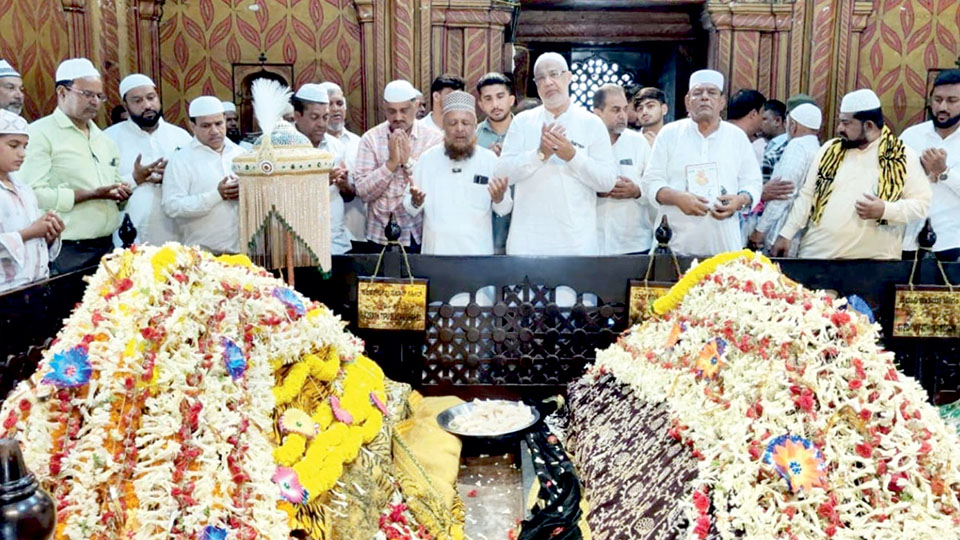
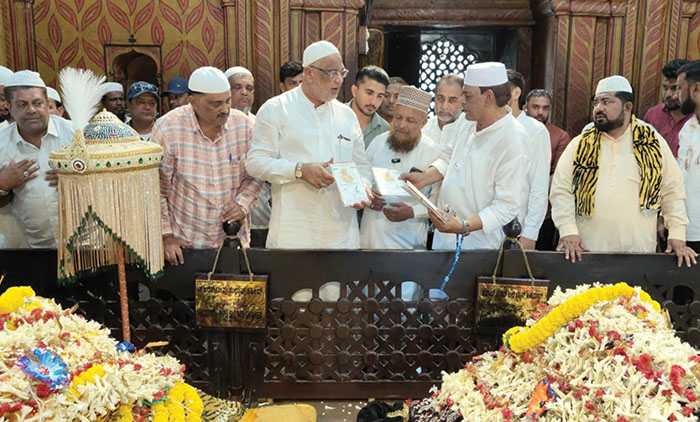
MLA Tanveer Sait, along with several others observed Tipu Sultan Martyr’s Day at a Fatha Khawni programme organised by Hazarath Tipu Sultan Shaheed Welfare and Urus Committee Secretary Afroz Pasha at Tipu Tomb (Gumbaz), Ganjam in Srirangapatna recently.
Hazarath Moulana Syed Inayathur Rehaman Razvi Saheb, Khateeb-o-Imam of Masjid Aqsa, Tipu Tomb, performed Fatha Khawni while Afroz Pasha and MLA Tanveer Sait spread the Flower Mat (Chadar) on the tombs of Tipu Sultan Shrine and his parents. Moulana Mohd. Inayath Ur Rehaman Razvi read Duwa supplications for the welfare of all.
Afroz Pasha distributed sweets (Tabruk) and felicitated the MLA by offering shawls.
Invitation, posters released
On the occasion, MLA Sait released the invitation and publicity posters of the 234th Annual Sandal Urus Shariff of Hazarath Tipu Sultan Shaheed.
The annual Sandal Urus Shariff will be celebrated on May 16 in city during which a public meeting will be held and a procession will be taken out.
Industrialist M.F. Jamsheed, Senior Congress leader Syed Iqbal, Waseem, Radiulla Khan, Member of the College Development Council of Government Girls’ Pre-University College Khwaja Mohammed Musheer Chishti, Syed Younus, Majeed Ahmed, Afroz Khan and a host of devotees were present.
source: http://www.starofmysore.com / Star of Mysore / Home>News / May 08th, 2026
Shahjahanpur, UTTAR PRADESH / Kolkata, WEST BENGAL :
My Kolkata shelves its biryani cravings for a day as Farah whips up a storm of Yakhni Pulao, Shami Kebab and Nargisi Kofta.
Video and images by Ritagnik Bhattacharya
When Farah whipped up Butter Chicken for 30 family members as notun bou in the Kadir household, she didn’t dream that in about two decades she would be supplying houses around the city with neatly packed boxes of biriyani, korma, pulao and kebabs. “My mother and grandmother were great cooks, so I always enjoyed cooking. It was never something I dreamed of doing professionally,” says Farah, who grew up in Shahjahanpur, Uttar Pradesh. She hails from a family of Pathans, originally from Afghanistan.
“Her legend just kept growing!” says her husband, Rubayat, her greatest fan and critic. “You know how we got married? Her brother-in-law lives in Kolkata and decided she absolutely has to marry a Kolkata foodie. Enter, Rubayat!” he says with a flourish.
They waited until their younger daughter had graduated school to resume full-fledged operation. The pandemic only expedited an eventuality which was long-simmering in the Kadir kitchen. Their friends were habituated to wrangling dinner invitations to Farah and Rubayat’s Ballygunge home for the fare which most regular Mughlai restaurants will find difficult to replicate. When social distancing became the norm, friends demanded that the food be sent to them. And so Beyond Biryani was born.
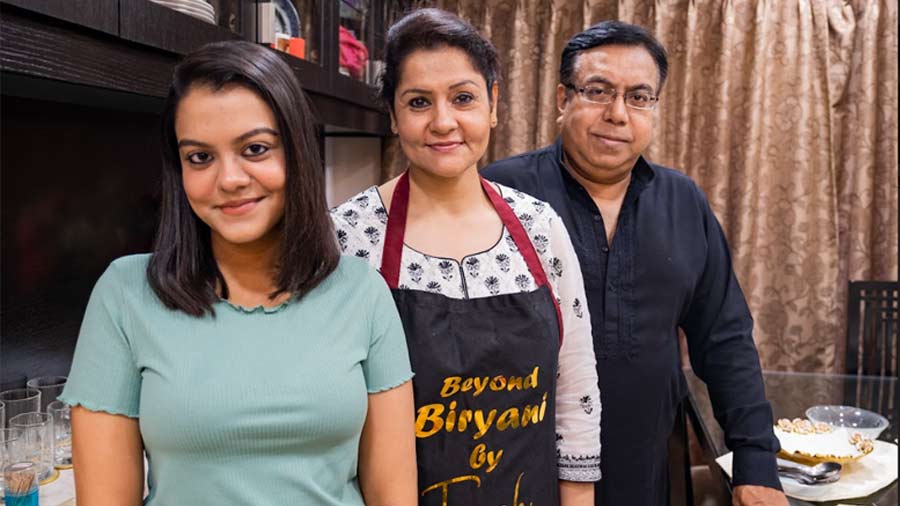
Farah (centre) with her younger daughter Ifrah and her husband, Rubayat
“Calcutta is crazy about biryani but we also want people to explore dishes beyond biryani,” explains Rubayat. He’s always at hand to taste her recipes and to guide patrons on their menu choices. He’s likely to bristle if you ask for an egg in the biryani and grimace if you want to pair the korma with biryani instead of roomali roti. “A boiled egg adds nothing to the biryani! It can be boiled separately and placed inside the rice. Besides, it takes up space in the container and which would you rather have anyway, more rice and aloo or a plain boiled egg?” he demands to know.
Not being a fan of boiled egg in my biryani anyway, I acquiesce. Farah’s biryani, having gained popularity and fame, tends to pop up at dining tables across the city, catching guests by delighted surprise. Following the trail to its source, I’m here today to dig into offerings that go beyond the Kolkata dum.
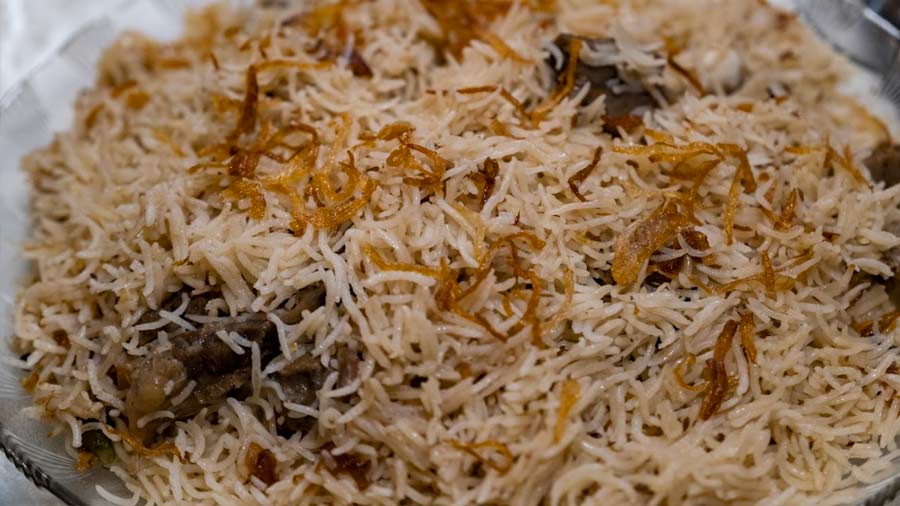
Yakhni Pulao
The flavour of the Yakhni Pulao is enhanced by the fact that the rice is cooked in mutton stock. It’s lighter than the biryani, which just means you’ll get to eat a lot more and fall into a bhaat-ghoom that much quicker. This one’s definitely a winner for summer.
Mutton Afghani Kebab
The Mutton Afghani kebab was one of Farah’s mother’s specialities, so it’s straight from the family legacies. Reminiscent of a galouti kebab, this one achieves just the right amount of tender with the help of papaya and not a slab of fat. “I don’t use extra fat or dalda. I cook like I would cook for my family,” explains Farah.
Mutton Akbari
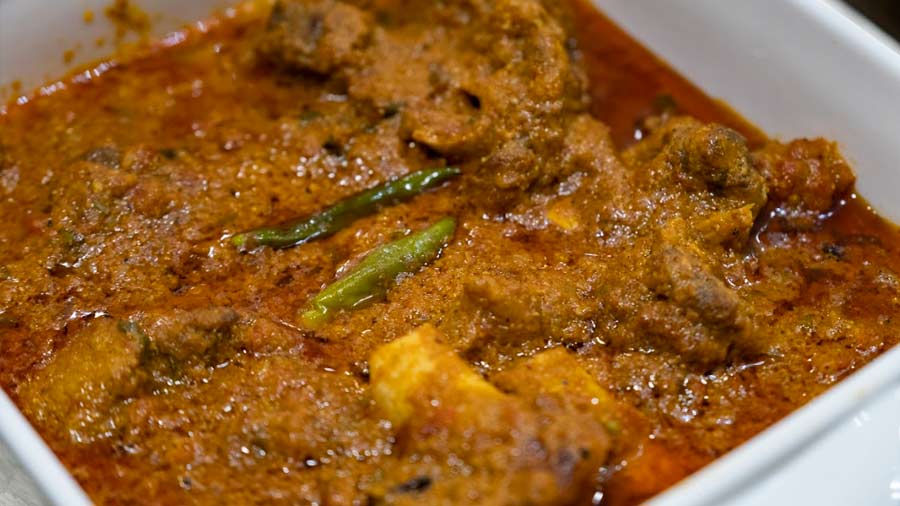
Mutton Akbari, like every great meat dish, is served on the bone, albeit almost falling off it. It cooks in its own juices, and though you might be tempted to moisten your biryani rice with it, like every good Bengali who likes his jhol, Rubayat insists you have it with paratha. Don’t worry, you’ll love that too.
Nargisi Kofta
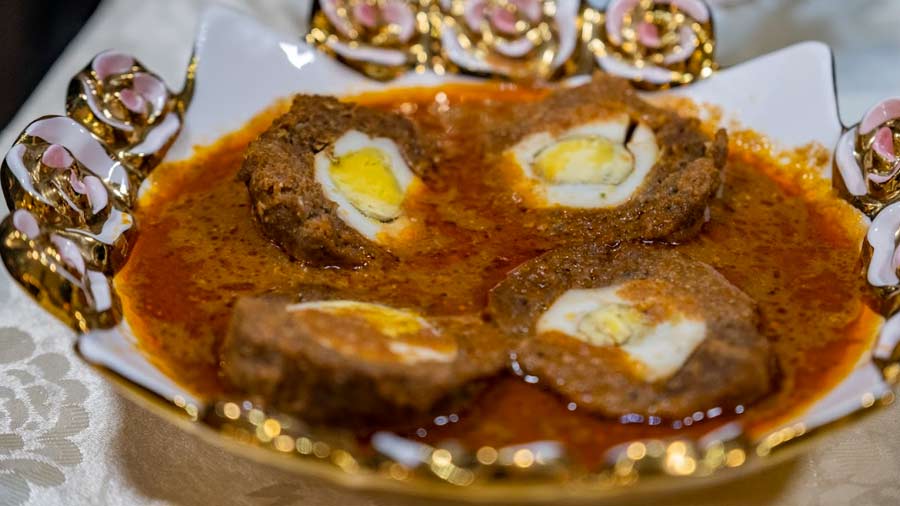
This one, another maternal hand-me-down, is one of the stars of the menu. The Nawabi cousin of the Bengali dimer-devil, Farah’s Nargisi Kofta is fried to a perfect brown and then placed in a surprisingly light gravy. All you need is a plate of fluffy white rice to soak it up with.
Shami Kebab
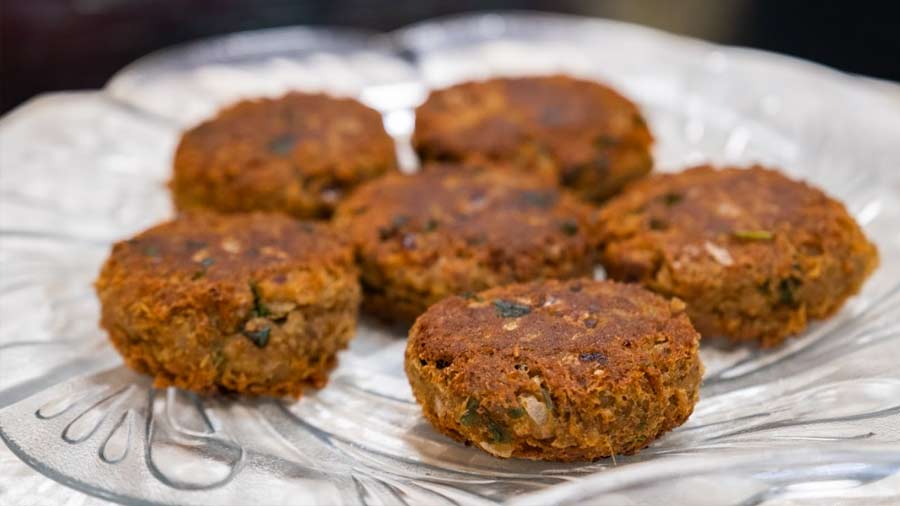
The Shami Kebabs are Farah’s primary claim to fame. “They’re our fastest moving item. These kebabs go all over the world – Canada, America, Bangkok. My elder daughter used to take it back with her when studying in the US. It’s the one dish I cook every day, as mutton, chicken or even soya which is also very popular. In fact, the soya is actually very tasty,” says Farah.
Which brings us to the crucial point that there are a great many vegetarian items on the menu as well. “We have very many vegetarian clients who are regulars too,” says Farah.
Farah’s full of surprises. She is able to make a mean prawn dish without tasting it because she prefers to not eat seafood. “There’s a de-shelled crab in butter garlic which I tasted in Trishna, Mumbai, that I’m trying to get her to recreate. She’s never eaten it, so I have to describe it really well,” says Rubayat, with all the purpose of a man setting out on a mission.
The other element of surprise lies in the size of Farah’s kitchen. It’s a small space attached to an apartment, just as fuss-free and efficient as the cook. It’s clean, compact and no-nonsense, spilling out a feast for a gourmand. In this kitchen, Farah insists on doing everything herself. She sets out every morning to buy meat from a regular Park Circus shop and then methodically goes about the cleaning, chopping and marinating. “The secret lies in knowing which cut of meat to use for which dish. The meat required for biryani, shami kebab and korma are all very different,” explains Farah.
“It’s the cut and the cook which determines the success of a dish,” sums up Rubayat, succinctly. “She has no recipes. It’s all on andaz, which is amazingly never wrong.”
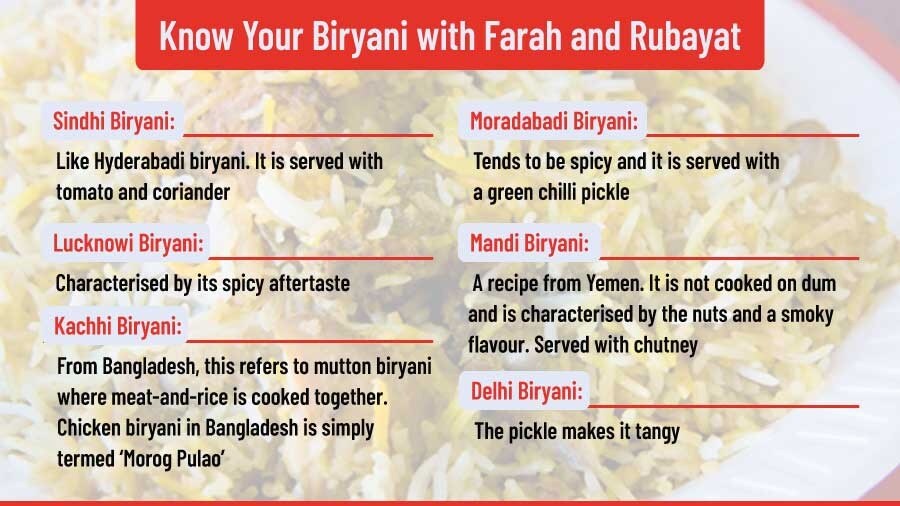
Farah is of the opinion that her dishes are infused with the flavours of Delhi because her grandparents lived in the capital city. Of course, she learnt just how Kolkata likes to have its biryani and proceeded to get it just right. It’s not the only biryani she knows how to make though, in case you’re enthused to go, not just beyond biryani, but beyond the Kolkata Biryani.
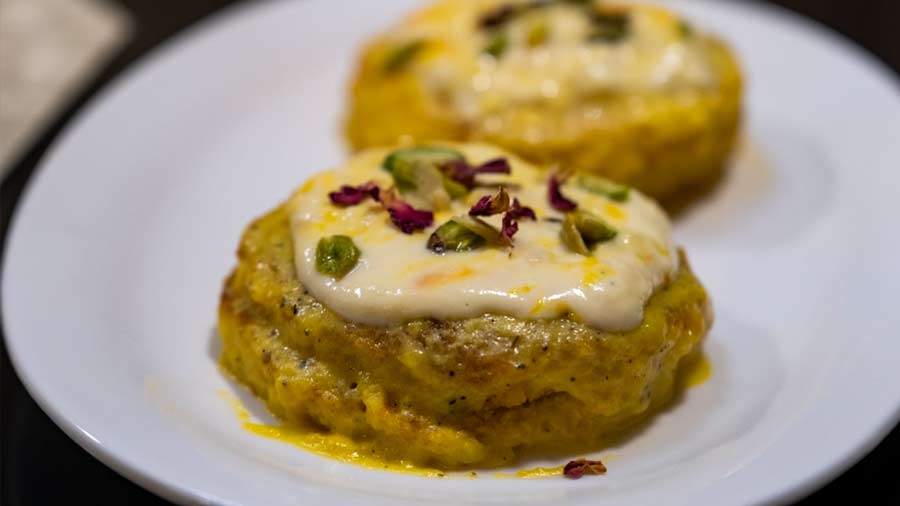
Shahi Tukda
Yes, Farah makes dessert too! Because in Kolkata we need our mishti mukh, even if we can look beyond the biryani.
source: http://www.telegraphindia.com / Telegraph Online / Home> My Kolkata / by Ramona Sen / June 14th, 2022
The 234th Urs-e-Sharieff of Hazarath Tipu Sultan Shaheed, organised by Hazrath Tipu Sultan Shaheed Wakf Estate, Ganjam in Srirangapatna, will be held on May 16 and 17 at Gumbad-e-Shahi at Ganjam in Srirangapatna.
The Sandal procession will commence from Masjid-e-Ala in Srirangapatna at 3 pm on May 16 and will reach Gumbad-e-Shahi at 5 pm.
Special programmes will be held from 7 pm at Gumbad and will continue the whole night till next morning.
For details, contact Hazarath Tipu Sultan Shaheed Wakf Estate on Ph: 08236-252786 or Mob: 97390-58786, according to a press release.
source: http://www.starofmysore.com / Star of Mysore / Home>In Briefs / May 05th, 2026
The marble throne of Bahadur Shah Zafar, the last Mughal emperor, symbolizes a collapsed dynasty, now housed in a museum near Humayun’s Tomb in Delhi.
Delhiwale: The ultimate Mughal souvenir
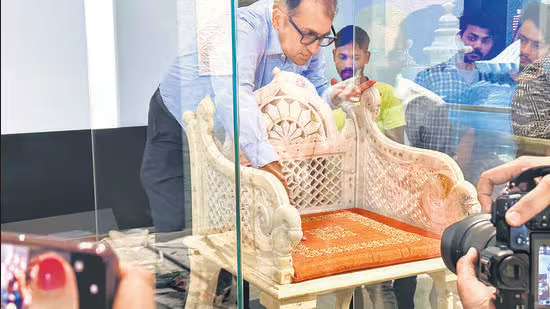
Behold this marble throne. Preserved inside a glass case at the Humayun World Heritage Site Museum in Delhi, it was once the stately seat of Bahadur Shah Zafar. As the last Mughal sovereign, the poet-king is likely to have sat on this throne while reflecting on the dissolution of his 300-year-old dynasty. The throne is, in fact, less ostentatious than the throne-like sofas found in the drawing rooms of Delhi’s wealthy today. Yet it is far more elegant. The armrests are supported on latticework, and faint flecks of colour cling to the marble like the last glimmers of extinguished stars. The fragile-seeming relic assumes truly epic proportions as the viewer connects it to the legend of a collapsed empire whose layered legacy continues to resonate in our republic (vividly chronicled in this newspaper yesterday).
The Mughals spanned over 18 rulers. Their kissa-kahani began 500 years ago in 1526, when Babur defeated Delhi Sultan Ibrahim Lodi in a field 80 kilometres from Delhi. Soon after, Babur entered the city and visited the shrine of the mystic Hazrat Nizamuddin Auliya. At that time, nobody would have guessed that this pilgrimage would recur across generations of Mughals, binding them to the city’s sacred, grave-dotted topography.
Truth be told, Delhi surpasses the dynasty’s other great centres, Agra and Lahore. Shahjahan may have built the immortal Taj in Agra, but his creation of Old Delhi throbs more with real life. For Delhi’s pre-eminence in Mughal India, we must first credit Babur’s son, Humayun, who established his capital, Dinpanah—today’s Purana Qila—near the shrine of Hazrat Nizamuddin. His son Akbar later built Humayun’s mausoleum close to the same shrine.
Over time, Humayun’s Tomb came to be known as the “dormitory of the Mughals.” This 16th-century complex contains 160 graves of kings, princes, and princesses, representing a broad cross-section of the dynasty. Seven Mughal emperors are buried here: Humayun, Azam Shah, Jahandar Shah, Farrukhsiyar, Rafi ud-Darajat, Rafi ud-Daulah, and Alamgir II. It was here, at Humayun’s Tomb, that Bahadur Shah Zafar took refuge after the collapse of the 1857 uprising against the British. He was captured at this very site, marking the end of the Mughal Empire.
The aforementioned museum, which houses Zafar’s throne, is across the road from Humayun’s Tomb. In the lead-up to its inauguration two years ago, a significant moment was the installation of the throne, personally overseen by museum curator Ratish Nanda—see photo. A conservation architect, Nanda had earlier helped restore the garden around the first Mughal emperor’s tomb in Kabul.
As for the last Mughal, the unfortunate Zafar had intended to be buried in Delhi, but the British exiled him to Rangoon, where he was finally laid to rest. As a consolation, his ill-fated throne may be seen as a symbolic substitute for his Delhi tomb. Indeed, as the tomb of his dynasty itself.
source: http://www.hindustantimes.com / Hindustan Times / Home / by HT Correspondent / May 04th, 2026
At a time when the stage was closed to women from conservative Muslim households, Ayesha walked into the spotlight at 16, confronting hostility that ranged from social ostracism to outright violence.
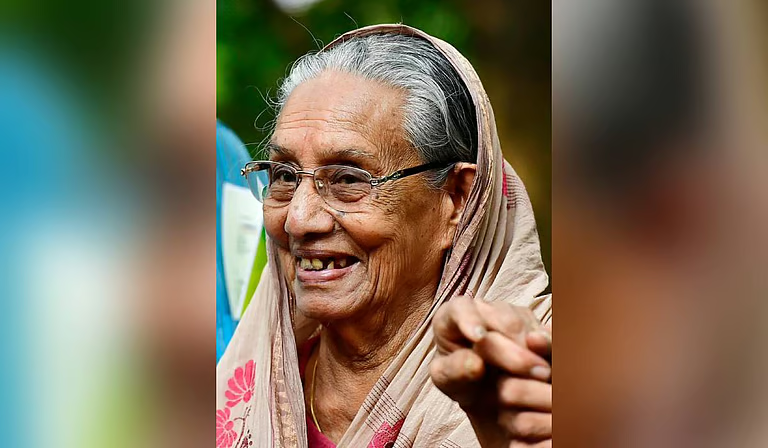
Nilambur Ayesha, Kerala’s first Muslim woman theatre artist.(Photo | Special Arrangement)
Malappuram :
Nilambur Ayesha, the indomitable force who shattered barriers to become the state’s first Muslim woman theatre artist, steps into her ninth decade with a legacy forged in courage, resistance and uncompromising artistry. Her life is not merely a story of performance, but a defiant march against religious orthodoxy that sought to silence her.
At a time when the stage was closed to women from conservative Muslim households, Ayesha walked into the spotlight at just 16, confronting hostility that ranged from social ostracism to outright violence. For generations of Malayalis, the very mention of drama evokes her name, a testament to a contribution that redefined Malayalam theatre.
Born into a once-prosperous family in Nilambur, Ayesha’s early life was marked by upheaval. Her father’s sudden death pushed the family into crisis. At 13, she was forced into marriage with a man decades older. The relationship lasted only days, leaving her to raise an infant daughter alone. She survived by selling rice and grinding grain, battling poverty with relentless determination.
It was in these harsh circumstances that playwright E K Ayamu invited her to act in a play staged by the Nilambur Yuvajana Kala Samithi. Backed by her brother Manu Muhammed but opposed by her mother, Ayesha chose the stage over submission. “No one who cannot save us has the right to punish us,” she declared, stepping into a world that would test her endurance at every turn.
The backlash was swift and brutal. When she first performed at Farooq Lakshmi Talkies under the banner of the Communist movement, it sent shockwaves through society. A Muslim woman on stage was seen as an act of rebellion. Stones were hurled at her during a performance in Nadapuram, leaving her bleeding, yet she refused to abandon the stage. In Manjeri, gunfire erupted during a play, narrowly missing her. In another incident, she was assaulted inside a make-up room. Each attack was meant to break her spirit. None succeeded.
Ayesha recalls those years with unflinching clarity. “I can never forget that. My first play was ‘Ijjh Nalla Mansan Aakan Nokku’. There was fierce opposition. The shooting incident when I was 16 was part of that. But I was not ready to give up and go back,” she said. “The Communist movement was always with me.”
Her journey extended beyond theatre into cinema, where she carved a notable presence. She acted in films such as Kandam Becha Kottu, Kavyamela, Kuttikkuppayam, Olavum Theeravum and Paleri Manikyam. She also performed with leading drama troupes, including K T Mohammed’s Kalinga Theatre, and took on demanding roles, including four characters in Kurangu Rasayanam.
Hardship followed even at the peak of her artistic journey. Driven by financial distress, she worked as a domestic worker in Riyadh, Saudi Arabia, for 19 years. Yet, she returned to the stage with renewed resolve, eventually performing in more than 29,000 shows.
Ayesha’s life has since entered academic discourse, studied by undergraduate students as part of their curriculum. Her journey, documented in Basheer Chungathara’s work, stands as a powerful narrative of resistance and artistic integrity.
Her achievements have been widely recognised. She received the Kerala Sangeetha Nataka Akademi Award for Best Actress in 2002, the SL Puram Sadanandan Award for overall contribution, and the Kerala State Film Award for Second Best Actress in 2011. The film Ayesha, starring Manju Warrier, draws inspiration from her life in the Gulf.
Reflecting on her journey, Ayesha says, “Whatever cinema has captured of my life has given me joy. It feels like my life has been accepted.”
Her legacy is now being celebrated in a three-day tribute organised by the Moyinkutty Vaidyar Mappila Kala Academy in Kondotty. The ‘Navathi Adharam’ celebrations opened with a film festival featuring works connected to her life and career. The final day included the screening of a documentary and a gathering of theatre workers, culminating in a felicitation where CPM state secretariat member M Swaraj honoured the veteran artist.
Ayesha did not merely perform on stage. She fought for her place on it, and in doing so, redrew the boundaries of art, courage and freedom.
source: http://www.newindianexpress.com / The New Indian Express / Home> Kerala / by Lakshmi Athira / May 04th,2026