JAMMU & KASHMIR :
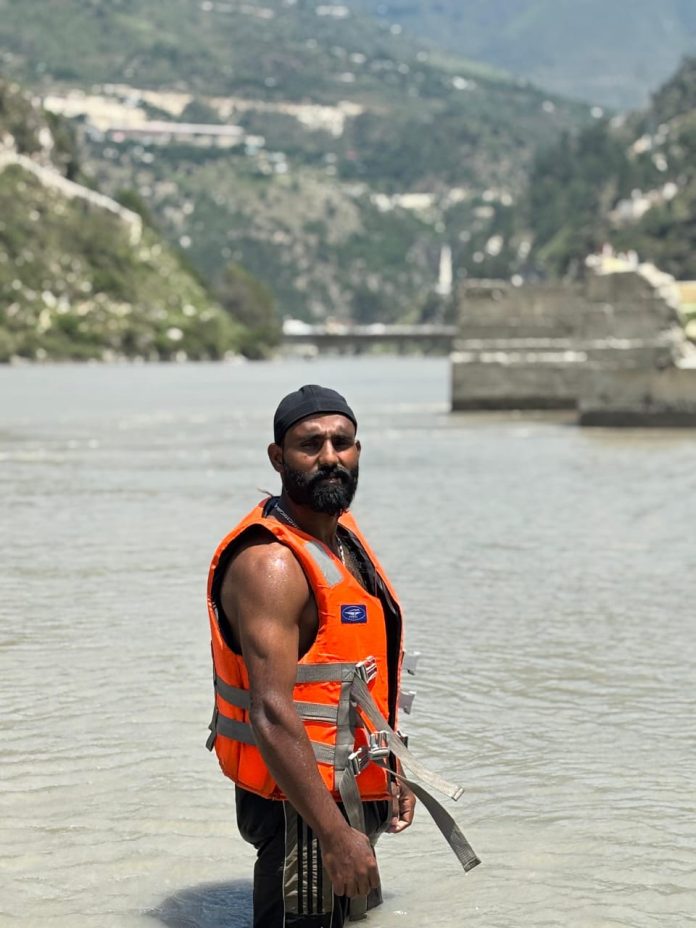
Hamza of the Chenab
On the jagged banks of the Chenab, where the river churns like a living force and the sound of its roar rises above the valley’s silence, one man stands as the last hope for those it swallows. He is neither a government employee nor a trained professional in the formal sense. He has no salary, no official title, and no protective gear. Yet for more than fifteen years, Hamza Sheikh has been the first to dive in when someone disappears beneath the grey water.
He is soft in voice, and almost shy in demeanour. But behind that calmness lies a kind of courage that borders on the extraordinary. In his own estimate, he has pulled “more than four to five hundred” bodies from the Chenab. And astonishingly, “in my 15-year journey, at least three hundred alive I have brought out.”
There are few stories like Hamza’s today—stories of a single man whose work is stitched into community memory, whose bravery is understood more by the grieving families he has helped than by any government record. His entire training, he says, comes from growing up near the river.
“This is Chenab,” he explains, gesturing towards its violent surface. “We have been living here since childhood. This is our training.”
A River That Became a Graveyard
The Chenab was not always a death trap. Hamza recalls a time when accidents were rare, when the banks were bustling with a small city called Pul Doda.
“There used to be a market here earlier… at least 450 shops,” he says. “The dam destroyed everything.”
When the dam collapsed during the 2008 earthquake, the river changed forever. What was once shallow and predictable became deep, erratic, and unforgiving. Entire markets and neighbourhoods were consumed by water. People promised rehabilitation never received land. The river became in parts a silent grave, in parts a raging beast.
It was around this time that Hamza’s role became essential. His family had lost their land and livelihood; he found purpose in saving others from what had taken so much from his own.
He still remembers the first dead body he pulled out. “I was about 10–11 years old… a body came running. I caught it. His condition was very bad. He had worms.”
That moment, shocking as it was, shaped his life. Since then, the river has rarely let him rest.
Inside the Mind of a Man Who Jumps In
The Chenab is deceptive. From afar, it looks like any fierce river. Up close, it is a trap. The water is icy, visibility is zero, the current can drag down cars, and the depth changes unpredictably.
“Many people run away after hearing the noise of Chenab,” Hamza says. “But for us, it is very common.”
He describes rescue attempts that sound superhuman. In many cases he dives blind, because “we close our eyes, because there is sand. We can’t see anything. We go 15–20 feet without oxygen.”
The riverbed is lined with boulders sharp enough to slice flesh. Some sections are calm for a few metres and then suddenly erupt in turbulence strong enough to flip a vehicle. Somewhere in the river’s deepest pockets, Hamza says, lie bodies that never surfaced.
“Imagine a chopper went here 15 years ago,” he says. “We didn’t find it. Neither the body nor the chopper.”
And yet, he returns each time.
When asked if he is ever scared, he shrugs. “Chenab is like our home.”
A Body in the River Is Only the Beginning
The most difficult part of Hamza’s job is not the water—it is what the water does to the dead.
He recounts incidents that would break most people. One case remains etched in him: a woman whose remains had been in the river for days.
“When I pulled her, her skin came out,” he says quietly. “There were worms. Her hands were full of worms.”
There are other stories—bodies broken by rocks, faces eaten away by the river’s minerals, limbs separated, the smell of decay rising even from the coldest water. But Hamza refuses to turn away.
“Emotions come,” he admits. “Because if someone’s family reaches their house, then it is a matter of reward. We don’t take money. We do it with the intention of reward.”
For families waiting on the bank, Hamza is not a rescuer; he is closure.
The Line Between Saving and Being Pulled Under
The living, Hamza says, are far more dangerous to rescue than the dead.
“A living person can drown you too,” he explains. “He will take a slap from you… he will take him too if you are not trained.”
He recalls one incident from 2017: a woman who had jumped in during the fast flow of mid-summer.
“I jumped without a jacket emotionally. I was in the water for half an hour. Sometimes she was drowning me and sometimes I was saving her.”
Both survived—but the memory remains a reminder of how narrow the margin is between life and death in the Chenab.
Some rescues haunt him differently. In Katra, a college girl jumped; her body surfaced only two months later. “At that time,” he says, “I was very sad.”
He remembers another scene—two girls swept away in a torrent so strong it resembled the sea.
“No one dared to go down,” he recalls. “I went into the water.”
Injuries That Tell a Story
Hamza lifts his cap to show a scar running diagonally across his head. It is long, thick, and uneven—evidence of how much he has risked.
“My head was cut from here,” he says softly. “There were 60 stitches inside. The blood was flowing and I came out. I didn’t know that my face was bleeding.”
It happened during a car rescue, when he was pushed beneath a rock and had to “adjust without any equipment.”
There are other injuries—bruises, cuts, nights spent shivering after hours of diving, the long-term damage cold water inflicts on the body—but Hamza doesn’t dwell on them. The river has taken more from others, he says, than it has from him.
Hamza’s work is made all the more remarkable by the fact that he does it with almost nothing.
“We have a boat, but we don’t have it,” he says with a faint, ironic smile. Their earlier boat, gifted years ago, “died in the water the next day.” Now he must request one from Doda each time there is an emergency.
He has no oxygen tank, no wetsuit, no underwater torch, no sonar, no rope strong enough to withstand Chenab currents.
“It takes four days to call an NDRF officer,” he says. “The dead body is in the water and rots. Even NDRF officers are not able to get into the water.”
He tells of one such officer whose rope snapped. “He had just got married… I saved him from the side without any equipment.”
The irony is bitter: the man who rescues even trained personnel is himself unprotected.
No official has offered him financial aid, let alone a salary. “I only got praise and nothing else,” he says.
Each time the phone rings, Hamza says, he thinks of the family waiting on the bank.
“We think and we get a phone call. We have to go… we get emotional.”
He recalls the day two of his classmates drowned. He watched their parents crying helplessly.
“I couldn’t bear it,” he says. No one else dared to enter the water that day. He went alone.
He has not always succeeded. “There were 11 people… I found only one,” he says. “Till date, I haven’t found any of the others.”
But it does not stop him.
“Whoever we went to save, we brought him alive,” he insists. It is his source of pride—and perhaps also his armour against grief.
The Man the River Has Not Defeated
As Hamza talks, the Chenab roars behind him—its sound too steady, too relentless. It is a reminder of how small one man is compared to a river that has eaten cities, choppers, buses, families.
And yet, when someone goes missing, people do not call the authorities first. They call Hamza.
Not because he is invincible. Not because he is paid. But because for fifteen years, whether at midnight or dawn, whether in winter cold enough to freeze blood or monsoon floods that turn the valley into a bowl of water, he has shown up.
“This is our training,” he says again. “Wherever Chenab goes, wherever there is someone, we go.”
It is perhaps the simplest explanation for what he does—but not nearly enough to describe the magnitude of it.
In a valley full of quiet resilience, Hamza remains its quietest hero: anonymous, unrecognised, and yet carrying within him the memories of hundreds of tragedies, hundreds of families, and hundreds of lives he pulled—sometimes limp, sometimes breathing—from a river that never gives anything back.
source: http://www.muslimmirror.com / Muslim Mirror / Home> Indian Muslim> Positive Story / by Babra Wani / November 18th, 2025