Tag Archives: Ali Adil Shah II

Pages from Bahmani days

KARNATAKA :

Six more books from the period of Adil Shah have been released
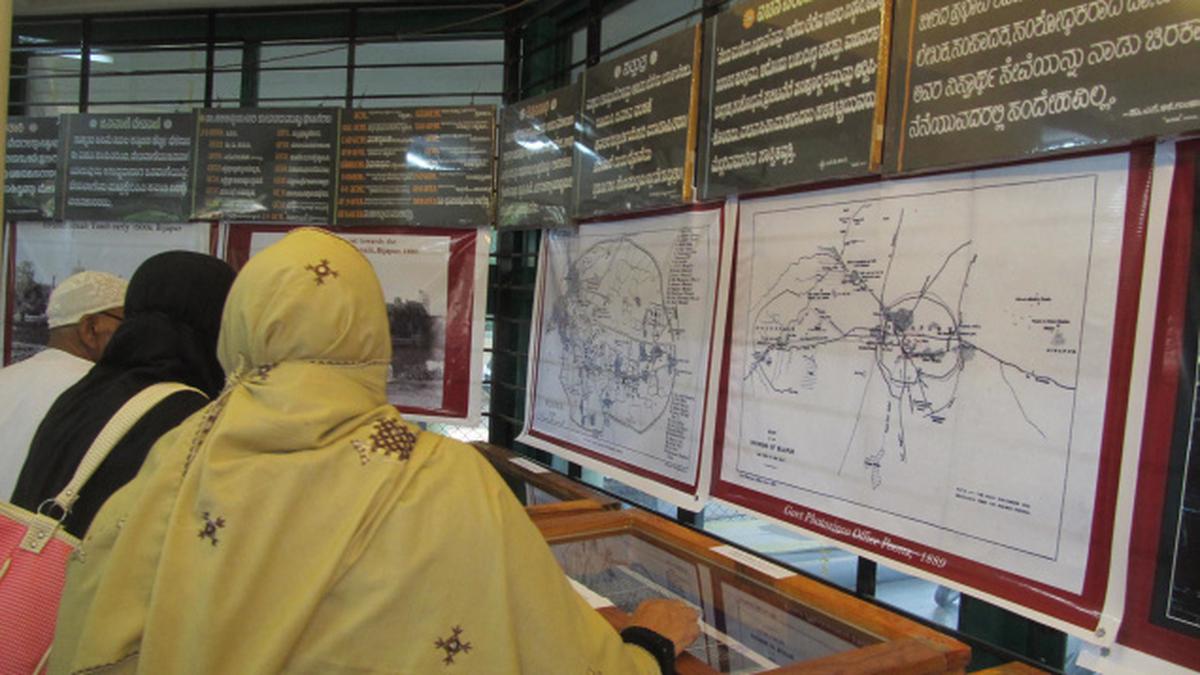
A GLIMPSE OF… the books, manuscripts and maps

The ambitious work of translating Adil Shahi literature in Kannada, has now achieved another milestone. Six more rare books of that era written in Persian and Dakhani Urdu have been released and are available for the readers.

The Adil Shahi Literature Translation Committee which was earlier headed by the late M. M. Kalburgi, is rapidly doing its work to complete the entire project by the end of this year.

Writer Krishna Kolhar Kulkarni, director of the committee, who now heads the project after the demise of Prof. Kalburgi, said that last year the committee came up with six books, this year, as the second instalment, the committee has released six more rare books after translating them into Kannada.

It was a difficult task to collect these books, since they are rare and hard to find. Names of the books that will be released and their brief description:

Mohammad Naama: The book written by Zahoor Bin Zahoori in Persian is gives demographic details of Karnataka and the expansion of Adil Shahi dynasty into southern parts of the country. The writer offers critical information about the life of Mohammad Adil Shah (1636-1656) who got the historic Gol Gumbaz built. The book has been translated by Dr. Mehnoor Zamani Begum, Prof. A.H. Masapati, Fakir Mohammad Katpadi and Moulana Rashid Al Khashmi.

Ali Naama and Tarikh-e- Sikandari: The books written in Dakhani Urdu by Mulla Nusrati, are primarily poems in which writer gives illustrated description of Ali Adil Shah-II (1656-1672) and Sikandar Adil Shah (1672-1686). The book meticulously writes about the historic Umarani war between Maratha King, Shivaji and Ali Adil Shah-II in which Shah humiliatingly sends Shivaji back from the battle field.

The books are translated by the late, Dr. Mohammad Sibkhatullah and Dr. Vithalrao Gaikwad.

Urus-e-Irfan: The book written by Hazrat Kazi Mehmood Behri in Persian, is about contemporary details of religious and historical moments. The book is translated by Bode Riyaz Ahmed Timmapuri.

Tazkirat-ul-Mulk: The book written by Rafiuddin Ibrahim Shirazi in Persian, is one of the best books on ancient Bijapur history of the famous Rakkasaki-Tandagi war in 1565.

The writer gives an eye-witness account of the war and mentions the fall of Vijayanagar Empire. The book is translated by Fakir Mohammed Katpadi.

Kitab-e-Nouras: Written by Ibrahim Adil Shah-II in Dakhani Urdu, who adored art and music. In his books, the king introduced Indian music to Persian people. The book is translated by Dr. Krishna Kolhar Kulkarni.

Rouzat-ul-Auliya: The book written by Mohammed Ibrahim Zuberi in Persian is about some 105 men and eight women Muslim Saints who lived in Bijapur district.

The writer visits each tomb and collects details of all the saints before compiling a book on their lives. The book is translated by Dr. Amiruddin Kazi.

While six book are translated now, previously, another six books that were translated and released are: Tareekh-e-Farishta, Basateen-e-Salateen, Guldasta-e-Bijapur, Ibrahim Naama, Tareekh-e-Haftakursi and Futuhat-e-Alamgeer .

Meanwhile, Dr. Kulkarni said that the team of experts is busy working on the final volume of eight books to be released by the end of this year.

“It is surely a painstaking and labour-intensive job. It has to be translated without distorting the originality,” he said.

Maps and manuscripts

He said that during their search of books, the team laid hands on some of the rare maps of ancient Bijapur district prepared between 1763 and 1909.

“This is no less than a treasure for us . We also got hundreds of manuscripts and ‘Farmaans’ (official correspondents between Kings and landlords).

We have decided to display them in a museum to be established in future,” he said.

source: http://www.thehindu.com / The Hindu / Home> Features> Friday Review / by Firoz Rozindar / October 18th, 2016
An unfinished episode

Embark on an adventure with Pheroze Kharegat as he takes us to a place steeped in history and conspiracy. Bara Kaman in Bijapur mesmerises and captivates anyone who looks upon it…

BaraKhambaMPos04mar2014

With an overwhelming number of Mughal monuments in India, we tend to forget that, down South, in Bijapur,Karnataka has a great treasure house of Islamic architecture. Peep into the annals of history and you will be intrigued to know how this obscure  little town in northern Karnataka attracted countless dynasties in its brief thousand years of existence.

Dynasty rules

The mighty Chalukyas led the pack, followed by the Khiljis, the Bahamanis and the Adil Shahis. Bijapur’s ancestry rattles off the veritable who’s who of medieval India. They came here to rule and left their imprints in stone – the Gol Gumbaz unparalleled anywhere in the world, the sombre mausoleums and the lavish mahals.

Of all these, the most mystifying in the unfinished edifice is known as the Bara Kaman, or twelve arches. Arches that are silently crumbling, yet graceful. The unfinished tomb of Ali Adil Shah lies a short distance to the north of the citadel and the Gagan Mahal. The great high basement upon which the building stands is 215 feet square.

The most peculiar characteristic of the building are its arches. They are purely Gothic in outline, being struck from two centres with the curves continued up to the crown. On a raised platform, in the inner enclosure is the tomb of Ali Adil Shah. Standing at a dead end of a lane, located a few km from the present day Bijapur town, the Bara Kaman — as this mausoleum was called, stands in ruins.

There are no domes or pillars; just towering stone walls that curve into arches, built to represent death and immortality, as they tried to reach out to each other. The original plan was to build an edifice of 12 arches arranged both horizontally and vertically around the tomb of the king and his queens. However, barely a couple of arches completed the picture, while the rest of them seemed to have been left undone.
This is the incomplete mausoleum of Ali Adil Shah, Sultan of Bijapur, who ruled from 1656 to 1686. This building is also called as Ali Roza. This is located near to the Bijapur main market.

Family politics

Built in 1672 A D, it was the burial place of Ali Adil Shah II and his queens and members of royalty. But the planning of such a grand monument spelt death for the prince.

Ali Adil Shah was murdered by his father Ibrahim Adil Shah to prevent him from completing Bara kaman. Ibrahim Adil Shah feared that Bara kaman would lessen the popularity of Gol Gumbaz that he had gotten constructed. Bara Kaman has the tombs of Ali Adil Shah, his wife Chand Bibi, his mistress and his daughters.

The architect Malik Sandal, initially raised solid walls in the form of concentric arches and once the entire wall was erected, the inner arches were toppled off and only the outermost arch was left intact. Also iron rings were used to hold the stones in place. They weren’t cemented together.

If the mausoleum had been completed, it would have definitely rivalled the Gol Gumbaz in Bijapur.

As a visitor enters the place, he is bound to be impressed by the huge symmetrical arches. The pillars are built of stone and stand tall. The architectural skill of those who designed and constructed this monument is noteworthy.

It is a fine example of Islamic architecture which is synonymous with grace, beauty and opulence. There is no roof over the structure, a clear indication that work had to be stopped due to unknown reasons.

Massive pillars, with large stones nicely held together, support the arches, which soar to the sky. The arches are interlinked giving a picture of continuity.

The tombs are simple with no decoration and a hemispherical smooth top. Two of the arches are located on a tiered high platform, at a distance from each other, and have an austere look.

A wall at the back of the monument has a small arched opening as a lookout. The entire monument is bereft of any embellishment.

The garden in front is well maintained and the Archaeological Survey of India is looking after the upkeep of the monument, though no entry fee is charged.

It was rather late in the evening, and the sun’s rays filtered through the towering  arches, radiating a soft glow. The cenotaph just stood there throwing no clues as to why it was incomplete.

The only motive available in history is   pride that came between the father and the son. They both tried to surpass each other in terms of massive mausoleums.

source: http://www.deccanherald.com / Deccan Herald / Home> Supplements> Spectrum / Maharaja Features / March 04th, 2014