Tiruchi, TAMIL NADU :
Makkah Masjid is among the oldest Islamic shrines in Tamil Nadu. An inscribed tablet dates the mosque back to the year 116 of the Al-Hijri calendar, corresponding to 734 A.D.
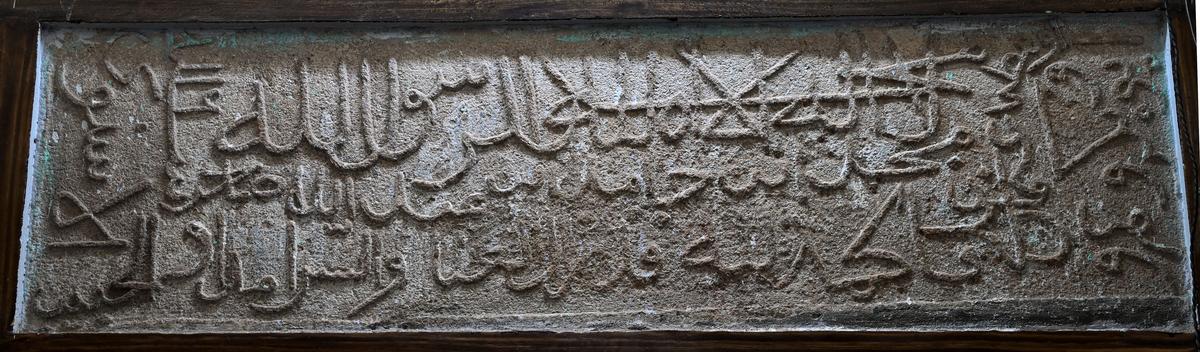
An inscription on the stone structure’s wall (background), dates the building to the Islamic (Hijri) year of 116, corresponding to 734 A.D. | Photo Credit: M. MOORTHY
The family of a cloth merchant has been taking care of the mosque for generations.
Tucked away next to a carpentry workshop on Tiruchi’s Fort Station Road is what is considered to be one of the oldest Islamic places of worship in Tamil Nadu: the Makkah Masjid that dates back to the year 116 of the Al-Hijri calendar, corresponding to 734 A.D.
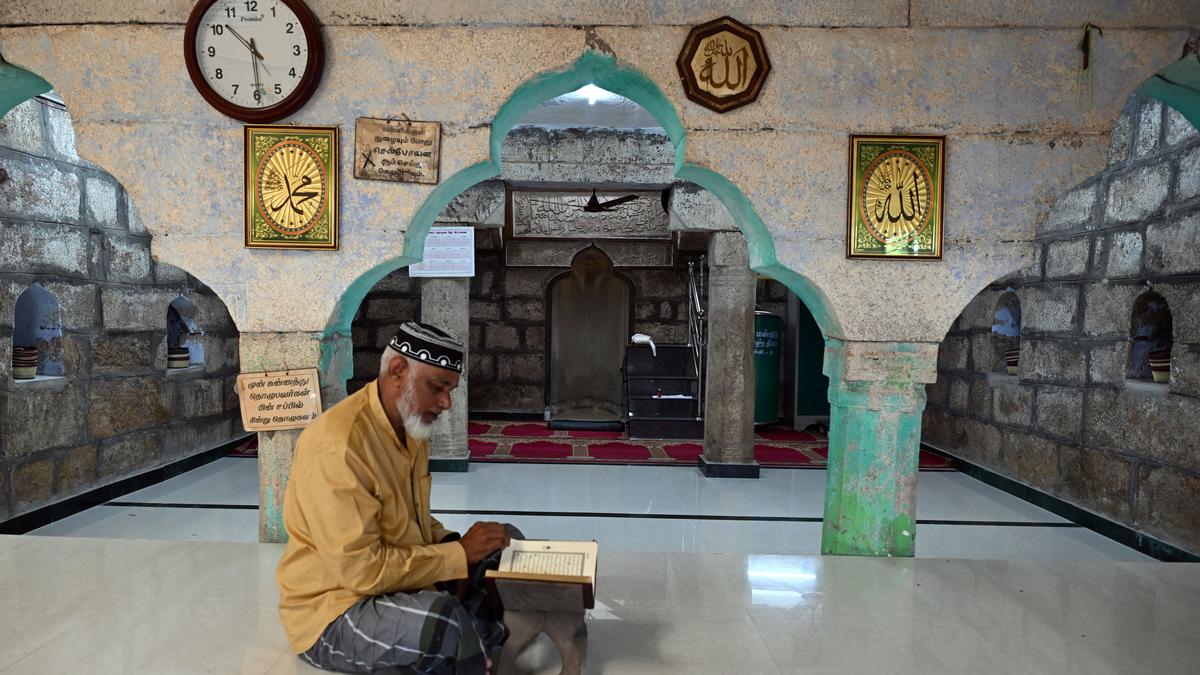
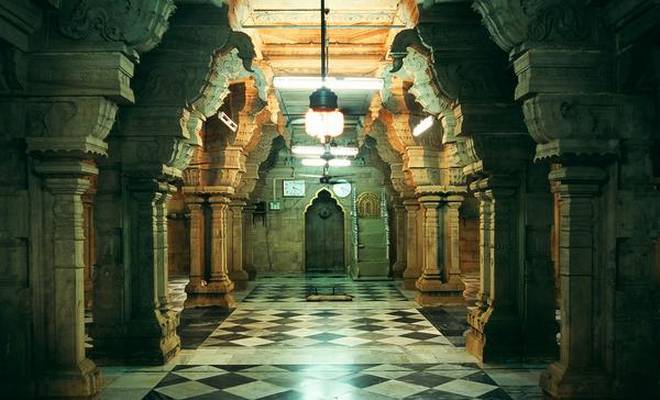
A view of the prayer hall of Makkah Masjid in Fort Station Road, Tiruchi. It is considered to be among the oldest Islamic shrines in the country. | Photo Credit: M. MOORTHY
The family of M.G.A.R. Abdul Rahman, a cloth merchant in Tiruchi, has been taking care of the property for several generations.
The mosque’s age is validated by an inscribed stone tablet in Arabic above the ‘mihrab’ (the niche that indicates the ‘qibla’ or direction of prayer). The graves of Mohamed Ibrahim, Hazrat Haji Abdullah, Hazrat Haji Mohamed Anwar, Ahmed Kabir, and Tahira Biwi, thought to be pious Muslims of yore, are also to be found here. Two recently added minarets indicate the mosque’s presence in this quiet part of town.
Surrounded by thorny bushes
“Until the 1980s, the mosque was very different from what you see today,” A.R. Mohamed Ghouse, hereditary trustee, and one of Mr. Rahman’s 12 children, told The Hindu. “When my father was bequeathed this shrine, it was surrounded by thorny bushes and palm trees. There was no road access; people would walk single-file on a narrow pathway to reach the premises. Since this is a low-lying area, the building would be flooded during the rainy season. Before we got electricity connection in the 1980s, the place used to be lit up with oil lamps and hurricane lanterns. We have been maintaining the buildings with the help of generous donors from all faiths,” he said.
The Muslim community has had a long and harmonious presence in Tiruchi since ancient times. The Makkah Masjid is a stone’s throw away from Hazrat Thable Alam Badhusa Nathervali Dargah, the mausoleum dedicated to a nobleman of Turkish-Syrian lineage born as Sultan Mutahirruddin in 927 A.D., in Suharwardy, near Samarkand, who gave up his privileged life to spread the message of Islam in southern Asia. It is said the saint stayed on the Makkah Masjid premises before he settled in the present site.
Mosques endowed by the erstwhile Nawabs of Arcot are also an indelible part of Tiruchi’s landscape. Woraiyur, the capital of the Chola dynasty from the 2nd Century (now a suburb of Tiruchi), was already known to Arab traders. After the birth of Islam, Arab-Muslim missionaries began travelling to the region. Biographies of Muslim saints and the local traditions of the period reveal that Islam spread in the southern part of India in a largely peaceful and voluntary manner.
According to J. Raja Mohamad, historian and former curator of Pudukottai Government Museum, the Makkah Masjid could have been built for the Muslim settlement that emerged in the Tamil hinterland during the Pallava rule. “When I visited the mosque in the 1970s, it was hard to spot because of the overgrown bushes. It resembled a small ‘mandapam’ (hall), built in granite, with six Dravidian style pillars that are square at the base, octagonal in the middle, and square again. The ceiling was also made of granite slabs. Though it has become more modernised now, the trustees have retained most of the old building,” he said.
While Dravidian-style granite mosques are present elsewhere in Tamil Nadu, the Makkah Masjid may be the only shrine with a contemporary dated inscription in the State as well as in southern peninsular India, he added.
Caliphs named in inscription
In his 2004 book, Islamic Architecture in Tamil Nadu, supported by the Nehru Trust for Indian Collections at Victoria and Albert Museum, London, Mr. Mohamad writes, “According to the Arabic inscription in the rectangular granite slab above the ‘mihrab’, this mosque was built by one Mohamed Ibn Hameed Ibn Abdullah in Hijri 116 corresponding to 734 AD. The names of the four Caliphs (successors to Prophet Muhammad) — Abu Bakr, Umar, Uthman, and Ali — are also mentioned in the inscription, which has been accepted by scholars as belonging to the 8th Century AD.”
Maintaining the mosque has been a labour of love for the family trustees. “The prayers have never stopped in the Makkah Masjid even though we do not have a ‘mohalla’ (a neighbourhood congregation).
Approximately, 200 people attend the Friday prayers,” said A.R. Abdul Razak, 74, the eldest son of Rahman and the imam (who leads prayers) for the past 39 years.
The annual ‘Urs’ (festival) commemorating Mohamed Ibrahim and Tahira Bibi on the 28th day of the Islamic month of Rajab (now in its 1,329th year) at the dargah on the mosque’s campus is supported by people of many faiths, who donate generously towards the public feast.
Mr. Razak gave up his job as a ship cook in Switzerland in deference to his ailing father’s wish to officiate as the chief cleric of the mosque. “I underwent training in Quranic recitation and Islamic theology from scholars in Tiruchi before taking up this position,” he said.
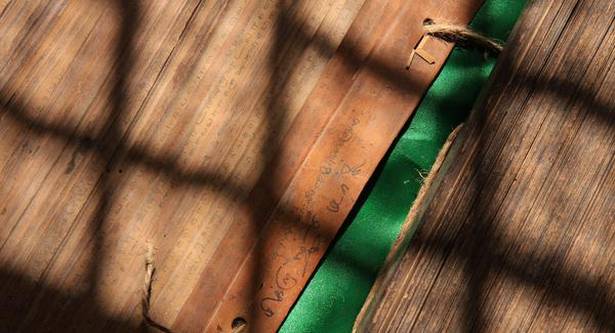
An antique copy of The Holy Quran is among the oldest artefacts in the mosque.
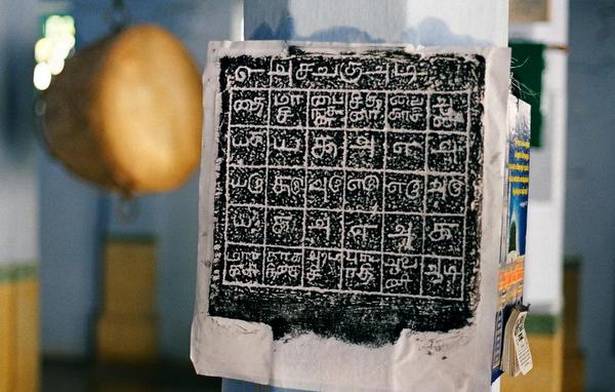
To prevent flooding, the ground level was raised with truckloads of mud after road access was granted by Southern Railway in the 1980s. As a result, five of the eight steps of the prayer hall are now permanently below the ground. Several coats of whitewash were scrubbed away to reveal the original granite walls and inscriptions. Some of the stonework also contains fragments of Tamil writing from the 10th Century. “We have tried to maintain the premises to the best of our ability. We hope succeeding generations of our family will continue to take care of the Makkah Masjid,” said Mr. Ghouse.
source: http://www.thehindu.com / The Hindu / Home> News> India> Tamil Nadu / by Nahla Nainar / June 28th, 2024