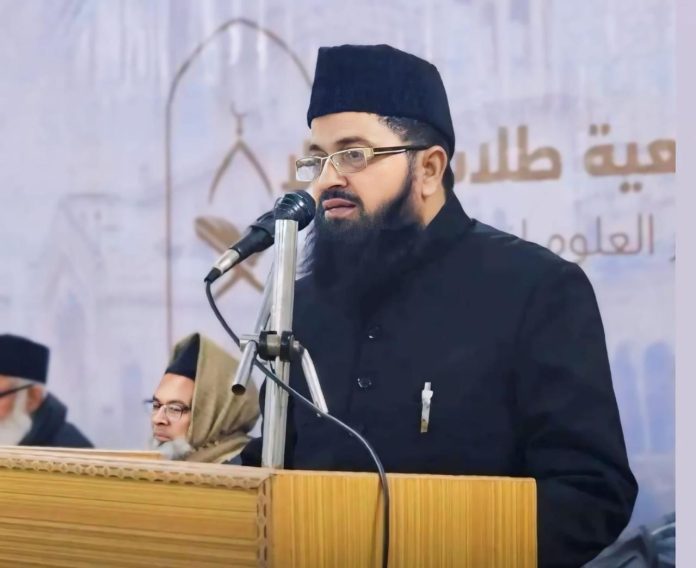
Dr. Nazir Ahmad Nadwi, senior faculty member of Darul Uoom Nadwatul Ulama, Lucknow passed away after a brief illness on 7 October 2025 in Lucknow. His sudden demise came as a shock for everyone.
Almighty Allah bestowed upon him extraordinary qualities and a variety of calibres. His personality was a marvellous amalgamation of a teacher, orator, journalist, academician, preacher of Islam and translator par excellence.
Born in 1965 in district Itawa, Uttar Pradesh (India), he received his basic education in his hometown. Thereafter, he joined Darul Uloom Nadwatul Ulama for higher studies. He did his Alimiat in 1987 and Fazilat (Specialisation in Hadith) in 1989 respectively. He also did his Ph.D. from the University of Lucknow. After completion of education from Nadwa, he was appointed as an employee in Al-Raid (Fortnightly), an Arabic wing of Nadwatul Ulama. While working at Al-Raid, he came in close contact with Maulana S.M. Wazeh Rasheed Nadwi, an accomplished journalist and prominent Islamic scholar. No doubt Maulana Wazeh left an indelible impact upon his life. It was Maulana Wazeh who had developed journalistic flavour and literary taste in him. Besides, he derived considerable academic benefits from Maulana S.M. Rabey Hasani Nadwi, former Rector of Nadwatul Ulama and Maulana Dr. Saeedur Rahman Azami Nadwi, Principal of Darul Uloom Nadwatul Ulama, Lucknow.
After a few years, he was promoted as a teacher. He was an embodiment of all sublime qualities and virtues, necessary for a good teacher. He proved himself as a selfless and dedicated teacher. His method of teaching was unprecedented.
He was a beloved teacher and scores of students quenched their thirst for knowledge from him.
Maulana led a very simple life. He left behind remarkable marks. He always kept himself away from name and fame. He did everything merely for the sake of Allah.
It should be noted that Maulana Nazir Nadwi achieved distinction in many languages such as Urdu, Arabic, English, Hindi, and Persian.
There are a number of things about Dr. Nazir Ahmad which people noticed and have written about. I personally have been most influenced by his personality. To him nothing was more precious than time. He was very punctual and meticulous.
The nicest thing is that he treated all with equal courtesy. He was a paragon of morality. He never showed egotism, pride and haughtiness. He performed his duties with honesty and integrity.
He had literary flavour, poetic flourish and journalistic taste. He wrote numerous articles for different newspapers and journals including Al- Raid. He also compiled a few books.
On his demise various condolence meetings were held in and out of India in which glowing tributes were paid to the departed soul.
A condolence meeting was held in Nadwa’s Jama Masjid on the second day of his death. In his condolence message, Maulana S. Bilal Abdul Hai Hasani Nadwi said, “Maulana Nazir Ahmad Nadwi possessed extraordinary qualities and sublime norms. He was a dedicated teacher who knew pros and cons of the Arabic language. He taught in Nadwa for more than three decades. He paid particular attention to each of his students to prepare them for the great task of spreading education in every nook and corner of the country. He left behind a galaxy of students.
Besides, he had profound knowledge of the Qur’an and Hadith. Truly speaking, he was a man of letters. His passing away is a great loss to Nadwa.
Describing his outstanding contributions in the field of the Arabic language, Maulana S. Ammar Hasani Nadwi, Nazir-e-Aam Nadwatul Ulama stated that Maulana Nazir Ahmad was a great Arabic scholar. He was well trained by Maulana Wazeh Rasheed Nadwi. He had good command over different languages. He always talked with authenticity and reference. A good number of students benefited from him. He will always be remembered for his selfless services.
Decidedly, Maulana’s sad death is an irreparable loss. He was not just a teacher but an institution. He is survived by his wife and a daughter. His funeral prayer was led twice. The first funeral prayer was led by Maulana S. Bilal Abdul Hai Hasani Nadwi, Rector of Nadwatul Ulama at the premises of Nadwa and the second was led by Imam of the late Maulana’s village and was buried in his ancestral graveyard. A host of his admirers from various parts of the country thronged to attend the last rites of Maulana Nadwi.
May Allah adorn his grave with luminosity and refulgence and grant peace to his soul! Aameen!
[Dr .Obaidur Rahman Nadwi is Faculty Member of Darul Uloom Nadwatul Ulama, Lucknow, Uttar Pradesh]
source: http://www.radiancenews.com / Radiance News / Home> Art & Culture> Focus> Obituary> Personality / by Dr Obaidur Rahman Nadwi / November 07th, 2025
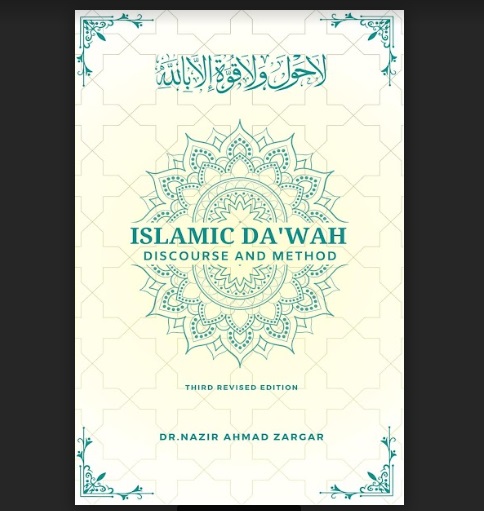
Author: Dr. Nazir Ahmad Zargar, Title: Islamic Da‘wah Discourse and Method, Publication Details: Chahattisgarh: Evincepub Publishing, 2024., Edition: Third Revised Edition , Pages: 297+ i-xx. ISBN: 978-93-5673-906-2. Price: ₹500
Islam is a missionary religion, and Da‘wah (the call to Islam) is a divine commandment. In common terms, Da‘wah invites people to Islam. A person who invites people to Islam through a dialogue process is called Dā‘ī. In a broader sense, it connotes an invitation to the Imān (Islamic faith) to the prayer or Islamic way of life. The book under review attempts to elucidate the methodological aspect of Da‘wah in the contemporary era.
The author maintains an academic tone throughout the book and presents Islamic Da‘wah as a means to eliminate misrepresentation, misinformation, and misconceptions regarding Islam and its worldview. Therefore, the main objective of this work is to make its readers understand that Da‘wah is an attitude that presents the actual teachings of Islam and the real image of Islam, free from division and prejudice. The methodological aspect of this work highlights the role of a Dā‘ī in contemporary times. In this context, the book offers a comprehensive approach to Da‘wah. The author deals with the communication part of Da‘wah methodology, including using social media and modern technologies to propagate the message of Islam.
The revised third edition has been improved to a greater extent than early editions; some sections have been edited with great detail. A few portions have been added afresh. The foreword of the revised third edition is written by Prof. S. M. Yunus Gilani, Malaysia. He says, “This work is an invaluable resource for anyone seeking to understand the essence of Islam, its profound teachings, and the wisdom behind its principles. It provides a roadmap for those who are called to the noble task of conveying the message of Islam with wisdom, compassion, and integrity (pp. vi-vii).” This book is spread over five chapters, excluding a vast introduction, conclusion, appendix, and an epilogue to the protocols. In his detailed introduction, the author draws an outline of the fundamental concepts and basic principles of Da‘wah. He introduces Islam as a peaceful religion and argues that it provides a solution to the problems of mankind.
Furthermore, it discusses the relation of Da‘wah with communal harmony and mutual co-existence. Similarly, it also analyzes conceptions such as the essences of Wahy (revelation) and Risālah (prophethood), the dichotomy between rational and revealed knowledge, and characteristics of a Dā‘ī. This section also highlights the historical perspectives of Da‘wah during the al-Khilafah al-Rashidah (Caliphate period) and Da‘wah in contemporary times from a global context.
Chapter first, Da‘wah and its significance, delves into the meaning and definition of Da‘wah. The author here focuses on the different dimensions of Da‘wah, such as ways and means, objectives, importance, causes of decadence, language and media of Da‘wah, and role of Da‘wah organization. Dr. Zargar is of the view that “the primary aim of a Da‘wah organization is to unite the disarranged Ummah into a unified whole once again (pp. 25-26). The author emphasizes Da‘wah, both individual and collective Da‘wah programmes, keeping a view of a particular place’s circumstances and social order. He argues that the prophet Muḥammad (SAW) preached the message of Islam both individually and in public. However, he asserts that there must be an organized group of individuals who can understand their responsibilities and perform Da‘wah, and he substantiates his argument with the āyat (verses) of the Qur’ān and ahadith. Dr. Zargar points out that the role of an organized group is not merely to perform the activities of Da‘wah but to play his role in “construction and deconstruction simultaneously” (p. 125).
Chapter second, a brief historical survey of the development of Da‘wah methodology, is through examination and analysis of Da‘wah from historical perspectives and early methods. The author divides Islamic Da‘wah into three major historical phases; the initial phase discusses the early Islamic Da‘wah that started from the mount of Ṣafa and was carried out during the whole time of the prophet Muḥammad (SAW). Dr Zargar believes that Da’wah’s scope, significance, and relevance grew gradually and substantiates his claim from the different āyat of the Qur’ān (p. 132-34). The second phase discusses Da‘wah in the period of al-Khilāfah al-Rāshidah as a state responsibility. This phase emphasizes the status of Da‘wah as an obligatory duty for the rulers and examines scholarly opinions. The third phase elucidates the decline of activities of Da‘wah at the governmental level and becomes more concerned at individual and collective or group level. However, Da‘wah continues to remain the duty of a Muslim. The author notes that the most crucial part of this phase is that throughout the first century of Muslims, the activities of Da‘wah remained peaceful, and no force was used to convert people to Islam (p. 140). The author has quoted many historical events that support the fact that Da’wah activities were peaceful. For instance, he evidently discusses how Berke Khan and other Mongols accepted Islam despite terrorizing Muslim lands. Therefore, the events in which Tartars became Muslim have been explicitly considered turning points in Muslim history. The concluding part of this chapter discusses the spread of Islam in India and the major factors responsible for the emergence of Islam. However, this section has been discussed briefly and needs further elaborations to substantiate the claims pertaining to major factors responsible for the spread of Islam in India.
Chapter third, ‘the contemporary Da‘wah movements’, discusses four major Da‘wah organizations in the contemporary era, such as al-Ikhwān al-Muslimūn, Tablīghī Jamā‘at, Jamā‘at-i-Islāmī and Ahl-i-Ḥadīth movement of India. The chapter’s main subject remains in discussing historical settings in which Da‘wah movements emerged, their ideologies, objectives, approaches, basic principles, contributions, activities, methodologies, and achievements and weaknesses to Da‘wah activities. For instance, the author states that the founders of al-Ikhwān al-Muslimūn have realized that Westernisation is a threat to Islam, which can be countered by returning to the basics of Islam (p. 153). Similarly, the author argues that the purpose of Jamā‘at-i-Islāmī was to establish a “theo-democratic state” yet to be found (p. 166). Regarding Tablīghī Jamā‘at the author has made a comprehensive analysis and focused on its major activities and hallmarks, purpose, and methods of Da‘wah. Dr. Zargar is of the opinion that while other Da‘wah movements focused on producing literature alongside their activities in the field Da‘wah, the TablīghīJamā‘at did not consider writing books any of the means of Da‘wah. However, they are very concerned about working in practical fields. Subsequently, a lucid analysis of the Ahl-i-Ḥadīth movement of India and other movements has been conducted. Dr. Zargar made mention of Ahl-i-Ḥadīth movement in Kashmir and highlighted its role in the reformation as well.
Chapter four is dedicated to the communicational perspectives of Da‘wah and highlights the basic qualities of a Dā‘ī and Mud‘ī, such as language, attitude, knowledge, organizational qualities, discipline, and righteousness. Similarly, the fifth chapter of the book focuses on Da‘wah in the contemporary global society. The author discusses here globalization from the Islamic perspective, post-modern materialistic society, concepts such as the definition of man in Islam, problems of materialism, individualism, and the decline of the West. Dr. Zargar has also highlighted the problems, concerned with Dā‘ī’s, the importance of Ijtihād in Da‘wah and education system, Da‘wah and women, following the law of land, nationalism, and Muslim politics as well. It is pertinent to mention that this work presents a thorough analysis of the contemporary position, aims, and objectives of the Zionist movement, formation of UNO, the establishment of the Kingdom of Israel, and economic institutions and multinational companies to support the causes of Israel are debatable issues discussed in Da‘wah and the Contemporary Global Society.
In sum, Dr Zargar argues that Islam is indeed the religion of Da‘wah. He asserts that Da‘wah is the real force behind the success of Islam and Muslims. Therefore, he offers some ways to continue Da‘wah in the contemporary era, such as inter-religious dialogue, debates, freedom of choice, and essay competitions. The book’s appendix is another valuable contribution because it discusses the Jewish protocols, which consist of 24 documents containing the most comprehensive programmes for world subjugation published in 1905. The author’s lucid explanations and examination of the protocols expose the aims, purposes, and approaches of Jews to the rest of the people of the world whom they called Gentiles. An epilogue to the protocols traces the need and significance of Islamic Da‘wah and the Protocols of the Elders of Zion. In sum, the book is a comprehensive guide and a valuable edition in the related field for students and researchers.
The author is a Doctoral Candidate, Comparative Religion, Department of Religious Studies, Central University of Kashmir
source: http://www.kashmirobserver.com / Kashmir Observer / Home> In-Depth Review / by Guest Author / April 20th, 2024