Tag Archives: Dr Rashid Jahan

Aligarh and Women’s Education: A Brief Overview

Aligarh, UTTAR PRADESH :
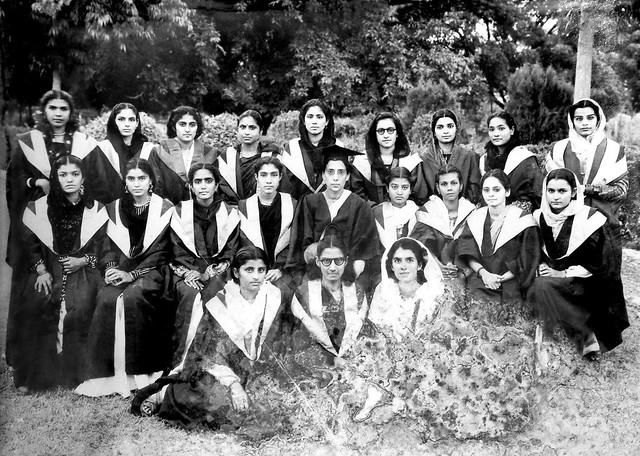
Women’s education in nineteenth-century India was no easy task. In the case of Muslim women, the task was even more difficult due to their triply marginal identity: as colonial subjects, as women, and as Muslims. Not only did the custom of purdah added to their seclusion from the social and cultural changes, their men hated everything about the western cultural influence (being displaced as rulers by the British). As a result, the middle class (the initiators of reform) was to develop late among the Indian Muslims than their Hindu counterparts. Nevertheless, by the late nineteenth century, a middle-class among the Indian Muslims was fledging. For this, no institution of the nineteenth-century can be given more commendation than Aligarh Muslim University.

Formed in 1920, the Aligarh Muslim University just completed its hundred years as a modern residential university. There has been a perception that the Aligarh Movement, for whatever reasons, neglected the issue of modern education to Muslim women. But there is more to this argument, some things to be explored, some to be re-interpreted.

This article, therefore, attempts to trace the genesis and trajectory of women’s educational reform in Aligarh through the profile of a woman reformer – Waheed Jahan (1886-1939), wife of Shaikh Abdullah (1874-1965), and the co-founder of Aligarh’s first girls’ school. Waheed Jahan was a pioneer of Muslim women’s education at Aligarh in the early twentieth century. Her role in ending the relative isolation of Indian Muslim women, while at the same time preserving the Muslim identity of the community, is worthwhile to recall. Her biography was published in Urdu by her husband in 1954. [1]

The educational reforms among Indian women were mostly started by men. Such men started with writings advocating women’s education. In this regard, among Muslims, Nazir Ahmad (1833-1912) published his novel, Mirat-ul-Arus, in 1869; Altaf Hussain Hali (1837-1914) published Majlis-un-Nissa, in 1874. Soon, magazines and journals followed, like the Tahzib un-Niswan by Sayyid Mumtaz Ali (1860-1935), the Khatoon by Shaikh Abdullah and Waheed Jahan, and the Ismat by Rashid-ul- Khairi (1868-1936). Gail Minault regards these as ’The Big Three.’ [2] Apart from literary activism, others tried more practical measures, like opening schools for Muslim girls.

As the movement intensified, so did the opposition against it. In such an atmosphere, even the talk of women’s education by a woman herself was quite a chivalry.

Yet, unexpectedly, there were women who defied the odds and broke the ground. Rashid-un-Nissa of Patna, became the first Muslim woman to write an Urdu novel, Islah-un-Nissa in 1881 (published in 1894), when writing was a distant dream for Muslim women. Rokeya Sakhawat Husain (1880-1932), a widow herself, pioneered Muslim women’s education in Bengal. Muhammadi Begam (1878-1908) edited one of the leading ladies’ home journals, Tahzib-un-Niswan. One such icon of women’s education at Aligarh was Waheed Jahan.

Waheed was born in 1874 in a landholding family in Delhi. Her father Mirza Ibrahim Beg was of Mughal ancestry, serving as a minor municipal official in Delhi. Her only brother, Bashir Mirza went to the Mohammadan Anglo-Oriental College (MAO Colege), Aligarh, where he befriended Shaikh Abdulla (a Kashmiri convert to Islam, named Thakur Das before conversion).

As was the custom, Waheed received no formal schooling. She learnt Urdu and Persian from her father and arithmetic and elementary English from a visiting English tutoress.

Ismat Chughtai, in her autobiography, Kagazi hai Pairahan, records, how Waheed Jahan, before her marriage, had dreamt of establishing a school for the girls. She would gather the servants’ children and teach them, and soon the rudimentary school became popular among her neighbours. It is noteworthy that, at a time when others (mostly men) were still imagining a school for girls (that too only in their writings), Waheed, in her own limited capacity, was practically making a difference.

In 1902, Waheed married Shaikh Abdullah – a lawyer at Aligarh, and an ardent supporter of women’s education since his school days. Following the marriage to a woman with some education, he began to consider concrete ways to promote Muslim women’s education. The Mohammadan Education Conference (MEC, founded at Aligarh by Sir Syed Ahmad in 1886) had established a Women’s Education Section (WES) in 1896 to start a Normal School for girls and to train female (zenana) teachers. In 1902, Shaikh became the secretary of WES, which by then had merely achieved anything beyond discussions and debates around women’s education.

Luckily, Waheed’s marriage to a reformist like Abdullah helped her materialize her dream. To champion women’s education, they started an Urdu monthly, the Khatoon, in 1904 with Waheed Jahan as editor. Begum Sultan Jahan (1858-1930) of Bhopal, Binnat Nazir-al-Baqir, Suharwardiya Begum, and Binnat Nasiruddin Haider were some important female contributors to the journal.

The paucity of funds made it impossible to start a Normal School. Waheed Jahan advised her husband to start a primary school for the elite (Sharif) girls. In 1904, the Mohammadan Educational Conference passed a resolution to start a girls’ school in Aligarh. Waheed proved to be an efficient manager and fund-raiser for the cause.

Her capacities as a fund-raiser and organizer were displayed in 1905, when she organized a meeting of Muslim women in Aligarh, with participants from far corners of Lahore and Bombay. Judging from the context of the time when purdah among Muslims was so harsh, even the idea of organizing such an event was quite revolutionary.

Aware of women education in Turkey and Egypt and its benefits to society, she tried to convince other women; she said:

When women meet among themselves, there will be more solidarity. . . Now there is a division between educated and uneducated women. Uneducated women, who do not go out, think that respectability is confined to the four walls of their houses. They think that people who live beyond those walls are not respectable and not worthy of meeting. But God has ordained education for both men and women, so that such useless ideas can be dispensed with. . . [3]

The meeting was a success, the exhibition of women’s craft secured good funds; finally, the women passed a resolution favouring a girls’ school in Aligarh. In October 1906, Aligarh Zenana Madrasa (girls’ school) opened its doors, and seventeen students were enrolled. Urdu, arithmetic, needlework, and the Quran formed the curriculum. Leaving her own children in servants’ care, Waheed took the responsibility of supervising the school. Within six months, the number of students increased to fifty-six. Waheed’s efforts secured the school a cumulative grant of Rs. 15,000 and a monthly grant of Rs. 250. By 1909, the school taught 100 students and shifted to a larger building.

The opposition to girls’ school took new forms. One amusing story is recorded in Shaikh Abdullah’s Urdu memoir (1969), Mushahedaat o Taaassuraat. [4] Maintaining purdah, the girls were carried in daulis (curtained carriages) to school, and some street urchins started harassing the school going girls by lifting the curtains of their daulis. The mischief only stopped when Shaikh gave one of the miscreants a good thrashing. In another incident, Shaikh confronted a tehsildar who had accused the school of making the girls insolent.

When the Abdullahs proposed a girls’ boarding school, it invited opposition from elite corners. The European principal of MAO College, W.A.J Archbold; Ziauddun Ahmad (1873-1947); and Viqar-ul-Mulk (1841-1917) opposed vehemently.

The couple, however, succeeded in 1914, witnessing the transformation of the school into a boarding school. The same year saw the culmination of Muslim women’s activism by the foundation of Anjuman-i-Khavatin-i-Islam (AKI) at the same venue. Begum Sultan Jahan (1858-1930) of Bhopal graced the foundational ceremony of the boarding school, felicitating Waheed; she urged other women to follow her example. Fyzee sisters, Abru Begum, Begum Shafi, and Begum Shah Nawaz were the other dignitaries.

The Begum was already active in various social and educational reform projects. She served as the first chancellor of AMU from 1920 until her death in 1930. Having a woman as the first chancellor was indeed a historic feat.

Only nine girls became the residents, most of them from Waheed’s own family. By the end of the year, the enrollment rose up to twenty-five. This was the result of what the historian Gail Minault calls as Abdullahs’ portrayal of girls’ school as an extension of girls’ families and also of their own. To make the school successful, Waheed used to invite the parents of girls to Aligarh, for a few days stay in the hostel, to convince them that the conditions there were safe enough to let their daughters stay, records Sheikh Abdullah, in his Mushahedaat o Taaassuraat. She supervised everything – housekeeping, laundry, shopping, and even tasted each dish cooked for the girls.

It could be said that Waheed Jahan acted as a foster mother to these girls, counselling, nursing, and treating them as a part of her own extended family. They called each other as Apa (sister), Shaikh Abdullah as Papa Mian, and Waheed Jahan as Ala Bi. This created a sense of sisterhood among the girls.

This familial system of ethos still remains unique to the Aligarh Women’s College.

The boarding school project contained other complex problems, such as maintaining proper purdah. Both Shaikh and Waheed agreed that the purdah practiced in the Sharif society was more restrictive than purdah sanctioned by the Shari’a (Islamic Law). But to secure social acceptance for their school, they chose to go with strict purdah, building fortress-like walls to fend off the male gaze, students’ mails were scrutinized, and only close relatives were allowed inside.

This accommodation of purdah within the gamut of their reformist agenda, to gain social acceptance, was indeed very astute of the Abdullahs. Thus, Waheed Jahan succeeded in preserving both the elite and the “Muslim” identity of herself and her community while simultaneously breaking the relative isolation of Indian Muslim women. The girls’ school became an intermediate college in 1925 and started degree classes in 1937 (with 250 students). Waheed passed away in 1939, only after seeing her school becoming a degree college.

The relation between education and social change is complex, varying from culture to culture and among different classes in the same culture.

True, that Aligarh movement was late to include women’s education in its fold. Even the school founded by the Abdullahs did not fulfil all its expectations – their choosing an exclusively elite (Sharif) clientele limited the impact of their reforms.

But their efforts indeed bore fruits; the educational reforms for Muslim women at Aligarh contributed to many social developments. After the formation of AKI in 1914, the number of meetings and associations (for women-only) increased rapidly in the 1930’s. The growth in the number of educated women created a market for new publications for and by women.

The Aligarh Women’s College produced many women of substance, who made sure to shine above and beyond purdah, some figuratively and others literally. These ladies excelled in various fields, from teaching to medicine to writing.

Rashid Jahan, Waheed Jahan’s daughter, became a successful physician, a radical writer, and a staunch communist. Her short stories in Angare (1932) became the opening salvo of the Urdu Progressive Writers Movement (1936). Rakhshanda Jalil, in her biographical work on Rashid, A Rebel and her Cause: The Life and Work of Rashid Jahan, writes that Angare was a “document of disquiet”; a self-conscious attempt “to shock people out of their inertia, to show how hypocrisy and sexual oppression had so crept in everyday life”. Rashid became an inspiration for a generation of women writers such as Ismat Chughtai, Attia Hosain, Sadia Begum Sohravi, and Razia Sajjad Zaheer, among others.

Like all other reform movements of that time period, the Aligarh movement had its limitations too. For a start, it did prioritize men’s education over women’s, for various reasons (a story that needs to be told elsewhere), but by the early twentieth century, things were changing. The Aligarh movement not only took up the cause of women’s education actively, but it also let women (Like Wahid Jahan) be a part of the process.

Notes

[1] Shaikh Abdullah, Savanih-i- Umri-i- Abdullah Begum, Aligarh, 1954

[2] Gail Minault, Gender, Language, and Learning: Essays in Indo-Muslim Cultural History, Permanent Black Publications, Ranikhet, 2009, p. 87

[3] Khatoon 3, 1 (Jan 1906) “Ladies Conference”, pp 7-8

[4] Shaikh Abdullah, Mushahidat-wa-Ta’asurat, Female Education Association, Aligarh, 1969, pp. 234-6

(Ishrat Mushtaq is PhD Candidate, Centre of Advanced Study in History, Aligarh Muslim University and Sajad Hassan Khan is PhD. Candidate, Centre of Advanced Study in History, Aligarh Muslim University. Article courtesy: Mainstream Weekly.)

Janata Weekly does not necessarily adhere to all of the views conveyed in articles republished by it. Our goal is to share a variety of democratic socialist perspectives that we think our readers will find interesting or useful. —Eds.

source: http://www.janataweekly.org / Janata Weekly / Home / by Ishrat Mushtaq and Saad Hassan Khan / January 24th, 2021
The Good Doctor

Aligarh, UTTAR PRADESH :

Though long neglected in translation, Rashid Jahan blazed a trail for Urdu writers.

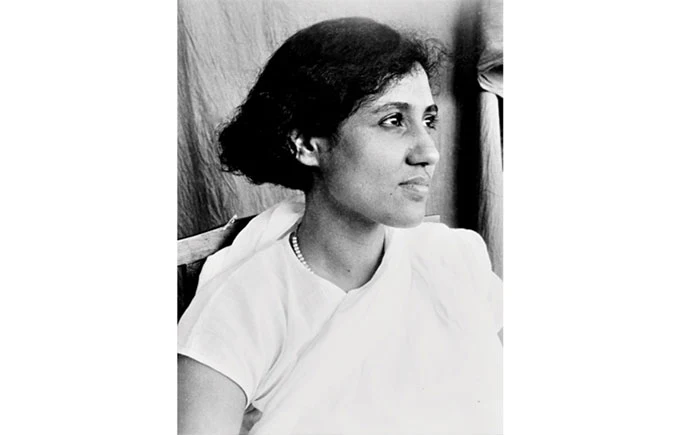
In her short, eventful life, Rashid Jahan made her mark as a literary stylist and an outspoken critic of patriarchal norms. COURTESY SHAHID NAJEB

1952. ISMAT CHUGHTAI HAD BEEN, for nearly a decade, the leading short story writer and novelist in the world of Urdu literature. But across the border in Pakistan, Qurratulain Hyder’s reputation as the disaffected chronicler of the generation lost to the tribulations of Partition was rapidly rising and would soon challenge Chughtai’s supremacy. In Lahore, Hijab Imtiaz Ali was turning to psychoanalytically inspired fictions about alcoholism and the Electra complex. Several other young, female Urdu short story writers, of a generation nurtured on the literature of the Progressive Writers’ Movement, were coming to maturity: Khadija Mastur, Hajra Masroor, Mumtaz Shirin, Shaista Ikramullah, Amina Nazli. And Rashid Jahan—doctor, political activist, Chughtai’s literary mentor and the forerunner of this entire wave of writers—died of cancer in a Russian hospital in July of that year, some weeks before her forty-seventh birthday, almost forgotten by the literary world she had stormed two decades before. Yet she had freed the tongues and the pens of several generations that followed; her impact would be surpassed only three decades later, by Fahmida Riaz and Kishwar Naheed, the feminist poets of the 1960s who replaced the forensic idiom of Rashid’s work with a lyrical celebration of women’s bodies.

The daughter of Shaikh Abdullah and Wahid Jahan Begum, an illustrious couple of educationists in Aligarh, Rashid came from an enlightened family, and her decision to study medicine was perhaps not surprising. Her literary reputation rested on her contribution to Angaare, a pioneering anthology of short fiction published in 1932. This milestone of Urdu literature had introduced four young writers in their twenties, who in their fiction presented contemporary philosophical and psychological ideas, and also techniques absorbed from modern European writing. The most famous of the four was Ahmed Ali, who, though not prolific, would go on to become one of the most respected Anglophone litterateurs of the subcontinent. Ahmed Ali had introduced the young doctor to the other contributors. Aware of her literary predilections, one of them, Sajjad Zahir, is believed to have persuaded her to write two pieces for the book; another, Mahmud-uz-Zafar, would become her life’s companion.

The contributors, radical and ready to challenge as they might have been, were perhaps unaware of the shockwaves their discussions of sex and religion would send out into an audience that, though probably ripe for a new literary movement, was unprepared for the force of this onslaught on their sensibilities. Rashid was the only woman in the gang of four. Critics have noted that she was also the only one of them that didn’t differ significantly from her predecessors in her choice of milieu or material, but her unabashed vocabulary earned her the censure of readers across the Urdu-speaking regions. Ordinances were passed against her and the others. She was advised to travel with bodyguards but, as a practising doctor, she refused to take such precautions.

Her zeal was infectious. Faiz Ahmed Faiz, arguably the greatest political poet of his generation, was said to have been awakened to his ideological responsibilities by Rashid and her husband and fellow communist, Mahmud-uz-Zafar. Ismat Chughtai said of her, “I stored up her work like pearls … the handsome heroes and pretty heroines of my stories, the candle-like fingers, the lime blossoms and crimson blossoms all vanished … the earthy Rashid Jahan shattered all my ivory idols to pieces … Life, stark and naked, stood before me.”

Even Premchand, the grand old man of Hindi and Urdu literature, who was a vital supporter of the Progressives and their aims, is said to have written his last few stories of “stark and naked” life—of down-and-outs and derelicts—under the direct impact of Rashid and Angaare.

Six years later came Aurat, the only book Rashid would publish in her lifetime, a collection of seven stories. Throughout the decade of the 1940s, she had been involved in her work as a medical practitioner and Communist Party worker; she only occasionally published a story or a play in some obscure journal. Her reputation as a trailblazer and pioneering feminist was held to be based more on her ability to tell bitter home truths than on any exceptional literary talent. Her promise, it was held and still is, was never fulfilled. Above all, perhaps, it was the eventfulness of her short, unconventional life that made her a legend.

But in the fleeting period of her fame—or infamy—she had written at least a handful of pieces that made an impact on literary history which continues, to this day, to be analysed and chronicled. Her uncollected stories were published in Shola-e-Jawwala (1974), while the uncollected plays were included in Woh Aur Dusre Afsane Drame (1977). There was no authoritative collection of Rashid’s work for more than 30 years till Nasr-e-Rashid Jahan appeared in Pakistan in 2012. Edited by Humera Ashfaq, this was a major retrospective volume of 16 stories, five plays and a few essays, bringing together the author’s most famous pieces and lesser-known texts. Now, in A Rebel and Her Cause: The Life and Work of Rashid Jahan (Women Unlimited, 256 pages, R400), Rakhshanda Jalil, the well-known critic of Urdu literature who translated and edited the volume, presents eleven stories and two plays (all but one of these texts are also in Ashfaq’s volume), prefaced by a brief biography and a critical assessment, to give us the first full-length study of Rashid Jahan’s life and work to appear in the English language.

Three of the texts included are widely acknowledged as minor classics: the very brief monologue ‘A Tour of Delhi’, and the plays ‘Behind the Curtain’ and ‘Woman’. These three works, written in the space of about five years, display the development of her perception. In the first of these, a woman wrapped up in a burqa, whose husband has promised her a day trip in Delhi, is left to sit alone at the railway station to guard their bags while the husband goes off on a jaunt with a friend. Later, the woman recasts her experience as a self-deprecating story to entertain her friends back home. Rashid’s wit, and her command of the idiom of semi-educated middle-class women, are in evidence here. Though Rashid may have been influenced in passing by Western literary models, the most remarkable trait she reveals in ‘A Tour of Delhi’, and indeed throughout her career, is an ability to weld disparate influences into a seamless whole and create fictions that are deeply rooted in the milieu she portrays. This quality makes her work less formally innovative but more radically relevant to her readers’ lives than the writings of her male contemporaries.

The second piece, ‘Behind the Curtain’, a dramatised dialogue for two female voices, is far darker in texture. Muhammadi Begum, the mother of many children, laments to a friend that her husband has lost interest in her.

The truth is that my womb and all the lower parts had slipped so far down that I had to get them fixed, so that my husband would get the same pleasure he might from a new wife … How long can a woman who bears a child every year expect to have her body remain in good condition? It slipped again. Again, he went after me, nagged and threatened me into going under the butcher’s knife. But he is still not happy.

These words, of an unprecedented frankness at the time in their charting of a woman’s anatomy and naming of reproductive organs, nevertheless do not release the woman who utters them into any form of freedom. But Rashid would complete this task in ‘Woman’, which has a wider cast of characters, both male and female, and a more intricately theatrical frame. Here, in a very similar situation, Fatima, whose ailment this time is gonorrhoea, actually throws the cheating husband who gave it to her out of their marital home. The long-suffering woman of Urdu literature is replaced by a character prepared to take control of her own destiny.

I have the disease you have given me. You caused my innocent babies to die. You murderer! I will get myself treated by whoever I want. No one can stop me now. I have suffered enough at your hands by listening to your commands.

Again, one could compare Rashid’s characters to Western ones—in this case, Ibsen’s Nora from A Doll’s House and his other stories of discontented wives. But Rashid’s stories derive so completely from their parochial contexts that such comparisons point more to the discontinuous universality of human—and in particular women’s—experience than to literary borrowing.

Shaista Ikramullah—an admirer, whose own concise fictions show the influence of Rashid Jahan—was one of the few critics to pay serious attention to Rashid’s work during the latter’s lifetime. In her seminal work, A Critical Study of the Development of the Urdu Novel and Short Story (1945), Ikramullah writes about ‘Woman’:

It is a common enough occurrence, namely a husband contemplating a second marriage on the ground that his wife is childless. The fiction writers of the last four decades have condemned and criticised this cupidity of man. But none of them had the smouldering indignation that is present in Rashid’s indictment of it, nor has anyone yet succeeded in showing how contemptible were such men as she has. So far authors have been content to show just this one trait in man’s character, but Rashid has shown the entire man in his grossness.

Ikramullah is perhaps alone in tracing the connection between Rashid and the earlier generation of reformist writers, and in showing how she extends and rewrites their agenda from her progressive standpoint.

The lot of the poor has been championed in novels and short stories from the time they appeared in the Urdu language. But they were treated with an air of fateful acceptance … In Rashid’s stories there is a fire and a defiance that were not found in the stories that were written on the same theme before … In this attitude lies the difference between the new and the old school of writers.

What Ikramullah might have added is that Rashid brought to the concise and elliptical form of the short story the concerns of the novelists of a prior generation, often saying in three or four pages what it had taken the reformists several times that number to narrate. Hers was not only a political but also a formal innovation.

THE STORY that opens Jalil’s selection, ‘That One’, is a first person account of a young teacher’s strange relationship with a syphilitic prostitute; his infatuation with her is expressed by the daily gift of a flower. Finally, one of the housekeepers in the narrator’s hostel abuses and insults the prostitute, and throws her out. This story was, in some ways, Rashid’s introduction to a new generation of feminist readers, especially when it was translated into English for Susie Tharu and K Lalita’s pioneering anthology, Women Writing in India600 BC to the Present, Volume II (1993). The editors, however, focusing on Rashid’s narrative technique and conflating it with her authorial persona, ranged Rashid with a generation of bourgeois liberal women writers, introducing in the process a new if somewhat skewed reading of her literary politics.

The focus of these narratives remains the middle-class protagonist and her moral awakening to social responsibility and therefore also to citizenship. The ‘other woman’—the prostitute, the working class woman—is a figure cut to the measure of this middle-class woman’s requirements that is also, we must not forget, the requirement of the nation. These stories may be about those at the margins, but they are, all the same, stories of the centre, told by the centre … Though many of the protagonists in the stories are women, the questions raised pose few threats to a patriarchal order.

How exactly Tharu and Lalita expected Rashid to overturn the patriarchal order they did not say. But their restaging of Rashid Jahan’s image persists. Priyamvada Gopal, in several nuanced and sensitive readings of Rashid, attempts to vindicate her and yet sees her returning to a default position as a bourgeois narrator—a surrogate for the author—who surveys her material with a lofty disdain. But this, today’s readers might find, is something of an advantage, as they can easily identify with her modern voice; and Rashid is able to use this narrative mode to inflect her stories with varying levels of irony.

Several such tales are included in Jalil’s selection. Foremost among them in terms of fame is ‘One of my Journeys’, in which a young woman student, on her way home for the holidays, gets into a compartment full of women, both Hindu and Muslim, who use every opportunity they find to engage in thinly disguised sectarian disputes. The narrator, a secularised Muslim, castigates them all for their bigotries and the story ends on a note of almost manic harmony. The comic note of ‘A Trip to Delhi’ is reprised but in a multi-vocal mode, with Rashid’s perfect ear for speech giving it the immediacy of one of her plays.

Far more subtle and intricate, and perhaps as a result not as competently translated, is ‘Sale’, in which a young narrator, hiding in the back of a car on a country drive and reminiscing about an erotic moment, observes strange goings-on through the window: three burqa-clad women and five men, one of whom the narrator recognises as a comfortably married neighbour, disappear into the woods for a bit of fun.

A torch flashed … those few seconds of strong light revealed two naked bodies. As soon as the torch lit the darkness, the man – scared of being recognised and uncaring of his body – hid his face in the woman’s burqa.

Evidently, it is not a sin to commit a sin; it is a sin to get caught.

Suddenly, peal after peal of dead laughter rent the air. She was laughing at the dogs.

It’s a chilling story, told from the centre about the centre, but pervaded by the “dead” laughter of the prostitute—to the extent that the centre begins to expose its own hollowness.

In ‘Thief,’ a doctor—obviously a very deliberate parody of the author—complains about the time, demands a fee, and generally behaves obnoxiously with a poor man who has brought a child in for emergency treatment, until pity or a doctor’s duty takes over. But the story keeps turning. The narrator then discovers that the same man had robbed her house only some time before, yet decides to let him go. The rest of the brief story is an examination of social conscience and of varieties of theft:

… petty thievery, picking pockets, robbery, larceny, black marketing, exploitation, filling your home with the money earned from the labour of others, swallowing up someone else’s land or country. After all, why aren’t these included in theft? … I looked around me. I saw that some of the biggest thieves walk around me, dressed up as saints.

Though not perhaps one of Rashid’s best, this late story shows her experimenting with technique in a combination of pseudo-memoir and ironic essay, and in its satirical retake on the familiar narrative persona.

The bulk of Rashid Jahan’s stories, though, are not told in the first person. More often, they begin in the breezy omniscient tone of a traditional tale, as in ‘Mute’, a beautifully calibrated story of a young woman whose parents fail to find her a suitable groom.

Siddiqa Begum’s marriage was proving to be a very difficult one to arrange. She was a true blue Sayyadani. Her father, Hamid Hasan, was reasonably well placed. What is more, she was one among thousands when it came to beauty. Yes, Siddiqa Begum was still not married and already twenty-three years old. Her mother … could not sleep at night for worry over her.

The multi-layered ‘A Daughter-in-Law For Asif Jahan’ is also set in the enclosed milieu of the women’s quarters, but this time the occasion that sets the story in motion is the birth of a much prayed-for girl child, whose cousin has already been chosen as a bridegroom for her. The story’s subtext chastises the women of the family for failing to summon a doctor; instead, they use traditional midwives and methods of delivery. But in place of polemic Rashid graphically describes the process of childbirth, interspersed with the manic humour familiar from other stories, which culminates in a celebration of women’s resilience as every female member of the household plays her part in bringing the girl child into the world.

Rashid is inevitably identified with portraits of women, but some of her writing, in particular her later, unpublished plays, show that she can also manage the voices of men with panache. This is also evident in one of the finest stories in A Rebel and Her Cause, ‘Bad Company’, about an establishment judge who rejects his Marxist son. The piece is created from a seamless weave of interior monologue, telephone conversation, and dialogue. There are times that the judge’s climb is seen with something close to sympathy, but that is soon revealed as an illusion when the man’s snobbery and deep conservatism are gradually uncovered.

Jalil comments on the unevenness of the author’s oeuvre, noting that Rashid Jahan probably wrote quickly and didn’t edit; some of the stories, she feels, read like drafts. Though this is true of one or two of the stories in Aurat, it largely isn’t evident in those Jalil has chosen to translate for this book, which consistently display, in their seemingly simple mode of exposition, the storytelling dexterity that is Rashid’s forte. There is some consensus that Rashid herself probably favoured the dramatic form for its immediacy and its performative qualities, which encouraged group activity of the kind she enjoyed—and some of her best later work (which Jalil comments on in an analytical chapter) is in this genre. As we have seen, Jalil includes the two most famous plays but has otherwise chosen to concentrate on the fiction, possibly because dialogue is harder to render in English than narrative.

Jalil’s translations valiantly attempt to convey the range of her subject’s interests, and the themes and styles with which Rashid experimented. It’s a laudable enterprise, as is the decision to accompany the fictions with biographical and historical facts. What doesn’t always come through here is the distinctive lucidity and diamond-hard precision of Rashid’s prose, which depends so much on her ability to balance various registers of the Urdu vernacular—pathos and satire, humour, anger, compassion and very occasional touches of lyricism—in a way that’s near-impossible to capture in English translation. In fact, Rashid is underrated as a stylist; and, if this timely book succeeds in sending bilingual critics back to the originals (as it did this reader), that will be yet another of its several achievements, the finest of which is to make us grateful that, in her short and exceptional life, Rashid Jahan found time to write so many outstanding stories.

source: http://www.caravanmagazine.in / Caravan / Home> Gender> Books / by Aamer Hussein / January 01st, 2014

Watch: 5 Indian Muslim Feminist Writers You Should Know About

INDIA :

Today, we remember these 5 powerful Indian Muslim feminist writers, who wrote boldly of issues that were considered taboo, shattering gender roles and stereotypes in their fierce writing and the politics they advocated for.

Watch this video detailing the life and times of luminaries like Ismat Chughtai, Rashid Jahan, Begum Rokeya, Wajida Tabassum and Qurratulain Hyder. #IndianWomenInHistory

source: http://www.youtube.com /

source: http://www.feminisminindia.com / Feminism In India (FII) / Home> History / by FII Team / November 09th, 2017