Tag Archives: Hasan Khan

Adiba Anam becomes Maharashtra’s first Muslim woman IAS officer, daughter of an auto-rickshaw driver

Yavatmal Town, MAHARASHTRA :
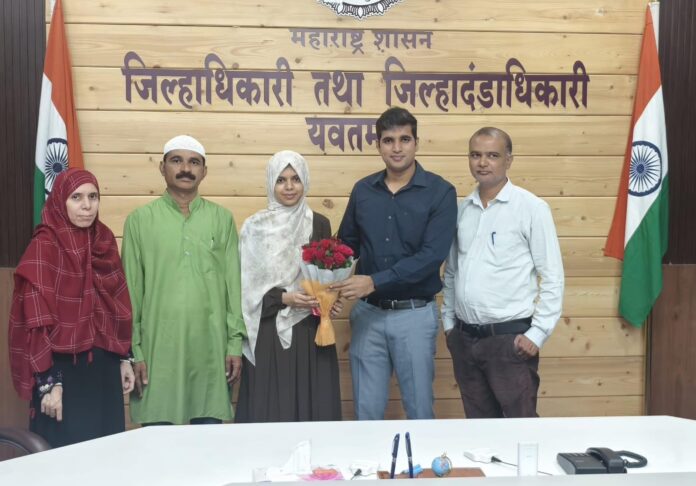
Adiba Aman in the centre.

New Delhi :

 The Union Public Service Commission (UPSC) declared the results of the 2024 Civil Services Examination on April 22, with 1009 candidates clearing one of India’s most competitive exams. Among them, Adiba Anam has made history by becoming the first Muslim woman from Maharashtra to be selected for the Indian Administrative Service (IAS).

Hailing from Kalam Chowk in Yavatmal, a small town in eastern Maharashtra, Anam secured an all-India rank of 142. Her achievement has been widely hailed as a breakthrough for both women and minorities in the state. Her father, Ashfaq Ahmed, earns a living by driving an auto-rickshaw.

Raised in modest circumstances, Anam completed her schooling in Urdu medium from a local Zilla Parishad school. Despite limited resources, she consistently excelled academically—scoring 94% in her Urdu board exams and 92% in 12th grade with a science stream.

Speaking to India Tomorrow, Anam recounted her journey through UPSC. Her first attempt in 2021 ended at the preliminary stage. Undeterred, she progressed to the mains in her second attempt, and finally, in her fourth attempt, clinched success with a rank likely to earn her an IAS cadre.

“My parents never asked me to give up on my education. There were people who suggested I take up a small job to ease our financial burden, but my parents never let those voices affect me,” she said.

Anam noted the social barriers women often face in her community. “Yes, girls do face restrictions. But these challenges only overpower us if we allow ourselves to feel weak. Once we build our mental strength, those obstacles lose their power,” she said. Her message to young women: “Stay mentally strong. Chase your dreams with courage and determination.”

Initially aspiring to become a doctor, Anam couldn’t clear the NEET exam. It was then that her uncle, Nizamuddin Sheikh—a local NGO secretary in Yavatmal—encouraged her to consider civil services as a way to serve the public.

Adiba Anam draws inspiration from the poetry of Allama Iqbal. Two couplets, in particular, fuel her determination:

“Khudi ko kar buland itna ke har taqdeer se pehle, Khuda bande se khud pooche, bata teri raza kya hai, ” meaning, “Elevate your selfhood to such heights that even destiny, before shaping your fate, is compelled to ask you: ‘Tell me, what is it that you desire?’”

This powerful verse emphasizes self-empowerment, urging individuals to strengthen their character and willpower to such an extent that even fate bows before their determination.

“Amal se zindagi banti hai jannat bhi jahannam bhi, Yeh khaaki apni fitrat mein na noori hai na naari hai.” This translates in English as “Through actions, life can become either a paradise or a hell. This being (the human) made of dust is by nature neither angelic nor demonic.”

The couplet underscores the idea that our actions determine the quality and direction of our lives. Human beings are not inherently good (like angels) or evil (like demons); it is their actions (amal) that shape their destiny and define their identity.

Explaining the two couplets, she said, “These lines remind me of the power of action. If you just sit still, nothing will change. But if you act, if you try to change your situation, something will definitely happen,” she said.

Anam’s journey—from a small-town Urdu-medium student to a future IAS officer—stands as a powerful story of resilience, ambition, and the transformative potential of education.

Here is the list of 26 Muslim candidates who cleared the UPSC Civil Services Examination this year, with their ranks written in front of their names.

•             Iram Chaudhary – Rank 40

•             Farkhanda Quraishi – Rank 67

•             Mohammad Muneeb Bhatt – Rank 131

•             Adiba Anam Ashfaq Ahmed – Rank 142

•             Wasim ur Rehman – Rank 281

•             Md. Nayab Anjum – Rank 292

•             Mohammad Haris Mir – Rank 314

•             Mohammad Shaukat Azeem – Rank 345

•             Alifa Khan – Rank 417

•             Nadia Abdul Rashid – Rank 429

•             Najma Salam – Rank 442

•             Shakeel Ahmed – Rank 506

•             Shah Mohammad Imran Mohammad Irfan – Rank 553

•             Mohammad Aftab Alam – Rank 560

•             Mohsina Bano – Rank 585

•             Syed Mohammad Arif Moin – Rank 594

•             Ghulam Haider – Rank 633

•             Hasan Khan – Rank 643

•             Ghanchi Gajala Mohammad Hanif – Rank 660

•             Mohammad Salah T.A. – Rank 711

•             Sadaf Malik – Rank 742

•             Yasir Ahmed Bhatti – Rank 768

•             Javed Mev – Rank 815

•             Nazeer Ahmed Bijran – Rank 847

•             Arshad Aziz Quresh – Rank 993

•             Iqbal Ahmed – Rank 998

source: http://www.indiatomorrow.net / India Tomorrow / Home> Education / by Mohammad Akram / April 2025
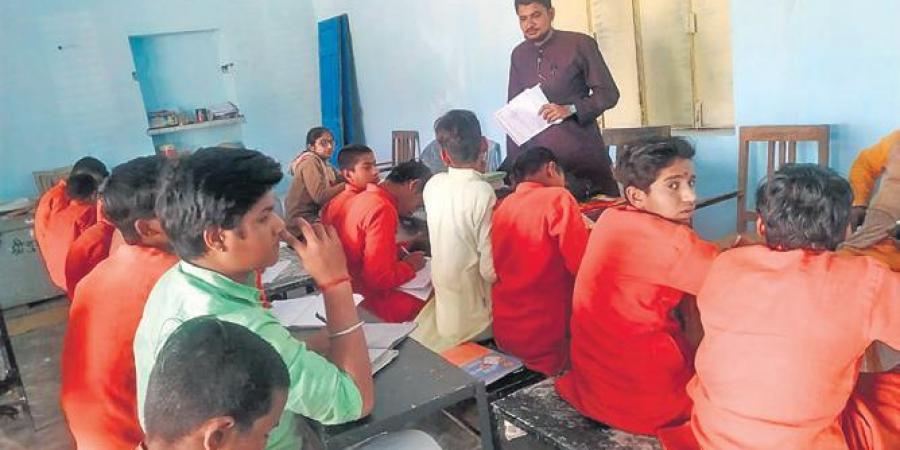
On a mission to take ‘Dev Bhasha’ to people: UP man conducts free online Sanskrit-speaking classes

Mahoba Village (Bundelkhand), UTTAR PRADESH :

Free online Sanskrit-speaking classes by UP is an instant hit as there is a surge in excitement about learning the ‘language of gods’.

free-of-cost online Sanskrit-speaking classes of 20-day duration (one hour daily) were planned and launched in the first week of this month.

Uttar Pradesh : 

Around 25 years back, Class V student Hasan Khan would spend hours with his friends at the local Hanuman temple in his Mahoba village in UP’s Bundelkhand region, listening to the Ramayan verses. He recited the ‘chaupais’ and ‘shlokas’.

Now 35, Khan is currently on a mission to popularise Dev Bhasha (the language of gods, as Sanskrit is known) as Jan Bhasha (the language of commoners). Pursuing PhD in Sanskrit, he isn’t alone in his mission but is joined by 40 other trainers working on a dedicated project of the Uttar Pradesh Sanskrit Sansthan to break the myth of Sanskrit being a difficult, primitive and elitist language.

“Four years back, UP embarked on a dedicated mission to popularise Sanskrit, starting with government school teachers and students. Till two years back, special camps were organised across the state which enabled not only 12,000 primary teachers, but their students also to learn how to speak in Sanskrit on a daily basis. Our next plan was to establish centres in all development blocks and train at least 1,000 people in each block to speak fluently in the language,” UP Sanskrit Sansthan president Vachaspati Mishra.

The Covid pandemic came as a big obstacle. As the pandemic shows no signs of ending, the Sansthan has taken to the online medium. Free-of-cost online Sanskrit-speaking classes of 20-day duration (one hour daily) were planned and launched in the first week of this month. Aspirants were asked to give a missed call on cell-phone number 9522340003.

“We received 45,000 missed calls. All those who made the calls automatically received forms to get enrolled for our free online course being conducted in one-hour slots from morning till evening. Over 8,500 have already enrolled,” said Mishra. While 60% of those enrolled are students (from Class V students to PhD scholars), the rest are professionals, including doctors, engineers, journalists, software engineers, lawyers, teachers and even sportspersons. Among the non-students, around 30% are women, many of them housewives. 

While the maximum (over 25%) of these 8,500-plus students are from UP, participants from Maharashtra are second only to UP. Madhya Pradesh, Gujarat, Karnataka, Punjab, Bihar, Delhi, Uttarakhand and Telangana too are in large numbers. Though the present duration is for only 20 days, the Sansthan is planning to follow it with virtual Sanskrit Vyakaran (Grammar) classes for those eager to delve deeper into the language. Also, the success has prompted the Sansthan to plan such courses in Pali and Prakrit languages as well. 

The participants are already excited. “Since childhood, Sanskrit and not Bengali has been my third language after English and Hindi. With my father being in a transferable job, I did my schooling in Chennai where I learnt Sanskrit in Devanagiri script,” says Shantanu Ganguly, associate professor of English language at a leading college in Kolkata. “The course has given me an opportunity to refurbish my Sanskrit knowledge attained during school days. I’m eagerly waiting to pursue further courses in the Dev Bhasha and would be happy if my services are used to run similar courses in West Bengal,” he says.

Ganguly’s batchmates in the virtual classroom include Anup Singh, a national-level rifle shooter from UP. “Meditation holds the key to concentration and success in target sports such as shooting and archery. I’ve been meditating with Hindi words, but mediation with Sanskrit shlokas generates different vibes,” Singh said. “I’ve never studied Sanskrit before. The free online platform attracted me,” said Nagpur-based software engineer S R Mungatiwar.

source: http://www.newindianexpress.com / The New Indian Express / Home> The Sunday Standard / by Express News Service / August 01st, 2021