Vijayapura (formerly) Bijapur, KARNATAKA :
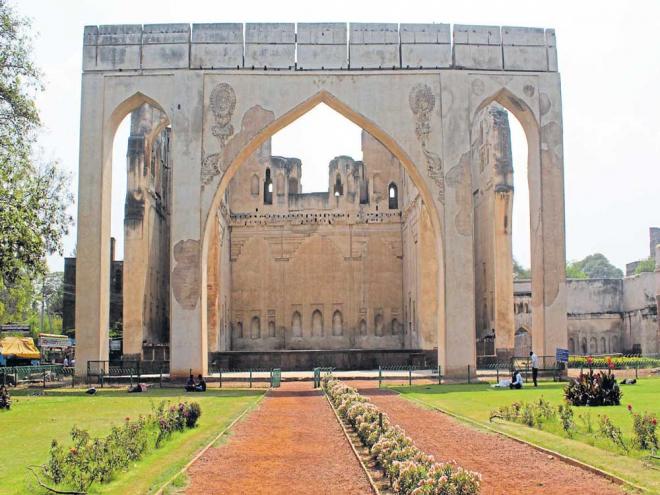
The myriad monuments of Bijapur, such as the Gol Gumbaz, the Jami Masjid, the Malik-e-Maidan and the Ibrahim Rauza, continue to evoke the grandeur of its past as the capital city of a sultanate that held sway for two centuries.

The Ibrahim Rauza contains the tomb of Ibrahim Adil Shah II (r. 1580-1627). The tomb and the mosque in the complex were built by Malik Sandal, the celebrated Abyssinian architect in the Adil Shahi Sultanate of Bijapur.
DURING the reigns of Ibrahim Adil Shah II (r. 1580-1627) and Mohammed Adil Shah (r. 1627-1656) over the Deccan Sultanate of Bijapur, there lived an architect of Abyssinian origin called Malik Sandal who, some historians aver, learnt his trade in Turkey before being lured to the lands of the Deccan. Among the many splendorous monuments that this architect designed is the Ibrahim Rauza, the tomb of Ibrahim Adil Shah II, which the architectural historian Helen Philon describes “as the most beautiful and splendid of all Adil Shahi funerary monuments”. Malik Sandal used the services of a guild of builders whom he trained, called the imaratwale (builders).
Almost four centuries after Malik Sandal’s time, a descendant of this guild of builders continues to live in the city of Bijapur (now Vijayapura). While he has abandoned the profession of his ancestors, Abdul Gani Imaratwale often wanders into monuments that his forebears must have built, laying one basaltic block over another. His wanderings are not nostalgic strolls but serious forays of a historian of the medieval Sultanate of Bijapur who teaches at the Anjuman Degree College in Vijayapura. Seeking a deeper understanding of the history of Bijapur, Imaratwale often finds himself staring for hours at something as obscure as the fish motifs that adorn many of the monuments in this grand city. Bijapur in its heyday, rivalled and, at times, surpassed its Mughal contemporaries such as Delhi, Agra and Lahore in magnificence.
Imaratwale, who has published several books on various aspects of medieval Bijapur, has now brought out his latest edited volume, Studies in Bijapur Sultanate . His co-editor in this work is Maqsood Afzal Jagirdar, who is the direct descendant of Afzal Khan (d. 1659), a powerful generalissimo of the Adil Shahis. Thus, the two editors of the volume, apart from being scholars, have primordial familial links with the history of the Adil Shahi Sultanate of Bijapur.
Studies in Bijapur Sultanate consists of 43 academic papers, of which 17 are from an academic seminar that took place in 1983 in Bijapur when Imaratwale was a young historian, while the remainder are the outputs of modern research. In the latter section, the majority of the papers are authored by Imaratwale, followed by Jagirdar. The work of a few more scholars complete the volume.
The inclusion of unpublished papers from the seminar of 1983 is an academic scoop of sorts as they add tremendously to our understanding of the history of this epoch. Scholars from New Delhi, Hyderabad, Pune, Kolhapur, Bangalore (now Bengaluru) and Mysore (now Mysuru) had made the journey to Bijapur to participate in this pathbreaking seminar. On the second day of the seminar, they were taken around Bijapur in horse-drawn tongas to see the Gol Gumbaz, Jama Masjid, the massive cannon called the Malik-e-Maidan and the Ibrahim Rauza. Many of these historians, who had spent most of their academic lives researching the Deccan and south India, have since passed away, making this exercise of publishing their papers even more precious.
The Bijapur Sultanate was founded in 1489 by the Persian migrant Yusuf Adil Khan (known as Shah in later histories) (r. 1489-1510), who was a protege of the Bahmani Prime Minister Mahmud Gawan. At the time, the almost 150-year-old Bahmani Sultanate that stretched across the northern Deccan was in its death throes because of internecine differences among the native and foreign components in its nobility. The execution of Mahmud Gawan in 1481 at the behest of Mohammed Shah III (r. 1463-1482), the last notable king of the Bahmani throne who ruled from Bidar, catalysed the breakneck speed at which this empire unravelled as governors of different provinces gradually assumed independent power.
Over the next two decades, the boundaries of the northern Deccan would have to be redrawn to account for the birth of five new principalities, or Sultanates, of the Deccan that emerged from the implosion of the Bahmani Empire. The Deccan Sultanates that emerged were Bijapur (the Adil Shahi Sultanate), Golconda (the Qutb Shahi Sultanate), Ahmednagar (the Nizam Shahi Sultanate), Bidar (the Barid Shahi Sultanate) and Berar (the Imad Shahi Sultanate). Of these five, the three Sultanates of Bijapur, Golconda and Ahmednagar survived as robust and strong states into the 17th century when the imperial ambitions of the Mughals snuffed them out forever. The last great Mughal, Aurangzeb (r. 1658-1707), personally led campaigns to the Deccan, vanquishing Bijapur and Golconda in 1686 and 1687 respectively, ending the era of the Deccan Sultanates. Thus, historians like S.K. Aruni argue that the Deccan Sultanates formidably “resisted the north Indian imperialism” of the Mughals. Nine Sultans ruled the Adil Shahi Sultanate of Bijapur over the two centuries of its independent existence between 1489 and 1686. They ruled over a linguistically diverse land from their headquarters of Bijapur that lay at the nebulous meeting point of the Kannada- and Marathi-speaking lands. Their reign would later extend into the Tamil-speaking areas of the deep south as well. Like the other Deccan Sultanates of Ahmednagar and Golconda, which were ruled by ardent Shiites (as opposed to the Sunni Mughals), Bijapur, too, had a Shiite orientation that manifested in its close relationship with the Shiite Safavid dynasty of Persia.
Here, it is important to mention that even though Yusuf Adil Shah was the first Muslim king in India to declare himself as Shiite, his descendants often vacillated between Shiism and the Sunni creed. These rulers also never imposed their Shiite creed on their fellow Muslims, which is vindicated by the fact that Shiites continue to remain a negligible minority among modern Muslims even in the city of Vijayapura. Sufi saints such as Sayyed Hashim Husaini Alvi (the full name of Hazrat Hashimpeer) were also patronised by the ruling clique.
Like the Bahmanis before them, the Sultans of Bijapur ruled over a variety of people. Among the nobility itself, the factional schism between the Afaqis (or the foreign component which Imaratwale prefers to call Gharibuddiyar ) and the Dakhnis (or the native component) that had been the bane of the Bahmani court continued to fester in the Bijapur court as well. There were also Habshis or the Abyssinians who were an important faction in the court as well. Among its non-Muslim population, the Bijapur rulers formed a tight patron-client relationship with the Maratha nobility, with at least one prominent historian of the medieval Deccan, P.M. Joshi, comparing this relationship to the one that existed between the Mughals and the Rajputs in Hindustan or north India.
Imaratwale lists some of the prominent Maratha families that served the Adil Shahis militarily. These include the “Nimbalkars of Phaltan, Ghatges of Maun, Manes of Muswar, Ghorpades of Mudhol, Dafles of Jath, Sawants of Wari, etc.”. Marathi-speaking brahmins also served Bijapur in its civil administrative work. This relationship dates back to the founder of the dynasty, Yusuf Adil Shah, who married a Maratha noblewoman, and before him to the Bahmanis who had built a close relationship with the Marathas.
Bijapur was often involved in wars with the empire of Vijayanagara, its powerful neighbour in the south. In direct confrontations such as the battles that took place in 1510 and 1520, Vijayanagara (that was ruled by Krishnadevaraya [r. 1510-1529] at the time) was able to trump Bijapur. In the chequerboard of the medieval Deccan, victories or losses were never permanent, which meant that Bijapur would often ally with Vijayanagara over the next few decades in conflicts with its sibling Sultanates, until a final breach in this fluctuating relationship led to the Battle of Talikota in 1565. Four (of the five) Deccan Sultanates, including Bijapur, set aside their squabbles to briefly ally in this ultimate battle, which sounded the death knell for Vijayanagara. Historians have argued that the confederation of Sultanates, while having the smaller army, gained an immense advantage because of their advances in artillery pioneered by engineers such as Fatehullah Shirazi who lived in Bijapur during the reign of Ali Adil Shah I (r. 1558-1579). Bijapur benefited tremendously from this battle as it paved the path for the southern expansion of its territory across the Tungabhadra river as they were able to defeat a number of vassals of Vijayanagara over the next century.
Moment of glory
The victory at Talikota also led to the commencement of a golden period for Bijapur which saw a flurry of construction as Hindu artisans from the defeated capital of Vijayanagara sought new patrons. Bijapur entered its moment of glory with the ascension of Ibrahim Adil Shah II in 1580, who ruled for almost 50 years and is considered the greatest Adil Shahi Sultan. Part of his reign coincided with the reign of the greatest Mughal king, Akbar (r. 1556-1605), and aspects of Ibrahim Adil Shah II’s personality were similar to those of Akbar as the Bijapur ruler also had an eclectic outlook and, some argue, tried to establish a syncretic religious creed on the lines of Din-i-Ilahi .
In fact, Ibrahim Adil Shah II was addressed as “Jagat Guru”, for, as an aesthete steeped in musical and literary pursuits, he was a devotee of Goddess Saraswati. In some of the farmans (royal edicts) issued during his rule, he is referred to as Az Puja Shri Saraswati . Ibrahim Adil Shah II’s own composition, the Kitab-e-Nauras , contains lavish praise of Saraswati. Ibrahim Adil Shah II was also more comfortable in Marathi, a consequence of the ruling dynasty’s close links with Maratha nobility and the status that the language had as the lingua franca, than with Persian, which he spoke with some difficulty. He also patronised poets in his court, including Mulla Zuhuri, who wrote: “If they make the elixir of mirth and pleasure/They make it from the holy dust of Bijapur”.
A Mughal envoy, Asad Baig, who visited Bijapur during the reign of Ibrahim Adil Shah II, describes it thus: “In one street [of the bazaar in Bijapur] were thousands of people drinking; and dancers, lovers and pleasure seekers assembled. None quarrelled or disputed with one another and this state of things was perpetual. Perhaps no other place in the world could present a more wonderful spectacle to the eye of the traveller.” On his return to the court of Akbar, he took along with him fabulous gifts, including tobacco and Chanchal, the favourite elephant of the Sultan, who was “accustomed to drinking two mans [one man is equal to 37.324 kilograms] of wine daily”.
Mohammed Adil Shah (r. 1627-1656) also displayed some of his father’s penchant for art, music and literature, apart from being a wise ruler. It is his remains that are interred in the Gol Gumbaz, the awe-inspiring mausoleum that has one of the largest free-standing domes in the world.
At its peak in the first half of the 17th century, the boundaries of the Bijapur Sultanate touched both the Arabian Sea and the Bay of Bengal. In the West, Bijapur traded with Persia, Arabia, East Africa and Europe through its entrepots of Chaul, Dabhol, Bhatkal and Goa (which it lost to the Portuguese in 1510). Leaving the eastern Deccan in the hands of its neighbour, the Sultanate of Golconda, Bijapur’s tentacle of power extended south and south-east across Bangalore, Mysore, Tanjore and Madurai. This vast swathe meant that it was the second largest kingdom in India at the time after the Mughal Empire. The territory of the Sultanate encompassed regions in the modern Indian States of Karnataka, Maharashtra, Goa, Telangana, Andhra Pradesh and Tamil Nadu.
Evan as Bijapur reached the apogee of its power, its clashes with the Mughals who had become its northern neighbour after gobbling up the Sultanate of Ahmednagar, and increasingly fractious wrangling with the Marathas who had coalesced under Shivaji’s leadership, restricted its power. The early rise of Shivaji, who became the first Chhatrapati of the Maratha Empire reigning between 1674 and 1680, can be indirectly attributed to the Adil Shahis. His father Shahji was one of the chief generals of the Bijapur army during the reign of Mohammed Adil Shah and Ali Adil Shah II (r. 1656-1672) and was even granted a string of titles and the jagir (landholding) of Bangalore for his services.
The decline of the Bijapur Sultanate set in after the ascension of Ali Adil Shah II, who was unable to complete the building of his own tomb (the incomplete structure is erroneously called Barakaman and was possibly conceived to be larger than the Gol Gumbaz), and continued under Sikandar Adil Shah (r. 1672-1686) who, after a year-long siege of Bijapur, was captured by Mughal forces in 1686 ending the saga of the Adil Shahis.
The Adil Shahis’ liberal religious policies, their broad outlook towards their subjects of various ethnicities, their patronage of art and literature also ensured that their reign engendered a unique Deccani culture in their territories, vestiges of which continue to linger on in modern Karnataka and Maharashtra. Their legacy in language can be seen in Dakhni Urdu, which continues to be spoken by Deccani and south Indian Muslims even to this day. In the implementation of justice, the “Adil Shahi kings preferred Hindu law for Hindu subjects and the Muslims were governed by Shariah .” The farmans of the Adil Shahis were in Persian but often appended by a translation in Marathi or Kannada. The historian and archaeologist Dr A. Sundara has demonstrated that the Deccani architectural style of the Adil Shahis even had an impact on temple architecture.
Imaratwale makes the important point that “Hindus enjoyed socio-religious freedom” during the Adil Shahi period. Many of the Persian histories written during the Adil Shahi period mention how the Hindu population celebrated festivals such as Ugadi, Holi, Deepavali and Dasara, and the rulers financially supported “annual fairs and the maintenance of religious places such as temples and mathas ”. The contemporary Persian histories that Imaratwale relies upon are valuable sources of Bijapur history. Chief among these is Tarikh-e-Farishtah of Muhammad Qasim Hindu Shah Astrabadi, who wrote this history under the patronage of Ibrahim Adil Shah II.
While modern Vijayapura, also the district headquarters, is a nondescript city, its myriad monuments continue to evoke the grandeur of its past. Both religious structures, be they tombs or mosques, and secular structures, such as forts, tanks, palaces, markets and gardens, still vie for the attention of the modern-day tourist. The detritus of majestic structures that survives in its suburbs and neighbouring towns and villages such as Afzalpur, Tikota, Kumatagi, Ainapur, Aliabad and Nauraspur, also beckon discerning visitors.
Abdul Gani Imaratwale can be contacted at dr.imaratwale@gmail.com
source: http://www.frontline.thehindu.com / Frontline / Home> Arts & Culture> Heritage / by Vikhar Ahmed Sayeed / July 09th, 2021