Tag Archives: Nawab of Awadh

Imam Bakhsh Nasikh Hindi Shayari: He never forgets her from his heart…

Faizabad, UTTAR PRADESH :

Imam Bakhsh Nasikh’s Hindi Shayari: 

Imam Bakhsh Nasikh was a poet of the Mughal period. He played a significant role in the development of Urdu poetry and couplets.
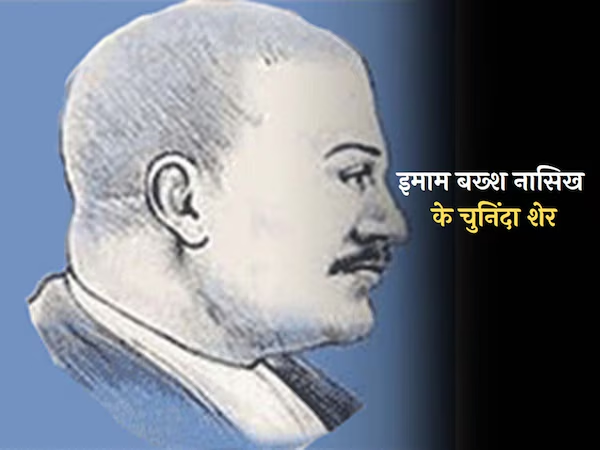
Imam Bakhsh Nasikh Hindi Shayari: 

Imam Bakhsh Nasikh was an Urdu poet of the Mughal Empire. He was born on April 10, 1772, in Faizabad, Uttar Pradesh.

He is considered the founder of the Lucknow school of poetry. Nasikh’s father died. He was adopted by Khudabakhsh, a wealthy merchant. He received a good education. Later, he also became the heir to Khudabakhsh’s estate. Nasikh rejected the offer of the Nawab of Awadh. After this, he was forced to leave Lucknow. After a few days, he returned to Lucknow. He died in Lucknow on August 16, 1839.

He never forgets me from his heart, 

I have seen him forget in a hundred ways. 

What can be achieved by any means, 
man is helpless due to fate 

You always kept delaying your arrival, 

I kept leaving and you kept coming with all your heart. 

He never forgets me wherever I go, 

oh what should I do, where should I go 

I cannot show my face to you out of shame, 

that is why my back is towards the sun. 

Let others’ work continue and we fail, 

what is our work in your government now? 

My friend’s sword is killing me,

it is the sword of swords, the speed of speed. 

It is foolish to search for anything, 

whatever is written on the forehead will have to happen. 

Life is the name of the lively, 

the dead live on nothing. 

I don’t take his name out of jealousy, lest someone hears it, 

I remember him in my heart. 

No one’s face matches yours, 

I roam around the world with your picture. 

You imprisoned me in your hair and killed me with your eyebrows, 

you did not listen to anything my heart said. 

He who says that fate is wrong is himself wrong, 

sometimes even the writing of fate may be wrong. 

How can I suddenly give up the thought of your hair, 

these black snakes have been kept for a long time. 

He is visible to me,

I am not visible to him in the dark at night. 

Though I don’t meet you, but due to the demands of my heart,

I come to your street a hundred times every day. 

Even after death I fear you so much 

I have not even raised my eyes to see any houris in heaven. 

source: http://www.zeenews.india.com / Zee News / Home> ZeeSalaam> ZeeSalaam News / by Siraj Mahi / July 17th, 2023
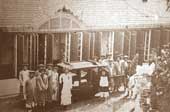
Second Lucknow ‘fixed’ in sepia

WEST BENGAL :

Liveried servants of the Nawab of Oudh wait with a palanquin in one of the rare photographs of Metiabruz, during Wajid Ali Shah’s time. The royal insignia is embroidered on the back of one of them. Copied from the original by Rashbehari Das

A portfolio of fast-fading photographs that provides possibly the only pictorial document of the second Lucknow that Wajid Ali Shah had created in Metiabruz, after he was exiled there, is urgently in need of preservation. The photographs are, moreover, some of the earliest examples of the art as practised the world over.

Amjad Ali Mirza of Garden Reach Road, in his 60s, who is a great-great-grandson of the ruler of Oudh, possesses the photographs. But he doesn’t know how to preserve these friable prints whose sepia has, in some cases, turned a ghostly shadow of its former self. Says Mirza: “I have no doubt about the authenticity of the photographs. The portfolio is ancestral property. It was handed down to me by my uncle, Yaqub Ali Mirza, who died in 1973.” Some of the photographs are captioned in Urdu. But the identity of the photographer shall always remain a mystery. Oscar Mallitte, a French commercial photographer, we know, had captured a view of the village at Garden Reach, circa 1864, but there is no evidence he did this assignment.

Abdul Halim Sharar (1860-1926) tells the story of Oudh in his book Lucknow: The Last Phase of an Oriental Culture. In it, he has also documented the last days of Wajid Ali Shah in Metiabruz, where he set up a city whose splendour surpassed Lucknow’s glory in the pre-Mutiny days. The palaces, pleasure gardens and zoo that the Nawab had created on the banks of the Hooghly come alive in these photographs, not much larger than postcards. It is as if chemicals and light had “fixed” the scenes that Sharar’s readers conjure up in their mind’s eye.

Soon after the Mutiny had fizzled out, the Nawab was released from confinement in Fort William and he returned to Metiabruz. There, while turning abstemious, he developed a passion for animals and for building beautiful houses. Before the Zoological Gardens was established in Alipore in 1876, the Nawab had already acquired a large menagerie that included rare birds, deer, horses and an open-air snake-pit that left visitors awestruck. But after Wajid Ali Shah’s death in 1887, Metiabruz became a hell-hole almost overnight.

The photographs prove that Sharar, when he described Metiabruz, never deviated from reality. Unlike the Lucknow architecture, with its embarrassment of stucco ornaments, the buildings of Metiabruz are constructed on the lines of European bungalows. The lines are simple but no less grand than the palaces of Lucknow.

Overlooking the river or surrounded by expanses of water, they are connected by bridges. Flags flutter on their tiled roofs. There is hardly any Islamic influence in their architecture, save a low-rise with triple minarets. Ostriches, deer, sheep and horses were the showpieces of the Metiabruz parkland. The snake-pit resembles a giant termite hill. One can almost hear the harsh calls of the clumsy pelicans and cranes strutting around the aviary. The liveried servants wait outside the palace gate with a palanquin. The piscine insignia of the royal family of Oudh is stitched on to the back of one man’s coat. There are two significant photographs. In one, the gang of smiling labourers carry construction material on their heads as they create the new Metiabruz. Another shows the buildings of Metiabruz being demolished. An exquisite way of life being wiped away forever.

source: http://www.telegraphindia.com / The Telegraph / Home> West Bengal / by Soumitra Das in Mirza / July 14th, 2003