Tag Archives: Obaid Siddiqi

PHOTO FEATURE : Her father’s voice: A photographer pays tribute to her celebrated scientist-father

UTTAR PRADESH / Bengaluru, KARNATAKA :

How a series of breakfast conversations grew into an exhibition and a book.

On some mornings, Diba Siddiqi would sit down at the breakfast table in her parents’ home in Bengaluru, and record her father’s voice.

He would hold forth on everything under the sun – science, history, justice, conflict, photography, politics, poetry, philosophy, the evolution of language and silence. The musings continued well after the meal was over and an Olympus digital voice recorder Diba Siddiqi had placed nearby would capture her father’s thoughts.

The sheer range of topics wasn’t surprising. Obaid Siddiqi was one of India’s most eminent scientists whose pioneering work in the field of molecular biology and neurogenetics are well known.

Siddiqi was keen to have an account of her father’s stories in his own voice so that she could revisit them later. She had tried taking notes, but found the process distracting. She started using the digital recorder so that she could give him his full attention.

But the recordings, which started in 2007, ended in 2013 when the senior Siddiqi was killed in an accident while taking a stroll near his home. He was 81.

Immersed in history

Months later, Diba Siddiqi finally revisited the “breakfast monologues” as she called them.

She immersed herself in the stories her father had shared of growing up in eastern Uttar Pradesh in pre-Partition India and the sadness at how the Siddiqis lost track of family members who moved to Pakistan.

It wasn’t long before Siddiqi began to dig through old family photographs, many of them developed in darkrooms by her father and his siblings.

It didn’t stop at that. Diba Siddiqi’s mother, Asiya, is a distinguished historian, who has spent a large part of her life studying Mumbai’s past. Siddiqi began to delve into her mother’s life too.

The result is Rooh: The Enduring Spirit, an exhibition of old family photographs interspersed with new images Diba Siddiqi has taken of places that played an important part in her parents’ lives. A book of the same name is set to be released shortly.

Dominating figure

It’s obvious that Obaid Siddiqi was an overarching presence for his daughter. “My father was this colossal figure in my life,” said Siddiqi. “No language is adequate to express his continuing presence in my life. I still find myself quietly and unconsciously carrying on conversations with him.”

Born in Basti, Uttar Pradesh, in 1932, Obaid Siddiqi completed an MSc from Aligarh University before obtaining a doctorate from the University of Glasgow in Scotland. His family lived in Benares in two spells between 1932 and 1948 before finally settling down in Aligarh.

Preventive detention

The includes an account of the two years Obaid Siddiqi spent in jail from 1949 under preventive measures at a time when 30,000 communists were detained across country. Recalling his period of detention in the company of 13 Communist leaders, he said:

“So you see jail authorities, they used the criminals, who were called pukkas, to beat us up. They were prisoners who had served ten years, fifteen years, had life imprisonment… They acted like small unofficial wardens to control other prisoners. They were dressed to look like police. They beat up our friend Syed Ali badly, giving him galis, saying, ‘Pakistan se saala Pakistani Communist banta hai!’

However, Obaid Siddiqi could also recognise the benevolent side of the police officer who had beaten up the comrades, realising that human nature can never be categorised as entirely good or bad.

His parents and six siblings managed to send him letters during his imprisonment. His sisters arranged to smuggle letters in and out of jail while delivering home-cooked food to him once a week.

In 2014, Siddiqi visited Benares, where her father spent some time as a child. Waking at the crack of dawn every day, she walked around the ancient city, photographing the people and its streets.

Mumbai chronicler

Siddiqi also took many pictures in Mumbai, a city whose past her mother has written about extensively. One of Asiya Siddiqi’s celebrated works recreates the lives of people who went bankrupt in the 19th century. Roaming the bylanes of Mohammad Ali road and Dongri, in Mumbai, Siddiqui imagined that the ghosts of these people “and their descendants surely dwell in the neighbourhood I roamed in… The descendants of tailors, carpenters, blacksmiths, milk vendors, courtesans, dancing girls and prostitutes may continue to live and work here.”

Though the project is intensely personal, she believes it has broad appeal. She said she hoped viewers would let her work touch their mind and spirit and perhaps remind them of their own histories. “It is an expression of life that I have been a part of,” she said. “It has been about finding a voice in the images and bringing it together in one space.”

Rooh: The Enduring Spirit can be viewed at Bangalore’s  1 Shanthi Road gallery until February 11.

source: http://www.scroll.in / Scroll.in / Home> Photo Feature / by Zinnia Ray Chaudhuri / February 09th, 2016
Obaid Siddiqui revolutionized bio-sciences

Basti, UTTAR PRADESH / Bengaluru, KARNATAKA :

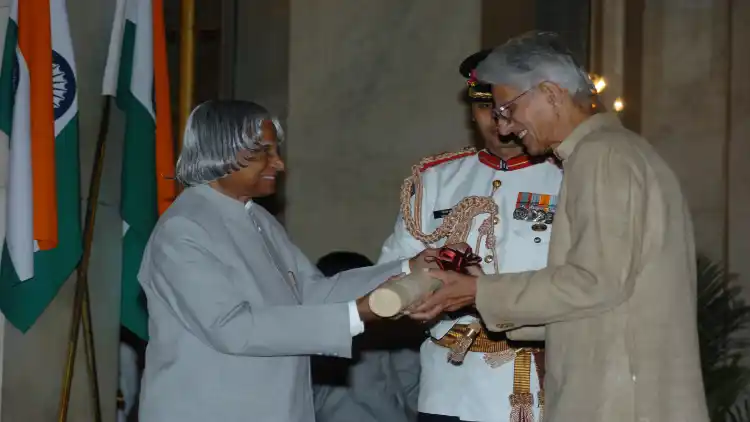
Obaid Siddiqui receiving Padma Vibhushan from the President

Genes and DNA are the words we hear frequently on our Televisions and other media. Genetic mapping has revolutionised the way humans understand organisms in general and themselves in particular. The past few decades have witnessed developments in biotechnology and genetics leading us to understand and treat diseases hitherto thought curable. Very few among us know that one of the important men who laid the foundation of this revolution was an Indian, Obaid Siddiqui.

Born on this day in 1932 in Basti, Uttar Pradesh, Obaid Siddiqui completed his Masters in Botany from Aligarh Muslim University (AMU) in 1953. Initially, he joined AMU as an agricultural scientist, after his Masters, and later moved to Indian Agriculture Research Institute (IARI), New Delhi. At IARI Siddiqui had prepared a testbed for wheat crossbreeds. But a devastating hail storm destroyed the crop and ruined his year-long labour. A frustrated Siddiqui, who had a keen interest in genetics, an emerging field at the time, wrote a letter to Professor Guido Pontecorvo at Glasgow asking him for a research opportunity with him. Pontecorvo accepted him and Siddiqui started his PhD at Glasgow on microbial systems – a paradigm shift from Botany.

During his PhD, Obaid made some path-breaking observations, which revolutionised the field of Genetics. Two very important observations made by him  were:

  • His studies were the first reports of fine mapping of a gene.
  • He pointed out the concentration of mutational sites in a small part of genes.

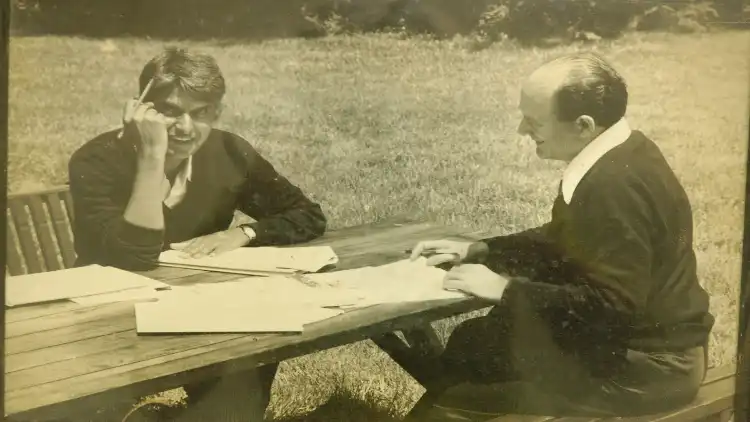
Obaid Siddiqui with Semour Benzer

So, when he submitted his PhD thesis in 1961 Siddiqui had already revolutionised the sciences in general and genetics in particular. Considering the fact that he shifted from Botany to a different field makes his achievement even more stellar.

The same year Siddiqui moved to Pennsylvania to work with Alan Garen as a postdoctoral fellow. Here, he discovered the suppressors of “nonsense” mutations. In simpler words, he discovered why a few mutations in a gene would not express themselves and remain suppressed. The discovery was a logical result of his earlier pioneering work in mapping of genes. Another important impact of this discovery was the finding of “nonsense” codons, the stop signal of genes. Har Gobind Khorana, Robert Holley, and Marshall Nirenberg received the 1968 Nobel prize for identifying “nonsense” codons and they personally acknowledged the role of Siddiqui in their research.

Siddiqui did not pursue his study of Codons further which got others a Nobel Prize because his heart was not in the USA. Siddiqui wanted to return to India to serve his motherland. This selfless patriot left the lucrative opportunities and told Alan Garen, in 1962, that he wanted to return to India.

Garen asked renowned physicist Leo Szilard to write to Homi Bhabha asking him to arrange a position for Siddiqui in India. Ignoring the opposition from fellow scientists in India, Bhabha showed confidence in Siddiqui and gave him the responsibility of establishing a molecular biology unit at Tata Institute of Fundamental Research (TIFR).

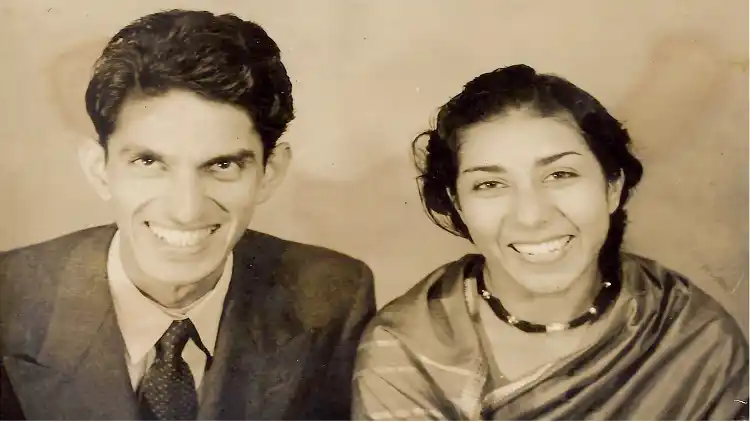
Obaid ASiddiqui with Wife Asiya Siddiqui

At TIFR, Siddiqui nurtured a younger crop of scientists and also brought Indians working in foreign labs back to India. With one of his students, P. Vijay Sarathy, Siddiqui showed that recombinant bacteria inherit DNA of bi-parental origin thus laying the foundation of principles of lateral gene transfer. In layman’s language his findings are the basis of the now well-known principle that genes pass from one generation to another.

With his other students like Kavita Arora and Veronica Rodrigues, Siddiqui showed that taste and smell of Drosophila have a genetic basis and thus opened a new field of chemosensory neurogenetics. These findings led others to research the role of genes on sensory perceptions, learning and memory.

Siddiqui was not a man who would compartmentalize his intellect to one branch of science. He contributed to fields as diverse as plants, Drosophila, bacteria, and genetics. He did not stop at research. He was an institution builder and established the National Centre for Biological Sciences in 1992 in Bangalore. Siddiqui was known for nurturing young minds by giving them the freedom to question.

Moreover, Siddiqui was a man who believed that sciences cannot operate in isolation of society. Scientists have a social responsibility and Siddiqui understood this. He stood for Human Rights, campaigned against communalisation and took part in social movements. Not only a music lover of Hindustani Music, Siddiqui was an established Sarod artist.

Obaid Siddiqui was awarded the second-highest civilian award, Padma Vibhusahan, by the Government of India. He was the true son of the soil who left lucrative offers in a foreign land to establish a research culture in India. His students are now serving the nation, which includes the present Principal Scientific Advisor of India, Professor Vijay Raghavan. 

source: http://www.awazthevoice.in / Awaz, The Voice / Home> Stories / by Saquib Salim / July 26th, 2021