Tag Archives: Shahjahan Magdum

Reading Great Books Enriches Knowledge and Guides Life: Senior Journalist Shahjahan Magdum

Islampur (Sangli Districti), MAHARASHTRA :
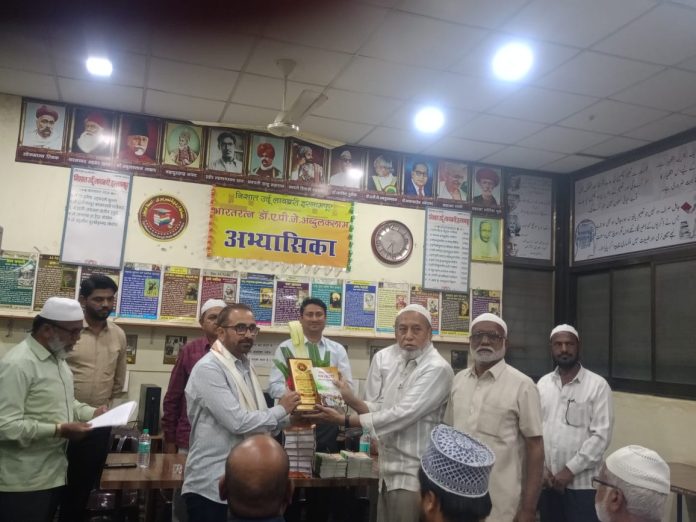
Book Distribution and Certificate Distribution Ceremony Enthusiastically Held at Nishat Urdu Library

Islampur:

“To make human life prosperous, profound, and radiant, as well as to give the right direction to life, it is essential to imbibe the thoughts of great personalities, and these thoughts are acquired only through the reading of books,” asserted Senior Journalist and Executive Editor of Weekly Shodhan, Shahjahan Magdum. He was speaking as the keynote speaker at the book distribution ceremony and the certificate distribution programme for the free basic computer course organised at Nishat Urdu Library here.

The programme, held on December 11, was presided over by social activist Jameer Nadaf, while Prof. Nazim Shaikh was present as the Chief Guest.

The ceremony began in a very auspicious atmosphere with a melodious recitation of the Holy Qur’an by students of the Madrasa.

Following this, the anchor, Mr. Altaf Momin, introduced the guests to the audience in his fluent style and presented a brief overview of the educational and social journey of the Nishat Library.

In his keynote address, Shahjahan Magdum underscored the importance of reading culture. He stated that everyone gathered there was inspired by the noble teachings of Islam and Prophet Muhammad ﷺ. With the noble intention that the Prophet’s message of humanity and his teachings should reach all communities in the Marathi language, he donated Islamic books and copies of the Marathi translation of the Holy Qur’an to the library.

He guided the audience by referencing inspiring articles and thoughts based on the lives of great personalities. Mentioning that his relationship with Nishat Library is not just formal but old and emotional, he assured all possible help for the library’s future progress and needs. He praised the institution’s office bearers, stating that Nishat Library is performing the sacred duty of preserving and growing the reading culture in the city and surrounding areas. He thanked trustees Abid Momin, Anis Momin, and other office bearers for the invitation.
While delivering the introductory remarks, Anis Momin, the Secretary of Nishat Library, presented an account of the institution’s 40-year penance. Narrating the inspiring history since the library’s inception, he mentioned that keeping the reading culture alive in Urdu, Marathi, and English languages and running a library in a city like Islampur for the last four decades was a major challenge. He detailed how difficult this task was and how the institution reached this stage by overcoming obstacles. He gratefully noted that many prestigious citizens, donors, and especially Urdu medium students consistently contributed to this journey. He explained that the library not only makes books available for reading but also fulfills its social responsibility by conducting free computer classes and various socially useful activities.

In his presidential address, Jameer Nadaf explained the significance of reading. Stating that reading changes a person’s vision and makes them complete, he proposed a significant concept for the better utilisation of the library. He suggested that a grand ‘Kavi Sammelan’ (Poets’ Meet) bringing together Urdu and Marathi literature should be organised in Islampur city. He also appealed that, not limiting the scope to just reading, other educational and social programmes should be organised with the cooperation of all communities. He assured that he would personally take the initiative and provide appropriate cooperation for such activities.

Chief Guest Prof. Nazim Shaikh provided valuable guidance to the students. He said that they have been blessed with a home of knowledge in the form of Nishat Library, and students should make the best use of it. He urged students from all sections of society, especially the needy, to take advantage of the ongoing free computer classes as well as coaching classes for Marathi, English, and Mathematics to build their careers. Prof. Shaikh is always striving for the development of Nishat Library and to fulfill the educational needs of Urdu medium students.

Delivering a message of social harmony, Sambhaji Brigade Sangli District President Umesh Shewale highlighted the progressive thoughts of Chhatrapati Shivaji Maharaj, Rajarshi Shahu Maharaj, Mahatma Jyotirao Phule, and Dr. Babasaheb Ambedkar. Citing history, he clarified that Chhatrapati Shahu Maharaj worked for the upliftment of not just the Bahujan society but people of all castes and religions. Significantly, Shahu Maharaj had performed a historic and important task of religious harmony by providing funds for the Marathi translation of the Qur’an in those times. On behalf of Sambhaji Brigade, he reminisced about the work of Lokshahir Annabhau Sathe of the Samyukta Maharashtra movement.

Sambhaji Brigade Islampur City President Ajit Havaldar emphasised his and his family’s harmonious and affectionate relations with the Muslim community. He mentioned that since it was a Nishat Library programme, he attended specifically as a book lover. He testified that his and his organisation’s cooperation would remain for any constructive work of the society in the future. On this occasion, Umesh Suryagandh also provided enlightening guidance to the audience and profusely praised the social work of Nishat Library.

Taking the opportunity of this ceremony, valuable books were donated to the library. Through the efforts of Shahjahan Magdum, 10 copies of the Marathi translated Holy Qur’an and 250 books on various subjects were handed over from the Islamic Marathi Publication Trust (Mumbai). Similarly, on behalf of Sambhaji Brigade Islampur, 8 volumes of selected literature of Lokshahir Annabhau Sathe were donated, and Shakirbhai Tamboli donated 100 copies of his self-authored book “OBC Reservation Sub-Quota: Ibadat Bhi, Zimmedari Bhi” to the library.

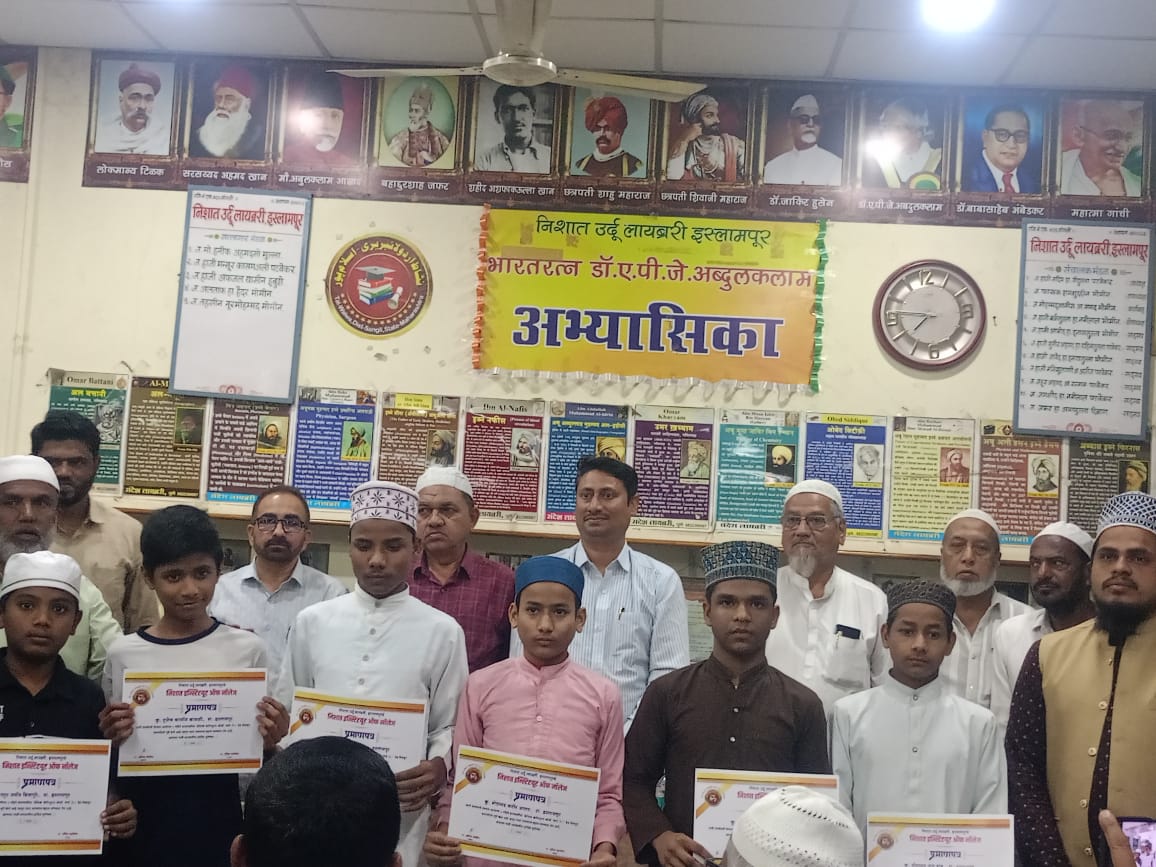
On this occasion, member students of the library were honoured with certificates at the hands of dignitaries for successfully completing the Free Basic Computer Training Course. In this programme, Chief Guests Shahjahan Magdum, Jameer Nadaf, and Prof. Nazim Shaikh were felicitated with bouquets, mementos, shawls, and books.

Haji Saif Mulla proposed the vote of thanks. The programme was attended in large numbers by reader members as well as Institution President Javed Momin, Nadeem Patwekar, Barkatulla Momin, Zahur Patwekar, Akil Momin, Shahnawaz Mulla, Nasimulgani Patwekar, Zafar Diwan, Nazir Bijapure, Maulana Ajmal Raza, Yashwant Dhumale, Deepak Todkar, and other dignitaries. Anis Momin, Abid Momin, Librarian Arman Patel, and Clerk Khushi Shanediwan took special efforts to make the programme a success.

source: http://www.radiancenews.com / Radiance News / Home> Latest News / by Radiance News Bureau / December 13th, 2025

Irjik and Vati-cha Vyavahar: A Confluence of Konkani Culture and Islamic Faith

KONKAN / INDIA :

video

Mumbai :

To understand a person’s character, nature, and values, it is enough to look at their neighbour. Your neighbour acts as a social mirror for you. There are many reasons for this. The people with whom we spend the most time unconsciously influence our thoughts and behaviour. If your neighbour is good, well-cultured, and helpful, it is highly likely that you are also like that or strive to be so. Conversely, if your neighbour is quarrelsome, selfish, or has bad habits, and you get along with them, people may conclude that you either share those same flaws or are indifferent to such things.

We can choose our friends, but the choice of our neighbours is not always in our hands. In such a situation, how you behave with your neighbour reveals your true nature. If your neighbour is good and you have an amicable relationship, it shows that you value goodness. Similarly, if your neighbour is troublesome, how you handle the situation reveals your patience, understanding, or resilience. Whether you argue with them, ignore them, or find a solution through mutual understanding provides an insight into your personality.

Especially in small villages or traditional societies, a person’s reputation often depends on the testimony of their neighbours. For any new relationship (for instance, when a marriage proposal is considered) or for financial transactions, people first inquire with the neighbours. The ‘Character Certificate’ given by a neighbour is considered the most reliable. If your neighbours speak well of you, your standing in society increases.

In India, particularly in rural and semi-urban areas, ‘Shejardharma’ (the ethos of neighbourliness) is given great importance. Life here is not individualistic but communal. Your every transaction, your joys, and your sorrows are not yours alone; they belong to the community and especially to your neighbours. Your neighbour is your first companion in joy and sorrow and your first witness, which is why your identity is intrinsically linked with theirs.

The soil of Konkan is not just a land of red laterite stones and verdant areca nut groves; it is a soft fabric woven with the threads of different faiths and cultures. The lives of its people are as indebted to the salty sea breeze and the mighty rains of the Sahyadris as they are to the harmony of Hindu-Muslim communities living together for generations. Two living and eloquent symbols of this unity are ‘Irjik’ and ‘Vati-cha Vyavahar’. Both these traditions have crossed the walls of religion and blended so seamlessly into the lives of the Muslim community of Konkan that they have become a part of their very faith.

Irjik: Brotherhood that Blossoms from Sweat

The Muslim community of Konkan is of this very soil, raised in its air and water. Rice farming is the backbone of their lives too, so during the hustle of planting and harvesting, helping one another was not a choice but a necessity. Out of this need, the tradition of ‘Irjik’ or ‘Saavad’, an exchange of sweat and labour, naturally took root among them. This was not merely a convenience but an effortless rule of life. Even today, in the villages of Konkan, a Muslim farmer lends his shoulder to his Hindu neighbour’s rice planting, and the Hindu brother rushes to help with his work.

According to a famous saying, “A man is known by his neighbour.” In Konkan, this identity is not confined to the walls of a house; it reaches down to the footprints in the mud. ‘Irjik’ is not just help with work; it is the sowing of a pure sentiment. Islamic teachings give this sentiment a deeper and more sublime meaning.

The Holy Qur’an, in Surah Al-Ma’idah, commands, “And cooperate in righteousness and piety.” وَتَعَاوَنُوا۟ عَلَى ٱلْبِرِّ وَٱلتَّقْوَىٰ ۖ وَلَا تَعَاوَنُوا۟ عَلَى ٱلْإِثْمِ وَٱلْعُدْوَٰنِ – Holy Quran, Surah Al-Ma’idah, Ayah 2 (Chapter 5, Verse 2) (Cooperate in righteousness and God-consciousness (Taqwa), and do not cooperate in sin and aggression.”) The practice of ‘Irjik’ is the finest example of this command, as it facilitates help for a good cause (agriculture) through mutual cooperation. ‘Irjik’ is the earthly, soil-level manifestation of this divine command. When a neighbour is in difficulty, what could be a greater act of virtue than coming together to work so that the work in their field is completed on time?

In Islam, Huquq ul-Ibad (the rights of fellow human beings) are given the highest status, and within that, the rights of the neighbour (Huquq al-Jar) are considered paramount. The Prophet Muhammad ﷺ stated unequivocally, “He is not a believer who eats his fill while his neighbour beside him goes hungry.” (ليس المؤمن الذي يشبع وجاره جائع إلى جنبه” Hadith – BukhariMusnad Ahmad). This Hadith clarifies that Iman (faith) is not limited to personal worship but is tied to social responsibility. To be unaware of a neighbour’s hunger is considered a sign of diminished faith. This teaching is not confined to hunger; it applies to every need of a neighbour. Lending a helping hand to a neighbour burdened by work is the very soul of that teaching.

‘Irjik’ is a humane solution to economic inequality. Even someone who does not have money to pay for labour can cultivate their farm with dignity because of this tradition. Here, ‘labour’ is the greatest currency, and this spirit of equality is very close to Islamic ideology. Therefore, when the Muslim community of Konkan gathers for ‘Irjik’, they are not just planting rice seedlings; through their actions, they are also cultivating the values of cooperation, brotherhood, and social justice.

Vati-cha Vyavahar: The Sweetness of Affection

The ‘vati’ (bowl) that circulates among the homes of Konkan is not just an exchange of food; it is a continuous flow of affection and warmth from the heart. This practice is just as alive in the Muslim households of Konkan. On Eid al-Fitr, their celebration is incomplete until the sweetness of Sheer-Khurma reaches the neighbour’s house. They find no peace until a share of the sacrifice from Eid al-Adha is given to the neighbour. This is not just a custom; it is a beautiful expression of their faith.

Islam has given such importance to neighbourliness that it is said, “The Angel Jibra’il (Gabriel) kept advising me about the rights of the neighbour so frequently that I thought he would command him to be an heir.” (مازال جبريل يوصيني بالجار حتى ظننت أنه سيورثه Hadith – Sahih al-Bukhari and Sahih Muslim). This shows the immense significance given to the rights of a neighbour in Islam. Inheritance rights are typically reserved for blood relatives, but the emphasis was so great that it seemed a neighbour might be granted a share. In the light of this teaching, the ‘Vati-cha Vyavahar’ ceases to be a mere social courtesy and becomes a religious duty, an Ibadat (act of worship).

Another heart-warming teaching of the Prophet Muhammad ﷺ is, “When you prepare a broth (stew), add more water to it and send some to your neighbours.” (يا أبا ذر إذا طبخت مرقة فأكثر ماءها وتعاهد جيرانك Hadith – Sahih Muslim). This teaching is extremely practical. It tells us to cultivate the habit of sharing whatever we have, even if it is a little. The idea behind the ‘Vati-cha Vyavahar’ is precisely this: to include one’s neighbour in the joy created in one’s own home. The message is so simple and beautiful! True happiness lies in sharing whatever you have, no matter how little. ‘Vati-cha Vyavahar’ is the essence of this teaching. That bowl is a small token of affection that enhances the sweetness in relationships. This is because, according to Islamic tradition, “Exchange gifts, and you will love one another.” (تهادوا تحابوا Hadith – Bukhari). This is a small but highly effective teaching. Giving gifts removes mutual resentments and increases love and affection. ‘Vati-cha Vyavahar’ is a beautiful manifestation of this teaching, where affection is exchanged without any expectation. The unwritten rule of never returning an offered bowl empty is an unspoken agreement to maintain the continuity of this flow of love.

‘Irjik’ and ‘Vati-cha Vyavahar’, these Konkani traditions, play a dual role for the Muslim community. On one hand, they connect them to the shared culture of this land, and on the other, they give them an opportunity to live their Islamic values and faith in practice. Therefore, when a bowl goes from a Muslim home in Konkan to a neighbour, it is not just a dish; it is imbued with a legacy of generations and the noble message of Islamic brotherhood. This, indeed, is the true wealth of Konkan.

The spirit of cooperation at the root of ‘Irjik’ is one of the foundational principles of Islam.

Ta’awun (Mutual Cooperation): The Holy Quran explicitly states (Surah Al-Ma’idah, Ayah 2), “And cooperate in righteousness and piety.” ‘Irjik’ is a practical and living example of this command. Helping one’s neighbour or community member in their work is considered not just a social duty but also a virtuous religious act.

Al-Faza’a (الفزعة): This is an Arabic word which means “to rush swiftly to someone’s aid. When a sudden calamity befalls a village or a tribe (e.g., a fire, an enemy attack, or the sudden threat of rain during harvest), a call for help is made. In response to this call, the entire village or tribe comes together and works without any charge. This practice is similar to the urgent and collective nature of ‘Irjik’.

Al-’Awna (العونة): This word is the closest in meaning to ‘Irjik’. Al-’Awna means “planned collective help.” People in a village come together, especially for agricultural work (harvesting, threshing), building a house, or digging a well. They help each other in turns. The practice operates on the principle that “today I will help with your work, and tomorrow you will help with mine.” There is no monetary transaction involved, only an exchange of labour.

Although the practice of ‘Irjik’ in Konkan is known by its local name, the underlying spirit of collective cooperation, reciprocal labour, and brotherhood is universal. This very spirit is the soul of Islamic teachings, and many practices similar to Irjik, such as Al-Faza’a and Al-’Awna, exist in Arab culture to this day.

[The writer is Executive Editor of “SHODHAN”, the Marathi weekly published from Mumbai, Contact: 8976533404]

source: http://www.radiancenews.com / Radiance News / Home> Features / by Shahjahan Magdum / Radiance News Bureau / November 21st, 2025