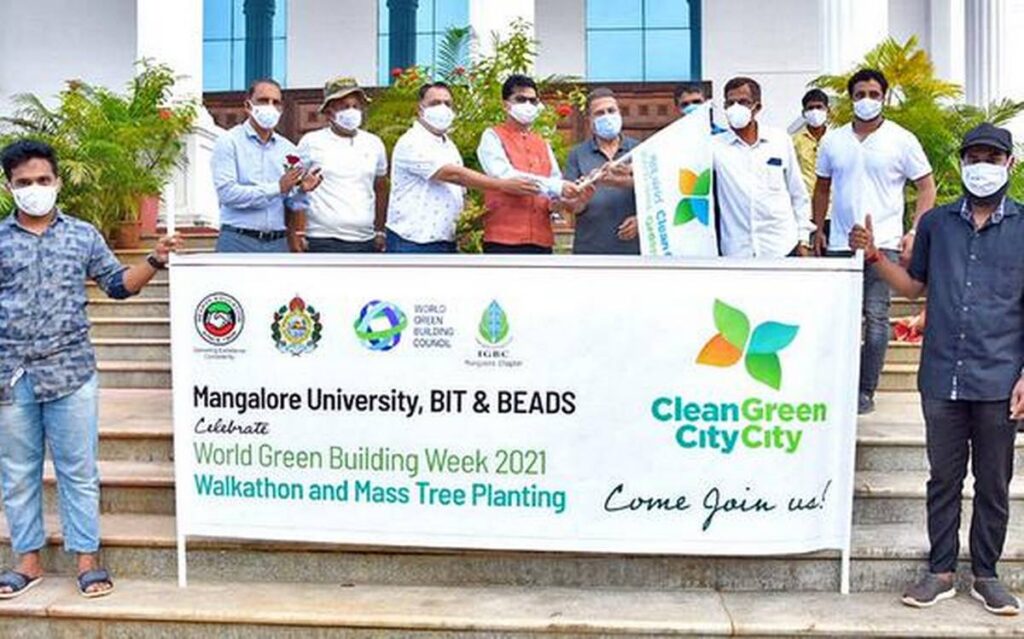
The ‘Green Walkathon – 2021’ organized by Beary’s Group was initiated in front of Mangala Auditorium of Mangalore University on Saturday September 25 morning.
The Green Walkathon, which is a part of the International Green Week – 2021 that started from in front of the university’s Mangala Auditorium moved towards Beary’s Turning Point at Deralakatte.
Mangalore University vice-chancellor, Dr P Subrahmanya Yadapadithaya, said that the environment will automatically become clean if our minds are clean. “We are following the policy of keeping our lives ahead of nature. For our lives to be saved, nature is very important. Therefore, we should join hands to conserve nature,” he stated.
Speaking after presiding over the programme, Beary’s Group president, Syed Muhammad Beary, felt that there is a need to create awareness to encourage a clean and green city. “Nature offers us several gifts. But it is important what we give in return to nature. We cut down many trees when constructing a house or building but we do not take care to plant a tree. Nature becomes green only if we keep planting the saplings. The walkathon is aimed at creating awareness about love of nature and clean environment,” he stated.
Syed Muhammad Beary said that environment in the world keeps on changing and it has cast grave influence on the hman beings. “Therefore, the humans have to strive to protect our earth. We are nothing in front of nature. We are not bigger than nature. We will survive only if we preserve nature,” he stated.
BIT principal, Dr S I Manzoor Pasha, welcomed, BEADS principal A R Ashok Mendonca, Dr Azuz Mustafa, Venkatesh Pai, Santosh D’Souza, BIT – ECE head of the department, Dr Abdulla Gubbi and others were present.
source: http://www.daijiworld.com / Daijiworld.com / Home> Top Stories / by Mohan Kuthar, Daijiworld Media Network – Mangaluru (SP) / September 25th, 2021
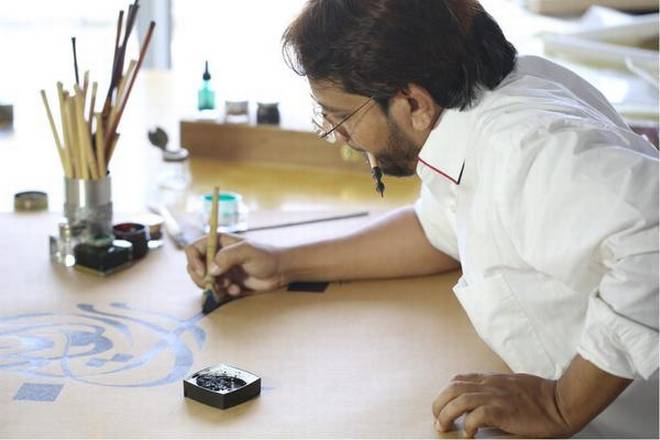
Muqtar Ahmed at work. Photo: Special Arrangement/THE HINDU
A 24-year-old with a global presence and her teacher are among a few keeping the art of Arabic calligraphy alive in India
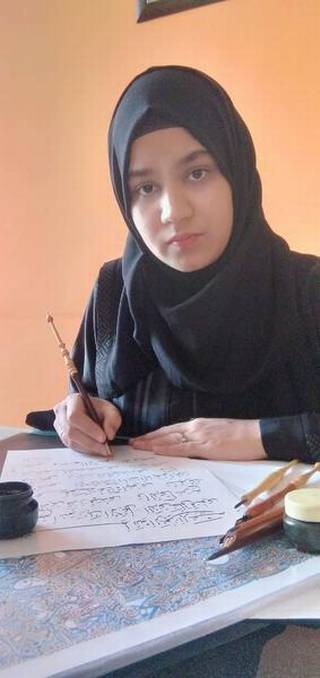
Bee Bee Laisa, a final year Engineering student in Bengaluru, has a dream. The 24-year-old wants to transcribe a copy of the Koran in Arabic. “I have always been interested in art and drawing, but it was only when I started learning English calligraphy that I was introduced to the art form in Arabic, which would help me transcribe the holy book,” says Laisa.
And so began her journey in 2016, as a student of the Institute of Indo-Islamic Art and Culture (IIAC) at Richmond Street, Bengaluru, to learn Arabic calligraphy. Also known as khat, this centuries-old art form is held in high regard by Muslims because of its association with the dissemination of the Koran before the era of printing presses.
In the past five years, Laisa has mastered the decorative script thuluth considered one of the most difficult fonts, and naskh (used to write the Koran). Her talent has been recognised on several international and local platforms: her calligraphic artworks of Koranic verses and Islamic phrases have been exhibited in Japan, UAE, and Jaipur since 2017.
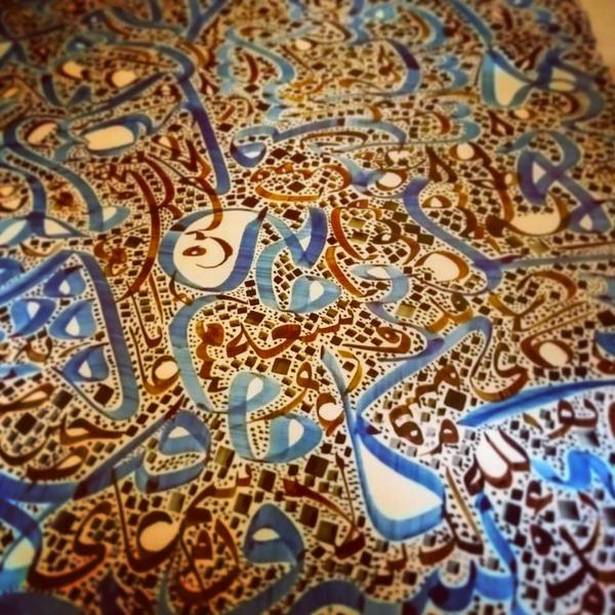
Calligraphy alphabet sampler by Bee Bee Laisa. Photo: Special Arrangement/THE HINDU
It is a huge leap forward for Laisa, whose father works as a banana delivery vehicle driver in Bengaluru. Laisa says calligraphy has helped improve her concentration and also use her drawing skills in her Civil Engineering classes.
“Calligraphers can’t have any dot or line out of place; this has helped me present spotless drawings for my coursework as well,” she says.
The school uses traditional materials to teach the art, including wooden or reed pens (qalam) and inks from plant-based resins. As per tradition, strands of raw silk are placed inside the inkpot (likka), to help regulate the amount of ink on the qalam tip, and also to prevent spills onto the paper.
“We use a paper called muqahar for the final version. Though it is commercially available, calligraphers also learn how to prepare their own muqahar sheets,” says Muqtar Ahmed, the principal and tutor at of the IIAC.
__________
Built to be timeless
The process of making muqahar was perfected in the 17th Century by Turkish calligraphers, and Arabic calligraphy students still learn it today.
Paper is stained with natural dyes (like tea or floral decoctions) and then coated with a tempering mixture of alum crystals dissolved in egg whites. It is then burnished to get a glossy finish.
“Muqahar paper, if made correctly, can last up to 700 years,” says Ahmed.
__________
Devoted to the art
Ahmed is the man guiding Laisa in her mission. He has the distinction of being the only Indian to have earned his Ijazah (Masters diploma) in Arabic calligraphy from the Turkey-based Research Center for Islamic History, Art and Culture (IRCICA), under the auspices of the Organisation of Islamic Cooperation (OIC). He has trained over 500 students through the school’s weekly courses, and has started online classes during lockdown.
“Calligraphy takes a long time to learn, and one only gets better with continuous practice,” says Ahmed.
His own encounter with the art form is a tribute to his tenacity. As an Intermediate school graduate in a small village in Telengana, he started learning Urdu and Arabic calligraphy and decided to make his career as a scribe for an Urdu publication in Bengaluru, in 1990.
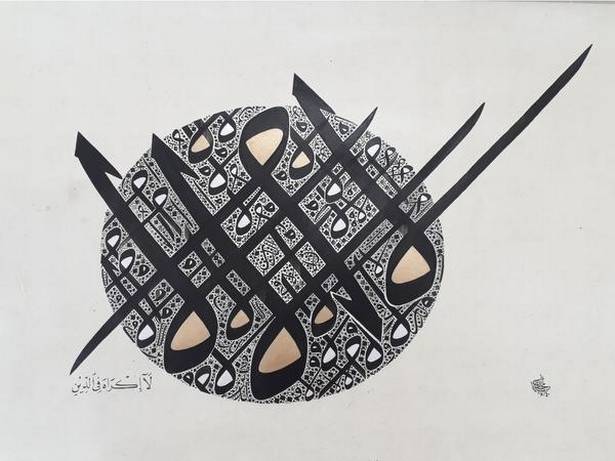
Arabic calligraphy by Muqtar Ahmed. Photo: Special Arrangement/THE HINDU
“I used to write entire pages of articles in the column style, before the computers came in,” he says.
Most of the commercial calligraphy that was done for Urdu and Arabic journals before automated printing lacked the aesthetic values of the original art form, he says.
“I’d like to revive Arabic calligraphy among young people and show them how this can not only be an art but also a way to remember the divine in our life,” Ahmed says.
When he lost his job in 1994, Ahmed decided to research how other calligraphers, especially those outside India, were sustaining their craft. He set up a small commercial press to keep his home fires burning, and kept looking out for masters in calligraphy.
“I realised that it is not a language transforming tool, but an art that has a different respect globally,” he adds.
Among the people who helped him were Washington-based Syrian font designer and calligrapher Maamoun Sakkal, and Mohamed Zakariya, the first Westerner to earn calligraphy diplomas from IRCICA in Turkey.
In what sounds like an incredible process today, Zakariya, who is based in Virginia and does not use electronic communication, tutored Ahmed over postal correspondence for three-and-a-half years.
“I used to send my completed exercises from Bengaluru, and he would reply with his comments and corrections by post. Mr Zakariya didn’t charge me any fees for the tuition, and I feel very fortunate to have been his student,” says Ahmed.
Zakariya also introduced Ahmed to his own master Hasan Chalabi from IRCICA, who invited him to Turkey in 2008. After several visits to Istanbul to learn the art, Ahmed earned his Masters degree in 2013.
Paying it forward
“My professors advised me to start teaching calligraphy in India after I graduated, so that I could rekindle the old majesty of the art. When Mr Syed Mohamed Beary [a local real estate developer] heard of this, he sponsored the establishment of the institute in Bengaluru, and put me in charge of it. I’m glad to see that though it is a very difficult field to excel in, at least 15 of our students are being recognised for their calligraphy,” says Ahmed.
Ameerul Islam and Abdul Sattar, two of his students, have set up a branch of the institute in Hyderabad. IIAC’s curriculum covers the Arabic scripts riqa (for newcomers), naskh and thuluth and nastaliq in Urdu. Learning any two scripts thoroughly is ideal for a calligrapher, says Ahmed.
Bee Bee Laisa. Photo: Special Arrangement/THE HINDU
Bee Bee Laisa’s aim of transcribing the Koran is shared by her teacher. “In fact it is the ultimate goal of every Arabic calligrapher,” says Ahmed. “But it is a huge project, because there are at least 600 pages to be transcribed. If we do something with our hands, it is priceless,” he says.
source: http://www.thehindu.com / The Hindu / Home> Society> History & Culture / by Nahla Nainar / February 19th, 2021
ECO-FRIENDLY ABODE : The Rs 2-crore mosque built by the Beary Group aims to promote harmony among all communities.
Udupi, KARNATAKA :
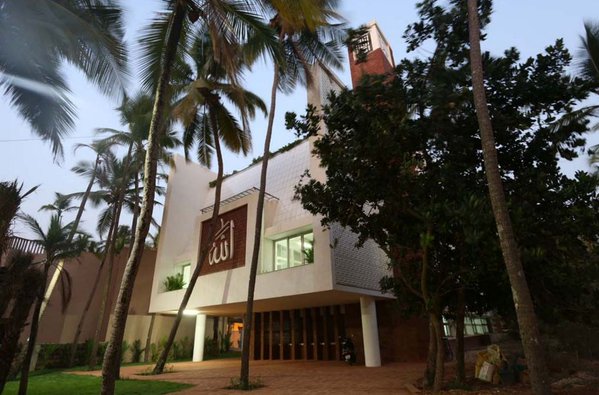
The Badriya Jum’a Masjid, a landmark on Kodi beach in Kundapur, holds out a new hope. Termed an ecofriendly mosque, it exemplifies sustainable technologies and also presents a modern face of Islam.
The green mosque, a typical Islamic architectural structure, aims to promote harmony among all communities in the world. There is a hope that the mosque will become a place of worship where people from all over the world will come and pray. It has already begun attracting non-Muslims.
Syed Mohamed Beary of the Indian Green Building Association’s state president told TOI that Badriya Jum’a Masjid is the world’s first `zero-energy’ green mosque. The Beary Group, with the help of locals, constructed the mosque at a cost of Rs 2 crore. Situated on two acres, the 1,500 sqft building can accommodate 2,000 people. It also has a library.
The Beary family built the mosque in memory of their grandfather. “Years ago, he wanted to go on the Hajj pilgrimage, but fell ill and couldn’t go. He used the same money to build a small mosque.It was renovated 40 years ago, but it wasn’t satisfactory . Now, using improved technology , we’ve come up with an eco friendly mosque,” he added.
Architects Sandeep and Manoj from Bengaluru have designed the mosque in such a way that the entire energy requirement is met through hybrid renewable energy , both wind and solar.
Their grandfather had planted a huge mango tree and a coconut palm on the premises. While the orientation minimizes solar heat gain, natural elements keep the inside of the building cool. The Lshaped building plan and elevated prayer hall, vegetation and water tanks around cool the environment naturally.
Natural cooling is accentu ated by a wind scoop on the 70-ft multifunctional minaret, from where the azan, or prayer call, is given. It forces down a draught of cool breeze into the prayer hall and also supports the tower structure of a wind turbine mounted atop it. The solar heat-reflecting terrace floor laid with white china mosaic and fitted with turbo vents not only keeps the prayer space cool but also reduces warming of the local micro climate.Non-conducting glass reinforced concrete jaalis with over 50% openings, maximize natural ventilation and supplement the design effort to reduce heat gain.
source: http://www.timesofindia.indiatimes.com / The Times of India / News Home> City> Bangalore / TNN / January 15th, 2016