Binziya was forced to abandon her studies when her family arranged her marriage in 1997.
Malappuram :
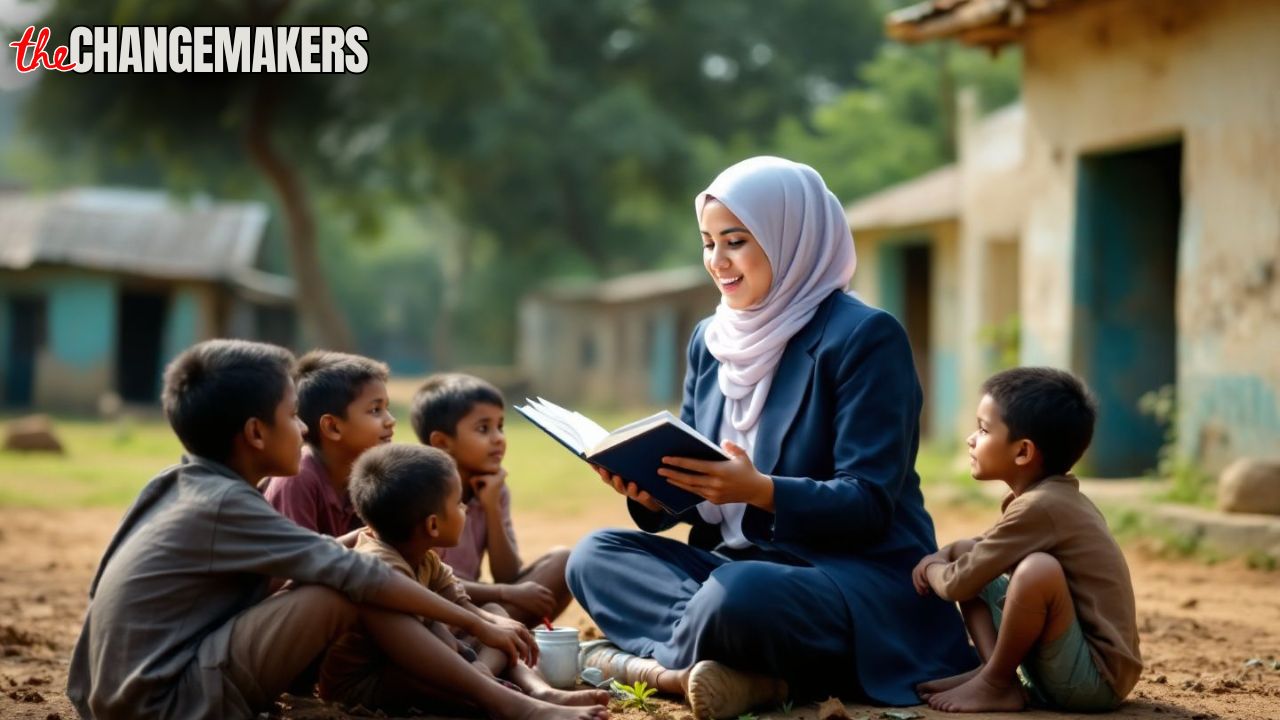
Married off at 14, confined within domestic boundaries for decades, and once ashamed to admit she had studied only up to Class 9, a woman from Malappuram has now rewritten her destiny through education. After 29 years of marriage, Makkaraparambha native Binziya has emerged with a postgraduate degree in psychology, proving that dreams delayed are never dreams denied.
Binziya was forced to abandon her studies when her family arranged her marriage in 1997. One year later, she became a mother. As the eldest daughter-in-law in a large joint family, she was tasked with looking after her husband’s younger siblings and managing all household responsibilities.
“I was still a child. But I had to act like a grown woman because everyone expected me to be one,” she recalls. Education became a distant memory as cooking, cleaning and childcare took over her life. “There was no space for my wishes. My daughter and later my son became my world. But deep inside, I always missed learning.”
A turning point came when the family shifted to their own home. She came to know about the government’s literacy mission and decided to ask her husband if she could attempt the Class 10 equivalency examination. “My husband supported me without hesitation. When I passed with good marks, I cried. I felt alive again,” she says. She went on to complete her higher secondary education next before enrolling for a BA English programme through distance education in 2020.
But her heart was always set on psychology. “I have gone through many emotional struggles in life. Who understands pain better than a woman? I wanted to learn psychology so that I could help others like me,” she says.
The biggest driving force behind her educational pursuit was her own self-respect. “Whenever someone asked me how much I had studied, I felt ashamed to say Class 9. That shame pushed me to continue learning. I wanted to feel proud of myself,” she explains.
Her years of effort finally came to fruition as she completed her MA in psychology. Binziya says she hopes her story encourages other women who were denied opportunities. “There are many women like me in Malappuram who are married off too early and remain confined to their homes. I want them to know that education is still possible.”
She is also proud of the change within her own family. “My daughter completed her Plus-II before marriage. She has finished her degree and is preparing for postgraduate studies. It makes me happy that she will not have to carry the same regrets I once had.”
Binziya now dreams of becoming a practising psychologist and providing support to homemakers who struggle.
source: http://www.newindianexpress.com / The New Indian Express / Home> Kerala / by Lakshmi Athira / November 28th, 2025
The device includes a ‘Help Me’ button that alerts the teacher whenever a student needs intervention, improving classroom management.
Mohammed Khwaja Muinuddin Chisti, Assistant Professor in the Department of EECE from GITAM Deemed to be University, has developed an embedded Braille Learning Assistant Embedded Kit (LAEK).Photo | G Satyanarayana
Visakhapatnam :
For many visually impaired children, the journey to literacy begins with the touch of a fingertip. But mastering Braille is often a slow and demanding process that requires constant one-on-one support from teachers, a challenge in schools where trained instructors are scarce and classrooms are full. For families living far from specialised schools, opportunities are even fewer, leaving children dependent on others for even the basics of reading and communication.
A faculty member at GITAM Deemed to be University, Visakhapatnam, is hoping to change that. Mohammed Khwaja Muinuddin Chisti, Assistant Professor in the Department of EECE, has developed an embedded Braille Learning Assistant Embedded Kit (LAEK), a simple, sensor-based device that allows visually impaired children to learn Braille independently, either at home or in school.
The device is a 3 × 2 hollow hemispherical Braille cell fitted with sensors that identify the dot patterns placed by the student. Once the pattern is detected, the system decodes it and provides audio feedback by announcing the corresponding letter, number or instruction. This makes it possible for students to practise and revise lessons without waiting for a teacher to guide every step. “In many schools, one teacher has to train 30 or 40 visually impaired children, and each child needs personal attention for Braille practice,” Chisti remarked, adding, “Many students hesitate to ask the same doubt again. I wanted to create something that lets them learn comfortably at their own pace.”
The device includes a ‘Help Me’ button that alerts the teacher whenever a student needs intervention, improving classroom management. The balls used to form patterns are designed to stay within reach even if dropped, and the device is chargeable, eliminating the difficulty of replacing batteries.
“The tool is also aimed at children who cannot attend blind schools due to distance or lack of accessibility. Parents can guide their child’s learning at home using the same pattern-based method followed in classrooms. Depending on the child’s learning ability, all basic Braille alphabets can be learnt within a few weeks,” Chisti stated.
Before developing this tool, Chisti created a ‘Walking Assistant’ device, a wearable tool that alerts visually impaired users about obstacles through vibrations and sound. His interactions with students and teachers during that project sparked the idea for a more focused educational device.
“When I visited blind schools to donate the walking aids, I saw the kind of effort teachers put in, and how much time it takes for each child to grasp Braille,” he said.
“I felt technology could ease that pressure and help children become confident, independent learners.”
The new learning assistant has been filed for patent registration. Chisti hopes to manufacture and distribute multiple units to blind schools using research grants and donor support.
Future upgrades may include computer vision and speech recognition to help students identify people around them and navigate with greater confidence.
source: http://www.newindianexpress.com / The New Indian Express / Home> Good News / by Usha Peri / November 30th, 2025
The cities created in the Deccan by Muslim leaders introduced the concept of public space to the Indian world.
Photograph of Aurangabad from the Allardyce Collection: Album of views and portraits in Berar and Hyderabad, taken by an unknown photographer in the 1860s. This view is of the Kham River, the city lies along its right bank. Photo: Public domain/Wikipedia.
When India specialists examine what Islam has brought to the country, they often focus on cultural aspects such as language, poetry, music, painting, culinary arts, or spirituality. They rarely consider the urban dimension.
Certainly, historians and geographers readily examine how what the Marçais brothers called “the Islamic city” spread throughout India, but mainly to see it as an exogenous institution, even an enclave sheltering an elite that came from outside and was cut off from society. Pratyush Shankar’s recent book covers this dimension, of course, but goes further.
In History of Urban Form of India, a work based on the analysis of 42 Indian cities, the author distinguishes three types of cities – which form the three parts of the book: ancient cities, medieval cities, and cities produced by the modern state.
Ancient cities, apart from those of the Indus civilisation, are mainly epitomised in the “temple cities” of southern India. While medieval cities follow several different patterns, Pratyush Shankar distinguishes above all between merchant cities – typical of Gujarat – those of the Himalayas (whose form is conditioned by the terrain), and those built by Muslims in the Deccan.
Comparing them proves very useful in understanding Islam’s contribution to the Indian civilisation – something Pratyush Shankar helps us to do, without attempting it himself – thanks to his morphological approach to the city: he is interested only in the form of the city, not in its local mode of governance or its relationship with the state.
All Indian cities inherited a significant part of their form or structure from the caste system. Pratyush Shankar points out in the introduction that the “Caste system had a huge impact in determining the location and formation of neighbourhood clusters that were inward looking (in cases of Jodhpur and Udaipur) and the possibility to shut off from the city by controlling the gates (Pols of Ahmedabad)”.
History of Urban Form of India: From Beginning till 1900’s, Pratyush Shankar, OUP, 2024.
The caste logic is naturally at work in the “temple city”:
“The idea of using a Brahmin settlement (with a temple) for creating a surplus economy was central to the birth of cities in South India. This was legitimized through the Brahminical ideology of the Brahmin-Kshatriya coalition expressed through Vedic and puranic religion”.
And naturally, the “temple city” is “divided into various sectors based on function differentiation that was represented through various caste-based housing. The caste system was strictly observed and manifested itself in the planning of these urban centers”.
The cities built by Muslim leaders from the 14th century onwards in the Deccan did not escape the caste system – especially since distinguishing between Hindu and Islamic cities constitutes “a very simplistic binary” that does not reflect a much more complex reality. But these medieval cities of the Deccan added something new to the urban form that had prevailed in the country until then. This innovation did not take place within the city, but outside – and still, that was a key element of the city dynamics: not far from the city walls, but well outside the city itself, Sufi saints settled in an almost systematic manner. They deliberately distanced themselves from the city to show their detachment from material things and live in peace. At the same time, the inhabitants revered them: “People would leave the material city behind to spend a day at the sacred Sufi sites and return by evening”.
After their death, these saints were buried in the very place where they stood, and a mausoleum called “Dargah” was built around their tomb, the size of which varied according to the popularity of the saint.
What Pratyush Shankar does not say is that throughout society, Sufi saints were attributed with considerable powers, even beyond death: many devotees continued to visit the Dargah centuries after the saint’s death to ask him to grant their wishes (whether it be to have a child, to be cured of an illness, or to pass exams). This votive logic, due to its transactional nature, transcends social barriers of all kinds: Hindus, Christians, Sikhs, etc. worship Sufi saints, people from all walks of life, from the elite to the lower castes, rub shoulders at the Dargah and, finally, even in the Holy of Holies, women and men are admitted on an equal footing. But Pratyush Shankar assumes that the reader what I have mentioned above when he concludes:
“The unique contribution of the Deccan cities was perhaps not so much in any extraordinary formation within, but rather in the development of the prominent district of the Sufi saints and the suburbs. Sufi saints were popular amongst the masses and provided the much-needed counterpoint to the state. If the city represented the material world of trade, commerce, and power, the suburban precincts of Sufi tombs were just the opposite; a sacred and spiritual space with frugal infrastructure which is out there in the lap of nature. Over the centuries, this typology took firm root as these complexes of tombs became public places that were frequented by city dwellers like a pilgrimage out of the city, as they often lay just outside the fort walls of the city”.
The word is out: “public space”!
The cities created in the Deccan by Muslim leaders in the 14th century introduced the concept of public space to the Indian world, which had ignored it until then due to the deep cleavages that divided society along lines of religion, caste, and gender. This is a contribution of Islam to India that some would call paradoxical, given that the image of this religion, today, is often dominated by the idea of segregation, even exclusion. But before Islam entered India, such open spaces did not exist in the country.
View of the Feroz Shah Kotla, Delhi, 1830, 1843 (oil on canvas) by Colonel Robert Smith (fl.1880-90). Photo: Wikimedia Commons.
Certainly, ascetics established their ashrams out of cities – like Ramana Maharshi’s cave above Tiruvannamalai – but his followers did not disturb him there, and when they did, they interacted with him on the mode of the guru-shishya parampara, whereas around the Dargah, one would find play grounds as well as picnic sites.
In his book, Pratyush Shankar confines this contribution to the Deccan, but it is tempting to argue that the innovation he points to can be found throughout India. In the north too, Sufi saints settled on the outskirts of cities – did Nizamuddin not choose to live far from Delhi? – and their mausoleums still offer the image of a public space open to all. This is even more striking when the Dargah is still surrounded by greenery, even though it has been incorporated into the city, such as Sarkhej Roza in Ahmedabad or Feroz Shah Kotla in Delhi, where Anand Taneja has clearly shown that people from all walks of life still gather today, as befits a public space!
Christophe Jaffrelot is Senior Research Fellow at CERI-Sciences Po/CNRS, Paris, Professor of Indian Politics and Sociology at King’s College London, Non resident Scholar at the Carnegie Endowment for International Peace and Chair of the British Association for South Asian Studies.
source: http://www.thewire.in / The Wire / Home> English> Opinion> Urban / by Christophe Jaffrelot / October 18th, 2025
By recreating a whole world around a group of traders in western India, Chhaya Goswami’s Globalization before Its Time is business history as it should be.
A Dutch trading ship from the late 17th-century. Credit: Wikimedia
The Arabian Sea has a special place in Indian business history. For centuries the cities and settlements on the Arabian Sea littoral traded with each other, exchanging Indian textiles for horse, armaments, pearls and ivory. In turn, some of the textiles were passed on to the Atlantic slave trade in Africa as a medium of exchange, or sent overland to European markets. Coastal merchants indigenous to the region bordering the sea engaged in this business and developed sophisticated systems of banking and shipbuilding to support the mercantile enterprise. The Hindu and Muslim traders of Kachchh were examples of such groups of people.
In the 17th century, the Arabian Sea trade flourished thanks to the control that three powerful empires – the Ottoman in Turkey, the Safavid in Iran and the Mughal in India – exercised on some of the key seaports, and regular transactions amongst them. This was also the time when the European merchant companies established themselves in the Indian Ocean trade, even though the Portuguese had arrived in this world somewhat earlier. In the second half of the eighteenth century, the Mughal empire had almost collapsed and its access to the Arabian Sea ports had long come to an end. Europeans were in the ascendance.
What happened to the indigenous traders and bankers during this period of transition? Two contending stories exist on this question. The first says that they lost ground to the Europeans while their patrons lost political power. The second says that the indigenous traders found partnerships and agency with the Europeans lucrative, and as their fortunes flourished, the Europeans gained in political power. Both stories overstate the Europeans’ commercial prowess and understate the Indians’ capacity to shape the course of history.
Chhaya Goswami’s book is a corrective to such biased histories. It shows that the Kachchhi traders did gain from European trade, and withstood well the decline of empires, but they could do so thanks to their own resources, which included well-developed institutions of commerce and banking, knowledge of the seas, shipping, and shipbuilding, past history of collaborating with political actors, and access to both maritime and overland trading routes.
The book is divided into four chapters, each one of substantial length. Chapter one explores the special characteristics of Kachchh that make it a “land of entrepreneurs”. Chapters two and three describe Kachchhi traders’ activities in Muscat and Zanzibar respectively, and chapter four deals with some of the prominent firms in the maritime trade, and how a few of them extended their operations beyond the southwest Asia region.
Why Kachchh? What is special about the region that it should produce so many merchant groups? The convenient location of the region on a navigable part of the eastern Arabian Sea, as well as the Mandvi port, of course, supplies a part of the answer.
Another part of the answer has to do with politics. The western coastal regions were ruled by small states that depended heavily on income from trade. This dependence was due to the poor agricultural conditions in the region. In turn, these states, though nominally vassals of the Mughals, could exercise a great deal of independence in policy. They used their freedom to create a model of rule where merchants and bankers had a prominent place, not only during warfare, the all-too-common palace intrigues or disasters, but also in normal times. Merchants and bankers helped the business of governance by collecting taxes, revenue farming, making loans, and taking part in administration, whereas the states helped them by offering lucrative contracts and implicitly recognising their laws and practices.
But the political and geographical environment explains little unless we also consider the social and institutional basis of entrepreneurship in the region. The merchant groups in question were ready to establish diaspora networks in port cities around the Arabian Sea. They conducted extensive and complicated financial operations including bill and insurance, and their bills were acceptable to the distant trading points thanks to the diaspora network.
The book shows in interesting detail how Vaishnavite temples and monasteries became effectively banks, clearing houses, and guarantors of reputation. Community law had great force. The merchants had considerable interest in shipbuilding, which in turn encouraged timber trade. In banking, trading, shipbuilding, and navigation, master-apprentice hierarchies were highly developed, showing how much skills were valued and how skills formed.
The book is well-researched and builds on the author’s deep knowledge of vernacular sources and the regional context. It is business history as business history should be, that is, it succeeds in recreating a whole world around a group of traders, and fills an important gap in Indian economic history scholarship.
One wishes, at the same time, that the author had tried to place the Kachchhi traders more firmly in debates on the 18th century economic transition in southern Asia, and attempted some comparative discussion of trading ‘firms’ in Kachchh and elsewhere in the world. Surely the Europeans operated in the same world, with a very different model of a firm. Did the difference matter to institutional and political change? But, perhaps wisely, Goswami’s book steers clear of dry historiography. Instead, it keeps in mind its readers – who will no doubt find the material presented fascinating and the quality of the narrative superb.
Tirthankar Roy is a professor at the London School of Economics and Political Science.
source: http://www.thewire.in / The Wire / Home> English> Books / by Tirthankar Roy / July 04th, 2016
Bombay’s Chinoy family pioneered India’s international wireless communication and shaped cosmopolitan capitalism in the colonial era.
The Bombay Garage in Meher Building, near Chowpatty Band Stand in Bombay, was chosen as the family home by Sultan Chinoy, one of Meherally Chinoy’s four sons. Photo: Public domain.
In the crowded economic history of colonial India, the spotlight is often trained on a familiar cast: the Parsis of Bombay – Tatas, Wadias, Godrejs; the Marwari financial giants of Calcutta like the Birlas; and Hindu industrial houses. These communities unquestionably shaped the contours of Indian capitalism. Yet this focus obscures the contributions of other groups who played pivotal roles in connecting India to global circuits of technology, finance and communication.
One such story is that of the Chinoys, a Khoja Ismaili Muslim business family from Bombay. Their rise from the China trade to the helm of India’s international wireless communication network illuminates a distinctive moment in India’s economic history – one in which indigenous capital, imperial technological ambition and flexible, cross-community partnerships came together to produce what we may call cosmopolitan capitalism.
This story not only unsettles the notion that Gujarati Muslim traders were confined to Indian Ocean commerce; it shows how local entrepreneurial families could position themselves at the centre of the empire’s most advanced technological systems.
The Chinoys: a family emerges
Like many Bombay merchant families, the Chinoys began in maritime trade. Their patriarch, Meherally Chinoy, started in the mid-nineteenth century as an apprentice to the Khoja merchant prince Jairazbhoy Peerbhoy. Through repeated voyages to China and Japan, he built a reputation for commercial acumen and established both capital and credibility. His sons consolidated and expanded this base.
By the 1920s, the family firm – Fazalbhoy Meherally (F.M.) Chinoy & Co. – had diversified into wheat, pearls, kerosene, postal contracts, cinema exhibition and, most famously, the Bombay Garage, one of India’s earliest and most successful motor car agencies.
Diversification, community networks and political visibility placed the Chinoys among Bombay’s prominent business families. They sat on the Municipal Corporation, held the Sheriff’s office and participated in legislative bodies. This broad civic footprint would soon prove crucial when new technological horizons opened.
The opportunity of empire: wireless communication
By the early twentieth century, the British Empire faced a strategic challenge: the submarine cable network, long considered the Empire’s “nervous system”, was overstretched. Radio communication offered a faster and cheaper alternative. The Marconi Wireless Telegraph Company proposed in 1910 an ambitious ‘Imperial Wireless Chain’ linking London to its colonies through long-wave radio. Yet Britain hesitated. Monopolistic power for a private company raised political alarms, and various government committees stalled progress.
The late Meherally M. Chinoy, who began by acquiring the licence for Shell, and the late Fazulbhoy M. Chinoy, one of Meherally Chinoy’s four sons, who was in the automative business in Bombay. Photo: Public domain.
Meanwhile, the Government of India – more pragmatic and less suspicious of private enterprise – was open to experimentation, provided the enterprise was Indian-led and financially sound. Into this space stepped the Chinoys.
In 1921, Sultan Chinoy travelled to England to negotiate with the Marconi Company and secure rights for India. It was a bold move; a single Bombay firm seeking to collaborate with one of the world’s pre-eminent technology companies was far from routine. But the Chinoys had two advantages: capital and credibility. Marconi demanded stringent terms, including a steep price for patents and proof that at least half the investment would be raised in India.
Understanding that they needed support beyond their own family, the Chinoys assembled a board that looked like a snapshot of Bombay’s commercial elite: the Parsi industrialists Cusrow and Ness Wadia, the Hindu financier Sir Purshottamdas Thakurdas, and the respected Muslim leader Ibrahim Rahimtoola, among others.
This coalition reassured the colonial state that the venture was both financially stable and politically broad-based. The resulting company, the Indian Radio Telegraph Company (IRTC), represented one of the most ambitious examples of cross-community capitalist cooperation in the late Raj.
Beam wireless comes to India
In 1925, the IRTC secured a ten-year licence from the Government of India. But just as the long-wave system was ready to proceed, Marconi announced a breakthrough: shortwave or “beam” wireless, capable of transmitting messages 95% cheaper and three times as fast. The IRTC pivoted immediately, abandoning the long-wave model in favour of the beam system. By 1927, the India–England beam service opened to great fanfare.
Within a week, message traffic exceeded expectations; within a year, the company handled millions of words of international communication. Beam wireless rapidly undermined the older cable telegraph companies, leading to a merger in 1932.
The new entity, the Indian Radio and Cable Communications Co. (IRCC), managed virtually all of India’s external traffic. In short order, an Indian-led company had assumed control of India’s most sensitive international communication infrastructure.
The IRTC succeeded because the Chinoys excelled at uniting Parsi, Hindu and Muslim capitalists, ensuring political legitimacy and financial strength. The brothers also recognised that mastery of cutting-edge communication technology would give Indian business unprecedented leverage.
Bombay was a major centre for the Khilafat movement, and many Muslim merchants faced financial ruination because of their association with the pan-Islamic movement. The Chinoys, however, stayed away from politics generally and the movement specifically, and prospered. The Khilafat movement was seen as a threat by the empire.
The Chinoys also led the Indian Broadcasting Company (IBC), launched alongside the IRTC. But while beam wireless thrived, the IBC collapsed. The reasons were structural. The government could not agree on the scale and scope of broadcasting, the sector required heavy infrastructure investment. Besides, the company was undercapitalised.
By 1930, it was liquidated; by 1936, its successor became All India Radio. Yet even this failure generated influence. Sir Rahimtoola Chinoy became president of the All India Radio Merchants’ Association, a powerful industry group, positioning the family at the centre of radio trade and regulation.
The legacy of cosmopolitan capitalism
The wireless story reveals a great deal about Bombay’s business world. In an era of rising nationalism and sharpening communal boundaries, major commercial projects still relied on inter-communal coalitions. The IRTC’s leadership – Khoja Muslim entrepreneurs partnering with Parsi industrialists and Hindu financiers – represented an economic cosmopolitanism that was both pragmatic and visionary.
The Chinoys used this moment not simply to participate in imperial networks but to shape them. Their stewardship of India’s international communication system lasted until 1947, when the newly independent state nationalised the IRCC. By then, they had already secured their place among the country’s leading capitalists and public figures, holding senior positions in banks, municipal bodies and national economic delegations.
The Chinoys’ story disrupts familiar narratives of Indian capitalism. Gujarati Muslim traders were not merely marginal or ocean-oriented merchants; they were capable of driving technological transformation at the very heart of colonial infrastructure. Their story underscores how families could convert commercial networks, political relationships and technological foresight into durable economic power.
For readers interested in the full archival study and the complete analytical argument, the original research article is available in Indian Economic and Social History Review.
Danish Khan is a historian and journalist based in London. His DPhil thesis is under contract to be published by Cambridge University Press.
source: http://www.thewire.in / The Wire / Home> Analysis> History / by Danish Khan / November 26th, 2025
The Urdu literary world mourns the demise of one of its gentle giants, Azizuddin Aziz Belgaumi, the celebrated Na’at poet, ghazal writer, teacher, and literary guide, who returned to his Lord on the morning of Friday, November 28, shortly after the Fajr prayer in Bengaluru.
Azizuddin Aziz was not merely a poet; he was a custodian of spiritual emotion, a voice that blended devotion, beauty, and sincerity in every syllable.
He was renowned for his Na’ats – soulful, tender, and overflowing with love for Prophet Muhammad ﷺ. His unique style of recitation, coupled with his soothing voice, made his poetry beloved among Urdu lovers across the region and beyond.
His iconic Na’ats, including:
اہلِ ستم کے پتھر کھا کر گل برسانے والے ہم
دعوتِ ہدایت کی ایک حسیں شفق لے کر میرے مصطفیٰ آئے
had gone viral among Urdu audiences, each line steeped in deep reverence and spiritual longing.
On his final night in this world, he once again recited “Dawat-e-Hidayat ki ek haseen shafaq lekar mere Mustafa aaye” on special request at a mushaira organized by Idara-e-Adab-e-Islami Hind, Karnataka. The audience responded with extraordinary affection, as if witnessing a sacred farewell.
By the next morning, he left this world – a departure many lovingly regard as a sign of divine acceptance.
Azizuddin Aziz’s published works reflect his emotional depth and mastery of language. His poetry collections include:
حرف و صوت
سکون کے لمحوں کی تازگی
دل کے دامن پر
نقد و انتقاد
زنجیرِ دست و پا
ذکر میرے حبیب کا
These works capture the freshness of spiritual experience, the fragrance of emotion, and the honesty of a heart in constant remembrance.
Azizuddin Aziz worked with Doordarshan Bangalore Urdu, where he interviewed prominent literary personalities. His conversations reflected both scholarship and humility, making him a respected voice representing Urdu culture on national media.
He served for a time as a teacher and later as the Principal of Zubaida College, Shikaripur, shaping young minds with the same warmth and refinement that characterised his poetry.
As an educator, he was loved for his gentle discipline, cultured manner, and his ability to ignite a love for language among students.
He also served as editor of several literary magazines, contributing significantly to Karnataka’s Urdu literary landscape. His editorial vision was marked by sincerity, high standards, and a deep respect for classical tradition.
Early on November 28, he experienced severe chest pain at his residence in Bengaluru. Despite attempts to rush him to the hospital, he breathed his last at home. He leaves behind his wife, three sons, two daughters, and a large community of admirers, students, and peers.
May Allah accept every word of love he wrote for His Beloved Prophet ﷺ. May He grant Azizuddin Aziz a lofty place in Jannat-ul-Firdous, and grant patience, strength, and peace to his grieving family. His voice has returned to silence – but his Na’ats will continue to illuminate gatherings, his ghazals will continue to warm hearts, and his legacy will remain a torch of devotion and grace.
Inna lillahi wa inna ilayhi raji’un. Most certainly we belong to Allah, and most certainly we will return to Him.
source: http://www.radiancenews.com / Radiance News / Home> Focus> Obituary / by Radiance News Bureau / by Mohammed Talha Siddi Bapa / November 29th, 2025
Sabir Ahamed, Programme Director at Pratichi Institute, Pratichi (India) Trust, and Founder Director of the Sabar Institute
Sabir Ahamed is the Programme Director at Pratichi Institute, and Founder Director of the Sabar Institute. His research spans the socio-economic status of Muslims in India, child protection, and education. He is proficient in analysing official datasets (NSS, Census, DISE, AISHS) using tools like Stata and R. Sabir has led largescale research and evaluation projects for the Government of West Bengal, including assessments of Kanyashree Prakalpa, Sabooj Sathi, Duare Sarkar, Lakshmir Bhandar, and the PM Poshan School Nutrition Garden Survey. He is currently leading the Human Development Report 2025 for West Bengal and directed the Second Human Development Report for Tripura.
His experience includes work with international organisations like Railway Children UK on projects supported by the European Union and UNICEF.
He served as the West Bengal State Lead for a UNICEF-commissioned study on secondary education transitions and was awarded the Just Transition Writing and Research Fellowship at IIT Kanpur (2022–2023).
He actively promotes the RTI Act (2005) in West Bengal and is a core member of the Know Your Neighbour campaign. He contributes op-eds to national dailies and has co-edited publications on development issues.
Excerpts from his interview with Mohd. Naushad Khan:
Q: How was the idea Know Your Neighbour conceptualised, when and how did it start, and what was the basic objective of this campaign?
We started the initiative because we noticed a deep division between different communities in our city. The immediate context was the publication of a report titled ‘Living Reality of Muslims in West Bengal’ in 2013. The findings shed lights on the deplorable condition of Muslims in West Bengal, yet a large section of people was unaware the status of Muslims. Many academics and Journalists were surprised to see those facts, especially they were educationally and economically backward. Secondly, historically different communities are living in the city for generations, Partition has created some chasm between Hindus and Muslims. The worst outcome is the spatial segregation – this led to the concept call ‘living together separately’. This gave birth of a plethora of myth and misconception about the Muslims.
We found that even well-meaning and educated people in Kolkata knew very little about the city’s Muslim community, even though it makes up 20% of the population.
We learned that most people didn’t visit Muslim-majority neighbourhoods because they didn’t have friends there or, in some cases, they believed the areas were unsafe.
To break the misinformation about Muslims and its neighbourhood, Know Your Neighbour (KYN) started neighbourhood walk in 2026. Till then, thousands of young people had participated in the walks and discussion.
The main goal is to build familiarity between communities that live close to each other but knew little about the other. The campaign aims to break down stereotypes and overcome the ignorance and distrust that can grow from different religious identities. This ignorance and distrust are the biggest barriers to communal harmony.
Q: Since its inception, how do you see the journey of KYN, and what were the challenges faced so far?
The journey of KYN involves actively bringing people from different backgrounds together. The main way it does this is by organising walks or visits to:
Areas with large Muslim populations, like Metiabruz and Rajabazar, Kidderpore, etc.
Places with shared, syncretic histories, like the Daptaripada area near College Street, where book-binding communities have co-existed.
Sites that remind people of the legacy of past communal violence, such as Selimpada.
Areas facing common problems that affect everyone, like pollution in the Rajapur canal, where both Hindus and Muslims use the water.
The campaign also organises events like Dosti ki Iftar (Friendship Iftar) and joint Durga Puja celebrations, allowing people to learn about and join in each other’s religious festivals.
The main challenge the campaign faces is ignorance, stereotypes, and fear that keep communities separated from each other.
Q: What has been the impact of KYN in Bengal, and how have people responded to this campaign?
Over the years, neighbourhood walks conducted by KYN have made a lasting impression on young minds, promoting peace, social cohesion, and pluralism. Around 1,500 students have joined us in exploring overlooked neighbourhoods across Kolkata through these immersive walks.
The initiative aims to instil core constitutional values – secularism, pluralism, and fraternity – through lived experiences and encounters with historical memory embedded in the urban fabric. These walks offer students a unique opportunity to engage with diverse communities, reflect on shared histories, and foster a deeper understanding of inclusive citizenship.
In collaboration with Maulana Azad College, our language course in Arabic, Persian, and Bengali enabled about 90 students to learn the basic reading of these languages. These programmes strengthen cultural roots and encourage appreciation for linguistic plurality.
We run a WhatsApp support network of over 850 students from marginalised areas, offering career counselling, peer mentoring, job opportunities, and regular workshops to help them navigate academic and professional spaces. We have trained more than 250 students on career counselling.
In partnership with Swayam and Azad Foundation, we’ve held group counselling sessions for children affected by communal tension, providing psychological support and nurturing safe spaces for recovery.
We conducted a hands-on RTI (Right to Information) workshop for students and professionals, teaching them how to use RTI to uncover critical datasets and hold government institutions accountable. Many participants have since used RTI to pursue issues of social relevance.
We host regular book reading and discussion sessions with acclaimed writers and scholars. Sabar Institute’s data for better lives initiative regularly post data on discrimination, lack of opportunity among the disadvantaged communities.
People, including college students, have started visiting Muslim-majority areas, even without our facilitation. The response from students has been particularly rewarding. These students, who had often been told by their parents not to go into minority areas, visited them and reported that they do not feel unsafe.
Q: Why do you think such campaigns are necessary in Bengal and elsewhere in the country?
Campaigns like KYN are necessary to repair growing divisions in our society. They are needed to address the loss of camaraderie between communities. The goal is to stop ignorance and indifference from turning into alienation.
Even among the educated city-dwellers, there is often a lack of friendship and familiarity with people from other communities. Campaigns are necessary to remove the distrust and ignorance that come from religious differences, calling this the biggest barrier to communal harmony. In a time of divisive politics and attacks on secular values, new ways of building unity are needed. Campaigns like KYN are important because they build social solidarity and brotherly or sisterly bonds directly between citizens.
Q: Finally, how can such a campaign add to the concept of a value-based society?
These campaigns are a key part of building a value-based society, as they focus on human connection.
The campaign helps build fraternity, which is a core value in the Indian Constitution. This means it focuses on building strong relationships and bonds of trust among citizens.
Instead of just using rational intellectual arguments for equality, these campaigns use shared cultures, local histories, and neighbourhood connections. This has a broad emotional appeal and helps trigger empathy in people.
By creating deeper emotional solidarity, the campaign helps people connect based on the shared value of equality. Ultimately, by creating new friendships and shared celebrations, these campaigns help to repair and restore the social fabric and build a more inclusive and united society.
source: http://www.radiancenews.com / Radiance News / Home> Face To Face> Focus / by Radiance News Bureau / November 20th, 2025
In Kashmir, a short Instagram reel posted last year unexpectedly drew significant attention. The video showed a man in a wheelchair presenting traditional Kashmiri clothing from his home. Its simplicity and warmth resonated widely, resulting in thousands of views within a short span. Behind this viral moment is Shahid, a 36-year-old resident of Gopalpora in Mattan, Anantnag, who now runs an online apparel venture he calls Adorn by Shahid.
Shahid’s life took a difficult turn early in childhood. He remembers being an energetic eight-year-old before sudden pain led doctors to diagnose him with a brain tumor. Although the surgery was successful, it left the left side of his body paralysed, forcing him to pause his studies. He recalls the aftermath as a period marked by long recovery and growing isolation. Many of the friends who once visited gradually stopped coming, which motivated him to pursue his education independently. Over several years, he completed his graduation privately.
As he grew older, Shahid hoped to find stability through a government job. He applied repeatedly, but because of his physical condition, his applications were consistently rejected. These setbacks eventually convinced him to look for a path he could shape himself.
Social media became that path. After observing others promote their work online, he decided to try something similar. With emotional and financial support from his family—especially his parents, siblings, and extended relatives—he launched his online business a year ago. What began as a small initiative gradually developed into a promising venture.
His Instagram account now showcases a variety of Kashmiri garments, including pherans, embroidered suits, shawls, and other traditional pieces. The viral reel that drew widespread attention introduced him to a much larger audience. Shahid says the feedback has been overwhelmingly positive. Since he works from home, managing orders and responding to messages online suits him well. Although he oversees the entire operation, his cousins and niece frequently help him film videos and create reels.
Despite limited mobility, Shahid’s outlook remains grounded and optimistic. He believes that difficulties can affect anyone, but what truly matters is having support and encouragement. For him, running this business represents independence, dignity, and the chance to express himself creatively. The same home where he once spent years recovering is now a workspace where he engages with customers from within and outside Kashmir.
Encouraged by continued online support, Shahid hopes to expand. He plans to open a physical store in the future so customers can visit and interact with him directly. Social media, he says, has given him opportunities he once couldn’t imagine, and he is determined to build on this momentum.
Shahid’s journey reflects resilience shaped by experience and determination. Rather than focusing on the limitations imposed by his childhood illness, he has chosen to rebuild his life through entrepreneurship, family support, and steady persistence.
source: http://www.muslimmirror.com / Muslim Mirror / Home> Positive Story / by Babra Wani / November 30th, 2025
At the India AI Impact Summit, which will be hosted by New Delhi in Feb. 2026, global tech leaders will also address issues surrounding the fear of job losses and equipping job-seekers to meet the needs of the changing job market, says the director, IndiaAI Mission.
The India AI Impact Summit to be held in New Delhi in February 2026 will witness deliberations between world leaders and top global tech leaders, leading to a formal declaration on ways to balance innovation and safety and the areas to be focussed for artificial intelligence innovation, Mohammed Y. Safirulla K., Director, IndiaAI Mission under the Union Ministry of Electronics and Information Technology, has said.
In an interview to The Hindu on the sidelines of a pre-summit conference here on Thursday, Mr. Safirulla said India can take pride in that it is the first country in the Global South to host the summit. New Delhi is hosting the fourth edition of the summit.
Objectives of summit
The objectives of the AI Impact Summit include democratisation of AI and bridging the AI divide, development of indigenous and local AI, aligning global standards and models for AI governance and innovation to needs of the developing world, harnessing AI for social good and development, and positioning India as a leading voice of the Global South on AI. The deliberations will take place across seven working groups, in which experts from over hundred countries will participate.
“We can see that there is a concentration of AI resources in certain countries in the Global North, especially when it comes to high-end data centres. There are biases which are coming out of algorithms because it is developed only from situations focussing on certain countries. We can also notice a language-wise divide since much of it is in English. One of our focusses will be on democratising AI so that no country in the Global South is left behind,” says Mr. Safirulla.
The summit will also address issues surrounding the fear of job losses and equipping job-seekers to meet the needs of the changing job market.
Training for youth
“We will look at how to train the youth coming into the job markets to be ready for AI-related jobs. Also, we need to see how we can use AI to increase the efficiency of the people who are already in the job markets working in various domains or how do we reposition them. We also have to nurture this intentionally in society so that we achieve economic growth,” he says.
Earlier this year, the IndiaAI Mission had opened up the MyGov platform to collect innovative ideas across sectors from researchers, startups, and students. Some of the innovation will be focussed on developing tools to authenticate AI-generated content, ensuring it’s traceable, secure, and free of harmful materials. Deepfake detection tools will also be developed to enable real-time identification and mitigation of deepfakes.
source: http://www.thehindu.com / The Hindu / Home> News> India> Kerala / by S R Praveen / November 20th, 2025
Formula 1 Academy-backed Indian racer Atiqa Mir showed scorching speed for her second pole position in as many weeks before picking up a Heat win in Round 2 of the RMC UAE Karting Championship here.
After a pole and podium finish in the Formula 1-backed COTFA series last week, Atiqa switched seamlessly into different equipment to set a blistering pace at the Al Forsan Circuit. She is the first Indian to be supported by Formula 1.
In the Official Practice sessions, Atiqa topped three out of the four sessions and clocked the fastest time of the day in a highly competitive field of international drivers. She was the only female.
Dubai: Indian racer Atiqa Mir during round one of IAME UAE Karting Championship, in Dubai. (PTI Photo)
Atiqa, who turned 11 last week, carried that form into qualifying, clinching pole position in the dying minutes of the session with a sizzling time of 60.686 seconds.
Representing Akcel GP, she led from the front in the Heat race for a deserving victory. She lost the lead briefly on Lap 1 before regaining it soon after and pulling away from the field of 18 drivers.
In the pre-final race, Atiqa suffered a big crash while fighting for the lead on the last lap, injuring her elbow.
Her determination and fighting spirit came to the fore when she drove the final lap with the injury and a broken kart. After making up five places on the opening lap, Atiqa’s kart developed a technical problem, forcing an early retirement.
”What could have been a dominant weekend ended back in the pits. But that is racing, we are racing so close to each other at such high speeds that crashes are bound to happen.
“I got a hard hit on my elbow, and it is bruised quite badly. I wanted to fight and get back to the front in the final, but it wasn’t meant to be as my panel broke and due to that I couldn’t drive,” said Atiqa.
Her father and former Formula Asia Vice Champion Asif Mir said luck was not on her daughter’s side this weekend, but at the same time, he called the collision part of racing.
“A dominant show by her, a slight touch with another kart changed her entire weekend. She deserved a better result, but that is how it goes sometimes in sport. She is driving at a high level week in and week out in different karting championships.
“She has to switch engines, tyres almost every weekend, and she can adjust well,” said Asif.
source: http://www.awazthevoice.in / Awaz, The Voice / Home> Sports / by PTI / November 18th, 2025