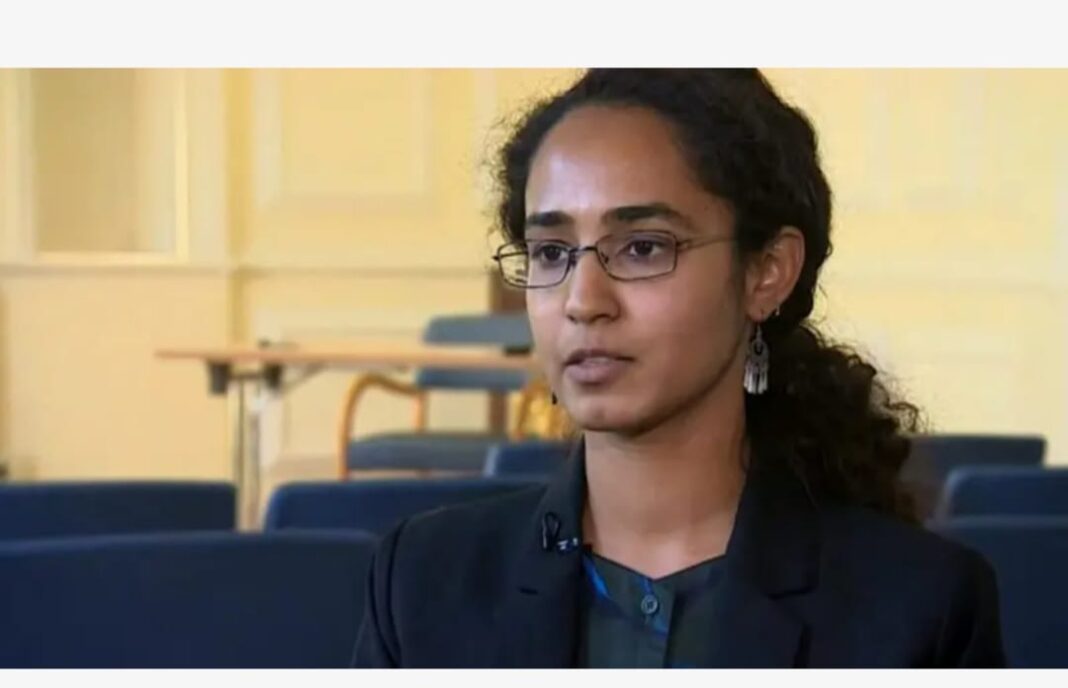
In a significant development, Dr Asiya Islam, an alumna of Women’s College, Aligarh Muslim University, has been appointed Assistant Professor as a permanent faculty at the Department of Gender Studies, London School of Economics and Political Science (LSE), London.
Retd. Professor Kaniz Khwaja Ahmed, who had taught Asiya Islam, Communicative English at Women’s College, told India Tomorrow, “I remember her as an ideal student as I taught her long back. Of all the students, I have taught so far, she stands out as the most ideal student. Although the subject I used to teach her was elementary, used in our daily life conversation, she always took it very seriously. She was very regular, attentive and punctual. In her, I saw the spark to achieve something in her life. I hope she still remembers me. We all are proud of her achievement and wish all the best for her career ahead.”
Before joining LSE Gender Studies, she was a Lecturer in Gender and Work at the University of Leeds. Before that, I was a Junior Research Fellow at Newnham College, University of Cambridge. In these positions, I taught on feminist global political economy, Black feminist theory, and intersectionality.
Asiya completed her PhD in Sociology at the University of Cambridge, her MSc in Gender, Media and Culture at the London School of Economics, and her BA(Hons) in Communicative English at Aligarh Muslim University.
Another teacher Professor Nikhat Taj, who also taught Asiya, said, “Asiya, indeed has made us very proud. Her achievement comes as no surprise for she had been a meritorious/promising student. She excelled not only in academics but was an ace performer in extra-curricular activities as well. She won the Zakir Hussain Medal for Academic Excellence at the undergraduate level, and that was just the beginning of her success story. I recall her as a diligent and committed worker, who would fulfil (most satisfactorily) any task, or project either given to her or taken up by herself.”
Professor Nikhat added, “Her appointment as an associate professor at the London School of Economics is just another step for many other achievements to come her way in the future. I see her as an inspiration and a role model for all the students of AMU – her alma mater.”
AMU Vice-Chancellor Prof Naima Khatoon, who was earlier Principal of Women’s College, while congratulating Dr. Asiya Islam on her achievement, said, “Asiya’s appointment at the London School of Economics will encourage our students to pursue higher studies abroad and work hard to make an academic career in prestigious foreign universities.”
source: http://www.indiatomorrow.net / India Tomorrow / Home> Education / by Mohammed Naushad Khan / September 16th, 2024
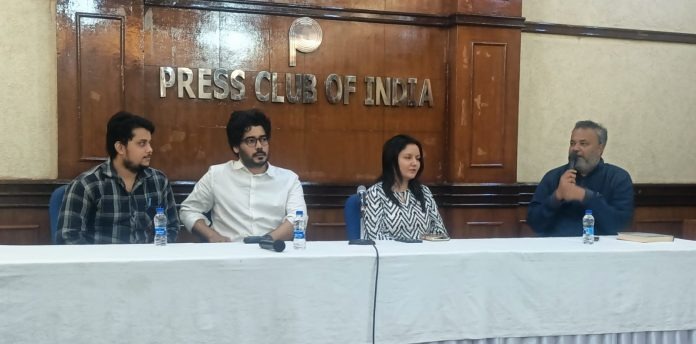
Press Club of India remembers Maulvi Mohammed Baqar on his 167th birthday on September 15, 2024.
New Delhi :
The Press Club of India (PCI) that has remained the last bastion to hold the flag of media’s independence high in the country, organised a programme on Sunday to remember the contributions of Maulvi Mohammed Baqar who used the power of his pen to challenge the Britishers who had brought a law to gag the press in India in the middle of 18th century.
Organized on the 167th martyrdom anniversary of Maulvi Baqar, the programme was attended by a host of writers, journalists, historians, academicians and intellectuals.
Shedding light on the contributions of Maulvi Baqar considered to be the founder of “spot” and investigative journalism in India, noted historian Dr. Swapna Liddle, author of The Broken Script, recalled Maulvi Baqar’s bold reporting of the events in Delhi’s 1857 revolt popularly known as India’s First War of Independence. It was when the press did not have facilities as available today, but Maulvi Baqar used to collect news stories from the field and print them in his newspaper published in the Urdu language.
The Britishers felt disturbed by the investigative reporting of Maulvi Baqar that became the reason for his martyrdom. British Army tied Maulvi Baqar to the mouth of a large gun and blew him into pieces.
Liddle emphasized how Moulvi Baqar became the voice of resistance against British rule, making him a significant figure in both the 1857Revolt and in the annals of Indian journalism.
According to Dr. Liddle, Moulvi Baqar’s work offers invaluable lessons for journalists today. His views on British governance, racial discrimination, job inequalities, and the exploitation of India’s wealth laid a foundation that remains relevant. Baqar’s sharp critique of British policies, combined with his unwavering call for unity among the people of Delhi, positioned him as a crucial figure in the anti-colonial struggle.
Presiding over the event, Gautam Lahiri, PCI President, hailed Moulvi Baqar as a pioneer of Indian journalism. Lahiri reflected on the state of modern journalism, pointing out that Baqar’s dedication and principles serve as a stark contrast to the current state of media, as reflected in India’s declining position on the World Media Freedom Index.
“It’s unfortunate that instead of rising to the level of journalism Baqar practiced, we seem to have regressed,” Lahiri noted, calling for introspection within the media industry.
Lahiri also stressed the importance of protecting institutions like the PCI, which he described as a cornerstone of Indian politics and modern history. “This land was given to us by our first prime minister, and it even served as the residence of former Prime Minister Indira Gandhi for a time. We must protect both the building and the institution, while upholding the constitutional values that it stands for.”
Senior journalist AU Asif, former member of PCI management committee, praised Baqar for his trailblazing work in investigative and field reporting. He underscored how Baqar’s journalistic integrity set a lasting example for future generations.
A panel discussion followed, focusing on Baqar’s legacy and the challenges faced by Urdu journalism today. Panelists included independent multimedia journalist Suhail Akhter, News18 Urdu anchor and author Munazah Shah, and Tasleem Raja, reporter for Siyasi Taqdeer and Qauwmi Aawaz. They discussed how Baqir’s newspaper, Delhi Urdu Akhbar, became a vital voice despite having a modest circulation of just 80 copies. The panel emphasized that the publication’s influence stemmed from its powerful content, which resonated with readers during a time of great political upheaval.
The discussion also touched on the difficulties Urdu journalism faces today, including issues of subscription, funding, and content creation. The panel drew parallels between the courage Moulvi Baqar exhibited in standing up to the British and the challenges modern journalists face in dissenting against the ruling establishment. The event was moderated by Mahtab Alam, journalist and PCI Joint Secretary.
source: http://www.indiatomorrow.net / India Tomorrow / Home> News / by Mohammed Naushad Khan / September 16th, 2024
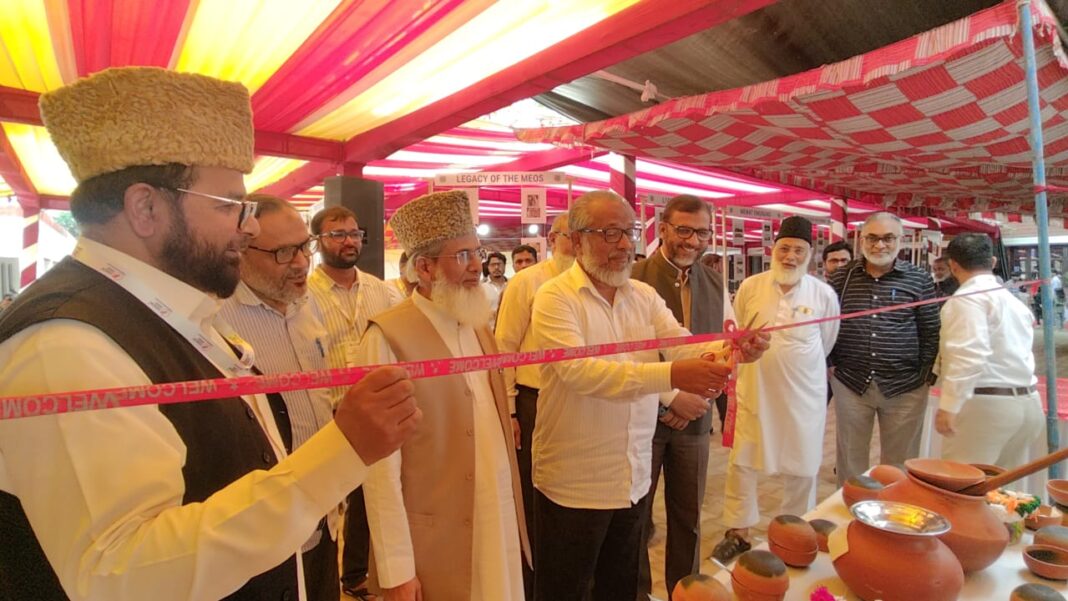
Human Welfare Foundation inaugurated the ambitious Vision Academic City” project in Mewat, one of Haryana’s most backward districts. Spread across 24 acres in Maroda village, the campus aims to transform the socio-economic landscape of the region by providing quality and affordable education, healthcare, and community services.
Speaking on the occasion, local MLA Mamman Khan described the campus as a “blessing” for the people of Mewat and assured full support to strengthen its educational initiatives.
P. Mohammed Ali Gulfar, Patron of Human Welfare Foundation and founder of the Gulfar Group, recalled that the dream of Vision 2026 was envisioned in 2005 and is now becoming a reality. “We will continue working for the educational and social upliftment of this region,” he said.
Adding to this, T. Arif Ali, Chairman of Vision 2026, emphasized that the sacrifices of Mewat’s people are deeply rooted in India’s soil, and the time has come to turn the dreams of their forefathers into reality.
Mewat is counted among the most underdeveloped districts of the country, grappling with poor education levels, lack of healthcare facilities, and inadequate sanitation. To address these challenges, the Vision Academic City has been developed under the Vision 2026 Programme.
During the inauguration, several institutions within the campus were formally opened, including Al Jamia Islamia Mewat Off-Campus, an undergraduate college building, separate hostels for boys and girls, and Chirag Middle School. The foundation stones of Scholar School and a Skill Development Centre were also laid.
The event also highlighted Mewat’s rich cultural heritage through Tarang Cultural Fest, Mewat Kitchen, and the Mewat Heritage Wall, showcasing the region’s traditions and identity.
Prominent guests included Engineer Mamman Khan (MLA, Ferozepur Jhirka), P. Mohammed Ali (Founder, Gulfar Group of Companies), and Maqbool Ahmed Anarwala (Retd. IPS Officer). Educationists, community leaders, and several eminent personalities also graced the occasion.
Speakers stressed the urgent need for quality education and skill development in Mewat, noting that Vision Academic City would not only provide modern infrastructure but also open pathways for higher education and research.
Among those present were M. Sajid (General Secretary, Human Welfare Foundation), Shibli Arslan (Academic Director, Al Jamia Mewat Campus), and many local dignitaries.
The inaugural ceremony concluded with a commitment to make Vision Academic City a hub of learning, development, and cultural pride for Mewat.
source: http://www.indiatomorrow.net / India Tomorrow / Home> Society / by Mohammed Naushad Khan / September 08th, 2025
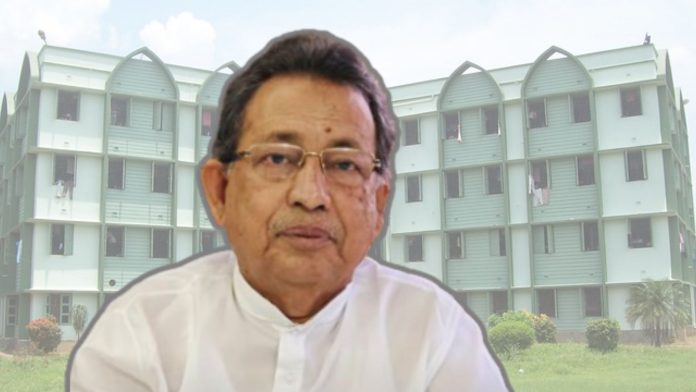
On the occasion of its Founder’s Day, the Al-Ameen Educational Society felicitated M. Nurul Islam, Founder and General Secretary of Al-Ameen Mission, West Bengal, with the prestigious “Al-Ameen All India Community Leadership Award 2025” for his remarkable contributions to education and community empowerment, reported the MPositive.
The annual event, held in memory of the Society’s visionary founder, the late Dr. Mumtaz Ahmed Khan, brought together members and supporters of the Al-Ameen movement. Nurul Islam was invited as the chief guest and was honoured for his tireless efforts in transforming the educational landscape, particularly for underprivileged students in West Bengal.
Islam began the Al-Ameen Mission in 1986 by establishing a hostel and the Institute of Islamic Culture in Khalatpur through community donations—famously collected as a fistful of rice from every household. In 1987, he renamed the initiative Al-Ameen Mission, inspired by the title Al-Ameen (the trustworthy), given to Prophet Muhammad ﷺ.
Since its inception, the Mission has achieved phenomenal success. With 77 residential branches, it currently houses more than 22,000 students, boasts a strong network of 50,000 alumni, and has produced over 2,400 doctors, 2,500 engineers, and numerous other professionals. In 2022 alone, nearly 500 students secured admissions in MBBS and BDS courses.
The late Dr. Mumtaz Ahmed Khan, who founded the Al-Ameen Educational Society in 1966 at the age of 30, is remembered as a renowned educationist, humanitarian, and reformer who dedicated his life to uplifting marginalized communities through education. His legacy continues to inspire the movement’s expansion across India.
source: http://www.radiancenews.com / Radiance News / Home> Education> Latest News> Report / by Radiance News Bureau / September 08th, 2025
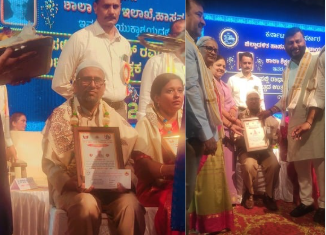
On the occasion of Teacher’s Day, Mr. Mohsin Ali, a dedicated Urdu teacher at The Mansoora School, Alur, has been honoured with the District Best Teacher Award by the Deputy Commissioner.
Mr. Mohsin Ali has been serving The Mansoora School, Alur, for over 35 years, inspiring and motivating students through his teaching and active participation in cultural activities. Despite opportunities for government jobs, he has chosen to dedicate his service to the welfare of his students.
Under his guidance, many students have achieved exceptional marks in Urdu and gone on to secure high positions in their careers. This award is a testament to his teaching excellence and commitment to education.
The Mansoora family congratulates Mr. Mohsin Ali on this prestigious achievement and wishes him continued success in his endeavours.
“Mr. Mohsin Ali’s dedication and passion for teaching have made a significant impact on the lives of his students. We are proud to recognise his outstanding contribution to education.”
source: http://www.radiancenews.com / Radiance News / Home> Awards>Latest News / by Radiance News Bureau / September 07th, 2025
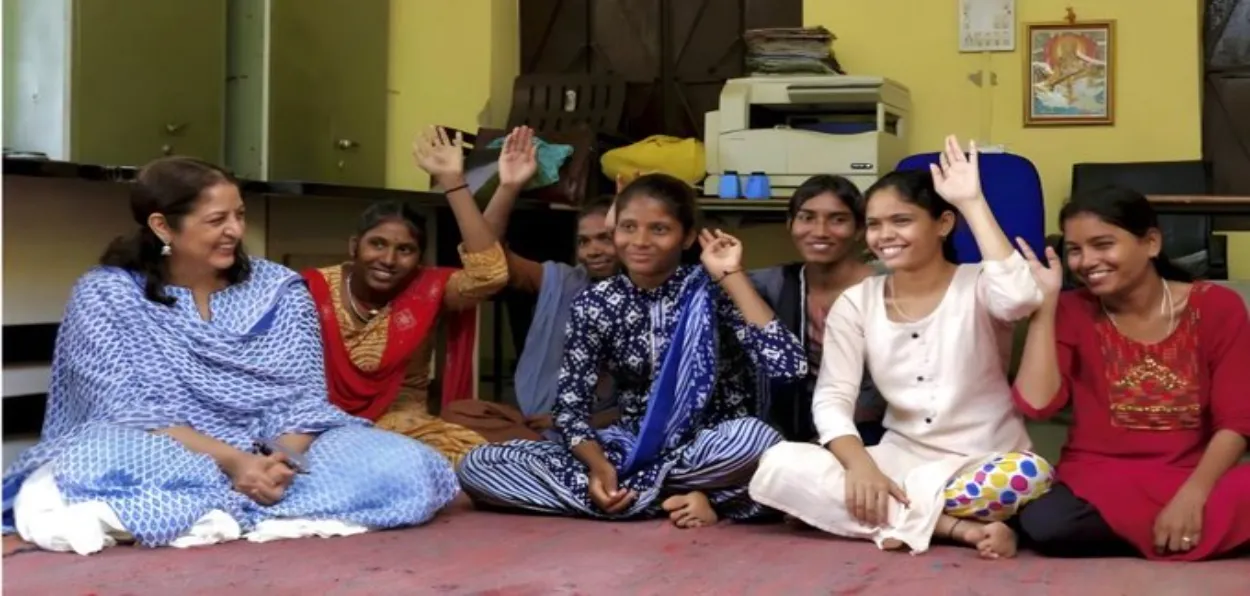
Safeena Husain (Extreme left) with some of the girls who whom her NGO helped
New Delhi
“The Ramon Magsaysay Award for ‘Educate Girls’ is a historic moment for India, and it places the global spotlight on a people-powered movement that began with a single girl in a remote village in the country,” said the non-profit’s founder, Safeena Husain, after the Manila based committee named her NGO for the coveted award for 2025, said.
Founded by Safeena Husain, The Foundation to Educate Girls Globally, widely known as ‘Educate Girls,’ has made history as the first Indian organisation to receive the Ramon Magsaysay Award, a statement from the Ramon Magsaysay Award Foundation (RMAF) said.
“Educate Girls” shares the 2025 Ramon Magsaysay Award with Shaahina Ali (Maldives), honoured for combating plastic pollution and protecting marine ecosystems, and Fr. Flaviano Antonio L. Villanueva (Philippines), recognized for restoring dignity to Manila’s poor and homeless.
‘Educate Girls’ has been named for Asia’s premier prize and highest honour for “its commitment to addressing cultural stereotyping through the education of girls and young women, liberating them from the bondage of illiteracy and infusing them with skills, courage, and agency to achieve their full human potential,” the RMAF statement said.
Reflecting on the milestone, Husain said, “Being the first Indian non-profit to receive the Ramon Magsaysay Award is a historic moment for Educate Girls and for the country. This recognition places a global spotlight on India’s people-powered movement for girls’ education, one that began with a single girl in the remotest village and grew to reshape entire communities, challenging traditions and shifting mindsets.”
The award honours dedicated Team Balika volunteers, valued partners, passionate gender champions, and supporters, and acknowledges the millions of girls who reclaimed their right to education, she said.
“As we work to reach 10 million learners in the next decade and share this blueprint beyond India, we carry forward a simple truth that when one girl is educated, she takes others with her, multiplying change across families, generations, and nations,” Husain said.
The organisation’s CEO, Gayatri Nair Lobo, said, “At Educate Girls, we believe that education is one of the greatest levers for development. But above all, education is every girl’s fundamental and inherent right. This prestigious award recognises the transformational change that is possible through partnerships with the government, philanthropic institutions, corporations, and grassroots communities, working together to tackle societal and systemic barriers and promote equitable and accessible education for girls everywhere.”
“We are deeply grateful to the Government of India for its phenomenal initiatives that have made this possible. Warm congratulations to our fellow awardees, Shaahina Ali and Fr. Flaviano Villanueva, whose work inspires us all,” she added.
Starting from Rajasthan, Educate Girls identified the neediest communities in terms of girls’ education, brought unschooled or out-of-school girls into the classroom, and worked to keep them there until they were able to acquire credentials for higher education and gainful employment, the statement said.
“It started with 50 pilot village schools reaching over 30,000 villages across India’s most under-served regions, involving over two million girls, with a retention rate of over 90 per cent,” the Foundation said.
The organisation is being recognised for its commitment to addressing cultural stereotyping through the education of girls and young women, liberating them from the bondage of illiteracy and infusing them with skills, courage, and agency to achieve their full human potential, a release said.
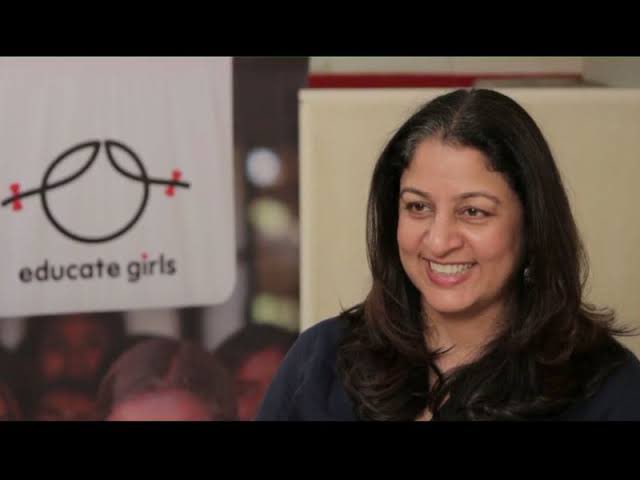
Safina Husain, founder The Foundation to Educate Girls Globally
It is the first Indian organisation ever to receive this award, in recognition of ‘its commitment to addressing cultural stereotyping through the education of girls and young women, liberating them from the bondage of illiteracy and infusing them with skills, courage, and agency to achieve their full human potential.’
The non-profit joins a lineage of distinguished laureates, including filmmaker Satyajit Ray, singer M.S. Subbulakshmi, social reformer Kiran Bedi, and Vinoba Bhave, alongside international icons such as Nobel Peace Prize laureates the Dalai Lama and Mother Teresa, as well as Oscar-winning storyteller Hayao Miyazaki.
Educate Girls, founded in 2007, empowers girls through education to break cycles of poverty and illiteracy. Since its inception, mobilising 55,000+ volunteers, it has brought back over 2 million girls to school and supported over 2.4 million children with remedial learning.
It operates in over 30,000 villages, aligning with the government’s priorities and initiatives. With a goal to reach 10 million learners in the next decade, the organization drives systemic change through government partnerships and ensures last-mile access for the most vulnerable. Its global recognition underscores the transformative power of investing in girls’ education.
The 2025 Ramon Magsaysay Awardees will formally receive their medallions and certificates during the 67th Ramon Magsaysay Awards Presentation Ceremonies on 7 November 2025 at the Metropolitan Theatre in Manila, Philippines.
source: http://www.awazthevoice.in / Awaz, The Voice / Home> Stories / posted by Aasha Khosa / September 02nd, 2025
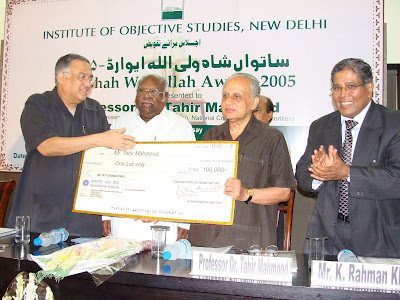
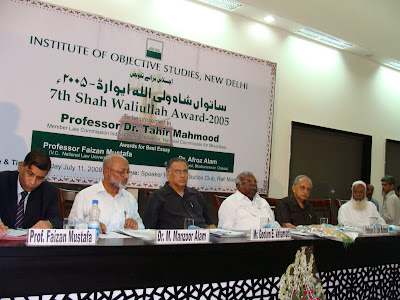
Vahanvati presenting the cheque to Tahir Mahmood with A R Laxamanan, and Rajya Sabha Deputy Chairman, K Rahman Khan
New Delhi:
The seventh Shah Waliullah Award was conferred on eminent legalist and an authority on Muslim Law Dr Tahir Mahmood today in New Delhi by Institute of Objective Studies (IOS).
The award carrying a shawl and a check of Rs one lakh was presented to Dr Mahmood, who is currently Member, Law Commission of India and former Chairman of the National Commission for Minorities, by Attorney General of India Goolam E Vahanvati in the presence of Deputy Chairman, Rajya Sabha, K Rahman Khan, Law Commission of India Chairman, Justice A R Lakshmanan, IOS chairman Dr Manzoor Alam and Lok Sabha Member Maulana Asrarul Haque Qasmi.
In his award accepting speech Dr Tahir Mahmood, author of several books and Muslim and general law, offered his gratitude to the IOS for selecting him for the prestigious award as it is named after renowned Islamic scholar and reformer Shah Waliullah Muhaddis Dehlvi and deciding to present it to him by the eminent jurist and present Solicitor General Goolam E Vavanvati in the presence of K Rahman Khan and other dignitaries.
Islamic law was distorted by the British judiciary, and what is today found in text books in the name of Islamic law, is in fact far from the true Islamic law, said Dr Mahmood who has spent about 50 years on working on Muslim Law – first 20 years since 1959 on studying it through original sources and next 30 years teaching and writing on Muslim Law.
Prof Faizan Mustafa, V-C, National Law University, Bhubaneshwar, IOS chairman Dr Manzoor Alam, Attorney General of India Goolam E Vahanvati, Justice A R Laxamanan, chairman, Law Commission of India, Dr Tahir Mahmood, Maulana Asrarul Haque Qasmi, MP, Lok Sabha
He announced to donate the award money to the Indian Association of Scholars of Religion and Law (ASRAL-India), a group he set up to create a platform for engagement between religion and law.
IOS instituted the award in 1999 to commemorate the outstanding services of Shah Waliullah to promote the Islamic values and to honour eminent scholars who have done outstanding work in Social Sciences, Humanities, Law and Islamics.
This was the 7th award for the year 2005. The first award for the year 1999 was conferred posthumously on Maulana Syed Abul Hasan Ali Nadvi on November 3, 2000. The second award went to Qazi Mujahidul Islam Qasmi, the renowned Islamic scholar and an authority on Islamic fiqh and the third to Prof Nejatullah Siddiqui, eminent Islamic economist.
source: http://www.twocircles.net / TwoCircles.net / Home> Indian Muslim / by Mumtaz Alam Falahi, TwoCircles.net / July 11th, 2009
Apart from the need for education, it underlines the importance of representation in legislative bodies and jobs
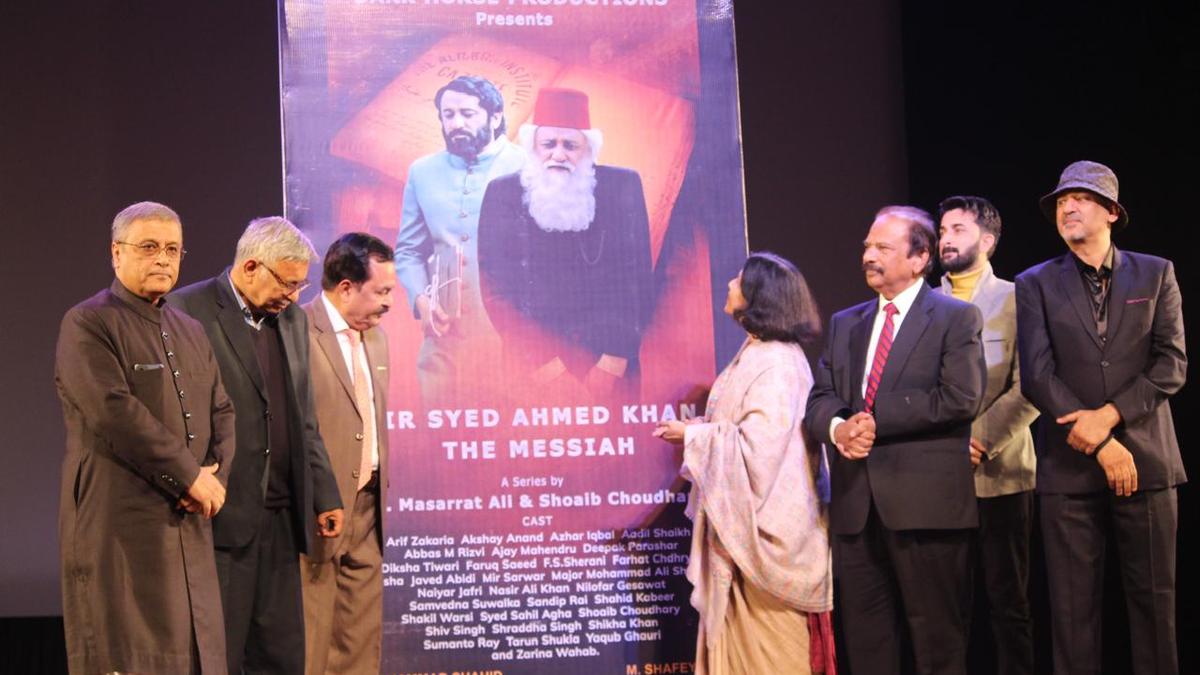
Syed Ahmed Khan biopic | Photo Credit: SPECIAL ARRANGEMENT
He is one of the architects of modern India or a proponent of the two-nation theory. However, moving away from easy binaries, the first biopic of Sir Syed Ahmed Khan attempts to find answers to the contested legacy of the founder of the Muhammedan Anglo-Oriental College that took the shape of Aligarh Muslim University (AMU). Long in the works, a two-hour cut of the OTT series, The Messiah premiered at the iconic Kennedy Auditorium in AMU on Monday, before the series streamed on Apple TV.
Coming at a time when the minority status of the Central University is being hotly debated in courts and society, the series details how Sir Syed confronted a section of the clergy and conservative elements within the Muslim community by creating a modern centre of learning to build bridges between the Muslims and the British government after the revolt of 1857, when the colonial power held the community largely responsible for the rebellion. “He held the ignorance as the primary reason behind the political decay of Muslims and thus pushed for modern education,” says Shoaib Hussain Chaudhary, who not only directed the series but also played the title role. “The role fell into my lap after big names declined to take up the challenge, perhaps because of the stigma attached to him.”
A known name in the television circuit, Chaudhary sees Sir Syed as an advocate of Hindu-Muslim unity, who was wrongly associated with the two-nation theory. “The theory came into being long after his demise in 1898. What he asked for was Muslim representation in legislative bodies and it remains relevant considering the political status of the community today.”
As someone who believed in answering a book with a book, Sir Syed responded to William Muir’s controversial commentary on Prophet Muhammad with a rational interpretation of Islamic tradition in Khutbat-e-Ahmadiya.
An adaptation of Hayat-e-Javed, Khwaja Altaf Hussain Hali’s biographical account of Sir Syed’s life, the series puts him in the league of reformists like Raja Ram Mohan Roy and Ishwar Chand Vidyasagar and argues that he was not a communal figure but a communitarian who was conscious of the fact that Hindus of Bengal were at least 50 years ahead of Muslims in taking up modern education.
Interestingly, the spark came from Mirza Ghalib. When Sir Syed approached the poet to write the preface of his translation of Ain-e-Akbari, he advised him to concentrate on the contemporary issues of the community and said there was no point in celebrating Akbar’s rule when the constitution of the world was being written in Calcutta.
‘Controversial ideas’
The series also critiques Sir Syed’s point of view on girls’ education and backward Muslims and debates whether he made a mistake by not joining hands with the Indian National Congress. It also explores his tumultuous relationship with his son Syed Mohammad, the first Muslim judge of a High Court during the British Raj, whose proclivity towards alcohol created problems in his personal and professional life. “Sir Syed’s character appears dichotomic but if you see him as a product of his times, things fall in place,” says screenwriter Mutyim Kamalee. “While Islam abhors slavery, he opted for pragmatism as after the revolt of 1857, the community was not in a position to take on the colonial power. Mahatma Gandhi also didn’t take the path of armed rebellion.” Kamalee says Sir Syed didn’t join the Congress but towards the end of his life he showed a change in his point of view and perhaps would have joined the Congress had he lived longer.”
Describing the series as an authentic portrayal of Sir Syed’s life and works, Prof. Shafey Kidwai, an authority on Sir Syed says, “Sir Syed views on women’s education and backward Muslims are widely misunderstood. The film tries to put the record straight in a convincing manner.”
Made on a tight budget, the series was shot on sets after AMU declined permission. “Filmmakers in the past didn’t live up to their promises, so the previous administration was circumspect about our intentions but I am glad now the university has embraced the film,” says Chaudhary.
Apart from Chaudhary, the series stars Akshay Anand, Zarina Wahab, Arif Zakaria, and Deepak Parashar in important roles.
source: http://www.thehindu.com / The Hindu / Home> News> India> Uttar Pradesh / by Anuj Kumar / December 20th, 2024
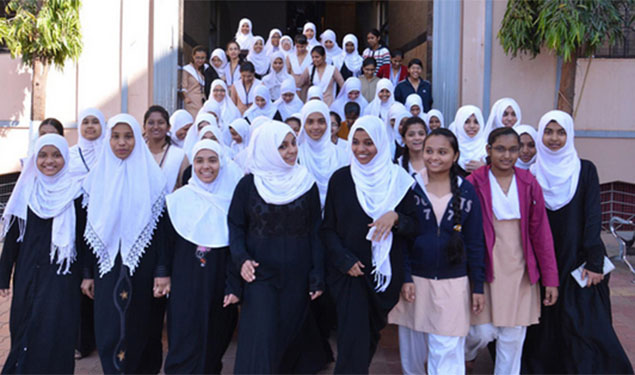
[Female students of Shaheen in a group photo. (File)]
Bidar (Karnataka):
Qurratul Aian, Shooa Fatima Khanam and Ammatulah Fatiha Nabisat, who passed the National Eligibility cum Entrance Test – UG (NEET 2018) and became eligible for admission to various medical courses, are Hafizah.
Hafizah is the Arabic term used to identify the females who memorise the entire Holy Quran comprising of 114 Suras or Chapters, and 6,236 Ayats or Verses.
While Hafiza Qurratul Aian scored 550 marks securing an All India Rank (AIR) of 7,446, Hafiza Shooa Fatima Khanam scored 483 marks with AIR 28,443 and Hafiza Ammatulah Fatiha Nabisat scored 462 marks and got 38,033th position in the NEET 2018 All India Rank (AIR).
The National Eligibility cum Entrance Test – UG (NEET 2018) result was declared on Monday June 04. A total 7,12, 635 candidates have qualified from India, 342 qualified students are from abroad, 1200 are Non Resident Indians (NRIs), 367 are OCI and 36 are PIO.
Qurratul Aian, Shooa Fatima Khanam and Ammatulah Fatiha Nabisat, the 03 female memorisers of the Holy Quran are the students of “Hafizul Quran Plus” program of Shaheen Group headquartered in Bidar, Karnataka.
The 04-year integrated course especially designed for Urdu speaking Huffaz and Aalims is divided into Foundation Course: (6 months), Bridge Course: (6 months), 10th class: (1 year) and Junior College: (2 years) preparation of 12th class along with NEET, JEE and other competitive examinations.
Besides the above three female memorisers of the Holy Quran, 10 other Huffaz of Shaheen Hafizul Quran Plus program have also passed the NEET 2018. A total of 1,600 Shaheen students had appeared for the National Eligibility cum Entrance Test – UG NEET in 2018. Of them, 1,363 students scored more than the minimum marks in NEET 2018.
“Out of the total 1,363 who qualified the medical entrance this year, 300 students have scored enough marks to get admission in different medical colleges”, Abdul Qadeer, Founder Chairman of Shaheen Group of Institutions, said while talking to ummid.com.
“Among them are 13 Huffaz including 03 Hafizah – female memoriser of the Holy Quran. One of the Huffaz who passed NEET 2018 is Waheed Abdullah of Gorakhpur, Uttar Pradesh. Like other students of Shaheen Hafizul Quran Plus, he never went to a school. He got free coaching at Shaheen’s Bidar center and scored 579 out of the total 720 marks to secure All India Rank (AIR) 3295”, he added.
Shaheen Group of Institutions was established in 1989 with Shaheen School to provide quality education to students from Urdu medium. Started with just 18 students, it now has more than 12,000 students and centers running in different cities of India including Bengaluru, Mysore, Belagavi, Shimoga, Kolar, Gulbarga, Raichur, Bidar, Basavakalyan, Humnabad, Aurad, Chitguppa, Aurangabad, Patna and Lucknow.
Besides special integrated course for Huffaz, the Shaheen Group also runs NEET coaching for regular students. It had sent more than 200 students to different medical colleges in 2017, 152 in 2016, 111 in 2015, 93 in 2014, 89 in 2013 and 71 in its first batch in 2012.
source: http://www.ummid.com / Ummid.com / Home> Education & Career / by ummid.com news network / June 11th, 2018
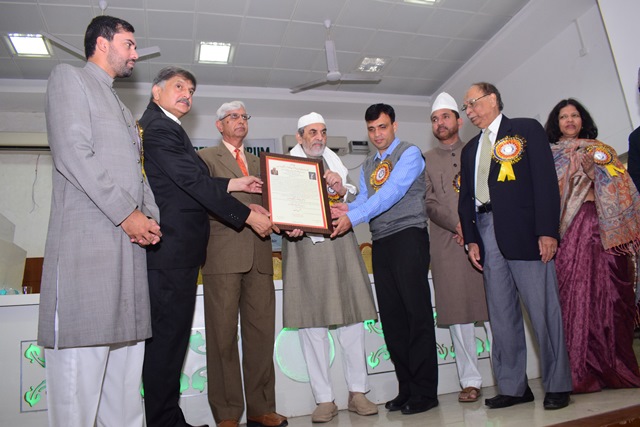
Mohsin E Millat Award being presented to Dr. Syed Shah Khusro Hussaini by Prof. Shakeel Samdani
Aligarh :
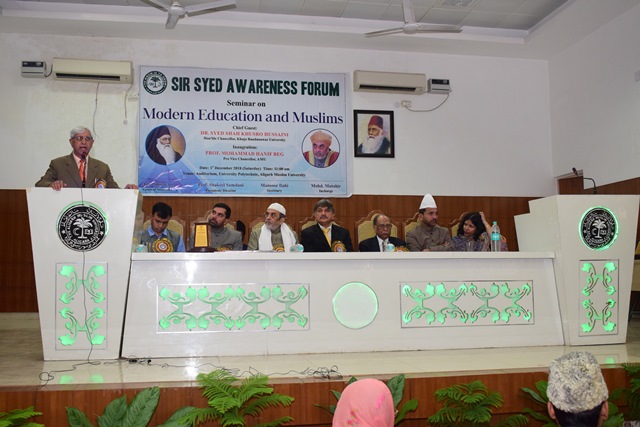
Dr. Syed Shah Khusro Hussaini, Founder and Chancellor, Khaja Bandanawaz University was conferred with “Mohsin-E-Millat Award” by Sir Syed Awareness Forum (SAF) during a function which was attended by many prominent personalities from the field of education at University Polytechnic Auditorium, Aligarh Muslim University (AMU).
During the occasion a seminar on “Modern Education and Muslims” was also organised by the Forum.
Addressing the seminar Dr. Syed Shah Khusro Hussaini said that education is necessary for Muslims throughout the world. He said that, Islam is a modern religion and if the principles of Islam are followed honestly, then everyone can achieve success in their lives. He further said that he is the admirer of Sir Syed Ahmad Khan and he is trying his best to carry forward the mission of Sir Syed by establishing a university. He appealed to the Muslims to focus on education as it is the key to success. In the last he said that division on the basis of school of thought is causing harm to the Muslims. It should be avoided by them.
Presiding over the seminar, Prof. Mohd. Hanif Beg, Pro Vice Chancellor, AMU said that in today’s world it is very important to discuss on the issues of education. He congratulated the SAF for organizing the seminar on modern education. He further said that Sir Syed has always given importance to modern education. At the end he requested the students to work hard for civil services and judicial examinations.
Prof. M H Beg, PVC, AMU delivering Speech sitting IPS Abdul Hamid, Dr. Khusro Hussaini, Prof. Shakeel Samdani, Prof. Pathan and others
Guest of Honor, Mr. Abdul Hamid, IPS and Registrar, AMU said that today Muslims are lagging behind in the field of modern education. Sachar Committee report has confirmed that the educational status of Muslims in India is lower than Scheduled Castes and Scheduled Tribes. He said that higher education is the only solution of this problem. He requested the students of AMU to focus on their education and keep themselves away from unnecessary activities. At the last he congratulated Prof. Shakeel Samdani, President SAF for organizing a wonderful seminar on a very important topic.
President of the forum, Prof. Shakeel Samdani, while delivering his speech, said that Muslims have dominated the world in the field of education, science, literature, etc for about 600 years and this was only possible because they focused more on education and research. He congratulated the South India for carrying forward the mission of Sir Syed Ahmad Khan. South Indian Muslims have established much more education institutions as compared to Muslims of North India. He further said that Dr. Khusro Hussaini has established 24 educational institutions and the most important among them is the Khaja Banda Nawaz University. He said that the work of Dr. Hussaini is appreciable as he has helped the poor sections of the society by establishing educational institutions. At the last he said that it is the pleasure of SAF that Dr. Hussaini has accepted the Mohsin-E-Millat Award.
Principal of Abdullah College, Prof. Naima Gulrez said that North India is lagging behind in establishing educational institutions as compared to South India. She gave the example of Parsis that although they are numerically less in population but they are one of the most prosperous community in the country. It is because they are educationally advanced and they focus very much over modern education. She expressed her sorrow about the condition of Muslim women in the society.
Vice Chancellor of Khaja Banda Nawaz University, Prof. Abdul Jaleel Khan Pathan congratulated SAF for conferring ‘Mohsin-E-Millat Award’ on Dr. Hussaini. He said that it is the need of hour to carry forward the mission of Sir Syed and to provide quality education to Muslims.
Dr. Mohib Ul Haque, said that the time has come for Muslims to focus on modern education if they want to succeed. He congratulated Prof. Shakeel Samdani and SAF for their contribution in establishing Tipu Sultan Block at AMU.
Anjum Tabassum Lashkri (Karnataka) and Mr. Tariq Hussain, AMU were felicitated with “SAF Excellence Award”. Ayesha Samdani conducted the seminar and Mansoor Ilahi proposed the vote of thanks. Sarah Samdani also spoke on this occasion. Poetess Rehana Shaheen recited a Nazm on Sir Syed.
Wajahat Jilani welcomed the guests and Aman highlighted the objectives of the Forum.
On this ocassion, Mr. Syed Ali Hussaini, Pro Chancellor of Khaja Banda Nawaz University, Mr. Haider Pasha Qadri, Sajjada Nasheen, Dr. Moinuddin, Superintendent, KBN Medical College, Gulbarga, and Maulana Syed Abdur Rasheed were present.
Seminar was made a great success with the tireless work and efforts of Adv. Shoeb Ali, General Secretary, SAF, Dr. Haider Ali, Abdullah Samdani, Mohd. Muthair, Hunain Khalid, Danish Iqbal, Sarim Ali, Hamza Noman Masood, Saad Asad, Pawan Varshney, Himanshu Singh, Ajay Singh, Hamda, Kashif Sultan, Ayesha Farheen, Razia Chauhan, Talat Anjum, Rubia, Fauzia, Faiz, Adeel Shervani, etc.
Many prominent figures who attended the program include Prof. Tariq Chattari, Chairman, Dept. of Urdu, Prof. Humayun Murad, Dr. Iqbal Siddiqui, Prof. Zafar M. Nomani, Prof. Kamil, Prof. Khalid Azam, Prof. Ashar Ansari, Prof. Mujeeb Ansari, Prof. K. Khalil Ahmad, Prof. Shakeel Ahmed, Dr. Nazar Abbas, Dr. Ayesha Munira, Dr. Raihan Akhtar, Dr. Rahat Abrar, Dr. Masood Anwar (Shahjahanpur), Dr. Yameen Ansari (Delhi), Syed Ikram Ul Haq (Hapur), Dr. Raghib, Dr Wasim Ali, Mohd Nasir, Dr. Kalimullah, Dr. Rahmat Ullah, Dr. Qaiser Ansari, Dr. Obaid Iqbal Asim, Dr. Iqbal Hadi, Dr. Naseem Ahmad Khan, Dr. Ali Nawaz Zaidi, Dr. Zafar Ahmad, Dr. Mohsin Khan, Adv. Khan Wajahatullah, Rabab Khan, Dr Zeba Azmat, Dr Tabassum Chaudhary, Huzaifa Amir, Secretary, AMUSU, Khalid Masood, Ex President, AMUSU, Raas Masood Khan, Court Member and a large number of students were also present in the seminar.
source: http://www.muslimmirror.com / Muslim Mirror / Home> Exclusive Reports> Indian Muslims / by Muslim Mirror Networks / December 10th, 2018