Category Archives: Community Involvement / Social Issues

Jamia Millia Islamia: A Living Idea of India

NEW DELHI :

Hue the aake yahin khemazan woh deewaney,

Uthhe the sun ke jo aawaz-e-rehbaraan-e-watan.

(Here pitched their tents those ardent dreamers; Who rose at the first call of their homeland’s liberators)

Step through the Centenary Gate, and you enter not just a campus but a living conversation between history and hope. Every lane carries memory; every wall speaks of struggle. Jamia is not made of stone and mortar alone; it is built of ideals, of founders who were freedom fighters and reformers, of teachers who worked for life on modest pay, of students who turned learning into service, and of a dream that education could make a nation free not only in body but in spirit.

Maulana Mohammad Ali Jauhar, Jamia’s first Vice-Chancellor, and a firebrand nationalist who, at the Second Round Table Conference in 1930, declared he would not return to a slave country, a vow he kept, breathing his last in London and resting forever in Jerusalem. His courage gave Jamia its pulse of defiance. Dr. Mukhtar Ahmad Ansari, a physician and President of the Indian National Congress, lent Jamia its healing vision, a belief that education, like medicine, must restore dignity to the human condition. Dr. Zakir Husain, later India’s President, gave Jamia its soul, transforming education into a moral act and underscoring that a teacher’s duty is not to instruct but to awaken.

On its 105th foundation day, let me take you on a Jamia tour. The Mohammad Ali Jauhar Marg leads through the majestic Centenary Gate into the heart of Jamia Gulistan-e-Gandhi, whose presence still seems to guide the university he envisioned.

The M.A. Ansari Auditorium stands ahead, alive with the echo of debates, drama, poetry, and protest, a place where generations have learned that knowledge without courage and compassion is incomplete. Nearby, the Mahmoud Darwish, a revered Palestinian poet and voice of resistance, exile, and identity lane winds toward the M.F. Husain Art Gallery, a riot of colour and imagination. The Nehru Guest House still echoes the voices of thinkers who stayed there. Beside it, the Maulana Azad House completes a poetic pairing — Nehru and Azad, once neighbours in prison, now neighbours in memory. Inside, guesthouse rooms are named after figures like Ritwik Ghatak.

The serpentine path leads past the Mohibbul Hasan House and Deen Dayal Kaushal Vikash Kendra and onward to the West Asia Centre, the Ho Chi Minh Conference Hall, Saadat Hasan Manto Lecture Hall, and the Shaikh Sabah Al–Ahmad Al–Jaber Seminar Library, where Jamia’s dialogue with the world continues. Through Jahane Kushuru, you arrive at Gulistan-e-Ghalib, where Ghalib’s statue stands beneath the trees, inscribed with his immortal verse:

Jaam har zarra hai sarshar-e-tamanna mujh se,

Kiska dil hoon ke do aalam se lagaya hai mujhe!

Every particle is intoxicated with longing for me,

Whose heart am I, that both worlds are drawn to me?

Ghalib’s verse mirrors the spirit of Jamia itself, a place that draws seekers from every corner, as if knowledge, memory, and desire converge upon it. A reminder that the soul of a true university is to become the heart of many worlds.

At the center of Jamia stands its intellectual sanctuary, the Dr. Zakir Husain Library; its silence is dense with thought. Not far away, the Sarojini Naidu Centre for Women’s Studies and the Nelson Mandela Centre for Peace and Conflict Resolution remind every visitor that dialogue and equality are central to Jamia’s compass.

Enter through the Qurratulain Hyder Gate, named after the Gyanpeeth award-winning Urdu novelist, and you arrive at the lush green Nawab Pataudi Cricket Ground, with its Virender Sehwag Pavilion, a tribute to the alumnus who brought glory to the nation. Nearby stands the King Abdul Aziz Faculty of Dentistry, a graceful emblem of international collaboration. Around it, hostels named after B.R. Ambedkar, Allama Iqbal, E.J. Kellat, and Obaidullah Sindhi reflect Jamia’s plural legacy, a living reminder that its map is also a moral landscape.

Closer to the metro station, the Noam Chomsky Complex, a reminder that free thought is Jamia’s lifeblood. Next door, the K.R. Narayanan Centre for Dalit and Minority Studies ensures that inclusion here is not a slogan but a lived truth. Through the Mahmud Hasan Gate, named for the scholar who inspired students and clerics to join the freedom struggle and who endured years of harsh imprisonment in Malta — the campus opens into its schools: the Mushir Fatima Nursery, the Abid Hussain School, and the Gerda Philipsborn Day Care Centre, where the smallest minds learn under the same canopy of values that shelter scientist, scholars and philosophers.

Gerda Philipsborn, a German-Jewish educator who left Germany and found a home in Jamia, is fondly remembered as Aapa Jaan. She embodied the university’s transnational conscience, the belief that education builds bridges, not boundaries. Mujeeb Bagh hosts the Ramanujan Science Block, named after the mathematical genius whose brilliance continues to inspire curiosity and wonder across generations. The women’s hostels named after Begum Hazrat Mahal and Aruna Asaf Ali celebrate the courage of women who turned resistance into art and activism. Further on lies the Khan Abdul Ghaffar Khan Enclave, honouring the Frontier Gandhi who preached non-violence not as political expediency but as an article of faith. And in the Munshi Premchand Archives lives the memory of the great storyteller, who wrote Kafan during his stay at Jamia.

Located near the Administrative Block on Khayaban-e-Ajmal, the Jamnalal Bajaj Block honours Jamia’s benefactor, whose steadfast support and financial contributions were instrumental in sustaining the university during its formative years. Within its serene precincts stand the Yasser Arafat Hall, the Edward Said Conference Hall, and the Mir and Tagore Convention Centre, spaces that echo Jamia’s spirit of dialogue, dissent, and cultural encounter, where ideas from East and West, past and present, continue to converse in quiet harmony. Nearby, APJ Abdul Kalam Gate takes you to India’s most reputed Anwar Jamal Kidwai Mass Communication and Research Center, a testament of global cooperation with Canada, which buzzes with cameras, questions, and conversation.

Few universities wear their philosophy so visibly on their map. These names are not labels; they are moral coordinates of a century-old experiment in inclusive education. Each block is a story of struggle; each road a reminder of Jamia’s founding spirit, where taleem (education) and tehreek (movement) are inseparable.

Jamia was not born of privilege; it was born of protest. Founded amid the Khilafat and Non-Cooperation Movements, it was a quiet act of rebellion, an insistence that colonialism would not define the Indian mind. Education at Jamia was never meant to produce clerks for an empire, but citizens of conscience. Zakir Husain, Mohammad Mujeeb, and Abid Husain, three of Jamia’s philosophical pillars, envisioned Nai Talim, a pedagogy that unites head, heart, and hand. Long before “experiential learning” became educational jargon, Jamia built it into its foundation. Knowledge was tied to labour, intellect to ethics, and inquiry to empathy. The Ustadon ka Madrasa, the first of its kind teachers’ training institute, became a living laboratory of this vision, where teaching was not merely a transaction of knowledge but a pursuit of truth, a cultivation of inquiry, and a moral apprenticeship in the art of understanding. It embodied the meaning of a true university, not a place that fills minds, but one that frees them.

In the dark days of Partition, when Delhi burned with fear, Jamia’s students and teachers became healers, offering shelter to the displaced, solace to the broken, and humanity to a city in despair. From those flames emerged a university that made communal harmony its cornerstone.

Perhaps no moment captures Jamia’s moral stature better than its Silver Jubilee in 1946. On that day, Dr. Zakir Husain brought on the same stage Nehru, Asaf Ali, Rajaji, Jinnah, Fatima Jinnah, and Liaquat Ali Khan. At a time when the country teetered on the edge of partition, Zakir Husain’s possible one of the best speeches, “For God’s sake, sit together and extinguish this fire of hatred,” moved them to tears.

To walk through Jamia today is to stroll through the living soul of pluralism, a quiet republic of ideas where liberty, plurality, inclusiveness, and fraternity breathe in every courtyard, in every classroom. Here, Gandhi still converses with Mandela, Chomsky finds his echo in Edward Said, and Ghalib whispers to Mir beneath the shade of red-brick walls. Darwish recites for Tagore, Arafat debates with Ho Chi Minh, Ramanujan solves number puzzles with AJP Abul Kalam, Manto reads his script to Ritwik Ghatak, Prof. Mujeeb debates with Pt. Deep Dayal Upadhyay, Maulana Azad, and Nehru discuss an education roadmap over jasmine tea, and Ambedkar stands in thoughtful dialogue with Sarojini Naidu. It is a rare moral geography, a constellation of minds, where the ideals of freedom, justice, equality and fraternity converge without collision, illuminating the enduring idea of India itself.

While many century-old universities are withering away, Jamia Millia Islamia continues to grow step by step. It carries not only a proud and luminous history, rich in struggle and idealism, but also a radiant present, consistently ranked among the nation’s top universities, with rising scientific citations and breakthrough research that place it firmly on the global academic map.

Yet in a time when higher education bends under market pressures and ideological conformity, Jamia endures as a counter-memory, a quiet act of defiance against becoming a mere factory of certificates. Its administration, faculty, students, staff, and alums continue to zealously guard the Idea of Jamia — where knowledge is pursued, not prescribed; where questions are not censored, and truth is never pre-decided. A true university must protect the space where evidence triumphs over ideology, where disagreement deepens understanding, and where inquiry itself becomes an act of freedom.

The idea of Jamia is not simply a place, a campus, but a proposition that education is not merely obedience or a commodity, but an awakening of the mind and conscience.

To walk through Jamia is to walk through the Idea of India itself – plural, principled, and forever in motion along the path of progress.

“Yahaan pe shamme-hidayat hai sirf apna zameer.”

Here at Jamia, the beacon of guidance is none other than one’s own conscience.

source: http://www.muslimmirror.com / Muslim Mirror / Home> Opinion / by Aftab Mohammad / November 01st, 2025

Kashmiri Man Who Saved BJP Worker’s Family in Pahalgam Attack Honoured in Chhattisgarh

JAMMU & KASHMIR :

Raipur:

Kashmiri local guide Nazakat Ahmed Shah, who saved the family of a BJP youth worker during the April Pahalgam terror attack, received a warm welcome in Chhattisgarh nearly six months after the incident. The attack in South Kashmir had left 26 people dead and several injured.

Shah, who has been visiting Chhattisgarh for over three decades to sell clothes, became a hero after rescuing the family of BJP youth wing worker Arvind Agrawal. During his first visit to the state since the attack, Shah was felicitated by Agrawal and around 50 residents in Chirmiri, Manendragarh-Chirmiri-Bharatpur district. The group expressed their gratitude with garlands, flowers, and a shared lunch.

Agrawal recalled that Shah’s quick thinking saved his wife and four-year-old daughter. “When the firing began, he asked us to lie down and shielded my daughter and my friend’s son. He took them to safety and returned to rescue my wife,” Agrawal said.

Speaking to reporters after the ceremony, Shah said he felt emotional meeting the families he had saved. “Chhattisgarh feels like home to us. We come here for three months every year for business, and people here have always treated us like family,” he said.

Shah’s act of courage has been widely praised across communities, highlighting the enduring human bonds that transcend politics and geography.

source: www.radiancenews.com / Radiance News / Home> Latest News> Reports / by Radiance News Bureau / November 01st, 2025

Dr. Mohammad Manzoor Alam: The Visionary Behind IOS and the Unfulfilled Dream of Empowering India’s Marginalized

Ranipur (Madhubani District), UTTAR PRADESH / DELHI :

SONY DSC

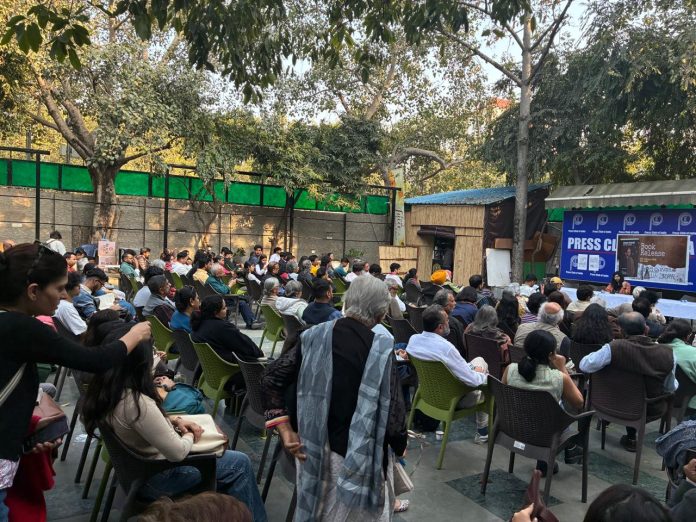
Dr. Mohammad Manzoor Alam, the founder of the Institute of Objective Studies (IOS), stands as one of the most prominent leaders of the Indian Muslim community. Recently, his biography “Dr. Manzoor Alam: Empowering the Marginalized” written by senior multilingual journalist A. U. Asif, was released at the Constitution Club of India in New Delhi. The event was attended by several distinguished personalities from politics, academia, the judiciary, and the media.

The biography reveals many unknown aspects of Dr. Manzoor Alam’s life, his contributions, and his wide national and international connections — from Dr. Manmohan Singh to Ahmed Patel, from cabinet ministers to chief ministers and governors. His close friendships extended to Malaysian Prime Minister Anwar Ibrahim and several prominent personalities across the Gulf Cooperation Council (GCC), including ministers and academicians. Among his international associates were Prof. Omar Hasan Kasule, Secretary General of the International Institute of Islamic Thought (IIIT), USA; Dr. Ahmad Muhammad Ali, the first President of the Islamic Development Bank (IDB); Dr. Ahmed Tutunji, General Secretary of the International Islamic Federation of Student Organizations (IIFSO); and Professor Ismail Raji al-Faruqi, co-founder of IIIT, Dr. Abdullah Al-Maatouq, Chairman of the International Islamic Charity Organization (IICO) Kuwait etc.

The Institute of Objective Studies: A Pioneering Muslim Think Tank

Undoubtedly, the IOS — the first Muslim-run think tank in India — has played an unparalleled role in academic and intellectual engagement. Over the past four decades, it has organized more than 1,230 conferences, seminars, symposia, and workshops on diverse issues affecting Muslims and Indian society at large. It has completed over 410 research projects and produced around 405 publications focusing on socio-economic, educational, and cultural challenges.

Through its data-based research, collection, and presentation, IOS provided valuable insights into the conditions of marginalized communities. The institution succeeded in building a network of more than 500 research scholars, social scientists, academicians, judges, lawyers, and politicians. Its studies and deliberations form a crucial body of work on the socio-economic conditions of Indian Muslims.

However, despite its achievements, the IOS has failed to evolve a sustainable mechanism for implementing the findings of its research. After nearly four decades of existence, the impact of its ideas on the ground remains negligible. The think tank, while rich in intellect and intent, fell short of translating its research into practical policies for the empowerment of marginalized communities. When one examines the ground realities, the absence of tangible transformation makes this collective effort appear more like an academic exercise than a movement for social change.

The Promise and the Reality

The Institute of Objective Studies was established in 1986 with the vision of empowering the 200 million-strong Indian Muslim community — a group that, even today, lags behind many other marginalized sections, including Dalits, on multiple socio-economic parameters. While IOS produced a wealth of research and data, it failed to create models of empowerment or tangible change on the ground.

It would be unfair to assume that Dr. Manzoor Alam’s vision was limited to research and conferences alone. He unsuccessfully attempted to extend his work into education, media, and healthcare. Unfortunately, many of those initiatives remained unrealized.

Dr. Alam had conceived numerous projects, including a dream university and  television channels Al-Hind and  Falak TV — both designed to serve as platforms for education and social awareness. He presented these projects at several events in India and abroad, yet they never materialized beyond the planning stage. Why these ideas remained confined to files is a question that only Dr. Alam himself can answer.

Dr. Manzoor Alam’s Tryst with Education and Development

In the 1990s, Dr. Alam invited Mohammad Yunus Saleem, then Governor of Bihar, to lay the foundation stone of an educational institution in his native village, Ranipur, in Madhubani district. Decades later, that very school continues to function from a thatched hut.

Similarly, he invited another Governor, Akhlaqur Rahman Kidwai, to lay the foundation of a hospital in the same village. However, there is no trace of that foundation today, and the land has reverted to agriculture. It is said that even a few delegations of Arab dignitaries visited the site to explore funding possibilities for these projects. Yet, despite such visits and promises, Ranipur remains a mirror reflecting the unfulfilled dreams of Dr. Alam’s vision for grassroots empowerment.

Akhlaq Ur Rehman Kidwai, then Governor of Bihar, during his visit to Ranipur — the native village of Dr. Manzoor Alam — for the foundation stone-laying ceremony of a school.

The Unfulfilled Dream of an Islamic University in India

Following the model of the International Islamic University Malaysia (IIUM), the International Islamic University Islamabad, and the International Islamic University Dhaka, it is said that funds were once earmarked for a similar university in India. The responsibility for establishing it reportedly rested with Dr. Manzoor Alam. A 25 acres  of land were even purchased in Palwal district, Haryana, under the Taawun Trust which was formed in 1980s for the same purpose. However, the project never moved forward, and its current status remains unknown.

Under the same trust, a clinic in Zakir Nagar, New Delhi, was inaugurated by the then Chief Minister, Sheila Dikshit. But today, little remains of that initiative — its fate is known only to its former manager, Mohammad Alam, son of Dr Manzoor Alam. Likewise, a valuable piece of land (D-16 worth over 10 crores) in Abul Fazal Enclave, earmarked for the Taawun Trust office, was later developed into a five-storey building. The ownership and purpose of this property are known only to Dr. Alam and other trustees.

Other Institutions and Initiatives

Along with the late Qazi Mujahidul Islam Qasmi, Dr. Manzoor Alam co-founded several organizations, including the All India Milli Council, Islamic Fiqh Academy (IFA), Qazi Publications, Universal Peace Foundation (UPF), Featured and News Analysis (FANA), United Mass Media Association (UMMA), Indo-Arab Economic Cooperation Forum, and the Taawun Trust. Except for IOS and IFA, most of these institutions are now nearly defunct.

In earlier years, FANA and UMMA operated from 166 Zakir Bagh but were later shifted to the IFA premises at Zakir Nagar. The present status of the Zakir Bagh flat remains unclear. Similarly, behind the IOS office once stood the premises of the Universal Peace Foundation (UPF), which was closed many years ago.

A Malaysian organization once sponsored Bharat Offset Press, located at 2035 Mumtaz Building, Gali Kasim Jan, Ballimaran, Delhi. The press was set up under Dr. Manzoor Alam’s patronage to provide financial support to widows and orphans. One can only hope it continues to serve that noble purpose today.

Interestingly, most of the important publications of the Institute of Objective Studies are now being published and marketed by Genuine Publications and Media Pvt. Ltd., where Dr. Alam’s younger son, Ibrahim Alam, serves as the Executive Director.

Now, his elder son Mohammad Alam has taken over as the General Secretary of the IOS. It is hoped that the unfulfilled dreams of Dr. Manzoor Alam will be realized and a university will be established on the proposed land in Palwal

The Unasked Questions

A serious question arises: Why has no one from among Dr. Manzoor Alam’s large circle of associates — including intellectuals, professors, writers, and bureaucrats — ever raised concerns or sought accountability? Why has there been such silence around the unrealized projects and abandoned initiatives?

Dr. Alam is a man of extraordinary connections and resources, with access to national and international leaders, institutions, and philanthropists. Yet, despite such privilege and goodwill, he could not establish even a modest school or clinic in his own native village — a village that once saw two governors visit to inaugurate his projects.

Dr. Manzoor Alam’s journey represents a paradox: a leader of vision and intellect who created one of India’s most influential Muslim think tanks, yet whose dreams for practical empowerment of the marginalized remain largely unrealized. His ideas, no doubt, inspired a generation of scholars and activists. But without concrete implementation, the towering edifice of research and conferences risks standing as a monument to missed opportunities.

source: http://www.muslimmirror.com / Muslim Mirror / Home> Exclusive Reports / by Syed Zubair Ahmad / October 30th, 2025

CPI(M) Hosts Conference to Address Socioeconomic Issues Faced by Karnataka Muslims

KERALA / Mangaluru, KARNATAKA :

The speakers addressed the marginalisation of Muslims along with self-criticism on the mistakes made by the community.

Starting May 31, 2022, CPI(M) hosted a 2-day conference on the issues faced by Muslims. The program was held in Mangaluru, Karnataka and saw over a 1000 delegates in attendance. The chief guest was KT Jaleel, former Minister for Higher Education in Kerala. Pictures by Nikhil Cariappa.

On May 31, the Communist Party of India (Marxist) hosted a two-day conference in Mangaluru on the issues faced by the Muslim community in Karnataka. The event was attended by more than one thousand Muslim delegates from across the state. The chief guest at the event was KT Jaleel, former Minister of Higher Education and member of the Legislative Assembly in Kerala. Other notable guests included Dr K Shareefa, a poet; Mavalli Shankar, state convenor of Dalit Sangarsha Samiti (Ambedkar Vada); BM Haneef, senior journalist; B Peer Basha and K Neela, noted writers; several teachers and activists. In the audience was Nabisab Killedar, the fruit vendor whose cart was vandalised by members of a Hindu extremist group in Dharwad.

KT Jaleel spoke about India’s history. He said, “The leader of the first war of independence was none other than Bahadur Shah Zafar. Until the moment he was exiled to Burma, he fought for the country’s freedom. After independence, Jawaharlal Nehru didn’t allow India to turn into a religious state. For instance, when he was inaugurating the Bhakra Nangal dam, he proclaimed that these dams were the temples of modern India because they were feeding crores of farmers. Subsequent governments also worked to keep India a secular state. Even Atal Bihari Vajpayee condemned the Gujarat riots in Parliament. But the present BJP (Bharatiya Janata Party) government is relentlessly oppressing minorities on the basis of religion, caste and even mode of dress.”

Writer K Shareefa also recalled incidents from the past. She said, “Muslims have shown remarkable patience in the face of persecution. However, religious organisations have not opposed anti-women ways. Oppression of women is happening within the community as well as from outside the community.” She continued, “Thirty years back, there was an incident in Bijapur. This is the story of Najma. She had gone to the cinema to watch a film. Men in the community tried to stop her from entering and decided that watching movies would corrupt women. The name of the film was ‘Khuda Gawah’. When she was stopped from going to the movie, she protested against it, saying that it was her right to watch it. Infuriated, the men picked up swords and threatened to kill her. She ran into a police station for protection. But the man came there and threatened to burn down the station. These were Muslim fundamentalists. We went there and ensured police protection for Najma. There are violent acts within our community as well. That too we have to confront.”

Some of the speakers referenced to the Sachar committee report, which notes how Muslims are in a worse economic state than even Dalits in various regions of the country. It was noted that Muslims require state assistance, and instead they receive state oppression. Muneer Katipalla, CPI(M) state committee member, noted, “Representation of Muslims is abysmal in education, government jobs, judiciary and legislature. For example, yesterday, a list of IAS and IPS officers was released. Out of 675 successful candidates, there were only 28 Muslims. A community which makes up 15% of the country has only 3% representation.”

Senior journalist BM Haneef introspected on the mistakes made by Muslims in failing to acknowledge fundamentalism within the community, especially during the Hijab row. He said, “By protesting for the hijab in educational institutions, we (muslims) gave the Sangh Parivar what they wanted, on a platter.”

He also spoke about the diversity within the Muslim community, which is largely ignored. He said, “All communities should get equal representation in every state. Among muslims in Karnataka, various commissions have identified at least 17 sub groups based on profession. It is known that Dalits are made to clean toilets. However, if you go to Bijapur, you will find Muslim women cleaning toilets. That community is called Band. There are many other communities – Chaparband, Darvesh, Vakil, Nalband and more. These are the oppressed groups within an already oppressed community. They can be considered as castes. They are in need of help and facilities from the government. However, the government has created development commissions for Brahmins and other dominant castes.”

The most fiery speech was arguably delivered by writer K Neela. She acknowledged growing communalism among the minorities, however, she also warned that one should not equate it to the danger of majoritarian communalism. She said, “Everybody knows how the hijab issue in Udupi became so big. We know which organisation (referring to PFI) made it so big. Similarly, where the BJP is likely to lose, which party goes there to contest? Doesn’t AIMIM contest there? The threats of these organisations cannot be compared to the communalisation of the majority. However, communalisation of the minorities cannot liberate us. This message has to be taken to the people. During the NRC, CAA protests, when you felt the ruling class was conspiring to take away your voting rights and remove your citizenship, you allowed women to come out and protest in large numbers. Once that issue came to an end, you sent them back to the kitchen. This is not going to bring any change or liberation for us.”

The program was concluded by songs and dances performanced by young boys of the beary Muslim community. The songs were sung in Kannada and Beary languages. Their songs were in praise of the nation as well as the almighty.

On Day two of the conference, a resolution was passed demanding that the government allocate funds in the budget for education, housing and social welfare to Muslims, in proportion to their population.

source: http://www.newsclick.in / NewsClick / Home> India> Politics / by Nikhil Cariappa / June 02nd, 2022

Begum Akhtara Ahmed is first Muslim woman elected to Bodoland Council

Bodoland, ASSAM :

Begum Akhtara Ahmed during her election campaign

For the first time, the Bodoland Territorial Council (BTC), led by Bodoland People’s Front (BPF) chief Hagrama Mohilary, has a Muslim woman as an elected executive member. As Muslims in BTAD (Bodoland Territorial Autonomous Districts) had been feeling marginalised for a long time, a Muslim woman’s election to a council is significant and historic.

BTC is the governing autonomous council of BTAD, aka BTR (Bodoland Territorial Region), comprising Kokrajhar, Chirang, Baksa, Udalguri and Tamulpur of Assam as districts. It was formed following the peace treaty with the Bodoland Liberation Front in February 2003. BTAD covers an area of over 9000 square kilometres and is predominantly inhabited by the Bodo people and other tribal communities of Assam.

Begum Akhtara Ahmed has been elected from Mathanguri constituency of the BTC and inducted into Mohilary’s cabinet. She has been bestowed with the responsibility of the Public Health Engineering (PHE) Department. Regional political party BPF won the single largest party majority in the BTC elections held in September 2025 with 28 seats.

Begum Akhtara Ahmed and  Hagrama Mohilary

Incumbent UPPL won seven seats and the BJP won five seats in the 40-seat council. The BTC was formed in 2003, and Hagrama Mohilary has been in power for the past five years.

Begum Akhtara Ahmed of the BTC had no aim or desire to be in politics as she wanted to be a litterateur. But destiny has another script for her life.

Begum Akhtara was born in the Kalgachia area of Barpeta district. She got her primary education in Kalgachia. She was married while studying in Class VII.

Her husband, Ibrahim Ali Molla, recently retired as a higher secondary school teacher. Begum Akhtara could pursue her education. Her first child was born while she was in Class X. She passed her matriculation examination under such circumstances.

Begum Akhtara Ahmed addressing a political rally

Her second child was born while she was in Class XII. Begum Akhtara continued her education and completed her postgraduate degree from Gauhati University in 2003.

She joined Langla College in the Bangaigaon district as a part-time lecturer, but quit soon. She got involved in politics. She joined the Congress and was appointed as the organising secretary of the Barpeta District Women’s Congress.

Since her matrimonial home is in Lawahur village of Mathanguri constituency in Baksa district, she changed her address and became the president of the Baksa District Women’s Congress. She joined the BPF in 2004.

Begum Akhtara Ahmed with Chief Minister Himanta Biswa Sarma

This is where her new political journey and new life of conflicts begin. Party chief Mohilary formed the women’s wing of the BPF, and she was appointed its president.

After three years as the women’s BPF president, she was appointed as the party’s organising secretary by party president Hagrama Mohilary.

She contested the 2020 BTC elections for the first time and was defeated by the BJP’s Gautam Das in the Mathanguri constituency. This time, however, Begum Akhtara contested from the same constituency for the second time and defeated the same opponent.

Begum Akhtara Ahmed was attacked and her house was torched in the once-violent BTC. She was even threatened and asked to stay away from politics in the BTC.  Once, while she was busy with a political meeting, her car was set on fire at the venue, and she barely survived.

Begum Akhtara Ahmed with activists of her party at a rally

Begum Akhtara Ahmed said three of her cars were set on fire in 2012. It may be mentioned that several incidents of attacks on minorities took place in the BTC in 2012. Most of the attacks took place in the Baksa district, from where many minorities were forced to flee their homes. Several people were even brutally murdered.

However, all this could not distract her from her goals and objectives.

Praising her leader, Hagrama Mohilary, Begum Akhtar said he wants the Bodo people to move forward along with all ethnic groups. So she is happy to work under the leadership of Mohilary.

According to Begum Akhtara, BTC is a small place. Therefore, it is necessary to rely on the governments at the Centre and in the state to work for its development. Otherwise, developmental work may be interrupted. “We don’t have to look at which party’s government is at the Centre or in the State, we have to work with that government in coordination,” she said.

source: http://www.awazthevoice.in / Awaz, The Voice / Home> Story / by Priya Sarma, Guwahati / October 27th, 2025

Punjab mosque to honour Muslims who died while distributing flood relief

Raizada Village (Ajnala Tehsil, Amritsar District), PUNJAB :

Shahi Imam of Punjab Maulana Usman Rehmani Ludhianvi taking charge of the mosque in village Raizada of Amritsar, Punjab

The Sikhs and Hindus of a village in the Amritsar district of Punjab have handed over a mosque which lay in a run-down state since no Muslims lived there after the partition of India in 1947, to the Muslims for restoration.

In a ceremony attended by Shahi Imam of Punjab, Maulana Muhammad Usman Ludhianvi, in the small village of Raizada in Ajnala tehsil of Amritsar, locals formally handed over the mosque to the Muslim community.

The initiative was led by the village sarpanch, Sardar Omkar Singh. Closed since the partition of 1947, the mosque, for the first time on Friday, echoed with the sounds of the Azaan, the call for prayers.

Sikhs, Hindus, Muslims, Christians and Dalits all stood together inside the mosque located on the banks of the River Ravi.

The mosque is in a dilapidated condition, wild grass and vegetation covered it; its walls collapsed. A school running inside it was closed 11 years ago.

Yet the non-Muslims of the village believed the mosque was not just a Muslim heritage, but that of the village. One of them remarked, “In Punjab, we are connected not by religion, but by heart.”

Shahi Imam of Punjab Maulana Muhammad Usman Rahmani Ludhianvi with villagers of Raizada

In his address, Maulana Muhammad Usman Rahmani Ludhianvi narrated the history of harmony in Punjab. He said Guru Nanak Dev, whom Muslims remember as “Baba Nanak”, was carried to a safe place by Muslim brothers Nabi Khan and Ghani Khan in his palanquin during the war.

He also mentioned Diwan Todarmal, a minister in Akbar’s Court, who dedicated his land for the burial of the Guru’s sons.

The Shahi Imam said that this is the real strength of Punjab, Sikhs, Hindus and Muslims have stood together for centuries. The greatest beauty of India is its “unity in individuation”.

He announced that the restoration of the village mosque was being done as a tribute to two Muslim volunteers who sacrificed their lives during relief work in the recent floods.

These youths were Shamshad Bhagwanpuri (Uttarakhand) and Zakaria Mewati (Rajasthan). Both of them distributed ration and medicines in the affected areas for a week, but met with an accident on their return journey. Shahi Imam said that they did not just deliver goods, but also conveyed a message of love and brotherhood. Punjab will never forget their sacrifice.

The mosque will be named ‘Masjid-e-Shamshad Bhagwan Puri’ to honour the sacrifice of the flood relief volunteers in the name of humanity.

He said while the foundation of the mosque will be laid this month, the story of Shamshad’s life and service will be engraved on the wall of the mosque.

The second mosque, “Masjid-e-Zakaria” will be built in Fagan Majra village of Mewati-Patiala district, the land for which was acquired this week. The parents of these two martyrs have been invited to lay the foundation. The Shahi Imam prayed that for love to spread throughout the country.

The incident comes amid a wider humanitarian effort that has been seen during the recent floods. Volunteers from Mewat in Haryana, traditionally allies of Punjab farmers, sent more than 300 truckloads of relief supplies to the states of Punjab, Himachal Pradesh and Jammu and Kashmir. It reflects agricultural ties that predate the separation of Haryana and Punjab in 1966. Organisations like Khalsa Aid have been on the ground since August, rescuing families and providing water and medical aid in affected areas like Gurdaspur and Ferozepur. 

The event took place in a backdrop of peaceful harmony. As the sounds of Gurbani recitation echoed from the gurdwara during evening prayers, the call to prayer for Maghrib was soon heard from the mosque, symbolizing the harmonious heartbeat of Punjab. The villagers distributed sweets to celebrate. As the sun was setting over the Ravi River, the Shahi Imam concluded the ceremony with a prayer. He said, “May this love spread throughout the country and every corner be illuminated like a lamp of brotherhood.”

According to media reports, more than 30 such mosques have been restored so far through interfaith cooperation, with most of them led by Sikhs in providing financial support, labour, and land.

According to Shahbaz Ahmed Zahoor, leader of the Idara Mosques, there have been about 200 such incidents across the state in which Sikh families have donated land for mosques and graveyards.

In 2018, in village Moom, Baranala district, while Hindus provided the land, the Sikhs raised funds for the construction of a mosque that shares a wall with their gurdwara.

This created a rare combination of Hindu, Muslim and Sikh places of worship in one place. In 2022, in the Bakhatgarh district, Barnala, farmer Amandeep Singh donated 250 square yards of land for the Noorani Masjid. Other Sikhs and Hindus shouldered a major part of the construction cost of Rs 12 lakh so that 15 Muslim families would not have to travel 5 km to offer prayers.

In January of the same year, former Sarpanch Sukhjinder Singh Noni and his brother Avininder Singh donated 5.5 biswas (worth Rs 7-8 lakh) of valuable roadside land for a new mosque in Umarpura village of Malirkotla district. They were joined by donors like Tejwant Singh (Rs 2 lakh) and Ravinder Singh Grewal (Rs 1 lakh).

In Malla village of Ludhiana district, in 2016, Sikhs and Hindus renovated the old mosque for the only Muslim family in the village and provided financial assistance while locals worked as labour for its construction.

In Nathuwal village of Sangrur district, in 2015, non-Muslims bore more than 65% of the Rs 25 lakh cost for the renovation of the Jama Masjid and the addition of a second floor.

source: http://www.awazthevoice.in / Awaz, The Voice / Home> Story / by Mansooruddin Faridi, New Delhi / October 27th, 2025

Syed Tanveer Urges Teachers to Build Active Learning Classrooms at MTB–IISER Workshop

NEW DELHI :

New Delhi:

Syed Tanveer, Secretary of the Markazi Taleemi Board (MTB), urged teachers to transform science and mathematics education during his keynote address at the Teachers Development Strand Cascade Workshop. The event was organised by Markazi Taleemi Board Maharashtra in partnership with IISER Pune. The session focused on methods to align classroom practice with the National Education Policy 2020.

Syed Tanveer began by welcoming the IISER Pune team and thanking the organisers for arranging training across Maharashtra and other states. He told participants that the workshop aims to shift teaching from rote memorisation to active, hands-on learning. He said teachers must make classrooms places where students observe, experiment, and think.

He pointed out a common issue: society often dislikes maths teachers, and science teachers face similar bias. Many students avoid science because it is considered difficult. Tanveer argued that this perception arises from how teachers teach. “We have treated maths and science as fact-transfer subjects,” he said, adding that this has made learning mechanical instead of meaningful.

Syed Tanveer explained Bloom’s taxonomy as a guide to moving students from lower-order to higher-order thinking. He described six cognitive levels. “Most of our classrooms are stuck at the first stage—knowing or memorising,” he said. The next stage is understanding, achieved when students learn by hearing, seeing, and doing. The workshop, he added, would train teachers to conduct hands-on experiments that encourage conceptual understanding.

The third level is applying. Tanveer urged teachers to help students connect formulas and scientific principles to real-life applications. The next levels—analysis and evaluation—involve breaking concepts into smaller parts and examining their relationships. The final stage is creation, where learning leads to innovation. “Education is not about memorising facts. It is about creating something new,” he said.

Giving examples, Syed Tanveer said a short experiment could teach photosynthesis better than hours of memorisation. A paper plane can explain mechanics, and observing local water pollution can connect science with social responsibility. He praised simple, observation-based teaching models such as those promoted by educator Arvind Gupta and scientists like C.V. Raman.

Syed Tanveer also highlighted the moral role of science. “Scientific temperament must not remain limited to exams,” he said. “It should guide ethics and social responsibility.” He explained that true education transforms human beings into moral, thoughtful individuals, not mere human resources for the market.

He concluded with five key tasks for educators: raise awareness of civic responsibility, reject divisive politics, support independent educational institutions, revive critical thinking in academia, and promote debate and dialogue among youth and women.

“Do not make students pen drives filled with memorised data,” Tanveer said. “Make them thinkers, creators, and problem-solvers.” He prayed for the success of the workshop and called on teachers to inspire young minds through curiosity and experimentation.

source: http://www.radiancenews.com / Radiance News / Home> Education> Latest News> Report / by Radiance News Bureau / October 16th, 2025

Maulana Mohammad Ismail Sambhali: Scholar, Freedom Fighter and Politician

Sambhal (Moradabad District) , UTTAR PRADESH :

One of the oldest places in Uttar Pradesh is Sambhal in District Moradabad, has a long list of people in its history who confronted with British and posed great resistance with their historic acts of gallantry. Abdul Qaiyyum, Lala Prem Pal, Qari Abdul Haq, Maqsood Turki, Chaudhary Riyasat Ali, Lala Chandulal, Lala Roop Kishor, Maulvi Noorul Hasan, Sheikh Abdul Raheem, Chetan Swaroop, Radhey Lal Poddar, Munshi Moinuddin, Ml. Sultan Ahmad,Maulvi Abdul Waheed are prominent among such people.

The exact date of birth of Maulana Ismail Sambhli is not known however, he might have taken birth in 1899 at Mohallah Deepa Sarai. He belonged to the Sarwar Waley family of Turk community. His father, Munshi Kifayatullah was considered among the educated people of the area and was famous with the nickname ‘Munshiji’. His grandfather’s name was Sarwar Husain who was a native to village Mundha in J. P. Nagar. Later he shifted to Sambhal. His family surname, Sarwar Waley was due to his grandfather’s name.

He received primary education at Madrasatul Mohammadia, Deepa Sarai and was admitted to class VI to continue further education in English against his mother’s wish. She wanted him to get Arabic education and finally her will prevailed. Meanwhile, his father passed away and he was sent to his elder brother at Bahawalpur where he had the honour to receive education from Maulana Farooq Ahmad, Sheikhul Hadees and Head, Jamia Usmania.

Maulana Farooq Ahmad was the disciple of Shaikhul Hind Maulana Mahmoodul Hasan and relative of Maulana Mansoor Ansari who was put on exile on the pretext of abetting and participating in the freedom movement. He was extremely unhappy with British and a staunch supporter of freedom struggle. It was his company that helped instill a sense of nationalism in the heart of Maulana Ismail Sambhli and inspired him to participate in the freedom struggle.

After completing education at Bahawalpur, Maulana Ismail Sambhli returned back to his native place, Sambhal and continued with his education at Madrasa Sirajul Uloom. In the meantime the barbaric incident of Jalianwala Bagh took place that put the whole of India on fire. A protest strike was observed in Sambhal as well and a mass gathering of all communities was organized at the gardens of Gul Chhatar. Maulana Ismail Sambhli delivered a very inspiring lecture at the mass convention. Maulana was the youngest among all orators yet his oration impressed the public most and thus his national and political life began. Maulana gained popularity as Raees-ul Muqarrareen (master orator).

When the British defeated Turkey, the resulting loss and the sense of defeat made the Muslims furious. On November 22, 1919 the Khilafat Committee was founded and the Jamiatul Ulema-e-Hind took birth in Delhi. The Khilafat Movement was pronounced through out the country. Just months after the sad demise of Sheikhul Hind Maulana Mahmoodul Hasan, Maulana Ismail Sambhli took admission in Darul Uloom Deoband where his nationalist ideas and concepts received firmness. He started partaking in the nationalist activities with much vigour and zeal and despite him being a student he was arrested on February 22, 1921 for his radical ideas and inflammatory speeches. After two – three days his case was heard at Moradabad Jail and he was sentenced to two years’ rigorous imprisonment. Then the political detainees were generally subject to extreme brutalities. Maulana and his companions borne all types of atrocities. They were put under penal servitude, were imprisoned in small cages and were compelled to sleep handcuffed. Precisely, they were put to all types of brutalities but did not tender apology. Finally, he was released after the term of his punishment was over. Back to home he concentrated on completing his education. After completing courses at Darul Uloom Deoband he joined Jamia Qasmia Madrasa Shahi, Moradabad as a teacher in later 1924. The country’s condition had changed by the time, Khilafat had come to an end, there were communal disturbances through out the country and Congress had suspended its Civil Disobedience Movement. Mahatma Gandhi was imprisoned for six years. People were feeling let down but Maulana Sambhali kept moving ahead with full confidence.

In 1930 when Congress proclaimed for complete freedom. On March 13 Mahatma Gandhi commenced his famous Dandi march in violation of the laws of salt. A Civil Disobedience Movement was also commenced.

The Britishers put the nationalist people to extreme brutalities. They were mercilessly beaten, shot by guns and imprisoned. The Jamiatul Ulema sense the need of the hour and vowed to support Congress in its Civil Disobedience Movement. It established a Daira-e-Harabia (Circle of War). Mufti Kifayatullah, Maulana Ahmad Saeed, Maulana Husain Ahmad and Maulana Mubarak Husain Sambhli were arrested one by one. Maulana Mohammad Ismail Sambhli was the seventh in this order to be arrested and was sentenced to six months’ rigorous imprisonment.

When the time came for Provincial Assembly elections, the Muslim League Parliamentary Board came to existence. On behalf of Maulana Ahmad Saeed, Nazim of Jamiatul Ulema Mohammad Ali Jinnah was given the right to nominate members to the parliamentary board. Mr. Jinnah nominated 22 members from 56 out of which 20 were of Jamiatul Ulema and two of Ahrar. The Provincial Boards were under the control of Central Board. Maulana Ismail Sambhli was admitted to UP Board. He was also declared candidate from Sambhal of Moradabad and Tehsil Bilari constituencies. Those days the land lords, nawabs, kings and English title holders enjoyed great immunity and British supported people were considered prominent in the society. The nationalists participated in the election to defeat the pro-British candidates.

In 1939, the war in Europe started and the Indian government without taking the members in confidence sent the Indian army to war. The Congress opposed the move and boycotted the Assembly. It convened its session at Ramgarh on March 20-21, 1940 under the president ship of Maulana Abul Kalam Azad. The Civil Disobedience Movement was pronounced in the session and finally in the last of 1940 the non-violent civil disobedience movement commenced. A programme was chalked out for individual speeches. Maulana Ismail Sambhli was arrested in Moradabad during the movement and was sentenced for nine months’ imprisonment. In August 1942, Congress gave the famous ‘Leave India’ slogan. Mahatma Gandhi was arrested and sent to Sabarmati Jail. There were arrests every where in the country. Maulana Ismail Sambhli was again arrested in Sambhal and was put under house arrest at Moradabad Jail for indefinite period. Later he was released after one year.

In 1946, when elections were declared, the tussle between Congress and Muslim League was at its peak. Maulana Sambhli was elected, remained MLA till 1952.

Maulana Ismail Sambhli did not participate in the 1952 elections and stationed at Delhi as the Nazim-e-Ala of Jamiatul Ulema. He served Jamiat for four years and remained busy in social and political affairs. In 1957 he resigned from Jamiat and returned to Sambhal.

In 1962, he was appointed as Sheikhul Hadees at Madrasa Imdadia, Moradabad and served there for about three years.. In 1974, he shunned the idea of service and returned back to Sambhal and engaged himself in the literary work only to complete the half hatched books. “Maqalat-e-Tasawwuf”, “Akhbarul Tanzeel” (the Quranic prophesies) and “Taquleed-e-Aimma” are some important books authored by him.

Meanwhile he went to Mawana, Meerut and taught Quran’s translation for eight months. In his last age, he spent a few Ramadhan months in Bombay delivering lectures on the translation and analysis of Quran every night after Taraweeh. He fell sick in the last Ramadhan of his life yet, and after returning to Sambhal he breathed his last on 23rd November 1975 after one and half months’ prolonged illness. (deoband.net)

source: http://www.milligazette.com / The Milli Gazette / Home> News> Family & Kids / by Mohammad Najeeb Qasmi / May 22nd, 2016

NGO supplies 50,000l of water in tanks to slums in North Bengaluru

Bengaluru, KARNATAKA :

The residents of these slums are prone to infection. Lack of water could cause dehydration in residents. Hence, we took up this initiative.”

‘Active Bengaluru’ supplies water to a slum in North Bengaluru. It has come as a saviour to the residents of several slums in the city Photo | Express

Bengaluru :

‘Active Bengaluru’, a non-profit organisation, has come as a saviour to the residents of several slums in the city this summer. The organisation is supplying water to these residents to tide over this harsh summer.

‘Active Bengaluru’ is supplying 50,000 litres of water at the doorsteps of the residents of slums in North Bengaluru, including in areas like Thanisandra, Hegde Nagar, and Saraipalya, every alternate day.

Like other parts of the city, close to 6,000 public borewells in these areas have gone dry this year. Members of ‘Active Bengaluru’ supply water in four water tanks (2,500-litre capacity each) mounted on mini-tempos.

Speaking to The New Indian Express, Tauseef Ahmed, a volunteer with ‘Active Bengaluru’, said, “Under ‘Project Zam Zam’, the slum population in North Bengaluru is being supplied water free of charge. The project began in March, and till date, over 12 lakh litres of borewell water has been supplied. The residents of these slums are prone to infection. Lack of water could cause dehydration in residents. Hence, we took up this initiative.”

“The water is collected from good Samaritans from their borewells, and the same is then supplied to the slums. The residents have been told to call the emergency number of the NGO to place a request. Based on the number of calls received from an area, a vehicle is sent. In each tank, about four taps are fixed, and residents are asked to come in a queue and collect water,” said another member of ‘Active Bengaluru’.

“The NGO mostly deals with policy issues, women’s empowerment, health, and education. Shortage of water directly impacts the health and education of children. We decided to do our bit to address the same and joined hands to supply water to the needy,” said another member of the organisation.

source: http://www.newindianexpress.com / The New Indian Express / Home> Karnataka / by Mohammed Yacoob / April 23rd, 2024

.

Aurangabad Chapter of Innocence Network India Launched to Combat Wrongful Incarceration

Aurangabad, MAHARASHTRA :

Advocate Faiz Syed leads new regional initiative inspired by Abdul Wahid Shaikh’s movement for justice and reform.

On 28th September, the Aurangabad (Chhatrapati Sambhaji Nagar) chapter of the Innocence Network, India was formally established, with an ad-hoc committee of 14 advocates led by Advocate Faiz Syed.

Speaking to Muslim Mirror, Syed said, “We felt the urgent need to start this chapter due to the widespread issues of wrongful incarceration, false implication, filing of bogus cases, and arbitrary arrests across the country. When a sole breadwinner or a poor individual is drawn into this legal labyrinth, it becomes incredibly difficult for them to navigate their freedom.”

He added, “Our aim is to provide legal aid and guidance across the Marathwada region and ensure that no instance of wrongful implication goes unchallenged.”

The Innocence Network was founded by Abdul Wahid Shaikh, one of the accused in the 2006 Mumbai train bombings (7/11 case), following his acquittal by the Maharashtra Control of Organised Crime Act (MCOCA) court in 2015. Shaikh spent nine years in Arthur Road Jail before being acquitted. “We had fought the case to the best of everyone’s ability,” he recalled. “Yet, we were convicted. That experience made me question the limits of legal struggle alone.”

As he was released, Shaikh’s co-accused urged him to continue the fight for their freedom—a moral responsibility that, he says, became his life’s mission. After returning to work as a teacher, Shaikh began assisting Advocate Yug Mohit Chaudhry, who led the 7/11 defense in the Bombay High Court. It was during this time that he met Advocate Pari Jata and researcher Sharib Ali, both deeply involved in civil rights work.

Inspired by the global Innocence Network movement, Ali proposed launching an Indian chapter. Together, they began mobilizing civil society to challenge wrongful convictions, especially in terrorism cases. Their first public gathering in Delhi—attended by lawyers, students, scholars, and activists—marked the formal establishment of the Innocence Network India.

The Network describes itself as “an all-India collective of individuals and organisations working for the rights of those wrongfully prosecuted or convicted, especially under charges of terrorism.” Led by exonerees and supported by lawyers, researchers, and civil rights groups, it focuses on criminal justice reform, rehabilitation, and policy advocacy. Its website also archives documents related to the 7/11 case.

Shaikh’s first book, “Innocent Prisoners,” exposed what he described as fabricated evidence by the Anti-Terrorism Squad (ATS) in framing 13 innocent men. The book was widely discussed as a crucial work highlighting the pattern of false implication of young Muslims in terrorism cases.

In 2016, the Network organized its first Innocent People’s Tribunal at the Constitution Club of India, where 16 wrongfully prosecuted individuals testified publicly about their ordeal. The report from this tribunal later informed the Law Commission’s Report No. 277. Another tribunal followed in Kolkata in 2018.

Since 2017, the Network has hosted two annual programs in Mumbai—one on the anniversary of the 7/11 bombings and another, the Shahid Azmi Memorial Lecture, in memory of the lawyer who represented the 7/11 accused. These events feature legal experts, journalists, and filmmakers such as Justice Abhay Thipsay, Hansal Mehta, Yug Mohit Chaudhry, Susan, Nazia Sayed, and Faisal Qazi, among others.

Shaikh has also used books, media, and digital platforms to expand his advocacy. His YouTube channel “Begunah Qaidi” features over 250 videos documenting cases of wrongful incarceration. His “Mobile Legal Aid” helpline operates 24×7, offering immediate support to those facing fabricated charges. “It has already helped prevent several cases of wrongful incarceration,” he noted.

Beyond advocacy, Shaikh continues to assist exonerees with legal representation, education, and rehabilitation. His upcoming books include an autobiography with Roli Books and a collaborative work profiling his co-accused.

Recently, the Innocence Network launched a think-tank to document wrongful incarcerations and misuse of draconian laws. “Our team includes researchers, professors, and lawyers,” Shaikh said, adding that a detailed report is in progress.

Sohail Shaikh, one of the 7/11 exonerees, told Muslim Mirror: “The Innocence Network may have been formally established in 2016, but its roots go back to Arthur Road Jail. Shaikh has only continued the work we all started in prison. The Network’s work made it possible for society to finally recognize our innocence.”

Advocate Shruti, a researcher with the network, emphasized, “The kind of miscarriage of justice in the 7/11 case represents a double injustice—innocent people are tortured while real perpetrators remain free. The Network’s work is vital to restoring ordinary citizens’ faith in justice.”

Shaikh revealed that new chapters of the Innocence Network are being planned in Bangalore, Jalgaon, Jalna, and Hyderabad, set to be launched later this month.

source: http://www.muslimmirror.com / Muslim Mirror / Home> Human Rights> Indian Muslim> Positive Story / by Osama Rawal / October 20th, 2025