Overcoming adversity to achieve medical excellence and serve society
New Delhi :
The life story of Dr. S.A. Ali is a testament to resilience and determination, illustrating how an individual can surmount varied challenges to achieve success. Born in a poor family in Andhra Pradesh’s Kadapa, Dr. Ali’s transformation from poverty to becoming a revered doctor and professor is truly inspiring.
Dr. Ali is now a prominent figure in the Uttar Pradesh city of Mathura where he runs a clinic. He previously served at the TB Sanatorium in the historic city of Vrindavan.
With an impressive array of qualifications including MBBS, MD, DNB, and MNAMS, as well as diplomas in ultrasound and cardiology, Dr. Ali, an expert in chest-related diseases, has treated over 150,000 patients with a remarkable 99% recovery rate.
Dr. Ali has not forgotten his childhood and the challenges associated with poverty. His encounter with hardships early on has instilled in his character a sense of compassion and magnanimity. And it shows: He does not charge anything from the poor and the needy and at times even provides the necessary medicines to them at no cost.
Reflecting on his childhood, Dr. Ali recounts the struggles his family faced due to his father’s modest income as a tailor. “Getting higher education was a dream,” he says. “I borrowed books and notes from friends, and often walked or borrowed a friend’s bicycle to get around.”
Despite these challenges, Dr. Ali studied tirelessly for over 18 hours a day. Initially aspiring to fulfill his father’s dream of becoming a lawyer, he eventually decided to pursue a career in medicine. “The challenges I faced in my childhood made me feel I should also help people. And now I work with this passion,” he explains.
Dr. Ali’s dedication and hard work earned him a prestigious status from the Indian Medical Association as a professor, a title awarded to only ten doctors for a five-year term, from 2021 to 2026. “The professors and teachers who taught me during my college days were very good. They helped me in every possible way,” he says with gratitude.
His commitment to serving others took him to Vrindavan. “Coming to Vrindavan was all about service,” he states. “Caste or religion had no place in coming here.”
Dr. Ali’s message to the youth is one of perseverance and community involvement. He advises them to “join the society and try to take it to a better state.” He encourages young people to walk or cycle whenever possible, both for health benefits and environmental conservation. “This will strengthen their health and the environment will also be protected by reducing fuel consumption,” he says.
Highlighting the importance of environmental conservation, he urges efforts to enhance water levels in rivers, streams, wells, and ponds. “Meaningful discussions on the environment should continue through political debates, political rallies, and social media,” he asserts.
Dr. Ali also calls on his fellow doctors to engage with the poorer sections of society and government schools to raise awareness about diseases. “They should connect with women groups because after becoming aware, women can give a healthy life to their entire family,” he adds.
In his journey from poverty to becoming a respected doctor, Dr. Ali exemplifies how adversity can be transformed into achievement through hard work, education, and a commitment to helping others.
source: http://www.clarionindia.net / Clarion India / Home> Clarion Special> Editors Pick / by Mohammad Alamullah, Clarion India / June 10th, 2024
Around 20 Muslim candidates were runners-up in the 18th Lok Sabha elections. Of them 7 lost to other Muslim candidates and the rest to other candidates.
Two of these were knocked out by Muslim candidates which made a cakewalk for BJP. In Amroha, UP, Danish Ali of INC secured 447836 votes against BJP’s Kanwar Singh Tanwar who got 476506, just 29670 more votes. Whereas BSP’s Mujahid Husain secured 164099 votes and finished third. Another four Muslims were also in the fray as independent candidates who together poled only 4503 votes.
Hafiz Rashid Ahmed Choudhry of INC from Karimganj, Assam lost to BJP’s Kripanath Mallh by just 18360 votes. Whereas the third in row was a Muslim from United Front, Shahbul Islam Choudhry who secured no less than 29205 votes. There were another 10 Muslims in the fray as independent candidates who secured 20162 votes combined. This invites the apolitical Muslim influential individuals’ and organizations’ role in making one strong Muslim candidate winnability bleak.
Shahnawaz of Rashtriya Janata Dal, in Araria, Bihar lost to BJP candidate by 20094 votes. There were five Muslim independent candidates totally scoring 39992 votes.
Mohammad Badruddin Ajmal, AUDF, in Dhubri Assam lost by 1012476 votes. He secured 459409 against the winning candidate Rakibul Hasan’s 14,71,885 votes. There were other eight Muslim candidates from seven different outfits and one independent. All of them put together pooled 486319 votes. Zabed Islam of Asom Gana Parishad who stood third alone secured 438594 votes.
The former Chief Minister of Jammu and Kashmir Mehbooba Mufti lost to National Conference candidate Mian Altaf in Anantnag-Rajouri by a margin of 2,81,794. Another 18 candidates were there to fish in the troubled waters.
Omar Abdulla, National Conference, Baramula lost to Engineer Rasheed, an independent who got 268339, lost by 204142. There were another 19 candidates in the fray.
Waheed ur Rehman Para, Peoples Democratic Party, Srinagar finished second 168450, lost by 188416 votes to Aga Syed Ruhulla of National Conference. Another 19 candidates tried their luck.
Mujahid Alam, Janata Dal (United), Kishanganj, Bihar, ranked second position against Tariq Anwar of INC who secured 343158 votes, lost by 59692 votes. There were another five Muslim candidates who together could not score beyond 45000 votes.
Md Ali Ashraf Fatmi, Rashtriya Janata Dal, Madhubani, Bihar, 2nd position. Lost to BJP. Secured 41483 votes and lost by a margin of 151945 (other Muslim candidates – Md. Waquar Siddiqi of AIMM and Sarfaraz Alam of Akhil Bhartiiya Parivar Party).
Hena Shahab was the only Muslim candidate among the 16 in the fray in Siwan, Bihar. An independent candidate, she scored an impressive figure of 296351 votes but lost to JD(U)’s Vijaylakshmi Devi by 92857 votes.
Mansoor Ali Khan, Indian National Congress, Bangaluru Central, Karnataka finished second, lost to BJP, secured 626208 votes still lost by 32707 votes. It was a straight fight and laser finish despite there were around 21 candidates who together could not cross 45000. In his first attempt, Mansoor has made a tremendous dent in the citadel of three-time BJP MP, Mohan.
AM Ariff of CPI(M) from Alappuzah, Kerala gave a tough fight to one of the general secretaries of Congress, KC Venugopal and secured 341047 votes only to lose by a margin of 63513.
Elamaram Kareem, CPI(M), Kozhikode, Kerala finished second against INC, got 374245 but lost by 146176 votes.
Vaseef and KS Hamza of CPI(M), from Malappuram and Ponnani in Kerala respectively lost to IUML candidates.
Mohammed Faizal PP from Nationalist Congress Party – Sharadchandra Pawar in Lakshadweep fought against Hamdulla Sayeed of INC and lost by 2647 votes.
Imtiaz Jaleel Syed, All India Majlis-E-Ittehadul Muslimeen, Aurangabad, Maharashtra, lost to Shiv Sena, by 134650 votes.
Mohammed Mubarak from All India Anna Dravida Munnetra Kazhagam, Dindugal, Tamil Nadu stood second against CPI(M) candidate.
Md Salim, CPI(M), Murshidabad West Bengal, lost to Abu Taher Khan of TMC by 164215.
source: http://www.radiancenews.com / Radiance News / Home> Latest News> Report / by Mohammed Atherulla Shariff (headline edited) / June 10th, 2024
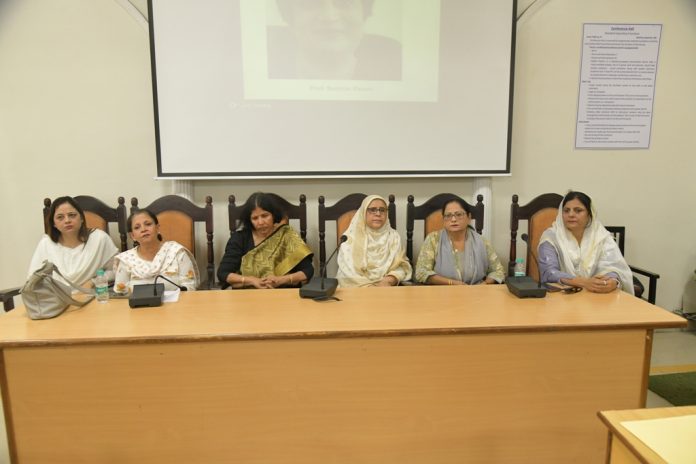
Prof Naima Khatoon, Dr Hamida Tariq, Prof Subuhi Khan and others during the condolence meeting of Seemin Hasan
Aligarh :
The Aligarh Muslim University (AMU) community gathered to honor the memory of the late Prof Seemin Hasan, who passed away on May 23.
During a heartfelt condolence meeting organized by the AMU Women’s Club, Vice Chancellor Prof Naima Khatoon paid rich tributes to Prof Hasan, reminiscing about their days together in Abdullah Hall. She prayed for Prof Hasan’s soul to find peace in Jannah and offered solace to her family and friends.
Prof Hasan, a senior faculty member in the Department of English and a valued member of the AMU Women’s Club, was remembered fondly by her colleagues and friends.
Dr. Hameeda Tariq, the founding Patron of the Club, highlighted Prof Hasan’s exceptional abilities as a professional, a friend, and her remarkable culinary skills.
Prof Azarmi Dukh Safavi, former President of the Club and former Dean of the Faculty of Arts, spoke of Prof Hasan’s caring and generous nature. Prof Syeda Nuzhat Zeba, current President of the AMU Women’s Club, praised Prof Hasan’s exemplary character and recounted their long-standing professional and personal relationship.
Prof Subuhi Khan, Secretary of the AMU Women’s Club, expressed the profound sense of loss felt by the community, describing Prof Hasan as a great source of inspiration. Dr. Faiza Abbasi, Director of the UGC MMTTC and founding Joint Secretary of the Club, lauded Prof Hasan as an outstanding English scholar and gracious teacher, emphasizing her role as a diligent role model.
On behalf of the family, Prof Hasan’s son, Dr. Saif, paid rich tributes to his mother and thanked the club members for their support during this difficult time. He mentioned that AMU was integral to her identity and announced the family’s intention to establish an endowment in her name. This endowment will fund commemorative lectures, literary and scholastic events, and quality publications at the university.
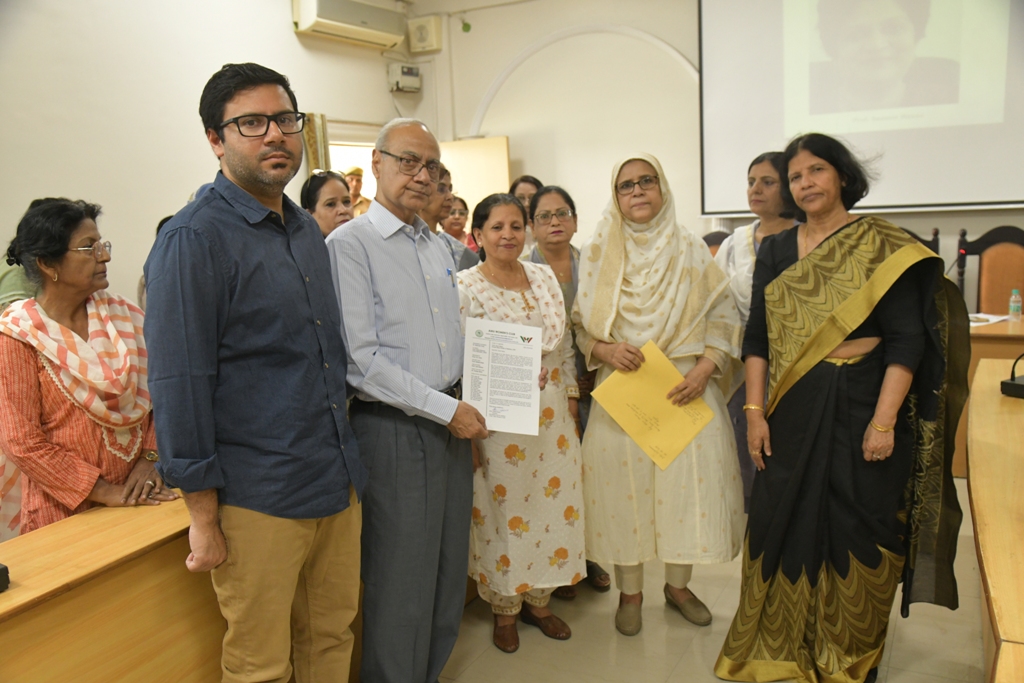
The condolence message was handed over to Prof Abrar Hasan, Prof Seemin Hasan’s husband and former Dean of the Faculty of Medicine, by Vice Chancellor Prof Naima Khatoon, Secretary Prof Subuhi Khan, and other club members.
A two-minute silence was observed in memory of Prof Hasan.
Prof Seemin Hasan is survived by her husband, Prof Abrar Hasan, and her sons, Dr. Saif and Dr. Shabih.
source: http://www.radiancenews.com / Radiance News / Home> Latest News / by Radiance News Bureau / June 10th, 2024
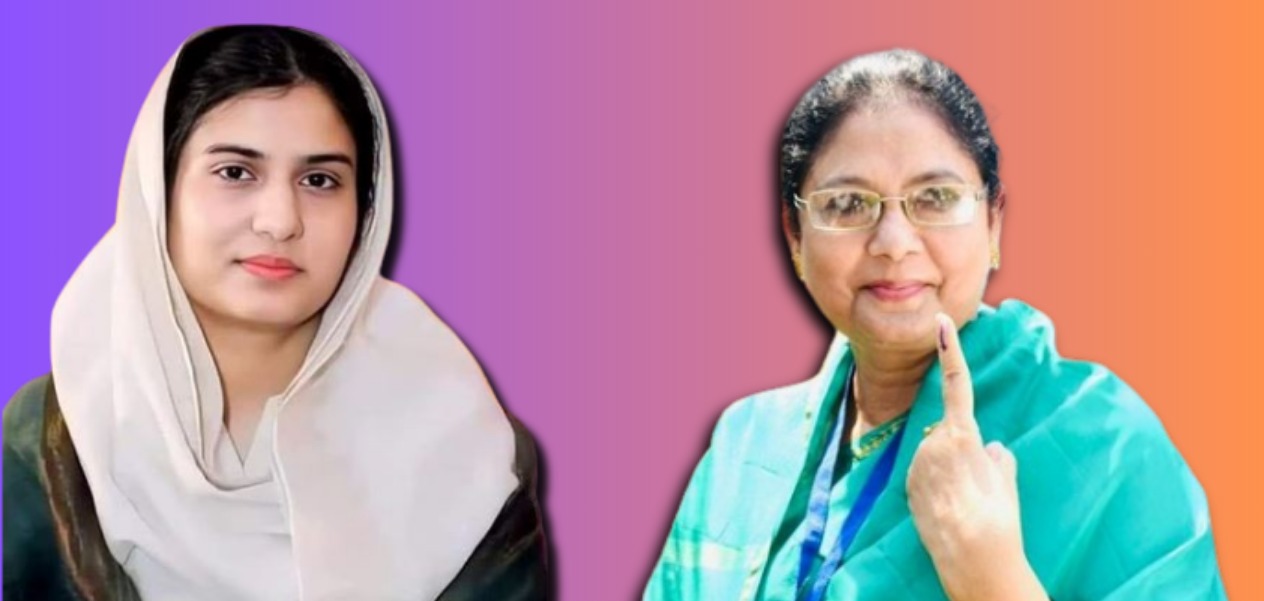
Sajda Ahmed of the Trinamool Congress (TMC) and Iqra Munawwar Hasan Chaudhary of the Samajwadi Party are among the 24 Muslim members who have been elected to the 18th Lok Sabha in the just concluded election.
The entry of 24 Muslims in the Lok Sabha is seen as a positive move towards the participation of India’s second-largest religious community in Parliamentary democracy.
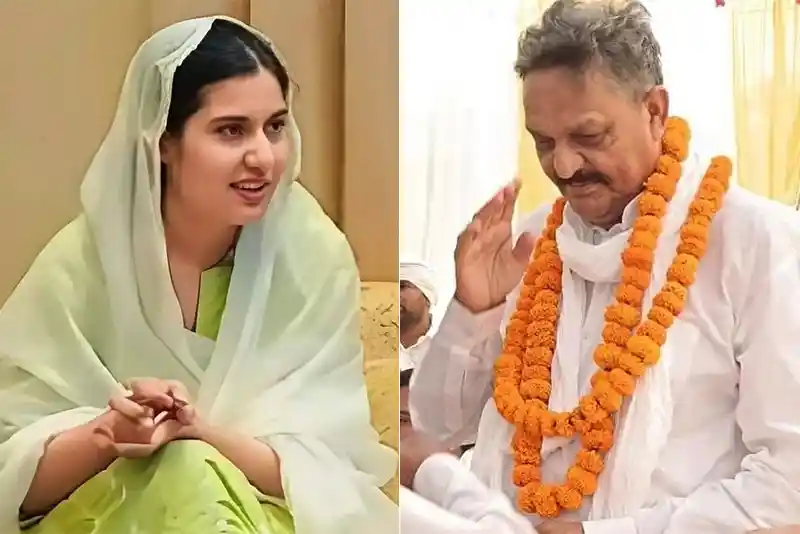
While the 27-year-old year Iqra is a law graduate who won from the Kairana constituency in Western Uttar Pradesh on the ticket of the Samajwadi party Sajda Ahmed is a veteran leader who has won for Lok Sabha election a third time.
Sajda Ahmed has been re-elected from the Uluberia constituency where she secured 694,945 votes and defeated her nearest rival of the BJP Arun Uday Pal Chaudhary.
Iqra, a debutant defeated her nearest rival BJP’s Pradeep Kumar by 69,116 votes in a closely contested election.
Iqra, an alumnus of the Lady Sri Ram College of New Delhi – she also graduated in law from the UK – hails from a political family of Shamli.
The number of Muslims elected to Lok Sabha doesn’t look as low as was feared by the Community. Muslims have been complaining about their diminishing presence in India’s political spectrum.
However, this time political parties had fielded only 78 candidates from the Muslim community as against 115 in the 2019 election.
The most well-known Muslim who successfully contested elections is cricketer Yusuf Pathan. He not only won his maiden political battle as the candidate of the Trinamool Congress (TMC) from the Baharampur constituency of West Bengal, he also turned out to be a giant killer as he defeated Congress veteran Adhir Ranjan Chaudhary.
Muslim leaders like the two former Chief Ministers of Jammu and Kashmir – Mehbooba Mufti and Omar Abdullah – were defeated in their respective constituencies. Omar was defeated by an independent candidate Abdul Rashid Sheikh who is known by his nickname of Engineer Rashid, whose campaign was run in absentia by his two sons.
Engineer Rashid, whose real name is Abdul Rashid Sheikh won the Baramulla seat by securing 4.7 lakh votes against his main rival Omar Abdullah, former Chief Minister and vice-president of the National Conference. He too is a giant killer in this election.
Interestingly, Engineer Rashid’s campaign was carried on by his two sons as he has been in Delhi’s Tihar Jail for five years facing trial for his alleged involvement in supporting terrorists in Kashmir.
In Jammu and Kashmir’s Anantnag-Rajouri seat, National Conference’s Mian Altaf Ahmed defeated Mehbooba Mufti by 2,81,794 votes, and in the Srinagar constituency, NC candidate Aga Syed Ruhullah Mehndi got 3,56,866 votes against PDP’s Wahid Para.
From Ladakh, Independent candidate Mohammad Hanifa won by a margin of 27,862 votes.
In Uttar Pradesh, Samajwadi Party’s Maulana Mohibullah fought the election for the first time and he won on the ticket of the Samajwadi Party from the Rampur seat by securing 4,81,503 votes.
Ziaur Rahman of the Samajwadi Party from Uttar Pradesh has been elected from the Sambhal constituency.
Afzal Ansari has won from the Ghazipur on the ticket of the Samajwadi party. He is the brother of the gangster Mukhtar Ansari who died while serving a sentence for murder in the jail.
Imran Masood of Congress won against his BJP rival Raghav Lakhanpal from Saharanpur.
From Hyderabad (Telangana) Asaduddin Owaisi of the All India Majlis-e-Ittehadul Muslimeen(AIMIM) won against BJP’s K. Madhavi Latha. He has won the Lok Sabha election for the fifth time.
In the 16th Lok Sabha, there were only 22 Muslim Members while the highest number of Muslims elected to the lower house – 49 – was in 1980 and most of them were from Congress. In the last General election 115 Muslim contested while only 22 won.
As against this, in the 2024 elections, only 78 Muslim candidates were fielded and 24 of them won.
West Bengal has elected the highest number of Muslim MPs in the just concluded elections. They are: Khalilur Rahaman, Jangipur, Yusuf Pathan, Baharampur, Abu Taher Khan, Murshidabad, S K Nurul, (Basirhat), Sajda Ahmed, (Uluberia), Isha Khan Choudhary, (Maldaha Dakshin).
Bihar: Muhammad Javed Kishanganj and Tariq Anwar Katihar (Congress)
Assam: Raqib Hussain Dhubri
Kerala: Shafi Parambil (Vadakara), ET Muhammad Basheer (Malappuram) and Dr. MP Abdul Samad Samdani (Ponnani)
Lakshdeep: Muhammad Hamdullah Saeed
Tamil Nadu: Nivas Kinis Ramanathapuram
source: http://www.awazthevoice.in / Awaz, The Voice / Home> Story / posted by Aasha Kosa / June 05th, 2024
Despite the impressive show by the secular parties in the 2024 Parliamentary Elections, number of Muslim MPs in the new Lok Sabha has gone down by 04 as compared to their tally in the last house.
Iqra Hasan and Afzal Ansari – both have won from Uttar Pradesh
LS Election Result 2024:
Lok Sabha 2024 to have 23 Muslim MPs New Delhi: Despite the impressive show by the secular parties in the 2024 Parliamentary Elections, number of Muslim MPs in the new Lok Sabha has gone down by 04 as compared to their tally in the last house.
According to the final result released by the Election Commission of India (ECI), the 18th Lok Sabha will have a total of 23 Muslim MPs from different states of the country.
Of them a maximum 07 are from the Congress Party followed by 05 of the Trinamool Congress Party (TMC), 04 are of the Samajwadi Party (SP), 02 of the Indian Union Muslim League (IUML), 02 of the Jammu Kashmir National Conference, 01 of the All India Majlis e Ittehadul Muslimeen (AIMIM) and 02 Independents.
List of Muslims in 18th Lok Sabha
Congress
Rakibul Hussain Congress Dhubri, Assam
Mohammad Jawed Congress Kishanganj, Bihar
Tariq Anwar Congress Kathiar Bihar
Shafi Parambil Congress Vadakara, Kerala
Imran Masood Cngr Saharanpur, Uttar Pradesh
Isha Khan Choudhury Maldaha Dakshin, West Bengal
Muhammed Hamdullah Sayeed Lakshadweep
Samajwadi Party (SP)
Iqra Choudhary Kairna, Uttar Pradesh
Mohibbullah Rampur, Uttar Pradesh
Zia Ur Rehman Sambhal, Uttar Pradesh
Afzal Ansari Ghazipur, Uttar Pradesh
Trinamool Congress Party (TMC)
Khalilur Rahaman Jangipur, West Bengal
Yusuf Pathan Baharampu, West Bengal
Abu Taher Khan Murshidabad, West Bengal
Sk Nurul Islam Basirhat, West Bengal
Sajda Ahmed Uluberia, West Bengal
Indian Union Muslim League (IUML)
E.T. Mohammed Basheer Malappuram, Kerala
Dr. M.P Abdussamad Samadani, Ponnani, Kerala
Jammu Kashmir National Conference (JKNC)
Aga Syed Ruhullah Mehdi Srinagar, Jammu Kashmir
Mian Altaf Ahmad Anantnag-Rajouri. Jammu Kashmir
All India Majlis e Ittehadul Muslimeen (AIMIM)
Asaduddin Owaisi Hyderabad, Telangana
Independent
Abdul Rashid Sheikh Baramulla, Kashmir
Mohmad Haneefa Ladakh
Prominent losers
Kanwar Danish Ali Amroha, Uttar Pradesh
Badruddin Ajmal Qasmi, Dhubri, Assam
Omar Abdullah, Jammu Kashmir
Mehbooba Mufti, Jammu Kashmir
Imtiaz Jaleel, Aurangabad Maharashtra
Hena Shahab, Siwan, Bihar
Mohd Salim CPI(M) West Bengal
None of the Muslim MPs are from the ruling BJP. The party had fielded Dr Abdul Salam from Malappuram Parliamentary seat in Kerala. He however lost the election to the IUML candidate.
Rakibul Hussain of the Congress won the 2024 Lok Sabha elections by more than 10 lakh votes which is the highest victory margin in India.
The number of Muslim MPs in 2014 was 23. However, Muslims improved their tally in 2019 by 04 despite a huge Modi wave.
LS Election 2024 Final Result
The Election Commission of India announced the final result late in the night Tuesday. According to which, the BJP led NDA alliance has won a total of 292 seats which include a total of 240 seats won by the BJP.
According to the ECI final data, the Congress led INDIA alliance has won a total of 234 seats which include 99 seats won by the Congress, 37 won by SP, 29 won by TMC and 22 won by DMK Tamil Nadu.
source: http://www.ummid.com / Ummid.com / Home / by Ummid.com News Network / June 05th, 2024
Bengaluru, KARNATAKA / New York, U.S.A / Mumbai, MAHARASHTRA :
Rummana Hussain’s conceptual artistic imprint on the state of India is relevant now more than ever. Dealing in the currency of feminist expression, postcolonial thought and perennial ideas, Rummana’s India is both doubly colourful and doubly dark.
In an inaugural show in its new West Village location, New York’s Institute of Arab and Islamic Art presents The Tomb of Begum Hazrat Mahal an exhibition encapsulating Rummana Hussain’s artistic ruminations about the space our bodies occupy in present and past through one of India’s most prominent Muslim woman.
Bangalore-born Rummana Hussain (1952-1999) was a pioneer in conceptual and performance-based political art in India during the 1980s and 1990s.
She was part of the Sahmat collective, a platform for liberal, secular engagés multidisciplinary artists including Safdar Hashmi, Bharti Kher, and Manjeet Bawa among others.
In this recreation of The Tomb of Begum Hazrat Mahal (1997), the respectful visitor enters a one-room shrine.
“In seeing The Tomb of Begum Hazrat Mahal today, I remembered Hussain’s bold feminist reclamation of her Muslim body through the reincarnated aura of Begum Hazrat Mahal to question monolithic identity, national narratives, and systemic marginalisation”
Various objects signify a site of lamentation, pride, and remembrance.
On the floor, occupying a central location, 12 votive-like papaya halves sit atop a mattress of uncooked rice, evoking both an altar to womanhood and fertility, and a symbolic funerary pyre.
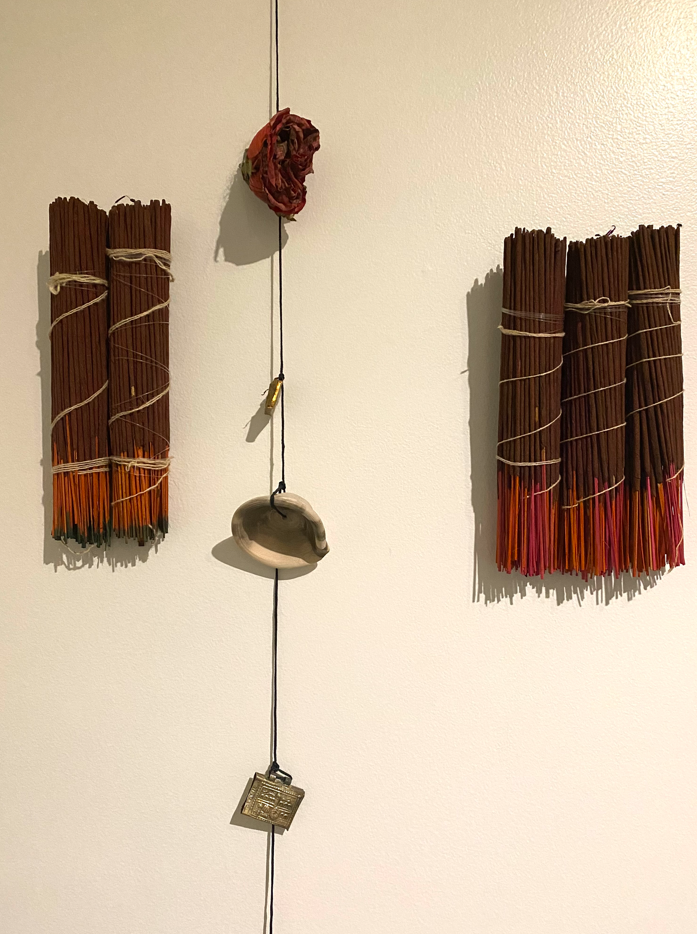
In front of them stands an installation of offerings comprising amulets, dried roses, shells, and incense sticks, tied in a rope.
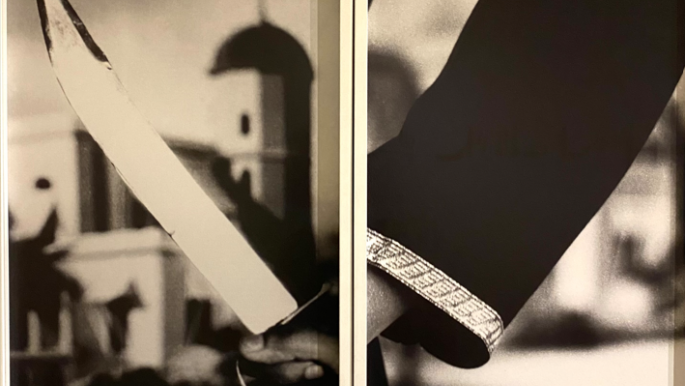
Against the three other walls is a calligraphic sculpture from rusty metal that reminds of a sacred spell and the embodiment of time, and an image frieze of detailed black and white triumphant photographs showing a woman’s arms, wrists, and hands.
In one of these frames, a woman raises her fist up as if calling others to join in. In another, she holds an ominous knife. Images of flames are interjected between the simulacra of archives.
The room is devoted to a woman, an invisible physical body which radiates from each of the static objects. Begum Hazrat Mahal (1820-1879), née Muhammadi Khanum, was born into a poor family.
She was sold and entered the royal harem of art-loving Wajid Ali Shah, the last king of Awadh, a kingdom that occupied the area of the present-day northern Indian state of Uttar Pradesh. Trained as a harem attendant, she would eventually rise to become the king’s concubine – one of his favourites. Beyond her charms, Begum Hazrat Mahal owes her entrance on the historical stage foremost to her political prowess and courage.
The British-owned East India Company operated in Awadh since the early 19th century. The Company increased its grip in 1856, when it directly seized control of Awadh, citing poor governance and the need to uphold the rule of law to justify their annexation (an excuse known as the “Doctrine of Lapse”).
A Chief Commissioner was rapidly appointed. This caused the king to leave Lucknow and seek refuge in Calcutta. The Queen Mother of Awadh petitioned Queen Victoria in person for her son’s rights, in vain. Wives, including Begum Hazrat Mahal were left behind in occupied Lucknow.
After this brutal annexation, discontent grew in several parts of India against the British and the interference of the Company, culminating in a mutiny and revolt in May 1857. Rebels looked to Awadh’s Crown Prince as a successor to his absent father when they captured Lucknow.
But Birjis Qadr, the son of Begum Hazrat Mahal and Wajid Ali Shah, was still a child then, too young to assume power. In his stead, Begum Hazrat Mahal took over Awadh’s revolutionary affairs, actively leading the armed revolt during her regency, towards the reinstatement of Indian rule over Awadh in July 1857.
She continued resisting British rule well after the retaking of Awadh by the occupying troops in 1858, as she refused various offers of collaboration. She died in exile in Kathmandu, Nepal, as an unwavering freedom fighter. Today, a humble stele near Kathmandu’s Jama Masjid marks her tomb.
Rummana Hussain, Living on the Margins, 1995, performance at the National Centre for Performing Arts, Mumbai
When Rummana Hussain first showed The Tomb of Begum Hazrat Mahal to the public in 1997, it was during a period marked by the tragic aftermath of inter-communal violence.
During the 1980s, radical Hindu nationalists campaigned to build a temple on the site believed to be the birthplace of Rama, where a mosque had been erected since the 16th century.
They took to the streets of Ayodhya, Uttar Pradesh, en masse in 1992. Security lost control of the crowd which eventually stormed into the site, demolishing the mosque.
This ignited weeks of violent clashes between Hindu and Muslim communities, causing the deaths of thousands. A later investigation on the destruction of Babri Masjid in Ayodhya pointed out the responsibility of leaders and supporters of the right-wing Bharatiya Janata Party (BJP), the political party of India’s incumbent Prime Minister, Narendra Modi.
Babri Masjid launched a turning point in Hussain’s artistic journey towards a more intimate, politically-conscious form of expression. In Dissected Projection (1993), she explored the multilayered meaning of ruins and dislocation through an allegorical work that exposes a fracture, a shattered piece of terracotta.
In her show Multiples and Fragments (1994), Hussain engaged with historical and domestic oppression in an installation of pigmented pieces of fabric on a clothesline, to denounce the colonial extraction of indigo in India and unpaid housework traditionally performed by women and girls. Labour is always physical and violence first hurts the most vulnerable.
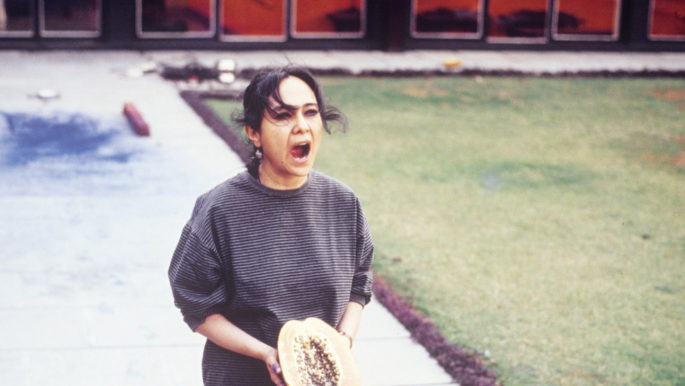
In her 1995 performance Living on the Margins, Hussain screamed while holding papaya halves, shapes that represent a universal vessel and the female anatomy.
Her works have been exhibited in the India Pavilion of the Venice Biennale in 2019, and in multiple institutions across India, Canada, Australia, Mexico, the United Kingdom and the United States during her lifetime and posthumously.
In seeing The Tomb of Begum Hazrat Mahal today, I remembered Hussain’s bold feminist reclamation of her Muslim body through the reincarnated aura of Begum Hazrat Mahal to question monolithic identity, national narratives, and systemic marginalisation. She wanted to say, we can turn the hate in love, we can turn the oppressed, the victims, into heroes they will one day celebrate. We can tell our own stories. They matter.
Outside, scores of brunch-goers live, love, laugh. If it’s dissonance we are meant to acknowledge, I acknowledge it. I closed my eyes in the silent white cube of the Institute of Arab and Islamic Art and saw images of the relentless violence and bullying Muslim women continue to face in Narendra Modi’s India.
In this reconstituted tomb, it’s hard to feel alone. Around me swarmed many other ghosts, of ordinary Muslim women – from Afghanistan to Iran and beyond – crushed and slain in their contemporary defence of freedom and justice against oppressors. Many have been killed in their fight.
A shrine calls for a quiet prayer, I realised.
Farah Abdessamad is a New York City-based essayist/critic, from France and Tunisia.
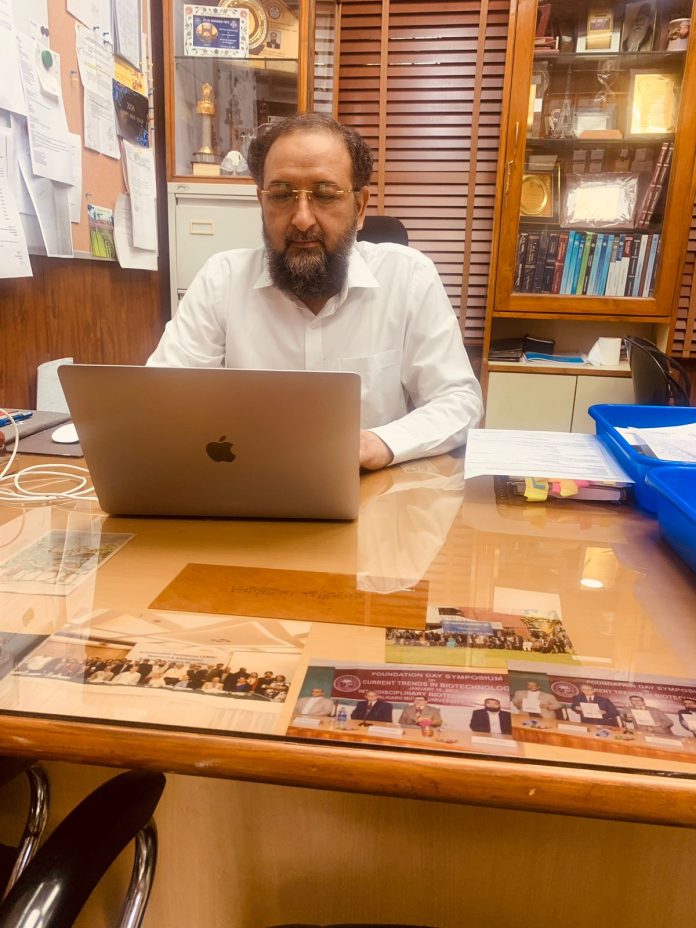
Prof Asad U Khan, from the Interdisciplinary Biotechnology Unit at Aligarh Muslim University, has achieved a significant milestone in the realm of Microbiology, securing the 39th position globally, according to ScholarGPS, the world’s foremost scholarly analytics platform. This platform utilizes advanced computational techniques such as data mining, artificial intelligence, and statistical analysis to evaluate scholarly impact comprehensively.
Named as an “Inaugural Highly Ranked Scholar,” Prof Khan joins an elite group of scholars, with only three Indian researchers ranking in the top 0.05% globally in Microbiology. His recognition among 67 scholars worldwide underscores his exceptional contributions to the field.
Expressing his elation, Prof Khan shared, “I was truly thrilled to discover my global standing. Being passionate about research and dedicating two decades to antimicrobial studies, this recognition surpasses my expectations.” He expressed gratitude to his family, mentors, and supporters for their encouragement throughout his journey.
Highly Ranked Scholars like Prof Khan are distinguished by both productivity (number of publications) and impact (citations), as well as the quality of their work (h-index). ScholarGPS’s extensive database, comprising over 30 million scholar profiles and 200 million scholarly publications, enables precise identification of scholars within specific specialties, disciplines, and fields.
Prof Khan’s accolades extend beyond this recent recognition, with previous honors from national and international scientific bodies, including the Ministry of Science and Technology, Government of India, acknowledging his outstanding contributions to combating Antimicrobial Resistance.
In summary, Prof Asad U Khan’s global ranking in Microbiology signifies not only his individual achievement but also highlights the excellence of research conducted at Aligarh Muslim University, reaffirming India’s presence on the global scientific stage.
source: http://www.radiancenews.com / Radiance News / Home> Pride of the Nation> Markers of Excellence / by Radiance News Bureau / May 09th, 2024
Saria Khan of Lucknow has become the second topper in the International Council for Schools Certification (ICSC) Board.
Saria Khan’s family lives in the middle-class neighborhood of Daliganj in the city. Her father Rais Khan is a lawyer by profession. She has two brothers senior to her.
After her results were declared, Saria said since she has an interest in Biology, she wants to become a doctor. She says medicine is a profession in which there is an opportunity to help others.
She said she is determined to become a doctor since her teachers have taught her not to have options in life. Options will not allow one to focus on the goal. Her parents and brothers have been supportive of her dreams and kept encouraging her to continue her focus. Saria says that she left no stone unturned in preparing for the board examination. She used to study for seven to eight hours after school.
The ICSE board released the 10th standard results with 99.97 percent clearing it. The result for the girl students was 99.98 percent and for boys 99.97 percent.
There are four toppers of the exam: Hargun Kaur Matharu from Pune, Anika Gupta from Kanpur, Pushkar Tripathi from Balrampur, and Kanishka Mittal from Lucknow – with 499 marks (99.80%).
Saria says there is only one mantra for success in life -focus on your goal. While doing other work never forget the target. To become a topper, she studied hard and diligently.
“I could see my goal and stay focused by adopting different strategies. Today, I am very happy that I have reached the first step toward fulfilling the dreams of my parents. But the destination is still far away, and I have to work for it.
Saria and her family have been busy receiving the congratulatory message on phone and receiving guests who are dropping in to meet her.
“I will never forget this moment, the way the people of the country are showering love on me. I am even exhausted from attending to the phone, but I am attending to each call and visitor. A total of 110 students are included in the list of top three rank holders for the ICSE board 10th examination. In which there is a difference of one point each between the three ranks.
While four candidates secured the top rank with 499 marks out of 500, 34 students including Saria stood second with 498 marks. Similarly, 72 candidates secured the third rank with 497 marks out of 500.
The Council for the Indian School Certificate Examinations announced a merit list after two years. The results were declared based on an alternate evaluation scheme after the examination was not conducted due to the COVID-19 pandemic. The overall pass percentage is 99.97, the officials said.
source: http://www.awazthevoice.in / Awaz, The Voice / Home> Story / by Tajo Khan, Lucknow / July 18th, 2022
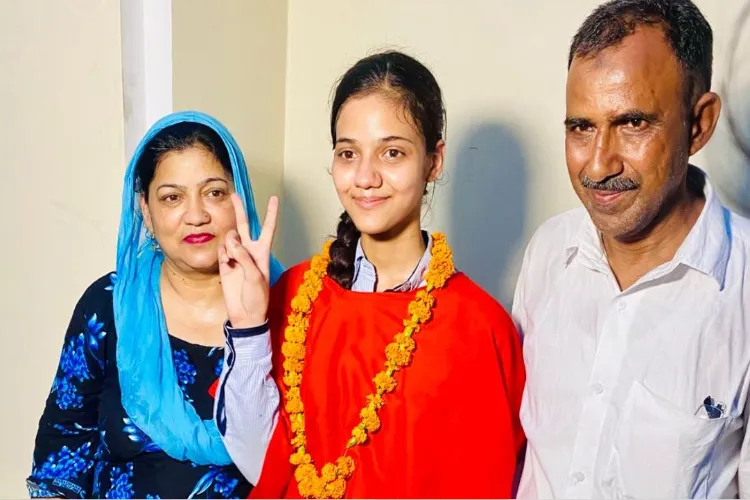
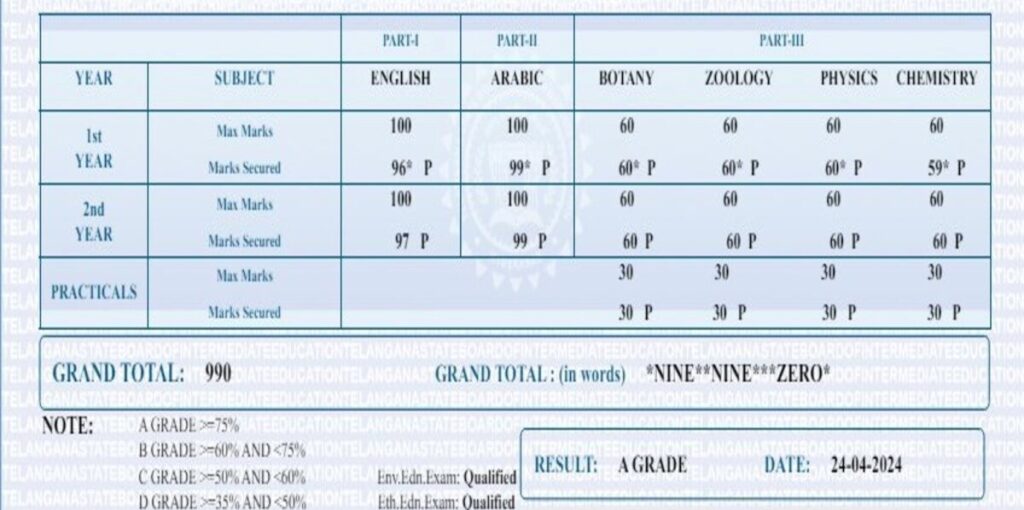
A Hyderabad girl, Ayesha Sultana, has emerged as one of the Telangana inter toppers. She scored 99 percent.
Out of 1000 marks in all subjects in the first and second years of intermediate, she scored 990.
How did the Hyderabad girl become one of Telangana inter toppers?
A student of St. Joseph’s Junior College in Hyderabad, Ayesha Sultana became one of the Telangana inter topper after scoring 100 percent marks in botany, zoology, and physics.
In chemistry, she scored 59 out of 60 marks in the first year, whereas in the second year, she scored 100 percent in the subject.
It was in the languages, English and Arabic, where she lost nine marks.
Telangana intermediate results
Today, the Telangana State Board of Intermediate Education (TSBIE) announced the much-awaited results for the first and second years of intermediate.
The pass percentage for the first year is reported at 60.01 percent, while for the second year, it stands at 64.19 percent. Notably, female students have outperformed their male counterparts in both the first and second year exams.
The incredible achievements of the Hyderabad girl Ayesha Sultana, one of the Telangana inter toppers, inspire all students.
According to officials, the Inter Advanced Supplementary Examinations will start from May 24 to June 1. The TSBIE has released the schedule to this extent. First year exams will be held from 9 AM to 12 PM, and the second year exams will be held from 2 PM to 5 PM.
The examination fee for the supplementary examinations will be collected from April 25 to May 2 in the respective colleges. Fees for recounting and reverification also have to be paid online at the same time.
source: http://www.siasat.com / The Siasat Daily / Home> Top Stories / by Sameer Khan / April 25th, 2022
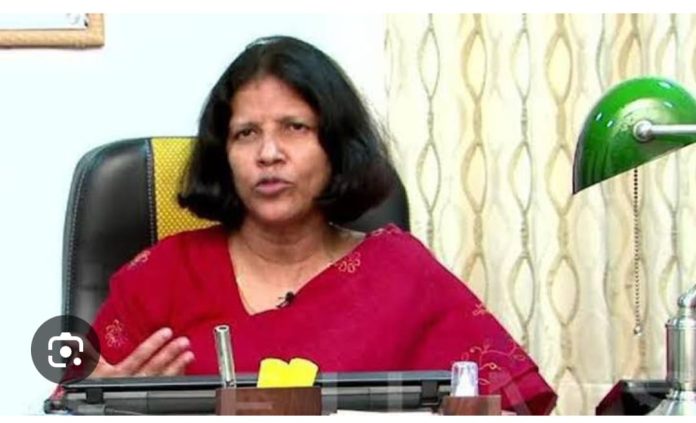
The President of India, Droupadi Murmu has appointed Prof Naima Gulrez new Vice Chancellor of Aligarh Muslim University (AMU) out of three names sent to the visitor (President of India) by the AMU court.
Prof. Naima Gulrez, who served as Professor and Chairperson of the Department of Psychology before joining as Principal, Women’s College in July 2014, also taught at the National University of Rwanda, Central Africa. A PhD in Political Psychology, she worked at Centre for the Study of Developing Societies, Delhi, and served as Deputy Coordinator of UGC assisted Special Assistance Program on Spiritual Psychology in the Department of Psychology, AMU.
She has authored, co-authored and edited six books and published many papers in journals of national and international repute. She has supervised 15 Ph.D. theses and a large number of dissertations. Her area of specialization is in the field of Clinical, Health, Applied Social and Spiritual Psychology.
Apart from academics, Prof. Naima Khatoon has vast experience in Educational Administration. She served as Provost in Indira Gandhi Hall and twice in Abdullah Hall. She also served as Deputy Director, Residential Coaching Academy and Deputy Proctor of AMU. She was elected twice to the Women’s College Student Union. She also worked as Literary Secretary and Senior Hall Monitor of both Abdullah Hall and Sarojini Naidu Hall. She was awarded the Papa Mian Padma Bhushan Best Girl Award for all-around excellence.
source: http://www.radiancenews.com / Radiance News / Home> Latest News / by Radiance News Bureau / April 22nd, 2024