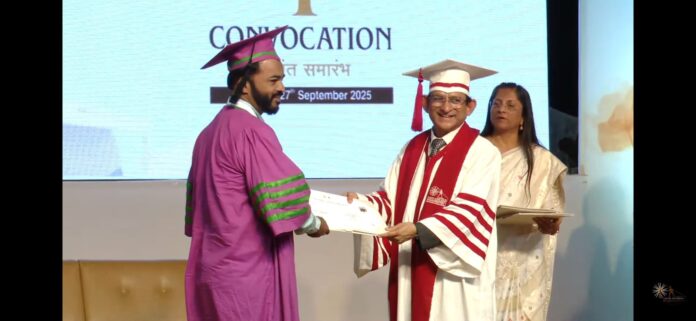
Bomb Blast Acquit Turned Advocate Abdul Wahid Shaikh Awarded PhD at MGM University, Aurangabad
Advocate Abdul Wahid Shaikh, noted lawyer, prison rights activist, and the first person person acquitted in the 2006 Mumbai train blast case, was conferred with a Doctor of Philosophy (PhD) degree at MGM University, Aurangabad. The degree was presented by Vice Chancellor Prof. Dr. Vilas Sakpal during a formal convocation ceremony.
Dr. Shaikh’s doctoral research, titled “Prison Literature: Post-Independence”, brings focus to the writings emerging from Indian prisons, highlighting voices of resistance, resilience, and injustice. His work underscores how incarcerated individuals have shaped Urdu literature and contributed to broader narratives of social justice in post-independence India.
Speaking on the occasion, Dr. Shaikh said:“This PhD is not just an academic milestone, but a continuation of my struggle for prison justice. Prison literature is the voice of the silenced, the testimony of those behind bars, and a mirror to our society’s conscience.”
As General Secretary of the Innocence Network, Dr. Shaikh has long campaigned for the release of wrongfully imprisoned individuals and advocated for humane prison reforms. His latest academic achievement strengthens his commitment to legal activism and adds a scholarly dimension to his work.
Faculty members, scholars, students, and well-wishers attended the convocation, applauding Dr. Shaikh’s perseverance and his contribution at the crossroads of academia, activism, and law.
His achievement is a landmark—demonstrating how an exoneree can turn personal suffering into intellectual strength and contribute meaningfully to the pursuit of justice and the rights of the incarcerated.
source: http://www.muslimmirror.com / Muslim Mirror / Home> Positive Story / by Muslim Mirror Special Correspondent / September 29th, 2025
Women’s education in nineteenth-century India was no easy task. In the case of Muslim women, the task was even more difficult due to their triply marginal identity: as colonial subjects, as women, and as Muslims. Not only did the custom of purdah added to their seclusion from the social and cultural changes, their men hated everything about the western cultural influence (being displaced as rulers by the British). As a result, the middle class (the initiators of reform) was to develop late among the Indian Muslims than their Hindu counterparts. Nevertheless, by the late nineteenth century, a middle-class among the Indian Muslims was fledging. For this, no institution of the nineteenth-century can be given more commendation than Aligarh Muslim University.
Formed in 1920, the Aligarh Muslim University just completed its hundred years as a modern residential university. There has been a perception that the Aligarh Movement, for whatever reasons, neglected the issue of modern education to Muslim women. But there is more to this argument, some things to be explored, some to be re-interpreted.
This article, therefore, attempts to trace the genesis and trajectory of women’s educational reform in Aligarh through the profile of a woman reformer – Waheed Jahan (1886-1939), wife of Shaikh Abdullah (1874-1965), and the co-founder of Aligarh’s first girls’ school. Waheed Jahan was a pioneer of Muslim women’s education at Aligarh in the early twentieth century. Her role in ending the relative isolation of Indian Muslim women, while at the same time preserving the Muslim identity of the community, is worthwhile to recall. Her biography was published in Urdu by her husband in 1954. [1]
The educational reforms among Indian women were mostly started by men. Such men started with writings advocating women’s education. In this regard, among Muslims, Nazir Ahmad (1833-1912) published his novel, Mirat-ul-Arus, in 1869; Altaf Hussain Hali (1837-1914) published Majlis-un-Nissa, in 1874. Soon, magazines and journals followed, like the Tahzib un-Niswan by Sayyid Mumtaz Ali (1860-1935), the Khatoon by Shaikh Abdullah and Waheed Jahan, and the Ismat by Rashid-ul- Khairi (1868-1936). Gail Minault regards these as ’The Big Three.’ [2] Apart from literary activism, others tried more practical measures, like opening schools for Muslim girls.
As the movement intensified, so did the opposition against it. In such an atmosphere, even the talk of women’s education by a woman herself was quite a chivalry.
Yet, unexpectedly, there were women who defied the odds and broke the ground. Rashid-un-Nissa of Patna, became the first Muslim woman to write an Urdu novel, Islah-un-Nissa in 1881 (published in 1894), when writing was a distant dream for Muslim women. Rokeya Sakhawat Husain (1880-1932), a widow herself, pioneered Muslim women’s education in Bengal. Muhammadi Begam (1878-1908) edited one of the leading ladies’ home journals, Tahzib-un-Niswan. One such icon of women’s education at Aligarh was Waheed Jahan.
Waheed was born in 1874 in a landholding family in Delhi. Her father Mirza Ibrahim Beg was of Mughal ancestry, serving as a minor municipal official in Delhi. Her only brother, Bashir Mirza went to the Mohammadan Anglo-Oriental College (MAO Colege), Aligarh, where he befriended Shaikh Abdulla (a Kashmiri convert to Islam, named Thakur Das before conversion).
As was the custom, Waheed received no formal schooling. She learnt Urdu and Persian from her father and arithmetic and elementary English from a visiting English tutoress.
Ismat Chughtai, in her autobiography, Kagazi hai Pairahan, records, how Waheed Jahan, before her marriage, had dreamt of establishing a school for the girls. She would gather the servants’ children and teach them, and soon the rudimentary school became popular among her neighbours. It is noteworthy that, at a time when others (mostly men) were still imagining a school for girls (that too only in their writings), Waheed, in her own limited capacity, was practically making a difference.
In 1902, Waheed married Shaikh Abdullah – a lawyer at Aligarh, and an ardent supporter of women’s education since his school days. Following the marriage to a woman with some education, he began to consider concrete ways to promote Muslim women’s education. The Mohammadan Education Conference (MEC, founded at Aligarh by Sir Syed Ahmad in 1886) had established a Women’s Education Section (WES) in 1896 to start a Normal School for girls and to train female (zenana) teachers. In 1902, Shaikh became the secretary of WES, which by then had merely achieved anything beyond discussions and debates around women’s education.
Luckily, Waheed’s marriage to a reformist like Abdullah helped her materialize her dream. To champion women’s education, they started an Urdu monthly, the Khatoon, in 1904 with Waheed Jahan as editor. Begum Sultan Jahan (1858-1930) of Bhopal, Binnat Nazir-al-Baqir, Suharwardiya Begum, and Binnat Nasiruddin Haider were some important female contributors to the journal.
The paucity of funds made it impossible to start a Normal School. Waheed Jahan advised her husband to start a primary school for the elite (Sharif) girls. In 1904, the Mohammadan Educational Conference passed a resolution to start a girls’ school in Aligarh. Waheed proved to be an efficient manager and fund-raiser for the cause.
Her capacities as a fund-raiser and organizer were displayed in 1905, when she organized a meeting of Muslim women in Aligarh, with participants from far corners of Lahore and Bombay. Judging from the context of the time when purdah among Muslims was so harsh, even the idea of organizing such an event was quite revolutionary.
Aware of women education in Turkey and Egypt and its benefits to society, she tried to convince other women; she said:
When women meet among themselves, there will be more solidarity. . . Now there is a division between educated and uneducated women. Uneducated women, who do not go out, think that respectability is confined to the four walls of their houses. They think that people who live beyond those walls are not respectable and not worthy of meeting. But God has ordained education for both men and women, so that such useless ideas can be dispensed with. . . [3]
The meeting was a success, the exhibition of women’s craft secured good funds; finally, the women passed a resolution favouring a girls’ school in Aligarh. In October 1906, Aligarh Zenana Madrasa (girls’ school) opened its doors, and seventeen students were enrolled. Urdu, arithmetic, needlework, and the Quran formed the curriculum. Leaving her own children in servants’ care, Waheed took the responsibility of supervising the school. Within six months, the number of students increased to fifty-six. Waheed’s efforts secured the school a cumulative grant of Rs. 15,000 and a monthly grant of Rs. 250. By 1909, the school taught 100 students and shifted to a larger building.
The opposition to girls’ school took new forms. One amusing story is recorded in Shaikh Abdullah’s Urdu memoir (1969), Mushahedaat o Taaassuraat. [4] Maintaining purdah, the girls were carried in daulis (curtained carriages) to school, and some street urchins started harassing the school going girls by lifting the curtains of their daulis. The mischief only stopped when Shaikh gave one of the miscreants a good thrashing. In another incident, Shaikh confronted a tehsildar who had accused the school of making the girls insolent.
When the Abdullahs proposed a girls’ boarding school, it invited opposition from elite corners. The European principal of MAO College, W.A.J Archbold; Ziauddun Ahmad (1873-1947); and Viqar-ul-Mulk (1841-1917) opposed vehemently.
The couple, however, succeeded in 1914, witnessing the transformation of the school into a boarding school. The same year saw the culmination of Muslim women’s activism by the foundation of Anjuman-i-Khavatin-i-Islam (AKI) at the same venue. Begum Sultan Jahan (1858-1930) of Bhopal graced the foundational ceremony of the boarding school, felicitating Waheed; she urged other women to follow her example. Fyzee sisters, Abru Begum, Begum Shafi, and Begum Shah Nawaz were the other dignitaries.
The Begum was already active in various social and educational reform projects. She served as the first chancellor of AMU from 1920 until her death in 1930. Having a woman as the first chancellor was indeed a historic feat.
Only nine girls became the residents, most of them from Waheed’s own family. By the end of the year, the enrollment rose up to twenty-five. This was the result of what the historian Gail Minault calls as Abdullahs’ portrayal of girls’ school as an extension of girls’ families and also of their own. To make the school successful, Waheed used to invite the parents of girls to Aligarh, for a few days stay in the hostel, to convince them that the conditions there were safe enough to let their daughters stay, records Sheikh Abdullah, in his Mushahedaat o Taaassuraat. She supervised everything – housekeeping, laundry, shopping, and even tasted each dish cooked for the girls.
It could be said that Waheed Jahan acted as a foster mother to these girls, counselling, nursing, and treating them as a part of her own extended family. They called each other as Apa (sister), Shaikh Abdullah as Papa Mian, and Waheed Jahan as Ala Bi. This created a sense of sisterhood among the girls.
This familial system of ethos still remains unique to the Aligarh Women’s College.
The boarding school project contained other complex problems, such as maintaining proper purdah. Both Shaikh and Waheed agreed that the purdah practiced in the Sharif society was more restrictive than purdah sanctioned by the Shari’a (Islamic Law). But to secure social acceptance for their school, they chose to go with strict purdah, building fortress-like walls to fend off the male gaze, students’ mails were scrutinized, and only close relatives were allowed inside.
This accommodation of purdah within the gamut of their reformist agenda, to gain social acceptance, was indeed very astute of the Abdullahs. Thus, Waheed Jahan succeeded in preserving both the elite and the “Muslim” identity of herself and her community while simultaneously breaking the relative isolation of Indian Muslim women. The girls’ school became an intermediate college in 1925 and started degree classes in 1937 (with 250 students). Waheed passed away in 1939, only after seeing her school becoming a degree college.
The relation between education and social change is complex, varying from culture to culture and among different classes in the same culture.
True, that Aligarh movement was late to include women’s education in its fold. Even the school founded by the Abdullahs did not fulfil all its expectations – their choosing an exclusively elite (Sharif) clientele limited the impact of their reforms.
But their efforts indeed bore fruits; the educational reforms for Muslim women at Aligarh contributed to many social developments. After the formation of AKI in 1914, the number of meetings and associations (for women-only) increased rapidly in the 1930’s. The growth in the number of educated women created a market for new publications for and by women.
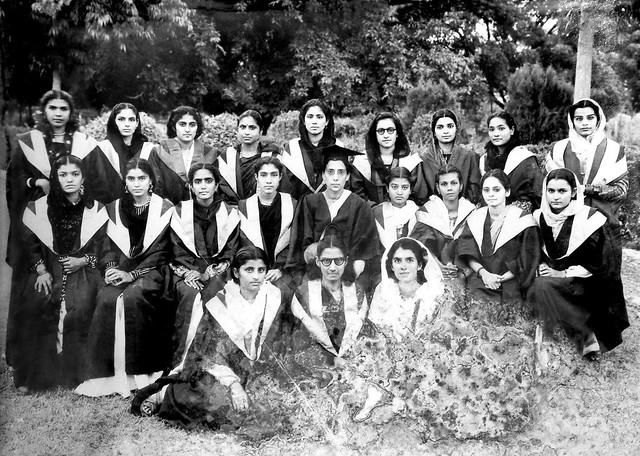
The Aligarh Women’s College produced many women of substance, who made sure to shine above and beyond purdah, some figuratively and others literally. These ladies excelled in various fields, from teaching to medicine to writing.
Rashid Jahan, Waheed Jahan’s daughter, became a successful physician, a radical writer, and a staunch communist. Her short stories in Angare (1932) became the opening salvo of the Urdu Progressive Writers Movement (1936). Rakhshanda Jalil, in her biographical work on Rashid, A Rebel and her Cause: The Life and Work of Rashid Jahan, writes that Angare was a “document of disquiet”; a self-conscious attempt “to shock people out of their inertia, to show how hypocrisy and sexual oppression had so crept in everyday life”. Rashid became an inspiration for a generation of women writers such as Ismat Chughtai, Attia Hosain, Sadia Begum Sohravi, and Razia Sajjad Zaheer, among others.
Like all other reform movements of that time period, the Aligarh movement had its limitations too. For a start, it did prioritize men’s education over women’s, for various reasons (a story that needs to be told elsewhere), but by the early twentieth century, things were changing. The Aligarh movement not only took up the cause of women’s education actively, but it also let women (Like Wahid Jahan) be a part of the process.
Notes
[1] Shaikh Abdullah, Savanih-i- Umri-i- Abdullah Begum, Aligarh, 1954
[2] Gail Minault, Gender, Language, and Learning: Essays in Indo-Muslim Cultural History, Permanent Black Publications, Ranikhet, 2009, p. 87
(Ishrat Mushtaq is PhD Candidate, Centre of Advanced Study in History, Aligarh Muslim University and Sajad Hassan Khan is PhD. Candidate, Centre of Advanced Study in History, Aligarh Muslim University. Article courtesy: Mainstream Weekly.)
Janata Weekly does not necessarily adhere to all of the views conveyed in articles republished by it. Our goal is to share a variety of democratic socialist perspectives that we think our readers will find interesting or useful. —Eds.
source: http://www.janataweekly.org / Janata Weekly / Home / by Ishrat Mushtaq and Saad Hassan Khan / January 24th, 2021
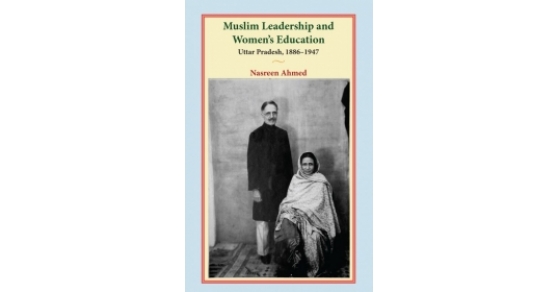
By Nasreen Ahmed / First Edition Pub. October 2012, x+190 pages, 8.5 x 5.5 in. / ISBNs: 978-81-88789-82-5
This is a broad study of the efforts at modern education for Muslim women, especially with reference to the Aligarh Movement and the initiatives inspired by it in other parts of UP, namely Lucknow, Allahabad, Rampur and Agra. The role of Muslim leaders, both male and female, the nature of the problems they encountered and the manner in which they countered them is the major thrust of this study. In the process we are introduced to the major debates on women and education during the course of late nineteenth and the first half of the twentieth century.
The author breaks many stereotypes as we learn that it was the more traditional among the Muslim leadership, rather than the ‘modernisers’, who pioneered women’s education and that Muslim women themselves played a major role in nurturing the first institutions under their personal care.
Based on an extensive range of primary sources and contemporary writings in English, Urdu, Hindi and Persian, this is a definitive work in many ways, gives food for thought on developments other than its main theme and will be useful to those concerned with women’s studies, social reform, education and modernity in colonial India, particularly with reference to Muslims.
CONTENTS
Muslim Women’s Education in the Nineteenth Century: A Study of the Traditionalist Attitudes
Efforts for the Education of Muslim Women, 1857-1885
Aligarh Movement and Muslim Women’s Education, 1875-1902
Female Education Section: Early Discussions, 1896-1904
A School for Muslim Girls at Aligarh
From Female Normal School to Muhammadan Girls’ School, 1906-1910
A Degree College Managed by the University
Establishment of Schools by Other Indigenous Efforts: Lucknow, Allahabad, Rampur and Agra.
Cover photo: Papa Mian (Sheikh Abdullah, 1864-1965) and Waheed Jahan Begum (1884-1939), founders of the first school for Muslim girls in Aligarh. Back cover: Carriage used to bring girls to school, accompanied by a female escort. (1923)
Nasreen Ahmed
Nasreen Ahmed (1954-2009) studied at the Aligarh Muslim University and later taught at the Karamat Husain College, Lucknow.
She is a pioneer among historians on concerns of Muslim women’s education, as her early essays on the theme published in the late 1970s show. Thereafter she presented her work at various national conferences and seminars. Her studies are rich in sociological data: she records a great deal that feminist scholars writing on Muslim women today have missed. She is author of many research articles published in the Proceedings of the Indian History Congress, a journal of frontier scholarship in history.
source: http://www.threeessays.com / Three Essays Collective
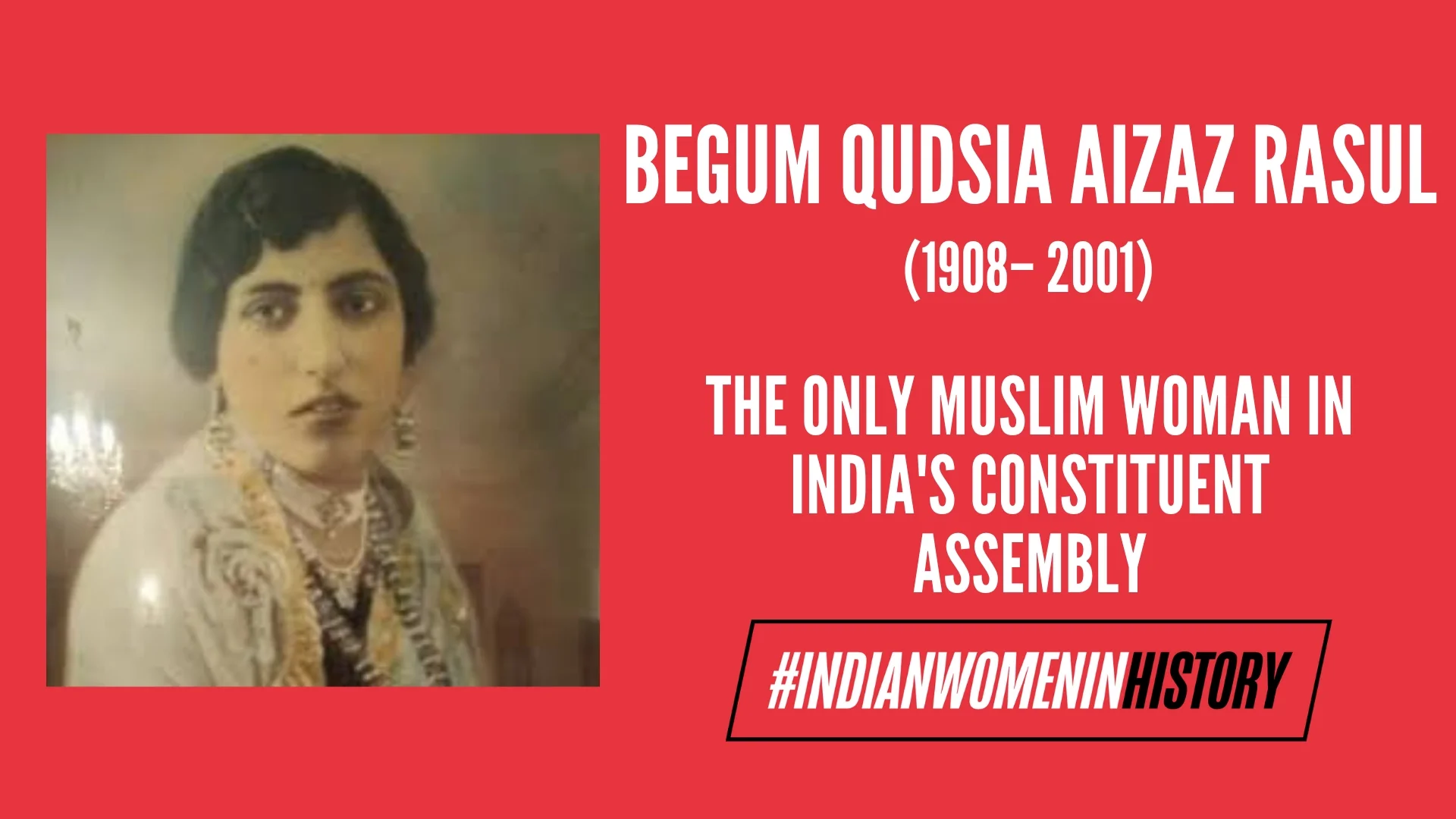
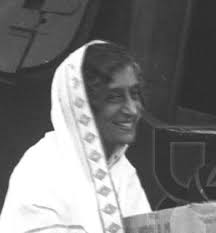
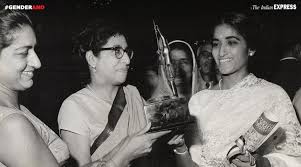
Begum Qudsia Aizaz Rasul was one of the 28 Muslim League members to join the Constituent Assembly of undivided India, and she was the only Muslim woman to be a part of the assembly.
Begum Qudsia Aizaz Rasul was born to the royal family of Malerkotla (situated in erstwhile united Punjab) on 4th April, 1908. Her father was Nawab Zulfiqar Ali Khan. Qudsia had a progressive upbringing and was encouraged from a very early age to lead a modern life, as opposed to several stringent restrictions imposed upon other contemporary Muslim women, such as that of the purdah.
She got married at quite an early age to Nawaab Aizaz Rasul from the erstwhile province of Awadh. Her husband held the position of a taluqdar, or a landowner. Qudsia had political exposure both before and after marriage, and her formal political participation took place after she got married.
Qudsia, along with her husband, joined the Muslim League in mid-1930s, soon after the passing of theGovernment of India Act in 1935. This was also her official entry into electoral politics, as she contested in the elections of 1937 from the U.P. legislative assembly, where she successfully held her seat till 1952. Aizaz was one of the very few female candidates to have contested and won from a non-reserved constituency during the pre-independent times.
“
She was the first Indian woman to achieve such feats, and this was truly commendable and noteworthy at a time when most formal political positions were almost implicitly reserved for men.
“
As an MLA, she also held several important posts, such as the Leader of Opposition (1950 to 1952) and the Deputy President of the Council (1937 to 1940). She was the first Indian woman to achieve such feats, and this was truly commendable and noteworthy at a time when most formal political positions were almost implicitly reserved for men. Moreover, to rise to prominence at a politically significant province such as the U.P. indeed made Qudsia Aizaz Rasul a trailblazer.
She is well known for her progressive, anti-feudal stances, such as the abolition of the zamindari system. Qudsia was a strong advocate for the abolition of communal electorates as well, as she believed it divided the society more than it united – which was counterproductive for the Indian electoral candidates at a time when there was an urgent need of a united Indian front to oppose the colonial rulers. She went on to create a strong and convincing case for the abolition of electoral reservations for religious minorities during her tenure as a member of the Constituent Assembly.
Qudsia was one of the 28 Muslim League members to join the Constituent Assembly of undivided India, and she was the only Muslim woman to be a part of the assembly. Her contributions in the assembly debates remain monumental till date and have been recorded in many official sources.
“
Her contributions in the assembly debates remain monumental till date, and have been recorded in many official sources.
“
After the dissolution of the League, she joined the Indian National Congress, and served as a member of the Rajya Sabha from 1952 to 1958. Later, she became a member of the legislative assembly of Uttar Pradesh from 1969 to 1989.
Other Achievements
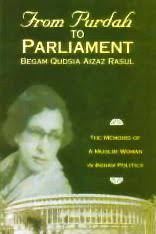
Begum Qudsia Aizaz Rasul is also well known for her autobiography, titled From Purdah to Parliament: A Muslim Woman in Indian Politics. It provides excellent insights into the intersectional aspects of organised politics as it functions in our country. Other than this, she also wrote a travelogue titled Three Weeks in Japan.
Besides her literary prowess, Qudsia had also served as the President of the Indian Women Hockey Federation for over fifteen years, and went on to become the President of the Asian Women’s Hockey Federation.
Begum Qudsia Aizaz Rasul was awarded the Padma Bhushan in 2000 for immense, invaluable contributions to the field of social work.
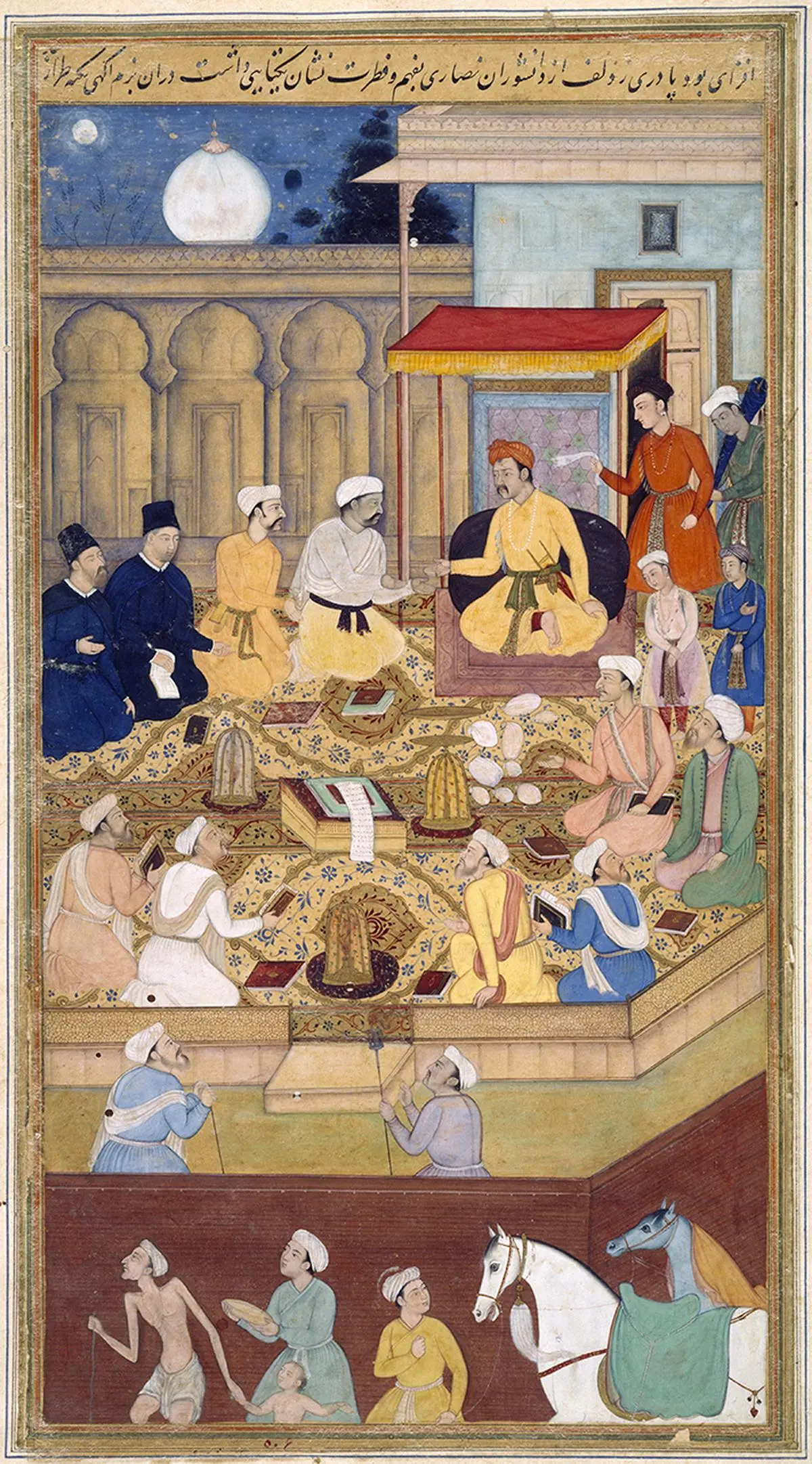
A Mughal painting of Akbar with Jesuits. The Great Mughals are well known in history, but few people are aware of the story of Gujarat’s Sultan Bahadur Shah. | Photo Credit: Getty Images
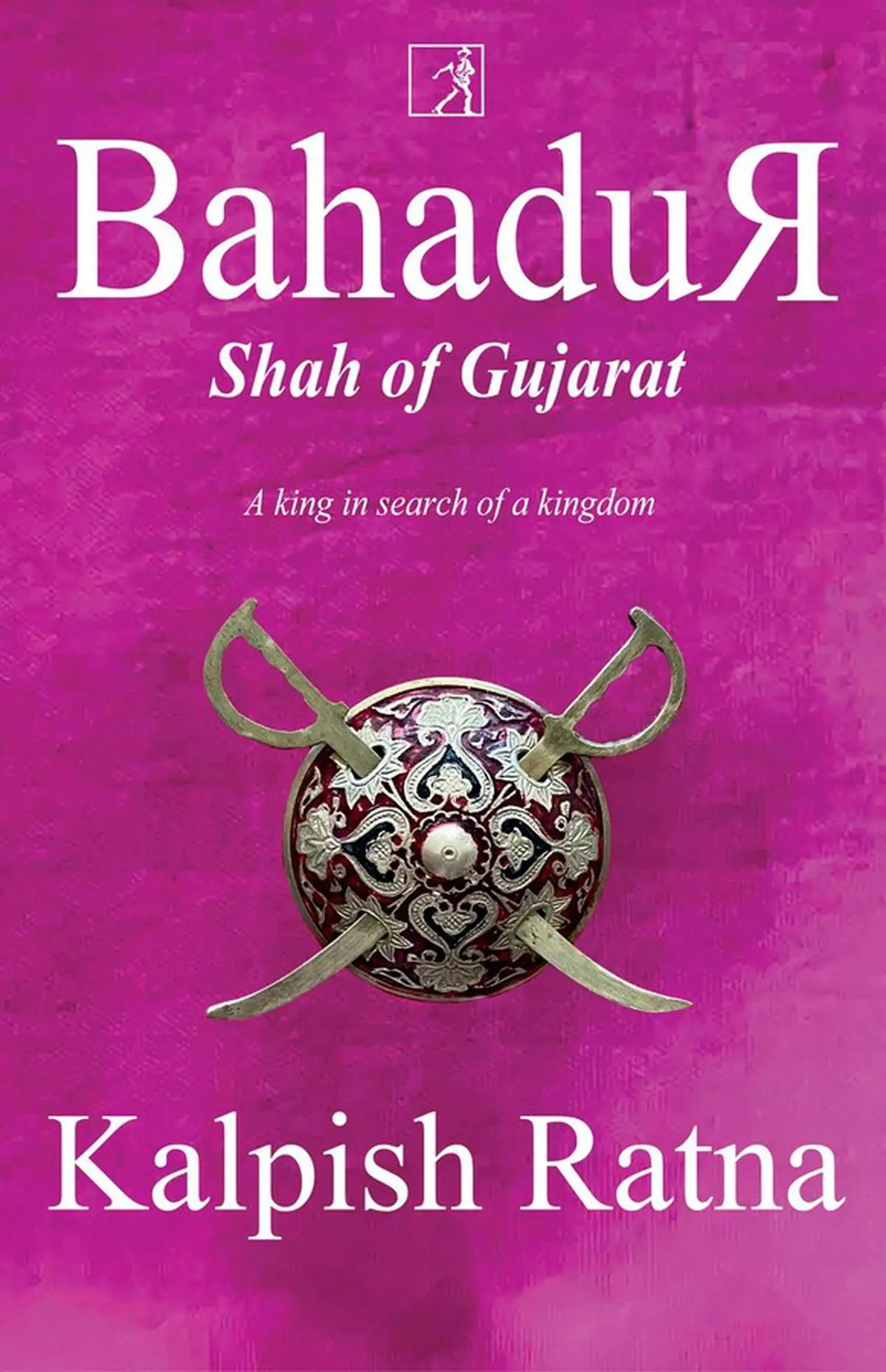
This fictionalised narration of the life of the 16th-century monarch of Gujarat is enjoyable but does not provide a coherent narrative.
The year 1526 was a watershed in the history of India. It was the year of the First Battle of Panipat, when Zahiruddin Babur defeated the last ruler of the Delhi Sultanate, Ibrahim Lodhi, and founded the Mughal dynasty. The Mughals went on to form a part of India’s most colourful, extravagant period in history: an era of cultural efflorescence and impressive art and architecture. A larger-than-life dynasty that drew the attention of faraway lands.
Bahadur Shah of Gujarat: A King in Search of a Kingdom
By Kalpish Ratna / Simon & Schuster India, 2023 / Pages: 395 pages / Price: Rs.809
What few people know is that 1526 also marked the ascension to the throne of another historical figure, Sultan Bahadur Shah of Gujarat. Caught between the Portuguese—then tightening their hold on western India—and the Mughals, Bahadur Shah is an enigmatic figure, a man of whom too little is known, far less remembered. As Kalpana Swaminathan and Ishrat Syed, writing as Kalpish Ratna, mention in the introduction to their novel Bahadur Shah of Gujarat: A King in Search of a Kingdom, most people coming across Bahadur Shah’s name confuse him with Bahadur Shah II “Zafar”, the last of the Mughals.
This fictionalised retelling of Bahadur Shah’s story sets out to explore his life and times. The book, divided into five parts, does not go the usual way of biographies: in fact, Bahadur Shah does not put in an appearance until the fifth chapter, “14 February 1537”. The first four chapters are all quite different from each other in style, setting, and narrative structure. The first chapter, for instance, centres round a village in North Konkan, its inhabitants trying as best as they can to deal with the firangi. The second chapter, narrated as a fast-paced, larger-than-life performance by a professional storyteller, a daastaango perhaps, is about Babur, “The Shining Sword of Samarqand” that came sweeping down on Hindustan. Chapter 3, “Hokka”, takes the form of a poem about (and narrated by) the two-headed doum palm of Diu, known locally as hokka:
“I’m prized here by only one man,
I’ve known him for years, and not a year goes by without his coming to see me.
Like me, he’s two-headed.
I’m the only two-headed palm in this part of the world, and he’s the only two-headed man I know.
Like a hokka, he’s hired for impossibilities.”
Just when the reader begins to wonder which way this novel is going, there comes Chapter 4, “Diu”, a somewhat dry essay on the history of this much-coveted, intensely fought-over port.
Too many threads in narrative
Is Bahadur Shah of Gujarat poetry? Is it a story? Is it factual essay? Is it adventure, ribaldry, bloodshed, politics?
It is a combination of all these and then some more. The canvas is enormous, stretching from Delhi to Chittorgarh, Diu to Shashti Pranth (now on the fringes of Mumbai), even going as far as Lisbon. The cast of characters is proportionately vast, reading like a who’s who of Indian politics in the early 16th century: Ibrahim Lodhi, Rana Sanga, Babur, Humayun, Afonso de Albuquerque, Malik Ayaaz. There are other famous names (Bhakti poet Meera Bai among them) and an array of people not so well-known: diplomats, warriors, cooks, librarians, interpreters. Plus, of course, there are fictitious characters.
There is war, revenge, lust, some farcical humour, and there are conspiracies galore. Most of it is based on fact, on events that actually happened, but narrated with a hefty dose of imagination thrown in. For instance, the attempted poisoning of Babur by Ibrahim Lodhi’s mother, Dilawar Begum, is narrated with a long prelude. It is heavily embellished with concocted details and some fairly juvenile humour: the cooks use unconventional (if that!) ingredients, the “poison” is not quite toxic after all; and the results are bizarre.
The scope of this book is so huge that it is hardly surprising that it ends up being confusing. Part of this confusion stems from the fact that the authors seem to have tried to include just about every aspect of Bahadur Shah’s struggle to get to and retain his throne. The conspiracies, plots, dialogues, and events are multifarious, and they are not tackled in a chronological or even logical fashion. Random chapters wander off here and there, telling an anecdote from the point of view of, say, Ibrahim Lodhi or Sikandar Shah (Bahadur Shah’s elder brother). Other chapters are devoted to a jewelled kamarband, to the Kohinoor, Meera Bai, the hokka. People reminisce, pontificate, and have conversations that are often obscure, leaving the reader baffled.
There are footnotes scattered through the pages and copious endnotes for almost each chapter, but these are often carelessly dealt with. The footnotes, which mostly explain a Hindustani/Persian word, are somewhat arbitrary, often explaining one fairly common word but omitting another. Some are repetitive, others are mirrored in the endnotes.
If the objective was to convey a sense of the turmoil and chaos of the era, Bahadur Shah of Gujarat achieves it. The best way to enjoy this book is to savour its language, to appreciate the somewhat quirky humour of it, and to take it one chapter at a time. To understand the many threads criss-crossing the life of its protagonist and get a firm grasp on what really happened may be a bit too much to ask of it.
Madhulika Liddle is a novelist and short story writer.
source: http://www.frontline.thehindu.com / Frontline / Home> Books> Book Review / by Madhulika Liddle / December 14th, 2023
Architectural exploration in the sultanate of Ahmednagar can provide deep insights into the political history of the Deccan.
B Y the late 15th century, the Bahmani kingdom that had ruled much of the Deccan since its establishment in 1347 was imploding because of internecine differences among its nobility. Westerners, or the “Afaqis”—immigrants from Persia and Central Asia—had differences with the natives, or the “Deccanis”, an eclectic group of nobles that consisted of descendants of the early Delhi sultanate migrants, local converts to Islam, Habshis (Africans) and Marathas. The weakening of the kingdom was accompanied by ambitious provincial governors declaring independence one after the other, leading to the emergence of five separate principalities, or sultanates.
The earliest to break away and proclaim himself sultan was Ahmed Nizam Shah I, who was the governor of the north-west province of the Deccan, later to be known as Ahmednagar, after the name of the city he would build and designate as capital of the sultanate. Of the four other sultanates that would cleave away chunks of the Bahmani kingdom, Bijapur and Golconda were the large and important ones to emerge.
Ahmednagar survived as a robust Shiite polity for more than a century, until 1600, and then in a feebler form until 1636 before the Mughals, with their unceasing imperial ambitions, completely swamped the city. It took 50 more years for the Mughals to subjugate all the kingdoms of the Deccan when Aurangzeb finally defeated the sultanates of Bijapur and Golconda in 1686 and 1687 respectively. Even though it was the first sultanate to fall to the Mughals because of its location, Ahmednagar survived as an independent state for more than 100 years.
During this time, it carved out a distinct identity in statecraft apart from leaving behind a fairly rich architectural legacy, which is the subject of study of the book under review. With this clearly defined ambition, Pushkar Sohoni, who is an architectural historian, has turned the spotlight on the sultanate of Ahmednagar and presented a method by which architectural exploration can provide deep insights into the political history of a geographical region.
The art and architecture of the Deccan sultanates was the focus of many scholars in the past. In pre-independent India, the region’s architecture was studied as an addendum to the Islamic architecture of northern India (for example, the second volume of Percy Brown’s seminal work on Indian architecture, 1942). More recently, the study of the Deccan as an independent area has come into its own, with scholars such as George Michell and Mark Zebrowski ( Architecture and Art of the Deccan Sultanates , 1999) publishing detailed studies.
Among exhaustively edited volumes on the same theme, a few stand out in recent times, including Silent Splendour: Palaces of the Deccan, 14th–19th Centuries edited by Helen Philon (2010) and Sultans of the South: Art of India’s Deccan Courts, 1323-1687 edited by Navina Najat Haidar and Marika Sardar (2011).
Richard Eaton and Phillip B. Wagoner have published a book titled Power, Memory, Architecture: Contested Sites on India’s Deccan Plateau, 1300-1600 (2014) that looks in detail at secondary urban centres of the Bahmani and Deccan Sultanate era such as Kalyana, Raichur and Warangal.
Coming to the scholarship on individual sultanates: Pramod B. Gadre has studied Ahmednagar in some detail ( The Cultural Archaeology of Ahmadnagar during Nizam Shahi Period, 1494-1632 , 1986); Deborah Hutton has looked carefully at the art of Bijapur ( Art at the Court of Bijapur , 2006); Marika Sardar has extensively studied the fortifications of Golconda (“Golconda Through Time: A Mirror of the Evolving Deccan”, unpublished PhD thesis, 2007). The book under review adds to this burgeoning bibliography on the art and architecture of the Deccan sultanates.
In his prefatory chapter, Sohoni makes a forceful case for the independent study of the Deccan, which had a distinct identity from “Hindustan”, or northern India, for most of the past. He writes: “The deep connections of the Deccan with West Asia, completely independent of Northern India, along with the autonomous cultural and historical developments in the south have shaped the Deccan very uniquely. Detailed studies of the polities of the Deccan, therefore, of architecture and statecraft, need to be undertaken in order to explain how, in moments of disengagement with the north, unique formations were created independent of developments in North India.”
This disconnectedness from north India led to the emergence of a distinctive architecture as the Nizam Shahis developed their own style. Sohoni’s argument is that the “…architecture of the Nizam Shahs does not follow a linear development from its Persian origins to the creation of a regional style. The buildings are variously of broadly Persianate and Indic characteristics, at times both, but to call them derivative is unfair, as the kingdom of the Nizam Shahs was trying to create a new architectural language as a regional claim.”
This study of architecture and the politics of Ahmednagar also leads Sohoni to argue ingeniously that the Deccani kingdoms saw themselves as “regionalists” who were resisting the “Hindustani” expansion led by the Mughals. This is an interesting perspective of medieval India.
Thus, the Deccan kingdoms were resisting the cultural expressions of the north by forging links with Persianate lands, which led to autonomous architectural representations. Chaul, Dabhol, Bhatkal and Goa were the principal ports through which connections with the wider Persianate world were forged independently, bypassing north India. In their architecture and in other aspects such as coinage, literature and painting, the Deccan sultans intended to bolster their independent claims as Deccan potentates. At the time, the Deccan was a multi-ethnic society with strong and independent connections to Persia.
There was also a great deal of cultural interaction and churning in the region involving ethnicities as diverse as African, Arab, Central Asian and South Asian. Thus, Sohoni provides ample evidence to back his argument that the Deccan has to be studied independently from “Hindustan”.
Sohoni’s intervention is valuable for the much-needed nuance it provides to the story of medieval India. In the reductive nationalist and colonialist versions of the time, Muslim rulers are seen as invaders “…upsetting indigenous practices until the ‘Hindu revival’ under the Marathas in the seventeenth century which is a simplistic and naive model of regional history”. Through Sohoni’s work, we see that the Nizam Shahi’s forbears were Brahmins who converted to Islam. Sohoni goes on to demonstrate, through his close reading of visual architecture, that the Nizam Shahi state “…formed the basis of the nascent Maratha state that emerged in the mid-seventeenth century under Shivaji Bhonsale”.
Sohoni delineates his method of studying architecture: “In this book, art-historical methods of visual inspection and formal analysis, along with documentation of architecture and construction, expand on earlier attempts to overcome the limited interpretations of previous text-based histories.” His book has a detailed historiographical note on the Nizam Shahis combined with the study of other aspects, such as the role of guilds and the material used in buildings of the time, providing a fulsome interpretation of architecture.
Sohoni also looks briefly at the literature, visual culture and coins of the Nizam Shahs. It is interesting to note that Ahmednagar started minting its own coins only in the second half of the 16th century, and this was done only when it realised the implications of Mughal expansion and had to symbolically demonstrate its independent status.
Commencing his detailed look at the architecture of Ahmednagar, Sohoni dedicates a chapter to urban patterns in six settlements of Ahmednagar: Junnar (the first capital of the Nizam Shahis), Daulatabad (the older capital of the northern Deccan), Ahmednagar (the capital built from scratch by the Nizam Shahis), Chaul (a major seaport), Parenda (a fortified military centre built by the Bahmanis) and Sindkhed Raja (the hereditary fief of the Jadhavs, Maratha nobles at the court of the Nizam Shahs). He also looks at the water technology and the fortifications in these settlements.
In the next chapter, Sohoni looks at the palaces and mansions of Ahmednagar such as Farah Baksh Bagh, a large building originally set on a raised platform in a pool of water. Sohoni spends some time on this monument before moving on to detailed discussions of other monuments such as the Hasht Bihisht Bagh, Manzarsumbah and Kalawantinicha Mahal.
In a subsequent chapter, Sohoni discusses the architecture of 12 mosques spread across various settlements in erstwhile Ahmednagar. Interestingly, Sohoni points out that there was no main congregational mosque in Ahmednagar where proclamations of sovereignty could be made on Friday, which is something unique and can be attributed to the Shiite orientation of its rulers. In the next chapter, Sohoni looks at tombs. One would imagine that like their royal forbears and peers among the Deccan sultanates the Nizam Shahis would also have grand tombs, but barring the first king of the dynasty, none of the other kings are buried here as their bodies were embalmed and sent off to Karbala (Iraq) in homage to their Shiite belief.
Thus, the 14 tombs that have been discussed are of the higher nobles who were buried in the region and memorials that are attributed to Maratha nobles, such as the ancestors of Shivaji in Verul and that of Lakhuji Jadhav in Sindkhed Raja. Another chapter is dedicated to the discussion of miscellaneous buildings, including royal hamam s.
Sohoni does not claim to have catalogued all the extant buildings from the Ahmednagar era, but his list is fairly thorough and includes all the prominent monuments in the region.
Through his work, the author sounds an urgent note of caution as many of these buildings are in a poor state of preservation with a few even slated for demolition. Several noteworthy monuments are not even protected by archaeological authorities. Sohoni has provided accompanying photographs and architectural plans for many of the monuments in his work. His detailed appendix is also useful as it provides an annotated listing of inscriptions on several monuments.
Sohoni concludes by providing an overview of what the Nizam Shahis represented. They were the last medieval state that the early modern Mughal state encountered as it swept across the Deccan.
He writes: “This study locates the Nizam Shahs as a critical component of the architectural and political history of the sixteenth-century Deccan, and hopefully can restore to them some of the status that they once commanded in their own time.” Drawing a direct link from the Nizam Shahis to the incipient Marathi state that emerged, Sohoni contradicts reductive scholarship that sees the Marathas as breaking from an Islamicate past. He writes that “…it is possible to conclude that there was no nationhood or polity based on an ethnic identity, and that their ethnic identity was a marker of social rise through military service. The cultural forms of the greater Islamicate world, as expressed in the Deccan by the Bahmanis, the Vijayanagar kings, and the later sultanates, were also adopted by the Maratha courts. In conception, execution, and ornament, the architecture of the early Marathas was exactly the same as that of their sultanate overlords and peers. The structural forms, decorative details, and planning logic conform to the Islamicate architecture of the Deccan sultanates.”
This book is valuable to architectural historians and historians of medieval India. A logical expectation would be for similar research to be done on the other Deccan sultanates, each of which represented robust regional resistance to the imperial policy of the Mughals.
source: http://www.frontline.thehindu.com / Frontline / Home>Books / by Vikhar Ahmed Sayeed / July 17th, 2019
A reading of three books throws light on the culture and politics of the Persianate world of the medieval Deccan.
Through fierce forays into southern India, rulers of the Delhi Sultanate like Alauddin Khilji (reign 1296-1316) extended the boundaries of their empire to its furthest extent at the end of the 13th and the beginning of the 14th centuries by dismantling the existing Yadava, Kakatiya, Hoysala and Pandya kingdoms. Khilji’s forces even reached Madurai in the deep south, where they established a base. Mohammed bin Tughlaq (reign 1325-1351), the eccentric genius of the Tughlaq dynasty that followed the Khiljis, moved the capital of his vast empire from Delhi to Devagiri or Daulatabad, located in what is now the central part of Maharashtra, in order to have his court more centrally located. The Delhi Sultans’ rule in these far-flung domains of their realm was always tenuous, and when Tughlaq’s rule, beset by internal crises and external challenges, withdrew to north India, many provincial governors rebelled, forming independent kingdoms or sultanates.
In the Deccan, an amorphous geographical region extending from the south of the Vindhya Range to the Krishna and Tungabhadra rivers, the Bahmani Sultanate was established by rebel Tughlaq nobles in 1347 with its initial base in Daulatabad. Across the Krishna, the vacuum that had set in after the Tughlaq withdrawal had led to the founding of the Vijayanagara kingdom sometime between 1336 and 1346.
The Bahmanis would shift their capital to Gulbarga (now Kalaburagi) in 1350 and in the early 15th century, to Bidar. At its height during the reign of Muhammad III (reign 1463 to 1482), when Mahmud Gavan was the prime minister, the Bahmani Empire extended from the Arabian Sea to the Bay of Bengal, helmed in by the Khandesh Sultanate in the north and the Vijayanagara empire in the south. While the Bahmani empire was a powerful state, ethnic affiliations overlaid with sectarian differences among the ruling nobility led to its implosion at the end of the 15th century. The provincial governors of Bijapur, Ahmednagar, Golconda, Bidar and Berar established their own Sultanates, snuffing out the Bahmani dynasty. Collectively referred to as the Deccan Sultanates, the 16th century would see these legatee states frequently fight with one another. The mighty Vijayanagara to their south usually sided with one or the other sultan in these conflicts.
Recognising the threat that the powerful Vijayanagarans perennially posed to them, the Deccan Sultanates came together in a temporary alliance in 1565 to defeat Vijayanagara, leaving it to totter to its eventual demise over the next century (See “Beyond the Hindu-Muslim Binary” in Frontline , January 18, 2019). This brief friendship was soon forgotten, and the Deccan Sultanates continued to fight with one another. Berar and Bidar were gobbled up by Ahmednagar and Bijapur respectively, leaving these two states, along with Golconda, as the unchallenged rulers of the Deccan for some time until their wealth attracted the attention of the Mughals. The expansionist policy of the Mughals led to the weakening and eventual subjugation of these regional powers as first Ahmednagar (1636) and then Bijapur (1686) and Golconda (1687) succumbed to Mughal might, ending the glorious epoch of the Deccan Sultans.
In popular understanding, medieval India is usually equated with the Mughal empire, but this is not to say that the Deccan was deprived of serious explorations of its medieval history. H.K. Sherwani and P.M. Joshi were early modern historians who looked at the Bahmanis and their descendants closely ( History of the Medieval Deccan: 1295-1724 , 1973). One of the books being reviewed in this essay, T.S. Devare’s A Short History of Persian Literature: At the Bahmani, the Adilshahi and the Qutbshahi Courts—Deccan (1961) is also from an earlier era. The work of these scholars has been followed by other prominent historians such as Richard Eaton and Phillip. B. Wagoner, who have closely looked at various facets of medieval Deccan. Manu Pillai ( Rebel Sultans , 2018) has attempted to tell the political history of the Deccan (for a review of this book, see “The Deccan Chronicles”, in Frontline , May 10, 2019). The architecture of the Deccan Sultanates has also been closely studied by architectural historians like George Michell and Helen Philon (the two scholars’ new book is being reviewed here). A new generation of scholars like Deborah Hutton, Marika Sardar, Pushkar Sohoni (for a review of Sohoni’s book, see “Deccan Architecture” in Frontline , August 2, 2019) and Emma J. Flatt (whose book is being reviewed in this essay) have begun to use innovative methods to explore other dimensions of the Deccan states, moving beyond political history.
Magnificent architecture
George Michell and Helen Philon are recognised scholars of the architecture of medieval Deccan. Early in his career, Michell co-founded the Vijayanagara Research Project, which continues to have a vast scope and consists of leading researchers on the history of this grand empire. Since the 1990s, Michell has moved on to study the architecture of Vijayanagara’s traditional rivals, the Bahmanis and their legatee sultanates. That makes him the only architectural historian whose expertise spans peninsular India. His many publications attest to his reputation as the foremost authority on medieval Indian architecture south of the Vindhyas. Helen Philon has published on Sultanate architecture in the past and her guidebook on Gulbarga, Bijapur and Bidar has become classic reference material for travellers to these Sultanate-era towns.
These two historical and architectural experts have combined forces with the photographer Antonio Martinelli, leading to the publication of the gorgeous coffee-table book under review. There are 290 photographs in the book capturing various monuments and their details in a fantastic display of exquisite photography. A significant number of architectural drawings adds to the value of this book.
While it excels as a coffee-table book, Islamic Architecture of Deccan India is also a handy academic work that collates existing literature on the theme in its introductory essay. This essay is a thorough summary of the medieval history of the Deccan, displays impressive historical and architectural awareness and serves as a perfect prologue to the book whose pages are otherwise filled with photographs of monuments. There are nine chapters that follow, each focussing on a Sultanate-era town. Towns gained prominence in a linear fashion in medieval Deccan and the chapters follow that development, with the photographs and captions highlighting the evolution of architecture.
Daulatabad and its neighbour, Khuldabad, attained early importance as the peninsular headquarters of the Delhi Sultanate and later as the first capital of the Bahmanis. After this, the capital of the Bahmanis was moved to Gulbarga and briefly Ferozabad (which is a necropolis now) before being shifted permanently to Bidar. The Bahmani empire eventually broke up into five separate sultanates. Ahmednagar, Bijapur and Golconda were the headquarters of these provincial kingdoms and boasted majestic architecture that saw a boost after the 1565 “Battle of Talikota” with Vijayanagara. These extensive chapter-long surveys end with Aurangabad, which was the Mughal bridgehead for conquering the Deccan. Interestingly, Michell and Helen Philon choose to include Burhanpur, the capital of the Khandesh Sultanate which separated the Deccan from “Hindustan”, in their examination of the Deccan. This is unusual, provoking the question as to what truly constitutes the Deccan.
Seeing the photographs in the book, each of which has immortalised a monument, one cannot help but recall Susan Sontag’s thoughts from her must-read book On Photography . She writes: “All photographs are memento mori. To take a photograph is to participate in another person’s (or thing’s) mortality, vulnerability, mutability. Precisely by slicing out this moment and freezing it, all photographs testify to time’s relentless melt.” Martinelli’s alluring and breathtaking photographs, accompanied by Michell’s and Helen Philon’s notes, not only make the reader aware of the magnificence of these monuments but also the relentless passage of time.
Persian in the Deccan
The second book under review is a reprint of a classic on Persian literature in medieval Deccan by T.N. Devare. A Short History of Persian Literature: At the Bahmani, the Adilshahi and the Qutbshahi Courts—Deccan was first published in 1961 and was the PhD thesis of the author, who died in 1957 when he was only 43 years old. It continues to remain relevant because it is the only book in English that exhaustively studies the vast corpus of Persian literature produced in the courts of the Bahmanis and the Deccan Sultanates. Devare’s contemporaries had made substantial progress in the study of medieval Indian Persian literature but their main focus was on the works produced under the Delhi Sultanate and the Mughals. Thus, Devare’s intention was to correct this academic anomaly and to show that great Persian literature was also produced in the Deccan.
Considering the demand in academic circles for a reprint, the author’s family took the initiative in reprinting this valuable book last year. Methods of historical and language research have changed substantially in the six decades since Devare did his research. Thus, the book’s conceptual approach and style may seem outdated if seen from the perspective of current scholarship, but its value lies in its wide scope and its ambitious attempt at collating texts and then critically discussing them. Merely locating all of these texts in the 1950s, when they were spread across several libraries and personal collections, must have been a tedious task.
By discussing the major works produced in the Deccan, Devare has also put together what could be read as an extended annotated bibliography of the literature produced at these courts, making the book both a useful primary and secondary source for historical research on Persian literature in India and the history of the Deccan Sultanates. Devare also reads all the Persian texts directly and interprets them for his readers. His work is foundational as he does not rely or build on the work of other scholars. It is rare, or almost impossible nowadays, to find a scholar with such advanced competence in medieval Persian. Devare also frequently translates passages of Persian poetry and prose, enriching the book.
Devare’s book is divided into seven chapters, not including an introductory chapter that looks at the historical connections between Persia (now Iran) and India. Reading these chapters, one becomes aware of the easy mobility of a vast number of Persian speakers who migrated to the Deccan. Five of the seven chapters have a clear focus on different kinds of personages and their contributions to Persian literature in the Deccan. In each chapter, Devare chronologically lists the writers, thematically linking them before discussing their work, devoting several pages to noteworthy contributors.
For example, in the chapter on saints of Islam and their contribution to the development of Persian literature, the longest discussion is on the literary contributions of Khwaja Bandenawaz, the Sufi saint buried in Kalaburagi, whose enduring spiritual legacy has established him as the most prominent Sufi of the Deccan. Bandenawaz wrote a number of treatises and pamphlets on religion and Sufism apart from the poetry that has been discussed by Devare.
Discussing the Persian literature produced by the rulers of the Deccan Sultanates, Devare devotes several pages to Ibrahim Adil Shah II (reign 1580-1627) of the Adil Shahi dynasty of Bijapur. Like the Mughal emperor Akbar (reign 1556-1605), his elder contemporary in northern India, Ibrahim Adil Shah II also had an eclectic spiritual curiosity that defined his world view. He was addressed as “jagat guru” because of his love for music and veneration of the goddess Saraswati. Devare’s exhaustive survey goes on to include discussions of the works of the prominent litterateurs, architects, calligraphists and other prominent nobles in the Bahmani, the Adilshahi and the Qutbshahi courts.
In the chapter on poets, the prominent poets discussed by Devare include Isami, the composer of the Futuh-us-Salatin , a masnawi (poem in rhyming couplets) on Muslim rule in India, who was at the Bahmani court, and Zuhuri, the master of ghazal writing who was employed by the Ahmednagar and Bijapur Sultanates.
In a chapter on historians, Devare discusses the craft of history writing as practised by Muslim historians before moving on to discuss the works of individual historians. He makes a rare accusation of plagiarism against Ferishta, the historian whose works provide the maximum primary material for writing the histories of those times. The last chapter of the book looks at the influence of Persian on Marathi and Dakhni languages.
A flaw, or rather, a handicap of the book is that most of the dates are mentioned in the Islamic or Hijri calendar, which makes it tedious for the reader to correlate them with the dates of the common Gregorian calendar.
Emma J. Flatt’s fabulous book adds tremendous new knowledge to the history of the medieval Deccan. Borrowing methodological tools from anthropology and seeped in a robust reading of original Persian texts, Emma Flatt’s book is a rigorously researched work that opens up the courts of the Deccan Sultanates in exquisite detail. Emma Flatt’s main intention is to investigate the “idea of courtliness in the political, social and cultural worlds of the late fifteenth- and sixteenth-century Deccan Sultanates”. The book studies a wide set of practices among the elite of the Deccan courts and will certainly become a landmark of historical research as Emma Flatt has demonstrated how a finite set of primary sources can be interrogated to wring out new kinds of knowledge and add to our understanding of a historical period. This work is also academically exciting as there are hardly any historical works that analyse South Asian “courts” as a category apart from Daud Ali’s pioneering work on courts in early medieval India ( Courtly Culture and Political Life in Early Medieval India , 2011).
Through the book, Emma Flatt reiterates the point made by the historians Richard Eaton and Phillip Wagoner in the past that it is erroneous to view the various Deccan Sultanates and the Vijayanagara Empire as having fixed geographical boundaries and that, as the movement of the courtiers showed, there was a fluidity in these boundaries. Emma Flatt writes: “During this period, individuals of different backgrounds and cultures moved from across the Persian-speaking world to take up service at the courts of the Deccan Sultanates, and between the Deccani courts with a felicity that belies modern assumptions about the fixity of political and geographical boundaries on the one hand, and the incompatibility of Indic and Islamicate religio-cultural systems on the other.”
Emma Flatt relies on three key theoretical terms—the court, ethics and the Persian Cosmopolis—to take her argument forward. By virtue of the easy movement between a variety of courts, the courtiers acquired a certain courtly disposition that was widely shared across the “Persian Cosmopolis”, a phrase that has recently acquired tremendous heft in its expression of the shared set of cosmopolitan training in Persian texts that informed the subsequent world view of the elite across a vast swathe of land from Persia to Bengal. Emma Flatt’s book looks at facets of these courtly societies and examines certain courtly skills that were necessary for courtiers in order to become part of this courtly culture.
The book is broadly divided into two parts containing three chapters each, “Courtly Society” and “Courtly Skills”. Emma Flatt argues that there was a shared cosmopolitanism that the courtiers acquired through a shared foundational education of key Persian texts whose aim was not merely the acquisition of knowledge but the development of a “specific type of disposition within each individual”. This helped them move easily across the Persianate Cosmopolis, allowing them to find employment in various Deccani courts, as evinced in the careers of two individuals discussed in the next chapter.
By examining the careers of two elite noblemen, Muhammad Nimdihi and Hajji Abarquhi, Emma Flatt demonstrates how individuals used familial, scholarly, mercantile, religious and friendly networks in order to move across the Persian Cosmopolis.
The court society of the Sultanates was heavily influenced by “…the practices, the commodities and the vocabulary of long-distance trade”. She looks at the biographies of three powerful individuals, Khalaf Hasan, Mahmud Gavan and Asad Khan Lahri, in some detail to argue this point.
In the second half of her book, Emma Flatt looks at the courtly skills that were required for “worldly success and ethical refinement”. She writes: “By disciplined repetitive practice, the participant honed his ability at a particular skill, and simultaneously refined his soul, rendering the pursuit of skills an ethical endeavour.” Emma Flatt looks at scribal, esoteric and martial skills as part of the training for worldly success and the development of a courtly disposition.
The importance of scribal skills in the development of a refined courtier is examined through the epistolatory skills of Mahmud Gavan (1411-1481), the dynamic merchant-scholar who rose to become a vizier of the Bahmani rulers.
In a fantastic chapter that looks at the esoteric skills that courtiers could acquire to rise in the eyes of the rulers, Emma Flatt does a meticulous reading of the “Nujum al-Ulum”, the esoteric text composed in the Bijapuri court of Ali Adil Shah I (reign 1558-1580). In its divergent sourcing from both Islamicate and Indic cosmologies, she sees “conceptual commensurabilities” for a courtly society made up of a people belonging to a plurality of religious and cultural beliefs.
In the last chapter, Emma Flatt looks at “…how the acquisition of martial skills was associated with an ethical ideal known as javanmardi or young-manliness, an ideal structuring the daily lives of courtly and urban men in the medieval Persianate world”.
This brief review hardly does justice to the wide scope of Emma Flatt’s work which will be valuable for anyone interested in the history of the medieval Deccan. As this review essay shows, there is a substantial amount of ongoing research in the history of the medieval Deccan, but compared with the large body of work on the Mughals, much remains to be done for historical research of the medieval Deccan.
source: http://www.frontline.thehindu.com / Frontline / Home>Books / by Vikhar Ahmed Sayeed / December 04th, 2019
A translation project, involving 21 volumes written in medieval Persian on the Adil Shahi dynasty of the Bijapur sultanate, which M.M. Kalburgi was heading before his murder, has been completed.
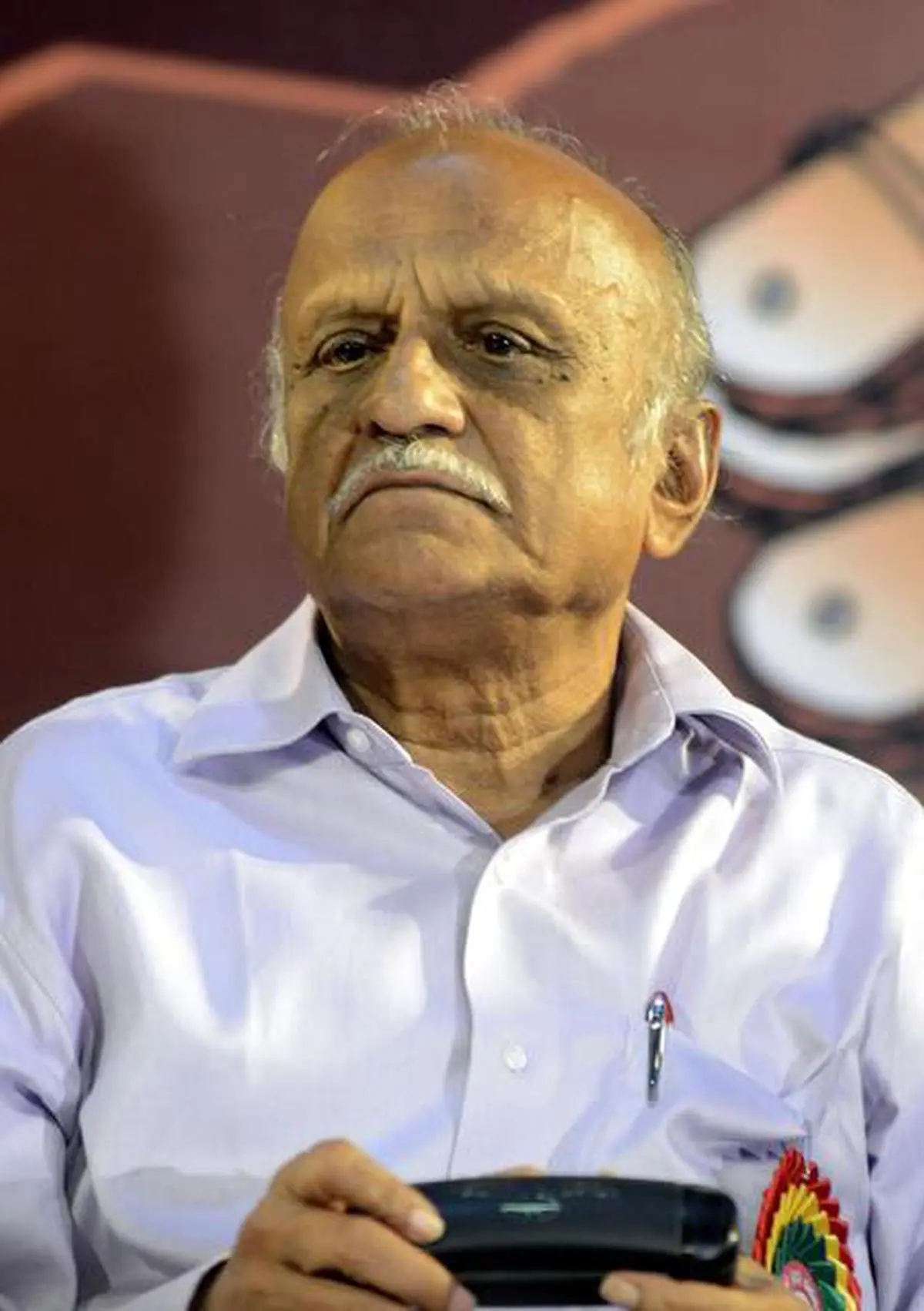
M.M. Kalburgi.
When the Kannada scholar M.M. Kalburgi’s life was suddenly and brutally ended by a gunman on August 30, 2015, he left many projects unfinished. The senior researcher was primarily known for his iconoclastic interpretation of the Lingayat credo, embittering conservative believers. But his work went beyond this, and he had versatile interests. As an epigraphist, he was keenly interested in the history of Karnataka. At the time of his death, he was supervising the translation of Persian manuscripts into Kannada from the time of the medieval sultanate of Bijapur, when the Adil Shahi dynasty (1489-1686) ruled the region.
The Adil Shahi Sultanate was one of the five kingdoms that emerged in the wake of the implosion of the Bahmani Empire. The Adil Shahis ruled a vast area from the city of Bijapur, and at its peak the boundaries of the Bijapur sultanate stretched from the Arabian Sea to the Bay of Bengal. It took the might of the Mughal Empire to finally defeat this kingdom in 1686. During the reign of Ibrahim Adil Shah II (r. 1580-1627), Bijapur was one of the leading urban centres of the Indian subcontinent, rivalling the majesty of Mughal administrative and cultural centres of northern India such as Delhi, Agra and Lahore. The population of Bijapur was around 10 lakhs at the time, and this exceeded the population of other royal Indian towns. The kings of the Adil Shahi dynasty left their mark on this town, which is littered with a variety of monuments, the most famous being the Gol Gumbaz, the mausoleum of Mohammed Adil Shah (r. 1627-1656).
The largest chunk of the Bijapur sultanate, including its capital Bijapur, lay in what is now modern Karnataka. Hence, an understanding of the sultanate’s history adds significantly to the understanding of the history of medieval Karnataka. Kalburgi’s translation project was staggering in its scale; it involved the translation of 21 volumes written in medieval Persian, forming most of the primary source material on the Adil Shahi dynasty. The material was a treasure trove for historians working on the region but had remained inaccessible because it was not available in Kannada.
A translation like this had never been done in Kannada and was only possible under the fervid leadership of Kalburgi. According to people close to Kalburgi, he was excited about this project as he felt that the history of Karnataka would have to be rewritten after the publication of these volumes. The first volume came out in 2014, the year before he was killed. He lived to see a few more volumes published, but the bulk of the project was finished after his death. The final volume was published only in 2018.
The provenance of the project can be traced to the early 2000s, when Kalburgi was the Vice Chancellor of the Kannada University at Hampi. He had reached out to Krishna Kolhar Kulkarni, a historian of Bijapur, to present a bibliographical essay on the Adil Shahi dynasty at the university. “Along with this, he encouraged me to translate at least one book from Persian to Kannada,” recalled Kulkarni, 79, in a chat with Frontline . Kulkarni, who is originally from the village of Kolhar near Bijapur (now Vijayapura), spent 11 years in Bombay (now Mumbai) as a telegraph employee. He became fluent in Marathi during those years. “The book that I chose to translate was the Basateen-e-Salateen , a nineteenth century account of the Adil Shahi dynasty by Ibrahim Zuberi. It had been translated into Marathi from Persian, and I relied on that translation to bring it out in Kannada,” explained Kulkarni.
Encouraged by the success and quality of this initial translation, a project proposal, “the Adil Shahi Literature Translation Project” was readied in 2011 under the aegis of the Dr. P.G. Halakatti Research Centre of the Bijapur Lingayat District Educational Association (BLDEA). The aim of the project was to translate the entire corpus of Adil Shahi literature into Kannada. The proposal received the support of M.B. Patil, a senior politician from Vijayapura who is known to take a keen interest in the heritage of his city. The Kannada and Culture Minister at the time, Govind M. Karjol, a native of a neighbouring district, approved the project, and Rs.75 lakh was sanctioned for this purpose in 2012-13. The translation was carried out by a committee under the chairmanship of Kalburgi and under the direction of Kulkarni.
“The first task that I did was to identify and acquire the primary Persian texts of the Adil Shahi era. This I did from several libraries all over the country as they were not located in one place. I got photocopies of original Persian texts from places like the Salar Jung Museum and the Andhra Pradesh Archives and Research Institute in Hyderabad. In Maharashtra, I visited the archives in Mumbai, Pune and Aurangabad, apart from using material available at the Bharat Itihas Sanshodak Mandal in Pune. Finally, I also had to visit the National Archives of India in Delhi for some rare material,” Kulkarni said.
After this, translators were identified and the work began in earnest. As the project had to be completed soon, several translators were identified for the purpose. Each translator was allocated a different text, and in some cases where the text was voluminous, different parts of the same text. Many translators worked in teams of two people, with one person more competent in Persian and the other in Kannada. Thus, a 2,626-page tome like the Tarikh-e-Farishta , which is a chronicle of Muslim history in the subcontinent written by Farishta, a courtier in Bijapur, was translated by eight translators.
As the director of the project, Kulkarni acknowledged that using multiple translators was not the most rigorous way to translate a text, but he explained how he made it work: “Once the translations came to me, I would work on them further to provide clarity and stylistic uniformity.” Kulkarni also acknowledged that while some texts were directly translated from Persian and old Deccani with the help of scholars like M. Rahman Madani of Vijayapura, many were translated from Urdu and English. So these were translations of translated texts. Some of the other texts that were translated were the poem Ibrahimnama of the Saraswati-venerating-monarch Ibrahim Adil Shah II, containing 712 stanzas, and his Kitab-e-Nauras , the Book of Nine Rasas. Chronicles of kings of the ruling dynasty like Mohammed Adil Shah and Ali Adil Shah II, Sufi texts from the era and compendiums of fatwas constitute the other volumes in the translated set.
It is evident that there is some arbitrariness in the way in which the translations have taken place, and a philologist may not approve of this. A historian specialising on the Adil Shahi dynasty who spoke to Frontline on the condition of anonymity said: “The quality of the translations is not up to the mark as they have not carried over the nuances of the Persian original.” While this may be true, the 21 volumes open up the world of medieval north Karnataka to modern researchers working in Kannada. Kalburgi’s dream of adding a great new source material to the understanding of the history of Karnataka has come true.
source: http://www.frontline.thehindu.com / Frontline / Home> India> History / by Vikhar Ahmed Sayeed / July 08th, 2019
Six more books from the period of Adil Shah have been released
A GLIMPSE OF… the books, manuscripts and maps
The ambitious work of translating Adil Shahi literature in Kannada, has now achieved another milestone. Six more rare books of that era written in Persian and Dakhani Urdu have been released and are available for the readers.
The Adil Shahi Literature Translation Committee which was earlier headed by the late M. M. Kalburgi, is rapidly doing its work to complete the entire project by the end of this year.
Writer Krishna Kolhar Kulkarni, director of the committee, who now heads the project after the demise of Prof. Kalburgi, said that last year the committee came up with six books, this year, as the second instalment, the committee has released six more rare books after translating them into Kannada.
It was a difficult task to collect these books, since they are rare and hard to find. Names of the books that will be released and their brief description:
Mohammad Naama: The book written by Zahoor Bin Zahoori in Persian is gives demographic details of Karnataka and the expansion of Adil Shahi dynasty into southern parts of the country. The writer offers critical information about the life of Mohammad Adil Shah (1636-1656) who got the historic Gol Gumbaz built. The book has been translated by Dr. Mehnoor Zamani Begum, Prof. A.H. Masapati, Fakir Mohammad Katpadi and Moulana Rashid Al Khashmi.
Ali Naama and Tarikh-e- Sikandari: The books written in Dakhani Urdu by Mulla Nusrati, are primarily poems in which writer gives illustrated description of Ali Adil Shah-II (1656-1672) and Sikandar Adil Shah (1672-1686). The book meticulously writes about the historic Umarani war between Maratha King, Shivaji and Ali Adil Shah-II in which Shah humiliatingly sends Shivaji back from the battle field.
The books are translated by the late, Dr. Mohammad Sibkhatullah and Dr. Vithalrao Gaikwad.
Urus-e-Irfan: The book written by Hazrat Kazi Mehmood Behri in Persian, is about contemporary details of religious and historical moments. The book is translated by Bode Riyaz Ahmed Timmapuri.
Tazkirat-ul-Mulk: The book written by Rafiuddin Ibrahim Shirazi in Persian, is one of the best books on ancient Bijapur history of the famous Rakkasaki-Tandagi war in 1565.
The writer gives an eye-witness account of the war and mentions the fall of Vijayanagar Empire. The book is translated by Fakir Mohammed Katpadi.
Kitab-e-Nouras: Written by Ibrahim Adil Shah-II in Dakhani Urdu, who adored art and music. In his books, the king introduced Indian music to Persian people. The book is translated by Dr. Krishna Kolhar Kulkarni.
Rouzat-ul-Auliya: The book written by Mohammed Ibrahim Zuberi in Persian is about some 105 men and eight women Muslim Saints who lived in Bijapur district.
The writer visits each tomb and collects details of all the saints before compiling a book on their lives. The book is translated by Dr. Amiruddin Kazi.
While six book are translated now, previously, another six books that were translated and released are: Tareekh-e-Farishta, Basateen-e-Salateen, Guldasta-e-Bijapur, Ibrahim Naama, Tareekh-e-Haftakursi and Futuhat-e-Alamgeer .
Meanwhile, Dr. Kulkarni said that the team of experts is busy working on the final volume of eight books to be released by the end of this year.
“It is surely a painstaking and labour-intensive job. It has to be translated without distorting the originality,” he said.
Maps and manuscripts
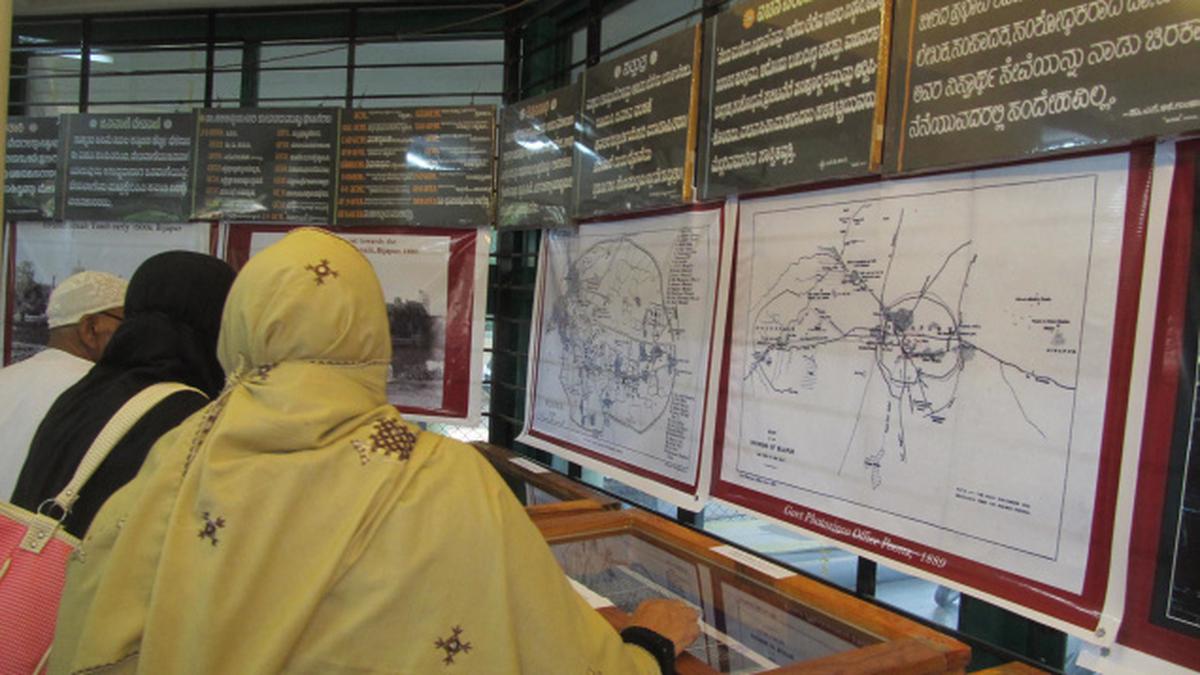
He said that during their search of books, the team laid hands on some of the rare maps of ancient Bijapur district prepared between 1763 and 1909.
“This is no less than a treasure for us . We also got hundreds of manuscripts and ‘Farmaans’ (official correspondents between Kings and landlords).
We have decided to display them in a museum to be established in future,” he said.
source: http://www.thehindu.com / The Hindu / Home> Features> Friday Review / by Firoz Rozindar / October 18th, 2016
Prayagraj (formerly Allahabad), UTTAR PRADESH / NEW DELHI :
Shamsur Rahman Faruqi with Baran Farooqi. Photos courtesy: Baran Farooqi
Abba was the magician who introduced me to the wide and varied wonders of the world, taught me everything about life and its customs and kept me enamoured of his extraordinary personality. I was awe- struck by his learning, his cool, confident air and the way and adulation he commanded sat comfortably on his shoulders.
And may there be no sadness of farewell
When I embark;
Alfred Lord Tennyson
“Yeh meri akhiri bimari hai (this is my last illness),” spoke Abba with a wry smile on his face. He was addressing Dr Nandani Sharma, a homeopath in Shivalik, Malviya Nagar (New Delhi), whom we were all very fond of and trusted. That evening we had taken him there since he had expressed a desire to actually see her and not consult her over a video call to ask about the chances of curing the fungal infection which had invaded his eye during his stint at Fortis Escorts hospital where he had been hospitalised after having tested Covid positive. None of us had imagined that it was a matter of just a few days before he would be gone, transited peacefully and in full preparation of “seeing his pilot face to face.” Dr Nandani assured him that he still had long to live and accomplish some more as she was confident her medicines would be able to control the fungus. This conversation had taken place in her driveway as Abba was not able to walk since he had returned from hospital and so it was decided that instead of him having to go into her clinic, he would be seated on his wheelchair near the car and she would examine him. We returned upbeat from Dr Nandani’s place but it was as if Abba knew better than Dr Nandani this time. He had been sent the summons and he had answered them with acceptance and great sporting spirit. So, he laughed at our jokes in his weak strength and held out his hands or arms to embrace whenever he saw me or my sister or my daughters enter the room. He would kiss my hands and softly caress my head if he happened to be sitting, bolstered by the electrically operated bed we had arranged, half a dozen pillows and bolsters around him.
Of late, in fact, right from the time he would send voice notes from the hospital, he would often repeat, “I love you” or “know that I love you.” Of course, we had never had any doubts about this ever because Abba was the master of expression. A vocal person, he taught me how I need to say “thank you” even to my own parents if they got me something and to house helps and friends for services rendered or acts of kindness. I once overheard him reproaching my mother for never doing salam to him first when he got home from office or smilingly extending her hand of welcome. Always cheerful and smiling when he came home from office, he expected everyone else at home to be as smiling and welcoming as he was. Each time any of us would enter his room for something, he would beam aaiye aaiye (do come in) and show his pleasure. He used to call me “funny face” sometimes, which didn’t seem very amusing to me but I knew I was supposed to show a sense of humour and not sulk over little things. I finally asked him one day, “Why do you call me funny?” He answered that funny faces are those who are delightful and make him feel happy and full of mirth. Once, when I made him fill out my columns of questions like, who is your best friend, what’s your favourite colour, what are you scared of and so on, (this was a raging activity in my school those days that you took autographs of people in your autograph book for no reason and also made them fill columns which were made in a double page of a register.) I remember almost all his answers to this day but I’ll speak of only a couple, to the question, “If you had a wishing wand, what would you wish me to be?” he had answered “Queen of Sheba.” I immediately understood this is something divinely great and luminous and so on, since I didn’t really know who queen of Sheba was at that time. In the answer to the question, “what are you scared of?” he had answered “centipedes,” making me aware that he was human and vulnerable in his own way.
I have wandered far from what I was initially talking about — his illness and his demeanour during those days. After stretching out his hands and making me sit close, he told me one day that the time for him to leave this world had come and that I should allow him to go. That the ceaseless struggle that we were putting up to withhold him was futile and he was convinced about his departure. He needed to go back to his spacious and open house where his favourite pet dog Bholi and others were, and he wanted the birds to sing near his window before he ceased to breathe. On those nights when he was awake and not faint with weakness, I would sit by him and read out his WhatsApp messages to him and also make him listen to the voice notes people had sent. He chose to respond to one or two voice notes or emails and messages every day. He would speak the voice notes himself and dictate the written messages or emails. He once made me write a mail to CM Naim sahib though there wasn’t one from him that day and also to Frances Pritchett, informing them about his health. One of the voice notes that he sent to Amin Akhtar (a relative of ours who has been assisting him in his library-cum-office and miscellaneous affairs for many years) was about the local graveyard which Abba’s efforts had helped restore and put in order after his return to Allahabad after retirement. He asked Amin to go to my mother’s grave and convey his salam there. He also asked Amin to see if it was still possible if he could be laid to rest right next to her, but in case anyone objected, he reminded Amin, he had chosen a remote corner of the graveyard for himself as a second choice. Amin responded next day tearfully that he had carried out his instructions and that there was no question of anyone objecting to his burial next to his wife. He had written the ayat he would like to be written on his tombstone and given it to Amin many years back already. I felt heart-broken at these conversations but I, too, knew that they must happen and not be left unfinished, for the day of parting may come if it had to, and there was nothing anyone would be able to do about it.
I marvel at Faruqi’s (as he would like to refer to himself, sometimes even calling himself “saala Faruqi” or “Fraudie”), courage and foresight for the way he bore his illness. He was also very kind and forbearing towards us, always succumbing to our pleas for making him eat or drink something despite being terribly averse to both ideas. Every time he would ask when we were planning to go back to Allahabad with him, and my sister or I would give a date a week or two away, he would nod patiently and agree. Ever since Ammi passed away, Abba had been careful to hand over all that she had left behind as money or property to both of us, saying this belongs to you both as she was your mother. But when it came to caring for us and endowing us with gifts or maintaining the large house, he acted as the perfect father. Never once did he ask us to bear any financial burden of any kind, be it the property Ammi left behind — he continued to pay property tax for it — or other charities that she was used to doing at her native village.
Unselfish by nature, and generous towards the world and its people, he once told me that he had spent his life with the aim to be of help to any number of human beings he came across in the journey of his life, particularly during his career in civil service. I have never known or seen, nor do I ever hope to see, another more good-hearted person who is also competent, capable and one of the greatest literary minds of the century. Abba loved exploring new things and enjoy them if the children so wanted. Any new joke, and we wanted to share it with him, a new piece of machinery or a gadget and he would be curious to know about it, any adventurous outing, and he would want to be a part of it. In fact, most of the interesting outings in my and my daughters’ lives were either planned by him or planned for him. It was just last winter that we all went to Kochi together to explore the backwaters of Kerala and spend some part of winter there to avoid the low temperatures up North. As he grew older, he had begun dreading the winters, as they confined him to his room and restricted his hours in the study. There were arrangements to keep his room, his study, and even his bathroom warm, but the cold got to him since he was finicky about wearing “inners” and heavy quilts bothered his frail body with their weight.
Apart from travelling to new places and exploring places of historical interest or natural beauty, Abba had a penchant for stylish and tasteful clothes and good food (which he always ate very little of, but wanted to be served in good quantity). However, he had this little thing in his head about what are supposedly “manly” dishes and which foods are meant to be consumed only by women. Consequently, I never saw him relishing anything even slightly sour. He was supremely dismissive of achar and chutneys or chaat of any kind. Even remotely foul-smelling vegetables were banned in our house, not to speak of home-made sirka or ghee being extracted from malai. I once witnessed a bitter exchange he had with my mother for having gotten mooli achar prepared in the courtyard of our house. This was even worse than cooking sabzi out of the mooli! Like any other subversive spouse, Ammi would sneak such things into the house and eat them secretly when he was in office.
Abba was a great animal lover, too. As children, having animals and birds around us was as natural as breathing and it must never have occurred to us that in the eyes of the world, we qualified as “animal lovers.” At any given time in our lives, there were always dogs, cats, turtles, mynahs, peacock chicks or grown peacocks, pigeons, partridges, quails and finches and other singing birds. Abba would often send a tid-bit or two to his pets (I said “send” because the house was really so huge in area that things had to be delivered from one place to another) and tell the person he had chosen for the task, “greet him with my salam and say that Faruqi sahib has sent this. We knew a lot about birds, which ones could be tamed or caged and which couldn’t be bred in captivity. He also had a collection of coffee-table type books on birds and animals and some of the exciting times of my childhood were certainly made of browsing through those books. Sea creatures like starfish, octopus or dolphins intrigued me greatly and I was enamoured by pictures of the mighty ocean. I longed for a trip to a coastal town but my wish was deferred for quite some time as my parents had already been to places like Bombay and Calcutta many times and were more focussed on the hills or animal and bird sanctuaries.
Abba played his favourite musical records of ghazals and classical ragas in the mornings which were spent enjoying three to four cups of bed tea. The tea, which would be brewed in an elegant tea pot and had a bitter aroma, would cool gradually as he read the morning papers. The music would continue to play up until he was almost ready for breakfast. Gradually though, I, too, developed a taste for singers like Farida Khanum, Iqbal Bano, Mehdi Hassan, Kishori Amonkar, and artists like Hari Prasad Chaurasiya, Ustad Bismillah Khan and other such maestros. My sister and I were also subjected to regular doses of mushairas and seminars which we had to duly attend along with our parents; I was still wearing frocks at that time. By the time I grew up, I had sat on the laps of many a great Urdu writer, poet or artist. I grew particularly familiar with Naiyer chacha (Naiyer Masud), Shamim chacha (Shamim Hanfi), Shahryar chacha and Balraj Komal uncle. The critic Khalil-ur-Rahman Azmi was someone I don’t clearly remember but I recall Abba grieving over him so much that Ammi had to chide him about moping a couple of times.
Abba was the magician who introduced me to the wide and varied wonders of the world, taught me everything about life and its customs and kept me enamoured of his extraordinary personality. I was awe- struck by his learning, his cool, confident air and the way and adulation he commanded sat comfortably on his shoulders. He lived a life of grace and élan. Once, when on one of our usual summer holiday road trips, when we were touring Uttar Pradesh and Himachal, there was an incident which impacted me for the rest of my life. It so happened that the road we were on was broken severely, blocked, you may say, so Abba decided to take a detour through another path, which was on the lower side of the road, beside the fields. It was a water-logged path but he estimated that our Ambassador car would be able to successfully wade through it. But to our chagrin, the car got stuck in the slush beneath and water began to enter the car at a high speed! The car seemed to be floating in the water, I began to bawl loudly saying, “Hum doob jayenge, hum doob jayenge, (I’m going to drown, I’m going to drown).” I got one of the most unexpected and loud scoldings of my life from him at that time, “Abey tu apne liye ro rahi hai sirf! Aur baqi tere ma baap aur behen? (Stop crying and saying such a selfish thing! Why are you worried about only yourself drowning and not your parents and your sister?)”. I wiped my eyes and looked at him, bewildered. It was a lesson I have remembered to this day — unselfishness and courage.
So close, so friendly and participative and yet so distinguished and awe-inspiring! They don’t make men like you any longer, Abba. I conclude my piece again from the poem quoted above. Abba would sometimes teach us English poetry, too, apart from Urdu and Persian. Abba had read out the poem to me many, many years ago and explained it to me. Alfred Lord Tennyson’s “Crossing the Bar” was one of his top favourite poems of the English language. I remember his voice almost choking at the sombre grandeur and sonority of the poem:
For tho’ from out our bourne of Time and Place
The flood may bear me far,
I hope to see my Pilot face to face
When I have crost the bar.
Perhaps, the very same lines were echoing in his mind when he breathed his last, in full control of his senses, aware and courageously ready for the journey across.
source: http://www.thepunchmagazine.com / The Punch Magazine / Home> Non fiction – Essay / by Baran Farooqi / February 28th, 2021