A Hindu priest and a Muslim social worker have come together to promote harmony during times of polarisation and communal discord.
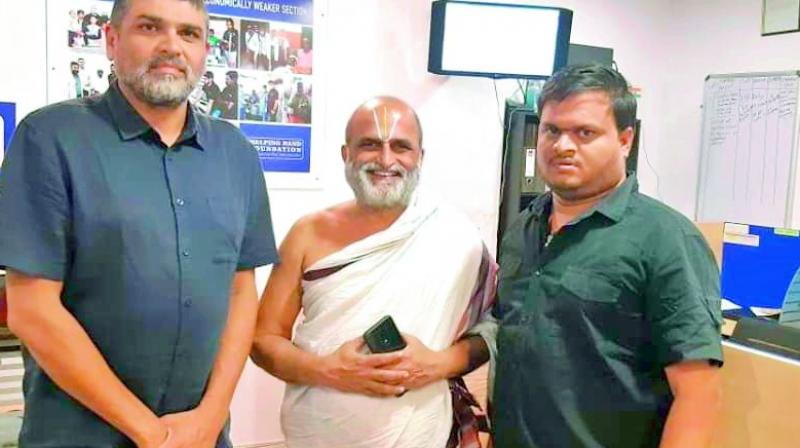
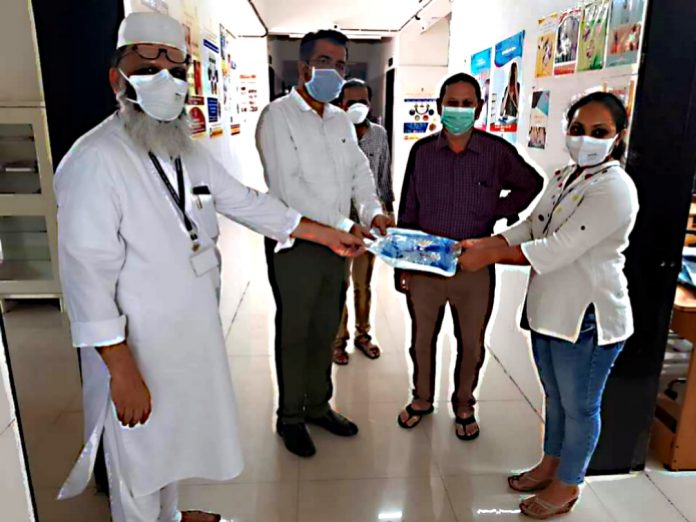
Mujtaba Hasan Askari with C.S. Rangarajan
Despite differences in their faith, culture, attire and, as some would see, calling, a Hindu priest and a Muslim social worker have been making a statement in humanity as they work together to foster love and goodwill. The polarisation they witness around them appears to be of no consequence to the duo.
C.S. Rangarajan, chief priest at the Chilkur Balaji Temple in the city, and Mujtaba Hasan Askari, of Helping Hand Foundation (HHF), have been working ceaselessly to give communal harmony a chance. They’ve been doing their best in promoting shared values and upholding the doctrine of ‘unity in diversity’ through well thought-out programmes.
“Our aim is to ensure that human values are placed above religion and faith. Humanity is the biggest religion,” they say in unison.
The divine intervention Both batch mates of the College of Engineering, Osmania University, Rangarajan and Askari quit their lucrative jobs at the peak of their career to bring about social change. While the former, a social reformer who wants to purge the society of caste-based prejudices, turned to spirituality and became the chief priest at the Chilkur Balaji Temple, the latter founded the NGO Helping Hand Foundation to serve humanity in his way.
Interestingly, what brought the duo together was a deaf Dalit woman named Kamalamma, who sells flowers at the Chilkur Temple. In 2018, she tied rakhi on Rangarajan’s wrist, but it would be much later that he learns about her handicap.
Rangarajan recounts how after he learnt of her deafness, with her rakhi on his wrist, he felt duty-bound to help the woman. He quickly took Kamalamma to the Gandhi Hospital in Hyderabad, where the ENT surgeon diagnosed her with profound hearing loss and recommended a hearing aid. The hearing aid, priced at `55,000, was expensive. The local newspaper reported the story, and as luck would have it, Askari read about it and got in touch with Rangarajan to let him know that his NGO would foot the bill. The hearing aid restored Kamalamma’s hearing. “There’s no doubt. Divine intervention has brought us together,” says Rangarajan, smiling. “God operates through human beings.”
Serving God through humanity Instead of parting ways after that incident, the good Samaritans stayed in touch. They met regularly to exchange ideas on the positive work they could do for a society caught in the whirlpool of political turmoil and religious polarisation.’
Then, sometime last year, Lucas — a Lallaguda-resident — approached Rangarajan, looking for support for his daughter’s education at the St Francis College, Begumpet. The priest immediately contacted Askari, who arranged the money from HHF. Here was a Muslim NGO reaching out to help a Christian girl on the recommendation of a Hindu priest.
Since then, the duo has been working closely to promote interfaith dialogue. Clearly, for the duo, humanity is an integral part of religion, while religion is a private thing. A few months ago, Rangarajan even visited the Masjid-e-Ishaq in the Old City, where HHF runs a primary healthcare centre. There, he addressed the community on the need for communal harmony.
Rangarajan and Askari plan to promote communal harmony in a visible manner, through social work and dialogue.
In fact, in the coming days, they intend to conduct health camps by Muslim doctors in some temples and by Hindu physicians in some mosques. The idea is simple-to make a difference through the work they do, and it’s heartening to watch just that restoring peaceful co-existence, one kind act at a time.
source: http://www.deccanchronicle.com / Deccan Chronicle / Home> Lifestyle & Trending / by J.S. Ifthekhar / January 23rd, 2020
What do people like Jahanara Bibi, Zakir Hussain, Heera, Rebecca, Mansura, Reshma, Hassanujjaman, Akbar, Raju and Rahim have in common?
One, they all are residents of West Bengal; two, they are Muslim and three, immune to the communal strife reported all around, they have dedicated themselves to help the poor, the ignorant and the needy in these times of Covid-19 irrespective of their communal identity.
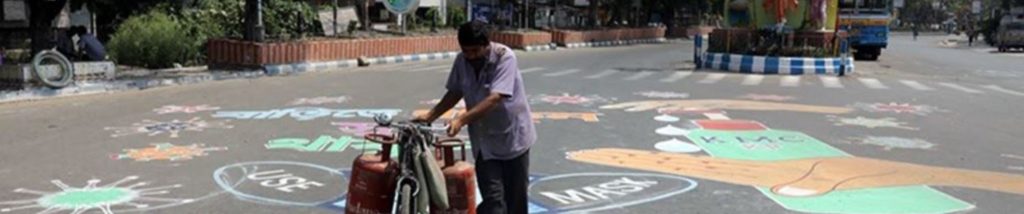
Some of them are making masks and distributing these free of cost among poor people who cannot afford to buy them, creating awareness in their respective neighbourhoods about the need for wearing masks, maintaining social distancing and staying indoors during the lockdown. They live in neighbourhoods in extended Kolkata where the majority is Muslim but Hindus live here too and there does not seem any communal strife raising its head here.
According to Arunakshya Bhattacharya of the Anandbazar Patrika (May 4, 2020), Jahanara Bibi, a housewife, who lives in the neighbourhood of Duttapukur Police Station, happened to chance upon a group of children moving about without masks during the lockdown. So, she asked them why they were not wearing masks. They chorused that they did not have the means to buy masks. She at once made up her mind to make masks herself at home with leftover pieces of cloth and distribute these for free among poor children. She personally distributed these masks to different localities in the neighbourhood. To end this happy story, her husband, Zakir Hussain, has joined her in this effort.
Explaining what motivated her, Jahanara says, “I know that people in these outskirts and suburbs areas are not aware of the importance of wearing masks and the ill effects of not wearing them. There are many who cannot afford to buy masks or know to make them, So, I took it upon myself not to make masks but also to visit homes from door to door and distribute the masks and also, if possible, to explain the importance of wearing masks when stepping out.”
Happily, other women of the community such as Heera, Rebecca and Mansura are distributing masks across neighbourhoods like Jagulia, Duttapukur, Golabadi, etc from one house to the next and also selling some masks to those who can pay.
Aamdanga is a neighbourhood crowded with people of the minority community. The same applies to Hadipur and Gorpara in Deganga. A group of women from the minority community noticed that the residents of these places were crowding needlessly in some areas, in violation of the rules of social distancing. Some were even seen chit-chatting at small tea shops.
A group of Muslim women took it upon themselves to form small groups and visit these crowded areas and counsel the locals against crowding needlessly and advising them to stay home. Reshma Tarafdar, a college student, went from door to door to advise them to stay at home and not step out during the lockdown. Some among these groups are also helping out in the distribution of free food among the poor and the very poor.
Hassanujjaman Choudhury, a young man who lives in Noornagar within Deganga, has invented an original “Food ATM” machine which carries the label “Please maintain social distancing” on its body. The very poor who cannot afford their daily meals are handed a metal token with the picture of Netaji Subhash Chandra Bose. They have to slip this token into a slot in the machine and at once, two packets of rice, potatoes, onions, soyabean and oil come out. Others involved in similar volunteer work are Akbar, Raju and Rahim who have vowed to stand beside the deprived and the downtrodden in these dark days.
These incidents come in the wake of the story of Abdul Rehman Sheikh, 30, a businessman, who, along with other Muslim neighbours, came to the aid of the sons of Draupadi Bai Verma when her sister refused to take care of her as she suspected the old woman of being a Covid-19 patient. No one was there to take her to a hospital and she died the following day. This happened in the beginning of April this year.
She lived with one son who is very poor while the other was away and could not come down when the mother was serious. They were very poor. The neighbours refused to even touch the body leave alone joining to help in the funeral rites. At this juncture, Sheikh brought ten Muslim men and came forward to arrange the cremation of the lady by Hindu rites both physically and financially.
This happened in South Toda in Indore. The old woman was suffering from paralysis for three months. According to Sheikh, her sister’s sons, who live just 100 metres away refused to step inside the house. “If she was taken to a hospital the same day, she probably wouldn’t have died,” said Sheikh. the 10 men, along with her two sons and their children, took out the procession to the cremation ground around a kilometre away.
Man-made schisms within two communities do not exist except when politicians try to ignite them for their own axe-grinding motives irrespective of the degree and intensity of the harm this igniting of hate can fall on the harmony and secular feelings the present situation demands. These are just a few examples that illustrate how Kolkata and its suburbs are being witness to the wonderful effort being put in by women of the minority community in volunteering to help people in distress, specially the economically deprived classes, with their help, without thinking about how their exposure in the public domain might place them at risk.
According to a Reuters Report in The Japan Times,(April 20, 2020), “There is no official breakdown of coronavirus cases by religion. But many Muslims feel unfairly blamed for spreading the disease after a cluster emerged at a gathering of Muslim missionaries in New Delhi last month. Sensational news coverage about the event, fanned by some Hindu nationalist politicians, helped spur the trending topic “Coronajihad” on social media.
source: http://www.thecitizen.in / The Citizen / Home / By Shoma A. Chatterji / West Bengal / May 06th, 2020
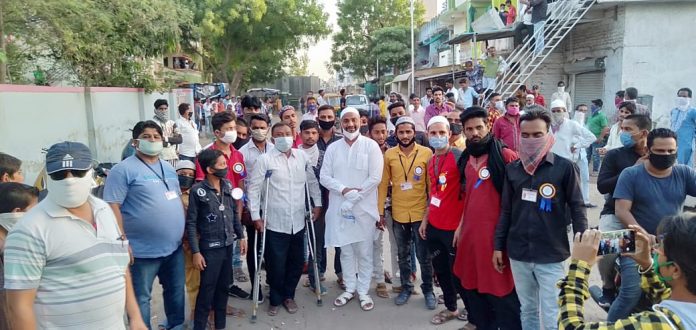
Babubhai (extreme right, with crutches) distributing ration kits to the differently-abled
Amid the ongoing nationwide battle against COVID-19 and the crisis created by the lockdown, Muslim groups in communally sensitive Gujarat have lent a helping hand to the administration, and aided scores, MAHESH TRIVEDI reports.
Gujarat :
As the coronavirus cases in BJP-ruled Gujarat spiralled to 3,548 and killed 162 people by April 29, the Muslim community of the state and voluntary organizations run by them have been silently lending a helping hand to the beleaguered state administration in fighting the deadly virus.
Muslims constitute 10 per cent of the population in this communally sensitive western Indian state. In spite of being a hard-pressed minority and having faced an anti-Muslim pogrom in 2002, the community has brushed aside its sorry state and in current pandemic has worked to bring relief to poor people of the state.
In Ahmedabad, a voluntary organization Vikalang Sahayak Kendra run by differently-abled Ghulam Murtaza (Babubhai) has not only distributed nearly 500 kits containing rice, sugar, wheat flour, edible oil, etc to widows, slum-dwellers and physically-challenged men and women but also has been providing meals once a day to homeless, besides guiding them on personal hygiene during the pandemic.
“It won’t be possible to give succour to the have-nots without financial assistance from generous donors from both Hindu and Muslim communities like Shankar Patel, Talha Sareshwala, Hanif Memon, Mohsin Memon, Akhtar Malik, Raju Patel, Ankur Patel, Ankit Patel, etc,” Babubhai told TwoCircles.net.
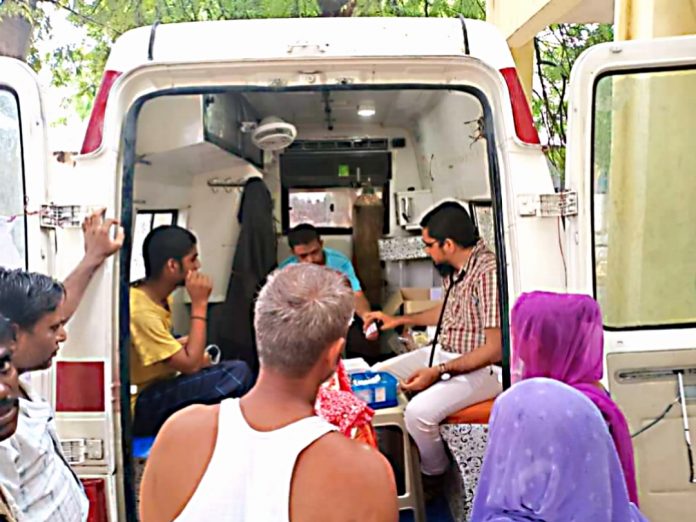
Medical check-up in a BMDA medical van
Other Muslims organizations like School of Education Campus, Chhipa Samast Jamaat, Anjuman-e-Saifee Jamaat, Qaswa Charitable Trust (Bhuj), etc have distributed hundreds of food and grains packets to needy in the ongoing lockdown.
At one of India’s largest Muslim ghetto on the outskirts of Ahmedabad in Juhapura, housing nearly 400,000 people, Muslim youth belonging to Ahmed Shah Army, an NGO took it upon themselves to sanitizing 30,000-odd houses.
Besides sanitizing the houses, the Muslim youth did not hesitate in providing free hair cuts to beggars – at least 180 of them, who had been lodged in a hostel by local authorities in Valsad in south Gujarat. The Muslim youth from the NGO also handed over two pairs of clothes to the beggar community.
Zuber Gopalani (extreme left) and BMDA members gifting PPE kits to a municipal doctor
In Vadodara, the citizens remember a benevolent Muslim auto driver Ali Hussain Udawala, who has been ferrying passengers to hospital during the lockdown without charging any fare.
Riddhi Soni, a 28-year-old visually-challenged college teacher at Rajpipla in south Gujarat, lives alone in the staff quarters and could not go back to her parents in Ahmedabad because of the shutdown. It was her neighbour and colleague Numa Ansari (26) who has come to her aid in the current lockdown.
Soni told TwoCircles.net that Ansari has always remained at her beck and call, sanitized her room, bought essentials for her, and took care of her.
With the shortage of isolation units in municipal-run hospitals in Ahmedabad to house the increasing number of suspected cases of COVID-19, Issa Foundation, which has already been running community kitchens, offered its three buildings as quarantine facilities with 1,200 beds and also offered to bear food expenses of patients and medicos.
In Baroda, where the services provided by the 300-member Baroda Muslim Doctors’ Association (BMDA), headed by chairperson Dr Muhammed Husain is earning them laurels.
BMDA chief Muhammed Husain prescribing medicines to a senior citizen
Ever since the government enforced the lockdown, BMDA has organized free medical camps, launched blood donation campaigns, and joined hands with the Vadodara municipal corporation in preventive and curative interventions to boost its anti-virus drive.
Husain told TwoCircles.net that 150 dedicated doctors of the association have been risking their lives by conducting door-to-door surveillance in COVID-hit areas declared as ‘danger zones’ in the cultural city.
Ever since BMDA was set up in 2012, the association, besides organizing events for medicos, has also been carrying out a number of social activities for the underprivileged to bring the marginalized into the mainstream.
BMDA has done this by promoting academic scholars, helping high-school drop-outs to join skill-based learning, starting reading rooms in slums and semi slums, free malnutrition check-ups and so on.
According to Zuber Gopalani, famed social activist and educationist, BMDA’s biggest achievement came recently when an expert group from the federal government lauded the invaluable services rendered by the doctors and paramedics of the association at an ideal COVID-care centre at the Ebrahim Bawany ITI Hostel in Vadodara.
“BMDA medicos threw their full heart and soul into this COVID care centre while working with the civic body’s health team, regularly examining the patients’ blood sugar, blood pressure, temperature, etc and monitored their hygiene and sanitation. The result was that for the first time in India as many as 45 COVID-19 patients were completely cured within 10 days and discharged together from one single care centre”, Gopalani said.
source: http://www.twocircles.net / TwoCircles.net / Home> Indian Muslim> Lead Story> Pandemic / by Mahesh Trivedi for Twocircles.net / April 30th, 2020
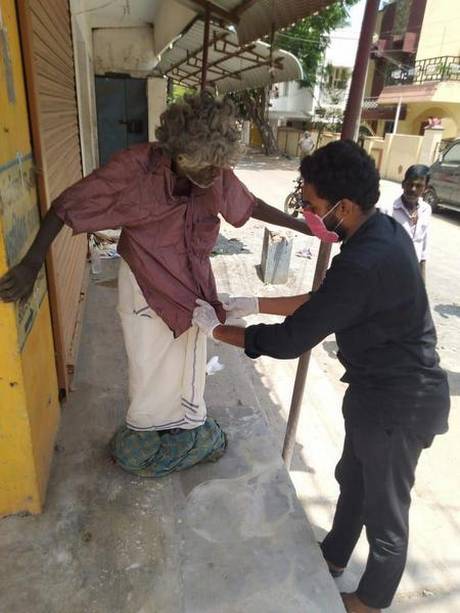
A homeless man being helped by a volunteer | Photo Credit: Special Arrangement
A trust started by a 24-year-old helps bury unclaimed bodies and takes homeless persons with injuries to government hospitals and shelters
A few weeks ago, Suseela, a 60-year-old homeless woman in Gaudiya Mutt Road, sustained a grievous injury on her head, and as she left it unattended, maggots formed in the wound. Similarly, Jeeva, a 70-year-old homeless man in Tambaram, with injuries on his legs, could not get medical attention. Luckily for them, 24-year-old Khaalid Ahmed came to their rescue during the lockdown. He, along with few other volunteers, cleaned their wounds, took them to nearest government hospitals and later, helped them move to shelters run by the Greater Chennai Corporation.
Khalid Ahmed, a mechanical engineering graduate, runs a trust called Uravugal, which helps bury unclaimed bodies after getting proper police and medical clearance. He has been running this trust since 2017 and has buried more than 800 bodies till date. There are around 500 volunteers working for the trust.
“People, who spot injured or dead homeless people, contact us after seeing our social media page. We immediately rush to the spot and co-ordinate with the respective government departments and render the help needed,” Mr. Ahmed says .
During the lockdown period, his team has not only been treating injuries of homeless persons, but have also been burying the bodies of daily wage earners, who are left without any money due to the curfew, and also of pavement dwellers who have no relatives.
“Since March 24, we have conducted final rites for nine persons. Most of the pavement dwellers manage to get food. But many are concerned about if they will get a proper burial once they die. This prompted me to start the trust,” explains Mr. Ahmed.
Apart from this, he has also helped three patients reach their hometowns. “We have our own ambulance for this purpose. Recently we shifted a pregnant woman to Jipmer, Puducherry,” he adds.
A senior police officer said that it was a very good initiative. “But if they do it in co-ordination with government, it will be more efficient,” he added.
source: http://www.thehindu.com / The Hindu / Home> News> Cities> Chennai / by Vivek Narayana / Chennai – April 18th, 2020
The superstar’s decision to donate his office comes just a couple of days after he made huge contributions to the government to aid the battle against the COVID-19 pandemic.
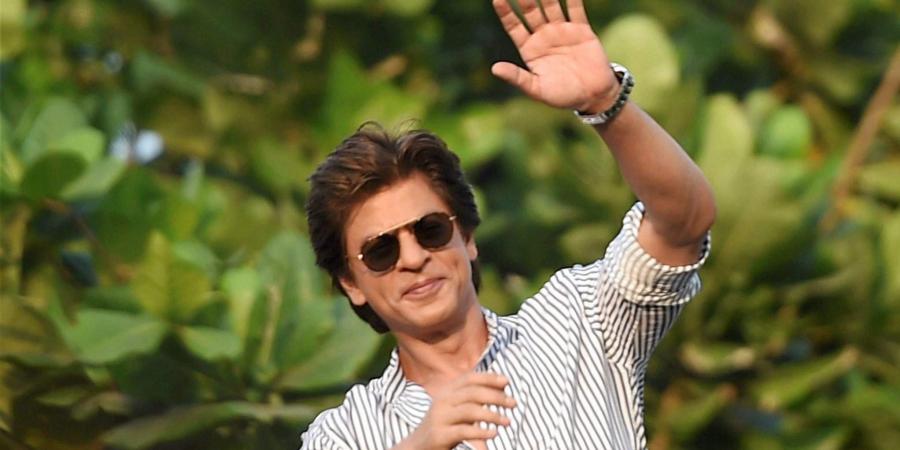
Bollywood actor Shah Rukh Khan (File Photo | PTI)
Mumbai :
Bollywood superstar Shah Rukh Khan and his wife Gauri have offered their four-storied personal office space to Brihanmumbai Municipal Corporation (BMC), to be utilized as a quarantine facility for women, children and the elderly. This comes at a time when the nation along with the rest of the world is battling the deadly COVID 19 pandemic.
Thanking the Bollywood superstar and his wife for their act of generosity, BMC shared on social media: “#StrongerTogether We thank @iamsrk & @gaurikhan for offering their 4-storey personal office space to help expand our Quarantine capacity equipped with essentials for quarantined children, women & elderly. Indeed a thoughtful & timely gesture! #AnythingForMumbai #NaToCorona.”
We thank @iamsrk & @gaurikhan for offering their 4-storey personal office space to help expand our Quarantine capacity equipped with essentials for quarantined children, women & elderly.
With 10.5K TESTs, #FlattenTheCurve is the mantra adopted by @mybmc since 3-Feb!
4K #HomeTests so that you #StayHomeStaySafe
Thanks to @mybmc Docs & Pvt Labs in Mumbai, we’re grateful to contribute to India’s efforts at testing 43K#ProudToProtect#AnythingForMumbai#NaToCoronahttps://twitter.com/mybmc/status/1246130737620779010 …
The superstar’s decision to donate his office comes just a couple of days after he made huge contributions to the government to aid the battle against the COVID-19 pandemic.
SRK, through his IPL franchise Kolkata Knight Riders (KKR), has committed to contribute to the PM-Cares Fund. Through his film production banner, Red Chillies Entertainment, he will give to the Maharashtra CM’s Relief Fund.
The superstar has also pledged Personal Protective Equipment (PPE) for healthcare providers and workers in Maharashtra and West Bengal.
SRK’s Meer Foundation along with the foundation Ek Saath will provide daily food requirements to over 5500 families for at least a month in Mumbai. Meer Foundation is also collaborating with Roti Foundation to provide meals to underprivileged people and daily wage laborers.
source: http://www.newindianexpress.com / The New Indian Express / Home> Good News / by IANS / April 04th, 2020
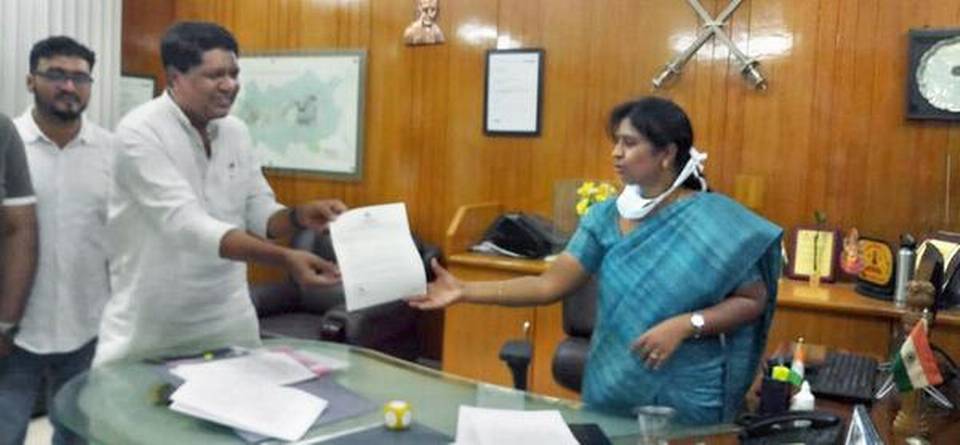
Managing Director of Hotel Metropolis handing over a letter to Deputy Commissioner Deepa Cholan in Dharwad on Tuesday offering 46 rooms of his hotel for quarantine purposes.
At a time when apprehensions about the spread of COVID-19 pandemic are increasing, a hotelier from Hubballi has offered a total of 46 rooms in his lodge for quarantine purposes of those who have returned from foreign countries.
Apart from providing 46 rooms in one section of Hotel Metropolis on Koppikar Road in Hubballi, Managing Director of the hotel Ashraf Ali Basheer Ahmed has offered to provide food to those quarantined.
Mr. Ashraf Ali handed over a letter on offering rooms for quarantine purposes to Deputy Commissioner of Dharwad Deepa Cholan here on Tuesday. Lauding the initiative by Mr. Ashraf Ali, Ms. Deepa Cholan termed the act of the hotelier as a model one.
Mr. Ashraf Ali requested Ms. Deepa Cholan to send a team of officials to inspect the hotel. He said that the Metropolis Group had already handed over 70 rooms owned by the group near the international airport in Mumbai to the Government of Maharashtra. The hotel group had taken up the initiative under its CSR activities, he said.
source: http://www.thehindu.com / The Hindu / Home> News> States> Karnataka / by Special Correspondent / Hubballi, March 25th, 2020
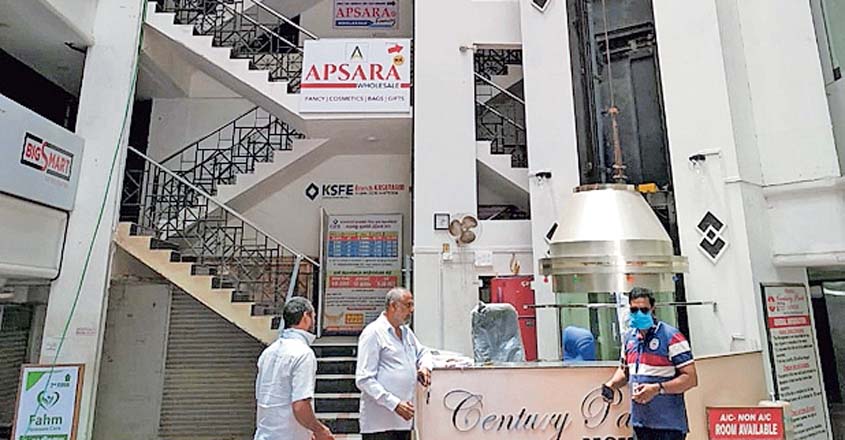
The Century Park building near the new bus stand in Kasaragod would be handed over to the authorities to be converted into an isolation ward
Kasaragod:
Even as authorities struggle to find accommodation facilities for quarantined people amid COVID-19 outbreak, responsible citizens have offered to help.
C I Abdullahkunji of Kudlu in Kasaragod district has informed the authorities that his three-star hotel can be used as an isolation facility for free.
The Century Park building near the new bus stand in Kasaragod would be handed over to the authorities. Eighty-eight rooms of the top three floors of the seven-storeyed building would function as isolation ward.
The daily rent of one room is Rs 1,500.
All rooms have two beds each and the bathrooms have geyser facilities. The hotel has a water tank with a storage capacity of 45,000 litres.
The hotel owner said the necessary precautions have being taken. The water tank has been sanitised and filled up. The hotel premises have also been cleaned.
Municipal secretary S Biju, and deputy DMO Dr Geetha Gurudas carried out an inspection at the building.
source: http://www.english.manoramaonline.com / OnManorama / Home> Districts> Kasargod / by Manorama Correspondent / March 27th, 2020
Taking up the challenging task of achieving unity and tolerance
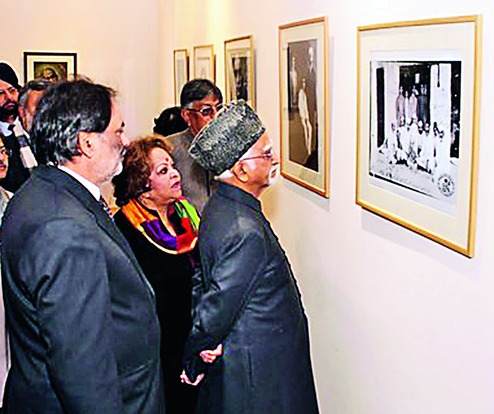
M.H. Ansari viewing an exhibition on Mukhtar Ahmad Ansari at the M.F. Hussain Art Gallery, 2015
Fifty-six is no age to die. Mukhtar Ahmad Ansari, MD, MS, with a tall reputation in London’s Lock Hospital and Charing Cross Hospital, and ‘free Doctor’ to uncountable poor in Delhi, was on a train bringing him back to his hometown, Delhi, from Mussoorie where he had gone to treat the Nawab of Rampur when, on May 10, 1936, a heart attack – his first and fatal – took him away. He was four years short of sixty.
Doctors are human and death’s sudden grasp comes to medical luminaries just as it comes to ordinary mortals. Ansari must have been in some disbelief at his heart’s capitulation. But his death shocked a whole world beyond himself, a world of grateful and trusting patients, former patients, friends, families of patients, countless Congress and Muslim League leaders who were his patients, some of them, and fellow freedom fighters, all. For he had been more, incredibly more, than the ‘good Doctor sahib‘. He had been, for over two decades, a political guide and pathfinder to all those who believed in India’s plural integrity and in India’s destiny as a leader of progressive causes globally.
The Balkan War in 1912 saw 32-year-old Ansari lead a medical team from India to Turkey to help wounded Turkish forces in what was not just a humanitarian act but one that formed lasting bonds, as the medical mission of the doctor, Dwarkanath Kotnis, to China in 1938 during the Sino-Japanese war was to do. The Kotnis Mission has been the subject of a film, Dr. Kotnis Ki Amar Kahani by V. Shantaram, for which K.A. Abbas wrote the script. A film has to come on Dr. Ansari Ki Amar Kahani about that mission’s work. Mrinal Sen could well have made such a film a decade ago but perhaps Javed Akhtar or Shyam Benegal will yet do it, for it cries out, filmographically and civilizationally, to be done.
M.A. Ansari’s life as such needs to be known, not for his sake – he is beyond the reach of recognition or neglect – but ours. Being invited to play a constructive political role in the formulation of the Lucknow Pact between the Congress and the Muslim League in 1916 and to preside over the Muslim League’s sessions in 1918 and 1920, Ansari emerged as a sturdy champion of the Khilafat Movement and Hindu-Muslim unity.
His commitment to that cause soon steered away from League politics, the separate electorates idea and all that was to lead to the demand for Pakistan. This resulted in his becoming inevitably, a general secretary of the Indian National Congress in 1920, 1922, 1926, 1929, 1931 and 1932 and in 1927, its president. A former president of the Muslim League becoming president of the Indian National Congress? Incredible, but incredible things did happen in Gandhi’s and Nehru’s India.
Drawing close to the Mahatma’s eclectic nationalism, Ansari became Gandhi’s ‘Delhi host’ in his old Delhi manor called ‘Darussalam’ and physician to members of Gandhi’s family, including his grandson, Rasik, son of Harilal Gandhi, who contracted typhoid in 1929 while on a visit to Delhi (from eating roadside jalebis, as Rasik himself explained) and in spite of Ansari’s valiant efforts, could not be saved. Gandhi was touring the North West Frontier at the time. Ansari sent him a telegram conveying the news. Gandhi steeled himself. “I loved the boy,” he wrote, “I had placed high hopes on him…” The trauma brought the doctor and the Mahatma closer to one another.
Ansari was instrumental in the founding of the Jamia Millia Islamia, and bringing to it a whole host of nationalists, Muslim and Hindu, to learn and to teach. In return for learning Urdu, Gandhi’s youngest son, Devadas, was recruited to teach the Jamia spinning. Ansari was Jamia’s chancellor when he died.
Liberation from mutual animosity and mistrust among Hindus and Muslims was for him a passion. Ansari was, to use an old-fashioned phrase, a man of God. He was also a man of Science. His being a man of science doubtless had something to do with his harbouring his eminently rational goal of wanting Hindus and Muslims to live in civilized amity, not conflict.
As it happened, on the very day Ansari died, Gandhi was meeting in the Nandi Hills, near Mysore, India’s most famous man of science, Chandrasekhara Venkata Raman. If a man of god can be a man of science, a man of science can be a man of god.
Raman to Gandhi: “The growing discoveries in the science of astronomy and physics seem to me to be further and further revelations of God. (But) Mahatmaji, religions cannot unite. (Only) Science offers the best opportunity for a complete fellowship. All men of science are brothers.”
Gandhi to Raman: “What about the converse? All who are not men of science are not brothers?” ( The Collected Works of Mahatma Gandhi, Volume 62, pages 387-9)
Within a few hours of this conversation, M.A. Ansari, man of science and of god, brother to all who came in contact with him personally, professionally or politically, lay dead in his railway coach.
Gandhi had gone to the Nandi Hills with Sardar Patel, among others, for a ‘health’ sojourn at Ansari’s behest. When the news reached him the next day, he was stunned. Penning a tribute for the Associate Press, he described him as “the poor man’s physician if he was also that of the Princes” and said, “His death will be mourned by thousands for whom he was their sole consolation and guide.” He added: “…He was my infallible guide on Hindu-Muslim questions. He and I were just planning an attack on the growing social evils.”
An attack on social evils. Strong words, scorching words. What was the biggest ‘social evil’ that Gandhi was exercised most about in 1936? Hindu-Muslim mistrust.
He needed a guide from among the Muslim community to tackle this. And, with Ansari, that guide was gone. At a loss to find a successor he turned first to Zakir Husain. “I ask, will you take Dr Ansari’s place?” On Zakir Sahib not agreeing, he turned then to Maulana Azad for that crucial assistance. It is entirely reasonable to suppose that had Ansari lived he would have played a defining role as a symbol, spokesman and strategist for Hindu-Muslim unity in the Constituent Assembly and then, very probably, in 1950, become president or vice-president of India. He would have been only 70, the age at which his grand-nephew, Mohammad Hamid Ansari, first became vice-president of India.
What was the main concern – ‘social evil’ – forcefully, passionately expressed in Vice-President Ansari’s farewell address to Rajya Sabha? The challenge to Hindu-Muslim unity, pluralism, not as mere ‘tolerance’ but in Netaji Subhash Chandra Bose’s words: cultural intimacy.
We know what Vice-President Ansari, descended from that great name in Indian pluralism – Dr M.A. Ansari – who rejected everything that led to Pakistan, has received by way of a ‘reward’.
Seventy five years after the Quit India Movement, 70 years after Independence, we the people of India, brothers and sisters in plural mutuality, must tell the shatterers of India’s unity, Hindu, Muslim and other: Quit, quit terrorizing India.
source: http://www.telegraphindia.com / The Telegraph, online editon / Home> Opinion / by Gopalkrishna Gandhi / August 22nd, 2017
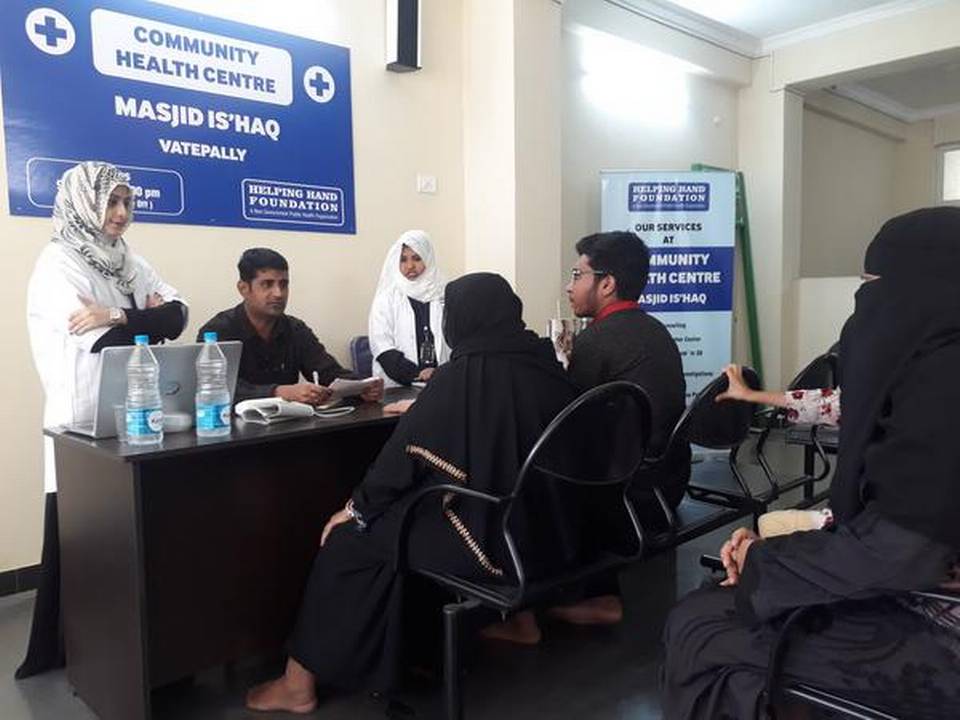
For the needy: Patients consulting a doctor at Masjid Ishaq at Achireddy Nagar in Old City on Saturday
Masjid Ishaq throws open a clinic for urban slum-dwellers
From the outside, the Masjid Ishaq at Achireddy Nagar in Old City looks like any other mosque. It has a mihrab, or a niche in a wall form where the Imam leads the prayer, and musallis or congregants are seen performing their ablutions and praying on the rows of prayer mats. But a closer look reveals that there is something more to this place of worship than meets the eye. In perhaps a first for the area, the masjid has thrown open a clinic for urban slum-dwellers, irrespective of caste, gender or religion.
The clinic is a collaborative effort of the Masjid Managing Committee, headed by brothers Fayaq Khan and G.M. Khan, and Helping Hand Foundation (HHF), an NGO.
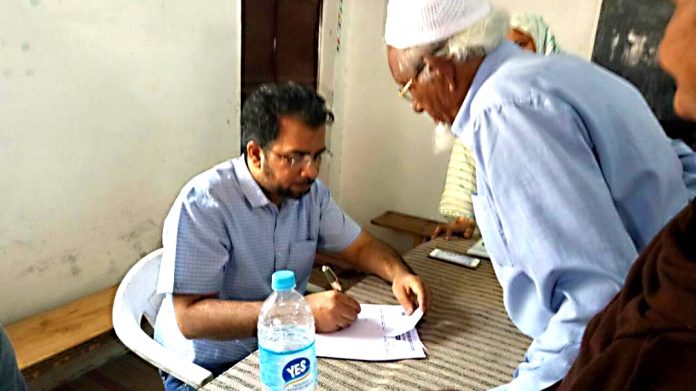
“We wanted to dedicate a space inside the masjid for the clinic where people from weaker sections of all religions can come for free treatment and guidance on healthcare. While the masjid was constructed two years ago and sees around 400 people on Fridays, the clinic is new and is spread over approximately 1,000 square feet. Since HHF has been working in the field of healthcare, we agreed to work with them,” says Fayaq Khan. According to HHF founding trustee Mujtaba Hasan Askari, the clinic has been informally functioning for about 10 days now. It was launched on Saturday. The clinic runs from 9 a.m. to 4 p.m., except on Fridays and Sundays.
Mr. Askari says, “A counsellor-doctor and nurse will be available at the clinic. It will also serve those who need home care. Several people are unable to go to hospitals, say for changing bandages and other minor treatments. The clinic will look after such cases as well.”
Apart from home care, Mr. Askari says the clinic also offers free physiotherapy, wound management and maternal care.
While free healthcare services are provided here, the larger aim, he says, is to ‘link’ patients to government hospitals and the government healthcare system. Thus, the clinic would also serve as a ‘referral centre’. Patients would be transported to the area hospitals or larger ones, depending on the nature of the case.
“Many urban slum-dwellers cannot afford to pay for the trip to hospitals, leave alone pay for medication. Apart from our two vehicles, we have engaged local auto-rickshaw drivers to transport patients,” Mr. Askari says.
source: http://www.thehindu.com / The Hindu / Home> News> Cities> Hyderabad / by Syed Mohammed / Hyderabad – November 10th, 2018
Faith healing is a scientifically accepted way-out. In Srinagar outskirts lives Abdul Qadir who treats more than 15000 patients a month and is considered a key healer for jaundice, reportsIrtiza Rafiq
Abdul Qadir
The plasma screen at Srinagar International airport shows the arrival of the Delhi- Srinagar flight and the lounge gets instantly active. Among the curious mixture of excited and bored arrivals, Ruqaya, a 33-year-old woman with her pale yellow face, sunken cheeks, and a feeble body stands out. Accompanied by her husband Javaid, 37, as she makes her way out of the airport, her anxious relatives waste no time in elaborate greetings. Flying straight from the USA, the couple is literally bundled into the car and their journey started towards Syedpora (Dhara) in city outskirts.
After a drive of around 29 km, the couple gets off, pass a small bridge across a shallow, crooked, clear, stream, walk down some narrow alleys and enter a house. In the time Ruqaya waits with dozens of other women, most of them mothers with children nestled up in their arms in a compound brimful of multifarious people, Javaid proceeds towards a chaotic, almost endless queue at a congested staircase where scores of people are nudging each other to pass their Rs 10 note for the exchange of a stamped paper piece from a 40-year-old man upstanding at the middle of the stairs. There is another man at the foot of the staircase for crowd control.
The scene resembles the representation of a shrine where followers with raised hands propel each other to get a touch of some higher deity or a sacred thing. The chit for which they are struggling for is their ticket to cross the stairway. This stairway crossing is heavenly for most of them because it leads to the Bab, the ‘spiritual healer’.
For the last five decades, the septuagenarian Bab has been treating all kinds of ailments, at his residence, a quiet and picturesque place, almost 2.5 km from Harwan.
The influx of patients can be gauged by the fact that the Reshi abode comprises three houses: one where the family lives, second where the patients wait for their turn and the third where Abdul Qadir Reshi, the Bab examines and treats his patients.
The room of the treatment-building is jammed by people, among yellow faces, crying neonates, ailing individuals, on the left corner, Bab sits on a bed at a slight elevation with his youngest son Abdul Ghani Reshi. In between them is a large copper bowl of water, on their either side various bottled up solutions, some powders, and in the front, lies a knife and a leather belt.
Khadija, 65, a woman from Rajbagh approaches him with her eight-day-old granddaughter having 7.68 mg/dL bilirubin level, Bab takes hold of baby’s clothes, lays her in front of him, squeezes her nipples, sprinkles handful of water from the copper bowl on her and then slowly rubs her forehead, eyelids all the while muttering something under his breath. He then hands the baby over to Khadija and asks her to make sure that her mother doesn’t eat oily or non-vegetable food. Interestingly, Khadija reveals that the mother of the kid is herself a doctor but has a firm belief in the healing powers of Bab. The medico mom didn’t comply to the paediatrician’s suggestion of exchange transfusion (blood change).
The certitude of this kind doesn’t come as a surprise, for Bab has treated thousands of people. Some of them approached him after they keenly heard their treating doctors telling them: “There is nothing more we can do”. But somehow after following Bab’s prescription, some of these people managed to do the unexpected − they lived, fully treated.
For 55 years and counting, sort of miracles have been happening around this solemn looking spiritual healer who credits it all to the Almighty. “I have been bestowed upon by the knowledge and ability by God that I can say by looking at a person what he is suffering from, particularly jaundice patients, one look at them and I can tell if they will make it or not,” Bab said after managing his patients. “It is a vision by God; the verses I read have a healing effect in them so the healing comes from God.”
This peculiar wisdom runs in the Reshi family and has been transferring from generation to generation. The story of this bequeathed enlightenment started when a spiritual healer from Kabul had a dream, so goes the family legend, wherein he was commanded to visit Mulfak, a neighbouring area of Syedpora, which is known to be home of peers. Once there, he spent a night and went touring adjoining areas escorted by a peer from Mulfak. When he saw ancestors of Abdul Qadir Reshi working in paddy fields, he told his escort, according to Bab’s son Abdul Gani Reshi, “Go back I have got what I was looking for. From that day, he resided with my great-grandfather and passed him his saintly knowledge,” said Reshi Jr.
“But we were warned by our spiritual teacher against being greedy,” Gami said. “So we do not take any money except on Sundays when we take Rs 10 from people and that too for Darsgah and charity. On the contrary, we provide tea and refreshments to visitors.”
Every day, up to 600 patients visit the place, and on Sundays, the number crosses 1000 people, all of whom are treated free of cost by Bab who does it as a social service. He and his family make their living out of their orchards and are financially well off.
“Except for gallbladder stones, everything is treated here,” claims Gani, and he then goes to name the ailments they take care of : Sorphtoph (snake bite), Gunstoph (cobra bite), Arkhor, Hounchop (dog bite), Malder (Herpes), Diabetes, Kambal (jaundice), psoriasis. “We deal with everything but a lot of cautiousness must be exhibited on our parts and we should abide by guidelines of our forefathers. Once my uncle made some mistake and as a consequence, he had a brush with death. This is like a sword hanging on our heads we have to be vigilant at every step.”
This guarded approach is quite evident from the way Bab instructs his son while he prepares herbal remedies and writes prescriptions for patients, even whilst himself dealing with a Malder (Herpes Zoster) patient, Fatima, 55, from Shalimar by dragging and flipping the knife over her lesions. He is doing the shoving and thrusting amid the surging crowd. Angry, he finally uses the leather belt and whips it over the unruly assemblage.
Family’s makeshift shop selling the prescriptions is run by his younger son, Ghulam Masood Reshi and grandson Rayees Ahmad Reshi. Even though it’s not mandatory for people to buy their stock from this shop, still they prefer it, because patients are patiently helped to understand how to follow their prescription. Bab’s prescriptions usually comprise of 80 per cent of herbs and 20 per cent of Hamdard products. Rishis say they take great care that herbs are genuine and hire peasants to handpick them.
People waiting outside Abdul Qadir ‘s abode.
“These unadulterated herbs when used in treatment do wonders,” Masood Reshi said. “There is a specific herb Wagan which heals the bite of rabies dog, without any need of injections, another herb, Sumbloo and Kawidarh Moul, helps to treat blood cancer, diabetes, cholesterol, and thyroid. Yet another herb, Jogi Patsah, found in dog free area of Ladakh aids in treating kidney and ovarian cysts. For jaundice patients, we use a rare herb called Michre Komal. The market value of these herbs is in thousands but we sell them at Rs 600 at the maximum.”
More diverse than the herbs here are the people who flock around Bub. People from all parts of Kashmir, urban as well as rural, from all socio-economic backgrounds, pin the hope of their healing on Bab, but what is more captivating is that people from different religions have belief in him as well.
Jaswant Singh, 60, brings his son, Gurpal Singh, 24, with some throat allergies and Bab after prescribing the medicines holds his turban and reads verses from Quran. This presents a quite peculiar sight.
= A month later, Bab informed this reporter that a non-resident Kashmiri couple from the USA have also come to him for a treatment. In the USA, she was diagnosed with severe jaundice. Her bilirubin count was 65 mg/dL, a level that has the least chances of recovery as per medical sciences. She and her husband then decided to return home, maybe they were preparing for the worst.
But back home, Ruqaya’s family wanted to try for the last time for which they travelled straightaway from Airport for Bab’s consultation.
After twenty days of Bab’s treatment, Ruqaya recovered and then left for the US along with her husband happily.
(Names of patients mentioned in this story have been changed to protect their identities.)
source: http://www.kashmirlife.net / Kashmir Life / Home / by Irtiza Rafiq / October 03rd, 2018