Category Archives: Green Products

In defence of Kashmir’s unpopular poplars

JAMMU & KASHMIR  :

A horse-drawn cart goes past poplars on a highway at Narbal, 15 km north of Srinagar.

Srinagar :

Mathematician Fozia Qazi has undertaken a campaign to protect the trees that are in danger of being axed in large numbers in the valley.

With around 16 million poplar trees facing the axe in Kashmir Valley following a High Court order, noted mathematician Fozia S. Qazi has started a campaign to “dispel the myths” that led to the systematic felling of the trees synonymous with the Valley landscape for decades.

In 2014, the Jammu and Kashmir High Court first banned the sale, purchase and plantation of female Russian poplars (Populus deltoides) following a public outcry and medical warnings that their cotton shedding laden with pollen, during late spring was the main cause of allergies in Srinagar.

Chopped down

Thereafter, lakhs of poplar trees were cut down across the Valley. A compliance report submitted to the court by the Deputy Commissioners of Kulgam and Pulwama district in June this year claimed that it targeted felling of six lakh poplars.

Dr. Qazi, Associate Professor of Actuarial Mathematics at Islamic University of Science and Technology, believes that the High Court’s decision to fell poplars is not only an “exceptional exercise but also a misinformed decision.”

Dr. Qazi, who is filing a petition before the court against the felling, has organised a meet of experts to collate scientific data on the subject and create mass awareness.

Backing Dr. Qazi’s contention that poplars are not the main cause of allergy in Kashmir during April and May, Dr. Dr. Naveed Nazir Shah, Consultant and Assistant Professor at the Department of Chest Medicine of the Government Medical College, Srinagar, said: “Poplar-induced allergy stands at number six as a cause of allergy. While dust remains the main cause, it is followed by lawn grass, deodar, kikaarand chinar pollen.

“Also, the size of its cotton is big enough to enter human body. There is no connection to prove that the poplar was the main cause of the allergies.”

Instead of felling the trees, Dr. Sajad Gangoo, an expert from Sher-i-Kashmir Institute of Agricultural Sciences, argues that pruning these trees during autumn would cut down cotton circulation by 80 per cent in spring.

Key to rural economy

Dr. Qazi, a doctorate from the Syracuse University in the U.S., argues that poplar trees are central to rural economy here.

“The tree grows faster [than the local species]. It’s a source of livelihood for many because fruit boxes are made of it,” she pointed out and said that while “it consumes water, purifies it more than any other tree and could be helpful for water bodies too.”

Poplars live up to 40 years and mature in just three years. They attain height up to 20-30 feet.

“Given its height, poplars stand distinctly in the landscape of Kashmir and dot most highways, forming a mesmerising canopy and fast becoming a tourist attraction too,” Ms. Qazi said.

source: http://www.thehindu.com / The Hindu / Home> National> Other States / Peerzada Ashiq / Srinagar – June 24th, 2016
Engineers come forward to support distressed farmers

Hyderabad, TELANGANA :

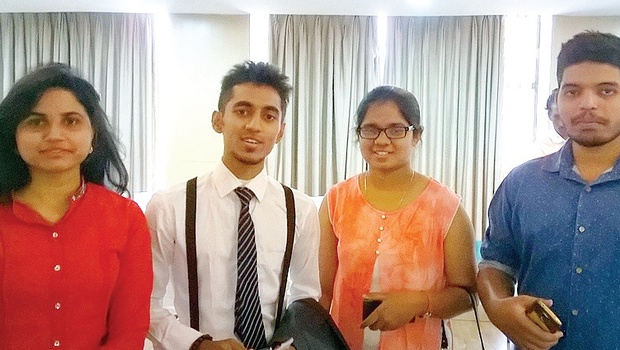
The quartet who are part of the start-up Toe-Up | Express Photo

Hyderabad :

Concerned over the plight of farmers, whose fortunes depend on the vagaries of weather, four engineers have shouldered the task of developing an app to help them out.

S Saquibuddin, Shaik Mukheet, Neha Bandari and Asma Fatima, working at the T-hub in Hyderabad are in the process of developing ‘Niyantran’, an app to provide crop related information to the farmers and help them seek help of experts for better yield.

“Initially we wanted to create an identity for ourselves and decided to take the startup route instead of a waiting for a job. As agriculture is the most neglected sector in spite of being the most important one, we decided to concentrate on this area. As we came to know about the plight of farmers, who land in debt-trap due to vagaries of weather, we decided to develop an app for the farming community,” said S Saquibuddin, CEO and co-founder of the startup christened ‘Toe-Up’.

Saquibuddin, Mukheet and Neha have graduated from Institute of Aeronautical Engineering, Dundigal and being aeronautical engineers they have experimented the use of drones to monitor crops. But as it proved unviable due to practical difficulties and cost factor, they have decided to come up with a more convenient and easy tool for farmers.

“After downloading the ‘Niyantran’ app, farmers can seek expert opinion regarding the problems they face in farming. They can click the picture of the plant or crop affected by pest or other problems and send it to the experts. He will immediately receive guidance from experts regarding pest control. They can even record their voice and send it like in WhatsApp for information and guidance,” explained Neha.

The quartet has been working on the app for the past eight months and it will be ready for launch in a month.

While these youngsters are not keen about financial returns through this app, they are ambitious about building a profile to catch the attention of venture capitalists and investors. The start up received a shot in the arm as NASA selected it to conduct its space app challenge in Hyderabad.

“Besides being selected for T-Hub we are also part of Collab House, co-working space launched by Mozilla in Hyderabad. This has given us good mentors and exposure. Our focus is on developing apps that will bring out a positive change and Niyantran is part of that effort. Once we add value and bring in a positive change, we believe that success will follow,” stated Saquibuddin.

source: http://www.newindianexpress.com / The New Indian Express / Home> Cities> Hyderabad / by J. Deepti Nandan Reddy / Express News Service / June 16th, 2016

Kerala’s farmers reap a rich plant genome saviour award harvest

Thrissur, KERALA  :

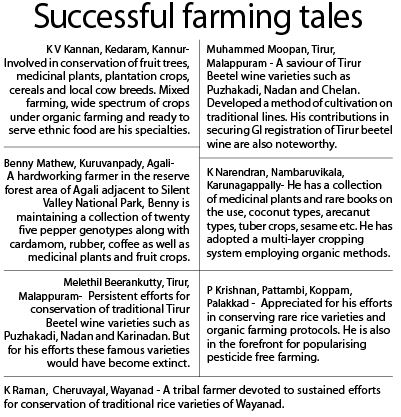
The Kerala farmers dominated the National Plant Genome Saviour Awards-2013 by winning seven out of fourteen rewards announced by the Protection of Plant Varieties and Farmers’ Rights (PPV & FR)  Authority, Government of India.

The seven farmers involved in conservation of traditional crop varieties were nominated for awards by Kerala Agricultural University (KAU).

FarmingTalesKERALA15may2016

K V Kannan ( Kannur), Benny Mathew (Agali, Palakkad), Melethil Beerankutty (Malappuram) and Muhammed Moopan (Malappuram) have been selected for Plant Genome Saviour farmer’s reward  which consists of a purse of `1.5 lakh, a memento and a citation, while K Raman (Cheruvayal, Wayanad), P Krishnan (Palakkad) and K Narendran (Kollam ) will receive Plant Genome Saviour recognition which consists of a purse carrying `1 lakh, a memento and a citation at a function to be held in Delhi shortly.

KAU Vice-Chancellor Dr P Rajendran described the seven awards as a significant acknowledgment for Kerala farming community as well as farm scientists. “Bagging seven out of fourteen awards is very special. The role of KAU in supporting such activists and helping them earn such recognition are often forgotten. I appreciate the efforts of our scientists, especially Dr C R Elsy, Coordinator, KAU IPR cell, Dr M C Narayanankutty, RARS, Pattambi and Dr M R Bindu, ORARS, Kayamkulam, who nominated these farmers,” he said.

The KAU had played a pivotal role in helping the Pokkali Rice farming Community (2011),  Akampadam Padasekhara Samithy (2012) and Ciby Kallungal of Thrissur and N Vasavan of Kannur ( 2012) win the Plant Genome Saviour Awards earlier.

source: http://www.newindianexpress.com / The New Indian Express / Home> States> Kerala / by Express News Service / May 11th, 2016

Savour the red mango, a new variety in Medak

Narsapur (Medak District), TELANGANA :

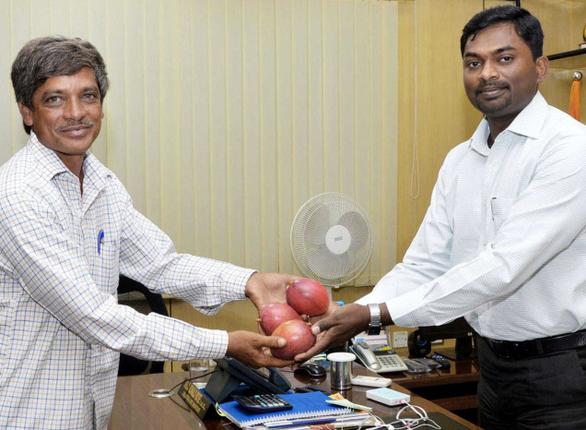
Eye-catching:(Above) Sk. Jalaludduin handing over the red mangoes to Collector D. Ronald Rose in Medak on Tuesday. The red mango sapling at his nursery.— PHOTOS: Mohd Arif

The red-coloured mango, grown by Sk. Jalaludduin of Narsapur in Medak district, was released here on Tuesday.

Mr. Jalaluddin had collected different saplings from forest area for his nursery out of which one was left to grow for a year that yielded red mangoes. Later, he started working on the mother plant and developed seedlings from that. At present, he has five mother trees and about 60 trees grown from the seedlings and he is planning to expand it to another six acres in the coming season. “Even after the harvest, the mango fruit is in good shape and has more fibre. Even the largest fruit will not be more than 300 grams,” Mr. Jalaluddin told The Hindu .

With the expansion, it is estimated that each acre would accommodate about 120 saplings under ultra high density system. He says while the cost for expansion the first year would be between Rs. 18,000 and Rs. 20,000, the annual expenditure would be about Rs. 6,000 from second year onwards. The variety was not yet named and he was in touch with the officials of the Agriculture University.

Mr. Jalaluddin met District Collector D. Ronald Rose

source: http://www.thehindu.com / The Hindu / Home> National> Telangana / by R. Avadhani / Sangareddy – May 11th, 2016

Environmentalist raises funds for drought-hit States

TAMIL NADU :


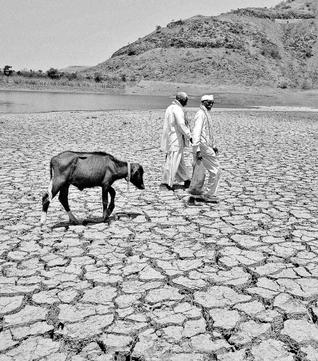
Bone dry:According to official data, over 90 lakh farmers in Maharashtra have been hit by drought. —file photo: PTI

Tamil Nadu-based environmentalist K Abdul Ghani has initiated a fundraiser through crowdfunding to mobilise resources for draught-hit people and cattle in Maharashtra, Telangana, Andhra Pradesh, Karnataka, Madhya Pradesh, Uttar Pradesh and Odisha.

Rs 5 lakh target

The target is to raise Rs 5 lakh, which will be utilised to arrange for water, food, and fodder.

Mr Ghani, who has planted over 40 lakh trees across the country, said Rs 1,000 has been collected so far. “India is facing an unprecedented draught and Maharashtra is worst-hit. It is the result of global warming and climate change. It is high time that we all woke up and protected the mother earth,” Mr Ghani told The Hindu . “The Rs 5 lakh, which we are planning to raise, may not be big, but this is the beginning. Crowdfunding will help spread the message that everyone should support the cause.”

Impact Guru, an online crowdfunding platform, is mobilising the funds through the campaign, #OutTheDrought, which has gone live, while NGO World Vision India will be reaching out to the affected with the relief.

According to official data, over 90 lakh farmers in Maharashtra have been hit. Mr Ghani said an estimated 2,58,117 households in the seven states are to be covered.

“We can mitigate the impact of the drought through collective efforts,” said Piyush Jain, co-founder and CEO, Impact Guru.

source: http://www.thehindu.com / The Hindu / Home> News> Cities> Mumbai / by Lalatendu Mishra / Mumbai – May 12th, 2016

Zarina’s charity flows freely, in Mumbai slum

 Mumbai, MAHARASHTRA :
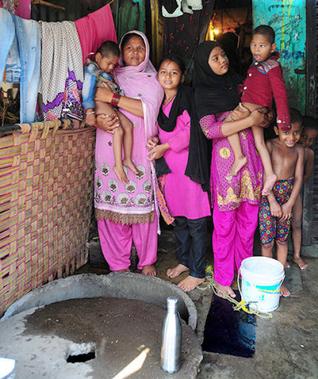
Zarina and her children along with two mentally challenged boys in Mumbai. Photo: Arunangsu Roy Chowdhury
The water mafia controls the area, but the woman of modest means is undeterred

She is an unlikely saviour for the struggling, water-starved masses in Mumbai slums. But save them she does, and without any cash reward. Zarina, mother of ten and of low means herself, provides water free to her neighbours in Indira Nagar, Mankhurd.

The entire slum here is in crisis. With no supply system in place, the residents buy drinking water as well as salt water (khara paani) from the ‘water mafia’. Khara Paani comes from numerous illegal bawries, wells dug and controlled by the toughs. This is used for washing clothes and utensils, bathing or for toilets.

Age-old bawri

Zarina has an age-old bawri with salt water at home but she doesn’t sell the blue gold. “Kyse paani beche saab? Jab Khuda ne jindegi ko mara, paani bechkar kya jina.” [How can I sell water? When almighty has taught enough lessons in life, how could I sell the water].

The woman struggles with her ten children, including the two who are mentally retarded.

Her husband has left it to her to bring up the children and the family has no means. “We do zari work at home, which brings Rs. 1,500 to Rs. 2,000 a month,” she says.

Her adolescent daughter Rukshana emerges from a room, and shows a piece of cloth on which she is doing zari embroidery. They get job work from a local ostagar (tailor), for a weekly payment based on the volume.

Zarina says her family never faces a summer water crisis since she has a well. They manage to get drinking water from outside. People living in her lane in Indira Nagar draw water during the crisis, and sometimes people from other lanes also come.

Painful grind

The water lady cannot afford to send her children to school. “What can I do, Sir? I know they are growing up without education. Moreover, two children are mentally retarded”, she says, wiping her tears.

For Zarina, life is a painful grind, but that does not stop her serving scarce water, free.

source: http://www.thehindu.com / The Hindu / Home> News> Cities> Mumbai /  by Arunangsu Roy Chowdhury / Mumbai – May 12th, 2016

Nawabi history to unfold on water screen at Husainabad

Lucknow, UTTAR PRADESH :

Lucknow :

Husainabad picture gallery pond is soon to become venue in the evening for a water screen show with fountains and laser lights depicting the history of the city since Nawab Asaf ud Daula’s arrival at Lucknow in 1775. As part of the beautification work around the Husainabad area, a water screen has been proposed with laser light multimedia projection against the backdrop of the red stoned picture gallery.

Blending technology with history, the multimedia projection will narrate story of the Nawabi era up to the British period and finally the modern Lucknow. Using laser lights projected on an aqua curtain comprising jets of water, the multimedia film would be of around 20 minutes.

“Lucknow will have a water screen show similar to what they have at Akshardham temples in Delhi and Gujarat and while mythological stories are there, the subject of the film here will be historic,” said Tracy, the consulting architect of the project.

With no visible structure in the background, the water screen creates a 3D effect with complete transparency, a fine spray of water jet allowing laser lights to form a graphic image. Apart from the water screen, a musical fountain with 72 effects of light and sound will also be beautifying the picture gallery pond.

Built by the third King of Awadh, Mohammad Ali Shah in 1839, the pond has been renovated with sandstones on the steps and both the zanana (for women) and mardana (for men) hamaam khana (enclosure for bathing and changing clothes) on either side of the pond have been restored to their original form with bricks.

source: http://www.timesofindia.indiatimes.com / The Times of India / News Home> City> Lucknow / Yusra Husain / TNN / May 03rd, 2016

Despite drought, this man provides water for free

Kalaburgi(Gulburga), KARNATAKA  :


Kalaburgi:

When the entire state is reeling under acute water shortage, a man from this village provides drinking water to his fellow villagers for free.

Asad Ali Ansari, in Nandur(K) village on the outskirts of Kalaburgi city is the man who has shown his richness of heart through his act.
AsadAliMPOs02may2016In the village, water sources have been drying up. Following water crisis, Asad came forward to help the villagers by providing them four tankers of water every day.

Asad’s initiative was inaugurated by the Zilla panchayat CEO Anirudh Sravan few days ago.

Sravan hailing Asad for his kindness, said that people should come forward voluntarily to share water in situations like this.

Gram panchayats too must provide work to farmers by resuming works under the Mahatma Gandhi National Rural Employment Guarantee Act. Works such as rejuvenation of water bodies, removal of silt from tanks, etc. will help recharge the groundwater table, he said.

source: http://www.newskarnataka.com / NewsKarnataka.com / Home> Cities> kalaburgi / May 02nd, 2016

Latur’s Good Samaritan: This man gives away 10,000 litres of water daily to help his neighbours

Latur (Marathwada region) , MAHARASHTRA :

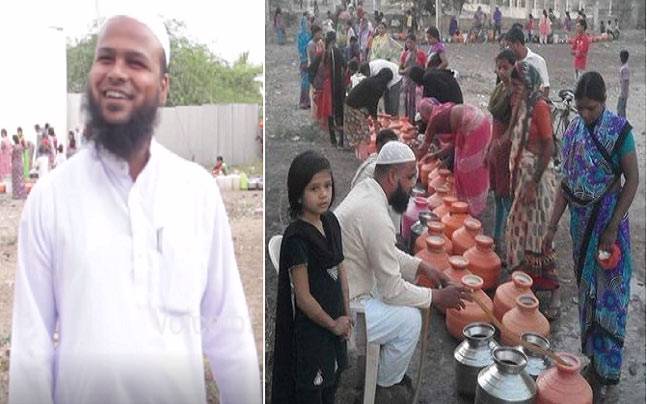
In the drought-struck land of Latur, Sheikh Mateen Musa has been distributing over 10,000 litres of water from his borewell everyday among his neighbours for the past three months. And he has been doing so free of charge.

Sheikh Mateen Musa. Source: Video screengrab

What would you do if your house was the only one with running water, while your neighbours’ taps went dry?

As you ponder over that, let us tell you the story of Latur’s Mateen Bhai.

The severe water shortage raging through Latur and elsewhere in Maharashtra has been all over the news. In this crisis, instead of locking up his borewell, Sheikh Mateen Musa has been distributing over 10,000 litres of water among his neighbours everyday.

And he has been doing that for free for the past three months.

His story was brought to light by Facebook page Voice Of Ram. In a video uploaded in this page, those witness to Mateen Bhai’s benevolent actions have no end to his praises.

“Mateen sir is not the name of a man, he is the name of action,” says one of his neighbours. ” If anyone can teach how to serve humankind, it is Mateen Bhai.”

“We ask them to take money in exchange of the water, but he sternly refuses,” says another woman about Mateen Bhai. “He tells us to take as much water as we need for free.”

A mathematics teacher in a local school, Mateen Bhai seems quite oblivious to the fame he has been garnering for his good works. In fact, he believes he has been doing nothing outstanding but just giving away what belongs to others in the first place.

“The water in my borewell may be the water others are destined to have, so they are only taking away what belongs to them,” says Mateen Bhai. “It is nothing mine to give.”

When asked what he would do if his borewell ran out of water, Mateen Bhai laughingly says, “When that happens, even I will pick up a pot and go around looking for water like others.”

https://www.facebook.com/VoiceOfRamDotOrg/videos/1274945099201465/

It is people like Mateen Bhai who remind the rest of the world that charity begins at home, and that humanity is bound by no race and religion.

source: http://www.indiatoday.intoday.in / IndiaToday.in / Home> News> FYI / by Shreya Biswas / New Delhi – April 27th, 2016