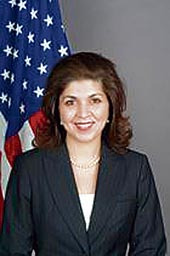
The highest-ranked South Asian in the White House traces her roots to the separatist stronghold of Sopore in Kashmir.
Farah Pandith was today appointed special representative to Muslim communities in the US state department headed by Hillary Clinton.
“This is not just an honour for our family but the entire Kashmir,” said her maternal uncle Mian Mushtaq Ahmad, a former chief engineer of the Jammu and Kashmir government.
“I spoke to her this morning and she was obviously very happy,” added the Srinagar resident.
Farah, in her early 40s according to her relatives, will be in charge of a new office that is responsible for reaching out to Muslims across the world, according to a release by the state department. They will take forward Clinton’s efforts to “engage with Muslims around the world at a people-to-people and organisational level”, it added.
Farah and Hillary : Indian connection
The Pandiths left for the US in 1970, when Farah was only four. Her father, Mohammad Anwar Pandith, is a businessman originally from Sopore, a place that has been in news for all the wrong reasons over the past 20 years. It is the hometown of Hurriyat hawk Syed Ali Shah Geelani and has been a separatist bastion all these years.
Her mother Mehbooba, from Srinagar, is a chest specialist. With their younger son, they live in Boston.
Farah, an alumni of the Fletcher School of Law and Diplomacy, has kept coming back to Kashmir over the years, her uncle said. She even did her postgraduation thesis on the Kashmir insurgency.
Earlier, she was a senior adviser on Muslim engagement at the state department, serving under the assistant secretary of state for European and Eurasian affairs.
“The last time she was here was some three years back. She was not allowed to come to this (troubled) region after that because she was working in the White House,” said Ahmad, many of whose relations are settled in the US.
The Pandiths are a respected business family in Sopore and Farah’s grandfather Abdul Samad Pandith was the first to set up a cinema there. Samad Talkies shut its doors after militants banned cinema in the Valley in 1990.
The appointment comes a year after the George W. Bush administration gave Neel Kashkari, a man of Kashmiri origin, the task of bailing out the US economy as the interim assistant secretary of the treasury for financial stability.
source: http://www.telegraphindia.com / The Telegraph, Calcutta / Front Page> Nation> Story / by Muzaffar Raina / Srinagar, June 25th / Friday – June 26th, 2009
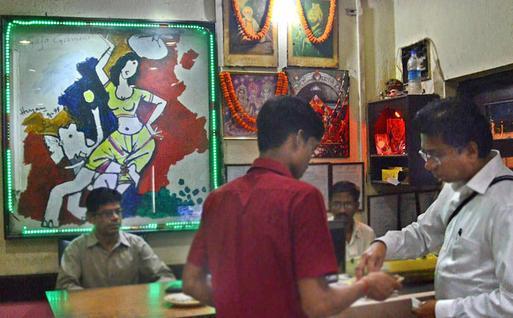
The wall of the Azad Hind Dhaba in Kolkata adorned with M.F. Husain’s Gaja Gamini. Photo: SUSHANTA PATRONOBISH
The now-famous painting, titled Gaja Gamini (one with a walk like an elephant), depicts a dancing woman, in a bright red background, while a white elephant looks on with its trunk held aloft
The memory of seeing M.F. Husain colouring one of his sketches back in 1999 is still fresh in the mind of Madan Sharma, one of the owners of Azad Hind Dhaba, a popular eatery in south Kolkata.
One fine afternoon years back, Mr. Husain walked into the dhaba, which he frequented during his visits here, and all of a sudden started adding colour to the black and white sketch on the wall that he had drawn three years before.
“The experience made me speechless,” Mr. Sharma said, on the eve of the 99th birth anniversary of the iconic painter.
The now-famous painting, titled Gaja Gamini (one with a walk like an elephant), depicts a dancing woman, in a bright red background, while a white elephant looks on with its trunk held aloft. Mr. Husain arranged a private show of his film Gaja Gamini at Azad Hind in 1999.
Sitting at the cash counter with the painting behind him, Mr. Sharma fondly recalled his memories of the famous artist. He remembers Mr. Husain as a “moody and humble person” who would come to the restaurant and sit quietly in one corner sipping his favourite “kadak chai [strong tea].”
“He did not talk much. But sometimes told me what kind of food he wants,” Mr. Sharma said. He was initially apprehensive of talking to an artist of Mr. Husain’s calibre, but eventually they became friends. “Mr. Husain could mingle with adults and children with equal ease. He was totally devoid of arrogance.” Whenever schoolchildren spotted him at the eatery, they flocked to him and asked for autographs. The world-famous painter complied with their demands with a smile and even drew them impromptu sketches.
When asked about the controversy that erupted in 2006 over Mr. Husain’s depiction of Hindu gods and goddesses, Mr. Sharma said the thought of removing the painting never entered his mind. “Nobody asked me to remove the painting even when the controversy erupted.”
Mr. Husain eventually had to leave the country under pressure from Hindu nationalist forces. He passed away in London in August 2011.
Meanwhile, the dancing woman with an elephant walk lives on happily on the central wall of Azad Hind Dhaba, in the company of numerous Hindu gods and goddesses.
source: http://www.thehindu.com / The Hindu / Home> Features> Friday Review> Art / by Soumya Das / Kolkata – September 17th, 2014
Mehmood Khan, Unilever’s global innovation head, goes back to his native village with a plan to turn it around.
Nai Nangla in Haryana’s Mewat district could be just another Indian village, ridden with the usual problems of a people trapped in poverty: Lack of healthcare and clean water, low productivity, high unemployment and illiteracy. But Haji Siddiq Ahmed, a local farmer in his late 60s, sees a different vision. “I want this village to be an adarsh (model) village. Others should look up to this village — that this is what an ideal village should be like,” he says.
The image Ahmed sees is actually taking shape in this quiet village with a majority Muslim population. What’s more surprising is the way the change is taking hold. It may be difficult to imagine the humble folk of Nai Nangla as business executives, but the cool concepts reviving the economy of the village are no less professional.
Take dairy farming, which engages nearly 80 percent of the villagers. Earlier, all they could get was Rs. 12 for a litre of milk; today they can get as much as Rs. 25. Three years ago, female literacy was at 2 percent; today, almost 85 percent of the female population can sign their names and 86 percent of the children in the district are enrolled in schools. Some women are also learning to sew and are setting up their own tailoring units. Companies like insurance provider Aviva, ICICI Bank and Larsen & Toubro are beginning to look at Mewat both as a market and as a field for recruitment. They have hired locals, offering dramatically higher incomes.
Image: Amit Verma / CHARGING UP: Memhood Khan’s plans changed Ramzaan’s life for the better. The young man treats Khan to a ride on his new motorcycle
The man behind these changes is a Nai Nangla native, someone who left the village nearly 40 years ago in search of an education and a career. His name is Mehmood Khan. Now 54, he is Unilever’s innovation head.
Now, thanks to him an experiment in introducing market economy is taking shape at Nai Nangla and the district of Mewat. An impossible feat for an outsider, but something the people of Nai Nangla have welcomed from one of their own. “Focus on education and use enterprise to bring change by leveraging resources in villages,” he says.
Khan has worked and lived in many countries over the years, making London his home for the last nine. But his link to his roots always remained alive; he would visit his village two or three times a year. He still remembers trudging a couple of kilometres to school everyday and taking cattle out to graze.
“I somehow landed a seat in university and then got into IIM-Ahmedabad. I was ejected by the system,” he says.
For the last five years, Khan has been hard at work to change “the system”.
He is converting a local resource, livestock, into a productive enterprise. He roped in the National Dairy Development Board’s Mother Dairy to spur Nai Nangla’s milk output and break the stranglehold that milk vendors had on local dairy farmers. At one time, these vendors — middlemen really — would lend money to farmers to buy milch animals.
In return, they would demand milk supply at low fixed prices until the loans were repaid. For most farmers, their income was too low to enable them to repay the debt. The result: They remained trapped in debt.
Khan was troubled by this age-old exploitation. He spoke to Mother Dairy and ushered in a new system to break this debt trap. Debt-laden farmers were given loans from institutions so they could repay the vendor and start selling direct to Mother Dairy. “Almost 25 people got loans to buy cattle, without having to pay any bribes,” says Ahmed.
Others who could repay on their own, did so and started selling to Mother Dairy for a better price. This competition forced the milk vendors to match market prices. Overall, incomes improved.
In July 2008, Mother Dairy set up milk collection centres in Nai Nangla and six other villages. In the first week, it got 70 litres of milk. Today, Nai Nangla alone gets 250 litres a day. “Gross income from agriculture has gone up from Rs. 80 lakh to Rs. 1.2 crore,” says Khan. “Milk (has become) a constant income source in a village which has seasonal income due to Kharif and Rabi crops.”
source: http://www.forbesindia.com / Forbes India / Home> Features – Beyond Business / by Neelima Mahajan-Bansal / June 05th, 2009
Kashmiri poet Agha Shahid Ali. / Photo: Special Arrangement / The Hindu
A tribute to Kashmiri poet Agha Shahid Ali on his 10th death anniversary.
Missing me one place search another/I stop somewhere waiting for you. Walt Whitman
The 10th death anniversary of the extremely talented Kashmiri poet Agha Shahid Ali (February 4, 1949 – December 8, 2001) again draws us to his poetry. Shahid’s name – the Persian “beloved” and the Arabic “witness” – is a signature of what adorned both, his life and craft. It is incredible to know how much Shahid was loved and how much he loved in return.
His poems exude the saffron of feelings, like the shaded yellow leaves of dusk. Friends, lovers, martyrs and a suffering mother overwhelm his poetry. Their voices add to his voice. Shahid is an embroiderer of language. It isn’t easy to catch him or let go as he invites you to unravel his deepest and most intricate feelings and concerns.
Need to be heard
Shahid evokes a mythical language of history, where he creates an urgent need to be heard against eras of loss. Like in the beginning of this beautiful poem, ‘A History of Paisley’: You who will find the dark fossils of paisleys/one afternoon on the peaks of Zabarvan –/Trader from an ancient market of the future,/. . . won’t know that these/are her footprints from the day the world began/when land rushed from the ocean, toward Kashmir.
Shahid’s Kashmir is a place looking for its future in the reclamation of its many pasts. In a poem dedicated to his friend Suvir Kaul, Shahid writes: We’ll go past our ancestors, up the staircase,/Holding their wills against our hearts. Their wish/Was we return – forever – and inherit…
Inherit what? The glass map of our country, says Shahid. But this country cannot be inherited without hands blossoming into fists/till the soldiers return the keys/and disappear. The soldiers must leave first, before the country can be painfully stitched back to recognition and the birds of childhood will find voice and the nameless graves will stir with names.
Shahid’s Kashmir, which he calls an imaginary homeland, echoing Salman Rushdie’s India, is nevertheless not a name attached to the idea of a nation. The word nation goes interestingly unmentioned in Nehru’s The Discovery of India, where he called India “a myth and an idea, a dream and a vision”. This appears significant today as the nation has not allowed India to dream generously and the idea of India has degenerated. The line of control has controlled India’s vision since Independence. We have to go back in time and hear how Kashmir and India spoke to each other. India should abandon the West’s language of nationalism. India should refuse to be among the “Rest” of the West’s imagination.
As Shahid asks in a poem: Will the middle class give up its white devotion? Just as Shahid learnt of Kashmir through the poetry of Lal Ded and the rishi Sheikh Noor-ud-Din, the idea of India needs to be revisited through Arab and Chinese travellers of the past, through Buddhist, Hindu and Muslim mystics, through Kabir, Bulleh Shah, Khusrau and Dara Shikoh. On lines drawn over a map of glass, looking for his other in the darkness of history, Shahid discovers the emblem of clarity: I must force silence to be a mirrorto see his voice, ask it again for directions.
Shahid, blind from the start, waits to ask his beloved adversary for directions. In his endearing letter of complaint to his other, the Hindus, Shahid mourns the severing event of their exodus. He is pessimistic about the possibilities of rapprochement: There is everything to forgive. You can’t forgive me. Shahid seems to suggest, if the other, driven by fondness (philia) and not reason, is willing to forgive, then there lies a long, shared history worth forgiving for.
Fate of Kashmir
As a poet of Kashmir’s struggle for dignity, Shahid paid his tributes and condolences to its martyrs and upheld their innocence. He attested fortune’s shame on the death of 18-year-old Rizwan. But even as Shahid was tormented by the fate of Kashmiri boys whose bodies were broken till they could sing no more, he asserted a lyrical, Brechtian resilience: Freedom’s terrible thirst, flooding Kashmir,/is bringing love to its tormented glass./Strangers who will inherit this last night/of the past? Of what shall I not sing, and sing?
Looking for Shahid you find yourself hearing a “witness” who dreams against the paranoia of borders. Looking for Shahid you find yourself marooned in the wailing of Paradise. Looking for Shahid you find a “beloved” hiding and seeking, veiling and unveiling, telling his lover amidst the fog: when you divide what remains of this night/it will be like a prophet once parted the sea.
Shahid, the playfully deceptive non-believer like Ghalib, once wrote in a ghazal: I (who) believe in prayer but could never in God. Elsewhere he countered Nietzsche, asking: When even god is dead, what is left but prayer?
Shahid seems to suggest, even an atheist is bound to a relationship of affect with this world. This relation can make an ethical demand on him in the heart of a despairing, Kafkan moment – to pray in god’s absence, to pray without hope, but pray nevertheless, as an unfathomable, mad duty towards the other. Shahid waits for us at the other end of that prayer.
Manash Bhattacharjee is a poet and scholar living in Delhi.
source: http://www.thehindu.com / The Hindu / Home> Features> Sunday Magazine / by Manash Bhattacharjee / December 03rd, 2011
This Muslim woman worked for the French resistance in WW2. Hear her remarkable story
By any standards, Noor Inayat Khan led an unusual life. Born in Moscow in 1914, she was a direct descendent of an 18th century Indian Muslim ruler, later becoming an accomplished musician and children’s author. But then the Second World War broke out, and she was recruited by British spies to help the French resistance. Documentary maker Alex Kronemer has been telling her remarkable story.
Nazrulgeeti exponent Firoza Begum, who was to be honoured with ‘Banga Bibhushan’ by the state government later this month, passed away in Dhaka on Tuesday evening. The 84-year-old was suffering from heart and kidney disease.
“She breathed her last around 8.15pm,” Bangladeshi media reports said. She had been undergoing treatment at the ICU of a private hospital. She was fitted with a pacemaker on Monday.
Mamata Banerjee grieved on social media as the news reached her on Tuesday night. “I am very sad to learn that the legendary Firoza Begum has just breathed her last. Her passing away will certainly create a huge void in the world of music and culture,” she posted.
The CM said her government had planned to confer the state’s highest civilian honour on her. “We had decided to honour her with ‘Banga Bibhusan’. She had also agreed to come to Kolkata to receive the award. But, now it’s all over,” she mourned.
Mamata recounted her last interaction with the legend by saying: “Hardly 10 days ago, we talked to each other. To me, her passing away is indeed a great personal loss. She used to treat me as a member of her family. On the last occasion of our meeting, she told me: ‘Ar ki dekha hobe? (Will we meet again?)’ Today, these words keep ringing in my ears,” the chief minister said.
source: http://www.timesofindia.indiatimes.com / The Times of India / Home> City> Kolkata / TNN / September 10th, 2014
Hundreds of thousands of students, alumni, and well-wishers of Aligarh Muslim University (one of the oldest and famous seats of learning in Asia) around the world will celebrate Founder’s Day, popularly known as ‘Sir Syed Day’ around this time of the year. In Bay area this event is organized by Aligarh Alumni Association of Northern California on September 20th at India Community Center in Milpitas, CA
Ambassador Islam A. Siddiqui, Senior advisor at the Center for Strategic and International Studies (Former Chief Agriculture Negotiator in the office of the U.S Trade Representative in Obama Administration) will give keynote addresses at the 17th annual Sir Syed Day.
Sir Syed Ahmad Khan
Sir Syed Ahmed Khan, the founder of AMU was born on October 17, 1817. Sir Syed, the famous 19th century scholar, historian and social reformer spent most of his time on promotion of social, economic and educational conditions of Indian Muslims.
Today, AMU symbolizes on the one hand the secular ideals of the Republic of India and on the other the aspirations of more than 150 million Muslims in India. The AMU, which Sir Syed planted as a sapling in British India, has now grown into a blossoming tree.
The Aligarh alumni are spread in large numbers all over the world with the majority being in the sub-continent. Prominent personalities in all walks of life including statesmen such as Dr. Zakir Husain – former president of India, Ayub Khan – former president of Pakistan, and M. Hamid Ansari – current vice president of India.
Dr. Islam Siddiqui
Dr. Shaheer Khan, one of the organizers of the event said, “The Aligarh alumni and present students are proud inheritors of Sir Syed’s legacy of open hearted tolerance, modern enlightened thinking, a love for scholarship, peaceful coexistence and above all a rational approach to our beliefs and our problems.” More than ever, it is time that the ‘Sir Syed Model’ gains wider currency in the Muslim World, Dr. Khan added.
This year’s event will also include the Annual International Mushaira. Many famous Urdu poets from India and Pakistan, along with poets from North America are expected to participate. AMUAA’s annual Mushairas are well recognized and widely acclaimed as the most sophisticated and popular in North America and attract almost 400-500 enthusiasts and admirers of Urdu poetry in the Bay Area.
The G. B. Pant University of Agriculture and Technology in Pantnagar, Uttarakhand, today honored its former student, United States Chief Agricultural Negotiator Ambassador Islam A. Siddiqui, with an honorary degree of Doctor of Science. The degree was conferred upon Ambassador Siddiqui in recognition of his contributions to agricultural research and development, as well as agricultural trade policy development and his work’s influence on world agriculture.
“I feel humbled and honored at the same time to be receiving this honorary degree of Doctor of Science. Thousands of agricultural scientists, engineers, and veterinarians graduating from Pantnagar and sister universities provided the foot soldiers to make the Green Revolution a reality. This massive technology transfer of modern agricultural practices – combining education, research, and extension — turned India from a net food importing country to a food exporting nation. As a student of the first batch of this great institution when it opened its doors 51 years ago, I had not imagined in my wildest dreams that one day I would receive this prestigious award.”
Ambassador Siddiqui was born in Haldwani, Uttar Pradesh and attended G.B. Pant University before taking a scholarship at the University of Illinois in the United States. Throughout his career, he has advocated for international cooperation, technology transfer, capacity building, and new technology development to achieve food security in the 21st century.
source: http://www.newdelhi.usembassy.gov / Embassy of the United States, New Delhi, India / Home> News & Events> Press Releases / New Delhi – May 20th, 2011
TOP HONOR: A TV grab shows International Indian School-Jubail Principal Dr. Syed Hameed receiving the award from Indian President Pranab Mukherjee in New Delhi.
The Indian government has conferred the National Award for Best Teacher on International Indian School-Jubail Principal Dr. Syed Hameed.
The award is given in recognition of Hameed’s valuable contributions to the field of education over the last 37 years. “He has been selected for the coveted award after rigorous scrutiny by the Government of India,” said an official statement from the Human Resources Development (HRD) Ministry.
Hameed received the award in New Delhi on Sept. 5 from Indian President Pranab Mukherjee and in the presence of HRD Minister Smriti Irani. “I’m thankful and grateful to Almighty Allah, my students, colleagues and friends who have supported and guided me throughout my 37-year teaching career,” he told Arab News from the Indian capital.
Sixty-year-old Hameed, a native of Hyderabad, India, is a popular principal with a huge following. Ever since he took the reins at the Jubail school a couple of years ago, he has inculcated a spirit of seeking merit and excellence among both teachers and students. In addition, he is a motivational speaker and has delivered many talks at local and international events. It was he who introduced media studies for 10+2 students at the Jubail school.
The Indian community in Saudi Arabia, and especially in Jubail, is delighted at the national recognition of Hameed. “He richly deserves this award,” said John Thomas, member of the Higher Board of Indian Schools in the Kingdom. “He has rendered exemplary services and made significant contributions to the betterment of thousands of students and teachers across the Kingdom and India.”
Syed Waheed Lateef, a prominent community member and good friend of Hameed, was delighted.
“It is a matter of great pride for the Indian community,” he said. “He is the flag-bearer of the dreams and aspirations of the community in Jubail, and has played a key role in shaping the futures of our children.”
Lateef has, in cooperation with other members of the community, planned a grand celebration for Hameed on Saturday at the Intercontinental Hotel in Jubail. “We want to recognize him for his great achievements,” he said
source: http://www.arabnews.com / Arab News / Home / by Siraj Wahab, Jeddah / Monday – September 08th, 2014
India-born author Surinder Deol has penned a new English translation of Mirza Ghalib’s works to bring the famous Urdu poet to North Americans as also those South Asians who have lost touch with their native languages.
Author Deol, who worked as a World Bank staffer for nearly 25 years before turning a poet and novelist, says he undertook the task “with the objective of bringing Ghalib to those North American readers who have found Persian poets like Rumi and Hafiz interesting to read.”
“That is a very large audience. And if I succeed in getting their attention, then my job is done. But I also feel that my book is useful for South Asian readers too,” Mr Deol told IANS in an interview.
Published by Penguin-Random House imprint Partridge, Deol’s 378 page free verse translation of Ghalib’s entire Urdu divan titled “The Treasure: A Modern Rendition of Ghalib’s Lyrical Love Poetry” was released last week.
It’s not easy to understand Ghalib even for those who have a normal level of proficiency in Urdu, Deol said, but “My book makes life easy for everyone.”
“If you have high school level understanding of English, you can read the whole book and get the true essence of Ghalib’s poetry without any difficulty.”
“The younger generation of Indians in the US and other foreign countries who do not read Urdu or Hindi scripts or can’t speak the language can now enjoy India’s most loved poet in a language that they speak every day,” he said.
Mr Deol said he was quite satisfied with the result of his efforts to bring Ghalib to American readers as also Indians abroad, but the key factor will be how people react to his work
“Most importantly, I have used a language that is poetic but it is not archaic. Look at the reason why Americans love Rumi in Coleman Barks’ translation. It is simple, direct, and touches you at a deep personal level as you read it.”
Asked what inspired him to translate Ghalib, who is considered “untranslatable”, Mr Deol said “Because I loved Ghalib, I wanted to see his work made available in a good English translation so that he gets the recognition as a great world poet.”
“Since I was very impressed with Coleman Barks’ free verse rendering of Rumi, I thought of using the same technique for Ghalib.
“My idea was to apply this technique on 15-20 compositions or ghazals as a creative experiment.”
“But you know Ghalib’s poetry is like red wine that he cherished so much. You start this work and you get intoxicated and you can’t leave it.” Mr Deol said.
“The task got harder as I proceeded but by then I had become an addict.
That took two solid years of my life. But I have no regrets.”
“A book like this takes much longer to find acceptance but I’m very hopeful that my rendition of Ghalib will one day become a popular text for ordinary readers as well as for students of oriental literature,” Mr Deol said.
“The Treasure” is available on amazon.com internationally and on FlipKart in India.
source: http://www.ndtv.com / NDTV / Home> Sections> Diaspora / Indo-Asian News Service / August 24th, 2014