Chana Mohallah Village (Budgam District ), JAMMU & KASHMIR :
Budgam:
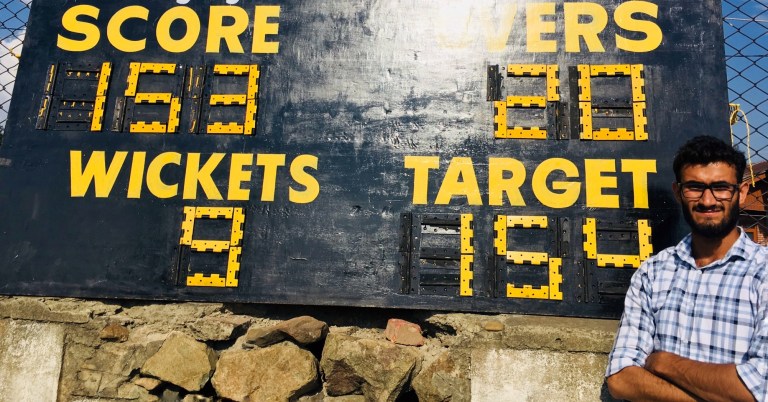
Nadeem Hussain Mir, 21, of district Budgam has designed a cricket scoreboard out of door hinges which has become a major attraction for the players and spectators at Budgam’s lone stadium in Paller village.
The manually operated scoreboard has been erected on the fencing of the playground.
Nadeem, a resident of Budgam’s Chana Mohallah village presented his scoreboard during the knock-out matches of a local tournament here in which Kashmir’s famous cricketer Manzoor Pandav is also participating.
His invention has stirred interest among the spectators here who remain updated about the score during cricket matches.
“In 2017, I noticed that cricket fans here were unable to keep a track of score and then an idea of designing a manually operating scoreboard struck my mind.”
Nadeem told ‘Kashmir Images’ that he wanted to make a scoreboard that would be different from a traditional number plate board. “Once I saw my father, who is a carpenter, fixing joints of a door with the hinges; then and there I began work on designing a score board out of door hinges.”
Nadeem, who is a student of final year, says that he had shared the idea with his friends, but received a negative response from them. “My friends told me that it was not feasible to make a scoreboard out of door hinges.”
“In 2018, I shared the idea again with my friends and I was told to give my idea a practical shape and was also given five thousand rupees by the organisers of the tournament,” he says.
He says that first of all he made a graph which took him many days to complete it. “I fixed 63 hinges on a blackboard. In order to make the scoreboard visible I painted the inside of each hinge with black color and colored those hinges yellow outside.”
When asked what people think of his invention, he says, “Everyone is lauding my effort.”
Nadeem says that a local player and one of the organisers of the tournament, Rameez Hassan, helped him to give his idea a practical shape. “Without the support of Rameez, it was impossible to even think of making a scoreboard.”
Nadeem is a famous chess player of his locality. He claims that no opponent has ever defeated him in a chess game.
source: http://www.thekashmirimages.com / Kashmir Images / Home> Budgam / by Abid Hussain / July 22nd, 2018
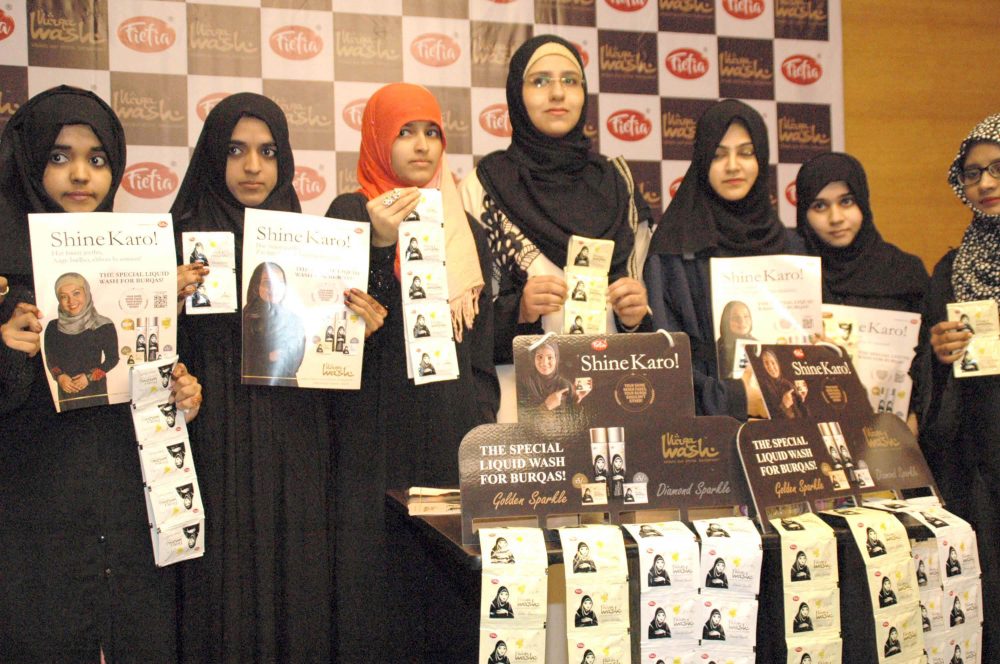
Hyderabadi girl Mahanoor Khatoon (C), launching her unique invention ‘Vurqa Wash’ a special liquid wash for Burqas, in Hyderabad on Wednesday. UNI PHOTO
source: http://www.siasat.com / The Siasat Daily / Home> Hyderabad> Photo News / July 12th, 2018
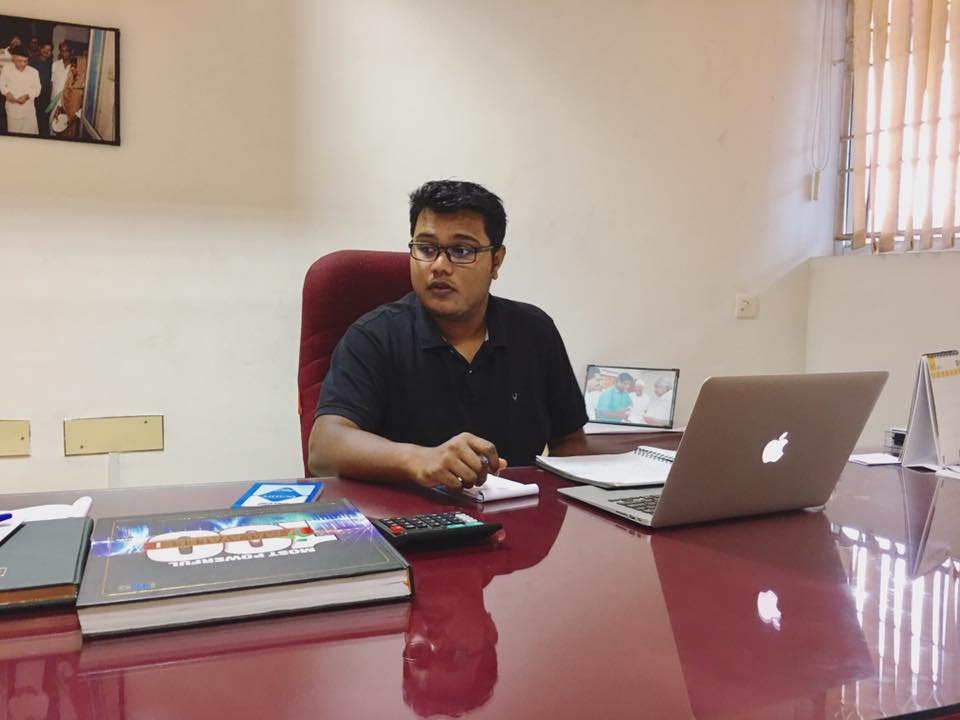
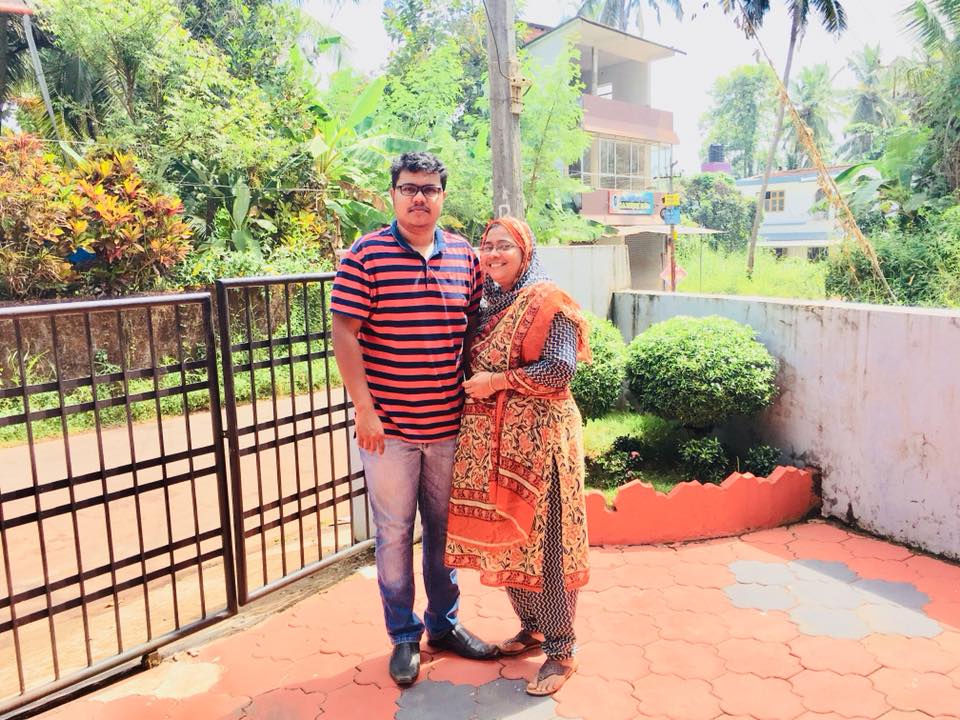
Today, Jawad is the managing director of TNM Online Solutions, a multi-crore IT establishment that deals with e-commerce, web designing and app development, and has a large clientele base from across the world.
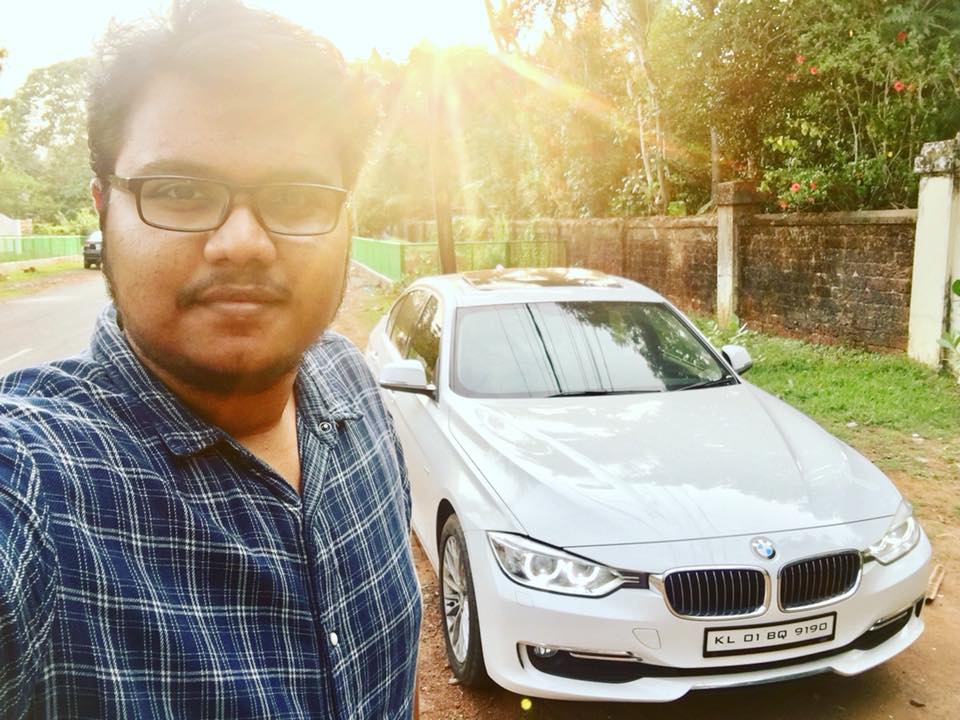
It was a computer gifted to TNM Jawad which overturned his fortune and changed his life for the better. The 21-year-old from Kannur, Kerala, is a millionaire today and owns a company that rakes in an annual income of ₹2 crore. He also owns a house and a BMW car—and all this is thanks to Google!
This is the inspiring story of an enterprising youngster who entered uncharted territory at a very young age and emerged a winner through sheer hard work and trust in his abilities.
Today, Jawad is the managing director of TNM Online Solutions, a multi-crore IT establishment that deals with e-commerce, web designing and app development, and has a large clientele base from across the world.
But let’s go back to where it all began.
All of 10, a young Jawad made every possible use of the computer his father had gifted him along with an internet connection. Interestingly, Jawad’s original name is Mohammad Jawad TN, and it was his father who created his Gmail ID.
The 21-year-old genius.
“At that point, the user ID with my name wasn’t available, and instead Google came up with the suggestion ‘TNM Jawad’, and the name stuck! When I look back, that instance was the beginning of everything good in my life,” says the 21-year-old to The Better India.
Back then, Orkut and similar social networking sites were the rage, and this always intrigued Jawad. “I was keen to learn about everything—like how websites were created and how they worked and spent most of my after-school hours in the same pursuit. You could say that I was addicted to the computer but in a good way,” he recalls.
He soon learnt the basics of blogging and web design through free website building applications and even made a few blogs on his own. By the time he was a Class 10 student, he had launched a website along with his classmate, Srirag, named jasri.tk.
“Both of us were equally passionate about everything web related, and this was our first outing. However, we couldn’t afford a dot-com domain since we didn’t have any pocket money, so we created the site through a free domain,” Jawad adds.
Even as this went on, Jawad made sure that his studies never suffered. After scoring an ‘A1’ grade in all subjects in his exams, he had a lot of time on his hands and decided to explore the field further. He spent his vacation time understanding how great performing websites were different and what made them better.
By then, Jawad’s interest started becoming more pronounced. Realizing that there was a looming scope for website development, he decided to take the plunge by registering his first domain name—TNM Online Solutions—and running it as a virtual company. He started out by announcing on Facebook about designing a website at prices starting from ₹1,000.
Soon enough, enquiries started pouring in, but he admits to being technically ill-equipped to handle almost 99 percent of the queries that came his way.
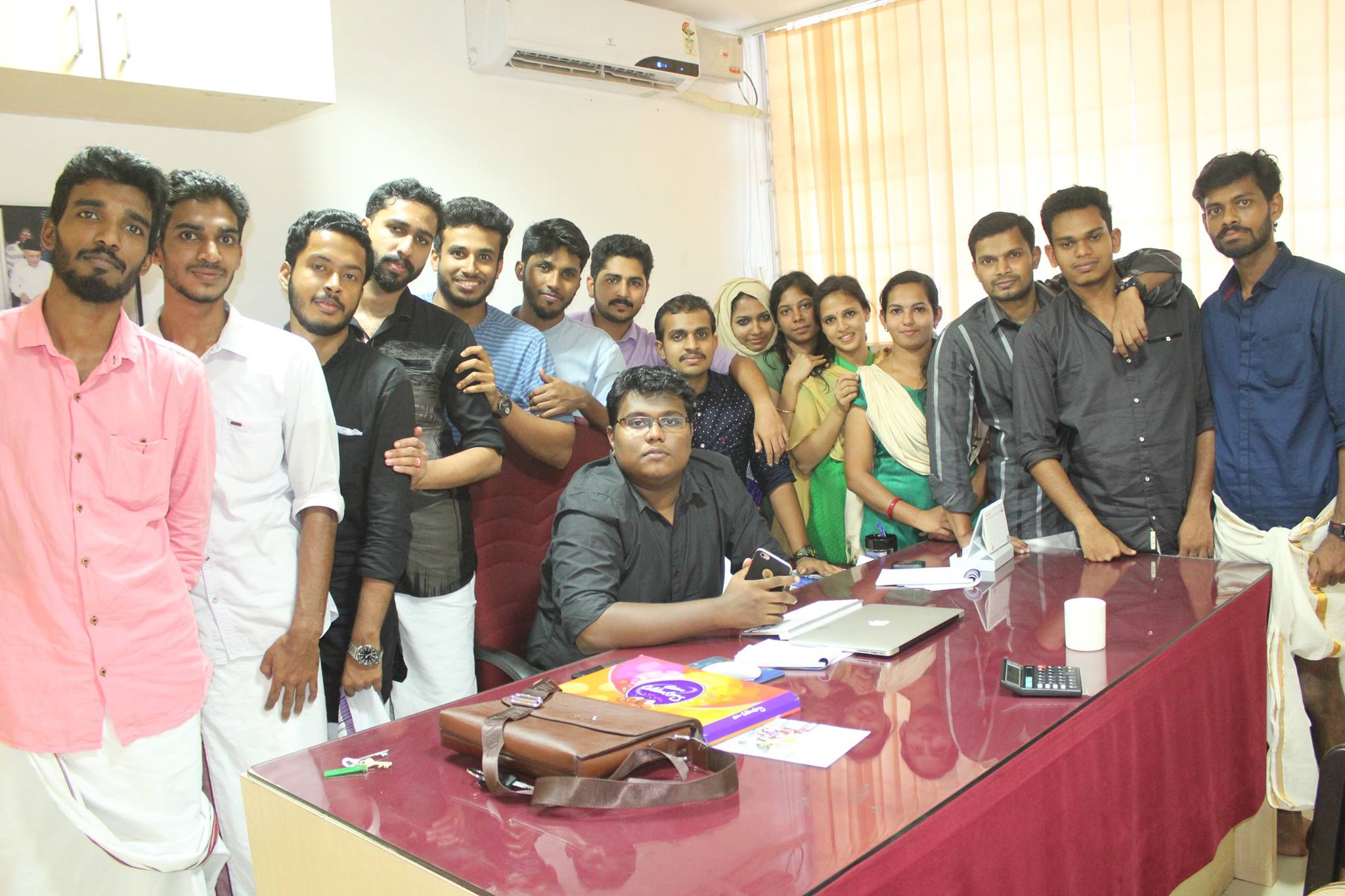
Jawad and his workforce.
“That is when I realised that I lacked strong tech-based skills that are important for website development, and to learn more, I even visited a couple of website design companies in Kannur and saw how they worked,” says Jawad.
When nothing seemed to be working for Jawad, the silver lining came in the form of a teacher from his school (where he was pursuing his higher secondary education) who had seen his Facebook post about website building. “Her brother had been an interior designer and was in need of a website. She came looking for me and requested if I could help, and guaranteed that she would pay the full amount I had quoted,” he recalls.
That was the first website formally developed under TNM Online solutions. “My teacher paid me the first ever remuneration I’d ever received in my life. Until then my folks at home had no clue about the company, so naturally, my mother, Fareeda, was shocked when I handed over an amount of ₹2,500 to her, and I had to explain what had happened,” laughs Jawad.
Somewhere around this time, Jawad’s family started grappling with a severe financial crunch after his father, who had been working in the banking sector in Dubai had to leave his job and return to India.
“Things started going from bad to worse, and I knew there was no time to brood over what had happened. Instead, I raised the subject of starting my own company to my parents and requested my father to somehow source ₹1 lakh for the venture. Knowing my penchant for computers and proclivity for web-based work, they wholeheartedly supported my ambition,” Jawad says.
In the meantime, he had signed up with an IT academy in Kannur, where he spent about a month professionally learning about website building and designing. This became yet another landmark turn in his life, as Jibin and Dinil, two of his teachers at the academy, agreed to work for him as salaried employees.
And thus on 23 June 2013, 17-year-old Jawad flagged off TNM Online Solutions at a small office in South Bazaar. Ably juggling school and work, Jawad would rush from school to office and work till 9:00 p.m., following which he would discuss business with clients till 2:00 a.m.
Jawad’s mother, whom he calls his backbone, was a constant pillar of support throughout his days of struggle.
Jawad with his umma, Fareeda.
What makes his commitment even more worthy of appreciation is that he managed to score 85 percent in his higher secondary exams.
However, nothing in life comes devoid of obstacles.
Jawad had been offering designing services at a paltry sum, and this provision wasn’t enough to cover the company expenses that included office rent and employee salaries. Also, business was slow, and the team was only getting 1-2 projects per month. That is when his mother stepped in and offered to pledge her golden bangles for money, as she was against the idea of not paying the employees on time.
After two years of testing times and learning curves, TNM Online solutions had worked with over 100 small-scale clients within Kerala itself. “In this time, I learnt that more than revenue generation, it is one’s portfolio that matters,” he adds.
Jawad cites his participation in the YES Kerala Summit for young entrepreneurs that gave him and his venture the visibility it needed and brought in many new projects, as a landmark achievement in his career.
The young man was always keen on living in his own home because, despite the fact that his father had a well-paid job while he was abroad, his family had always lived in rented houses. At the age of 19, he fulfilled this dream by building a home of his own in Varam.
Today, the 21-year-old works with clients from over 18 countries and has opened an office in Dubai, which has a clientele base of over 900.
The young man with his prized possession.
Another significant trajectory for TNM Online Solutions started when Jawad started incorporating Search Engine Optimisation (SEO) for the websites he created, making it much easier for websites to be found during a search.
For his incredible achievements at such a young age, Jawad was recently felicitated in the UAE and bestowed with an award by Dr Ram Buxani.
At present, Jawad is busy with a new initiative. He has started the TNM academy that provides professional training in areas like web designing and digital marketing to youngsters. The academy was recently inaugurated in Kannur and is open for anyone, irrespective of age.
Jawad’s resilience and determination deserve to be admired and recognised, and his story will surely motivate everyone. We wish him great success in life and hope that all his future endeavours are fruitful.
Nada Village, Belthangandy Taluk (Dakshina Kannada District) , KARNATAKA :
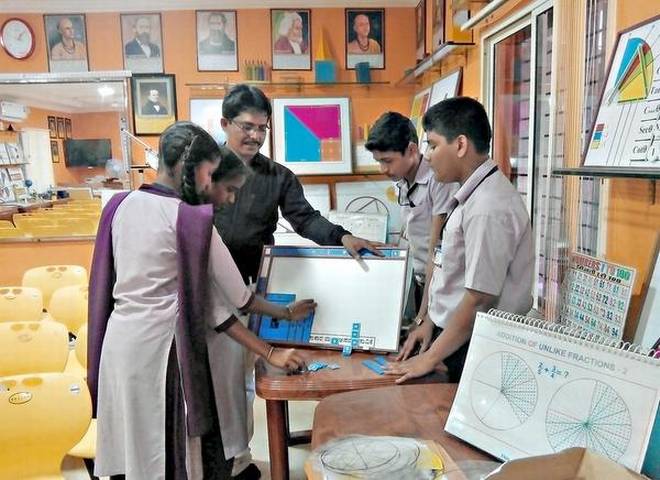
Yakub Koyyur, assistant teacher in mathematics, at the lab opened by him at Government Kannada Medium High School in Belthangady taluk of Dakshina Kannada district.
All SSLC students pass the maths paper; their success is being attributed to a laboratory in the school
A government school teacher setting up a laboratory to help students overcome their fear of mathematics four years ago appears to have borne fruit in a Dakshina Kannada village school as all the 43 students who appeared for the mathematics paper in the recently held class 10 exam have passed.
The Government Kannada Medium High School at Nada village in Belthangady taluk had previously recorded cent per cent results in mathematics way back in 2002.
It was Yakub Koyyur, an assistant teacher in mathematics, who opened the laboratory in the school in February 2014. But it was effectively put to use one year later, from the 2015–16 academic year.
It was the first such laboratory opened in a government school in the State. The objective was to make students having less-than-average learning ability score well and at least pass the mathematics paper.
When the first batch of class 10 students who used the laboratory wrote the exam in March 2015, the pass percentage in mathematics went up to 77.35 from 69.38 in 2014. It further rose to 95% in 2016 and witnessed a slight decrease — 94.59% — in 2017. The dream of the teacher to see all class 10 students pass in the subject was achieved this year.
Mr. Koyyur said many students end their education in class 10 for having failed in mathematics as they feel it is tough nut to crack. He, however, wanted to make the students first shed the fear about the necessary evil and pass the SSLC exam.
Before setting up the laboratory, the pass percentage in mathematics in class 10 in the school varied between 62.6 and 86.76 during 2008–13.
All those students who passed in mathematics in class 10 this year had made use of the laboratory since they joined the school for class 8 in 2015–16. “The laboratory inspired the students to shed the fear and also provided a base to understand the concepts of mathematics. Three years of continuous exposure of students to the laboratory could be one of the reasons for all having passed this year,” Mr. Koyyur said. But the pass percentage also depended on the questions asked and the learning ability of students, he added.
In his bright and colourful ‘Maths World’ laboratory, all students from class 8 onwards get hands-on experience through models, audio-visual tools, and charts. The laboratory was opened with a partial government funding of ₹2.5 lakh and ₹13 lakh contributed by the school alumni.
source: http://www.thehindu.com / The Hindu / Home> News> States> Karnataka / by Ravi Prasad Kamila / Mangaluru – June 18th, 2018
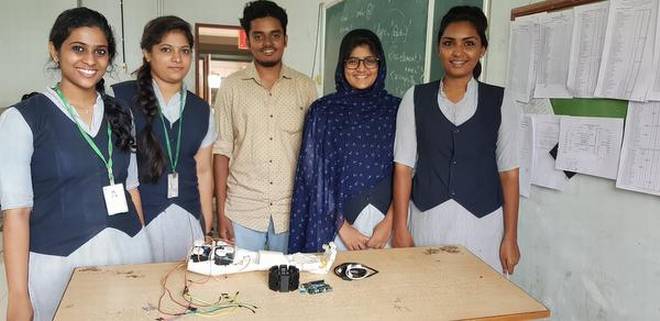
Students of Toc H Institute of Science and Technology, Arakunnam, with the Electromyography-controlled prosthetic arm that they developed.
It will meet the basic daily requirements of an amputee
Five engineering students of Toc H Institute of Science and Technologyat Arakunnam near here have come up with an Electromyography (EMG) controlled prosthetic arm.
The students – Mereena Baby, Aysha Zenab Kenza, Nikitha Sajan, Lakshmi Mohan, and Sharon Alex – are in the final year of their B.Tech Computer Science programme.
A release issued by the college claimed that the robotic arm would meet the basic daily requirements of an amputee, even though it lacked advanced features.
The prosthetic arm is priced at ₹2 lakh while those with advanced features cost anywhere between ₹15 lakh to ₹25 lakh, which is out of the reach of the common man, it said.
The students said that the Myo-armband interprets the electric signals produced as a result of the muscle movements and converts them into accurate hand gestures. They are then read by a micro-controller through a Bluetooth dongle.
Server motors
Based on those signals read, an appropriate number of server motors are rotated to move the prosthetic limb, they said.
The release said that the product could be made faster and easier by using advanced technologies such as artificial intelligence.
The students expressed the hope that they would get support from investors to take the product to users.
source: http://www.thehindu.com / The Hindu / Home> News> Cities> Kochi / by Special Correspondent / June 03rd, 2018
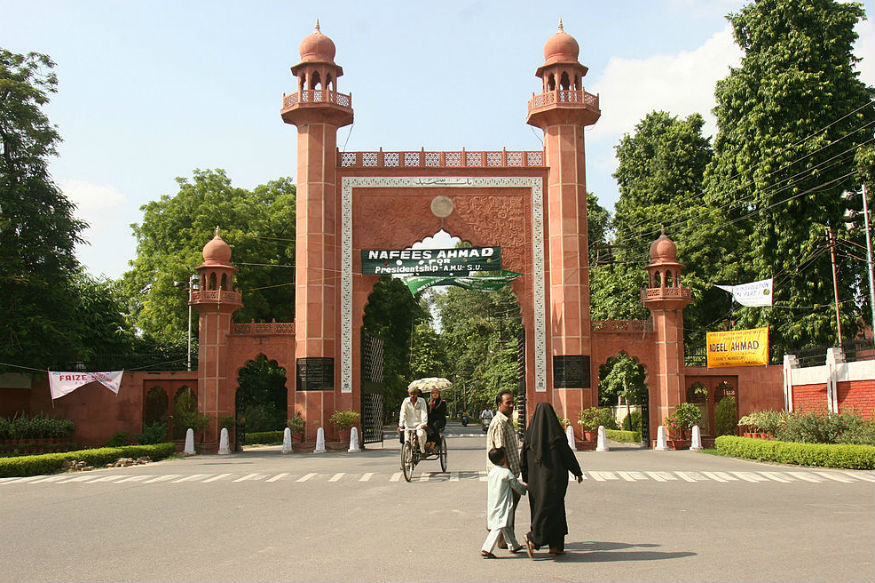
The collaboration with the Healing Little Hearts charity was initiated by AMU Vice Chancellor Tariq Mansoor, Tabassum Shahab (Pro Vice-Chancellor) and Shamshul Zoha, an AMU alumnus.
File photo of Aligarh Muslim University campus.
Aligarh:
Free heart surgeries will be available for children with congenital defects at the Aligarh Muslim University’s (AMU) Jawahar Lal Nehru Medical College (JNMC) after the varsity signed a deal with a British charity.
The collaboration with the Healing Little Hearts (HLH) charity was initiated by AMU Vice Chancellor Tariq Mansoor, Tabassum Shahab (Pro Vice-Chancellor) and Shamshul Zoha, an AMU alumnus.
Javaid Akhter (Registrar), Mohammad Hanif Beg (Chairperson, Department of Cardiothoracic Surgery) and Azam Haseem signed the Memorandum of Understanding (MoU) with HLH’s Sanjiv Nichani (Consultant Paediatric Interventionist) and Zoha.
“Since independent researches show yearly births of over 100,000 babies with congenital heart defects in India, it is high time to take necessary steps for helping these children with heart ailments,” said professor Beg.
Many children requiring corrective heart surgeries do not get treated due to financial constraints and even the affordable treatment available is sub-standard with poor expertise.
JNMC provides affordable treatment with state-of-art facilities to patients from underprivileged sections, he added.
source: http://www.news18.com / News18 / Home> India / by IANS / May 24th, 2018
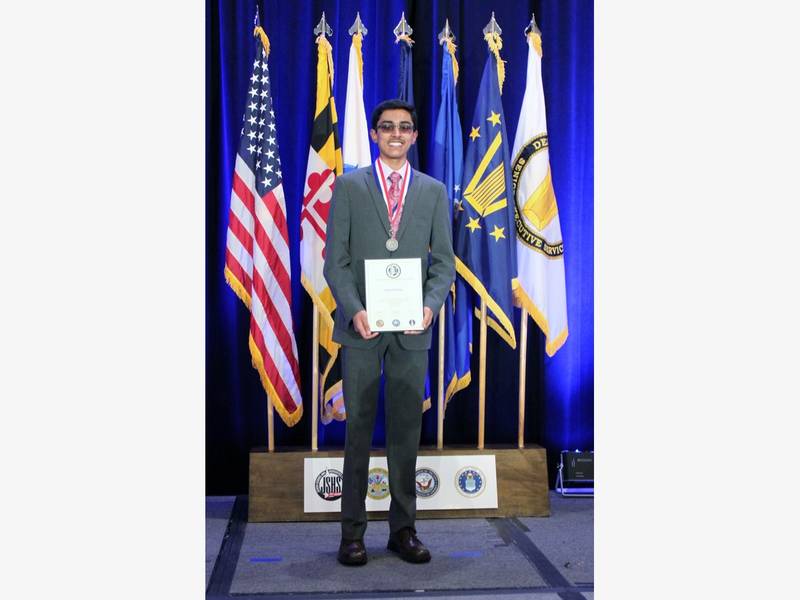
Amaan Khan placed at the National Junior Sciences and Humanities Symposium in Maryland.
PLAINFIELD, IL :
Plainfield South High School sophomore Amaan Khan won second place in the National Junior Sciences and Humanities Symposium (JSHS) held in Maryland May 2 to May 5, 2018, for creating a self-driving model car.
He advanced to the national competition after winning first place at the regional JSHS competition in March.
Khan’s model car can drive within designated lanes, stop and go at traffic lights, and avoid obstacles.
His second-place finish earned him an $8,000 scholarship in addition to the $2,000 scholarship for winning the regional event. The regional competition is open to ninth through twelfth grade students.
Most of the 97 national competitors were high school juniors and seniors. “Second in national is still really great,” Khan said.
Students compete in several categories including computer science and math, bioengineering, behavioral science, medicine, health, physics, engineering and environmental science.
Khan wants to enter the Intel International Science and Engineering Fair next year, he said.
Photo/article via District 202
source: http://www.patch.com / Plainfield Patch / Home> Kids & Family / by Shannon Antinori , Patch National Staff / May 17th, 2018
A Plainfield South High School sophomore is traveling to a national science competition, after he created and programmed a self-driving car.
Amaan Khan, 15, will compete this week in the National Junior Science and Humanities Symposium in Maryland, after winning the Illinois Junior Science and Humanities Symposium (JSHS) in March, according to a news release from Plainfield District 202.
Khan created and programmed a self-driving car that can drive within designated lanes, stop and go at lights and avoid obstacles.
He won a $2,000 college scholarship and free trip to the national competition. He is one of two students from Illinois heading to Maryland to compete Tuesday through Saturday with 93 students from across the nation.
Competitors must submit a research paper and present their projects before a panel of judges and an audience of their peers.
Khan became interested in robotics and artificial intelligence last year, after he built a voice-controlled toy car. He took online college courses and watched college lecture courses and YouTube videos to teach himself computer programming.
“As I was learning I kept building the project,” Khan said. “I’d learn one thing, implement it, learn another thing and implement that.”
Patrick and Samantha Scanlan, PSHS science teachers, have supported Khan along the journey.
Samantha Scanlan helped Khan register for the contest. Patrick Scanlan helped Khan polish his oral presentation.
“[Khan] knows what he wants and seeks out the resources to do it,” Patrick Scanlan said. “And if there’s something he needs to learn, he’s able to figure out what he needs to be successful.”
The JSHS is designed to challenge and engage students in science, technology, engineering or math.
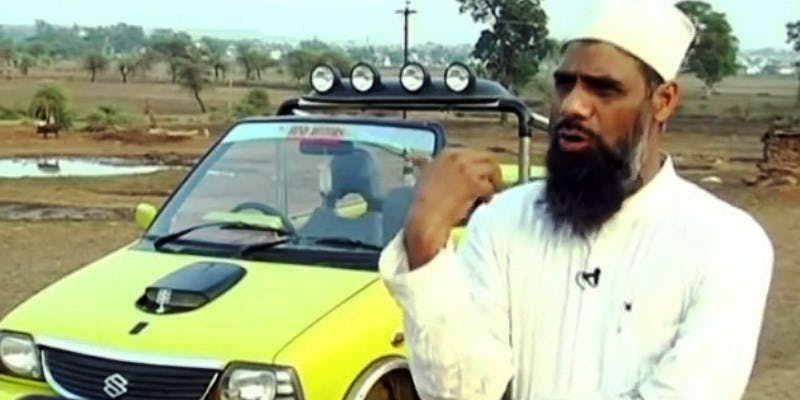
44-year-old car mechanic Mohammad Raees Markani from Madhya Pradesh has invented a car that runs on water.
This 12th pass took five years to develop the final product. The car runs on acetylene gas, which is formed from a chemical reaction between calcium carbide and water. Raees now has a patent for his water car. According to Mirror, Raees has been modifying an 800 cc engine for the last five years – and now believes he has made the scientific breakthrough. The eco-friendly car uses a mix of water and carbides.
Raees who has been a mechanic for the last 15 years told Mirror, “The gas is used for several industrial purposes including welding and portable lighting for miners. But in my case, I am using it to propel the car engines . I have made other changes to the engines, which helps the overall performance of the car. So basically, it is just about the water.”
“The market for environmentally friendly cars is getting bigger and automobile companies around the world are looking for eco-friendly ways to reduce pollution. So a car like mine can be a good alternative. It costs close to nothing to operate and it is environment friendly,” added Raees.
Image : Pultan
The Chinese automobile companies have invited Raees to develop the idea further. All the companies that are interested in Raees’s water car project will have to meet his one condition – any plant to make new cars will be established only in his hometown in Madhya Pradesh. “I want things to change in my hometown. So this is where my work should continue,” Raees stated.
NEW DELHI / TAMIL NADU / TELANGANA / Minnesota – Washington DC, U.S.A. :
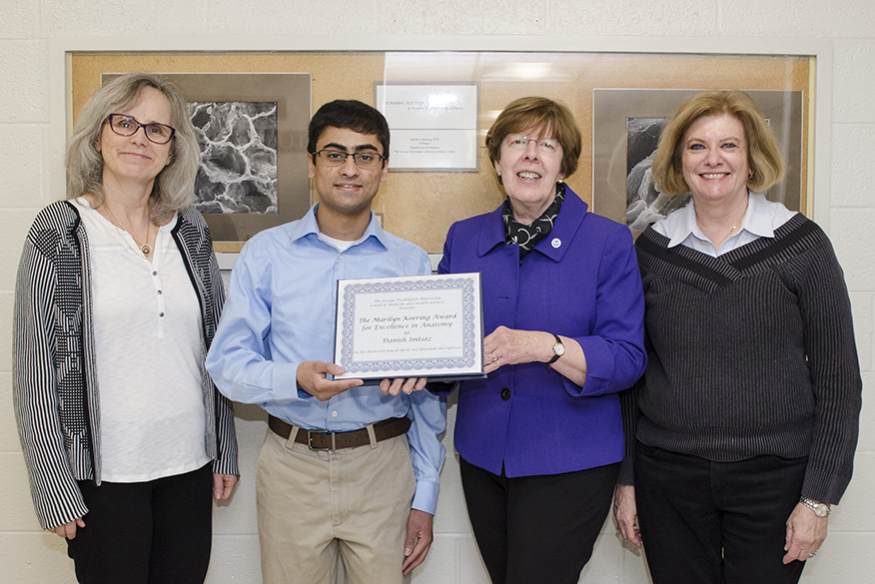
For many in the lecture hall during the 9th Annual Marilyn Koering Award ceremony, devoted teacher, research scientist, mentor, and patient advocate Marilyn Koering, PhD, Professor Emeritus of Anatomy and Cell Biology at the George Washington University (GW) School of Medicine and Health Sciences (SMHS), was an inspiration.
“She had a tremendous impact on my life,” said Koering’s sister, Susan, who travels from Minneapolis Minnesota each year to present the award. “Going to the same college, going into the medical world … she was an inspiration to me.”
The award is presented each year by Koering’s sister to the first-year medical student with the highest overall grade in the anatomical sciences. This year, Danish Imtiaz earned that distinction.
“I feel extremely honored to receive this award in the name of the esteemed Dr. Koering,” Imtiaz said, adding that her legacy will inspire him to continue exploring the anatomical sciences.
“I would like to thank Dr. Koering’s family for the award,” he said. “And also, I would like to thank the anatomy and histology professors at GW SMHS for their excellent instruction. I hope to continue to work hard and learn more about the anatomical sciences from them.”
Kenna Peusner, PhD, professor of anatomy and regenerative biology at SMHS, organized the award and introduced the speakers at the assembly. Peusner said that Marilyn Koering was dedicated to her students, teaching histology to more than 5,000 GW medical and graduate students. For 34 years, Koering taught in the classroom and labs at the SMHS until her retirement in 2003. She passed away in 2008 after a fierce battle against malignant melanoma.
“After Marilyn was diagnosed with melanoma, she fought the cancer for 21 years through essays, appearances on television, addressing cancer support groups, and writing letters to pharmaceutical companies and the federal government to gain support for patients who volunteered for experimental treatments,” Peusner recalled.
Mary Ann Stepp, PhD, professor of anatomy and regenerative biology at SMHS, who knew Koering both as a member of the faculty and as a student, spoke on her remembrances.
“When I came here and entered the Anatomy Department, the Chairman … saw my weaknesses in the anatomical sciences, so I was assigned to learn histology with the first-year medical students,” Stepp explained. “So I sat in the classroom with the medical students, and got to know Marilyn not only as a faculty member, but as a mentor. She was an excellent teacher; she really cared about making sure that the students understood what they were doing and how to do it well.”
During the ceremony, Susan Koering told a story of her 6-year-old grandniece, whom she said Marilyn would have loved. One day, she asked the young girl what she wants to be when she grows up. Her response: “A mommy.”
“I said, ‘Well, OK, but how about a scientist?’ And then about a month later I asked again ‘What are you going to be when you grow up?’ This time she said ‘a scientist,’” Koering said to laughter.
source: http://www.smhs.gnu.edu / GW, George Washington University, School of Medicine & Health Sciences / Home> News / by Katherine Dvorak / April 23rd, 2018