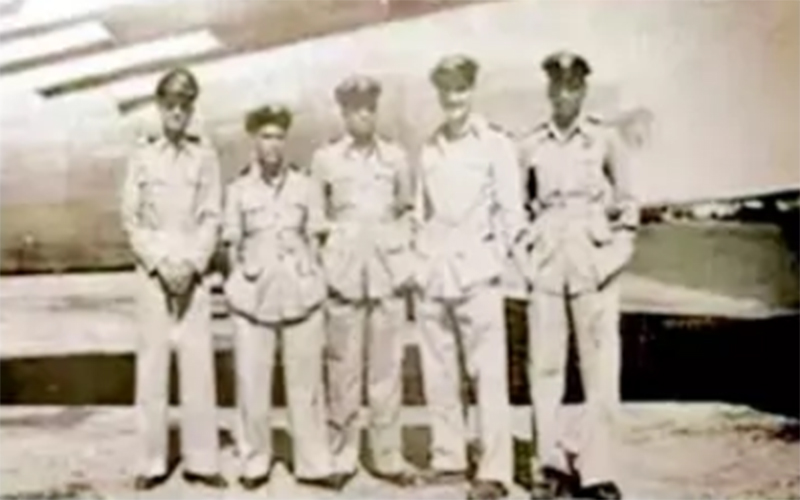
India’s first flight carrying Haj pilgrims took off from Hyderabad On 22nd October 1946. Earlier, pilgrims used to travel by a sea route for performing Haj.
According to the report published in Times of India , the first flight carried 18 Haj pilgrims. Two Deccan Airways Dakota aircrafts took off from the old airport of Hyderabad located at Begumpet in 1946 amid slogans “Allah-u-Akbar”. Khan Bahadur Nawab Ahmed Nawaz Jung was also traveling on that flight.
It may be noted that at that time, there was no flight from other Indian cities to Jeddah.
The name of the pilot who took off the first flight was Captain Cox and his junior was Munshi. The technical support was provided by Nasir, Radio Officer and Lord, Flight Engineer.
It may be mentioned that Deccan Airways was the leading airlines at that time. In 1948, the flights of Deccan Airways were discontinued due to uncertain political situation in erstwhile Hyderabad State. It was again started in 1949 after the Police Action.
source: http://www.siasat.com / The Siasat Daily / Home> News> Hyderabad / posted by Sameer / August 08th, 2019
When Syed Ahmed noticed the bag, he waited at the same spot thinking the passenger would return to collect the bag.
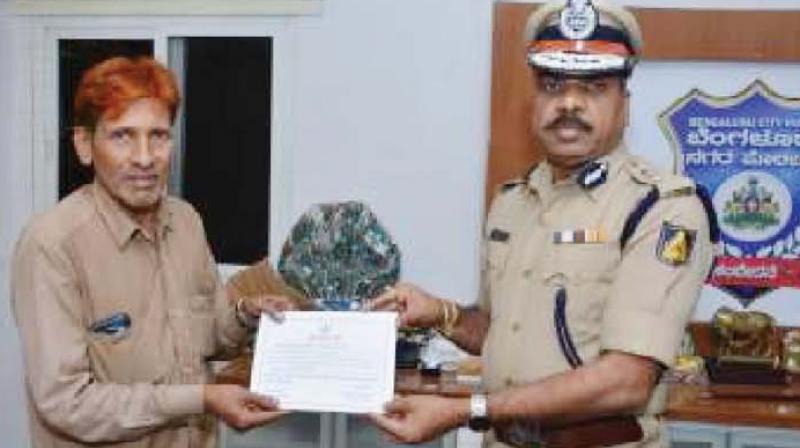
Syed Ahmed receives his award from Police Commissioner T. Suneel Kumar.
Bengaluru:
The city Police Commissioner T. Suneel Kumar rewarded a 45-year-old autorickshaw driver for his honesty, when he returned a bag containing cash, ATM cards and an expensive mobile phone which was left behind by a passenger on Wednesday.
The passenger, identified as Pramod Kumar Jain, took the autorickshaw from Majestic driven by Syed Ahmed. When Jain got off at the City Railway Station, he left behind a bag containing cash and other valuables.
When Syed Ahmed noticed the bag, he waited at the same spot thinking the passenger would return to collect the bag.
When the passenger did not return even after hours, Ahmed took the bag to the city Police Commissioner’s office seeking help in returning the bag to its owner. The police checked the bag and found a visitng card of Jain.
The police him to collect the bag, which contained Rs 45,000 in cash, two ATM cards and an i-Phone.
The bag was handed over to Jain in the presence of the Commissioner.
Kumar gave Ahmed a certificate of appreciation and a cash reward.
source: http://www.deccanchronicle.com / Deccan Chronicle / Home> Nation> Current Affairs / May 23rd, 2019
Den Thimmaiah emerged as the fastest driver at the National level 4-wheel Autocross Championship organised at Begoorkolli.
Organised at the fields belonging to the members of Chendira, Ippumada, Chekkera and Thethira families by JCI Ponnampet Golden, he emerged victorious as he clocked in at 2.02 minutes at the 850-meter rally course.
He also won the Coorg Local Open, 1,400-1,600cc category and Indian Open categories, adding three victories to his name.
In ‘The Coorg Local Open’ category, Den Thimmaiah won the first place, followed by Kokengada Darshan and Karavanda Thimmiah respectively.
Mohamad Shiek won the first place, Shrihari the second and C.K. Somanna the third place in the 800 cc category.
In the 1,001-1,400 cc category, the first place was won by Ismail Khan, second by Harshad Pasha and the third by Sparsh Nanjappa.
Den Thimmaiah won the first place while Dhruva Chandrashekar and Kokengada Darshan won the second and third place respectively in the 1,400-1,600 cc category.
The first place was bagged by Den Thimmaiah while the second and third place were won by Dhruva Chandrashekar and Roopesh respectively in the Indian Open Class.
In the XUV class, Mekerira Kariappa won the first place while Shriganesh won the second place.
In the Women’s category, Puttichanda Dayan Somaiah won the first place and Pooja Karumbaiah won the second place.
Over 40 participants took part in the event.
JCI Ponnampet Golden President Koniyanda Kavya Sanju, Mondovi Motors Gonicoppa showroom manager Manoj, JCI secretary Kotangada Nanaiah, JCI leaders Kotrangada Subbaiah, Arasu Nanjappa, Katimada Giri, Nirin Monappa, Robin Subbaiah, Pullangada Natesh distributed prizes to the winners.
source: http://www.starofmysore.com / Star of Mysore / Home> Sports / May 09th, 2019
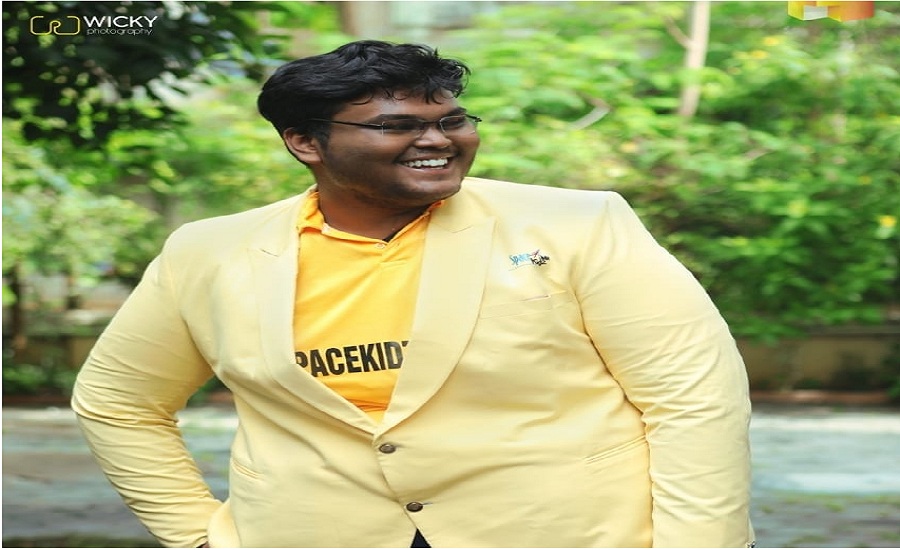
On January 25, India’s Polar Satellite Launch Vehicle (PSLV-C44) successfully injected Microsat-R and Kalamsat-V2 satellite into their designated orbits. Two young engineers who played lead role in designing and building world’s lightest satellite Kalamsat-V2 are Rifath Sharook and Mohammed Abdul Kashif.
They were part of a 12-members team of Space Kidz India- a group which trains aspiring space students. The group was being led by 18-year-old Sharook who hails from Tamil Nadu. Sharook is the youngest student of the team. Giving the credit of building the satellite, the media called him one-man army.But Sharook rejects to take credit solely.
Apart from Kashif (lead engineer), those who are in his team include Vinay S Bhardwaj (design engineer), Yagna Sai (lead technician) and Gobi Nath (biologist).
They were all working on rocket and space technology under the mentorship of Chennai-based Srimathy Kesan, who is the founder of Space Kidz India.
Sharook who hails from Tamil Nadu’s Karur is Chief Technology Officer (CTO) at Space Kidz India. Sharook’s father, Mohammed Farook, was also scientist. When he was in Class V, his father had left for heavenly abode. He was interested in space since his childhood.
“My dad was also a scientist. He’d do independent research on astronomy. We’d spend hours watching the space through a telescope,” Sharook was quoted by rediff.com as saying.
Talking about the Kalamasat V2, Mohammed Abdul Kashif said “We have produced a new electronic architecture for this satellite that ensured that it was lighter, smaller, more economical and consumed less energy while functioning like any other communication satellite”.
He added “There are a wide variety of uses it can be deployed for. But with this launch, we are only testing the technology and seeing how it operates”.
The satellite was 64 grams, 3.8 centimeter-cube-sized and it is world’s lightest and smallest satellite. It was made through the competition ‘Cubes in Space’ which was a collaboration between NASA and ‘I Doodle Learining’.
Muslim boy Sharook and Kashif played larger role in building the world’s lightest satellite and it was named also after a Muslim scientist A P J Abdul Kalam, who was the president of
India.
source: http://www.caravandaily.com / Caravan Daily / Home> Indian Muslim> Indian Muslims / by Caravan News / February 04th, 2019
A vivid piece of maritime history is hidden in the memories of the cooks and deckhands who once sailed off the Malabar coast
By noon, the sun would heat up the vast blue expanse through which they sailed at great risk to their lives. By evening, when salt and dirt clung to their bodies, the skies would turn crimson, symbolising streaks of revolt. Later, weather permitting, the shimmering stars would give them clues to the voyage that lay ahead through the inky waters of the Arabian Sea, often to the Persian Gulf. On the shore, they would unload the goods they had loaded on to the wooden dhows: timber, bamboo, coconuts, tapioca, tiles, salt, sugar, fertilizers. And sometimes, hidden among the cargo, people .Being smuggled to the far shores.
But even when they returned to their homes in Kerala, none of the deckhands of the dhows wrote about their experiences; in fact they actively strove to forget this tempestuous period in their lives that ended when better transportation facilities arrived. It’s been nearly four decades since these traditional vessels with their distinctive masts set sail from the Malabar coast, either along the coastline or farther afield. But it’s only now that the world has begun to hear the stories of these intrepid men, an integral part of the maritime history of peninsular India.
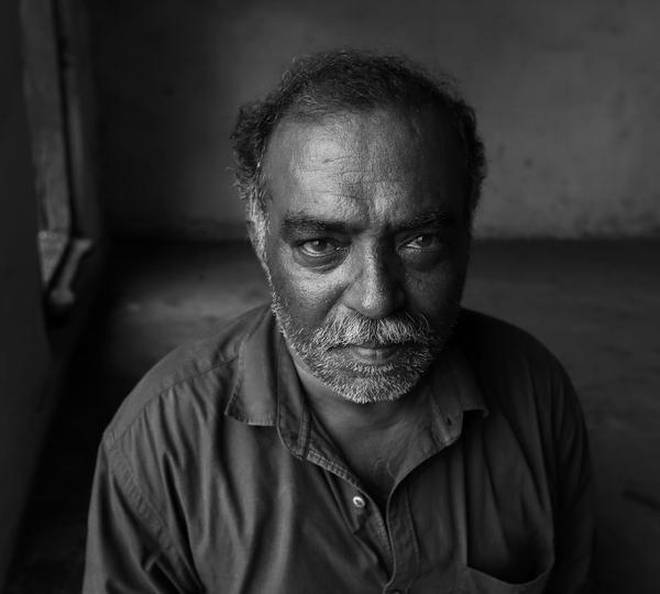
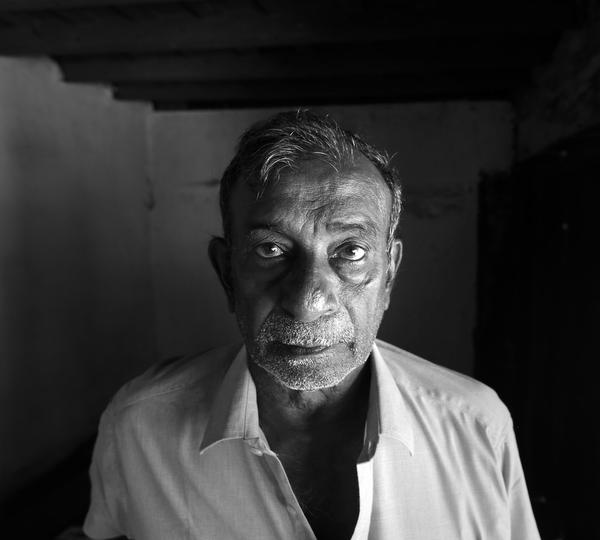
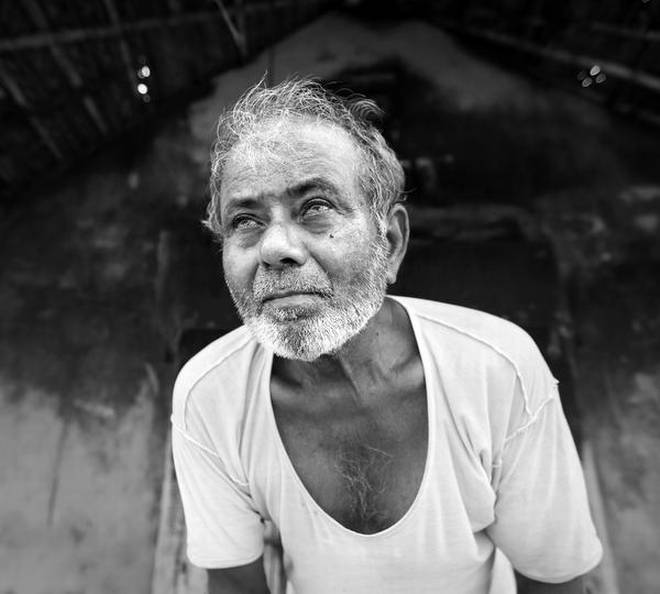
And this is thanks to a photo artist from Kerala’s port town of Kodungallur, around which scholars speculate the ancient Muziris harbour existed until destroyed by the 1341 calamity. K.R. Sunil’s photographs, a series titled ‘Manchukkar — The Seafarers of Malabar’, captures the faces of 34 deckhands. It was on show last month at URU Art Harbour in Kochi. Through them we learn of the misery of people caught in a vortex of exploitation and unshielded from nature’s furies.
Bare frames
The faces are stark, the frames bare. But every black-and-white image tells a story. Of how poverty forced pre-teen boys to pack themselves off in an uru or sailing vessel on long-distance voyages battling rough seas and uncertainty for weeks on end, and then return home — if lucky — only to set off on another strenuous voyage. Years would pass, the boys would turn into middle-aged men. Then, seen as worthy of nothing else, plagued by ill-health, they would be sent home, discarded like boats with rotten hulls.
T. Ibrahim is now 80 and lives an unremarkable life in Ponnani, a fishing town in Malappuram district. He considers himself fortunate to have lived this long. As a youth, he recalls how he once sailed a dhow laden with tiles and a dozen sailors that got caught in a storm on its way to Ratnagiri in Maharashtra. Ibrahim joined his panicked colleagues and began jettisoning cargo. The vessel sank nevertheless. “Some of them managed to get away on a lifeboat. Ibrahim and four others held on to a piece of wood and floated for two days,” says Sunil, recalling his meetings with Ibrahim.
Ibrahim’s …
The youngest in Sunil’s photo series is also called Ibrahim, or simply Umboocha. Now 53, the man from Kasargod, along the Karnataka border, had his final sailing trips on motorised dhows in the 1990s. Memories of manchu, as the boat is called in his part of Malabar, where people also speak Tulu and Kannada, still make him shudder. Their vessel once sank during a cyclone when they were bound for Iran. They roped together emptied cargo barrels and drifted on the improvised float for three days. Rescue came, but they landed in jail: all of them had lost their identity documents.
Siva Sankaran, also from Ponnani, remembers that his first trip on a dhow to Bombay took seven weeks instead of four days. Reason: bad weather. But tempests were just one part of the deckhands’ ordeal, says Sunil. From starvation to sexual exploitation to unhygienic conditions to taxing work hours, the voyages were invariably hellish. “Circus in the seas,” is how Abdul Rahiman, 68, recalls them. “One had to climb 50 feet up on swinging ropes to set the sail. You may have to do it deep in the night, when the boat is violently rolling,” Sunil quotes the sailor as recalling.
The artist’s first trip to Ponnani was in 2014, though it was only two and a half years ago that he turned his focus on these deckhands of yore. “As a child, I had heard a lot about Ponnani. We had country boats with merchandise travelling there from Kodungallur.” The town charmed him on his first visit and inspired several more. The next time he brought his camera along. A photo series from these trips was shown at the 2016 Kochi-Muziris Biennale.
Steeped in pathos
Then, four months before the biennale, Sunil stumbled upon an old man singing a song to his friends. “There was something curious about its lines and the tune steeped in pathos. I thought I should explore more,” he says.
This was T. Ibrahim and this wasn’t the only sailing song he knew. He had learnt several from Rasakh Haji, a merchant of essential oils who owned the boat in which Ibrahim was a deckhand. Haji had a talent for creating songs and had composed one about the dhow. They sailed together from Mumbai to Kerala and “the ditties seeped into Ibrahim too,” says Sunil.
Most deckhands began their careers as cooks (pandari) when they just 11 or 12 and were routinely sexually exploited. Those who moved up the ladder became deckhands or khalasi. The capable among them rose to become captains or srank.
Abdul Lathif thought himself lucky to become a deckhand at 17, but is now repulsed by the memories. “The boat’s woodwork was always infested with roaches and scorpions. You would see them floating even in the drinking water. We were covered with lice. The winter winds gave us mouth ulcers,” he trails off. “After unloading the goods, we would appy a mixture of oil, lime and ghee to the boat’s keel to prevent barnacles. The work was done standing in a slush of mud and human excrement.”
C.M. Ummar was a young man during the 70s when he crewed in dhows carrying people looking for work in West Asia. Illegally. “A couple of hundred job-seekers would be taken aboard along with the cargo. You’d hide them with a tarpaulin. And in the high seas, another boat would come to fetch them,” he recalls. “Sea-sick, they would sometimes plead to be taken back home. Getting them back was equally dangerous.”
Deaths weren’t uncommon — whether from falling from the mast or from disease. Hussain, 64, recalls a friend’s demise: “With a heavy heart we offered prayers, and buried him at sea with a rock tied to his body.”
The primary duty of Muhammad Koya, 81, was to smear kalpath, a mixture of coconut-fibre, cow-dung, sawdust and ghee, on the keel to plug gaps. “It involved holding one’s breath under water for long periods; the job affected Koya’s hearing,” notes Sunil, who is now in the process of making a documentary on this bit of “ignored history”.
Floating bodies
P. Ummar is 20 years younger than Koya, and recalls how armed pirates would sometimes rob their cargo. “Such encounters were common along the Maharashtra coast,” he says. Koran, now an oracle for the traditional Theyyam dance in Kasargod, talks of the dead bodies he saw floating near the Bombay port during his manchu days. He suspects this was from the smuggler-customs encounters.
Kochi, Kerala, 07/02/2019 : K K Khadher, from the series ‘Manchookar – The seafarers of Malabar’ by K R Sunil. Photo: Special arrangement
K.K. Kadar talks of how seasoned sailors would read signs of impending danger in “unusual changes in the colour of seawater, the rising froth, intertwined sea-snakes, dead fish…. they were indicators for the crew to prepare themselves for eventualities,” he says. Today, he is a public worker, and preoccupied with the 80th anniversary of a historic beedi workers’ strike that had once been held in Ponnani.
T.V. Moideenkutty …
For T.V. Moideenkutty, too, life is calmer. The 54-year-old lives on the tranquil shore of Ponnani with his family in a tile-roof house. He started life as a cook in a dhow and then worked as a deckhand for eight years. At least it staved off poverty, he says, smoking a beedi.
Life on the dhow taught him a lesson: the value of drinking water. “I learned the word for water in many languages, especially before hitting ‘Hindistan’ during our Mumbai voyages,” he says, retying his mundu and tucking it in at the waist.
The lighthouse near Moideenkutty’s house stands tall with its gas flasher scanning the ocean. Standing outside URU gallery, I can see the sea dotted with gleaming new-age ships filled with crew and cargo heading out to harbours around the world.
The Delhi-based journalist is a keen follower of Kerala’s traditional performing arts.
source: http://www.thehindu.com / The Hindu> Voyager> Society / by Sreevalsan Thiyyadi / April 13th, 2019
Never for a moment could he take his eyes off the handle, because enjoying the vistas would mean falling…
Muhamed Musadhiq
Thiruvananthapuram :
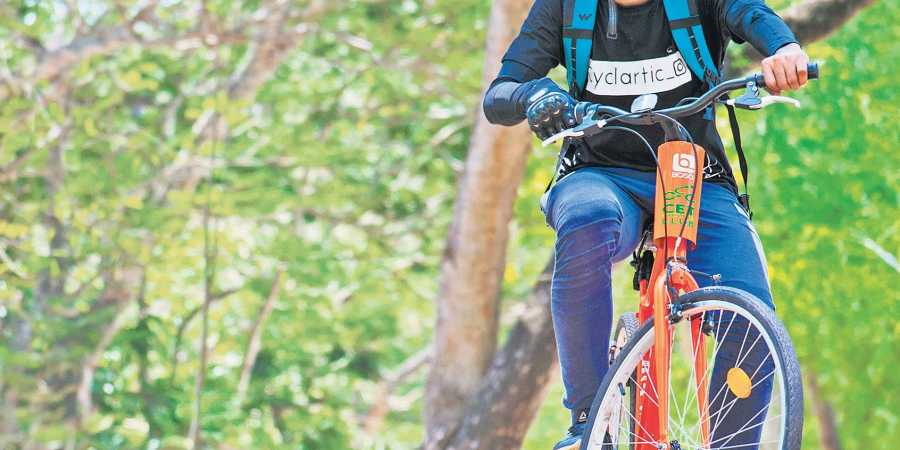
“All I could see was the handle and the front wheel,” says Muhamed Musadhiq, after a 504 km journey on a cycle that turns left if you turn the handle right. All day long, during the six-day ride, he had his eyes fixated on the handle and the wheel, riding at a pace below 25kmph. Never for a moment could he take his eyes off the handle, because enjoying the vistas would mean falling. Manoeuvring this cycle is not a leisurely, easy breezy task, but a very demanding one. Because the cycle has a mind of its own, acting in contrary to the brain’s command.
‘Brain Cycle. Abnormal Cycle. Keep Distance’, so reads the warning note plastered on Musadhiq’s cycle. It has been several months since he remodelled the cycle and crafted a brain cycle out of it. But then, riding it still needed one to be careful enough. “At first the note was plastered for fun, but then after a few falls, I knew there was indeed a need to keep distance,” chuckles the final year mechanical engineering student.
He rode all the way from Kozhikode to Thiruvananthapuram along with his college mates attached to the College of Engineering, Thiruvananthapuram as part of promoting cycling across the state. Through the ride, he was also attempting a Guinness World Record in riding the max distance in the brain cycle. “Till now, no one has attempted the ride in the brain cycle. So it is a new event I am attempting,” says Musadhiq.
According to Musadhiq, the mechanics implemented in the cycle is simple.It was during the tech fest of his college that Musadhiq put forth this cycle, arguably the first in India to be made. “I am not aware of anyone who has made the brain cycle in India. At first, I made it for fun. But after making this, someone had to ride this. And that forced me to learn to ride the cycle,” he recalls. The result was numerous falls. “Oh, I fell a countless number of times. It might look simple from the outside. But to ride it is challenging. You have to train your brain accordingly,” he says.
His cycle is the connoisseur of all eyes, wherever he goes. Having introduced the cycle at various colleges, his aim is to popularise the art of cycling amongst the public. There are also plans to set up brain training centres in schools and colleges using the brain cycle to popularise cycling among the younger generation.
He has even put forth a challenge- ride 10 metres in the cycle and it will fetch you Rs 500. More than 2000 people have attempted the challenge, but none has won it.
“There are no tricks to ride the brain cycle, but practice,” says Musadhiq. “At one point I hope I will reach a state where I can ride the cycle at the same leisurely pace I do on a normal cycle,” he adds.
source: http://www.newindianexpress.com / The New Indian Express / Home> Cities> Thiruvananthapuram / by Aathira Haridas / Express News Service / March 08th, 2019
As a river pilot, Naha’s work is to guide ships from Sagar right up to the Calcutta and Haldia ports through the meandering Hooghly
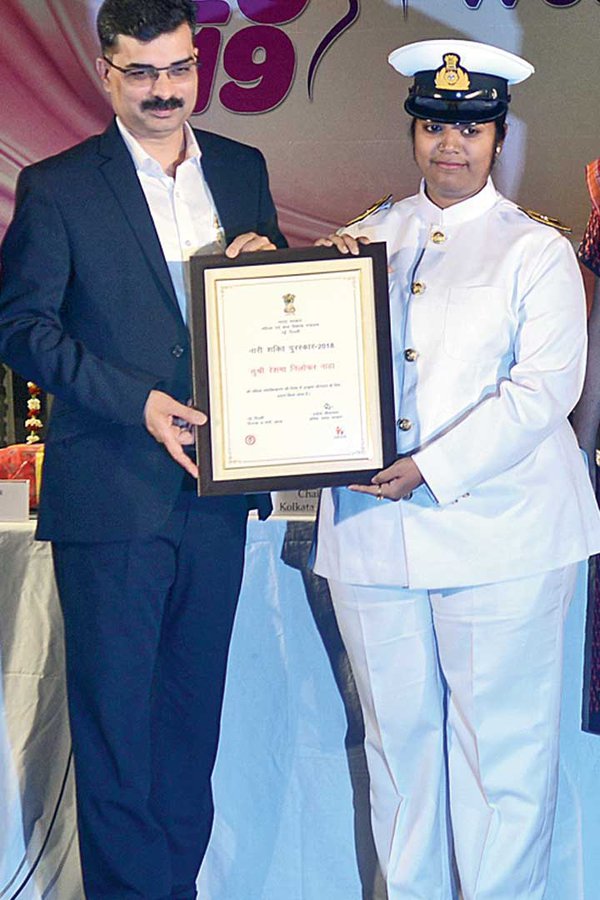
Reshma Nilofer Naha, India’s first woman river pilot, with Vinit Kumar, chairman, Calcutta Port Trust, at ICCR on Monday. Picture Bishwarup Dutta
Reshma Nilofer Naha goes to the high sea on a small boat, climbs on to a large vessel with a rope ladder and enjoys it.
India’s first “river pilot” was felicitated at a women’s day programme hosted by the Calcutta Port Trust on Monday, having returned from Delhi where she received the Nari Shakti Puraskar from President Ram Nath Kovind.
As a river pilot, Naha’s work is to guide ships from Sagar right up to the Calcutta and Haldia ports through the meandering Hooghly, something she has been doing “efficiently and professionally”.
“If you think there are no boundaries then you think everything is possible. There is no glass ceiling. It is just an imaginary concept we all have heard for many many years,” Naha, 30, said during a panel discussion on Challenges: Work and Life.
A BE in marine technology, Naha said she had been keen on an offbeat career ever since she was a child. The Chennai woman joined the Calcutta Port Trust in 2011 as a trainee pilot and qualified as a river pilot in 2018.
“It is a great feeling (to be the only woman river pilot) on one hand but on the other hand I would like to have other female colleagues very soon and I look forward to it. I think my story will inspire more women to get in here,” she said.
Naha said navigating the Hooghly is tough because of “bends and narrow channels” where the depth of the water is a concern. “We have different kinds of ships and each ship behaves differently. The tides are strong here… and all this makes pilotage tough,” she said, recalling how she had to once anchor for four days because of bad weather and strong winds.
“It is a proud moment for the Calcutta Port Trust to have India’s first lady river pilot with us…,” said Vinit Kumar, chairman, Calcutta Port Trust, who felicitated her.
“It is a long treacherous journey she has undertaken. To be a first in anything is always a challenge because the infrastructure, the attitudes, the systems are not very friendly or they are made with keeping only men in mind…. So the struggle of the first person is always more than those who follow,” Kumar said.
source: http://www.telegraphindia.com / The Telegraph, online edition / Home> West Bengal / by Jhinuk Mazumdar and Cordelia Nelson in Calcutta / March 12th, 2019
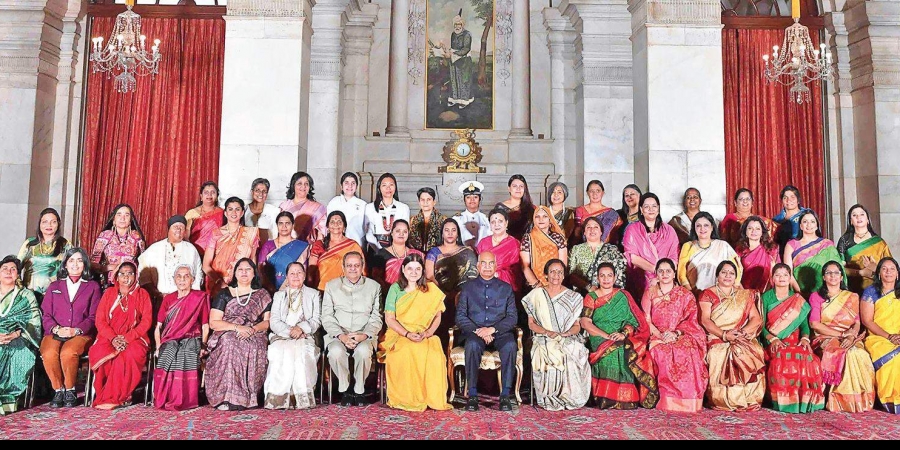
Other awardees included spiritual leader Sister Shivani, commando trainer Seema Rao and the only woman marine pilot in India, Reshma Nilofar Naha.
President Ram Nath Kovind with recipients of ‘Nari Shakti Puraskar-2018’ at Rashtrapati Bhawan in New Delhi on Friday.| PTI
New Delhi :
President Ram Nath Kovind on Friday presented the Nari Shakti Puraskar 2018, the highest civilian honour for women, on the occasion of International Women’s Day.
Among 44 awardees selected out of around 1,000 nominations received by the Women and Child Development Ministry were names such as scientists A Seema and Ipsita Biswas, Doordarshan News anchor Neelum Sharma, acid attack survivor Pragya Prasun, radio music composer Madhuri Barthwal and activist Manju Manikuttan.
Other awardees included spiritual leader Sister Shivani, commando trainer Seema Rao and the only woman marine pilot in India, Reshma Nilofar Naha.
“The awardees are a face of change, reflecting a shift in the status of women, from women development to women-led development,” said WCD Minister Maneka Gandhi adding, “No field has been left untouched, where women have not left their indelible mark, making women the leading force of our development trajectory,” she added.
A statement by the ministry said that while making the selection from the nominations, the nominee’s contributions in empowering vulnerable and marginalised women was taken into account.
source: http://www.newindianexpress.com / The New Indian Express / Home> Nation / by Express News Service / March 09th, 2019
Slice of history: Nawabs probably used fish-shaped boats for transport in 17th century, says historian.
The ongoing excavation work at Chattar Manzil reached another level on Monday as workers unearthed a ‘water gateway’ leading to this iconic structure.
The UP Rajkiya Nirman Nigam (UPRNN), the construction agency engaged in the restoration of the structure, termed it one of the major discoveries so far.
Officials said workers engaged in the excavation stumbled upon a ‘cylindrical structure’ that was lying buried for years.
On clearing the debris, it was found that the structure made of lakhauri bricks was a tunnel, which connects the over 200-year-old Chattar Manzil to river Gomti, flowing just a few metres away.
“This tunnel is around nine metres beneath the ground,” said Nitin Kohli, the contractor supervising the excavation work.
The task is being performed under the supervision of a high-powered committee comprising Archaeological Survey of India (ASI), Abdul Kalam Technical University (AKTU), State Archaeology Department and officials of the civil engineering department, IIT BHU.
Experts said once they are done with the excavation work, they would explore details like the total length of the tunnel and where it leads to.
Officials said the discovery of the tunnel would unravel another chapter from the history of Chattar Manzil and Kothi Farhatbaksh.
The tunnel would also demystify myths and folklore about the Nawabs using water boats to sail within the palace complex, they added.
However, historians have a different take on this tunnel.
PC Sarkar, a noted historian, said: “The structure seems more of a water gate than a tunnel.”
He said some old timers who have been to Kothi Farhatbaksh (Lakhi Pera), residence of major general Claude Martin, had mentioned the structural uniqueness of the twin structures. “In fact, it is on record that the structures were easily approachable from the northern (river Gomti) side by boat also,” added Sarkar.
“After Nawab Saadat Ali Khan bought the fortress-like structure, it was remodelled into a palace-like structure. However, the river side entrance remained the principal one, with the Nawab adding pavilions in the middle of the river itself,” he said.
He said Gomti was the main channel of transport – the nawabs used barges (boats) of various shapes and sizes, some looking like fishes, crocodiles, for transport in the 17th century. The famous ‘More Pankh’ boats were in vogue during that era, said Sarkar.
He said ‘water gates’ may sound unique now, but they were common in the olden days.
The Lucknow Residency too had a ‘water gate’. But it became defunct when Gomti changed its course and more means of road transport came up, he said.
source: http://www.hindustantimes.com / Hindustan Times / Home> Lucknow / by Oliver Fredrick, Hindustan Times,Lucknow / November 20th, 2018
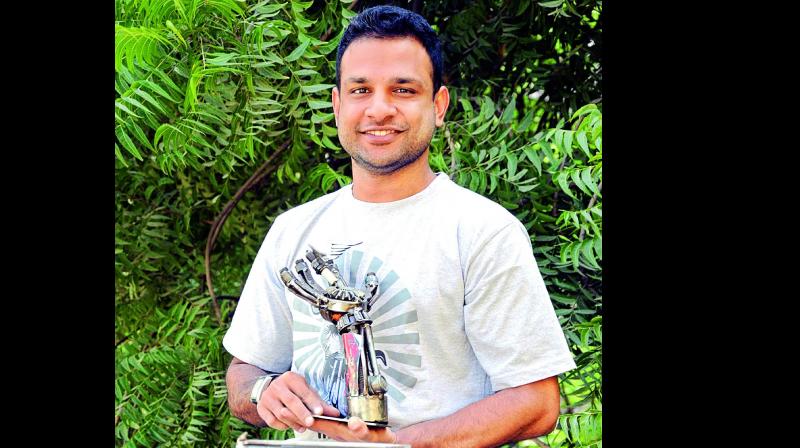
Md Saaduddin is on an artsy journey where he utilises scrap metal to construct purely artistic as well as functional sculptures.
I was always inclined towards art but I never had the nazakat that is needed to wield a paint brush. The hammer and grinder are a better fit for me. (Photo: DC)
It is quite common for a young boy to fall in love with machines. But what is not so common is translating that love into beautiful art. Although Md Saaduddin is today an artist, he does not work on canvases, but with scrap iron, steel and sometimes copper to make beautiful sculptures and functional art pieces like lamps and furniture, some set in the backdrop of interesting storylines.
With Saad’s father being a vintage car restorer, he, along with his brother Hamzauddin, grew up around machines, albeit with a unique perspective. On how he took up the hobby, the mechanical engineer and self-made artist says, “I was always inclined towards art but I never had the nazakat that is needed to wield a paint brush. The hammer and grinder are a better fit for me. I love it also because of the physical work that is involved in creating it.” Saaduddin spends time on his artwork in the evenings, after work, and has made furniture for a couple of breweries in the city.
Explaining his style of work, he shares, “I try to incorporate a sense of movement. A bird just about to take flight, for instance! I’ve learnt the art by watching other people online and practicing. I used to help my dad in his workshop, and that’s how I got introduced to it. Just once a year, my brother and I collect all our savings and build a modified bike. We ride it around to our heart’s content and then sell it.”
He further reveals, “I’m also getting into blacksmithery now; I usually make the handles of spatulas and ladels with this. People appreciated my work and said I should get on Instagram. That’s how I started IRONic”
His brother, Md Hamzauddin is another bundle of talent, whose digital art is recognised around the world. He goes by the name ‘Hamerred’. Hamzauddin’s works have been showcased in countries like the US, Mexico and many others. In fact, he was also one of the only 13 artists from around the world to display their art at the Oil and Ink Expo, a motorcycle art show. Hamza’s signature style features paint dripping from motorbikes.
source: http://www.deccanchronicle.com / Deccan Chronicle / Home> Lifestyle> Books and Art / by Nikhita Gowra, Deccan Chronicle / December 04th, 2017