Karnataka Cabinet Approves Premji Foundation’s Rs 1,000 Crore Hospital For Organ Transplant In Bengaluru
The Karnataka Cabinet has approved the signing of a memorandum of understanding with the Azim Premji Foundation to establish a super-specialty hospital for organ transplantation in Bengaluru at an estimated cost of Rs 1,000 crore.
Under the MoU, the Foundation will be allotted 10 acres of land on a 99-year lease at the premises of the Rajiv Gandhi Institute of Chest Diseases. The hospital will be developed near the Nimhans campus and is expected to significantly strengthen organ transplant infrastructure in the state.
Medical Education Minister Dr Sharan Prakash Patil said the project will be implemented in phases, with a 300-bed hospital to be completed within three years. The facility will later be expanded to a 1,000-bed hospital over five years, offering all major organ transplant services, including liver, kidney, heart and intestine transplants. The location is expected to facilitate organ harvesting from brain-dead donors.
The project will follow a public–philanthropic partnership model, with the Azim Premji Foundation bearing the entire cost of construction and operations, while the state government provides the land. The Foundation is expected to spend around Rs 350 crore annually to run the hospital.
The state government noted that Karnataka currently has more than 5,000 patients awaiting kidney transplants and over 1,000 patients in need of liver transplants. Of the total bed capacity, 70 per cent will be reserved free of cost for economically weaker sections, particularly below-poverty-line families. The remaining 30 per cent of beds will be available to other patients under the Ayushman Bharat Arogya Karnataka (ABArK) scheme.
The hospital will be governed by a board comprising the medical education minister, the department secretary and the finance secretary, and will be named after the Azim Premji Foundation. The existing Institute of Gastroenterology Sciences and Organ Transplant (IGOT) Hospital will continue functioning and is expected to be taken over by the Foundation-run hospital in the future.
The state government said the project will benefit not only Karnataka but also patients from across the country, positioning Bengaluru as a major hub for advanced organ transplant care.
source: http://www.vohnetwork.com / VOH, Voice of Health / Home> Hospitals & Providers / by Team VOH / January 04th, 2025
Renowned educationist and thought leader Rashid Nayyer was conferred the Lifetime Achievement in Education Award at the Edupreneur Conference & Educational Excellence Awards 2025, held on December 21 at Hotel The Panache near Gandhi Maidan here.
The conference was organised by the Maeeshat Foundation, Mumbai, in collaboration with the Falcon Group of Institutions, Bengaluru, and Great India Academy (GIA), Madhubani, Bihar. Over 100 educators, school founders, administrators, and social leaders from across India participated in the event.
Held under the theme “Human Intelligence + Artificial Intelligence = The New Education Equation,” the conference focused on AI integration, institutional sustainability, teacher development, and holistic learning models.
Delivering the keynote address, Nayyer stressed the need to move beyond rote learning and focus on character building, skill development, and social responsibility. The award recognised his decades-long contribution to strengthening access to quality education, particularly in underserved regions of Bihar.
The event also featured presentations by Dr Abdul Subhan (Falcon Group) and Najmul Huda Sani (GIA), who highlighted innovations in school governance, AI-enabled curricula, and infrastructure development.
The Edupreneur National Excellence Awards 2025 were also presented. Key awardees included Ikram Rahman (Edupreneur of the Year), Al-Manar Educare (Best Innovative School, East India), Tarbiyah Public School, Malda (Best Use of Technology), and Mohammad Sabir (Best Principal of the Year).
Organisers said the conference aimed to create a national platform for sharing best practices and strengthening value-based, skill-oriented education.
source: http://www.muslimmirror.com / Muslim Mirror / Home> Positive Story / by Muslim Mirror / December 27th, 2025
Life, at times, chooses the most unexpected moments to introduce us to extraordinary souls
December 22, 2025, began like many days in my life – packed, restless, and unforgiving. I was in Dushanbe, Tajikistan, where winter had wrapped the city in silence. Snow fell gently, yet relentlessly. The temperature hovered below zero, biting through layers of clothing and fatigue alike.
As dawn broke, I boarded my first flight – Dushanbe to Delhi. A journey of nearly 1,350 kilometres, around 3.0 hours in the air, crossing borders, time zones, and climates. When the aircraft descended into Delhi, the contrast felt surreal – 22°C, sunlight replacing snow, warmth replacing numbness.
There was no pause. From Delhi to Hyderabad – another 1,250 kilometres, roughly 2 hours of flight – followed by a 3-hour layover that felt longer than it was. And then the final leg: Hyderabad to Calicut, close to 725 kilometres, carrying me not just across India, but toward a meeting that would quietly redefine my understanding of strength.
By the time I landed in Calicut (Kozhikode), exhaustion sat heavily on my shoulders. Yet, something deeper pulled me forward.
Next day early morning alongside Dr. Thouseef Ahmed Madekeri, we headed straight to a school event and other meetings followed by another surprised meeting organised with warmth and purpose by M. Dawood Sahib. I assumed it would be another meaningful gathering.
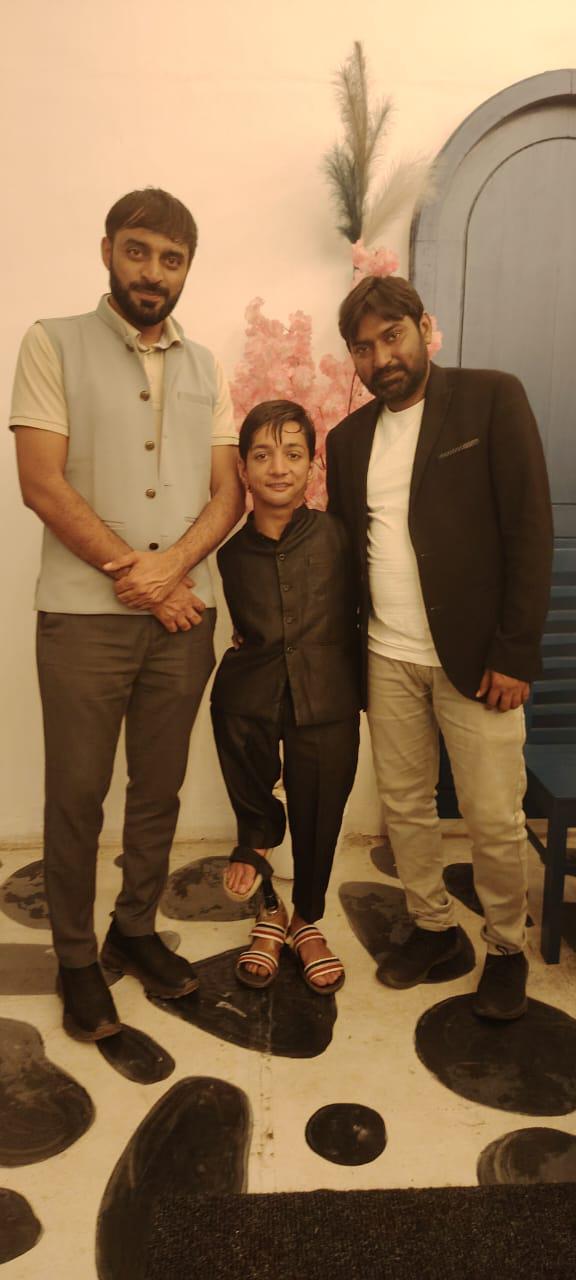
I was wrong. That evening, I met history disguised as humility. Meeting a Warrior, Not in Armour – but in assistive limbs. The special guest was introduced simply. “Saeed Asim… and his father.” No grand announcement. No dramatic buildup.
Yet, the moment I saw him – calm, composed, eyes filled with clarity far beyond his age – I knew this was not an ordinary young man.
Muhammed Aasim P, born on 1st February 2006, a native of Velimanna, Kozhikode, Kerala, came into this world with 90% physical disability. What most people don’t know – what history often forgets – is that doctors advised his parents to abort him. They spoke of limitations. Of suffering. Of a life not worth living.
But Muhammed Shaheed and Jamseena, his parents, chose faith over fear. They chose love over medical predictions. They chose to accept Allah’s will wholeheartedly, ready to face every consequence – together.
That decision did not just give birth to a child. It gave birth to a movement.
A Child Who Changed a Village Before He Changed the World
While most children learn to write alphabet, Asim learned to question injustice. As a student of Velimanna Government Lower Primary School, he noticed something adults had accepted for decades – the school stopped at lower primary. Children had to travel far or drop out.
From a wheelchair, Asim challenged the system. He wrote letters. Filed petitions. Knocked on doors of power.
His fight reached the Prime Minister’s Office, the National Commission for Protection of Child Rights, the Kerala State Human Rights Commission, and the Kerala High Court.
The result?
The school was upgraded to an Upper Primary School.
Today, over 800 students study there.
And Asim didn’t stop. Now, the fight to upgrade it to a High School stands before the Honourable Supreme Court of India. A boy with 90% disability carried the educational future of an entire village on his shoulders.
No One Should Drown Because They Don’t Know How to Swim
Asim once did not know how to swim. Yet, when he learned that around three people drown every day in Kerala, he decided fear had no place in purpose. What followed stunned the nation. He swam over 800 meters across the mighty Periyar River – in 1 hour and 1 minute. Not once. Not twice. “More than 40 times.”
This earned him recognition from:
Asian Book of Records,
India Book of Records, and
World Records Union.
They began calling him “The Warrior of Periyar.” But Asim never celebrated records. He celebrated lives saved.
From a Wheelchair to the World’s Biggest Stages
To push his school’s cause further, Asim undertook a 52-day wheelchair journey, covering 450+ kilometres from Velimanna to the Secretariat in Thiruvananthapuram. No luxury. No shortcuts. Only belief.
In 2021, the world noticed. Out of 169 nominations from 39 countries, Asim became one of the Top 3 Finalists of the International Children’s Peace Prize, announced by Nobel Laureate Desmond Tutu’s foundation – a platform that once honoured Malala Yousafzai and Greta Thunberg.
The Pool Where History Was Rewritten
Then came sports. Not sympathy sports. Competitive sports. At the National Para Swimming Championships, Asim didn’t just participate – he dominated.
9 Gold Medals at Kerala State level (3 consecutive years)
3 Gold Medals with National Records at the 24th Nationals (Goa)
Awarded Best Para Swimmer of the Year, from the Chief Minister of Goa
In Paris, at the Para Swimming World Series, he became the first Indian S2-category swimmer to receive international classification.
Today: World Rank: 8th and Asia Rank: 2nd. Yet, he remains largely unknown to the Indian community.
From Velimanna to the FIFA World Cup
In 2022, Asim walked onto football’s biggest stage – the FIFA World Cup in Qatar.
He met Ghanim Al Muftah, walked alongside Messi, Mbappé, Giroud, and shared the field during the Argentina vs France Final. A boy once advised to be aborted… Now walking with legends.
Asim says:
“A person becomes incomplete only when fear conquers the mind.”
He dreams of flying in an airplane. Of climbing Mount Everest. Of representing India at:
2026 Asian Para Games,
Commonwealth Para Games, and
2028 Los Angeles Paralympics.
He serves millions through his foundation – Aasim Velimanna Foundation, guided by one motto: “Embracing the Inclusive Excellence.”
A Message for Parents, Children, and All of Us
That evening at Calicut beach, watching Asim sit beside his father – quiet, grounded, grateful – I felt something shift inside me.
This was not just a success story. It was a lesson in acceptance.
To parents: Never fear Allah’s decree. The child you are asked to abandon may be the one destined to inspire the world. To children and youth: Your limitation is not your body; it is your belief. To all of us: Thank the Almighty for whatever He has given. Every challenge is a hidden invitation to rise.
From snowfall to shoreline… From silence to standing ovations… From a wheelchair to the world’s top stage…
Saeed Asim is not just climbing records. He is lifting humanity with him. And his life whispers a truth we must never forget: “If I can do it, so can you.”
source: http://www.radiancenews.com / Radiance News / Home> Features> Focus / by Syed Azharuddin / Radiance News Bureau / January 02nd,2025
As many as 10 Muslims have won the 2025 Municipal Council President elections in different parts of Maharashtra results of which were declared on Monday.
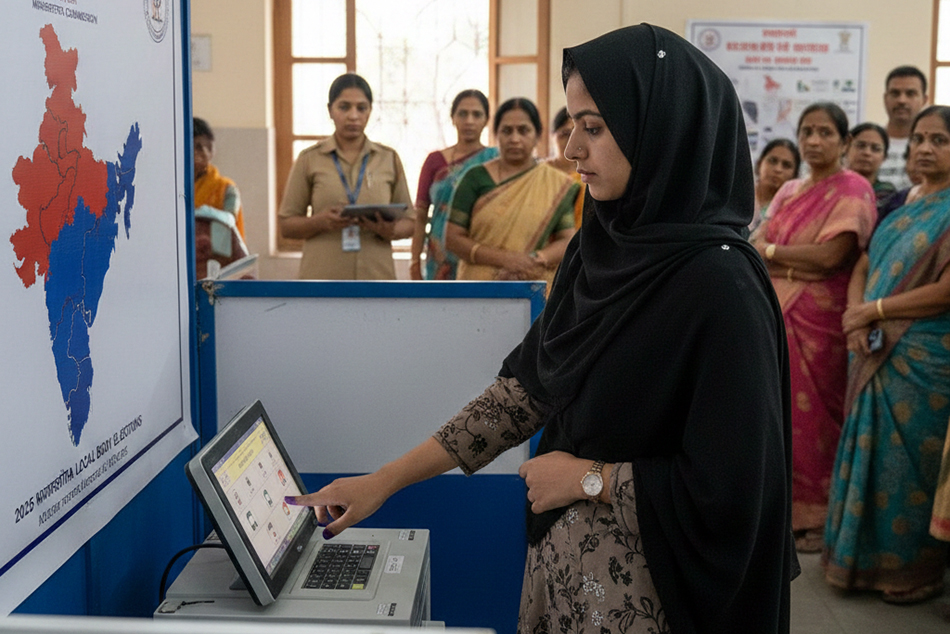
[Gemini AI image for representation.]
Mumbai:
As many as 10 Muslims have won the 2025 Municipal Council President elections in different parts of Maharashtra results of which were declared on Monday.
According to the final results of the 2025 Maharashtra local body elections (Nagar Parishads or Municipal Council, and Nagar Panchayat or Municipal Panchayat), the Mahayuti alliance comprising of the BJP, Shiv Sena (Eknath Shinde) and the NCP (Ajit Pawar) swept the polls winning 207 of the 288 local bodies.
On the other hand, the Maha Vikas Aghadi of Congress, Shiv Sena (Uddhav Thackeray) and NCP (Sharad Pawar) could win just 44 local bodies.
But what surprised the pollsters is the victory of as many as 10 Muslims in the Municipal Council President elections.
The Presidents of the local bodies were elected in Maharashtra by direct voting unlike the earlier practice where councilors were electing the Municipal Council Presidents.
Muslims in Maharashtra Local Bodies
As per the final election results announced by the Maharashtra State Election Commission, 03 of the 10 Muslims who won the president elections in the state are from Aurangabad district.
Of them, Aamir Patel of Congress won the Municipal Council President elections from Khuldabad. Khuldabad is the City where Mughal Emperor Aurangzeb is buried, and his tomb is located.
In Sillod, Samir Abdus Sattar, son of local MLA and former minister Abdus Sattar, won the president election as Shiv Sena (Eknath Shinde) candidate.
Shaikh Farheen Javed Seth of the Congress won the Municipal Council President election from Kannad.
As per the Bhokardan Municipal Council Election Result 2025, Samreen Mirza defeated former Union Minister Rao Saheb Danve in a high profile poll.
Other Muslims, who won the 2025 elections, are Aasif Khan (Pathri in Prabhani district), Mehreen Bilal Chaush (Majalgaon in Beed district), Dr Aafrin (Balapur in Akola district) and Shaikh Parveen (Ausa in Osmanabad district).
Likewise, Farida Bano Punjabi of All India Majlis e Ittehadul Muslimeen (AIMIM) has won the Municipal Council President election from Karanja Lad in Washim district. Along with Farida Bano, 17 AIMIM candidates have also won as councilors in Karanja Lad.
Overall the AIMIM of Asaduddin Owaisi has won 87 seats including 1 post of council president in Karanja. The AIMIM has won 13 seats in Buldhana, 11 seats in Akola, 17 seats in Karanja, 07 seats each in Yewatmal and Amravati, 02 seats each in Kamti, Nanded, Beed and Udgir, and 04 seats in Jalgaon.
source: http://www.ummid.com / Ummid.com / Home>Maharashtra / by ummid.com news network / December 23rd, 2025
Mr. Junaid Malik, Senior Research Fellow in the Department of Law at Aligarh Muslim University, has won the Best Paper Award at the 6th International Conference on “Law and Technology: Ethics, Regulation and Innovation.”
The conference was organised by IPEM Law Academy, Ghaziabad, in collaboration with Uttara University, Dhaka, and RV University, Bengaluru, and saw participation from national and international scholars, academicians and legal experts.
Mr. Malik’s paper, titled “Balancing Privacy and Public Interest: The Emerging Landscape of the Right to be Forgotten in India,” was commended for its strong doctrinal analysis, contemporary relevance and nuanced engagement with constitutional values in the digital age.
He is currently pursuing his PhD under the supervision of Dr. Mohammad Nasir, Assistant Professor in the Department of Law at Aligarh Muslim University.
source: http://www.radiancenews.com / Radiance News / Home> Awards> Latest News / by Radiance News Bureau / December 16th, 2025
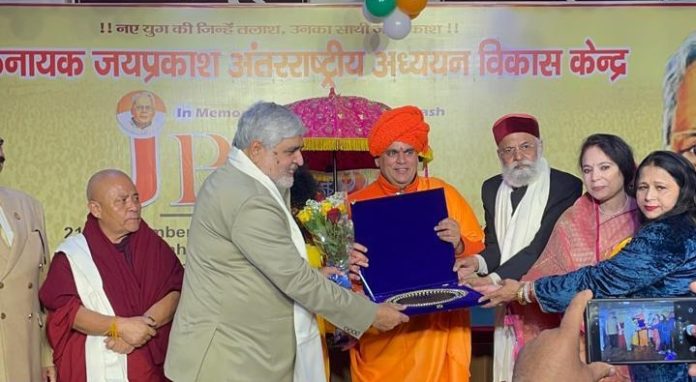
Syed Tahseen Ahmed, Board Director of Sahyog Urban Thrift and Credit Cooperative Society, was honoured with the Loknayak Jayaprakash Smriti Award for Excellence in the Business Sector on December 21, 2025, in recognition of his leadership in building a cooperative model rooted in self-reliance and financial dignity.
The award recognises Ahmed’s role in shaping Sahyog as an institution that addresses a critical gap in access to credit for working-class communities. Sahyog Urban Thrift and Credit Cooperative Society was established to support labourers, street vendors, small shopkeepers, skilled workers, and young people seeking self-employment – groups that are often denied assistance by conventional banks due to collateral and interest-related constraints.
Sahyog operates on principles of mutual trust and cooperation. Through its microfinancing model, the society provides financial assistance without interest, does not demand heavy collateral, and offers simple, installment-based repayment. The objective, according to the society, is not merely to provide loans but to enable members to build sustainable livelihoods with dignity and self-respect.
Under Mr. Ahmed’s guidance, Sahyog has evolved into more than a financial cooperative. It functions as a community-driven movement that encourages members to become economically independent and, in turn, support others within the cooperative framework. Members are able to start or expand small businesses, improve employment prospects, and secure greater financial stability for their families.
The Loknayak Jayaprakash Smriti Awards are presented to individuals whose work reflects integrity, social commitment, and long-term institutional vision. The jury cited Sahyog’s steady growth and community impact as evidence of a responsible and inclusive approach to enterprise.
source: http://www.radiancenews.com / Radiance News / Home> Latest News> Report / by Radiance News Bureau / December 30th, 2025
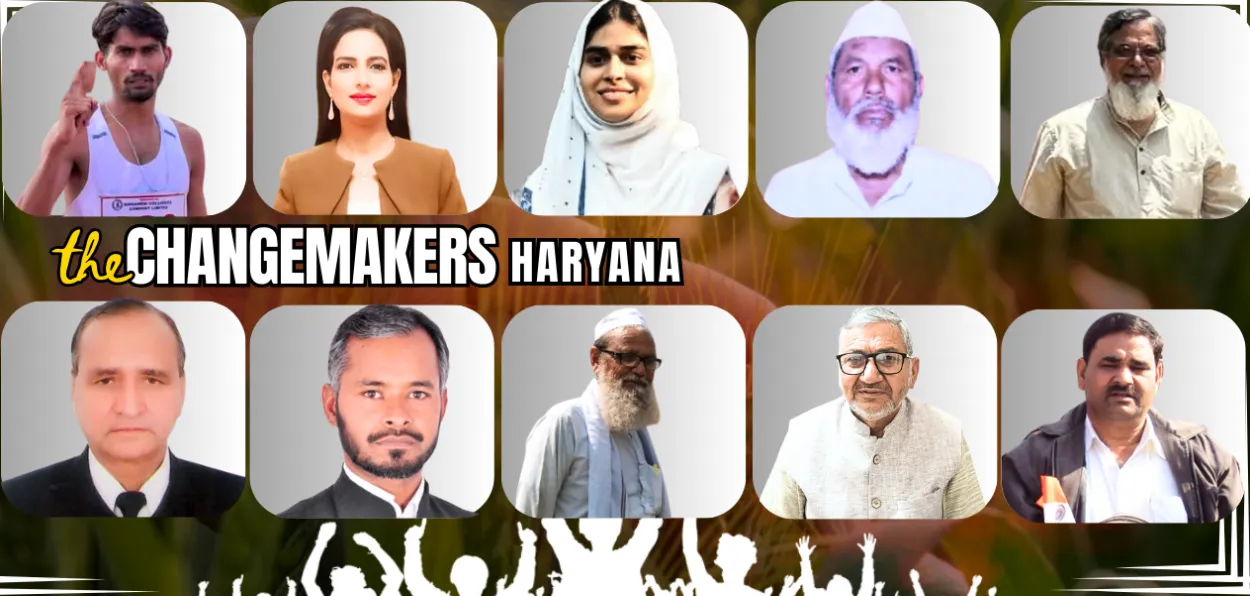
Awaz-The Voice presents ten notable Change Makers from Haryana, who are bringing about positive changes in the state known for its agricultural produce. These are men and women who have struggled against odds and emerged as sources of great inspiration. In this series, we focus on personalities from the most backward areas. Through these stories, we aim to feature people who are working selflessly for the public.
Haji Ibrahim Khan
Haji Ibrahim Khan of Mewat has launched many water conservation campaigns for three and a half decades. As president of Aravalli Jal Biradari, he has been fulfilling his responsibilities with sincerity. He says, “Since childhood, we have seen extreme water scarcity. Women suffer the most because they manage all household chores and walk long distances to fetch water. My inspiration came from ‘Waterman’ Rajendra Singh. I first built a dam between two hills near Ghatta Shamshabad. It solved the drinking water crisis for villagers. Later, with the help of Tarun Bharat Sangh, we built several johads (ponds) in villages like Pat Khori, Firozpur Jhirka, Giyasanian Bas, Mewli, and others, including on hilltops for wild animals.”
Parvez Khan
Parvez Khan of Mewat has proven that talent can take you anywhere. He rose from a small village to reach the United States. In May 2024, he won a gold medal in the 1500m race at the SEC Outdoor Track and Field Championship in Louisiana, finishing in 3 minutes 42.73 seconds. His personal best, however, is 3 minutes 38.76 seconds, achieved in California. He also won third place in the 800m race.
Mumtaz Khan
Mumtaz Khan from Chandeni village in Nuh has become the voice of Mewat. She has participated in many social movements and has raised her region’s issues through the media as well. Chandeni is known for education and women’s empowerment initiatives, and this credit goes to people like Mumtaz.
She says, “Since childhood, I have been raising the voice of Mewat from various platforms. I actively took part in movements related to district formation, fair compensation for farmers, and issues of education, health, and employment.”
Siddiq Ahmad Mew
Dr Siddiq Ahmad Mew is a renowned writer and social worker from Haryana. He has done extensive work on the history of Mewat. He says, “My first article on the history of Mewat was published in 1991 in HaryanaSamvad, the magazine of the Information and Public Relations Department. After that, many more articles followed. In 1997, my first book, Mewat: A Quest was published. In 1999, my second book Mevati Culture came out. Since then, I have been writing books, and by 2025, my 12 books on the history, culture, and folklore of Mewat have been published. Three poetry collections have also been published, while two more are under publication. Apart from this, about 200 of my poems have appeared in ten collaborative poetry anthologies.”
Mohammad Rafiq Chauhan
Mohammad Rafiq Chauhan from Karnal is an advocate and a social worker. He runs the voluntary organisation, Haryana Muslim Khidmat Sabha, which works to raise awareness on education, health, environment, and women’s rights. He is so committed to the cause of Women’s rights that at times, when he finds the victim is unable to pay his fee, he contests their cases free of cost and doesn’t even charge for the stationery.
Rukhsana
Rukhsana from Sunari village in Nuh is working as a magistrate in Gurugram. After two failed attempts, she cracked the West Bengal Judicial Services examination, securing third rank. Her success has inspired many girls across Haryana and the country, especially those who believe that a girl’s world is limited to the four walls of her home, to work towards independent careers.
Rafiq Ahmad
Rafiq Ahmad from Indri in Karnal is the first Muslim graduate of Karnal. He devoted his life to public welfare, especially the construction and restoration of mosques. He says, “Many mosques and Eidgahs were built between 1960 and 1962. My life was spent working for these causes. Many people joined this mission, and gradually a caravan grew.” He believes that it is important to convey the true spirit of Islam.
Rajesh Khan Machchhari
Rajesh Khan Machchhari from Sonipat is a lawyer and a well-known social worker. Since 2006, he has been president of the Qabristan Intizamiya Sangharsh Samiti, which manages graveyards, ensures water and electricity supply, removes encroachments, builds boundary walls, and buries unclaimed bodies.
Aslam Khan
Aslam Khan from Gurugram is the founder of Haryana Anjuman Charitable Trust, which helps the poor and orphans. This trust began after Aslam witnessed patients suffering without money while seeking treatment for his mother, who had cancer. Deeply moved, he decided to create a trust for the needy. In 2003, the organisation was formally registered and has since attracted many supporters.
Hoshiar Khan
Hoshiar Khan from Hisar is the president of the Muslim Welfare Committee. The organisation works for the welfare of the Muslim community, raising issues related to reservations, basic amenities, and community rights.
Due to the lack of mosques in Hisar, Eid prayers are organised in Krantiman Park with expenses borne by the committee.
source: http://www.awazthevoice.in / Awaz, The Voice / Home> The Changemakers / by ATV / posted by Aasha Khosa / December 06th, 2025
The University of Delhi awarded Taha Yasin with the degree of Doctor of Philosophy (PhD) on the 12th of September, 2025.
The panel of experts appreciated the thematic breadth and originality of the ambitious and intellectually rich investigation of the contradictions within Indian democracy in the thesis titled: ‘Reclaiming Democracy: Looking into Literature of Independent India’, and urged for its immediate publication as a monograph.
Dr Taha Yasin completed his 10+2 from Bishop Westcott Boys’ School, Namkum. After graduating with English (Hons) from St. Xavier’s College, Ranchi, he completed his Master’s, M.Phil. and LLB from the University of Delhi.
Moreover, after clearing NET in the first attempt, he has been teaching in the Department of English, Ram Lal Anand College, DU, since January 2013.
As an active participant of Delhi University Teachers’ Association (DUTA) and it’s executive member in 2019-2021, he has been raising voices for representation, reservation and upliftment of Adivasi, Dalit, Minorities and other marginalised sections of the society. Possessing both vision and ideology, he has not only left mark with impactful presentations in international conferences, but has also been published in reputed national and international journals.
Dr Yasin belongs to the honourable “Haji family” of the historical and academically renowned village – Sons, district Ranchi. He is a permanent resident of Ranchi city now.
In this context, it would be pertinent to argue that Dr Taha Yasin represents the bright academic and political future of the state of Jharkhand.
source: http://www.maeeshat.in / Maeeshat / Home / by Editor / September 14th, 2025
The 19th Memorial lecture commemorating the esteemed Urdu journalist Mahfoozur Rahman was held at the Ghalib Academy in Nizamuddin, Delhi. Mahfoozur Rahman, a distinguished journalist from India, was among the eminent Muslim journalists who passed away on February 6, 2010. Every year, one or two such memorial lectures are organized to honour his invaluable contributions.
This year’s lecture centred on the theme: “Syed Shahabuddin’s National and Milli Services.” Urdu journalist Wafa Azmi of Rashtriya Sahara newspaper, Delhi, delivered a meticulously prepared discourse on this subject. He emphasized that amidst those dedicated to religion, politics, culture, journalism, and social service, the late Syed Shahabuddin remains a prominent ambassador and distinguished IFS officer. Azmi underscored that omitting his name from discussions would be a disservice not only to him but also to society at large.
Wafa Azmi shared that Shahabuddin was born on November 4, 1935, near Gaya in Bihar—though some accounts suggest Ranchi as his birthplace. After completing his early education locally, he moved to Patna for higher studies, earning an MSc from Patna University. He also served there as a faculty member for a few years. During this period, he prepared for the Union Public Service Commission exams, qualified, and secured a high rank in the Indian Foreign Service (IFS).
His diplomatic career began as Deputy Consul General in New York. Over the years, Shahabuddin represented India in various countries, serving as an ambassador and diplomat. In 1978, he voluntarily retired from diplomatic service and ventured into Indian politics to address national issues.
Dr. Zafarul-Islam Khan a senior journalist, scholar and author shared his long-standing association with Shahabuddin, recalling that he was brought into the national fold by him. Initially a journalist, Shahabuddin invited him to participate in the All India Muslim Majlis-e-Mashawarat, where he was soon appointed General Secretary and later President. Dr. Zafarul-Islam praised Shahabuddin’s deep trust in him, both professionally and personally.
He recounted a personal experience from a 2003 trip to Kashmir with Shahabuddin, where sharing a room revealed his inner greatness—his early morning Fajr prayer and recitation of the Quran. Dr. Zafarul-Islam also highlighted Shahabuddin’s unwavering commitment to Indian constitutional principles, always insisting that all actions be within the framework of the Constitution, which he regarded as a sufficient safeguard of rights.
Furthermore, he mentioned that Shahabuddin launched the English-language magazine “Muslim India,” which he published from 1980 to 2000. In 2002, Shahabuddin asked him to resume publication, which he did for two years before halting due to financial constraints. Later, Shahabuddin revived the magazine, which continued to be published for several more years.
Dr. Zafarul-Islam lamented that although “Muslim India” was a quality publication, its readership remained limited, and it often operated at a loss. Despite this, it featured valuable discussions on Muslim and national issues. He revealed that he had compiled Shahabuddin’s editorials into two volumes, which are soon to be published and have been personally proofread by him. He also shared plans to publish a comprehensive volume of all Shahabuddin’s writings.
He clarified that Syed Shahabuddin was not a populist leader—a view reinforced after the demolition of the Babri Masjid. Moreover, Dr. Zafarul-Islam recounted Shahabuddin telling him that the idea of boycotting January 26, the Republic Day or wearing black bands was not his but originated from Azam Khan, and that Shahabuddin was compelled to accept it.
Senior journalist Masoom Moradabadi highlighted Shahabuddin’s heroic role during the Shah Bano case, when the Indian Muslim Personal Law Board launched the largest post-independence movement among Muslims, with Shahabuddin’s speeches drawing crowds in the hundreds of thousands.
Prof. Naseer Ahmad Khan, a close associate of Shahabuddin, expressed regret that despite his stature as a respected leader across educated circles and among the masses, only a modest funeral was held—attended by a few officials from Jamaat-e-Islami Hind, the Muslim League, and other organizations. He contrasted this with the funeral of Maulana Muhammad Ahmad Samar, which saw an estimated two to 2.5 lakh mourners, highlighting society’s oversight of Shahabuddin’s immense contributions.
Father Solomon George, the guest of honour, remarked that the stories and media reports about Shahabuddin barely scratch the surface of his efforts in social welfare and minority rights. As a fellow minority, he emphasized the importance of reflecting on why minority leaders often become vulnerable at critical moments, especially in today’s India.
Mr. Nisar Khan moderated the event, which was attended by notable Urdu personalities and presided over by retired Professor Abdul Haq of Delhi University, an esteemed scholar of Urdu and Persian literature.
In his presidential address, Professor Abdul Haq expressed his gratitude for the opportunity to participate in this gathering. He extended heartfelt congratulations to Shahabuddin, recalling his first meeting with him during Chandrashekhar’s tenure as Prime Minister. He reminisced that Shahabuddin was then a shining star in Muslim politics, actively listening to the Prime Minister’s serious discussions on the Babri Masjid issue.
This event served as a fitting tribute to a truly remarkable leader who left an indelible mark on society through his dedicated service and unwavering principles.
source: http://www.indiatomorrow.net / India Tomorrow / Home> Politics> Society / by Zillur Rahman Haider / December 02nd, 2025
To understand a person’s character, nature, and values, it is enough to look at their neighbour. Your neighbour acts as a social mirror for you. There are many reasons for this. The people with whom we spend the most time unconsciously influence our thoughts and behaviour. If your neighbour is good, well-cultured, and helpful, it is highly likely that you are also like that or strive to be so. Conversely, if your neighbour is quarrelsome, selfish, or has bad habits, and you get along with them, people may conclude that you either share those same flaws or are indifferent to such things.
We can choose our friends, but the choice of our neighbours is not always in our hands. In such a situation, how you behave with your neighbour reveals your true nature. If your neighbour is good and you have an amicable relationship, it shows that you value goodness. Similarly, if your neighbour is troublesome, how you handle the situation reveals your patience, understanding, or resilience. Whether you argue with them, ignore them, or find a solution through mutual understanding provides an insight into your personality.
Especially in small villages or traditional societies, a person’s reputation often depends on the testimony of their neighbours. For any new relationship (for instance, when a marriage proposal is considered) or for financial transactions, people first inquire with the neighbours. The ‘Character Certificate’ given by a neighbour is considered the most reliable. If your neighbours speak well of you, your standing in society increases.
In India, particularly in rural and semi-urban areas, ‘Shejardharma’ (the ethos of neighbourliness) is given great importance. Life here is not individualistic but communal. Your every transaction, your joys, and your sorrows are not yours alone; they belong to the community and especially to your neighbours. Your neighbour is your first companion in joy and sorrow and your first witness, which is why your identity is intrinsically linked with theirs.
The soil of Konkan is not just a land of red laterite stones and verdant areca nut groves; it is a soft fabric woven with the threads of different faiths and cultures. The lives of its people are as indebted to the salty sea breeze and the mighty rains of the Sahyadris as they are to the harmony of Hindu-Muslim communities living together for generations. Two living and eloquent symbols of this unity are ‘Irjik’ and ‘Vati-cha Vyavahar’. Both these traditions have crossed the walls of religion and blended so seamlessly into the lives of the Muslim community of Konkan that they have become a part of their very faith.
Irjik: Brotherhood that Blossoms from Sweat
The Muslim community of Konkan is of this very soil, raised in its air and water. Rice farming is the backbone of their lives too, so during the hustle of planting and harvesting, helping one another was not a choice but a necessity. Out of this need, the tradition of ‘Irjik’ or ‘Saavad’, an exchange of sweat and labour, naturally took root among them. This was not merely a convenience but an effortless rule of life. Even today, in the villages of Konkan, a Muslim farmer lends his shoulder to his Hindu neighbour’s rice planting, and the Hindu brother rushes to help with his work.
According to a famous saying, “A man is known by his neighbour.” In Konkan, this identity is not confined to the walls of a house; it reaches down to the footprints in the mud. ‘Irjik’ is not just help with work; it is the sowing of a pure sentiment. Islamic teachings give this sentiment a deeper and more sublime meaning.
The Holy Qur’an, in Surah Al-Ma’idah, commands, “And cooperate in righteousness and piety.” وَتَعَاوَنُوا۟ عَلَى ٱلْبِرِّ وَٱلتَّقْوَىٰ ۖ وَلَا تَعَاوَنُوا۟ عَلَى ٱلْإِثْمِ وَٱلْعُدْوَٰنِ – Holy Quran, Surah Al-Ma’idah, Ayah 2 (Chapter 5, Verse 2) (Cooperate in righteousness and God-consciousness (Taqwa), and do not cooperate in sin and aggression.”) The practice of ‘Irjik’ is the finest example of this command, as it facilitates help for a good cause (agriculture) through mutual cooperation. ‘Irjik’ is the earthly, soil-level manifestation of this divine command. When a neighbour is in difficulty, what could be a greater act of virtue than coming together to work so that the work in their field is completed on time?
In Islam, Huquq ul-Ibad (the rights of fellow human beings) are given the highest status, and within that, the rights of the neighbour (Huquq al-Jar) are considered paramount. The Prophet Muhammad ﷺ stated unequivocally, “He is not a believer who eats his fill while his neighbour beside him goes hungry.” (ليس المؤمن الذي يشبع وجاره جائع إلى جنبه” Hadith – Bukhari, Musnad Ahmad). This Hadith clarifies that Iman (faith) is not limited to personal worship but is tied to social responsibility. To be unaware of a neighbour’s hunger is considered a sign of diminished faith. This teaching is not confined to hunger; it applies to every need of a neighbour. Lending a helping hand to a neighbour burdened by work is the very soul of that teaching.
‘Irjik’ is a humane solution to economic inequality. Even someone who does not have money to pay for labour can cultivate their farm with dignity because of this tradition. Here, ‘labour’ is the greatest currency, and this spirit of equality is very close to Islamic ideology. Therefore, when the Muslim community of Konkan gathers for ‘Irjik’, they are not just planting rice seedlings; through their actions, they are also cultivating the values of cooperation, brotherhood, and social justice.
Vati-cha Vyavahar: The Sweetness of Affection
The ‘vati’ (bowl) that circulates among the homes of Konkan is not just an exchange of food; it is a continuous flow of affection and warmth from the heart. This practice is just as alive in the Muslim households of Konkan. On Eid al-Fitr, their celebration is incomplete until the sweetness of Sheer-Khurma reaches the neighbour’s house. They find no peace until a share of the sacrifice from Eid al-Adha is given to the neighbour. This is not just a custom; it is a beautiful expression of their faith.
Islam has given such importance to neighbourliness that it is said, “The Angel Jibra’il (Gabriel) kept advising me about the rights of the neighbour so frequently that I thought he would command him to be an heir.” (مازال جبريل يوصيني بالجار حتى ظننت أنه سيورثه Hadith – Sahih al-Bukhari and Sahih Muslim). This shows the immense significance given to the rights of a neighbour in Islam. Inheritance rights are typically reserved for blood relatives, but the emphasis was so great that it seemed a neighbour might be granted a share. In the light of this teaching, the ‘Vati-cha Vyavahar’ ceases to be a mere social courtesy and becomes a religious duty, an Ibadat (act of worship).
Another heart-warming teaching of the Prophet Muhammad ﷺ is, “When you prepare a broth (stew), add more water to it and send some to your neighbours.” (يا أبا ذر إذا طبخت مرقة فأكثر ماءها وتعاهد جيرانك Hadith – Sahih Muslim). This teaching is extremely practical. It tells us to cultivate the habit of sharing whatever we have, even if it is a little. The idea behind the ‘Vati-cha Vyavahar’ is precisely this: to include one’s neighbour in the joy created in one’s own home. The message is so simple and beautiful! True happiness lies in sharing whatever you have, no matter how little. ‘Vati-cha Vyavahar’ is the essence of this teaching. That bowl is a small token of affection that enhances the sweetness in relationships. This is because, according to Islamic tradition, “Exchange gifts, and you will love one another.” (تهادوا تحابوا Hadith – Bukhari). This is a small but highly effective teaching. Giving gifts removes mutual resentments and increases love and affection. ‘Vati-cha Vyavahar’ is a beautiful manifestation of this teaching, where affection is exchanged without any expectation. The unwritten rule of never returning an offered bowl empty is an unspoken agreement to maintain the continuity of this flow of love.
‘Irjik’ and ‘Vati-cha Vyavahar’, these Konkani traditions, play a dual role for the Muslim community. On one hand, they connect them to the shared culture of this land, and on the other, they give them an opportunity to live their Islamic values and faith in practice. Therefore, when a bowl goes from a Muslim home in Konkan to a neighbour, it is not just a dish; it is imbued with a legacy of generations and the noble message of Islamic brotherhood. This, indeed, is the true wealth of Konkan.
The spirit of cooperation at the root of ‘Irjik’ is one of the foundational principles of Islam.
Ta’awun (Mutual Cooperation): The Holy Quran explicitly states (Surah Al-Ma’idah, Ayah 2), “And cooperate in righteousness and piety.” ‘Irjik’ is a practical and living example of this command. Helping one’s neighbour or community member in their work is considered not just a social duty but also a virtuous religious act.
Al-Faza’a (الفزعة): This is an Arabic word which means “to rush swiftly to someone’s aid. When a sudden calamity befalls a village or a tribe (e.g., a fire, an enemy attack, or the sudden threat of rain during harvest), a call for help is made. In response to this call, the entire village or tribe comes together and works without any charge. This practice is similar to the urgent and collective nature of ‘Irjik’.
Al-’Awna (العونة): This word is the closest in meaning to ‘Irjik’. Al-’Awna means “planned collective help.” People in a village come together, especially for agricultural work (harvesting, threshing), building a house, or digging a well. They help each other in turns. The practice operates on the principle that “today I will help with your work, and tomorrow you will help with mine.” There is no monetary transaction involved, only an exchange of labour.
Although the practice of ‘Irjik’ in Konkan is known by its local name, the underlying spirit of collective cooperation, reciprocal labour, and brotherhood is universal. This very spirit is the soul of Islamic teachings, and many practices similar to Irjik, such as Al-Faza’a and Al-’Awna, exist in Arab culture to this day.
[The writer is Executive Editor of “SHODHAN”, the Marathi weekly published from Mumbai, Contact: 8976533404]
source: http://www.radiancenews.com / Radiance News / Home> Features / by Shahjahan Magdum / Radiance News Bureau / November 21st, 2025