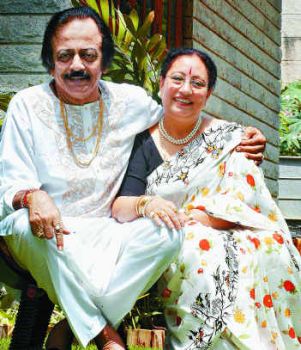
The grand couple of Hindustani music Begum Parween Sultana and Ustad Dilshad Khan get into a jugalbandi of words
MUTUAL ADMIRATION Ustad Dilshad Khan calls Parween Sultana his perfect student and she considers him her perfect guru Photo: V. Sreenivasa Murthy
When Begum Parween Sultana and Ustad Dilshad Khan pose for our camera, they’re completely at ease. She tells us how beautiful his compositions are, including the one he has composed in Maluhamand. He says he calls her Yaman (the raga), because no one sings it like her. Getting them to talk to each other, but not about each other, was quite a challenge, says MALA KUMAR, who caught the exuberant couple just before they performed yet another enthralling jugalbandi.
Both have been child prodigies. Begum Parween Sultana received her early training from father Ikramul Majid, then from Acharya Chinmoy Lahiri in Kolkata, and finally from husband-to-be Ustad Dilshad Khan in Mumbai.
Ustad Dilshad Khan started learning the tabla at the age of four from his father and later took up singing under the guidance of N.C. Chakravorty, Hidan Banarjee and Gyan Prakash Ghosh. Influenced greatly by the gayaki of Ustad Bade Ghulam Ali Khan of the Patiala gharana, he later became the disciple of Fayyaz Ahmed Khan and his brother Ustad Hiaz Ahmed Khan of Kirana gharana. Having been exposed to the best in the Seni, Patiala and finally the Kirana styles, Dilshad became so obsessed with classical music that he gave up a lucrative career as a marine engineer to dedicate his life to the cause of Indian classical music.
In an intimate conversation, the musical couple speak of the tehzeeb or culture of old world music and the politics of today’s “music talent” world. Excerpts:
Begum Parween Sultana (BPS): Let’s talk about our music.
Ustad Dilshad Khan (UDK): What? And displease the best cook in the world! No, no… (To the writer) Parween is an excellent cook, and I love to eat. You know, we’re almost South Indian in our tastes.
BPS: (Getting right back to their favourite topic, music) Achcha Khansaab, do you remember? We first came to Bangalore as musicians in 1978, invited by the Rama Seva Mandali, and today again we are here to perform for them.
UDK: Yes, the Bangalore audience has always been excellent, isn’t it? Those were great days… people used to take so much trouble to listen to great artistes. The singers were great because they used to be so experienced and they used to do so much riyaaz. Everyone seemed to have time to sit through long recitals… (He then gets into a two-minute conversation with the writer.)
BPS: (Bringing him back to the conversation) Khan saab, zara idhar dekhiye…
UDK:Battees saal se dekh raha hoon… two years as my student and for 30 years after our marriage!
BPS: In the music room you are my guru…
UDK: And you are an excellent student. We do have very good students all over the world. But isn’t the world itself changing? People want to learn music, learn karate, painting… everything in quick workshops.
BPS: True. But we are different. We have been teaching only those who want to become professional singers. And we teach not just music but the tehzeeb — the culture, the etiquette, that an artiste should have.
UDK: We don’t want to teach students for whom it means hobby… or hubby!
(But Parween got both, didn’t she?!)
UDK: That is true, but even today she is a true student. But haven’t we seen people who want to become singing sensations within 48 hours? They want to become Indian Idols. See that Ravind…
BPS: Now don’t bring him up Khan Saab.
UDK: But how did people vote for that besura man?
BPS: Why do you want to talk about him? We are not bothered. You know, you must be careful about what you say. We have to realise that to be successful, it is not enough just to be talented. One needs to be blessed, one needs to know the nerve of the audiences and you also need a cool temperament. Success comes and knocks on the door, but you have to open the door. And to maintain success you have to work very hard. You have to be diplomatic.
UDK: Yes, I agree, you are my guru in this department. There is a small difference between being simple and being a simpleton. And I’m often thought of as the latter!
BPS: No, no, you are just too sentimental. And too nice. We all need to be disciplined, but you are too much! So many times I have had to drag you away from riyaaz because people are waiting for us, or we have a flight to catch….
UDK: See, my guruji died on my lap. And he told me never to let go of two things — namaaz and riyaaz. So it’s very difficult for me to change.
BPS: I am a singer and a performer.
UDK: So you need to add garam masala!
BPS: Yes, we need to be very practical. Knowing your audience and catering to them is not just important, it is the most important thing.
(Is that why Lata Mangeshkar continues to sing, even when her voice shakes?)
UDK: Why not, when she sings so well? And when… (turning to his wife) ok, I won’t take his name.
BPS: Why are you comparing Amma with that man? She still doesriyaaz before coming for a recording!
(Changing the topic to talk about their other interests)
BPS: You are an excellent artist and paint so well. You have a great sense of colour and style. You even chooses my saris, my lipstick.(laughs) But you don’t like to come shopping with me.
UDK: But don’t you have the best companion, the love of our life, our daughter.
BPS: At 17, she has a voice that has an excellent range. She is a kind, sensitive, loving child, and she and you are very close.
UDK: I object! You are her favourite!
BPS:Bakwaas!
UDK:(Turning to the writer) Let me take two minutes to tell you….
BPS:Bas, bas, Dilshad, these two-minutes will be endless and we have to leave…
UDK: We have to meet Sai Baba to take his blessings, let’s go.
source: http://www.thehindu.com / The Hindu / Home> MetroPlus Mangalore / by Mala Kumar / Saturday – May 28th, 2005
Zila Khan is the daughter of Ustad Vilayat Khan. In his time he was the most famous Sitar player in the country. Today, she is as her father, grand-father Ustad Inayat Khan and great grand-father Ustad Imdad Khan were in the times they lived. 42-year old Zila Khan is currently amongst the best of our country’s singers of classical and light classical Hindustani music specialising in Sufiana and rendering ghazals of great poets of Urdu and Hindi. She was put through a rigorous mill of singing eight hours a day while still a child in school in Calcutta. She was not allowed to study beyond the 10th standard in order to devote all her time to music . She was the first girl in seven generations to become a professional singer. She did me the honour of singing at one of my mehfils. It was a memorable evening.
There were a few surprises in store for me. I was expecting her to come alone. She came bustling in, followed by her harmonium and tabla players, a photographer and a lackey. I expected her to be a demure and reserved young lady; she kissed my beard or both sides as I sat wrapped up in my shawl by the fire-side. I offered them sharaab (Scotch): they declined and asked for tea. The first thing she did was to keep her mobile with her while sipping tea. I am allergic towards mobiles in mehfils.
The session started with the harmonium and tabla players warming up. Zila sang a few notes to get the harmonium to the right notes and slapped her thighs to indicate the beat for the table. In between she answered my questions in fluent English and Urdu: Her mobile rang. Call from New York. She confirmed her date with the caller. Then back to singing a note or two for the harmonium, thigh slaps for the tabla, answering my questions and pressing buttons on her mobile. She was on line to Kochi telling the fellow at the other end to change the date of her performances in Kerala till after she had fulfilled her engagements in the States. She was like a six-armed goddess doing six things at a time. I lost patience and pleaded with her “Switch off that damned mobile before you start. “She did not take offence. ‘I’ve finished with it,” she replied as she put it in her hand bag. She turned to me with a bow, for permission to begin “Ijaazat?” I nodded my head: “What would like to hear first?” she asked. I was not prepared for the fermaish, so came out with the first ghazal that came to my mind : Muddat hoee hai yaar to mehmaan kiye hooey (it has been a long time since I entertained my beloved in my house).Then she broke into full throated song — arms and hands emphasising meanings. At the end of every couplet she turned to me rather than her note book for the next — whether to test me or flatter me. Fortunately, I did not let myself down. I was able to show off my memory and was mighty pleased with myself.
So it went on from Ghalib to Hafeez Jalandhari, and others she interwove lines of poets to give her songs a theme, which ghazals rarely have. I was transported into another world — as was everyone else in the mehfil. Long after I had retired for a night her voice kept ringing in my ears and her animated gestures dancing in my eyes.
source: http://www.hindustantimes.com / Hindustan Times / Home / by Khushwant Singh / January 02nd, 2009
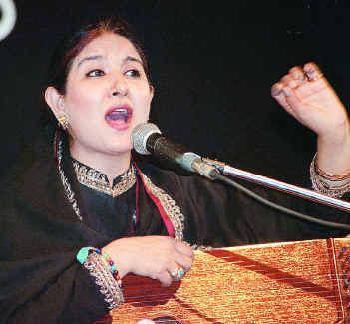
Sufi-based renditions by Zila Khan in New Delhi commemorated World Hospice and Palliative Care Day.
SINGING FOR A CAUSE: Zila Khan. / Photo: Shiv Kumar Pushpakar / The Hindu .
Linking the world with the ring of music is invariably dismissed as a metaphorical thought except on World Hospice and Palliative Care Day, when musicians and vocalists hold a global concert in their respective regions, on that day. This week, the organisers of this event in India, CanSupport, who work for quality care and palliative support for cancer victims and their families, hosted the fourth concert of this world-series.
The decisive moment of this musical humanism began at 7.30 p.m. local time, with an inaugural concert in New Zealand. Thereon, the baton was passed from country to country and was slated to end in Hawai.
In India, the precise moment was commemorated with a recital of Sufi-based renditions by the much acclaimed artiste Zila Khan. In consonance with the prevalent mood of the occasion, Zila Khan rendered a vocal recital of Iqbal’s poem, `Zindagi,’ regaling her listeners into a mesmerising warp by touching upon the emotive pull of the notes ga, ma, pacham, nishad and swara. This high touch start by Zila Khan also brought into focus the highlights of Zila’s personal oeuvre. Her sound vocal training enabled her to delight her listeners with soul stirring content that did justice to the phraseology of the immortal verse.
Structured
The choice of classical insets into an overall ghazal format was a sanguine compositional choice by the artiste. Her penchant for singing medium paced, poised and well-accented literary verse came to the fore, in her rendering. The highly structured methodology of the geet-numa ghazal that Zila chose, recounted the universal appeal of tradition in the midst of thoughtless innovation. The audience was left satiated with her compositional flair, her intrinsic musical command and her easy mannerisms even through the trickiest passages of the verse. The next rendering of the verse of Hasrate Mohani gave listeners a chance to savour her musical talents a notch further. The singer in her remained in full control as she accented the phraseology with deliberation and combining it into an inviting musical weave. The tenets of the gayaki gharana that Zila Khan hails from, as part of the Imdadkhani tradition of her late guru and father Ustad Vilayat Khan, remained in the forefront without taking on a dominating role. Her concert thus immersed audiences in its strong content and serious listeners were able to decipher the guiding presence of the gayaki tradition just beneath the ringing tones of the artistic appeal.
source: http://www.thehindu.com / The Hindu / Home> Features> Entertainment Chennai and Tamil Nadu / by Prakash Wadhera / Friday, October 21st, 2005
Zila Khan was in Delhi the other day to launch her new album of classical and semi-classical musical forms. Music is her passion, and music is in her blood, but over a cup of tea, the delights of a good lemon tart cannot be surpassed, she tells ANJANA RAJAN… .
Zila Khan performing rare musical forms in Delhi at the release of her new album./ Photo: Shiv Kumar Pushpakar / The Hindu.
THE CHILDREN of eminent artistes often struggle to maintain their individual identity before a public that insists on regarding them as appendages of their more illustrious parents. Zila Khan, daughter of pre-eminent sitar maestro Vilayat Khan might be considered among this number. But while she is carving out a niche for herself by performing across the world as a solo vocalist known for her mastery over rare forms, she is also fiercely proud of her lineage.
“Yeh khoon hai naa,” she reiterates more than once, referring to her solid background. Even the recorded music in her family goes back four generations. But it is not merely a blood relationship with her father, it is the bond of a guru and disciple too.
Zila, who divides her time between Oman and London and was in Delhi recently for the release of her music album by Art Karat Entertainment, has as much encouragement for the aspiring `first generation’ artistes who don’t come from traditional music families, as she has praise for the offspring of famous performers, who like herself have decided to carry on the tradition despite the temptations of living a life of indolent luxury fuelled by the parent’s music royalties.
From the time of her grandfather Inayat Khan, the family has been known as generous in sharing and teaching, and, stressing her grandfather’s progressive outlook in teaching women, she declares we would not find a woman from a well-off family in West Bengal who has not had the opportunity of learning from him. And yet, in her own family, she is the first woman to learn and perform music! Paradox or no, Zila has no qualms about admitting it.
“I am absolutely honest,” she affirms, and her eyes have a fiery glint. It was her father who was the radical in her family, but though he taught her “like a son” he asked her to refrain from performing till she got married, and blessed her that she may get a husband in conformance with her aspirations.
Zila is sure his blessings have found their mark, and in Khalid Anwar Shaikh, she has found the perfect match who understands her passion for music and supports her in her globe trotting career.
Thankful that she is able to pursue “my greatest love and passion,” Zila, with her vast range of musical forms, like qaul, qalbana, gul, and others – each with its own special method of singing, its own theka – and her 10-year-old son Faizan who roams the world with her while simultaneously pursuing his studies, in the process keeping up the khaandani tradition, still finds delight in the little pleasures of life, like India International Centre’s irresistible lemon tarts. You have to agree with her when she calls herself “magan.”
source: http://www.thehindu.com / The Hindu / Home> Features> MetroPlus Delhi / Thursday – December 19th, 2002
Kashmiri poet Agha Shahid Ali. / Photo: Special Arrangement / The Hindu
A tribute to Kashmiri poet Agha Shahid Ali on his 10th death anniversary.
Missing me one place search another/I stop somewhere waiting for you. Walt Whitman
The 10th death anniversary of the extremely talented Kashmiri poet Agha Shahid Ali (February 4, 1949 – December 8, 2001) again draws us to his poetry. Shahid’s name – the Persian “beloved” and the Arabic “witness” – is a signature of what adorned both, his life and craft. It is incredible to know how much Shahid was loved and how much he loved in return.
His poems exude the saffron of feelings, like the shaded yellow leaves of dusk. Friends, lovers, martyrs and a suffering mother overwhelm his poetry. Their voices add to his voice. Shahid is an embroiderer of language. It isn’t easy to catch him or let go as he invites you to unravel his deepest and most intricate feelings and concerns.
Need to be heard
Shahid evokes a mythical language of history, where he creates an urgent need to be heard against eras of loss. Like in the beginning of this beautiful poem, ‘A History of Paisley’: You who will find the dark fossils of paisleys/one afternoon on the peaks of Zabarvan –/Trader from an ancient market of the future,/. . . won’t know that these/are her footprints from the day the world began/when land rushed from the ocean, toward Kashmir.
Shahid’s Kashmir is a place looking for its future in the reclamation of its many pasts. In a poem dedicated to his friend Suvir Kaul, Shahid writes: We’ll go past our ancestors, up the staircase,/Holding their wills against our hearts. Their wish/Was we return – forever – and inherit…
Inherit what? The glass map of our country, says Shahid. But this country cannot be inherited without hands blossoming into fists/till the soldiers return the keys/and disappear. The soldiers must leave first, before the country can be painfully stitched back to recognition and the birds of childhood will find voice and the nameless graves will stir with names.
Shahid’s Kashmir, which he calls an imaginary homeland, echoing Salman Rushdie’s India, is nevertheless not a name attached to the idea of a nation. The word nation goes interestingly unmentioned in Nehru’s The Discovery of India, where he called India “a myth and an idea, a dream and a vision”. This appears significant today as the nation has not allowed India to dream generously and the idea of India has degenerated. The line of control has controlled India’s vision since Independence. We have to go back in time and hear how Kashmir and India spoke to each other. India should abandon the West’s language of nationalism. India should refuse to be among the “Rest” of the West’s imagination.
As Shahid asks in a poem: Will the middle class give up its white devotion? Just as Shahid learnt of Kashmir through the poetry of Lal Ded and the rishi Sheikh Noor-ud-Din, the idea of India needs to be revisited through Arab and Chinese travellers of the past, through Buddhist, Hindu and Muslim mystics, through Kabir, Bulleh Shah, Khusrau and Dara Shikoh. On lines drawn over a map of glass, looking for his other in the darkness of history, Shahid discovers the emblem of clarity: I must force silence to be a mirrorto see his voice, ask it again for directions.
Shahid, blind from the start, waits to ask his beloved adversary for directions. In his endearing letter of complaint to his other, the Hindus, Shahid mourns the severing event of their exodus. He is pessimistic about the possibilities of rapprochement: There is everything to forgive. You can’t forgive me. Shahid seems to suggest, if the other, driven by fondness (philia) and not reason, is willing to forgive, then there lies a long, shared history worth forgiving for.
Fate of Kashmir
As a poet of Kashmir’s struggle for dignity, Shahid paid his tributes and condolences to its martyrs and upheld their innocence. He attested fortune’s shame on the death of 18-year-old Rizwan. But even as Shahid was tormented by the fate of Kashmiri boys whose bodies were broken till they could sing no more, he asserted a lyrical, Brechtian resilience: Freedom’s terrible thirst, flooding Kashmir,/is bringing love to its tormented glass./Strangers who will inherit this last night/of the past? Of what shall I not sing, and sing?
Looking for Shahid you find yourself hearing a “witness” who dreams against the paranoia of borders. Looking for Shahid you find yourself marooned in the wailing of Paradise. Looking for Shahid you find a “beloved” hiding and seeking, veiling and unveiling, telling his lover amidst the fog: when you divide what remains of this night/it will be like a prophet once parted the sea.
Shahid, the playfully deceptive non-believer like Ghalib, once wrote in a ghazal: I (who) believe in prayer but could never in God. Elsewhere he countered Nietzsche, asking: When even god is dead, what is left but prayer?
Shahid seems to suggest, even an atheist is bound to a relationship of affect with this world. This relation can make an ethical demand on him in the heart of a despairing, Kafkan moment – to pray in god’s absence, to pray without hope, but pray nevertheless, as an unfathomable, mad duty towards the other. Shahid waits for us at the other end of that prayer.
Manash Bhattacharjee is a poet and scholar living in Delhi.
source: http://www.thehindu.com / The Hindu / Home> Features> Sunday Magazine / by Manash Bhattacharjee / December 03rd, 2011
Scores of Haj pilgrims across the world traveling to Mecca prefer to apply ‘Bareilly-wala surma’ (kohl manufactured in Bareilly) rather than the kohl prepared in other Asian and Arab countries.
A city-based manufacturer claimed that the demand for Bareilly’s surma increases by over 30% during Haj time as compared to other seasons.
The USP of Bareilly’s surma is that it is finely grinded and instantly provides cool comfort to the eyes, he says.
“While preparing surma, other manufacturers based in India and other countries use a grinder and other modern appliances for crushing the semi and precious stones. However, we still stick to our traditional method of using baton stone (sil batta) which helps us finely crush the metal or stone,” said M Haseen Hashmi (67), the manufacturer of Bareilly’s surma.
He claimed that it was his ancestors who made surma popular in the country after setting up their firm in 1794. Since then, generation after generation of Hashmi’s family has been producing surma. At present, hundreds of people in Bareilly work under him.
Even the baton stone used in the preparation of surma is unique. “The stone is black and it is available in Jaipur. The black stone crushes the metal into fine pieces but metal is unable to grind the black stone,” said Hashmi, as he recalled that it was the same black stone with which Shahjahan wanted to build a black Taj Mahal.
He added, “The main ingredient of Bareilly’s surma is the stone of Kohetoor mountain which is located in Egypt. From there, it is exported to India and we purchase it from traders.”
Shabbu Miyan, who is the manager of Khanquah-e-Niyaziya and younger brother of Sajjadanasheen, said, “It is mentioned in the holy Quran that applying surma extracted from the Kohetoor mountain is pious and good for eye-sight. Even Prophet Mohammed used to apply surma made from Kohetoor stone before going for prayers and sleeping.”
Though surma prepared in Bareilly is available in more than 80 varieties, a majority of Haj pilgrims from all over the world opt for surma gulab. “It is a general surma and can be applied by anyone,” said Hashmi. Apart from this, pilgrims prefer to apply ‘surma mamira 777’ and ‘sadi kajal’. ‘Surma mamira 777’ actually causes irritation in the eyes, but cleans all impurities, he claimed.
Sadi Kajal is for women and enhances the beauty of their eyes. The other popular variants help in curing diseases related to eye-sight like red spot in sclera (white area of eyes), eyes pain and also help in improving eye-sight, Hashmi claimed.
The manufacturer provides Bareilly’s surma to agents in Mumbai and Delhi who later export it to Arab countries. As pilgrims offer prayers at Mecca on Eid-ul-Adha or Bakri-Eid, the demand for the city-based surma soars by 30% three months before the festival.
Masqood Hasan, a timber businessman who will be leaving for Haj soon, said, “Applying surma is following Prophet Mohammed. As people across the country are attracted to Bareilly’s surma, I always get surma packed to gift it to my relatives and friends whom we meet during Haj.” Another Haj pilgrim, Shahida Mahmood (42) said, “Bareilly’s surma not only provides comfort but also protects the eyes from all diseases.”
source: http://www.timesofindia.indiatimes.com / The Times of India / Home> City> Bareilly / by Priyangi Agarwal, TNN / September 08th, 2014
At 93 years of age, MF Husain could have been forgiven for calling it a day. But when he sought exile from India in 2006—on account of the vandalisation of his works and the stress of presenting himself in small-town courts all over India, where cases of obscenity had been filed to harass him for having had the temerity to paint goddesses in the nude—he sought not retirement but revalidation.
And that came easily for, arguably, India’s most popular artist. In spite of his advanced age, the royal family of Qatar commissioned him to paint an epic series on the Arabic civilisation for the Museum of Islamic Art in Doha. And in London, the Mittal family—which had gifted the city the controversial ArcelorMittal Orbit ahead of the Olympic Games—seized the opportunity to ask him to paint a tribute to Indian civilisation.
That should have been enough to keep most artists busy, but Husain, missing familiar places and faces in India, was known to have painted extempore at the homes and offices of a large number of Indian families, demanding nothing more than affection and a home-cooked meal in exchange for a hastily improvised drawing or painting. He would appear at the doughty Dorchester, where the staff invoiced him for scribbling figures on its pristine damask napkins. In Mayfair, where he had a studio, the white-haired and often barefoot artist became a familiar sight for Londoners bemused that he should carry a large paintbrush with him as an indication of his profession. At the venerable Victoria & Albert Museum, like scores of art students on any given day, he could be seen sketching on his pad at the Ironwork Gallery, unaware of the chuckles he inspired among visitors ignorant of his fame but conscious only of his age.
It is from this phase of his life, spent in Doha, Dubai and, in particular, London, that a number of ‘last’ works by the artist are gaining currency.
Most, understandably, are not for sale; they are the legacy of families who befriended him in an alien city and extended warmth and hospitality. Though Husain was wealthy—if his collection of sports cars and bikes is any indication, he was extremely rich—money was something he rarely carried on him, so his art became the currency of exchange for favours rendered. The right-wing parties that had hounded him in India enjoy the support of many non-resident Indians, but in London Husain seemed not so much offensive as vulnerable. Secretly, they clamoured for his works, so even though prices were falling back home—or, at least, they were failing to keep pace with modernists SH Raza, FN Souza, Tyeb Mehta and VS Gaitonde—his popularity never waned. Because he still had a large inventory of unsold canvases, he was not required to paint to eke out an existence, however luxurious. The sale of those works—this writer is privy to some of them—now afforded him the comfort to paint in a manner and style of his choosing.
Some of these ‘last’ works, the ones commissioned by Usha Mittal, will now go to the V&A’s gallery 38A for a viewing as ‘Master of Modern Indian Painting’ from May 28 to July 27. According to a spokesperson, even though Husain is “not very well-known” in London, “this exhibition will rectify that”. The V&A had been in conference with the Mittals about a number of projects, and it was natural that the First Family of Steel should suggest the Husain exhibits as a starting point for that venture.
Husain wanted to paint 31 triptychs or 93 panels to express his vision of India, a country that he referred to as “a museum without walls”. Among the peers of the Progressive Artists’ Group, Husain alone, among the founding members, chose to paint a holistic view of Indian society from the vantage of the street, often portraying myths from the Ramayana and the Mahabharata, but also singers, dancers, musicians in a manner that some described as expressionistic while others dubbed it primitive impressionism. Wrongly called ‘the Picasso of India’—that sobriquet better suiting Souza—Husain was maverick, manipulative, marketable, as popular for his remarkable talent as his ability to command the media. He mocked the press, made films with popular film stars, and was quick with repartee, a one-man act that became the face and form of modern art in India from the 1950s till his death in London in 2011.
Critics and collectors claim his best works were done in the early decades, but Husain continued to reinvent and surprise himself and everyone else. Identified for his paintings of horses, he is equally well regarded for his works on Mother Teresa. He courted controversy during the Emergency, when he painted Indira Gandhi in the form of Durga riding a tiger, but was a member of the Rajya Sabha in the eighties.
An observant artist, his eye for detail livens up the Mittal canvases, even though he was at an advanced age when they were painted. Husain completed eight of the 31 triptychs before he died, each painting consisting of three 12ft x 6ft panels (or 12ft x 18ft for the triptych), and it is this unfinished collection that offers a glimpse into his thinking.
Not only did he refuse to create a linear historicity, his insistence on providing glimpses of the life and culture of India in the manner that he experienced it became the context from which he visualised the whole project. The exhibition, therefore, begins with an invocation to Ganesh, the beloved elephant-headed god who is considered a remover of obstacles, the only single panel or painting in the exhibition. The eight triptychs, which form part of his vision of India from Mohenjodaro to Mahatma Gandhi, span “mythology, architecture and popular culture”, according to Usha Mittal, who was privileged to see the artist work on the series in London.
However sure he might have been, Husain pored over books, journals and tomes to ensure that he chose the correct nuances for the triptychs.
Which other artist would have picked something as banal as Indian Households as a subject for one of those triptychs? Yet, in his hands, it becomes a comment on the co-existence of religions and faith in India with its unique syncretism. The first panel of the painting depicts a Muslim household, where the old man with the hookah could be an allegory for his grandfather, and the little boy playing under the charpoy may be autobiographical. The second panel peeps into an educated Hindu household from the south—witness the head of the family immersed in The Hindu—while the familiar image of the umbrella, another leit-motif for his grandfather, links it to the previous panel. The third panel depicts a warrior Sikh family, but not without its middle-class nuances, captured through the table clock and Singer sewing machine, voyeuristic glimpses of middle class lives in India.
It is these delightful insights that make up the rest of the triptychs. In ‘Indian Dance Forms’, the sage Bharata holds forth on the Natya Shastra, while the other two panels depict bharatnatyam and kathakali. The ‘Hindu Triad’ has, of course, Brahma, Vishnu and Shiva in their roles as protector, preserver and destroyer, while in ‘Three Dynasties’ he picks the Mauryan, the Mughal and the British Raj for their abiding influence. In ‘Tale of Three Cities’, he opts for Delhi for its historicity, Varanasi for its spirituality and Kolkata for its culture, and in ‘Indian Festivals’ he chooses Holi, Tulsi Pooja and Poornima—all Hindu festivals, the right-wingers will be glad to know—while ‘Language of Stone’ highlights the country’s—again, Hindu—sculptural tradition alongside poet-laureate Rabindranath Tagore’s poetry.
Handwritten notes describe each panel and their importance, something he discussed at length with Usha Mittal as part of a venture that, had it been completed, would have changed the visual perspective of India as well as that of its artist.
Let it be said: Husain was its most enthusiastic votary.
Image: Dave M.Benett / Getty Images Steel magnate Lakshmi Mittal with wife Usha and MF Husain
The Commission
Usha Mittal was principally responsible for the patronage the family extended to MF Husain when he began work on the project in 2008 in London. In this email interview, Usha Mittal shares the shaping of the series and her interactions with the artist.
Why did you choose Husain for painting this series?
Husain Sahib had a profound understanding of Indian history and culture and was knowledgeable about many aspects of life in the subcontinent, from mythology and religious beliefs to architecture, poetry, music and the visual arts. On seeing Husain’s series on the Hindi film Mughal-e-Azam, I suggested to him that he should capture the history of the Indian civilisation on canvas. The conversation led to a major commission, which the artist started working on during the final years of his life.
Why pick on the Indian civilisation as the series theme?
The Indian civilisation is rich in culture and diversity, and spans thousands of years. Aspects of Indian civilisation have been represented in Husain’s paintings from the start, whether folk images, rural life, dance, mythology or history. With his immense understanding of India and her culture, I felt that Husain Sahib was uniquely endowed to execute such a commission.
Did he discuss the panels with you before painting them?
He was very inspired by this project. Every time I would meet him, he would talk only about the next panel, and would ask for my opinion. In fact, he was talking and dreaming about the forthcoming panels on his last day.
Which are the other Indian artists in your collection?
Apart from Husain, I very much admire the works of Ram Kumar, Tyeb Mehta and SH Raza.
Can you share incidents
of your interactions with Husain while he was working on this series in London?
I saw him paint on several occasions. When he painted, he was totally submerged in the paintings. He had a childlike enthusiasm, and happily painted while listening to music. He had a great sense of humour, and his knowledge of Indian culture, customs and traditions was commendable. Before he started painting the history of India, he read several books on Indian history, and spent several weeks analysing and determining what he wanted to paint and how. He decided he wanted to paint 31 triptychs, but unfortunately could complete only eight. I always admired his qualities as a painter.
Husain’s worth, or the worth of a Husain
Despite a fall from grace, he cared about his legacy
Image: Amit Verma / A Husain (left) and a Souza displayed on the same wall at the Christie’s auction in Mumbai last December
That he was prolific has never been in doubt, and observers have speculated about the number of paintings he painted in his lifetime: Variously between 20,000 and 40,000 works, which record has a parallel with that other equally productive artist, Pablo Picasso.
Husain was always conscious of his value, using it as a benchmark of his talent as well as his popularity. Early in his career, he would sulk if Raza’s prices at an exhibition were marked higher than his, removing his own works on one such occasion. He did see Raza’s prices, as well as those of Souza’s and Tyeb Mehta’s, best his own in his lifetime, by which time he was concentrating harder on his painting, knowing that time was now against him as he raced to complete commissions that would result in a unique legacy of art.
Even so, for decades he enjoyed the distinction of being India’s most expensive artist, and the movement of Husain’s works in galleries and at auctions has always been brisk. With his most iconic works in museums and in collections that are unlikely to sell, it is only those works in the market that determine his benchmark.
For now, his top canvases do command prices in the region of Rs 2–5 crore. Since uniqueness and provenance adds value to an artist’s worth, his triptychs for the Mittals could be among the more expensive of his works, though Usha Mittal has refrained from commenting on the commission’s value, only commenting that it was “a private matter between Husain Sahib and myself”.
source: http://www.forbesindia.com / Forbes India / Home> Life/Special / by Kishore Singh / May 13th, 2014
This Muslim woman worked for the French resistance in WW2. Hear her remarkable story
By any standards, Noor Inayat Khan led an unusual life. Born in Moscow in 1914, she was a direct descendent of an 18th century Indian Muslim ruler, later becoming an accomplished musician and children’s author. But then the Second World War broke out, and she was recruited by British spies to help the French resistance. Documentary maker Alex Kronemer has been telling her remarkable story.
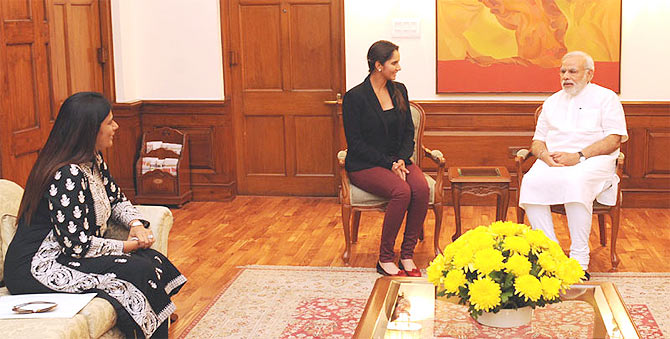
Sania Mirza speaks with Prime Minister Narendra Modi, while her mother, Naseema, looks on, during a courtesy visit on Friday. Photograph: PIB
Indian tennis star Sania Mirza called on Prime Minister Narendra Modi on Friday after her victory in the US Open mixed doubles last week.
Sania met the Prime Minister in a courtesy visit. She was accompanied by her mother Naseema Mirza.
“Indian tennis player and winner of the 2014 US Open Mixed Doubles Event, Ms Sania Mirza, called on the Prime Minister, Shri Narendra Modi, today,” a PIB release said.
Partnering Bruno Soares of Brazil, Sania clinched her third mixed doubles Grand Slam title last week.
Modi had also congratulated Sania just after her victory.
“Congratulations to Sania Mirza for the victory in the US Open Mixed Doubles Finals. We are very proud of the achievement @MirzaSania,” the PMO had tweeted.
On Wednesday, Sania met Telangana Chief Minister K Chandrasekhar Rao in Hyderabad. She is the brand ambassador of the newly-formed state.
Nazrulgeeti exponent Firoza Begum, who was to be honoured with ‘Banga Bibhushan’ by the state government later this month, passed away in Dhaka on Tuesday evening. The 84-year-old was suffering from heart and kidney disease.
“She breathed her last around 8.15pm,” Bangladeshi media reports said. She had been undergoing treatment at the ICU of a private hospital. She was fitted with a pacemaker on Monday.
Mamata Banerjee grieved on social media as the news reached her on Tuesday night. “I am very sad to learn that the legendary Firoza Begum has just breathed her last. Her passing away will certainly create a huge void in the world of music and culture,” she posted.
The CM said her government had planned to confer the state’s highest civilian honour on her. “We had decided to honour her with ‘Banga Bibhusan’. She had also agreed to come to Kolkata to receive the award. But, now it’s all over,” she mourned.
Mamata recounted her last interaction with the legend by saying: “Hardly 10 days ago, we talked to each other. To me, her passing away is indeed a great personal loss. She used to treat me as a member of her family. On the last occasion of our meeting, she told me: ‘Ar ki dekha hobe? (Will we meet again?)’ Today, these words keep ringing in my ears,” the chief minister said.
source: http://www.timesofindia.indiatimes.com / The Times of India / Home> City> Kolkata / TNN / September 10th, 2014