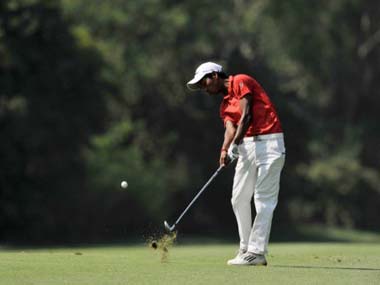
Indian golfer Rashid Khan claimed a play-off victory over Bangladeshi Siddikur Rahman at the SAIL-SBI Open with a birdie on the first extra hole Saturday.
The 23-year-old completed a memorable wire-to-wire victory at his home course, the Delhi Golf Club (DGC), which also atoned for his heartbreaking play-off defeat at the same event a year ago to countryman Anirban Lahiri.
Khan’s maiden Asian Tour victory was worth $54,000 after tapping in his birdie on the par five 18th hole as Siddikur could only make par in the season-opening $300,000 event.
“It feels awesome. It’s my home course and winning here is special. It’s amazing. I lost this event last year. The way I started on the first day with a 61, it was an amazing week. I don’t like play-offs. I played seven play-offs in the last 14 months and I won only three. It’s a lottery,” said a jubilant Khan, who carded a final round one-under-par 71 and totalled 18-under-par 270 for the week.
Khan needed a stroke of fortune in regulation play which forced extra time. He trailed Siddikur by one with two remaining but produced a lucky birdie on 17 to draw level. Both players birdied the 18th hole under immense pressure to take the tournament into a play-off.
File photo of Rashid Khan. AFP
Khan’s aggressive approach paid off when he produced an imperious three wood approach shot from 269 yards out which landed on the apron before taking two more shots to defeat Siddikur, who missed his birdie chance from 15 feet.
“On 17, I actually hit a bad shot, hit it right, but I don’t know how my ball pitched over the bunker and rolled to one and a half feet to the flag. I was shocked. It was really lucky,” said Khan, who will now be fully exempted on the Asian Tour until the end of 2015.
“I had to be aggressive in the play-off. I had to go for it. I took out the driver and hit a good shot in the middle of the fairway and then had about 269 yards to the flag. I went with a three wood and that was one of the best shots I’ve hit.”
When Round 3 was completed this morning, Siddikur trailed Khan by two but soon tied the Indian with an opening eagle. His hopes of a second title at DGC, after clinching the Indian Open in November, faded as he missed his long birdie chance.
Sweden’s Rikard Karlberg, a two-time winner in Delhi, finished third after closing with a 68, six shots from the play-off duo, while S.S.P. Chowrasia of India, Spain’s Carlos Pigem and Martin Rominger of Switzerland shared fourth place on 277.
Two-time defending champion Anirban Lahiri, who was bidding to become the first man to win three straight titles at the same tournament, closed with a disappointing 74 for tied eighth with Sri Lanka’s Mithun Perera (72) and countryman Jyoti Randhawa (69).
Leaderboard:
270 – Rashid Khan (IND) 61-69-69-71, Siddikur Rahman (BAN) 67-67-67-69.
(Khan wins play-off with birdie on the first extra hole)
276 – Rikard Karlberg (SWE) 71-70-67-68.
277 – Carlos Pigem (ESP) 69-71-69-68, S.S.P Chowrasia (IND) 68-69-72-68, Martin Rominger (SUI) 72-63-70-72.
278 – Steve Lewton (ENG) 68-70-68-72.
279 – Abhijit Chadha (IND) 68-73-69-69, Jyoti Randhawa (IND) 71-69-70-69, Anirban Lahiri (IND) 70-66-69-74, Mithun Perera (SRI) 66-68-73-72.
280 – Rahil Gangjee (IND) 71-70-68-71, Chiragh Kumar (IND) 69-73-70-68, Arnond Vongvanij (THA) 74-69-67-70, Sutijet Kooratanapisan (THA) 71-72-69-68, Akinori Tani (JPN) 66-71-71-72, Scott Barr (AUS) 67-70-72-71.
281 – Thanyakon Khrongpha (THA) 69-73-69-70, David Lipsky (USA) 70-70-71-70, George Gandranata (INA) 68-70-71-72.
source: http://www.firstpost.com / FirstPost.Sports / Home> Sports / by Ashish Magotra / New Delhi – March 01st, 2014
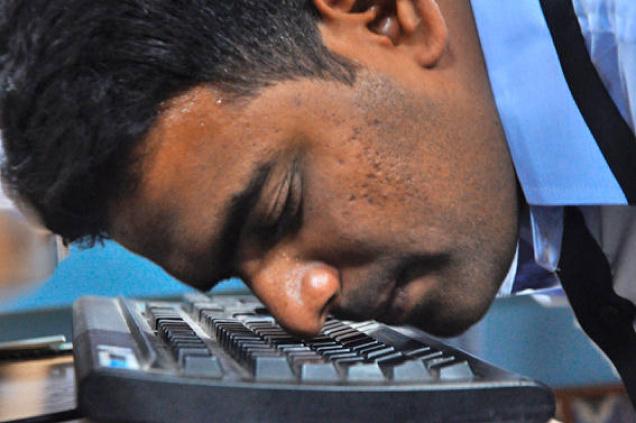
Mohammed Khurshid Hussain currently holds the world record for typing A to Z on a keyboard in 3.43 seconds. – Photo: G. Ramakrishna / The Hindu
The youngster types a sentence using his nose in 47.44 seconds, more than half-a-minute faster than the current world record
Mohammed Khurshid Hussain, who holds the Guinness World Records for typing the English language alphabet in 3.43 seconds on a keyboard, attempted to break the record for typing a 103-word sentence in the shortest time, with his nose, here on Thursday.
It was Mr. Hussain’s second attempt to break the world record for typing the sentence ‘Guinness World Records have challenged me to type this sentence using my nose in the fastest time’ with his nose.
According to the Guinness website, the current record holder is an Indian named Neeta, who achieved the feat in one minute and 33 seconds at Guinness World Records Pavilion in Global Village, Dubai, UAE, on November 16, 2008.
Mr. Hussain’s clock stopped at 47.44 seconds when he finished typing the sentence with his nose, more than half-a-minute faster than the current world record.
“This is my second attempt to break the record. A few months ago, I typed the sentence with my nose in 54 seconds, for which I am yet to receive the certificate,” he said.
Mr. Hussain currently holds the world record for typing A to Z on a keyboard in 3.43 seconds.
The feat was achieved on February 2, 2012, according to the Guinness website. He performed the feat in the presence of S. M. Arif, Padmashree and Dronacharya awardee; Mohteshyam Ali, silver medallist at the Mr. World body building championship; Naina Jaiswal, an international table tennis player; and Iftekhar Shareef, who acted as witnesses for the record-breaking attempt.
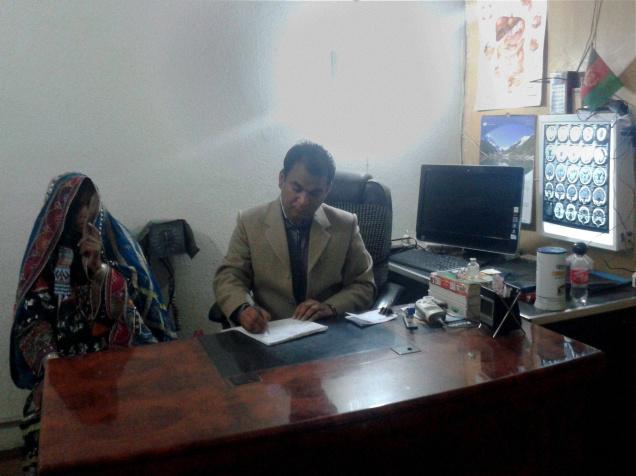
Doctor Shah Nawaz with a patient at a private hospital in Kandahar in Afghanistan.
Shah Nawaz says he is happy to serve the Afghan people
Set to complete a decade in the former power hub of the Taliban, Dr Shah Nawaz, the ‘lone Indian’ here, is happy to help the war-weary Afghan people with their medical needs.
Nawaz, 45, is a doctor working at a private hospital. Officials said Dr. Nawaz is the only Indian working in the city apart from a handful of staff at the Indian Consulate in Kandahar city.
Recalling his journey to Afghanistan, Dr. Nawaz said an Afghan businessman in the dry fruits trade had contacts with his family in India. The businessman often spoke to Dr. Nawaz of the plight of people in Kandahar and their health requirements.
“I then gave him a proposal to build a hospital. He (the businessman) was ready to invest and I expressed readiness to come to Afghanistan and serve the people,” Dr. Nawaz said.
“People here are very simple, their needs are very limited. Actually even basic treatment is not available,” said Nawaz, who hails from Maharashtra.
“I am here since August 2005. My family is not here. They are in Malaysia. I visit them twice or thrice a year and they come once a year to India,” he said. Dr. Nawaz said he was the only Indian working in the city but a number of his compatriots were employed in a huge U.S. military base in Kandahar. According to sources, Indians working at the U.S. base come through Dubai and are not registered with the Consulate.
India last week helped Afghanistan establish its first agriculture university here as part of a major capacity-building project to help the war-torn country increase farm output and attain economic independence.
The Afghan National Agricultural Sciences and Technology University (ANASTU) is coming up in the sprawling Tarnak farm in the former Taliban stronghold of Kandahar.
source: http://www.thehindu.com / The Hindu / Home> News /by PTI / Kandahar, February 24th, 2014
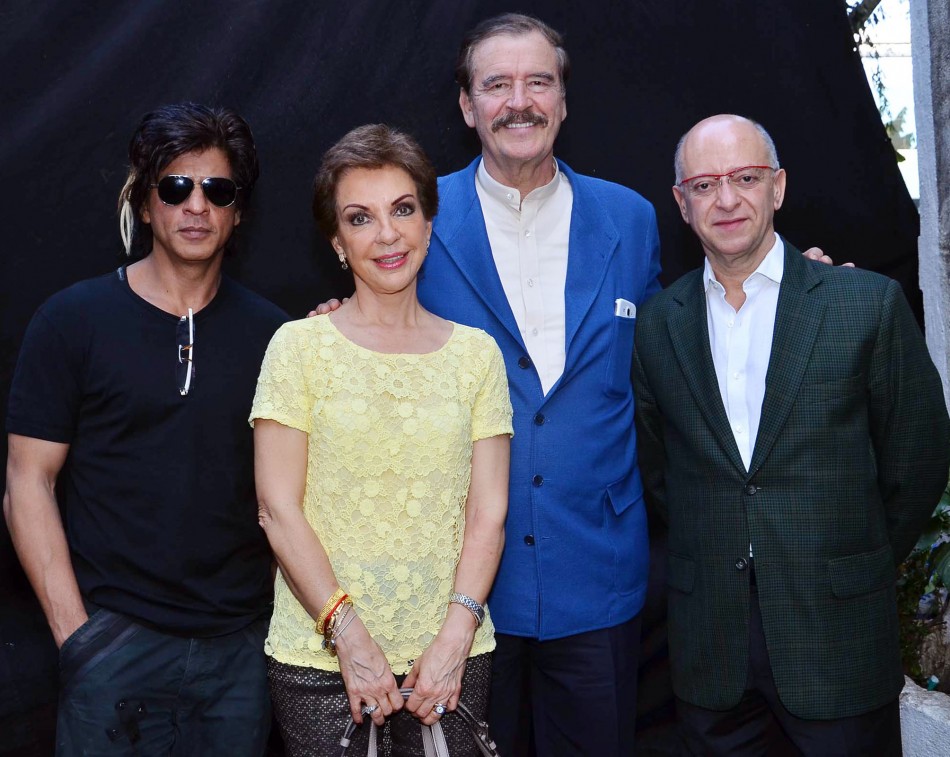
Shah Rukh Khan and former Mexican President Vicente Fox met on the sets of Red Chillies Entertainment Pvt Ltd’s film ‘Happy New Year’ on Feb 11, which is currently being shot in RK Studios in Mumbai. Fox was accompanied by his wife, Martha Fox, and the current Mexican ambassador to India Jamie Nualart. They discussed everything from Bollywood films, to things about Mexico and the importance of education.
About the meeting, Fox said, “We have been visiting many places, but meeting SRK and talking to him we feel he is a great person. The set is fabulous and the activity is just amazing. We hope that Mr Shah Rukh Khan would visit us at Mexico some day.” Well, no-one ever doubted SRK’s diplomatic skills!
source: http://www.timesofindia.indiatimes.com / The Times of India / Home> Entertainment> Hindi> Bollywood / by Reza Noorani, TNN / February 13th, 2014
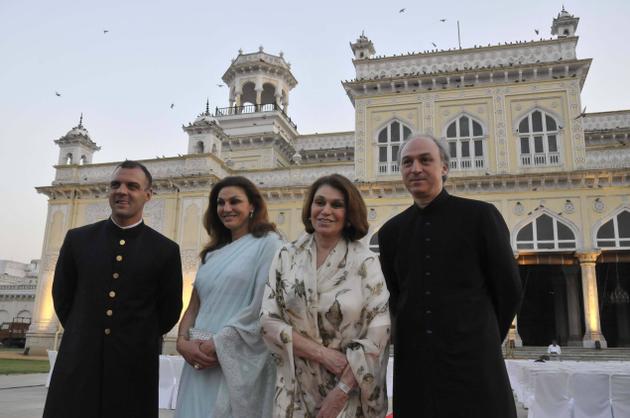
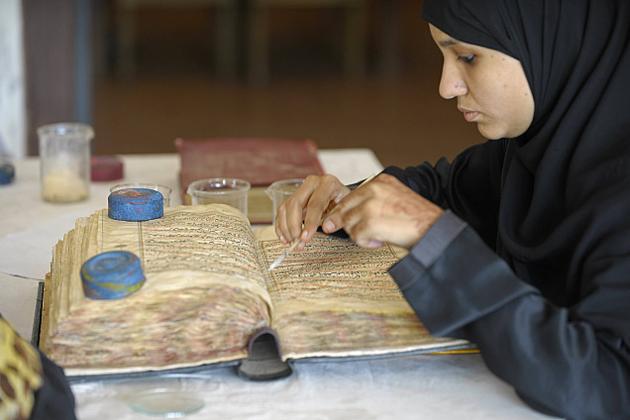
36 restored Nizam-era Qurans complete with precious gold and gem stone ink are on display at Chowmahalla
Today Chowmahalla palace will be teeming with visitors and lovers of history to see the unveiling of numerous Qurans some of which date back to early 1400 A.D. Princess Esra, of the erstwhile royal family, who has been an important part of the revival and restoration of the Qurans says, “It was a Herculean task but worth the sweat and effort. These valuable Qurans couldn’t have been let to rot in the state they were found. Once we discovered the collection we took notice of the work it needed and set out with a serious pace,” she revealed .
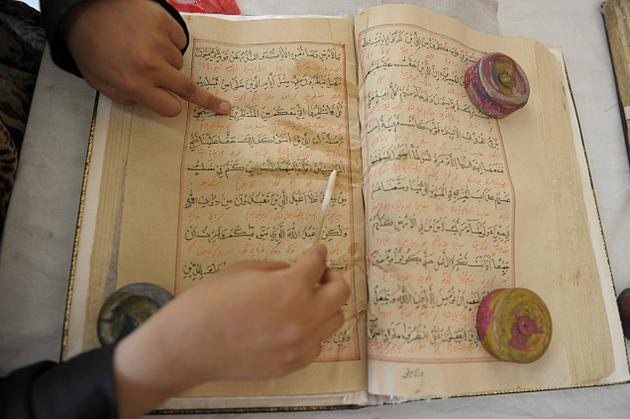
A conservator restores an antique copy of the Quran at Chowmahalla Palace in Hyderabad / AFP
Esra adds, “It’s only for the sake of culture and heritage. When I came here as a bride I was shown night pictures of the lanes and areas and I was in awe of the silenceand solitude . My mother used to tell me ‘you will know once you get there,’ and after I came to Hyderabad I realised what it meant to be a part of the royal family,” she smiled. In awe of the grandeur and the luxury as well as the love that people had for the royal family, she felt humbled. “When I returned after years to see the dilapidated state of the things I had touched and felt, including the Qurans, I was grief-stricken; I couldn’t let them rot away. I am sure even the Nizams themselves didn’t know how many of the precious holy book of scriptures they owned. When the final discovery was made, the total number of the Qurans, of all sizes, stood at 36. There are some very tiny ones as well,” she says.
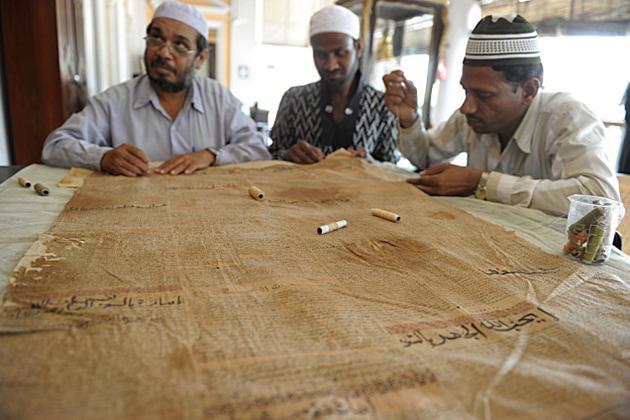
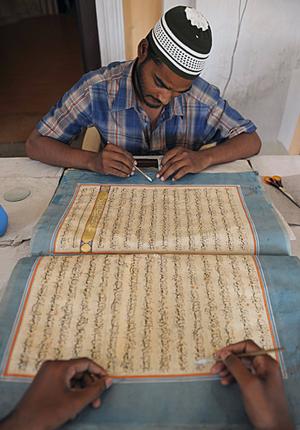
Conservators working on the antique cloth quran / AFP
Esra also speaks with pride of another cloth Quran that was found; the entire Quranwritten on cloth. The cloth’s dimensions stood at 9.5 feet x 5 feet. The Qurans are of immense value not only because of their heritage but also the quality of ink used in them. “Besides gold and silver ink, inks made from powdered gems and semi precious stones were also used. In some Qurans mother-of -pearl has also been used as ink,” informs G. Kishan Rao, director of Chowmahalla Palace.
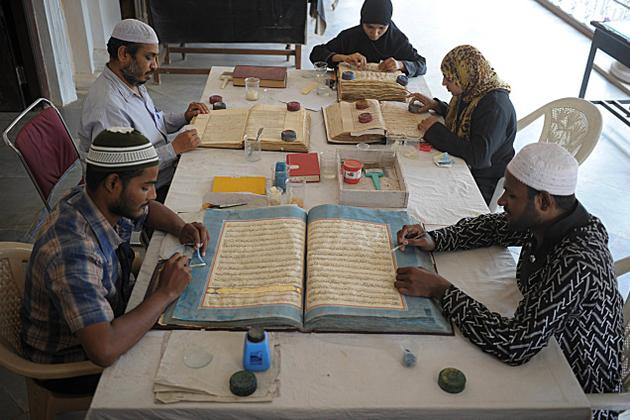
Indian paper conservators restore antique copies of the Quran at Chowmahalla Palace / AFPA conservator restores an antique copy of the Quran at Chowmahalla Palace / AFPRestoration work of the Quran at Chowmahalla Palace / AFP
Since no royal item is permitted to go outside the Palace, specialists from The Indian National Trust for Art and Cultural Heritage (INTACH) have been approached. “They worked continuously for two years to revive the precious books, with Esra’s continual monitoring. The restored Qurans will be displayed in the room opposite the Council Hall in the palace,” informs Kishan Rao.
The Qurans will be unveiled by Esra and Muffakham Jah’s son at Chowmahalla Palace today.
source: http://www.thehindu.com / The Hindu / Home> Features> MetroPlus> Events / by Prabalika M. Borah / Hyderabad – February 06th, 2014
Home / Infosys Prize / Laureates 2013 / Prof. Ayesha Kidwai … / Prof. Ayesha Kidwai Humanities – Linguistics, 2013
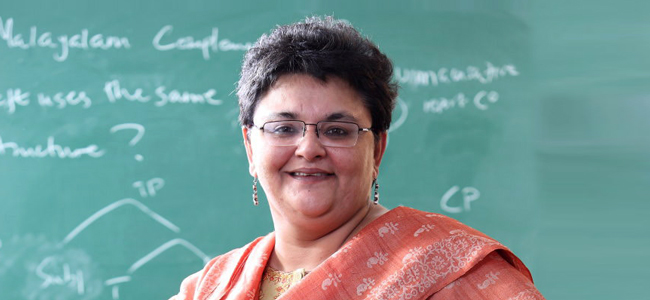
Ayesha Kidwai Professor, Centre for Linguistics, School of Language, Literature and Culture Studies, Jawaharlal Nehru University, New Delhi
The Infosys Prize 2013 in Humanities – Linguistics is awarded to Prof. Ayesha Kidwai for her exceptional contribution to the field of theoretical linguistics. Her research on syntactic relations in Hindi-Urdu has related wider debates in linguistics to the study of Indian languages and has extended our understanding of India’s linguistic diversity.
Congratulatory Message From The Jury Chair – Amartya Sen
“It’s wonderful for me to have the opportunity of congratulating Prof. Ayesha Kidwai for the extraordinary work she does on theoretical linguistics. India is a country of many languages and she has been able to use her general skills to find ways and means of studying the languages with the kind of international global understanding. That is one of the delights of contemporary linguistics. Totally delighted to be able to count on her being part of the community of scholars that we are honoring through this annual giving of prizes”
Bio
Prof. Ayesha Kidwai completed her M.A. and Ph.D. in Linguistics from Jawaharlal Nehru University. Her research interests include linguistic theory, with particular reference to the (generative) syntax and morphology of Indian languages, philosophy of language, gender and language, the politics of English, and the evolution of language. Her current research interests include the syntax of finite complementation and the properties of adjunction in natural language.
She has authored several papers and a few notable books such as XP-adjunction in Universal Grammar: Scrambling and Binding in Hindi-Urdu, and In Freedom’s Shade, an English translation of Anis Kidwai’s Urdu memoir Azaadi Ki Chaon Mein.
Scope And Impact Of Work
Prof. Kidwai’s research ranges around a wide variety of syntactic topics, united by a preoccupation with the properties and effects of optional displacement operations in Universal Grammar.
Universal Grammar is the radical hypothesis, put forth five decades ago by Noam Chomsky, that the innate human linguistic ability is a domain-specific intelligence that must be modeled as a distinct Faculty of Language. This innate endowment, a system of principles and parametric options, forms the basis for the human knowledge and acquisition of any natural language, and is the source for both the relatedness of and differences between human languages. Prof. Kidwai’s contributions to the field have been the study of the principles and parameters that must be hypothesized to explain the syntactic properties of a number of South Asian languages, including Hindi-Urdu, Bengali, Malayalam, Meiteilon and Santali.
The phenomenon of free word order found in many languages of the world – ‘scrambling’– raises many intriguing questions for Universal Grammar, as such word order variation is apparently optional, and therefore difficult to characterize by grammatical rules. Prof. Kidwai’s work in this intensively studied and debated domain proposes a novel theory of how the referential properties of scrambled noun phrases in Hindi-Urdu may be characterized once the discourse effects of these optional variations are taken into account. These proposals have had important implications for the hypothesized design of Universal Grammar as well as the displacement operations conjectured to be central to it.
Recently, Prof. Kidwai also distinguished herself as an ace translator, having rendered Anis Kidwai’s moving Urdu memoir of the aftermath of partition, Azaadi Ki Chaon Mein, into English, In Freedom’s Shade.
Long Citation
Prof. Ayesha Kidwai is an outstanding theoretical linguist. Her work has earned recognition from leading international experts, as it relates the general theoretical framework of the principles of Universal Grammar to some of the particular syntactic features of Indian languages like Hindi-Urdu, Santali, Meiteilon, Bangla and Malayalam, analyzing these within the structures of human cognitive systems and their general properties.
Central to these achievements is Prof. Kidwai’s work on a wide range of adjunction phenomena. On the intensively studied and debated syntactic phenomenon of ‘scrambling’, her work proposes a novel theory of binding in extensive analytical investigation of Hindi and Urdu.
Prof. Kidwai has helped raise the respectability and significance of the field of theoretical linguistics by providing leadership and mentorship to young linguists in India. She has consistently stressed on the political and cultural importance of the study of India’s linguistic diversity.
source: http://www.infosys-science-foundation.com / Infosys Science Foundation / Home> Infosys Prize / Laureates 2013 / Feb 2014
Indian business leader, scientist and philanthropist Dr Yusuf Hamied on Monday announced a major financial donation to the Royal Society of Chemistry, the world’s leading chemistry community, to support an innovative chemistry education programme for school students in India.
Dr Hamied, who is the chairperson of the generic pharmaceuticals company Cipla and has pioneered the model of producing affordable medicines for patients in developing countries, is donating Rs eight crore to the Royal Society of Chemistry’s Hamied Inspirational Chemistry Programme.
The programme will be managed by the Royal Society of Chemistry in partnership with the UK’s Salters Institute and leading Indian academic institutes to enhance the skills and knowledge of Indian chemistry teachers and inspire students to study chemistry at university.
Over the next five years, the programme aims to equip 8,000 teachers across India with the specialist knowledge and skills to deliver exciting and engaging chemistry lessons, and to pass this knowledge on to their colleagues. It will also provide 1,600 of the brightest chemistry students from all backgrounds with places at chemistry camps to motivate them to reach the necessary standards to study chemistry at university.
Dr Hamied said: “I am very pleased to be working in partnership with the Royal Society of Chemistry to support the Hamied Inspirational Chemistry Programme. I believe the programme will make a real difference to the education and experience of students studying chemistry in schools across India.”
Chief Executive of the Royal Society of Chemistry, Dr Robert Parker, said: “We are delighted to be working with Dr Hamied and grateful for his generous donation to enable us bring together leading organisations from the UK and India to deliver this education programme and make a real impact.” Dr Hamied added: “To inspire the next generation of great Indian scientists we must equip our teachers with the specialist knowledge and practical skills they need to show their students that chemistry is a fascinating.”
Just as teachers pass on their knowledge to their pupils, the programme will support the most talented chemistry teachers in India to train their colleagues to deliver informative and exciting chemistry lessons – a “train the trainer” approach. I am very pleased to support this sustainable model for teacher training which will allow the programme to reach thousands of teachers across the country.” Dr Hamied said: “An inspiring chemistry education isn’t just about excellent teachers.
We need to encourage and motivate the best students to achieve the knowledge and skills they need to go on to study chemistry at university and eventually, to make a strong contribution to India’s success. This isn’t just about getting the best grades – we also need students to develop problem-solving and interdisciplinary skills. That is why I am also very pleased that this joint initiative will support the best students – particularly those from disadvantaged backgrounds – to take part in chemistry camps at leading academic institutions and experience a true taste of chemistry at university.”
Dr Simon Campbell, former president of the Royal Society of Chemistry and personal friend of Dr Hamied, said: “This unique programme is a significant educational investment with great potential to train the skilled chemists that will be vital for India’s growth and social wellbeing.”
source: http://www.deccanherald.com / Deccan Herald / Home> State / Bangalore – DHNS / February 10th, 2014
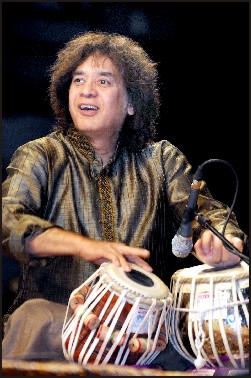
The jam-packed audience in the Nada Mantapa at Sri Ganapathy Sachchidananda Ashram last evening were in a different world while the ensemble of the violin duo of Ganesh and Kumaresh, tabla virtuoso Ustad Zakir Hussain and the mridanga artiste Trichy Harikumar took them on a journey of mesmerising, transcending and a rapturous trance.
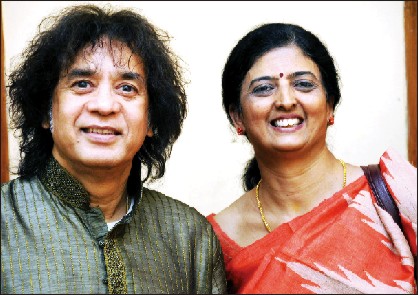
Ustad Zakir Hussain, who like his illustrious father Ustad Allah Rakha, has successfully brought tabla on to the centrestage globally, in a brief tete-a-tete with Star of Mysore Correspondent Nandini Srinivasan shares his views on the evolution of music — why he is not the only ‘good’ tabla player and how fabulous the young musicians are… Like a review in The New York Times aptly said… the blur of his fingers rivals the beat of a Hummingbird’s wings.
SOM: Whistles for a classical concert? How do you justify that?
Kumaresh: Why not?
SOM: That is what I am trying to ask…. how do you artistes manage that?
Zakir Hussain: I think it is a refreshing expression of joy and happiness and release of incredible moment of passionate energy. They have to scream and they have to shout as they are in such ecstasy. That’s what it is..Ecstasy…not whistle-tacy!
SOM: From tabla being just an accompaniment to bringing it to centrestage… How much effort has that taken from your illustrious father and you?
Zakir Hussain: It’s not an effort by me, it’s an effort from the audience. I am doing exactly what I used to do before. Tabla is still an accompanying instrument. I accompanied them (Ganesh and Kumaresh) today. It’s just the love of the audience that brings that much attention focus and blessing to the instrument. I just do what I’m taught to do and it’s pretty much just that.
SOM: Solo tabla has a huge audience, so does it become difficult to accompany?
Zakir Hussain: Playing accompaniment is more challenging than playing solo, as you are trying to gauge the mood of the people you are playing with and try to offer them the kind of support that they want or is necessary. With these guys (points to the violinist brothers) I take much more liberty and they offer me support ! So that’s the challenge…In solo you are in control and you do what you want to do.
SOM: You play with instrumentalists and vocalists… which is more difficult?
Zakir Hussain: Both are…Like I said, accompaniment is itself challenging because when you are on the stage you are not only playing the tabla, but also judging the mood of the audience, the mood of the composition being played, the expression that it is supposed to be put out. This is not just for tabla. It is for any accompaniment. We have to provide them with the kind of support they need.
Half the time the drummer doesn’t even know what is going to happen. In that sense it’s even more challenging and difficult because the instrumentalist may think of something to do and then the rhythm player has to immediately rise and provide the carpet… the kind of rhythmic carpet that is needed. And it has to be like a smooth highway on which the instrumentalist can drive. If it’s bumpy then it’s going to be a problem. So yes it is a difficult challenge.
SOM: At one point in your career you had said that you would retire from music as you were unhappy with the commercialisation of music?
Zakir Hussain: I did ?? I would never say that because commercialisation helps me (smiles). It allows me to live better, buy a bigger car, buy a nice bath gel to shower with. It’s not a question of what you would call commercialisation. I don’t think the musicians of today have ever complained about music becoming so acceptable to the masses. It’s specially joyful for us to watch so many people listen to music. And so many people listen to all kinds of music. They listen to classical, jazz, rock, pop anything…
What’s interesting in India is that the same people who listen to jazz will listen to classical music, they listen to ghazals, they go to a theatre… the same people… they have such varied interests. Such a vast panorama that they understand and enjoy and choose. For us it’s such a great thing that music has become so available and accessible, which is helping the music to survive, music to prosper and nurture. So no issues about commercialisation there you see !
SOM: I did read your statement somewhere…
Zakir Hussain: Maybe I was misquoted. It happens… somebody asks me a question like commercialisation of music is not a good thing and I’m answering the question and it gets turned around to say how I’m explaining why it’s such an unhealthy thing ! It’s not. It’s very healthy!
SOM: You are the poster boy of Indian classical music…
Zakir Hussain: It’s a curse that I have to live with until someone else becomes the poster boy! It’s like this you know.. .I have to tell you… I play tabla and I’m a pretty good tabla player. But there are just as good tabla players around in India, at least 20-25 of them. They are just as good, if not better tabla players than I am. It’s just that people resonate with me at the moment, people respond to what I do. I am not doing anything different than 20 other tabla players and I am not even doing it better than 20 other tabla players. It’s just that I have found a wavelength that the audience and I have latched on to and are connected. That’s all it is. And you must know and you must please realise that just like there are 5 great sitar players who are playing all good, 10 great Saarangi players, 20 vocalists who are performing… , they are all as good as each other. It’s just that somebody becomes a marquee name and a poster boy and the media starts to believe and project, mistakenly that he is the best. His concerts are always listed in the papers, people are coming in thousands to listen to him, so he must be the best! That is not the criterion, ok…
Yes it’s a fact that I am supposedly the poster boy in classical rhythmic tradition but certainly I am not the only one.
SOM:Indian percussion has had an impact on other kinds of music…
Zakir Hussain: I think it goes both ways. I have to admit that my tabla is a concoction of North Indian classical music, South Indian classical music, Indian folk music, Indian spiritual music and rock, pop, jazz, latin, soul….you name all these music… my tabla actually is a concoction of all that. It represents where I started, where I have been, where I am now and hopefully where I am going to go. So all those inspirations are projected in my tabla playing. So I have to say that yes I am inspired and influenced by so many other elements of rhythmic music in the world. Similarly every other drummer, tabla player, percussionist will tell you the same thing I told. Ask Shivamani sitting here. He will say he’s inspired by 500 other drummers from all over the world not just India. Ganeshji and Kumareshji will tell you the same thing. You will hear harmony and counter point. You will hear cannon, you will hear western classical music in their Indian classical music. So all these inspirations have come forth and that somehow becomes who you are. You could be dressed in jeans and a sweater, but you are an Indian. You are influenced by Western design. But it’s now a part of you and so you express yourself by being this complete person that has not only absorbed all that has to be absorbed from out there, but has now become a mirror of all that exists out there.
It’s a great thing and that’s what music is. Look at Shivamani. That’s why he can be in LA yesterday and in Mysore today. And these guys (Ganesh and Kumaresh) play all over India and the western world and open up schools in Portland and Seattle…
[To be continued]
Part 2 :
Tabla Wizard Ustad Zakir Hussain Speaks About His Kind of Music …
Ustad Zakir Hussain poses for a photograph with SOM Correspondent Nandini Srinivasan.
“I was watching my father playing when he was 70-73 years old. He would get on to the stage and he looked his age. As soon as he started playing, he looked 20 years younger. The smile on his face would be a mile long… and he would look like he was on the best ride ever… he was in the greatest play pen that he could ever be in,” says tabla wizard Ustad Zakir Hussain about his illustrious father late Ustad Allah Rakha in a brief tete-a-tete with Star of Mysore Correspondent Nandini Srinivasan during his visit to city on Jan. 30 to perform at Sri Ganapathy Sachchidananda Ashram along with violinists Ganesh-Kumaresh and mridangist Trichy Harikumar.
[The first part of the exclusive interview was published in SOM yesterday. Today we publish the second and concluding part.] — Ed.
SOM: There is a sect of puritans who feel fusion music is killing the very essence of pure classical music?
Ganesh: Yeah…fundamentalism in anything is good.
Zakir Hussain: Yeah I would agree with them. You need those puritans to maintain the core of the music as it was conceived. But in defence of music progressing and evolving into something that is today you have to realise that we have no clue how music was 300 years ago. We hear stories… I’m sitting here and saying Saint Thyagaraja composed different kritis and hundreds of compositions. But we don’t know exactly how he composed it… I am sorry Sir! I have to say that it’s been handed down and interpreted by so many different musicians who were around him. They kind of heard it, pieced it together because he was in his trance and he was putting the music out. And everyone around him were taking bits and pieces, comparing notes and coming up with compositions. We have no clue what happened 150 years ago… who played what and how… we don’t know… we just have stories, belief and faith that this is how the music was.
So when you have these puritans that’s what they have. They have this very strong belief and faith that music was like this in those days. And thank God for that because without them we would have no identity. They create this beautiful frame from which young musicians emerge and we plug into that. We now have an identity and we can go out and conquer the world because we know who we are. We are not lost. Shivamani you travel around the world and create music that is so unique…you should say something about that.
Shivamani: Whether Carnatic or Western, wherever you go, music never dies, it’s always alive.
SOM: You have been a great inspiration to the younger generation…
Zakir Hussain: Don’t blame me, it’s not my fault ! Did you see…when Shivamani walked into the hall what incredible happiness and joy was in that applause and welcoming of him. It’s all of us… but I have to say one thing to the young people…if they are looking for an inspiration…if they are looking for a role model and if it’s not their parents then there is something wrong. It has to be them…we can be guides… we can be the suggestion judges, we can offer a way, we can offer help and that’s what we should be doing. The young people should look inside themselves and inside their cocoons for inspiration and role models.
SOM: You are the one carrying forward the legacy of your illustrious father. How heavy is this onus on you?
Zakir Hussain: My father carried the tradition of his guru and his guru carried the tradition of their gurus. It’s not something or unusual or unique…this has been going on for thousands of years in the world. The son of a cook has been a cook and the son of a musician has been a musician and that’s happened over centuries. It is not too much of a weight to carry; it is an honour… it’s joy and it’s with pleasure that I sit out there because I know what I have or what I have seen or what I have heard and I have experienced with my instrument is a wondrous world. It’s a world that is so beautiful, so stupendously fabulous… that I have no problem saying to you or the audience…”Look what I’ve got… It’s something special. It’s the greatest toy in the world, it’s the most fabulous Lego anywhere!”
It’s incredible because I was watching my father playing when he was 70-73 years old. He would get on to the stage and he looked his age. As soon as he started playing, he looked 20 years younger. The smile on his face would be a mile long… and he would look like he was on the best ride ever… he was in the greatest play pen that he could ever be in. And I always used to say to myself ‘God! I hope I feel that way when I play’. That I could have that kind of joy and happiness with my connection to the spirit of the tabla when I am 70. It would be such a fabulous thing. So it’s not a weight or a burden, it’s with joy and happiness and willingness that I share with people what my father shared with people and what his guru shared too. Everybody does that. Shivamani’s is a unique case here. What he has assembled together has never been done before; so his energy and his creative world…that burden or weight, whatever you call it, will have to be carried by someone else that he will designate and another legacy will begin. And I’m sure that whoever he designates it to, will with pleasure go out. When a General points to a soldier and gives him the flag and a sword and asks him to lead, that soldier with pleasure goes into battle to die.
SOM: Who is your soldier?
Zakir Hussain: Oh! I’m very happy to say that I have a whole battalion out there. And they are not my students, they are my guru brothers… I don’t have students. Whoever I teach, I teach in my father’s name. When you talk about Yogesh, Satyajit Talwarkar, Vijay Ghate, Anindho, Shubhankar…we are in the category of sharing…of sitting on a big dining table called the tabla.
SOM: You have a lot of female fan following. Do you know that?
Zakir Hussain: Actually you know what, it’s not that I have a lot of female fans; it’s just that we are at a point in our world and it’s a happy point, where the women are not hesitant to express themselves. I mean 30 years ago they were just as ecstatic about watching Palghat Raghuji, Palghat Mani Iyer, Ustad Allah Rakha or Pandit Kishen Maharaj. It’s just that they couldn’t express themselves… they just couldn’t scream and shout and say ‘Wah Wah’ ‘Shabaaz’. Now they do that and they will do that for me and I’m very jealous to say to Shivamani and many other people. In general there is a great equalising support now within young people male and female. So it just appears that there are more female fans. They’ve always been there for everybody. It’s just that they didn’t put up their hands. I’m thankful to society for letting that happen and I’m thankful to the ladies for getting out there and grabbing that opportunity.
SOM: There is a lineage of course, but you have created your own space?
Zakir Hussain: My space? I wouldn’t want to create something that is my space. What I have is for everyone. I can’t just keep it to myself. It’s just so great and so good that the whole excitement of wanting to share will kill me if I keep it inside of me. It has to be heard…It’s not my space and I haven’t tried to create my space. I’ve tried to create an environment in which everyone for a second can be most ecstatically happy that they can ever be. We have very few happy moments in this world now…in this day and age… so when we come here and sit in a concert and they enjoy and they are happy… for those few moments the worries of the world are forgotten… they are just outside this concert hall.
SOM: There is an allegation that the media does not give enough space for the performing arts…
Zakir Hussain: Like I pointed out to you the media knows that I am the best, but it’s wrong. The media is not bothered to find out who are the other 20 who are good. Because when I said there are 20 others who are just as good, you didn’t even ask me who they were… you didn’t want to know… you were not concerned… It’s just that I’ve got this guy, he’s the beat and I’ll write about him… It’s like you walk into a restaurant and ask to bring me your BEST chicken dish… we just want the best and we forget that Best is a 4-letter word. It’s not really where it is at…We need to move at. The media needs to themselves go and adopt young musicians and put their names forward so that the audience can know about them…they are all very good, they are young, they are handsome…the girls will shriek for them too ! They are fabulous.
Media should nurture our arts and culture. An artiste is just a representative of the art…
SOM: Any favourite raaga?
Zakir Hussain: No…it depends on the day and the moment. You can arrive at a concert because some great musician is known for playing this raaga very beautifully and you want to hear it and you are excited about it… but it doesn’t work that evening…you can never say that… but then another raaga he plays is so incredible that that becomes your favourite raaga for that evening…
SOM: Any concert that you think is unforgettable?
Zakir Hussain: No…I hope not… if I do then I’ll be considering that concert as the best that I’ve ever been and if that’s the case then I should retire. There’s no thing like the best… you got to keep getting best.
SOM: How have you managed to stay the same ever since the ‘Wah Taj days…’
Zakir Hussain: Do you know how many hours it takes me to remain the same! No it’s not me, it’s the music, it’s the energy that we are around that energises us and rejuvenates us. I could be dead tired but I get on to the stage but halfway through the concert I actually feel more energy, more excitement, more pulse inside me. So it has to be music…
Part 2 of Interview : source: http://www.starofmysore.com / Star of Mysore / Home> Feature Articles / February 01st, 2014
Part 1 of Interview : source: http://www.starofmysore.com / Star of Mysore / Home> Feature Articles / January 31st, 2014
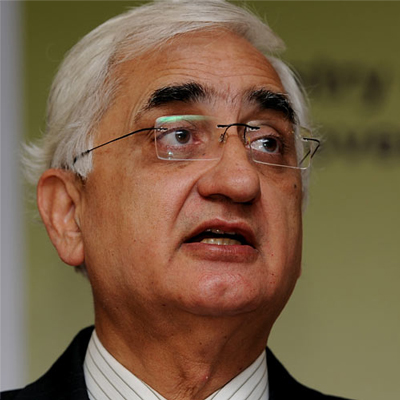
Observing that disparities between the rich and the poor are growing, External Affairs Minister Salman Khurshid today pitched for a new global awakening and a means to meet the needs of the poorest “effectively and adequately”.
“We are living in a complex world where disparities between the rich and the poor, as just being told, are wide and continue to grow. The world population continues to grow and increase globally,” he said during the inaugaral address of the Delhi Sustainable Development Summit.
“Consequently, the needs also grow exponentially. We, therefore, need a new global awakening to be able to deal with disparities and means by which the needs of the poorest can be met effectively and adequately,” Khurshid said.
He said this was not just a political imperative, as has been reminded due to important and dramatic changes taking place in several countries of the world, but also a moral obligation. He asked the global community to take urgent steps to anticipate future challenges and start dealing with them right away in the wake of growing problems of energy, water and food.
“Problems of energy, water and food are likely to become more acute over time unless we take urgent steps globally to anticipate future challenges in this regard and start dealing with them right away,” Khurshid said. He said while large number of people in this world do not have access to electricity, there are others who are living under the shadow of water shortages, hunger and malnutrition.
“Continuation of these conditions will lead to global tensions and threats to lasting peace. The global community and international organisations in particular have to be at the forefront of efforts — to change directions if need be — and take such initiatives as are required to solve these problems,” Khurshid said. He said India has placed great emphasis on food, water and energy and no global efforts to live in peace together will be possible unless we ensure sustainable development.
source: http://www.dnaindia.com / DNA / Home> India / Thursday – February 06th, 2014