Another historical for Kannada

KARNATAKA :

MahmoudGawanMPOs26ocy2018

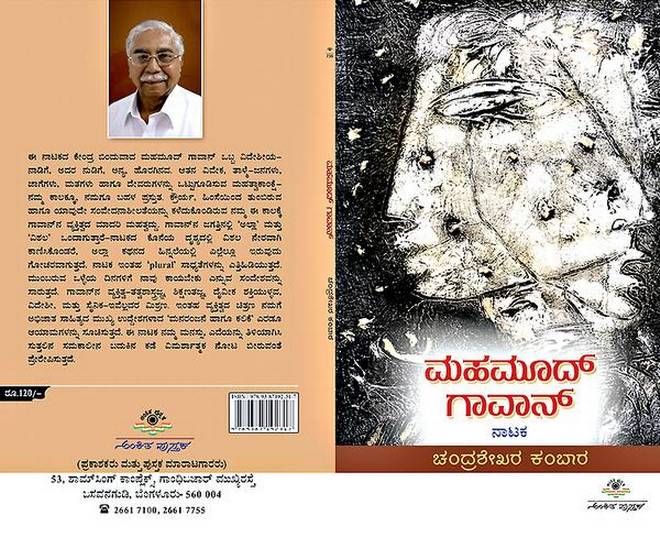
Chandrashekhar Kambar’s new historical play, Mahmoud Gawan, based on the life of the merchant who arrived in Bidar and later became the Prime Minister of the Bahmani Sultanate, will be released on Sunday

The word “global” is something that we come across not infrequently in literary discussions in recent times. It seems to be used in a very complimentary manner too. When we study it more closely, we see its multiple uses, ranging from the highly complimentary to the particularly disturbing connotations (especially, in the political and economic aspects of the so-called “globalization” phenomenon). Depending on the context, the philosophy implied in this use is vastly interesting.

In this context, dipping into pardonable autobiography, I must confess that my early acquaintance with the kind of writings I found in Chandrasekhar Kambar (this was back in 1964) was very new to my navya taste-buds of those days. This was around the time he wrote Helatini Kela . But, by the time Jokumaraswami arrived, I had begun to sense the fascinating spread of his literary intentions. The play seemed to insist on a message of passion (closely related to sexuality, the body, as well as the body politic!). The legitimacy of this passion was far more powerful than any petty legal correctness, or any mundane understanding of what constitutes the “moral” in our society. I was of course reminded of Lawrence. Kambar was utilizing passion as a powerful motive-free force, and constantly pushing at obstructions in its way. I became an avid follower of Kambar’s growth as a writer. His use of “sexuality” as a central and powerful theme and his struggle out of its grasp.

The latter part of his career witnesses an attempt to cover areas of creativity which could not be accommodated inside the constrictions of this strong force (note, however, a sliver of this sexuality is noticeable even in his latest play,Mahmoud Gawan ). I would assert that it is this constant and consistent presence which turns all of Kambar’s writing into his legitimate oeuvre.

Here was a writer, who, on the one hand was close to the North Karnataka folk and at the same time could engage the political and the modern predicament of our lives. You see this everywhere beginning from Helatini Kela , Rishyashringa , or Jokumaraswamy to the recent works like Shikharasoorya , Shivana Dangura orMahmoud Gawan . I would like to go back to what I began with, the idea of the “global” in relation to Kambar’s works. In what sense is Kambar global? It is true that at least in one of the recent novels globalisation and neo-colonialism figure predominantly (in Shivana Dangura ).

Could we try to identify an effort, more indirect, and subtler perhaps, to highlight an earlier moment in history, a moment that marked the international and inter-cultural ferment that characterised North Karnataka in his play, Mahmoud Gawan ? Interestingly, the choice of language in Gawan is not the kind of North Karnataka folk that Kambar worked with in say Helatini Kela or Jokumaraswami. I would describe the language of Gawan as Kambar’s idea of “neutral” Kannada, a conscious avoidance of the folk dialect. Again, look at the choice of the central figure in this play, Gawan. Hee is a foreigner, a non-Kannada person. He enters the world of Bahamani politics in the North Karnataka of fourteenth and fifteenth centuries. All these, I would venture to suggest, point towards a movement, a possibility, beyond the strictly local and Kannada contexts. In other words, Kambar is found testing his talent in handling something beyond what could be identified as exclusively Kannada, Karnataka. The significance of this kind of language use is for Kambar like playing a field without his arch-player—the folk tongue! Does he succeed in working this language, playing in this new field? Perhaps in a manner that is different from say Jokumaraswamy , where he is using sexual passion in order to design and project the drama experience, he is trying to move into other spaces in which his choice of an “other” Kannada could function adequately. This kind of language lends itself more easily to translation across other linguistic contexts. The absence of localism in itself is a strong pointer towards achieving such a global presence.

Could we simply say perhaps that Kambar moved from passion to politics—apparently, it seems so. This also begs the question, why? It is my opinion that an author like Kambar, a writer of immense literary imagination, constantly feels the need to move out of his familiar area of creativity and attempts to work in other new areas. As a result, politics becomes the main driving force in a play like Gawan . Overall, he succeeds in creating a layered experience of such historical and political play-fields. In Gawan , you see an extension of the literary Kambar, of Kambar’s entire literary oeuvre. And to say that is to acknowledge a serious happening in contemporary Kannada literature.

Finally, I invite my reader to look at Mahmoud Gawan, the protagonist. Here is a foreigner, theoretically foreign to the land and its language. His wisdom and his calming presence, his overarching ambition to unite people, places, religions, and gods—these are things crucially and painfully relevant to us and our times, times of cruelty and abhorrent insensitivity. In times where you see the cream of the population failing to respond to the degradation of all that is human, all that is noble and valuable in human experience.

In Gawan’s cosmos, Allah and Vitthala still fuse brilliantly—one as the implied presence and the latter as the explicit presence in the final scene. The play moves towards a certain sense of legitimization of this conclusion, the hope of better times to come. In a way, the encompassing presence of Gawan—the philosopher, educator, the saint, foreigner, and a soldier—should take us back to the classical idea of the function of literature, what literature should do—“to educate and entertain.” A closer look at the play would also perhaps clear our hearts and minds, making us look around at our own times with a sharply critical eye.

(Mahmoud Gawan by Chandrashekhar Kambar will be released on October 28 at 10. 30 a.m., Indian Institute of World Culture, B.P. Wadia Road, Bangalore).

(The author is a critic and musician of repute)

source: http://www.thehindu.com / The Hindu / Home> Features> Friday Review / by Dr. Rajeev Taranth / October 26th, 2018
This man feeds 300 people outside hospitals

Bengaluru, KARNATAKA :

Serving compassion

Nimhans saviour
Nimhans saviour

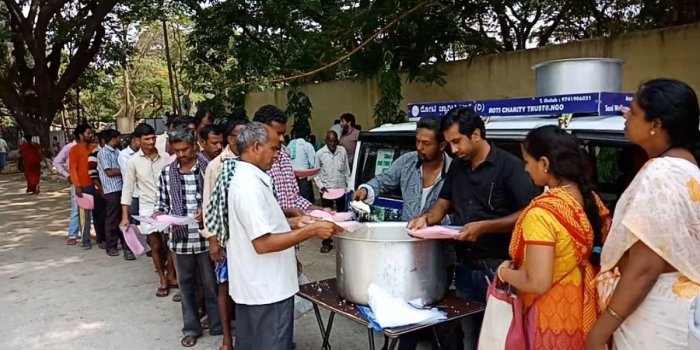
Syed Gulab, an automobile spray painter by profession, is a saviour for many who live on the pavement outside NIMHANS and nearby hospitals.

He has been serving free lunches to over 300 people for the last two years.

People come from across the country to admit their family members at these hospitals.

But with very little savings they tend to skip meals for days to afford the treatment at the hospital. The hospitals only provide food for the patients and not their family. Unable to afford accommodation the relatives also sleep on the pavements or  sheds outside the hospital. Pained by this scene while visiting a relative at a hospital in 2015, Gulab started serving the meals.

“The sight would pain me and I wanted to do something about it,” said Gulab who has set up the Roti Charity Trust for carrying out the initiative.

Gulab started it with the support of some of his friends. “We started by serving lunch on Sundays as the nearby hotels would remain closed at noon. I was inspired by Azhar Maqsusi from Hyderabad who has been feeding destitute people every afternoon for the last six years in the Old City,” he added.

When Maqsusi met Gulab on his visit to Bengaluru he was impressed by the initiative and said he will also support Gulab. He then started sending 30 bags of rice weighing 25 kg each to Gulab every month.

“It was due to his encouragement and support that we were able to make it a daily service,” Gulab added.

Gulab has now rented a small house near Jayanagar to store his materials. The lunch is cooked by 1 pm and a van takes the food to the hospital to be served by 2 pm.

They started serving breakfast — idli and chutney — a few months ago.

Gulab said they have never sought for donations but many people have come forward with donations.

Sharath Kumar from Kolkata has admitted his child at the Indira Gandhi Institute of Child Health for a kidney disease for the last two months. “Gulab is a blessing in disguise. It is because of him that people like me are able to get our meals,”  Kumar said.

source: http://www.deccanherald.com / Deccan Herald / Home> City / by Aparna Karthik, DH News Service, Bengaluru / October 20th, 2018

‘The scooter was my Boeing’

Aligarh, UTTAR PRADESH / NEW DELHI :

ZafarIqbalMPOs25oct2018

Zafar Iqbal, former India hockey captain, shares his memories of what may have been his first ‘vehicle’ and what actually was

Like most people at that time, I also learnt to use a cycle. The first vehicle I ‘owned’ was a bicycle that was presented to us (the Indian hockey team) in 1980 for winning the Olympic gold at Moscow. I was so happy. But when I went to claim my prize, I discovered the cycle had no accessories. I was asked to pay for the accessories, which I politely declined. I returned home without my prize, but the same year I bought a scooter.

The acquisition of the scooter is an interesting story. It was a Bajaj which I grabbed without having gone through the process of bookings. The waiting period was more than a year. It so happened that we were playing a tournament (Scindia Gold Cup) in Gwalior and one gentleman from the organising committee wanted to sell his scooter. The demand was huge and one had to shell out double the original price. I haggled and struck a decent deal. It was a greenish colour and the scooter was driven home to Delhi from Gwalior, by a mechanic. I remember the registration number to this day: GPW 737. I was employed with Indian Airlines (now Air India) and this scooter was my Boeing (737).

My best memory of the scooter was, by the grace of God, the fact that I never suffered a fall or an accident. For ₹20, I could fill up the tank. It would last me for ages really. I drove the scooter for five years, using it to travel for practice at the National Stadium, or taking my wife to the Karim’s near Jama Masjid. Shanti Path was a great place to drive around. I have also driven to Aligarh on it.

In 1985, I purchased a Maruti Suzuki. The car was a luxury. It served me well before I shifted to an Innova Crysta (automatic) recently. I also drive a Mahindra Thar now, exclusively for my golfing trips to the Noida Golf Club every morning.

Driving is no more a pleasure in Delhi. But I can’t take public transport either, because they are too crowded. At some point, it was fun travelling by bus from my home in Vasant Vihar to the Indian Airlines office at Parliament Street. I remember the route number (640) too. Sometimes people, hockey lovers who would have seen me in action at the Shivaji Stadium, would recognise me.

I felt sad when last year I had to dismantle my dear Bajaj scooter. Maybe I could have had it painted and preserved it as a souvenir. It is a memory now, but a pleasant one of my early years of driving.

source: http://www.thehindu.com / The Hindu / Home> Life & Style> Motoring / by Vijay Lokapally / October 23rd, 2018

Amer Ali Khan releases book on ‘Karbala’

Hyderabad, TELANGANA :

KarbalaMPOs24oct2018

Hyderabad:

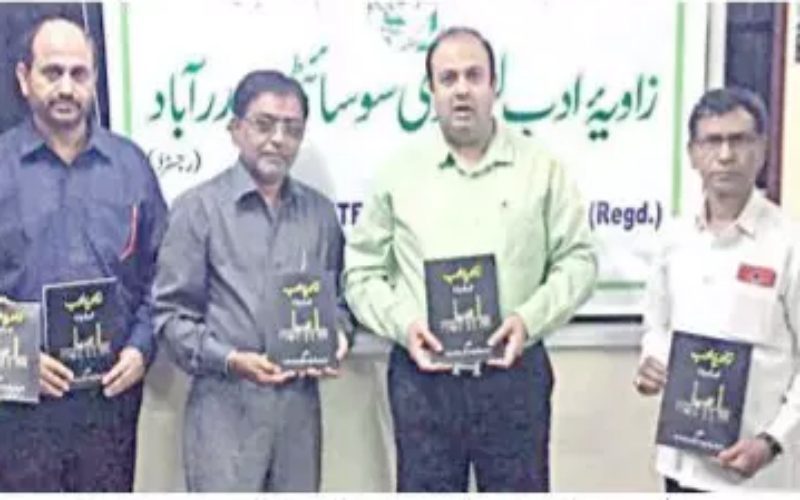
Mr. Amer Ali Khan, News Editor of Siasat Urdu Daily released the Sovenir of “Zawia Adab” society.

It is the first book of the society. In his speech, Mr. Amer Ali Khan told that the incident of Karbala is the eradication of evil forces and support of the values of Islam.

On this occasion, he made a references to various literary books published in English, Hindi and Urdu right from Meer Taqi Meer to the present day.

At the beginning of the function, Mr. Mazharul Haq, President of the society highlighted its aims and objectives.

Present on the occasion were Mr. Ali Anjum Sadiq, Mr. Ali Inayat, Mr. Baquer Mehdi Abedi, Mr. Akhtarul Hasan and Mr. Meer Haider Ali.

Mr. Faraz Rizvi thanked Mr. Amer Ali Khan and the audience.

source: http://www.siasat.com / The Siasat Daily / Home> Hyderabad / by Sameer / October 23rd, 2018

Rich tributes paid to founder of Jamia Hamdard Hakeem Abdul Hameed

NEW DELHI :

HakeemAbdulHameedMPOs24oct2018

New Delhi:

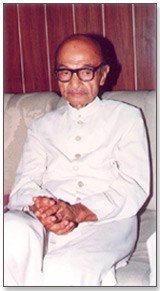
Birth anniversary of noted Hakeem Padma Bhushan Hakeem Abdul Hameed was celebrated on September 14, 2018. Former Rajya Sabha MP and noted journalist Shahid Siddiqui delivered the lecture on ‘Hakeem Abdul Hamed, a great thinker, philosopher and his role in the construction of the nation’ as Chief Guest. The programme was presided over by Prof Syed Ihtesham Hasnain Vice Chancellor Jamia Hamdard. Prof Ihtesham Hasnain said late Hakeem Abdul Hameed was ‘Hamdard’ in the real sense.

Pro Vice-Chancellor Prof Ahmed Kamal, registrar Saud Akhtar, relatives of Hakeem Abdul Hameed from India and Pakistan, a large number of teachers, officers and students were present on the occasion.

Late Hakeem Abdul Hameed, a renowned physician, was the Founder-Chancellor of Jamia Hamdard, which he established with his own resources. A great philanthropist, thinker and visionary, he set up several institutions with the funds of Hamdard Wakf Laboratories. Some of the esteemed institutions established by him include Hamdard National Foundation, Hamdard Education Society, Hamdard Study Circle, Hamdard Public School, Hamdard Institute of Historical Research, Ghalib Academy, Centre for South Asian Studies and Business & Employment Bureau.

Hakeem Abdul Hameed was honoured by several national and international awards including the Avicenna Award presented by the erstwhile USSR in 1983. He was conferred with Padma Shri and Padma Bhushan by the Government of India. He was also an honorary member of the Academy of Medical Science of the Islamic Republic of Iran and Chancellor of Aligarh Muslim University, Aligarh. In October 2000, the Research Centre for Islamic History, Art and Culture (IRCICA) Istanbul, Turkey, presented IRCICA Award for Patronage in Preservation of Cultural Heritage & Promotion of Scholarship to Hakeem Saheb posthumously.

source: http://www.siasat.com / The Siasat Daily / Home> India> News  / by Rasia / September 15th, 2018

The personal side of a public servant

Chennai (formerly Madras),  TAMIL NADU :

Mohamed Usman held important Government posts in pre- and post-Independence India.

Ahead of Madras Week celebrations (August 20 to 27, 2017), we profile Sir Mohamed Usman, the first Indian to be appointed Acting Governor of the Madras Presidency

Usman Road is one of Chennai’s most popular shopping districts. It was recently in the news for a fire that gutted a popular clothing store here in early June. YouTube houses a mine of video information (albeit of dubious value) about the many angles of the busy thoroughfare.

And yet, only the most ardent of history buffs may be able to identify the person whose name graces the road.

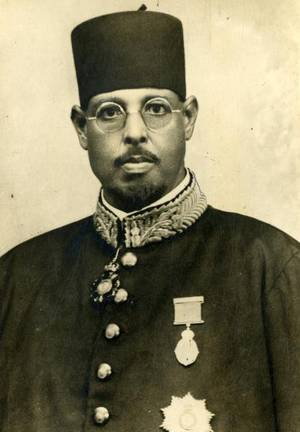
Khan Bahadur Sir Mahomed Usman (1884-1960) is the man whose name has been enshrined in Chennai’s street signage. With increasing levels of Indianisation, his titles (he was also a KCSI — Knight Commander of Star of India and KCIE — Knight Commander of the Indian Empire) have disappeared, and his name is spelled as Mohamed or Muhammad in scholarly journals.

A Minister of Home for the Madras Presidency in the Justice Party government of the Raja of Bobbili (Sir Ramakrishna Ranga Rao), Sir Usman was the first Indian to be appointed as its Acting Governor on May 16, 1934.

Born in 1884 to Mohamed Yaqub Sahib Bahadur, of Madras (with links going back to Thanjavur), Sir Usman was educated at the Madras Christian College.

He married Shahzady Begum, daughter of Shifa-ul-Mulk Zaynulabideen Sahib Bahadur, a native medicine practitioner from Thanjavur, who later settled down in Madras.

Sir Usman held several offices of distinction during his early career and was, among others, Honorary Presidency Magistrate, Member of the Senate of Madras University, Sheriff of Madras and President of the Madras Corporation.

From 1925-1934, he served as Member of the Executive Council of the Madras Government.

Later, he was Vice-Chancellor of the Madras University, and from 1942-46, he went over to the Central Government as Member of the Viceroy’s Executive Council. At the time of his death on February 2, 1960, he was a member of the Madras Legislative Council.

Offices of the Madras Corporation, The Anjuman (of which Sir Mohammad Usman was the president) and the Government College of Integrated Medicine (later renamed as College of Indian Medicine) were all closed as a mark of respect on the day he died.

A key study

The maternal and paternal grandfathers of Sir Usman were skilled practitioners of Unani medicine — a Perso-Arab system based on the teachings of Greek physicians Hippocrates and Galen (Unani means Greek in Arabic).

Sir Usman was a respected Unani physician and often addressed as ‘Hakim sahab’ or ‘Doctor’ though he didn’t have a medical practice of his own.

In 1921, he chaired a Government committee whose deliberations led to the founding of the School of Indian Medicine in 1925. The findings of The Usman Report, detailed the indigenous systems of healing in India and the need to let them thrive alongside Western medicine. The document is considered to be the first major health report to have been published in India.

As mentioned in Modern and Global Ayurveda: Pluralism and Paradigms, (edited by Dagmar Wujastyk, Frederick M Smith, published by State of New York University Press in 2008), among the more interesting features of the exhaustive report are the testimonies of Vaidyas and Hakims recorded in their original languages.

There were 183 responses to a detailed questionnaire prepared by the Usman Committee that were sent out in English, Tamil, Sanskrit, Urdu, Telugu, Kanarese and Oriya.

Though published as a regional report, a 3-member sub-committee had toured the entire country, and the views represented an all-India survey.

Sepia memories

Despite his distinguished career, it is difficult to find anyone today who can speak about him as a person away from the public eye.

Fatima Yaqub, the 76-year-old widow of Sir Usman’s foster son Mohamed Yaqub, is perhaps among the last of his relatives to remember life in the Bada Bungla (Big Bungalow) in Teynampet that housed the Governor’s joint family.

The palatial home on Eldams Road was demolished in 1993 to make way for the inevitable block of apartments.

“My maternal grandfather and Sir Usman’s mother were siblings. Sir Usman didn’t have any children of his own. So he was foster parent to his younger brother Dr Abdullah’s two children — my husband and his sister Khamarjaan,” says Mrs Fatima.

The arrangement, though not strictly conforming to Islam (which forbids adoption), was quite common in close-knit Muslim families of the day.

For over an hour and a half, Mrs Fatima, who was married at the age of 10, in 1953, sketches a verbal portrait in Urdu of a sepia-tinted life teeming with memories of a lavish lifestyle.

Lavish lifestyle

“There were only three bungalows on Eldams Road at the time. Bada Bangla’sgrounds started from the Teynampet gardens and spanned over two and a half streets away,” says Mrs Fatima, whose current home neighbours the former site of the family pad. “The house itself was 8,000 square feet, with three floors. Sir Usman and his wife (called Ammajaan by the family) used to have a bedroom, prayer room, visiting hall, dining hall and dance hall for their use. The other side of the house was occupied by Sir Usman’s aunt who had two sons. My mother-in-law (Yaqub’s mother) had died of a heart attack, before our marriage. There were 10 servants’ quarters at one end of the estate. So we had a mixture of people living together,” she adds.

Mrs Fatima’s reminiscences have a childlike awe attached to them, because as she reiterates often, she was no more than a child herself when she got married. Her husband was 21 years old. “My mother’s elder sister and my mother-in-law were classmates in school, so they used to visit very often, especially over the weekends,” says Mrs Fatima, whose father Mohamed Azmatullah Basha was a leather, jute and gold merchant from Arcot later based in Triplicane.

Sir Usman and Ammajaan used to be based in Delhi for the best part of the year. The couple used to come home to Madras for summer holidays and also for Ramadan, says Mrs Fatima.

“After our marriage, we visited him twice in Delhi, but his life was very different from ours. He used to move around with at least four security guards. It was very difficult to meet him when he was on official duty,” she says.

Hospitality for all

Mrs Fatima remembers Sir Usman as a man of simple eating habits. “He would ask for everything to be served as a soft mash or gruel rather than solid food,” she says. There was no stinting on the hospitality for the others though. “At least 50 padi measures of rice would be cooked daily to feed the fasting Muslims in the area during Ramadan. And there would be two different types of banquets for Eid — one at midday for the family, and the other, with a different team of cooks, for his friends in the evening,” she says.

Off-duty, Sir Usman was a caring and jovial companion, says Mrs Fatima. “Whenever we’d request to watch a film in the city, he would book the entire balcony of the cinema theatre,” she remembers.

Sir Usman treated his foster children as his own, and was a big influence on their life, says Mrs Fatima. “When I visited my parents in Triplicane, he would send his Hillman car and his manservant to follow my husband’s Rover to drop me off. I was so well-taken care of, more of a daughter than a daughter-in-law,” she says.

Denouement

A snakebite is thought to have led to Sir Usman’s demise. Mrs Fatima says, “Sir Usman tried to cure himself with allopathic and Unani remedies, and got back on his feet within six months. But then his health started weakening, and he became bedridden for a month before his death.”

Upheaval of family and fortune soon followed. “First the security guards left. And then slowly, after the death of Ammajaan in the mid-1960s, the family started growing apart,” says Mrs Fatima with a sad smile. Mrs Fatima’s husband passed away on May 28, 1974. “It was a huge shock to me,” she recalls. “I had two children aged 3 and 5, and no real education.”

She suffered an emotional breakdown that took her a year to recover from.

“For the first time in 1974, I started using public transport. I would personally go to the lawyers’ offices to sort out property disputes and other issues after my husband’s death,” she says.

Though few photographs of Sir Mohamed Usman have survived in the family collection, there are some keepsakes, such as a marble-topped circular dining table, that Mrs Fatima still treasures.

“Sometimes as a family we feel ashamed that we know so little about this great man. But in a way Sir Usman would have been happy. He always used to say that one should never achieve things by showing off one’s rutba (rank). Then the adulation is for the position, not the person himself.”

source: http://www.thehindu.com / The Hindu / Home> Society> History & Culture / by Nahla Nainar / August 18th, 2017

Stitch by stitch, homemaker weaves dream into reality

Bengaluru, KARNATAKA :

It takes Dadu two weeks to complete an order.

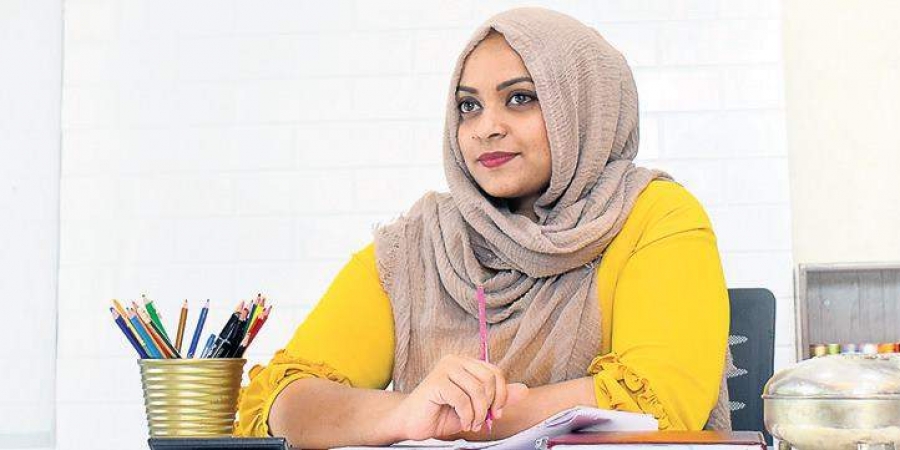
Nusaiba at work (Photo | Pandarinath B)

Bengaluru :

Nusaiba, the sole working woman from her family, runs her own boutique on Commercial Street. A fan of Sabyasachi and Manish Malhotra, she was once recognised as a homemaker alone, but today aims to turn her designs into a brand one day. Her journey till this point, she claims, has been a result of maintaining a fine balance between her household expectations and her passion for her dreams. “My kids were young and I had to attend classes to learn more about designing. It was tough but I had my mind set on opening a boutique, so I managed it,” she recalls.

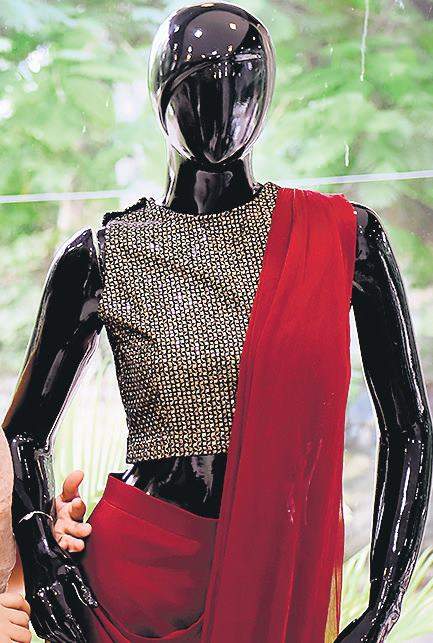
One of Nusaiba’s designs

Now, she says, her kids are proud of her. “Their school bus passes by my store. They feel happy to tell their friends that this is their mother’s store. On the opening day, my daughter struck off my occupation as ‘housewife’ and wrote ‘fashion designer’ in her school diary.”She also goes on to give credit to her family members, saying, “My husband, a businessman, is a great support. All my family members are supportive,” she adds.

Popularly known as Dadu, the passionate fashion designer has named the boutique on Promenade Road after this nickname. “My customers ask me about the name of the boutique. They say it is intriguing,” Dadu says with a smile.Speacialising in Indo Western wear, Dadu provides customised services. “I discuss client requirements and design the attire accordingly. I show them my colour charts and once it’s all finalised, we work on designs. I give my suggestions and draw them out for my customers,” she explains.

It takes Dadu two weeks to complete an order. “It takes time because we source fabrics from Kolkata and Mumbai. We source white fabrics, dye them to the client’s preferred colour, and then polish them,” she says. Behind this successful woman, is a team of 15 who aid her.

“Only after the trial is done and the fitting is right, we deliver the order,” she says, adding that she always maintains client relationships even after orders are delivered.On an average, she gets at least four to five orders a day. “We have many regular customers. I have customers from the UK and the US as well, who have liked the designs I share on social media, and have gotten in touch with me. I have been getting a good response,” she says.

Dadu is a diploma holder in fashion designing, with a one-year diploma course in Calicut and another 1.5 year diploma course in Bengaluru. With the sky as the limit for her dreams, she is planning to expand her venture to Kochi, Hyderabad and Chennai in two years.

source: http://www.newindianexpress.com / The New Indian Express / Home> Cities> Bengaluru / by Akhila Damodaran, Express News Service / October 23rd, 2018

Md Saaduddin a scrap metal artist

Hyderabad, TELANGANA :

Md Saaduddin is on an artsy journey where he utilises scrap metal to construct purely artistic as well as functional sculptures.

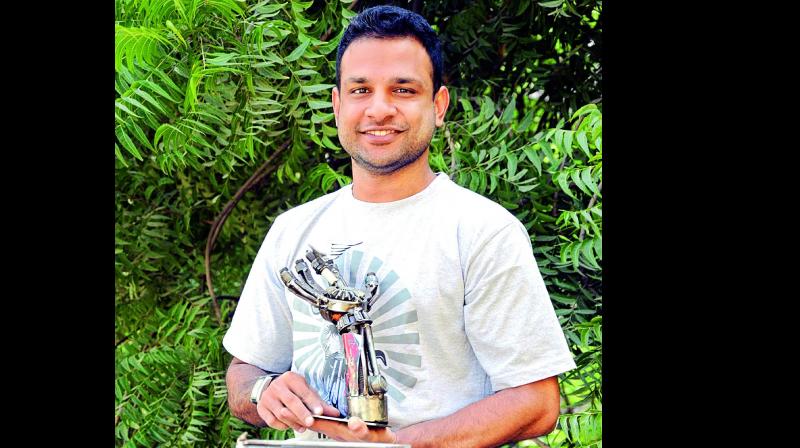
I was always inclined towards art but I never had the nazakat that is needed to wield a paint brush. The hammer and grinder are a better fit for me. (Photo: DC)

It is quite common for a young boy to fall in love with machines. But what is not so common is translating that love into beautiful art. Although Md Saaduddin is today an artist, he does not work on canvases, but with scrap iron, steel and sometimes copper to make beautiful sculptures and functional art pieces like lamps and furniture, some set in the backdrop of interesting storylines.

With Saad’s father being a vintage car restorer, he, along with his brother Hamzauddin, grew up around machines, albeit with a unique perspective. On how he took up the hobby, the mechanical engineer and  self-made artist says, “I was always inclined towards art but I never had the nazakat that is needed to wield a paint brush. The hammer and grinder are a better fit for me. I love it also because of the physical work that is involved in creating it.” Saaduddin spends time on his artwork in the evenings, after work, and has made furniture for a couple of breweries in the city.

Explaining his style of work, he shares, “I try to incorporate a sense of movement. A bird just about to take flight, for instance! I’ve learnt the art by watching other people online and practicing. I used to help my dad in his workshop, and that’s how I got introduced to it. Just once a year, my brother and I collect all our savings and build a modified bike. We ride it around to our heart’s content and then sell it.”

He further reveals, “I’m also getting into blacksmithery now; I usually make the handles of spatulas and ladels with this. People appreciated my work and said I should get on Instagram. That’s how I started IRONic”

His brother, Md Hamzauddin is another bundle of talent, whose digital art is recognised around the world. He goes by the name ‘Hamerred’. Hamzauddin’s works have been showcased in countries like the US, Mexico and many others. In fact, he was also one of the only 13 artists from around the world to display their art at the Oil and Ink Expo, a motorcycle art show.  Hamza’s signature style features paint dripping from motorbikes.

source: http://www.deccanchronicle.com / Deccan Chronicle / Home> Lifestyle> Books and Art / by Nikhita Gowra, Deccan Chronicle / December 04th, 2017

Junkyard innovators

Hyderabad, TELANGANA :

Five engineering students are building one-of-a-kind bikes from scrap materials.

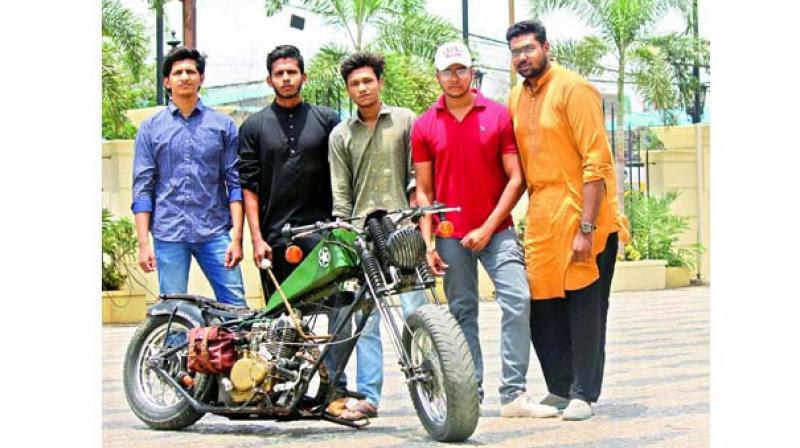
(Left to right) Wahaj Uddin, Ilyas khan, Amer Hassan, Osman Quadri and Awais Amjad

The woes of an engineering student are well known. Four years of lectures, classes, exams and backlogs are neither easily survived, nor forgotten. But five fourth-year students from the Lords Institute of Management and Technology are putting their theoretical knowledge to use in a way that not only helps the environment but also nurtures city-dwellers’ love for bikes. They’re custom-building bikes from scratch using scrap materials.

Talking about their prized projects, Ilyas Khan, the captain of the team, says, “The ‘Brat Bob’ and ‘Fury’ were built to show youngsters and students how they could enjoy custom-built bikes while doing something good for the environment. The engines of these bikes are specially tuned to reduce carbon emissions. Everything but the engine and the wheels have been custom-designed and built by our team. The ‘Brat Bob’ has a car-like gear shift, and its front suspension is unique both in terms of engineering and aesthetics. We started building it in August last year and it took us almost a month and a half to complete.”

Ilyas’ team consists of Awais Amjad, Wahaj Uddin, Osman Quadri and Amer Hassan. For Ilyas, Awais and Wahaj, this project is not their first build. In the past, the trio has built an electric skateboard and a dual-engine car, among other things. For newbies Amer Hassan and Osman Quadri, the experience has been thoroughly exhilarating.

The group initially started working on their bike-building project by themselves, until their work was noticed by their college, which led to an inflow of funding. Since then, the institute’s faculty members Mohammed Ahmed and Yousuf Ahmed have also guided and mentored the boys. As part of the process, the team goes out to collect raw materials like sheet metal, rods, and metal pipes, which they then fabricate into bike parts by hand. The few parts that they aren’t equipped to build by themselves, they acquire from second-hand bike markets and scrap shops. Each bike takes them a little over two months to build.

The question is, are these just passion-projects or do they plan on putting their creations up for sale? “These bikes are definitely for sale. Each bike will probably cost around Rs 80,000, and they can be used daily. We are also open to receiving customisation orders from people outside our college,” Ilyas says.

source: http://www.deccanchronicle.com / Deccan Chronicle / Home> Lifestyle> Viral & Trending / by Oishani Mojumder, Deccan Chronicle / August 06th, 2018

Thousands pay last respects to P B Abdul Razak

Kasargod, KERALA :

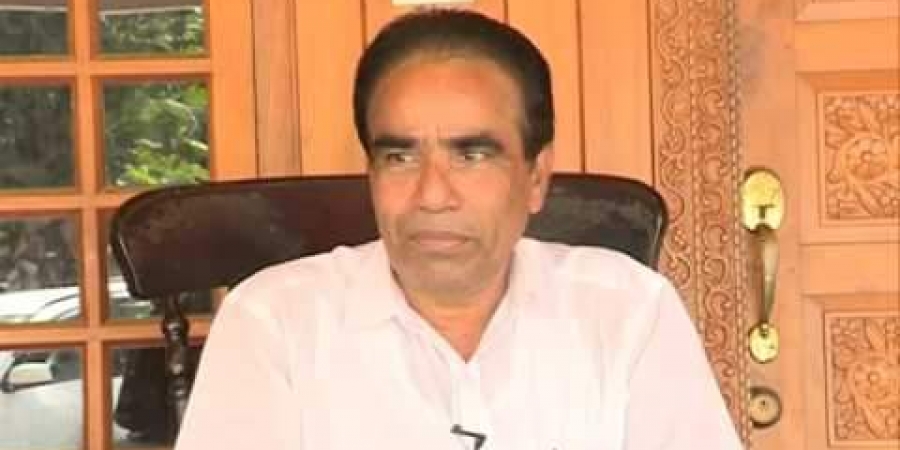
PB Abdul Razak. (Photo|Youtube screen grab)

Kasargod :

P B Abdul Razak’s body was taken to his house at Naimarmoola in Kasargod. Later in the evening, the body was taken to Uppala in Manjeshwaram constituency for the public to pay their last respects.

Razak, a two-time MLA, registered a dramatic victory in the 2016 Assembly election by defeating K Surendran of the BJP by 89 votes. The slender margin shook the party, but he gifted himself a car and took 89 as its registration number. He first became an MLA in 2011, when he defeated C H Kunhambu of the CPM by 5,828 votes in Manjeshwaram constituency.

Razak, a businessman, was also a member of IUML national working committees.Born on October 1, 1955, to Beeran Moideen and Beefathima, Razak’s schooling stopped at class 4.

He entered politics through the Muslim Youth League and went on to become the general secretary of the organisation.In 1979, he went abroad to make a living, and returned in 1990 and dived into active politics.

In 2000, he became the president of Chengala grama panchayat and held the post for seven years. In 2008, he was elected to the district panchayat council and became the district panchayat president in 2009.

He is survived by wife Safiya Abdu Razak, and children Saira, Shafeeq, Shyla and Shyma.

Those who paid their last respects include ministers E Chandrasekharan and Kadannappally Ramachandran; Opposition leader Ramesh Chennithala, deputy opposition leader M K Muneer; MPs P K Kunhalikutty, E T Mohammed Basheer, P V Abdul Wahab and M K Raghavan, MLAs K N A Khader, V K Ebrahimkunju, P K Abdu Rabb, K K Abid Hussain Thangal, T V Ibrahim, Manjalamkuzhi Ali, P Ubaidulla, C Mammootty, N Shamsudheen, K M Shaji, N A Nellikkunnu, C Krishnan, K Kunhiraman, Sunny Joseph, Shafi Parambil, P Abdul Hameed, M Rajagopalan, P T A Rahim and Karat Razack and party leaders Panakkad Sahid Ali Shihab Thangal and Munavvar Ali Shihab Thangal.

source: http://www.newindianexpress.com / The New Indian Express / Home> States> Kerala / by Express News Service / October 21st, 2018