The stone and lime mortar tomb has been painted white in violation of conservation rules.(Pic: Syed Omar)
Hyderabad :
Hazrat Syed Khaja Hussain Shah Wali. The very mention of this revered name evokes spirituality and science. The saintengineer of the early Qutub Shahi period was responsible for the picturesque Hussainsagar that once irrigated vast stretches of green belts and quenched the thirst of thousands of people in the Hyderabad of yore. He also designed the Purana Pul, Hyderabad’s first bridge across the Musi. With the unique distinction of witnessing the reign of three Qutub Shahi kings, Hussain Shah Wali also oversaw the execution of the world’s first food-for work programme.
Sadly, large parcels of prime land attached to the grand mausoleum, where his mortal remains are buried, have fallen prey to land sharks.The mausoleum once had about 2,000 acres, but today only a small portion is free of illegal occupation. Encroachments have come up all around the mausoleum in utter disregard to the city’s spiritual and engineering heritage. Even the road leading to the dargah (tomb) is not free of encroachments. As if this was not enough, those manning the dargah have whitewashed the tomb built of stone and lime mortar, thus robbing it of its original beauty. Earlier, the managing committee had painted the tomb green. This is in clear violation of conservation rules. Neither the state Waqf Board nor the archaeology department has taken cognizance of this blatant violation.
“Heritage sites built of stone and mortar are not to be whitewashed or painted. Cement is never used for restoration as it is like cancer to mortar. The tomb was built during the reign of Abdullah Qutub Shah VII. Bad and unscientific upkeep has made the structure weak,” said city historian Dr Mohammad Safiullah, demanding that the tomb be restored by the government on the lines of the Qutub Shahi tombs where experts from the Aga Khan Development Network (AKDN) are working.
Hussain Shah Wali was the son-in-law of Ibrahim Qutub Shah IV. He was the head of all civil works in the kingdom. He built Hussainsagar in 1562. The saint-engineer died in 1620 and the tomb was constructed later by Abdullah Qutub Shah VII.
source: http://www.timesofindia.indiatimes.com / The Times of India / News> City News> Hyderabad News / by Syed Akbar / TNN / October 29th, 2017
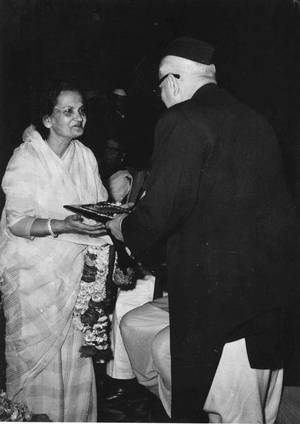
Tribute to the voice: Vice-President G.S. Pathak presenting the Sangeet Natak Akademi Award for Hindustani vocal music to Begum Akhtar
It’s been an annual ritual for over 25 years. The first and last week of October have always had legendary ghazal and thumri singer Begum Akhtar spinning on my system. The doyenne was born on October 7, 1914, in Faizabad, Uttar Pradesh and passed away on October 30, 1974, in Ahmedabad. So a few days before the dates, I have this Begum Aapa trip.
If there’s a voice that defined pathos, dard, deepness, gehraai, technique, taiyyari, she was definitely somewhere on top, globally. Check out her rendition of Shakeel Badayuni’s ‘Mere Humnafas Mere Humnava’ and the picture is absolutely clear.
Begum Akhtar fans are totally devoted to her singing, and I am no exception. Strangely enough, I hated her the first time I heard her. She didn’t let me sleep in peace. This was back in Jaipur, where I was a young rookie journalist. I was more into rock bands like Jethro Tull, Pink Floyd and Moody Blues, but my senior colleague and room-mate Abhay Kant hated my taste and insisted on playing Begum Akhtar late at night. It was torture, initially. But in a few weeks, I just got hooked on to Mir Taqi Mir’s ‘Ulti Ho Gayi Sab Tadbeerein’ and Momin Khan Momin’s ‘Woh Jo Hum Mein Tum Mein Qaraar Tha’. Honestly, I discovered the names of these poets much later.
Equations changed. Tull and Floyd were put on hold and I would listen to Akhtar even after Kant slept. By the time he left the following year for another job, I think he was sick of my listening to her. Yet, he took all his cassettes with him, leaving me bereft. For the next five years, her songs would only appear as earworms in the recesses of my mind. One day, at Rhythm House, Mumbai, I picked up a double compilation. The surprise was that many compositions were credited to the great Khayyam.
Some old favourites like Badayuni’s ‘Ae Mohabbat Tere Anjaam Pe Rona Aaya’ and Mirza Ghalib’s ‘Dil Hi Toh Hai Na Sang-o-Khisht’. But the real discovery was her rendition of Sudarshan Faakir on ‘Kuch Toh Duniya Ki Inaayaat Ne Dil Tod Diya’, ‘Ishq Mein Ghairat-e-Jazbaat Ne Rone Na Diya’ and ‘Apunon Ke Sitam Hamse Bataaye Nahin Jaate’.
And there was Faiz Ahmed Faiz on ‘Aaye Kucch Abr Kuchh Sharaab Aaye’ and ‘Donon Jahaan Teri Mohabbat Mein Haarke’. Besides ghazals, there was light classical repertoire like ‘Deewana Banaana Hai Toh’ and ‘Hamari Atariya. What timbre, texture, throw, tonality, totality.
Akhtar has always been special. She physically left us 43 years ago, but her music still rings in our ears and resounds in our hearts. Interestingly, there is another musician I get back to this month. The great music director S.D. Burman was born on Oct 1, 1906, and passed away on October 31, 1975. Next week’s column is dedicated to him.
PS: Thank you Abhay Kant for the Begum Akhtar introduction. Sorry about blasting the rock music.
source: http://www.thehindu.com / The Hindu / Home> Entertainment> Music / by Narendra Kusnur / October 25th, 2017
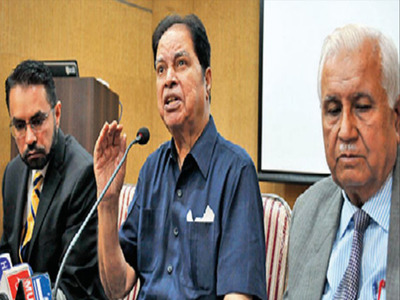
Chairman of Indo Arab League, Hyderabad, Syed Vicaruddin at Media Plus Auditorium in the city on Wednesday. Vice Chairman Mir Akbar Ali Khan and Syed Amiruddin are also present
Charminar :
The Indo-Arab League on Wednesday announced provision of space for establishing Palestine’s consulate office in the city free of cost. The league chairman Syed Vicaruddin told media personnel that it has decided to ensure land for the Palestine consulate office in Indo-Arab culture center sans any cost.
“We want to see Palestine’s consulate office opened in Hyderabad,”IndoArab league chairman Syed Vicaruddin said. He added that the central and state government want to establish an Indo-Arab university in either the country or the state, so that Arabs and Indians can study together. He further said that the proposal was discussed with other foreign ambassadors as well.
Apart from this, the Indo-Arab League is going to organize programmes in the city on October 29, in which, delegates from different Arab countries, including Sudan, Yemen, Iraq, Syria, Lebanon , Judge of Palestine, Egypt and Saudi Arabia are expected to visit.
source: http://www.timesofindia.indiatimes.com / The Times of India / News> City News> Hyderabad News> Schools & Colleges / TNN / October 26th, 2017
Here is a very special tribute from team Kootathil Oruthan to the one person who, Till date continues to inspire everyone with his words and deeds and raised India to its heights – Honorable Dr. APJ Abdul Kalam.
Short-story writer, novelist and playwright Bolwar Mahammad Kunhi has been announced the winner of this year’s ‘Literary Achievement Award in Kannada’ presented by Atta Galatta and Bangalore Literature Festival.
The awardees have been announced ahead of the sixth edition of the literature festival on October 28 and 29.
This year, in the fiction category, Anees Salim has won the prize for his book ‘The SmallTown Sea’. In the non-fiction category, Ruskin Bond’s autobiography ‘Lone Fox Dancing’ has been selected for the prize. In the newly introduced category of ‘Popular Choice’, the prize has gone to Twinkle Khanna’s book ‘The Legend of Lakshmi Prasad’.
The prizes will be given away at an award ceremony during the festival which will be held at hotel Lalit Ashok on Kumara Krupa Road.
source: http://www.deccanherald.com / Deccan Herald / Home> City / DH News Service / Bengaluru – October 22nd, 2017
The 23-year-old speedster from Hyderabad, born to an auto rickshaw driver came to limelight with his scintillating performance in the 10th season of Indian Premier League | Photo Credit: PTI
New Delhi:
You call it a fairytale rise up the Indian ranks claiming it to be a classic rags-to-riches story, or praise his bowling prowess as he honed it little by little, but Mohammed Siraj’s run from an absolute nobody to a call-up for the T20I series against New Zealand has created quite a stir in Indian cricketing fraternity.
It was only in late Monday afternoon that the Board of Control for Cricket in India (BCCI) announced the 16-member squad for the three-match T20I series against a touring New Zealand side. Much to the surprise of many, Siraj and Shreyas Iyer – two uncapped players were named in the squad for the shortest format of the game.
The 23-year-old speedster from Hyderabad, born to an auto rickshaw driver, came to limelight with his scintillating performance in the 10th season of Indian Premier League (IPL). And it was not just after the Hyderabad-based franchise roped in the pacer with a whopping INR 2.6 crore, but also because he lived up to the expectations finishing off the campaign with 10 wickets in six matches. Well, it did include a stunning four-fer against Gujarat Lions that helped the former champions qualify for the playoffs. But that is not where it had all started.
It was at the age of seven that Siraj fell in love with the Gentlemen’s game. Back then, it was mere bunking classes to play tennis-ball cricket. Later in 2015, he picked up the red ball and bagged quite a few five-wicket hauls. He soon got a call-up for Hyderabad’s Under-23 side and then the senior team and finally for Ranji. In the 2016-17 season, the pacer scalped 41 wickets at an average of 18.92 as he became the third-highest wicket-taker in the campiagn after Shahbaz Nadeem and Anupam Sanklecha. And what followed next was a maiden IPL season.
He then recieved a call for the India A series against South Africa where he continued with his brilliancy picking up 10 wickets. Of late, he played against New Zealand A where he picked up four wickets in three matches. Overall, he has played 16 T20 matches, picking up 26 wickets at an average of 18.73.
“I knew that some time in future I will get a call-up but did not expect it this soon. I can’t tell you how happy I am. When I told my parents, they were speechless. It’s a dream come true,” said Siraj in an interview to PTI.
“Whatever I am today is primarily because of Ranji Trophy performance. My 40-odd wickets last season gave me the confidence. There’s nothing like getting wickets in first- class cricket. I was picked for Rest of India after that and because of Ranji Trophy, I got the IPL deal. So 60 per cent credit for this call-up is performance in first-class cricket,” he added. “I can’t tell you how much I am indebted to Bharath Arun sir. He is a brilliant coach. Last year, he was with the Hyderabad team and for the first time, I got an insight to the kind of variations needed to survive at the highest level.”
source: http://www.timesnownews.com / Times Now / Home> Sports . by Times Now Digital, Agencies / October 23rd, 2017
Ayub Ahmed, also known as ‘Body Miyan’, has been voluntarily burying unidentified and unclaimed bodies
Ayub Ahmed at a burial ground in Mysuru.
Shifting unidentified and unclaimed bodies is no enviable work. But 38-year-old Ayub Ahmed, a resident of Mysuru, not only shifts such bodies voluntarily to the mortuary, he also takes them to the burial ground and lays them to rest after the police declare them unidentified and unclaimed.
Mr. Ahmed began doing this selfless act about 19 years ago after he came across a body lying on the outskirts of Mysuru on Nanjangud road for more than 10 hours. That was the first unclaimed body he buried.
“While I was going to Gundlupet in a KSRTC bus to purchase a car, the driver stopped the vehicle near Bandipalya where a crowd had gathered around a dead body lying on the road. Ten hours later, when I was returning to Mysuru in my new car, the body was still there,” he says.
A policeman standing near the corpse said he could not find anybody to shift the body to the morgue. “When anybody buys a car, they take their friends or relatives on a drive. But I transported a dead body to the mortuary in mine,” he says.
When he realised the aversion and taboo surrounding the handling of dead bodies and transporting them, Mr. Ahmed began offering his services.
After helping the police as well as the public to shift bodies over the last 19 years, he has lost count of the number. But it has helped him earn not only the respect of the police department in Mysuru and neighbouring Mandya, but also the nickname “Body Miyan”.
Mr. Ahmed says his phone rings soon after the police is alerted about a dead body. By the time the police completes formalities, he reaches the spot and gets down to work. He helps in the toughest of circumstances, such as when a body has to be recovered from water, says Lakshmikant Talwar, Inspector of Mandi police station in Mysuru.
Mr. Ahmed says he does not receive more than ₹50 to ₹150 every time he transports a body. “Even if a body is claimed by relatives, it is very difficult to ask them for payment to transport the body when they are in grief,” he says.
Mr. Talwar endorses Mr. Ahmed and says that he offers to shift the bodies after post-mortem to their native even free of cost if the relatives are from a poor background.
The last rites of the unclaimed bodies are conducted as per their respective religion. “When bodies are taken to the burial ground near Jodi Thenginamara road near Highway Circle for the last rites, a Hindu priest assists me. If the body is of a Muslim, it goes to a graveyard near Mandi Mohalla. The bodies of Christians are taken to the cemetery in Ramanahalli,” said Mr. Ahmed.
Now, he has been promised the assistance of the police in securing a vehicle that is suitable for transporting bodies, which will be better than the old car that he uses.
source: http://www.thehindu.com / The Hindu / Home> News> States> Karnataka / by Laiqh a Khan / Mysuru – October 24th, 2017
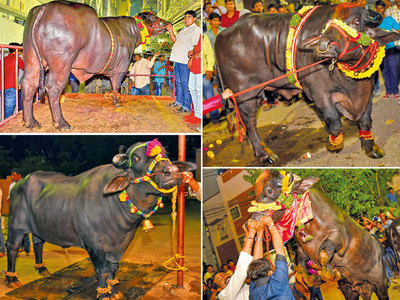
Eemaata, eemaata, yuvarajula sye aata… (What a delight it is, this dance of the princes…) Thus goes the popular song that best encapsulates the essence of Sadar festival aka Telangana’s very own ‘Dunnapothula Panduga’. Its English translation, ‘Buffalo Carnival of Telangana’ doesn’t quite have the same ring somehow. That’s besides the point though. For this festival is a celebration of the buffaloes — the ‘dancing princes’ that the aforementioned lines of the Sadar song extol. And the star attraction of this year’s festivities were the magnificent Murrah quartet — Raja, Dara, Maharaja and Shahenshah — each weighing well over 1,200 kilos!
As their proud handlers rave about the USP of these hulking bulls, your jaw drops in amazement. “The 4-year-old Raja weighs close to 1300 kg and is a 12-time National Livestock Champion. Maharaja, 6, from Chevella is a 6ft 2 inch-tall 1400-kg alpha male who makes for a breathtaking sight. Then there is Dara, son of the 24-time National Livestock Champion, Yuvraj, who’s fathered over 2,00,000 calves. Like his massive father, Dara tips the scales over 1,300 kgs. And the most expensive of them all is four-and-a-half year old Shahenshah who towers at a staggering 7 ft and weighs a whopping 1500 kilos,” say brothers Mahesh Yadav and Madhukar Yadav, organisers of the Sadar festivities which were held in Srinagar Colony on Friday night.
Bred and raised in Hyderabad, Shahenshah is hailed as the pride of Telangana by E Haribabu Yadav, state general secretary, All India Yadav Mahasabha. “Recently a buyer offered `25 crore to buy Shahenshah but his owner Ahmed Alam Khan refused to sell,” says Haribabu, adding, “Shahenshah was bred and groomed with the intention of beating the celebrated super bull Yuvraj of Hissar (Haryana),” says Haribabu who organised the Sadar festivities in Musheerabad on Saturday night.
And it seems like he’s already living up to expectations. Shahenshah recently entered the record books as the ‘World’s Most Expensive Bull’. “Shahenshah is one of the finest specimens of the murrah breed of buffalos that is ethnic to India. Standing 7 ft tall and 15 ft long, this bull is the pride of India,” says Suman Palle, CEO, High Range Book of World Records.
“The price of a bull is determined by the value of it’s semen which is much in demand. Each ejaculation fetches anywhere between `1,00,000 to `1,50,000. Hundreds of doses are prepared from the semen discharged during every ejaculation which is frozen in liquid nitrogen and sold to dairy farmers,” explains Ahmed Aalam Khah.
These bulls lead a charmed life indeed. “We spend about `4,000- `5,000 every day. They are given oil baths three times a day and it has a couple of attendants looking after it all day. Shahenshah drinks 30-40 litres of milk mixed with raw eggs every day. It’s diet consists of 100-150 apples, laddus made of kaju, pista, badam and dates, concentrates, green grass and hay.”
source: http://www.timesofindia.indiatimes.com / The Times of India / News> City News> Hyderabad News / by Karthik Pasupalate / TNN / October 23rd, 2017
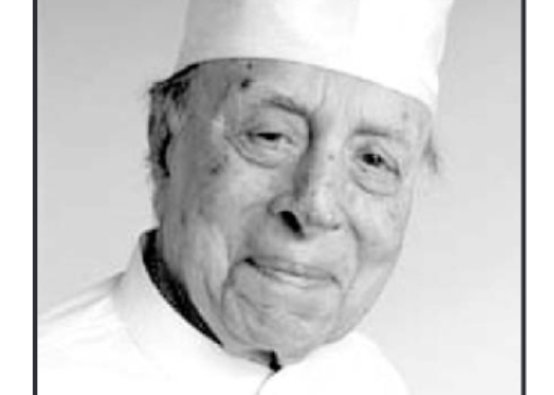
Nawab Shah Alam Khan, Chairman of Hyderabad Deccan Cigarette Factory expired today at 1 am.
He was also the chairman of Anwarul Uloom Educational Society and many more educational societies.
He converted Anwaruloom from a small educational institute into an educational hub. Today about 18,000 students attend schools and colleges run by society.
An engineering college ‘Nawab Shah Alam’ was named after him.
He is survived by seven sons
Nawab Mehboob Alam Khan
Nawab Qader Alam Khan
Nawab Zahed Alam Khan
Nawab Mohammed Alam Khan
Nawab Mehmood Alam Khan
Nawab Ahmed Alam Khan and
Dr. Mustafa Alam Khan.
He was born in a Jagirdar family in 1921 and expired at the age of 96.
Namaz-e-Janaza will be performed at Masjid E Salima Khatoon, Himayath Nagar after Asar prayer today.
For further details contact +91-9849030244
source: http://www.siasat.com / The Siasat Daily / Home> Hyderabad> Top Stories / October 23rd, 2017
The master’s style became so well established that it has come to stay.
Abdul Karim Khan (centre)
Abdul Karim Khan was born on November 11, 1872, at Kirana, a village near Panipat. His father, Kale Khan, was also a musician and Abdul Karim and his two other brothers, Abdul-Majid and Abdulhug, imbibed their earliest lessons in music from him. It is said that Abdul Karim and one of his brothers left Kirana when they were still in their teens and came to Baroda where Abdul Karim soon earned a name for himself as a young poet and talented musician.
He then left Baroda and travelled to Poona and Bombay. He imparted his knowledge of music to a few earnest students and soon established himself as an outstanding musician of the Kirana gharana. He finally left Bombay and settled in Miraj, which was then a princely state. Among the well-known musicians of his time, he was the first who studied the complex problems of shruti. He was the principal and perhaps the only demonstrator of the shruti scale of the chromatic scale of Hindustani music. He demonstrated that the subdivision of the seven notes of the usual gamut into 22 parts was a fact to be reckoned with and not just a fantasy in the minds of ancient musicologists.
Abdul Karim was a man of simple and frugal habits, non-ostentatious and kindhearted. He did not bully or ill-treat his pupils and those who lived with him enjoyed parental care and attention. At Miraj, he developed an interest in the tanpura and brought his own musical knowledge to bear in the construction. He was on his way to Pondicherry when he experienced a severe pain in the chest at Chingalpeth. On October 27, 1937, he died peacefully on the platform at Singapuram Koilam, reciting Kalma in the raga Darbari.
We find it a little difficult to understand how it is that geophysical regionalism has become synonymous with the history of gharanas rather than the names of those maestros who have devoted their lives propagating and teaching the mode of music perfected by them in their own way and after their own heart. Is it the typical oriental philosophy of the impermanence of man that is responsible for the transference of credit and merit from man to place?
Geography of music
Tansen’s disciples made his music the music of the Gwalior gharana; Alladiya Khan’s complex music came to be linked with Jaipur or Atrauli; Fayyaz Khan and Vilayat Khan belonged to the Agra gharana; Bade Ghulam Ali was associated with the Patiala gharana; and Abdul Karim’s cultivated pattern of music came to be known as the Kirana gharana. Our inquiry into this aspect may not lead us on to any definite results. But it is important to explore how a gharana is born.
Let us consider the Kirana gharana and its distinguishing points. First, not much is known about Abdul Karim’s teacher, his father, Kale Khan. Abdul Wahid Khan, another exponent of the Kirana gharana, learnt his music from his father Hyder Khan. Not much is known about him either. Bande Ali Khan, the been maestro, is said to have belonged to this gharana and except for his celestial music and the romance which culminated in his marriage to his disciple, Chunna, there are few mentions of the Kirana gayaki. Most accounts of musicians, both living and dead, are anecdotal. They do not give us even a glimmer of the manner in which these great masters imbibed their music, the methods, the routine they followed and the influences which worked on them. It is not possible to convey accurately the idea of a gharana through words because our musical aesthetic or critical vocabulary have yet to arrive at a stage of absolute precision. It is still in a state of evolution. A listener feels the stamp of a gharana and there it rests; the musician, guided by his fancy and immersed in his own interpretation, has already left familiar ground and is in his own world where the gharana is as far removed from him as an airman from terra firma.
A common observation about the Kirana school is that the musician develops his song or cheeja merely on the strength of the alapi or elongated notes, so dovetailed that in his exposition of the melody, his only aim is to fix and cajole or caress a note, the only limitation being that of tala (the time measure), which beckons him to the point of return. The sweetness of melody is primarily due to the tonal quality, which imbibes a gradual, subtle use of semi-tones in the main note, whose placement in the scheme of the melodic weave is the main objective. For him the cheeja are only a help in articulation.
The Kirana musician seems to have all the time in the world once he has started and closed his eyes to mundane things like the audience. He weaves his net of alapi around a note and ascends the melodic structure as delicately as a gossamer spread over a leaf. He is in love with his swara he has captured that very moment. He plays with it, is engrossed in its nodal and sub-nodal musicality. This has provoked derisive and wholly unjustified remarks from listeners. They say if one Kirana gharana musician takes half an hour to reach gandhar, another musician of the same gharana will take one hour to do so.
The form matters
Some musicologists are of the opinion that this gayaki lacks form. The existence of so many gharanas is proof that what is termed form is an elastic, accommodative arrangement and not a principle of scientific rigidity. In our music, the artiste sets out and sings a cheeja perhaps once; he enunciates it properly and then begins to establish the melody in a multi-pronged manner. The chosen melody is set to a particular tala, and his beginning in slow tempo necessitates a slow and leisurely progress. Each school of music has decided over a long period of deliberation and practice its own mode of such measured progress. If we compare two music lovers’ assessments of a gharana, both of them may agree on the overall effect of the music but often disagree on individual movements or methods of elaboration. In our music there is really nothing inherent which dictates to us that only one arrangement is possible. Witness, for example, the different ways of enunciating the world kaku in Sanskrit musical treatises. Witness, also, the musician’s improvisations in changing the stress for the sama. One can pile up a whole list of such individual gimmicks employed by a musician.
In our music, the basic material is the melody or abstract series of sounds related in an artificial manner. These sounds are subject to some arrangements: for example, five-note ragas, six-note ragas and so on. It is easy to understand that once this arrangement is stretched over a composition, that is, on the musical theme, the musician is permitted a great amount of freedom in his handling of it. When we think of form in our music, we have to think of the sound content and not of a rigid structure superimposed on a cheeja and its movement. Hindustani music, is not written and, therefore, the duration of a performance differs from musician to musician. If a musician compresses all his art in a short period of time and another stretches his recital over a longer span, we do not consider it amiss. The total impression is what we finally have in mind.
When a Kirana musician creates an agreeable atmosphere of a melody by a succession of notes woven carefully and gradually, and when he expounds the cheeja with finesse and keeps you rooted to your seat, you cannot merely dismiss his art, and his effort as charming yet formless. We will have to grant then that the Kirana musician has evolved his own form and this is no mean achievement.
Focus on swara
A distinctive feature of this school of music can be briefly summarised thus: a Kirana musician places greater stress on the presentation of melody by employing alap or lengthened flights of swara continuation, running through the full time-measure. He does not play within the inherent rhythm or laya in the manner of a musician of the Agra gharana. In fact, his obsession with the swara overshadows every other facet of the presentation of music. He does not unfold the melody through playful hide-and-seek either with the time-measure or with intricate and complex variations of the rhythmic pace. His main concentration is on the note or swara, and with this as his base, he creates an atmosphere of deep reverence. A listener who concentrates on the performance notices that the Kirana musician does not deal with scattered or separate musical ideas, individual movements within the time-circle but builds up his melody, note by note, like a weaver.
Another distinctive feature of the Kirana musician is his voice culture. His gestures seem to indicate that he is really at great pains to produce a sound, and that he has some difficulty in sustaining it; but actually the artiste is not greatly constricted in his articulation. The Kirana musician’s sense of control of the subtle inflexions in voice production is remarkable and he has had to strive hard to attain it. He seeks to achieve the desired tunefulness. But his mannerisms appear somewhat odd; even so, they are natural to him. In his taans, there is more facial or jaw-bone control. The Kirana musician elaborates the sargam or notation of phrases deftly and in an ingratiating manner. In fact, this has become one of the notable and accepted ingredients of this gharana. His vocal line has a wide range – wider than that of most of the musicians of other schools of music.
One significant aspect of the Kirana musician is his presentation of the thumri in his own cultivated way. The Kirana musician’s voice culture is suited to singing the thumri because there is equal stress on both the composition and its meaningful presentation. The Kirana musician’s delineation of a thumri is again swara-dominated and tends towards a khayal pattern.
A genius arrives
Abdul Karim evolved and perfected the style entirely on the basis of his own genius. There is a gramophone disc of Abdul Karim, rare, yet still available in the possession of connoisseurs. It reveals an entirely different kind of musician. One can hardly place the musician as Abdul Karim even after ten guesses.
It is clear that Abdul Karim pondered over the problems of musical expression. He was gifted with a sweet and extremely pliant voice, which he cultivated in his own rigorous manner and it is on record that he enjoined his disciples to conform to the voice culture he taught them and to perfect it through persistent practice. Abdul Karim could reproduce all the 22 shrutis of our chromatic scale. Apparently, what we call form came to the musicians through the dhrupad style which was rigid in its structural presentation. Our musical progress, however, is traceable to rebels who boldly deviated from the uncompromising elements in the attitude of the dhrupadiyas. Abdul Karim ought to be applauded for the leadership he took in this battle.
Abdul Karim’s style is now so well established that it has come to stay. He who creates, lives. He has established his own norms, his own code of conduct. He lived at a time when great, very great and even outstanding musicians lived and performed in their own ways. If he rejected some of the ideas of other music styles, he must be applauded rather than accused of departing from them. New and upcoming musicians (like Kumar Gandharva or Vasantrao Deshpande) have also boldly created, established and consolidated their own styles and our music is the richer for their contributions.
Abdul Karim’s performances delighted his listeners. In addition to khayalgayaki, he raised thumri presentation to a new and beautiful state. During his performances, the listener experienced a mental repose. He sang khayal, thumris, Marathi stage songs, Marathi pads. He was not a purist or a dogmatic upholder of a particular tradition. He remained in his own sound of swara-dominated trance the whole day, and those who were close to him say he would pick up a tanpura and tune it to the basic note of a tanpura tuned the previous day, without striking the note of the harmonium for support. This meant that he was in constant harmony with that note both during his sleep and during his waking moments.
This article first appeared in ON Stage, the official monthly magazine of the National Centre for the Performing Arts, Mumbai.