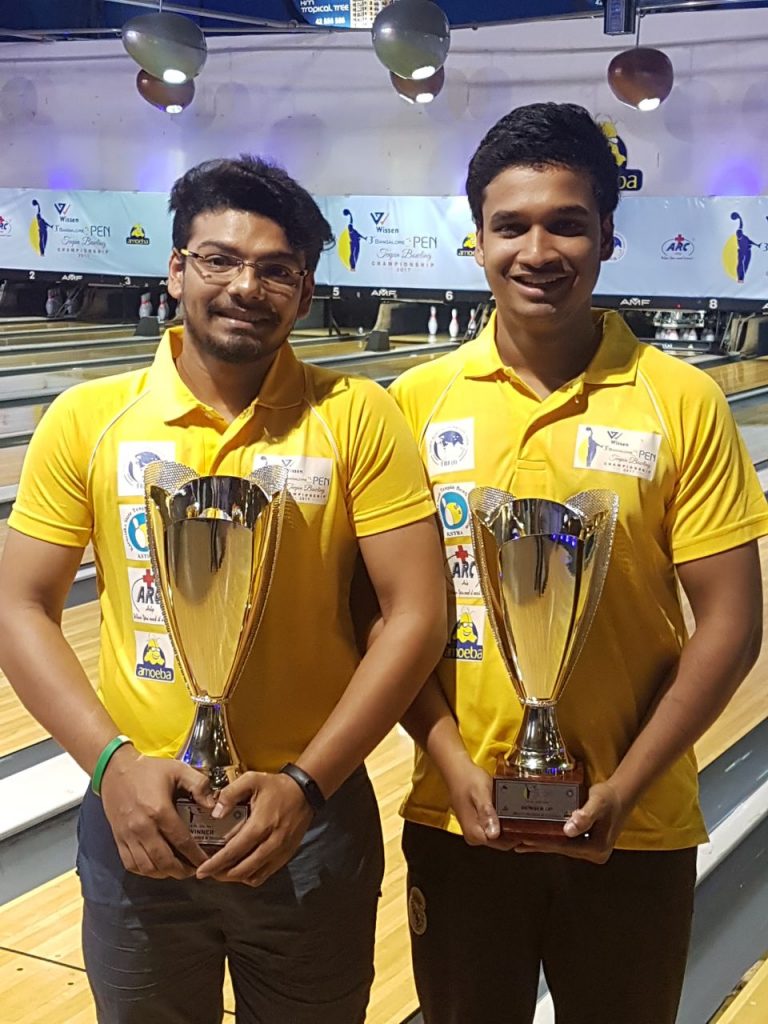
Abhishek Dhudasiya of Tamil Nadu won the Men’s Graded ‘A’ Division Title at the Wissen 3rd Bangalore Open Tenpin Bowling Championships – 2017 being held at the Amoeba Bowling Center, Church Street, Bangalore.
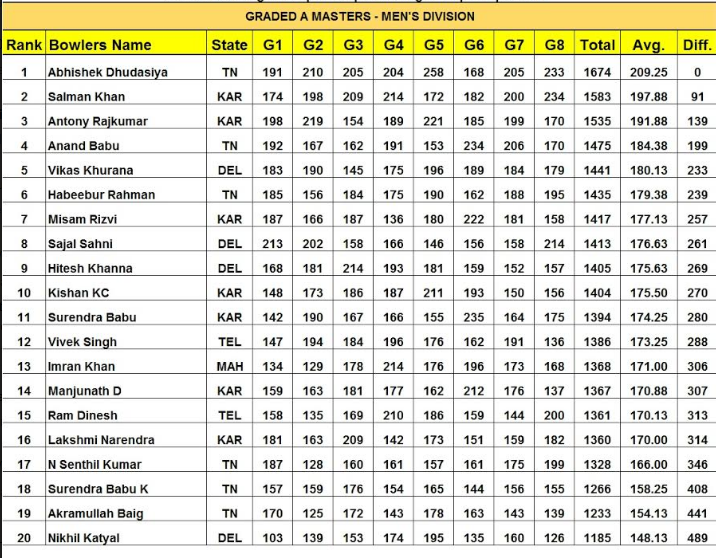
In the Masters Round, held this morning, where Top 20 bowlers bowled 8 games block to decide the winner based on total pinfall. Abhishek bowled quite consistently, scoring 6 games above 200 and ending up with total pinfall of 1674 and an impressive average of 209.25.
Sports India Live Staff | Sports India Live
The 22-year-old Abhishek finished 91 pins ahead of Salman Khan of Karnatakawho finished 2nd with total pinfall of 1583. Former International Antony Rajkumar (1535) of Karnataka finished 3rd.
In the Masters Round of Open Division, out of 16 bowlers who made the Cut, 8 bowlers are from Karnataka. Vijay Punjabi of Karnataka is injured and in his place, 1st Reserve Surendra Babu from TamilNadu will play this evening.
All 16 bowlers will bowl 8 games this evening and 8 games tomorrow morning. Top 4 bowlers, based on cumulative pinfall of 16 games will move to the Knock-Out Stepladder round. The Finals will be held at 5 pm tomorrow.
source: http://www.sportsindialive.con / Sports India Live / Home> Bowling / by Sports Ind ia Live Staff / July 28th, 2017
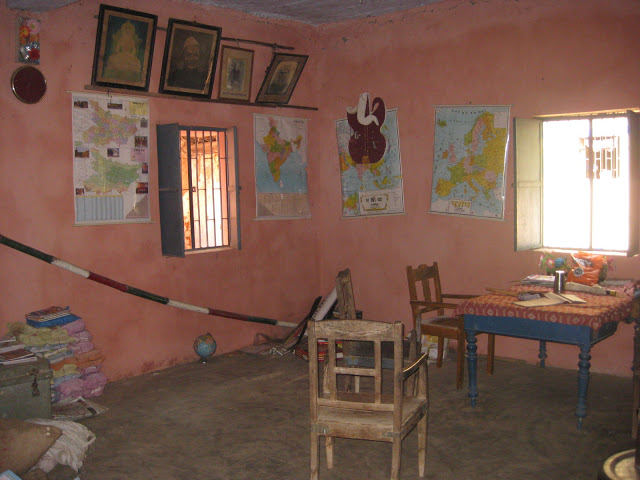
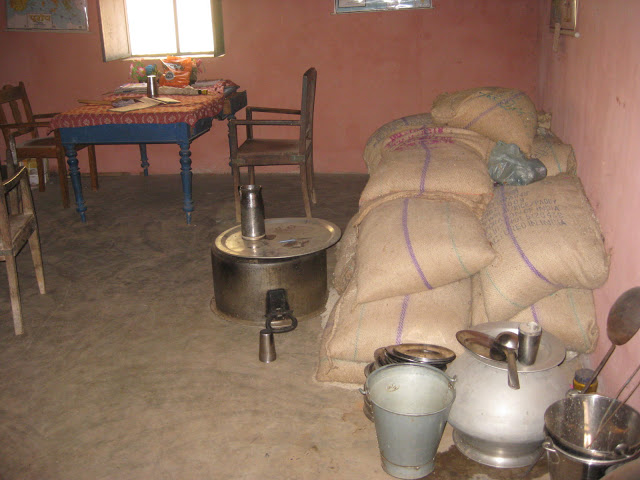
Maulana Mazharul Haque, the man who was a firm believer in complete Independence being “the birthright of every Nation”, has his birth place in office of a government run school that doubles as food storage.
Maulana Mazharul Haque was born to a rich landlord, Sheikh Ahmedullah, in Bahpura, Thana Bihta of Patna district on December 22nd, 1866. His primary education was at home by Maulvi Sajjad Hussain, but he passed his matriculation from the Patna Collegiate in 1886. He joined Canning College in Lucknow for higher studies but same year left for England to pursue a course in Law. He started legal practice in Patna after his return from England in 1891.
He made a significant contribution to relief efforts launched during the famine in Saran district of Bihar in 1897. Maulana Mazharul Haque’s public life actually commenced with the creation of the Bihar Provincial Conference, a move he supported as he believed in the need for the constitution of Bihar as a separate province.
In 1906 Maulana was elected Vice Chairman of Bihar Congress Committee. Mazharul Haque helped organize the Home Rule Movement in Bihar and was its President in 1916. He actively participated in the Champaran Satyagraha for which he was sentenced to 3 months imprisonment.
Subsequently, when the Non Cooperation and Khilafat Movements were launched, Mazharul Haque gave up his lucrative legal practice and his elected post as member of the Imperial Legislative Council and turned all his efforts to the freedom struggle. By now, he was a firm believer in complete Independence being “the birthright of every Nation”.
Mazharul Haque was also a fervent believer in democratic decentralization and he organized the Panchayats in Saran district towards meeting this vision. He also made many requests for better educational facilities in Bihar, especially for free and compulsory primary education.
Maulana Mazharul Haque actively participated in anti-purdah movement launched in Bihar in response to the Non-Cooperation Movement of 1920. Mahatma Gandhi sought to bring women also into mainstream politics, to strengthen the resistance against British rule as well as empower them to play a more active role in society. The purdah system espoused by Muslim and many Hindu families, especially in Bihar, meant that women remained behind men in all spheres of life.
In 1919, he gave up and burnt his western attire to adopt traditional Muslim attire. He was given title of “Desh Bhushan Faqir Mazharul Haque”.
1920, he donated his 16 bigha land on Patna- Danapur road for Sadaqat Ashram and Vidya Peeth which served as college for students who left government colleges in response to Non-Cooperation Movement. Sadaqat Ashram played important role in Independence movement in Bihar.
Maulana also launched his weekly magazine “The Motherland” from Sadaqat Ashram. He also jailed for his articles in this magazine. Sadaqat Ashram continues to serve as headquarters of Bihar Congress. But it is a tragedy that even Congress do not remember the person who has given so much to the party. Till few years back, even Maulana picture was now where to be seen in the ashram.
Maulana was firm believer of Hindu-Muslim unity. His famous quote sums up his conviction, “Wheather we are Hindu or Musalmaan we are in the same boat, we must sail or sink together”.
When in London, Maulana established Anjuman Islamia. This brought Indians of various religion, region and sects under one umbrella. This was also place to discuss about India’s problem. Mahatma Gandhi first met Maulana Mazharul Haque in Anjuman Islamia, London.
Person who gave everything for the country has not got due recognition. Maulana donated the house where he was born, to start Madrasa and middle school within same compound in 1926. Idea behind establishing both in one campus was to promote communal harmony.
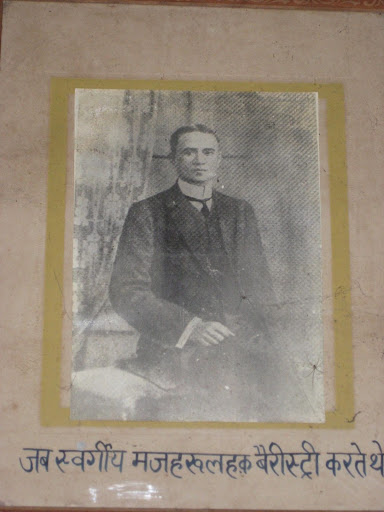
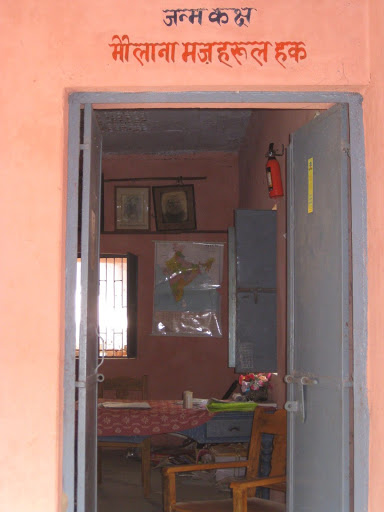
Now the very place where he was born is a principal office of government middle school. On the entrance door of principal office, a line is written in Hindi “Janam Kachh Maulana Mazharul ”(Birth place of Maulana Mazharul Haque). If you enter in the office apart from a picture of Maulana Mazharul Haque along side Dr. Rajender Prasad picture will not give any indication of place being birthplace of a person of such stature. Principal office house the ration for mid day meal scheme for the school apart from general school office stuff.
But this is an improvement from before. Before this school structure was build in 2004, place he was born was used as a toiler for villagers after original structure fell down. Because of the effort for few locals, this place was cleaned up and school building was build and place was marked as birth place.
On December 22nd politicians do come to shower words of praise on Maualana’s contributions but the pity condition of place has not moved anyone. Their promise has remained promise till date.
While talking to TwoCircles.net, Md. Yusuf Khushidi, former HOD Urdu department, Patna University said, “Locals have been demanding to build Library or Technical Institute in that place to commemorate but so far nothing has materialised.”
Yusuf Khhurshidi who belongs to Bahpura added, it is unfortunate that for a person, who sacrificed every thing for the country has been forgotten so fast. Maulana foresightedness can be judged by the fact that Maulana had emphasized on the communal harmony, democratic decentralization and education right from early stage of his life. Maulana was also in the forefront in establishing Bihar state which was carved out of Bengal.
Echoing Yusuf Khurshidi sentiments, Dananjay Yadav also demanded a memorial should be built for the one of the tallest visionary leader of Bihar.
Maulana’s family is living a struggling life in obscurity. It is disheartening to see family of a person who sacrificed everything from career to wealth for the sake of county is left high and dry.
Next birthday of Maulana Mazharul Haque is a month away. I am sure VIPs will be lining up to pay respect especially in election year. Few fascinating speeches will be delivered and few promises will be made. Politicians are known to have short term memory. So those promises will be forgotten sooner than later.
People in India too have selective memory, only very few are remembered for their part in freedom struggle and rests are still struggling to get freedom from obscurity.
source: http://www.twocircles.net / TwoCircles.net / Home> Indian Muslim / by M. Zajam, TwoCirlces.net / November 20th, 2009
Ibrahim Thabreez, 23, has equipped his bus with WiFi and offers free tax consultation
Owner of a private bus in Mangaluru encourages people to file IT returns by offering information and free consultation
After offering free Wi-Fi services on a private city bus, a Golden Line bus that runs between Mangaluru city (State Bank of India Bus Stand) and Hoo Hakuvakallu near Konaje will offer free consultancy services on several issues such as GST, linking PAN with Aadhaar, filing IT returns and how to go about it.
Ibrahim Thabreez, a 23-year-old MBA graduate working as an export executive at Sharief Marine Product Private Limited decided to spread awareness on the subject. Thabreez‘s family is into transport business and they own about three city buses.
Speaking to Bangalore Mirror, Thabreez said, “People panic when they hear the word tax. Now, with GST, the panic has only increased. I am campaigning so that people come forward and file their returns. I explain to them the benefits of filing returns and how to go about it. For this, I have pasted posters inside the bus. I thought this is the right time to spread awareness as there are few days left to file returns for the last financial year. I addition, I am helping people with getting a PAN card, as well as linking it to their Aadhaar cards and bank accounts,” he said.
The non-salaried class often try to avoid filing returns. “I have provided my mobile number on the posters on the bus. While I guide them for free, in case they want me to take it further and get them a PAN card, I will do so only by charging a fee prescribed by the government. Regarding IT returns, I can guide them on the taxable amount and how to go about filing e-returns. In case they insist that I file it for them, I can provide the services at my office at a reasonable fee,” he said.
When JIOFi was launched earlier this year, Thabreez saw to it that a device was placed inside the bus so that people could use WiFi for free. Though the free offer has ended, they use upto 5 GB data in the bus every day.
source: http://www.bangaloremirror.indiatimes.com / Bangalore Mirror / Home> News> State / by Deepthi Sanjiv, Bangalore Mirror Bureau / July 27th, 2017
Janab Khaleel Mamoon and Gopchand Narang at the inauguration of All India Seminar on Life and Works of Eminent Urdu Poet Akhtarul Iman in Bangalore, on 22, January, 2012. Photo:V Sreenivasa Murthy
On Sunday, Urdu aficionados across the city came together to remember, discuss and delve into the nuances of the life and works of noted Urdu poet and award-winning screenwriter in Hindi cinema Akhtarul Iman.
Though Iman was recognised as among the important faces of modern Urdu poetry after he was awarded the Sahitya Akademi Award in 1962, there has been little discourse, or few seminars held on him, said academic Gopichand Narang at a daylong seminar organised by the All-India Urdu Manch and Sahitya Akademi.
Dr. Narang, professor emeritus at the Hyderabad Central University, spoke about several facets of the Iman’s life and his poetry, alluding them to a “jigsaw puzzle”. Having been recognised by the Urdu community only after he was conferred the Sahitya Akademi award for Yaadein, Dr. Narang said that Iman’s works needed to be revisited.
“It was only after the award that everyone started reading him, and his name was taken with the likes of Meeraji and N.M. Rashid,” he said. He was fiercely independent, and though he was writing for Bollywood for his “source of livelihood”, he was always “an outsider” to Hindi cinema. He said Iman neither compromised on his ‘shayari’ nor ‘films’.
Screenplays
Iman wrote several award-winning screenplays, including for classics such as Waqt, Dharmputra, Kanoon, Patthar Ke Sanam and Gumrah. However, he did not write lyrics for film songs unlike many of his Urdu poet contemporaries, Dr. Narang pointed out.
‘Jigsaw puzzle’
On the “jigsaw puzzle” that he compares the poet’s persona to, Dr. Narang said Iman’s writing was multifaceted. While, on the one hand, his poetry reflected a sense of longing for human values, relationships and innocence that a migrant would feel in a metropolis like Mumbai (Iman himself migrated to Bombay from Uttar Pradesh), it also dealt with weighty socio-political issues such as corruption, poverty and injustice, he said.
“A facet of his writing can be compared to R.K. Laxman’s ‘common man’ who observes all that is wrong around him, all that is commercialised, and the erosion of human values,” Dr. Narang explained. While Iman did refer to and appreciate revolutionary poet Faiz Ahmed Faiz, he was not among the activists, he added. “Some are activists, and then there are others who simply use the power of their pen.”
No ghazals
Several papers discussing the works of Iman were presented at the seminar. Khaleel Mamoon, former chairman of the Karnataka Urdu Academy, said Iman would be remembered for his strong individualism. “He never wrote ghazals as he felt that the form does not permit expression of original ideas and concept. He also believed that ghazals as a form had already reached its zenith by the time of Mirza Ghalib… so kept himself away from the tradition of ghazals.”
source: http://www.thehindu.com / The Hindu / Home> News> States> Karnataka / by Staff Reporter / Bangalore – January 23rd, 2012
Syed Ghayorul Hasan Rizvi assumed charge of the Chairman of the National Commission for Minorities in New Delhi today. After assuming the charge, Shri Rizvi said that the Commission will work for the welfare and development of minorities.
Syed Ghayorul Hasan Rizvi is a graduate in Arts and also holds Diploma in Mechanics. He served as Chairman, U.P Minority Finance Development Corporation Ltd.
Shri Rizvi has been actively participating in social service. He worked for the improvement of the basic facilities and working conditions of Beedi workers and Weaver community in Uttar Pradesh. He also worked for Communal Harmony and National Integrity.
BCK/AK
source: http://www.pib.nic.in / Press Information Bureau, Government of India, Ministry of Minority Affairs / May 26th, 2017
Actor Adaa Khan says that along with getting good reviews for her role of Shesha in Naagin, she has also been complimented by people comparing her look with that of Sridevi in the film Nagina.
Actor Adaa Khan played the role of Sesha in the TV show Naagin and its sequel, Naagin 2.
For actor Adaa Khan, the TV show Naagin and its sequel hold a special place in her heart. The reason is not just that the shows were a hit, but also because her look in the serials was compared to that of Sridevi in the 1986 movie Nagina.
“The response to Naagin and Naagin 2 was encouraging for all of us,” says Adaa. “That the audience loved my portrayal of Shesha added to my happiness. I enjoyed playing the character, as it had several layers to it. I feel that doing the show has been a turning point in my career.”
The Amrit Manthan actor also got several compliments for the way she looked in the serials. Many have compared her look in Naagin to that of actor Sridevi in Nagina. “I have been praised for the way I looked on the show. But the best [compliment] was when people said that I looked like Sridevi. I am a huge Sridevi fan, so getting such compliments made me feel really special,” says Adaa.
Naagin 2 recently ended and Adaa says that she will miss her co-stars from the show — working together for so long, they really became close to each other. “Working with Mouni (Roy) and Sudha Chandran was, in a word, wonderful. We all used to have so much fun on the sets and now I am missing that already. I feel Naagin was one show where everyone had put in a lot of hard work and that helped in making the show such a success,” says Adaa.
source: http://www.hindustantimes.com / Hindustan Times / Home> Entertainment> TV / by Shreya Mukherjee , Hindustan Times / July 16th, 2017
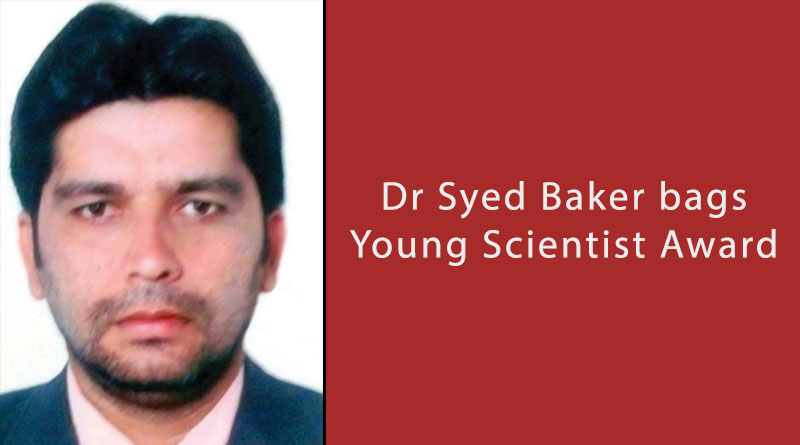
City based researcher Dr Syed Baker has been conferred with Young Scientist Award by Siberian Federal University, Russia. Dr Syed is one among the seven candidates to have been awarded across the globe and one among three Indian with only researcher from Karnataka.
He has completed Ph.D in Microbiology from University of Mysore under the supervision of Dr S Satish and was also honoured with National Post-Doctoral Fellowship from SERB Government of India under the supervision of Dr Nagendra Prasad, Department of Biotechnology and SJCE.
During his research tenure, he was also selected as exchange research for Finland in 2013 which was awarded by CIMO, Government of Finland.
He was also awarded Senior Research Fellowship and Research Associate from Indian Council of Medical Research.
During his research stay he will be working on developing smart nonmaterial towards combating drug resistant microbial pathogens.
source: http://www.citytoday.news / City Today / Home> Mysore / by Editor / June 03rd, 2016
Bringing string of accolades to the Aligarh Muslim University (AMU), one after the other; Shah Faaiz Alam, a Mechanical Engineering Postgraduate student of the Zakir Hussain College of Engineering and Technology, AMU has been selected by the Indian Air Force under Permanent Commission for the Aeronautical Engineering (Mechanical) Branch.
Alam, earlier brought laurels to his alma mater by getting recommended by Air Force Selection Board, Dehradun. Alam achievements did not stop there as he later made it to the All-India merit list securing 5th All-India rank under the technical stream.
He will now be joining the Air Force Academy, Hyderabad in July for the commencement of training for a period of six months. Alam will be further sent to Air Force Technical College (AFTC), Bangalore for further advanced technical training of 52 weeks under the rank of ‘Under-Training Flying Officer’.
Professor Mohd Altamash Siddiqui, Chairperson, Department of Mechanical Enginneering and Dr Nafis Ahmad II have congratulated Mr Alam for the achievement.
source: http://www.twocircles.net / TwoCircles / Home> Indian Muslim / by TCN News / July 03rd, 2017
IT was perhaps in the early 1970s that I first heard Ali Sardar Jafri at a mushaira (poetic soiree) in Delhi. I do not have a very vivid recollection of all he chose to recite on that evening because the dais had a galaxy of eminent Urdu poets. Yet I still cherish the memory since he had made a great impression on me and other young men on account of his fiery poetry. What struck me most was the freshness of imagery, the transparent commitment to the man-on-the-street, and the intensely felt love for this country and its composite culture.
When the Sardar recited “har aashiq hai Sardar yahan, har maashooqa Sultana hai” (Here, every lover is Sardar and every beloved is Sultana), I was struck by the boldness of expression. I knew that romantic poetry was all about self-expression, but this was something absolutely new. Normally, lovers fashion themselves after Majnu and their beloveds after Laila, but here was a poet who identified himself and his beloved Sultana, who later became his wife, with every lover and beloved. Majnu and Laila were no longer the measure, the yardstick. It was the poet himself and his love that became the new symbols of lovers. This was a startling example of transmutation of literary symbolism. Here, one was faced with a totally new aesthetics.
So much has been written about Ali Sardar Jafri’s contribution to the progressive writers’ movement. He was one of its leaders, and insofar as Urdu poetry is concerned, its tallest leader in India. He belonged to a generation that began with participatio n in the freedom struggle and gradually moved from nationalism to Marxism. This was no fashionable Marxism embraced for its intellectual attraction. This was a Marxism that dislocated them from their comfortable aristocratic or upper middle class existen ce and compelled them to live the hard life. The many possibilities of fundamental social and economic change opened up before this generation, which remained unsatisfied with the attainment of political freedom alone. This was a generation that produced the likes of Shambhu Mitra, Bijon Bhattacharya, Mrinal Sen, Utpal Dutt, Balraj Sahni, Sahir Ludhianvi, Kaifi Azmi, Rajinder Singh Bedi, Shailendra, Salil Chaudhury, Majrooh Sultanpuri, Ramvilas Sharma, Kedarnath Agrawal, Nagarjun, Shamsher, Makhdoom Moh iuddin, Faiz Ahmad Faiz, Ismat Chugtai, Krishen Chander and a host of other equally eminent creative talents.
It was not without reason that the legendary Premchand had presided over the first ever conference of the Progressive Writers’ Association held in Lucknow in 1936. The clarion call he issued then, to “change the measure” of beauty, remains to this day a landmark event in the evolution of Indian literature.
Ali Sardar Jafri never forgot Premchand’s call. In fact, he uses this as an epigram to begin his celebrated poem Samandar ki Beti (Daughter of the Ocean) with. Unlike many other writers and poets, Jafri did not go to Bombay (now Mumbai) to write for Hindi films. He went there to work as a full-time activist of the undivided Communist Party of India (CPI). His involvement with writing film lyrics came much later and he was to set a standard of lyrical beauty that has remained unique. His composi tion for the film Footpath, “Shaam-e-gham ki kasam, aaj ghamgeen hain ham“, rendered in Talat Mahmood’s silken voice, remains memorable even today. Jafri even produced a film Gyarah Hazar Ladkiyan (Eleven Thousand Girls) in 1960 for friend Khwaja Ahmad Abbas. Incidentally, it was Abbas to whose film Anhonee Jafri lent his pen for the first time in 1952.
BORN in an aristocratic Muslim family of Balrampur, Uttar Pradesh in 1913, Ali Sardar Jafri plunged into politics early and joined the national movement. He went to jail several times on account of his political activities. He left for Bombay in 1942 and spent most of his life in this metropolis. A friend of revolutionary Turkish poet Nazim Hikmat and Nobel Prize winner Chilean poet Pablo Neruda, Jafri remained the leader of progressive Urdu writers till the end. He began his literary career with a collection of short stories Manzil (Destination) in 1938 and made a mark as a poet with Parvaz (Strength to Fly) in 1943. His Nai Duniya ko Salam (Salute to the New World) and Asia Jaag Utha (Asia has awakened) were translated int o many Indian as well as foreign languages.
Jafri also came to be respected as an editor of critical editions of the works of Mir Taqi ‘Mir’ and Ghalib, the two poets who influenced the course of Urdu poetry the most. He also edited the works of Kabir and Meera. Jafri wrote erudite introductions t o all these books, establishing himself as an extraordinarily perceptive critic. As a poet, his unique contribution was to get the free verse its rightful place in the Urdu literary world. Josh Malihabadi, his senior by many years, had effected a sort of shift from the dominant form of ghazal to nazm, which was not bound by the rules of rhyme. Yet, even Josh’s nazm followed conventions of literary metres and was not exactly “free”. It was Ali Sardar Jafri who, like Suryakant Tripathi ‘Nira la’ in Hindi, freed the nazm from its metrical shackles. If Josh was hailed as Shair-e-Inqilab (The Poet of Revolution), Jafri came to be known as Shair-e-Awam (The Poet of the People).
While Marxism permeated his whole being and writing, it never became an ideological cage for him. Jafri encompassed the great humanistic traditions and compassion of the Sufi and Bhakti movements, the love of nature found in the works of Kalidas, and an assimilative vision of India’s composite culture. In no other Urdu poet – perhaps with the sole exception of Nazir Akbarabadi who lived in the 18th century – would one find quite the same kind of effusive celebration of Krishna with his Gokul, Gautam Bud dha with his disciple Anand and Chandalika, glory of the Vedas, the Radha of Vidyapati’s poetry, and so on. True to his commitment, he penned beautiful poems on Karl Marx and Paul Robeson too.
Several honours came to Jafri during his long literary career. These included the Padmashri, the Pakistan government’s Iqbal Award, the Uttar Pradesh Urdu Academy Award, the Kumaran Asan Award and the Toronto Urdu Literary Academy Award. The irony of it was that in 1986, the same Aligarh Muslim University that had expelled him on account of his participation in the freedom struggle, honoured him (or rather itself), by conferring the D.Litt. on him. In 1998, he won the Jnanpith award.
Such was the force of his personality and the power of his pen that even Prime Minister Atal Behari Vajpayee, a life-long member of the Rashtriya Swayamsevak Sangh (RSS), had to concede in his speech while giving away the Jnanpith award that one could di ffer with Jafri’s views but not with his vision. When Vajpayee made his bus trip to Lahore last year, Jafri went along as a special invitee, chosen since he best symbolised the essential unity of mankind. Among the Indian Prime Minister’s main gifts to his Pakistan counterpart was a collection of Jafri’s poems entitled Sarhad (Border).
Ali Sardar Jafri was steeped in the best traditions of secularism. He fought against imperialism all through his life while remaining aware that imperialism had a great capacity to take on newer forms. His Marxist convictions gave him a strong sense of s ocial justice and equality between classes, castes, religions, languages, and sexes. With his demise at the age of 86, Urdu literature has lost a man who broadened its horizons and deepened its perceptions. Truly he was the Sardar of Urdu literature.
Such was the force of his personality and the power of his pen that even Prime Minister Atal Behari Vajpayee, a life-long member of the Rashtriya Swayamsevak Sangh (RSS), had to concede in his speech while giving away the Jnanpith award that one could di ffer with Jafri’s views but not with his vision. When Vajpayee made his bus trip to Lahore last year, Jafri went along as a special invitee, chosen since he best symbolised the essential unity of mankind. Among the Indian Prime Minister’s main gifts to h is Pakistan counterpart was a collection of Jafri’s poems entitled Sarhad (Border).
Ali Sardar Jafri was steeped in the best traditions of secularism. He fought against imperialism all through his life while remaining aware that imperialism had a great capacity to take on newer forms. His Marxist convictions gave him a strong sense of s ocial justice and equality between classes, castes, religions, languages, and sexes. With his demise at the age of 86, Urdu literature has lost a man who broadened its horizons and deepened its perceptions. Truly he was the Sardar of Urdu literature.
source: http://www.frontline.in / Frontline / Home> Obituary / by Kuldeep Kumar / Volume 17, Issue 17, August 19 – September 01, 2000
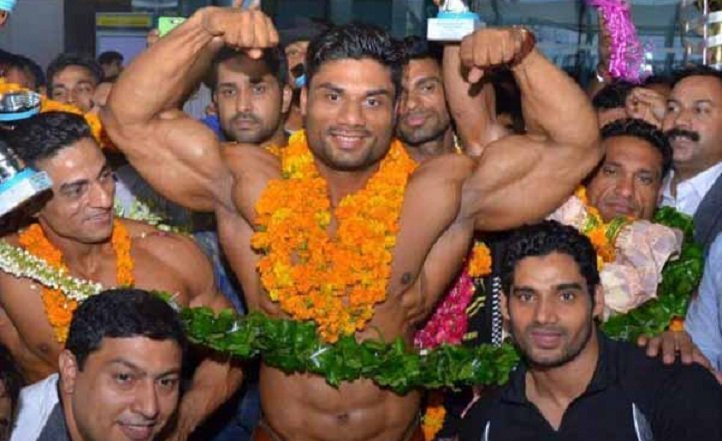
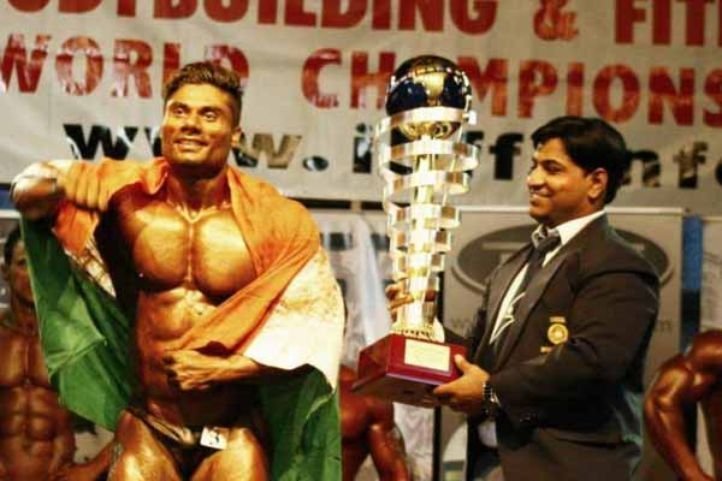
Indian bodybuilder Wasim Khan has won the International Bodybuilding Fitness Federation (IBFF) championship held recently on June 21 at Koper Slovenia, Slovenia
Khan not only won gold medal in one category but also won the overall title. In total, he won three medals. About 350 body builders from 37 countries participated in this event.
Source: Sahara Samay
The Indian bodybuilding team created history at the World Championships by winning four titles. Suresh Kadam who is the general secretary of IBFF said that it was the first time in bodybuilding that the Indian team had performed so well and also bagged the most coveted title of ‘Mr World’.
Khan will be aiming for Mr Olympia next, which happens to be the most coveted title in bodybuilding. Kadam also said that Khan has the potential to win the coveted title of Mr. Olympia.
Khan said, “I want to thank all my fans who always there for me in my tough times and Allah who gave me power to move forward to follow my passion (sic).” He thanked his wife by saying that she was the only person who believed in him and supported him throughout his struggle in his career.
Source: Sahara Samay
He was also thankful to India for providing him opportunity to showcase his talent.
This is not the first time that Khan has made the nation proud. Last year he had won ‘Mr Universe’ title at IBFF event in Rome.
Two other Indian bodybuilders, Sashi Kumar and Tarun Dutta, also won silver medal in their respective categories.
We congratulate Khan and the Indian bodybuilding team for this landmark victory. Here’s to more six packs!
source: http://www.scoopwhoop.com / Scoop Whoop / Home / by Saswat Singhdeo / July 06th, 2015