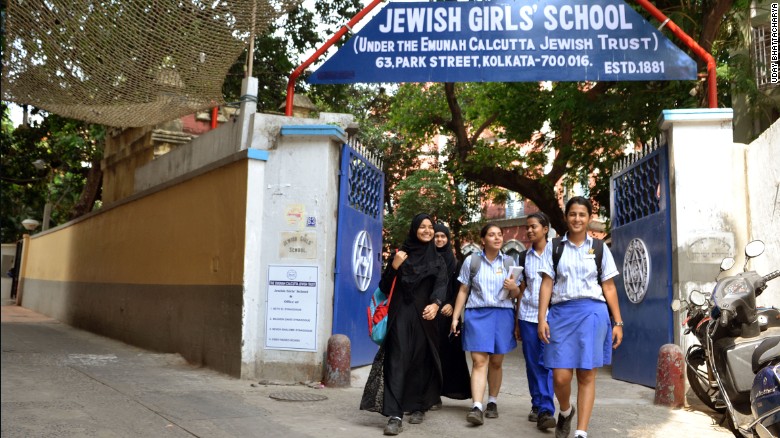
Muslim girls, some in the burqa and some in the regular uniforms, leave the Jewish Girls School in Calcutta.
Editor’s Note : Anik Basu is a Kolkata-based independent journalist.
Kolkata, India (CNN) :
When Mitana Alexander bid goodbye to Kolkata’s Jewish Girls School in 1975, she was its last Jewish student. The bulk of the others were Muslims.
But it was not the steady influx of Muslim girls in the preceding two decades that moved Alexander’s parents to take her out of the school, she says.
They were worried because she was last remaining occupant of a Jews-only dormitory, as most Jewish girls they had known had migrated to Israkel, America or Europe “with their folks.”
“They (school authorities) had to retain a matron just for me,” recalls Alexander, now aged 50. “I would be alone in the dormitory at night and my parents started panicking. Muslims had nothing to do with my leaving.”
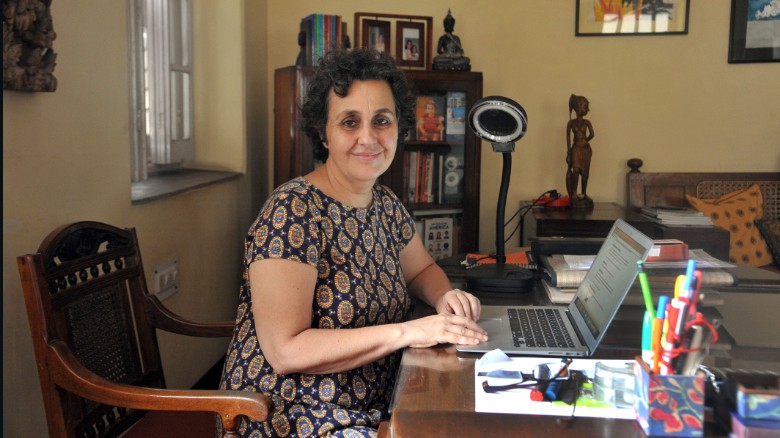
Author-scholar Jael Silliman, whose children are settled in the US, says development in India and the outside world in the 1940s-50s led to an exodus of Jews from Calcutta.
Distinctly Kolkata
The swelling ranks of Muslim girls in the Jewish school offer a glimpse into the deep ties between Kolkata’s Muslim and once-thriving Jewish community.
More than 1,200 of the nearly 1,400 students are Muslims, as is the school’s vice principal and half the faculty.
The change began in the 1950s, when there were not enough Jewish families needing an institution set up specifically to instil Jewish values.
As Jewish enrollment petered out, the authorities decided to admit children of other faiths. The biggest response came from the Muslims of nearby areas.
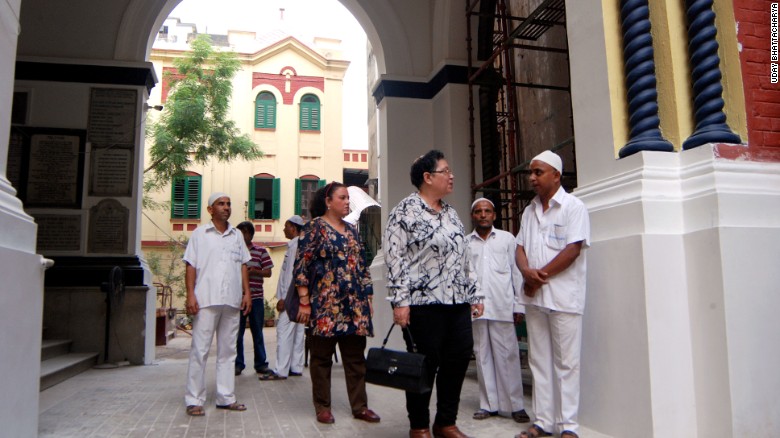
Aileen Jo Cohen (foreground) and Mitana Alexander talk to Muslim caretakers at one of Calcutta’s three synagogues.
Today, there is very little “Jewish” about the school, save for perhaps its name, the Star of David on the school gates, the school uniform and notebooks, and portraits of Jewish patrons on the walls.
Authorities have made available a “changing room” for Muslim girls whose parents frown upon their stepping out in public in school skirts.
These students leave home in the burqa, change into their uniforms once in school, and put on the burqa when leaving. “Our parents don’t like it if we bare our legs,” says senior student Zara Ahmed, 17.
“The school has come to symbolize Jewish-Muslim harmony in Kolkata,” says managing trustee Aileen “Jo” Cohen.
The harmony is visible elsewhere too; the city’s three synagogues — the smallest of which boasts of more chairs in its prayer hall than there are Jews in Kolkata — are looked after by Muslim caretakers.
Muslims also help with the dressing of bodies for Jewish burials and outside the Magen David Synagogue, Muslim bangle sellers wearing the topi (the Muslim prayer cap), have set up kiosks on the bustling footpath.
“The close ties and positive working relationships between Muslims and Jews are deeply rooted in the local context of Kolkata,” says Jael Silliman, 62, a city-born Jewish scholar and author, and a former Associate Professor of Women’s Studies at the University of Iowa.
Exiting Kolkata
The first Jew to arrive in Kolkata, on August 4, 1798, was Shalom Ha-Cohen. A native of Aleppo, Syria, Shalom was initially the court jeweler to a Muslim prince in northern India.
Shalom’s prosperity attracted other Jews from West Asia. According to community records, the population of Jews “of Arabic disposition” expanded to 600 by the 1830s. That number stood at around 4,000 when India gained independence from British rule in 1947.
However, soon after the community started emigrating en mass, beginning the end of a 200-year association with the city.
“A combination of national and global events in the ’40s and ’50s led to a very rapid dissolution of the community,” says Silliman, whose two daughters settled in the US.
With India’s independence, British settlers began returning to England, Israel came into being in May 1948, and the fledgling Indian government’s Socialist policies were perceived as not being conducive to business.
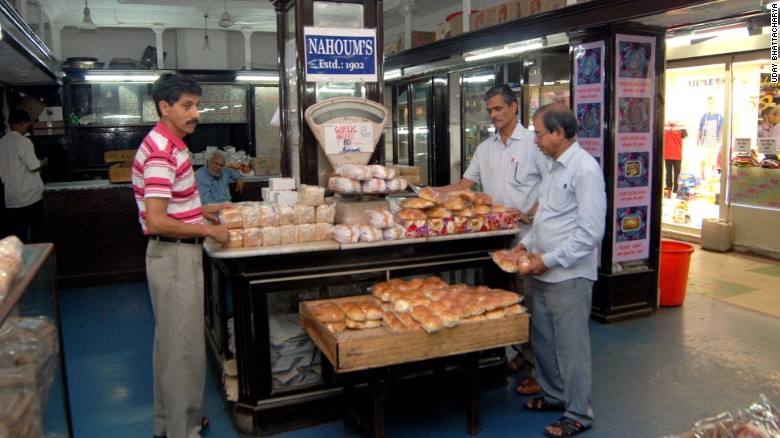
Muslim workers at the 115-year-old Nahoum’s confectionary, founded and owned by Jews, in downtown Calcutta.
Today, the number of Jews in Kolkata stands at 22, the middle-aged Alexander being probably the youngest.
And it is left to the likes of the Jewish Girls School Vice-Principal Abeda Razeq to keep those ties alive.
Her father’s best friend at college was a Jew, whose family runs the 115-year-old confectionary store Nahoum’s, and their friendship, which continued beyond college, first exposed Razeq to Jewish culture.
The two families exchanged gift hampers during their respective festivals and Razeq learnt of the similarities and differences between kosher and halal cuisine.
She even helped out at Nahoum’s at Easter and Christmas: a Muslim girl at a Jewish bakery wrapping cakes during Christian festivals in a predominantly Hindu city.
The Nahoum family has shrunk to just one member now, who spends much of his time abroad, and the workers — many of them Muslims — run the show.
Razeq did her dissertation on Kolkata’s unique Jewish-Muslim relationship, and wishes she had the time to complete her doctorate on it.
“It’s a rich subject,” she says.
source: http://www.edition.cnn.com / CNN / Home> Region> Asia / by Anik Basu / June 16th, 2017
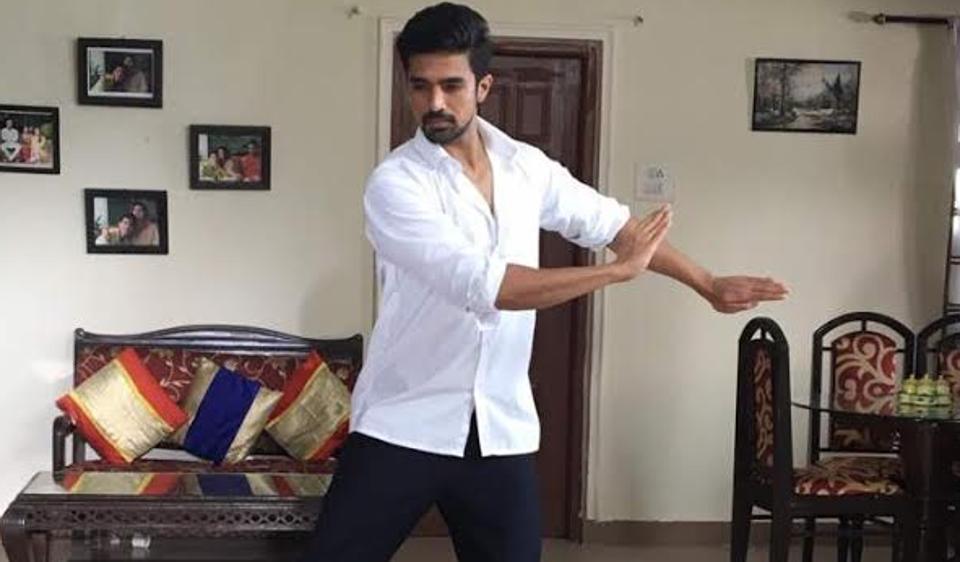
Saqib Saleem practices Kathak for his upcoming short film on Fathers’ Day.
Saqib Saleem is working on a short film that will be released on the occasion of Fathers’ Day this Sunday. The actor has learnt Kathak for the project.
Bollywood actor Saqib Saleem, who was recently seen alongside Huma Qureshi in Dobaara: See Your Evil, is now learning Kathak, a classical Indian dance form for his next project.
Saqib is working on a short film titled Aamad, where he plays the character of a Kathak dancer.
Though it was very challenging for him, the actor took it in his own stride and put together a genuine effort to learn the dance form from professional Kathak guru and actress Ishita Sharma.
Aamad is about a father who is a Kathak dancer and how his son is embarrassed of his father’s art. The plot explores how they build their relation over a period of time and overcome their personal apprehensions and start a new friendship.
source: http://www.hindustantimes.com / Hindustan Times / Home> Entertainment> Bollywood / HT Correspondent – Hindustan Times / June 16th, 2017
Two policemen –Sajjad Ahmad and Shabbir Ahmad– were killed in separate attacks by militants in Kashmir in last 24 hours.
Unidentified militants fired upon two policemen outside mosque after namaz in Hyderpora, resulting in injuries to both. One of them, Sajjad Ahmad, succumbed to his injuries on Friday.
This was the second attack by militants on policemen in the Kashmir valley.
Earlier on Thursday, militants shot dead a policeman in south Kashmir’s Kulgam district.
Constable Shabir Ahmad was shot outside his residence at Bogund in Kulgam, a police official said.
The cop was rushed to a local hospital but he did not survive.
The terrorists, however, managed to escape the scene after firing. A search operation was also launched to track them down.
Terror attacks aimed at security forces have increased in the Kashmir Valley, in the recent times.
A cordon and search operation was also launched at Arwani village in Jammu and Kashmir’s Kulgam district on Friday after security forces received intelligence inputs about the presence of suspected terrorists in the area.
Militants had carried out a series of attacks on security forces on Tuesday in Kashmir, in which 13 jawans were injured and four service rifles looted. The attacks — four in south and one in north Kashmir — came in a span of four hours.
A grenade was hurled at a CRPF camp at Ladiyar in Tral area of Pulwama district. 10 paramilitary jawans were injured in the attack.
In the second attack, the militants opened firing on the security personnel guarding the residence of a retired high court judge at Anchidora in Anantnag district, resulting in injuries to two cops.
The third attack took place on a CRPF camp at Padgampora in Pulwama, but no one was hurt in it as the grenade hurled by the militants exploded mid-air.
The militants also hurled a grenade at Pulwama police station, resulting in minor injuries to a policeman.
Another attack took place near Bomai in North Kashmir’s Sopore, but no damage was caused.
(With inputs from agencies)
source: http://www.abplive.in / ABP / Home> ABP Live> India / by ABP News Bureau / June 16th, 2017
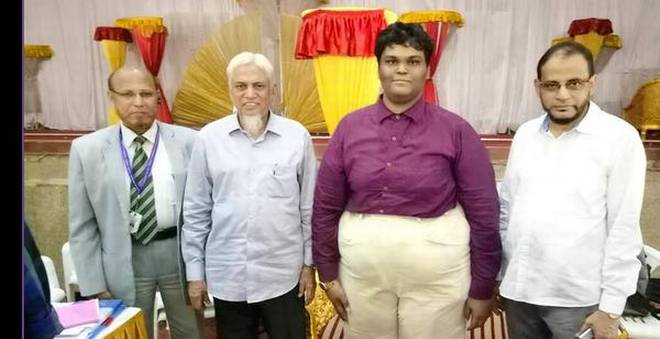
(From left) Zahid Husain, Alhaj A. Mohammed Ashraf, Mohamed Rifath Shaarook Raaj and Amanullah Shah | Photo Credit: special arrangement
Mohamed Rifath has just joined a physics undergraduate course at New College, but his classmates and teachers are seeing him as a star scientist. Read on and find out why
Can you imagine a fresher receiving a rousing welcome at his college, on the day of joining? When Mohamed Rifath Shaarook Raaj recently joined the B.Sc Physics stream of New College, he was being accorded a reception befitting a celebrity. Not only that, the secretary and correspondent of the college, A. Mohammed Ashraf, had waived off his fee for the undergraduate course, and also promised that the college would take care of his education till he completed his Ph.D.
Rifath, 18 years old, is the Lead Scientist of Space Kidz India (SKI), a Chennai-based organisation promoting students’ research in science and working towards making science accessible to students. Rifath is part of a team that has designed a satellite, which is expected to be launched into space on 21 June, 2017 from the NASA Wallops Space Flight Facility, Virginia, at no cost.
Major Zahid Husain, principal of the college, said that fellow students should emulate this young scientist and that it was a great honour for the college to enrol him. The student scientist has not only taken the local educationalists by storm but even the judges and directors of Colorado Space Grans Consortium were awe-struck by his experiment. Thus his satellite (supported by his team-mates) is planned to be launched into space on June 21, 2017 from NASA Wallops Space Flight Felicity, Virginia at no cost.
“NASA and I doodle Learning Inc. conducted a space challenge called ‘Cubes in Space’. Students have to design an experimental satellite which will help develop space technology. The best-designed satellite will get a sub-orbital space flight to real space on a NASA Rocket. Being a member of the NASA Kids Club, I learnt about this challenge and decided to design together with my team, an experimental satellite that will fit inside a 4cm cube and weigh 64 grams with +/- 1 gram limit (neither high nor less since it may affect the centre of gravity). Apart from creating just a payload, we wanted to design, build and launch a full satellite within a 4cm cube with a mass of 64 grams,” he explains.
Rifath, who hails from Pallapatti in Tamil Nadu, completed his schooling from Crescent Matriculation School, scoring 62.5% in the higher secondary board exams, and wants to emulate former President A.P.J. Abdul Kalam.
“It all started when I was chided for making paper rockets; so I was determined to make a real one. I participated in the first edition of Young Scientist-2013 conducted by Space Kidz India and met its director Srimathy. I participated till the third edition of Young Scientist, even though I didn’t win but she noticed my talent. Then, I joined the organisation. My initial project with SKI was making a balloon-satellite with NSLV (Near Space Launch Vehicle) which was a huge success and we got into the Limca Book of Records and became the first private company in India to launch an NSLV. After launching a balloon-satellite to near space (>40km altitude), we wanted to send a satellite or a spacecraft to true Space (>100km where the Karman line and official true space starts). At first, we concentrated on the standard one unit 10cm cube satellite of 1kg mass but as we proceeded, we realised the cost would be too high. As students we were strapped for money and therefore, reduced the size and mass of the Cube satellites (Cube Satellite itself is a Nano satellite but we wanted to reduce the size further).
“At first, we wanted to create something similar to Kicksats but they are not true satellites but just a postcard sized PCB with non-customisable electronics, which cannot work, without a big mother satellite — in other words, it’s just a Space toy. But we always wanted to create an independent full-fledged fully-customisable, scalable, low-cost satellite with new technology. Initially we designed a 125gram, 5cm cube satellite which is 1/8th of a standard cube satellite which will also reduce the cost of the launch. But later, due to NASA’s challenge guidelines we built a 3.8cm independent cube satellite. Previously, a 5cm cube satellite was the smallest satellite, but now we are about to break that record and it’s also going to be the first 3D-printed satellite to be launched into space.
“Here, we are only talking about sub-orbital spaceflight in which our satellite will go into space on a rocket, do the research and land again on surface/ocean in a capsule, so the students can get back their satellite, research more and create a better space system which can be used in orbital and interplanetary missions. Our aim is not to just send a Cube satellite, built from Off-the-shelf components previously available in space market, and launch that into space. Our invention is to create a new space platform. We are also creating a space platform where our future scientists can develop their own payloads, and, for example, we can use this kind of Femto satellite constellations as Ham Radio reflectors which we can use in disaster-like situations when all other communications may fail.
We may face solar flares which may destroy satellites outside earth’s magnetosphere (36,000 km altitude). In situations like these, these Femto satellites can be a backup; they can be quickly launched and protected by an artificial magnetosphere, since they are very small. This satellite is fully 3D-printed, other than electronics.”
source: http://www.thehindu.com / The Hindu / Home> News> Cities> Chennai / by M.O. Badsha / June 16th, 2017
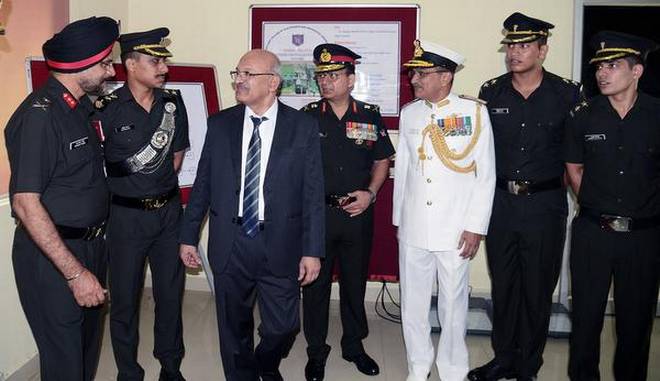
Appreciating efforts: JNTU Hyderabad Vice Chancellor Venugopal Reddy interacting with students who designed the street lights control system and exhibited at Military College of Electronics and Mechanical Engineering during convocation ceremony in Hyderabad on Thursday. | Photo Credit: K.V.S. GIRI
If it were left to young engineers of Military College of Electronics and Mechanical Engineering, Country’s street lights would be auto-operated. The 91st graduating batch of the college produced a GSM connected, cell phone-operated lighting system which can be turned on and off based on requirement.
The power-saving circuit built by Noushad M.E., Ashish Kaushik, Sumit Dhanda and Akhil A.R. cost ₹ 57,200. It could be used for both civilian and defence purposes, the innovators said. The model also allows operators to operate just one or two light bulbs in a whole series. “If the operator thinks that just a few light bulbs are enough for lighting any area, they could turn off the rest by texting the details into the circuit,” said Mr. Akhil A.R. The model displayed in MCEME contained a circuit connected to six bulbs.
“The model also detects faulty operations if there are any. If a light bulb goes off, it will alert the operator,” M.E. Noushad told The Hindu. Mr. Sumit Dhanda said the project will be useful in huge military campuses which use power. “If the model is adopted by city development corporations it could cut power costs by one third,” said Mr. Dhanda. The MCEME awarded its annual best project prize to the four officers at its Convocation Ceremony on Thursday.
The MCEME passing out batch had also come up with a simple solution – a microcontroller-based automatic ventilation system – for car interiors which get heated when parked in the open. The ventilator contains a small control unit and a solar-powered exhaust fan which runs on external battery.
The microcontroller which is programmed to check the status of temperature and humidity inside the car every two seconds, triggers the exhaust fan when needed, to clear out the heat,” said an officer Vipin Jaiswal and the team leader. Other members of the project were Mukesh Thakur, M. Hariharan and M.S. Shakhavat.
Military boost
The college displayed a solar rechargeable backpack for troopers among its exhibits. The backpack with solar panels can be used as a tracking devise when soldiers go for long treks in the field, graduates said. “In any dire circumstance if the user presses a button on the backpack it sends a Save Our Souls message to control base. It will help officers to track those who are in danger during combat situation,” said Pankaj Saini who was the syndicate leader of the team which came up with the model. The other members in the team were Harmeet Singh, Sachin Yadav and Sagar.
Speaking at the convocation, A. Venugopal Reddy, Vice Chancellor of Jawaharlal Nehru Technological University asked the graduates to pay attention to new developments in cyber security and be abreast of technological innovations. “Your convocation is not like others’ passing out functions. You leave this institution to serve the motherland,” Mr. Reddy said.
source: http://www.thehindu.com / The Hindu / Home> News> Cities> Hyderabad / by Nikhila Henry / Hyderabad – June 16th, 2017
According to an agreement ironed out by some Kerala mosque committees, the use of loudspeakers for all other religious purposes will be stopped. (Burhaan Kinu/HT File Photo)
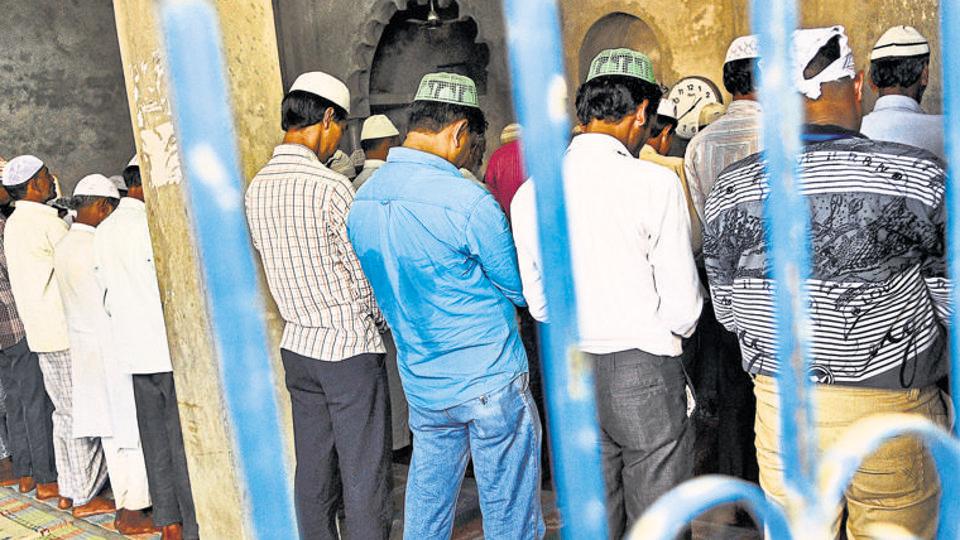
The Valiya Juma Masjid will deliver only one azaan in place of five and 17 mosques in Vazhakkad will repeat without speakers.
A prominent mosque in the Muslim-majority Malappuram district in Kerala has set an example by curbing noise pollution during the holy month of Ramzan.
Valiya Juma Masjid, the biggest in Vazhakkad area, has decided that only a single ‘azaan’, the Islamic call to prayer, will be delivered from the mosque and 17 other small mosques dotting the area will only repeat it without any noise.
Taking a cue from the grand mosque, other mosque or mahal committees are also planning to follow it. There are seven mosques run by various denominations in Vazhakkad and 10 others in the village areas.
According to an agreement ironed out by these mosque committees, the use of loudspeakers for all other religious purposes will also be stopped.
“Initially many opposed the idea but later came around. Nearby schools and hospitals often complained about the indiscriminate use of loudspeakers,” TP Abdul Aziz, president of the mahal council, said.
The council has also constituted a five-member panel to unify the timings of the azaan. It will also consult the chief qazi of Kozhikode, who wields enough influence among community members.
Many NGOs, social bodies and residents of the area have lauded the latest initiative.
“Valiya Juma Masjid has set an example. It will go a long way in curbing the mindless use of ear-splitting speakers. Now, political parties will have to follow suit,” Mohamed Koya, a trader in the area, said.
In 2015, the supremo of the Muslim League Sayed Hyderali Thangal requested all mosque committees to restrict the use of loudspeakers to check noise pollution and respect the sentiments of other communities.
The district was in the news earlier this month after the Shree Narasimhamoorthy Temple in Punnathala threw a sumptuous vegetarian Iftar for Muslims in the area, who helped renovate the centuries-old shrine.
source: http://www.hindustantimes.com / Hindustan Times / Home> India / by Ramesh Babu K C, Hindustan Times, New Delhi / June 14th, 2017
Slum girl Khushboo Khan — who hones her hockey goalkeeping skills by pitting herself against male players in Bhopal — has finally realised her dream. The 17-year-old has been selected in the 33-member core group of the Indian women hockey team.
Khushboo is now practising at the SAI centre in Bengaluru. She is waiting with bated breath for July 15 when the camp of the core group will be held in her hometown Bhopal. Talking to TOI on Wednesday, an elated Khusbhoo said, “Everything has changed all of a sudden in my life. After being selected in the core group, my confidence has soared. I am now confident I will be part of the national team.” She was selected from among 60 hockey players from across the country.
“I am keen to come back to Bhopal. This Bengaluru tour has given me lot of experience and my family is thrilled,” she said. TOI had brought the gritty athlete to limelight on March 25, showing how she has to play with men because there aren’t any women players in Bhopal. Playing with men, who run faster and hit harder than most women players, has sharpened Khushboo’s reflexes, said her coach Habib Hasan.
Khushboo laughs and calls herself an “aberration”. The boys she plays with call her a hero. The teenager lives in a tin shed where you can’t turn around without hitting something. She runs, sweats, and competes with men — even gets the better of them.
A national player, she is the daughter of an auto driver and one of five children. She understands nothing will ever come easy for her. Such is the condition of her family she did not even have money to repair her cycle so she walks from her slum in Jehangirabad every day, in searing heat, to Major Dhyan Chand ground for practise.
She has represented the state in national tournaments in senior, junior and sub-junior categories. She embraced hockey only four years ago. “One of my friends told me about a hockey summer camp at Lal Parade ground. I went there. After the camp, I started going to the men’s MP Hockey Academy at Maj Dhyan Chand ground as I believe I can make a career in this game. Since then, I have never looked back,” said Khushboo.
Asked about playing with boys, the sprightly teenager said, “There is no coaching facility for girls in Bhopal. But playing with the boys is a blessing in disguise for me. Defending the goalpost against men has made it easier for me to play with girls in national tournaments. Now, it has become a habit for me to practise with the boys as I peg my game at their speed and strength.”
Khushboo says she’s not waiting for someone to come forward to help her. “If someone helps, fine. I will keep playing, anyway. My dream is to get into the MP women’s hockey academy,” said Khushboo. “I am ready for any challenge to realize my dream.”
Coach Habib Hasan and other hockey players have congratulated her.
source: http://www.timesofindia.indiatimes.com / The Times of India / Home> News> City News> Bhopal News / by Ramendra Singh / TNN / June 15th, 2017
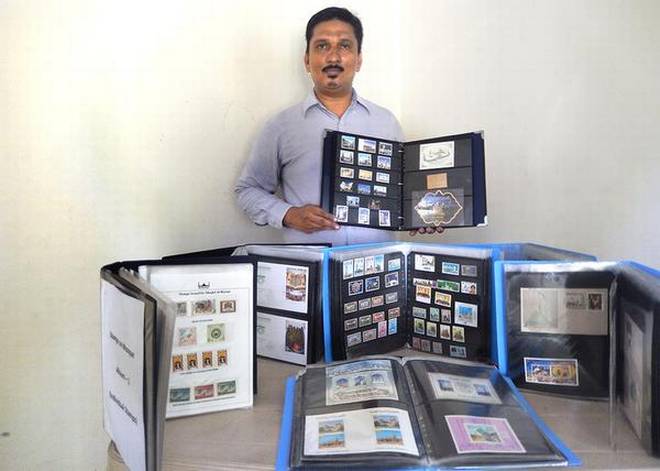
Going strong: Y. Abdul Rasul has been collecting stamps since he was 10 years old.
Abdul Rasul’s trove of 5,915 mosque stamps sets a world record
Y. Abdul Rasul was one of many philatelists collecting whatever stamps came his way, till a chance meeting with Viswanatha Iyer, another philatelist, in 2005 paved the way for his entry into the Guinness Book of Records.
“He gave me his collection and advised me to focus on the theme of mosques and it has paid rich dividends,” recalls Mr. Rasul, a 41-year-old IT professional who has entered the Guinness Book of Records for the largest collection of 5,915 stamps featuring mosques.
The oldest stamp in his possession was released by the Afghanistan government in 1892. Mr. Rasul also has a rare stamp with inverted centre — printed upside down — released in Somalia in 1902. “Normally these stamps are immediately withdrawn. A few people, however, are able to get them and I obtained one,” said Mr. Rasul, who began collecting stamps when he was 10 years old.
Both his grandfather G. Abdul Rasul and father R. Yusuf were ex-servicemen. His grandfather saw action against the Japanese in the Second World War.
“When my father was working in the Middle East, he would write letters and I started collecting the stamps,” recalled Mr. Rasul who has stamps from 95 countries, many displayed on his interactive site www.mosquestamps.com.
Besides Viswanatha Iyer, who had a huge collection of stamps from Travancore, Balakrishna Das, president of the South Indian Philately Association, and Abdul Azeez, a Varanasi-based philatelist, also played a major role in Mr. Rasul achieving his feat.
Saudi Arabia and other Islamic countries release special stamps to mark the annual Haj pilgrimage and these stamps form a section of Mr. Rasul’s collection.
source: http://www.thehindu.com / The Hindu / Home> News> States> Tamil Nadu / by B. Kolappan / Chennai – June 12th, 2017
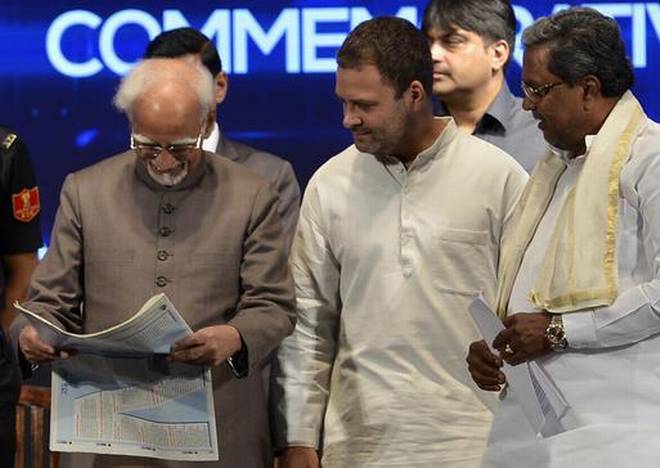
Vice President Hamid Ansari, AICC vice president Rahul Gandhi, and Chief Minister Siddaramaiah during the release of National Herald’s commemorative publication, “70 years of India’s Independence” on Monday. Photo: Bhagya Prakash K.
Bengaluru :
Vice President Mohammand Hamid Ansari, on Monday, said a free media is not only beneficial but also a necessity in a free society and any attack on press freedom will result in jeopardising citizens’ rights.
Mr. Ansari, who launched National Herald’s commemorative publication – “70 years of India’s Independence” – in the presence of All India Congress Committee Vice President Rahul Gandhi at a function here, said the State should not impede the free flow of information.
When faced with unjust restrictions and the threat of attack, self-censorship in the media could have the opposite effect, aiding the covering up of abuses and fostering frustration among marginalised communities.
Mr. Ansari also said the Constitutional framework provided for required intervention by the State to ensure smooth working of the press and society; but the laws state that it should only be in the interest of the public at large. “The media, if it is to remain true to its calling, has to do likewise. In an open society like ours, we need a responsible press to hold power to account. This is why freedom of press under Article 19 (1)(A) of the Constitution is subject only to reasonable restrictions in the interest of the sovereignty and integrity of India, the security of the state, public order, decency, contempt of court, defamation and incitement to an offence.”
The Supreme Court has held that ‘freedom of speech and of the press is the Ark of the Covenant of Democracy’ because public criticism is essential to the working of its institutions. In this age of ‘post-truths’ and ‘alternative facts’ where ‘advertorials’ and ‘response features’ edge-out editorials, “we would do well to recall Jawaharlal Nehru’s vision of the press playing its role of a watchdog in democracy and look at the ethos and principles that powered his journalism.”
Noting that Nehru, who started National Herald newspaper, believed that media was a pillar of democracy, Mr. Ansari said he envisioned a free, unfettered and honest press. “Nehru watched over the interests of media persons in independent India.”
The Working Journalists Act, which tried to give a degree of protection to journalists, to ensure freedom of press, was largely Nehru’s doing.” However, the Act, I believe, is now in disuse, and short term contracts, that make journalists beholden to the ‘preferred lines’ of the publications, are in vogue.”
Chief Minister Siddaramaiah said it was heartening to note that the Associated Journals Ltd. is reviving National Herald by launching its English website and resuming phased publication as a multi-media outlet, focusing primarily on a news presence in digital form.
source: http://www.thehindu.com / The Hindu / Home> News> States> Karnataka / by Special Correspondent / Bengaluru – June 12th, 2017
Bengalureans Santosh Chandrasekhar, 26, Aiman S, 24 and Sumit Dasgupta , 24 started working on their dream project Rangzen – a 39-minute-long documentary film on Tibetans, hardly did they know it will fetch this trio the award for best documentary in Bangalore Short Film Festival 2017.
Not just that, this documentary film featuring lives of Tibetans who had escaped Chinese invasion and took refuge in India has made three Bengalureans proud by bagging a special jury award at International Film Festival of Prayag, Delhi and the audience award at Feel the Reel International Film Festival in the UK, this year.
Santosh Chandrasekhar, assistant professor at a city college, “The movie is all about their struggle to hold on to their Tibetan identity in a foreign land and how they dream to go back to a nation that doesn’t exist anymore. The film has got answers to seeking their identities and their perpetual fight for freedom and a struggle to find their self.”
“We, through this documentary, were trying to initiate discourses related to the Tibetan struggle for freedom and generate awareness about our ‘guests’ among our fellow Indians. Although in exile for over 56 years, we fail to recognise Tibetans. We ignorantly see them as either northeasterners or Chinese. The Tibetan freedom struggle being one of the longest after the exodus of the Jews can put this documentary film into major political articulation,” added Aiman S, a copy writer and another maker of this documentary. The documentary has also made an entry to official selection category at International Documentary and Short Film Festival, Kerala and Calcutta International Cult Film Festival, 2017.
source: http://www.timesofindia.indiatimes.com / The Times of India / News> City News> Bangalore News / by Sreemoyee Chatterjee / TNN / June 13th, 2017