Dasara Sports 2016 : Three new records created on day – 2

KARNATAKA :

( Picture right shows ) Keerthi Kumar of Belagavi who created a new meet record in Discus Throw attempting his final throw at the Chamundi Vihar Stadium. (Centre) K.A. Bharath of Bengaluru City sporting victory sign after creating a new meet record in the men's 1,500 meter run. ( Picture in extreme left shows ) the Bengaluru 4x100 meters women's team sporting victory symbol after creating a new meet record in 4xx100 meters relay.
( Picture right shows ) Keerthi Kumar of Belagavi who created a new meet record in Discus Throw attempting his final throw at the Chamundi Vihar Stadium. (Centre) K.A. Bharath of Bengaluru City sporting victory sign after creating a new meet record in the men’s 1,500 meter run. ( Picture in extreme left shows ) the Bengaluru 4×100 meters women’s team sporting victory symbol after creating a new meet record in 4xx100 meters relay.

Mysuru :

Three new meet records were created on the second day of Dasara athletic events held at Chamundi Vihar Stadium yesterday.

K.A. Bharath of B’luru City in 1500 mts), Keerthi Kumar of Belagavi Division in Discus Throw and 4×100 women’s relay team of Bengaluru City broke old records to set new records in men’s and women’s categories at the Chamundi Vihar Stadium here yesterday.

At the end of Day-2, Bengaluru City tops in both men’s and women’s category with 10 gold, two silver and two bronze medals and are followed by hosts Mysuru with 9 golds, 11 silver and 7 bronze medals.

Bharath shines: K.A. Bharath of Bengaluru City, who had earlier won gold in 800 mts, hogged the limelight again by creating a new meet record in the men’s 1500 mts event by clocking 3:58.00s to erase the previous record of 4:01.58s set by M.D. Manjunath of Mysuru Division in 2009.

Keerthi Kumar of Belagavi division threw the discus to a new meet record of 49.77 mts and broke the previous record of 47.76 mts set by Dharamveer Singh of Mysuru Division in 2011. Keerthi Kumar on day-1 had won a silver medal in the men’s shot put.

The third record came in the women’s section with the Bengaluru City’s relay quartet of Afsana Begum, Nityashree, Prajna S. Prakash and Reena George creating a new meet record in the 4×100 mts relay event with a timing of 47:00 sec, erasing the old mark of 47.48 sec, set by Bengaluru City’s athletes in 2014.

Swimming:

In the swimming events held at the University Swimming Pool. S. Nishanth of Bengaluru City with 11 points (gold in 200 mts Breaststroke, silver in 100 mts Breaststroke & silver in 200m Individual Medley) won the individual champion title in the men’s section. Sunaina Manjunath of Bengaluru City excelled in the pool in the women’s section by winning the individual title with 15 points (three golds).

Team games:

In the team games, Mysuru men’s tennis team spearheaded by S. Prateek won the title beating Bengaluru Rural 2-1 in the final. Bengaluru Rural won the women’s title beating Bengaluru City 2-0 in the final.

results

Athletics:

Men: 400mts: Tarun Shekar (B’luru City, 48.10 sec), 2. V. Gowrishankar (B’luru City), 3. Ananda Bhyrava (Mysuru), 1500mts: K.A. Bharath (B’luru City (NMR-3: 58.00 sec, 2. Vinayaka Ghadi (Mysuru), 3. T.S. Sandeep (Bengaluru Rural), 110m Hurdles: Akshaya Shalavadi (Belagavi-16.90 sec),2. M.D. Dnayanashwar (Belagavi), 3.M. Amog (Bengaluru Rural), Discus Throw: Keerthi Kumar (Belagavi, NMR: 49.77 mts), 2. V.S. Vikyanth (Mysuru), M.R. Nandish (Mysuru), High Jump: Abhijeet Singh (Mysuru -1.95mts), 2. Nagaraj Gowda (Belagavi), 3. Raje Nayak (Belagavi) & A. Ravi (Bengaluru Rural), 4x100m Relay: Mysuru (42.30 sec), 2. Bengaluru City, 3. Belagavi.

Women:

400 mts: 1. Nityashree (B’luru City, 56.40 sec), 2. R.A. Chaitra (Mysuru), 3. Supreetha (Mysuru), 1500 mts: Thippavva Sannakki (Mysuru, 5:04.00 sec),2. Shraddha Shetty (Mysuru), 3. R.Usha (Bengaluru City), 100m Hurdles: 1. Prajna S. Prakash (B’luru City,14.30 sec), 2. P. Harshitha (Mysuru), 3. S.G. Priyanka (Mysuru), Discus: 1. Navya Shetty (Mysuru, 38.43 mts), 2. P.S. Uma (B’luru City), 3. N.M. Jayasheela (B’luru Rural), High jump: Abhinaya Shetty (Mysuru, 1.65 mts), 2. V. Chaitra (Mysuru), 4x100m Relay: B’luru City (NMR- 47:00s-Afsana Begum, Nityashree, Prajna S Prakash, Reena George), 2. Mysuru, 3. Belagavi.

Team Games

Men:

Tennis (Final) Mysuru Division bt Bengaluru Rural 2-1 (S. Prateek bt Basavaraj 6-4, 6-4, Aryan Pathage lost Alokh Aradhya 4-6, 4-6, S. Prateek/Manjunath Prasad bt Alokh Aradhya/Basavaraj 6-3, 7-5).

League Results

Kabaddi: Bengaluru Rural bt Kalaburgi 33-14, Bengaluru City drew with Belagavi 14-14, Mysuru bt Kalaburgi 31-9, Bengaluru Rural bt Kalburgi 30-19, Football: Belagavi 4 (Navaz (1), Sufain (1), Faran (1) & Kiran (1)) bt Kalburgi 0, Bengaluru City 2 (Sunil (1), Sujith Kumar (1)) drew Bengaluru Rural 2 (Surya (1), Sampath (1)), Mysuru Division 6 (Praveen Kumar (3), Kiranthan (1), Praveen (1), Manju (1) bt Kalburgi 1 (Vijay (1)), Bengaluru City 8 ( Satish (1), Sunil Kumar (1), Manivannan (1), Vignesh (1), Sujay Kumar (1), Sridhar (1), Suresh (1), Hariharan (1)) bt Belagavi 1 (K.Joped (1)),

Hockey:

Bengaluru Rural 7 (Srikanth (4), Jay Karan Kumar (1), Rohan (28), Sanjeev Kumar (38)) bt Kalburgi 2 ( Bharath (1), Anand (1)),

Kho Kho: Belagavi bt Kalaburgi 12-6, Bengaluru Rural bt Bengaluru City 20-10,

Net Ball: Mysuru Division bt Belagavi 39-8, Mysuru bt Bengaluru Rural 16-10.

Women:

Tennis: (Final): Bengaluru Rural 2 (Kushi Santosh bt Tejaswini 6-2, 6-3, Sagarika bt Tanuja 6-4, 7-6 (8)) bt Bengaluru City 0.

League Results:

Kabaddi:

Mysuru bt Belagavi 44-13, Bengaluru City bt Kalaburgi 55-5, Bengaluru Rural bt Belagavi 41-8, Mysuru bt Bengaluru City 26-16,

Net Ball: Mysuru bt Bengaluru Rural 12-4, Bengaluru City bt Belagavi 20-5,

Hockey: Bengaluru Rural 5 (Shalini (1), Sriraksha (3), Dhruthi (1) bt Kalburgi 1 (Vijayalakshmi (1), Bengaluru City 7 ( Sandra (1), Anjali (2), Abhinashree (2), Mahira (1), Dhruthi (1) bt Belagavi 0,

Kho Kho: Belagavi bt Kalaburgi 11-4, Bengaluru City bt Bengaluru Rural 11-10.

Swimming

Men:

200mts Individual Medley: 1. V.M. Hemanth Jenukal (Mysuru, 2:19.40 sec), 2. S. Nishanth (Bengaluru City), 3. P.M. Suhas (Mysuru), 100mts Breaststroke: 1. D.S. Pruthvik (Mysuru, 1:10.67 sec), 2. S. Nishanth (Bengaluru City), 3. L. Manikanta (Bengaluru Rural), 200mts Backstroke: 1. V.B. Hemanth Jenukal (Mysuru, 2:22.71 sec), 2. M. Sharath (Mysuru), 3. Jagrut Amuri (Bengaluru City), 100mts Freestyle: 1. Gaurav Yadav (Bengaluru City-0:55.84 sec), 2. Tanmay R. Shetty (Bengaluru Rural), 3. H.M. Anirudh (Bengaluru City), 4x100mts Medley Relay: 1. Bengaluru City (4:28.26 sec), 2. Belagavi, 3. Bengaluru Rural.

Individual Champion: 

Nishanth (Bengaluru City-11 points).

Women:

200mts Individual Medley: 1. Sunaina Manjunath (Bengaluru City-2:45.13s), 2. Arundhathi S. Deshpande (Bengaluru Rural), 3. A.B. Bhavana (Bengaluru City), 100m Breaststroke: 1. D. Arundhathi (Bengaluru Rural-1:25.62s), 2. Pratiksha Patel (Bengaluru City), 3. B.G.Madhura (Bengaluru City), 200mts Backstroke: 1. A.B. Bhavana (Bengaluru City-2:45.24s), 2. K. Kshitija (Mysuru), 3. Bhoomika R. Kesarkar (Bengaluru City), 100m Freestyle: 1. Sunaina Manjunath (Bengaluru City-1:05,56 sec), 2. U.S. Saptami (Bengaluru City), 3. D. Arundhathi (Bengaluru Rural), 4x100mts Individual Medley:1. Bengaluru City (5:23.64 sec), 2. Bengaluru Rural, 3. Kalaburgi.

Individual Champion:

Sunaina Manjunath (Bengaluru City-15 points).

source: http://www.starofmysore.com / Star of Mysore / Home> Sports News / October 04th, 2016

After 50 years, Begum Talab brims with life

Vijayapura, KARNATAKA :

The historic tank has been revived with water from the Krishna river

Brimming with water, with women washing clothes at the edge while children swim in the fresh water, it is hard to believe that just a month ago, the Begum Talab, spread across over 234 acres, was a barren wasteland, with few small pools of water.

The ancient tank, built during the rule of Mohammad Adil Shah in 1651, has not seen such water levels for the past five decades. But under an ambitious project of the Water Resources Ministry to rejuvenate and replenish tanks, water from the Krishna river has been drawn to fill the tank and recharge ground water. Over the past year, a 50 km pipeline was laid from the river to the tank. The tank was among seven revived in the district at a cost of Rs 190 crore.

Crucial water source

According to historian Abdulghani Imaratwale, Adil Shah built the tank in the name of one his queens; Jahan Begum. The construction was supervised his commander Afzal Khan to provide drinking water to Bijapur city which then had the population of around nine lakh.

Dr. Imaratwale said the water was not only used for the palaces or prominent places of the kingdom, but also for public consumption as the city did not have other drinking water sources.

The tank, located on the southern part of the city, used to supply water through the earthen pipes to many ganjs (overhead stone tanks). It was the second major water source for the city after the Ramalinga tank. Unfortunately the ganjs and the old pipes have fallen into disrepair,

Expressing elation over the government decision to refill the tank, Dr Imaratwale termed the project a significant step in restoring the history of the city.

“ It is heartening to know that Water Resources Ministry led by M. B. Patil is showing concern to restore and revive the ancient tank which had once served a major water source. The tank still has the same capacity if the water is stored and used,” he said.

source: http://www.thehindu.com / The Hindu / Home> National> Karnataka / by Firoz Rozindar / Vijayapura, October 10th, 2016

Woman psychotherapist from DK gets international laurels

Mangaluru , KARNATAKA :

Mangaluru:

A woman from Dakshina Kannada  district got an international certificate in transactional analysis psychotherapy. She is reportedly the third Muslim woman in the world to achieve this feat.

Forty-two-year-old Haseena Abdulla, daughter of K Abdulla Parkala of Manipal , received the certificate by the International Transactional Analysis Assoication  at the conference hosted by SAATA – a South Asian Association in September. Transactional analysts from many countries witnessed the event and examiners were from Germany, UK, Japan, South Africa, US, and India. This award is an appreciation for her eight years of effort in exploring the world of psychotherapy.

P K Saru, the former president of SAATA and founder director, ASHA Counselling and Training Centre, Coimbatore and Fuson, provisional teaching supervising transactional analyst from Turkey are the only two Muslim women, to have got this certificate before Haseena Abdulla.

Haseena said she is very passionate in discovering the frames of relationship and initiating empowerment efforts for many. “As an ardent learner of human behaviour, my journey of seeking knowledge led me into the world of transactional analysis.

It was a road less travelled for Muslim women, and I am the third Muslim woman transactional analyst in the world, and second in the country to earn this certificate,” she said proudly.

Haseena, who was trained under P K Saru, is a post graduate in psychology and sociology. She has also been trained in hypnotherapy, gestalt therapy and psychodrama. She is a master practitioner in NLP trained by Dr. Richard Mc Hugh, USA. Currently she is a practising psychotherapist and has a clinic in Manipal. She is also a visiting practitioner at Calicut, Kerala.

“Transactional analysis is a most advanced discipline in psychotherapy arena, which empowers the patients with awareness and the power to heal. It has a strong evidence based, effective diagnosis and participatory treatment plan for patients with psychiatric problems. Consulting a psychologist is still a stigma in the community and labelling the client as psychotic, sometimes even by the practitioners caused this unfortunate situation. Discovering the unknown part of the self is essential in completion of a healing process. Transactional analysis psychotherapist helps the client to achieve this by not being labelled,” Haseena said.

“The concepts in transactional analysis could be readily applied in our lives from the moment we are exposed to them. It believes that the power to cure and heal is in the patient. Therapist is just a facilitator to the patient to think and decide. Application of TA has also been instrumental in organizational success and educational excellence,” she added.

source: http://www.timesofindia.indiatimes.com / The Times of India / News Home> City News> Mangalore / Vinobha KT / TNN / October 05th, 2016

Asian CT Hockey: Rookies Kular, Yousuf make cut

Bhopal, MADHYA PRADESH :

P.R. Sreejesh will lead India in Kuantan, Malaysia.

Bengaluru :

Following their impressive performances in domestic tournaments, Hockey India named two youngsters — defender Jasjit Singh Kular and striker Affan Yousuf — in the senior national team for the fourth edition of the Asian Champions Trophy to be played in Kuantan, Malaysia, from October 20.

In the 18-member side announced on Thursday, goalkeeper P.R. Sreejesh will lead, while midfielder Manpreet Singh is vice-captain.

Kular will join experienced seniors Rupinder Pal Singh, Kothajit Singh, Surender Kumar and Pardeep Mor to form India’s defence line.

V.R. Raghunath has been ruled out with an elbow injury and Sansapur’s Kular is expected to take his spot as a drag flicker. Birendra Lakra makes a comeback after a long-term on the sidelines.

Ace drag-flicker Raghunath has been advised rehabilitation for three weeks and though Manpreet and S.V. Sunil are carrying minor injuries the duo have been cleared to play.

Skipper Sreejesh believes the team is well-balanced. “It is time for a new cycle. Usually the cycle is from one Olympics to another so it is a new beginning for us. A couple of youngsters have been added to the team, especially in the forward line and defence. Raghu has a few niggles so has been rested. It is a good and well-balanced side,” stated the custodian.

Taking charge in the absence of chief coach Roelant Oltmans, strategy coach Roger van Gent said the Asian event would be a challenge for young striker Yousuf.

“We know him for long and it’s time for him to challenge and play in the senior team. In the last two weeks in the camp, he’s working on exactly what we want from him,” said the Dutchman.

Over the last two weeks at the Sports Authority of India, South Centre, van Gent stressed on improving overall skills. “When we analysed the way we played at the Olympics and also the tournament before that, we got some points where we have to improve.The way we are playing right now we are focusing on the PCs and there needs improvement,” he added.

Squad
Goalkeepers: P.R. Sreejesh (capt), Akash Chikte; Defenders: Rupinder Pal Singh, Pardeep Mor, Jasjit Singh Kular, Birendra Lakra, Kothajit Singh, Surender Kumar; Midfielders: Chinglensana Singh Kangujam, Manpreet Singh (vice-capt), Sardar Singh, S.K. Uthappa, Devindar Walmiki; Forwards:Talwinder Singh, S.V. Sunil, Lalit Kumar Upadhyay, Nikkin Thimmaiah, Affan Yousuf.

source: http://www.asianage.com / The Asian Age / Home> Sports> Hockey / by Abhishek Baadkar, Bengaluru / October 07th, 2016

Haji Oosman Sait

Bangalore, KARNATAKA :

hajioosmansaitmpos14oct2016

Freedom fighters suffered for a cause and passed away, leaving behind a shadow of their love for India. One such person now forgotten by the new generation is Haji Oosman Sait. His family still lives in the city of Bangalore, where once upon a time, it was richest owning nearly 27 bungalows, Imperial Talkies on St. Marks Road, the most costly land in the city.

Whenever our his wife was pregnant, Hajee Usman Sait used to name the bungalow where she will deliver the next baby.   That is why, until recently, all these bungalows had the stone name-plates like Yakoob Villa, Ebrahim Villa, Khader Villa, Iqbal Villa etc. All bungalows starting from Richmond Road petrol station to the present-day India Garage was known as “Cash Bazaar departmental stores”.

This highly successful businessman and cloth merchant met Gandhiji and Nehru who changed his life and infused him with a mission to work for the independence of India, to be free from the bondage of the British rule. Haji Oosman Sait now started supporting the freedom movement financially. He gave gold coins in leather bags to Nehru and Gandhiji so much so that he was labelled as the “cash bag of the National Congress”. His support to the freedom movement  angered the British who started boycotting Haji Oosman Sait’s businesses. He had to sell and pledge his properties and yet continued paying the National Congress regularly to continue its activities. The amount spent by Haji Oosman Sait in support of the freedom struggle has been estimated in today’s terms at 7000 crore rupees.

At the call given by Mahatma Gandhi to boycott English schools, Haji Oosman Sait was first to open an Indian National School in 1921. This motivated many Muslims to start their own schools.

The family of Hajee Oosman Sait, consisting of 102 members today, are proud of the sacrifices  of their grandfather. The leaders of the freedom struggle never forgot their friend in need. After independence, Nehru in 1949 allotted 300 acres of land to the family of Hajee Usman Sait, but the family showing great respect for the sacrifices made by their grandfather, refused to take any favours in return for the sacrifices offered by Haji Oosman Sait who was the first   Congress President of the erstwhile Mysore State and  served the National Congress till his death. His children hope to see the India that their grandfather and leaders of the freedom struggle had in their dreams. (Based on information provided by Haji Oosman Sait’s grandson, Mohamed Ali Javeed)

This article appeared in The Milli Gazette print issue of 16-31 August 2013 on page no. 12

source: http://www.milligazette.com / The Milli Gazette / Home> Online News> Community News / August 22nd, 2013

Nawazuddin Siddiqui gone in Muzaffarnagar but Nizamuddin continues to rock Ramlila stage in Agra

Agra , UTTAR PRADESH :

Agra :

Bollywood actor Nawazuddin Siddiqui may have backed out of his Ramlila  act in riot-affected and divided Muzaffarnagar , but in adjoining Agra, Nizamuddin continues to rock the Ramlila stage.

He’s been doing key roles for over last five years and is Janak, the father of Sita, this time, no less. It wasn’t always that easy for Nizamuddin though.

During his early years in the Ramlila theater, he too faced protests and opposition like the way Nawazuddin did. But he stood his ground. In fact, another Muslim will do the part of Bharat along with him this year.

The 55-year-old Nizamuddin, who is the track man at Agra cantt station in north central railway zone, never had any acting classes but landed up for top notch role in 46th edition of Ramlila theater on dussehra.

Speaking to TOI, Nizamuddin said, “Back in 2010 when I gave my first audition for Ramlila play organized by railway, I was offered roles of Shantanu (father of Shravan) and Rishi Atari (mentor of Sabri). But soon, scores of people from my own community raised questioned on my faith in Islam. I was almost ousted.”

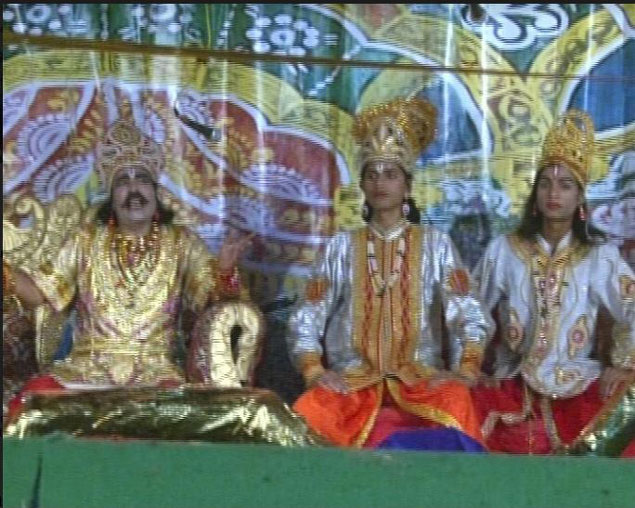
Nizamuddin playing Janak character, father of Sita, sits on the extreme left and delivers his dialogues.

“But as an artist I never changed my stance. There is no sin if a Muslim man acts in Hindu play. Ramlila talks about peace and triumph over evil. Getting a role in Ramlila is a matter of pride for me,” he said.

Expressing his dissent on Bollywood actor Nawazuddin Siddiqui backing out from play after opposition from right wing members, Nizamuddin said, “Nawazuddin is an artist, he should have continued with his act instead of giving up against bullies. I’m sure, the local residents and administration would had supported him if he would have stood up.”

Talking to TOI, director of Ramlila theater, Manoj Singh, who has been playing role of Ravan since 1998, said, “It is amazing to see the zeal of men like Nizamuddin, who outsmart other contestant for the roles. This is blunt and appropriate reply to those people, who want to create enmity and disturbance among different communities.”

“This year we had only two Muslim artists who have notched the top roles, while for the first time a woman has joined the play to act as Sita,” added Singh.

source: http://www.timesofindia.indiatimes.com / The Times of India / News Home> City News> Agra / by Arvind Chauhan / TNN / October 08th, 2016

Sculptors camp at Kalamandira

Mysuru, KARNATAKA :

sculptorsmpos04oct2016

by Rajkumar Bhavasar

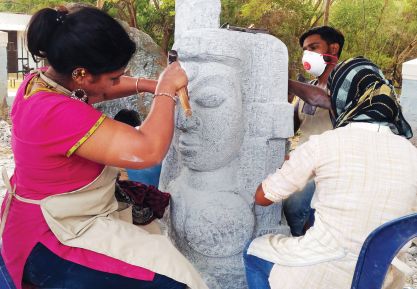
The ongoing 11-day Sculpture Workshop, jointly organised by Karnataka Shilpakala Academy and Lalitha Kala Akademi at Kalamandira on Hunsur Road in city, has provided vast experience to the sculptors.

Seven senior sculptors, assisted by an equal number of assistants, who have come from Raichur, Mysuru, Bengaluru, Mandya and Ballari districts, are busy giving final touches to their sculptures, with the camp drawing to a close on Oct. 5.

Tukaram of Sindhanur in Raichur district assisted by Manoj Kumar is sculpting ‘Kalikadevi’ idol, while Manjunath Acharya of Yelahanka assisted by Kumar of Bengaluru is giving final shape to ‘Shiva’ idol, Kalachari of Ballari assisted by Vivek M. Podar of Vijayapura is giving final touches to ‘Kambada Narasimha’ idol and our very own Shyamasundar Bhat of Roopa Nagar in Mysuru, assisted by Krishnappa is in the last leg of sculpting ‘Veerabhadra’ idol.

There are women sculptors too in the camp, exhibiting the skills they have learnt over the years. Gayatri A. Shipli of Chikkalasandra in Bengaluru assisted by Tabu Tabassum of Hospet, is sculpting a folk figure. The other sculptors, taking part include Deepak and Lokesh from Mandya.

The stones for sculpting were procured from Hampapura in H.D. Kote taluk.

The camp also features wood sculpture and carving. G.V. Shivakumar of Bengaluru has carved ‘Ardha Nareeshwara’ idol out of wooden piece, while on M. Chidananda of Girinagar in Bengaluru has carved ‘Shiva’ idol, Vasant Naikar ‘Madanike,’ Sashidhar Acharya ‘Krishna,’ Nagendra S. Kammar ‘Darpana Sundari,’ and Vijay and Shivakumar contemporary art works.

M. Ramamurthy of Bengaluru is the camp Director, while Karnataka Shilpakala Academy Member Dr. Geetanjali Achar of Mysuru is the convenor.

source: http://www.starofmysore.com / Star of Mysore / Home> Feature Articles / October 04th, 2016

Kashmir’s Mlecch Era

JAMMU & KASHMIR :

Abortive takeover bids did not prevent the Muslim influences from impacting the Kashmir society. Long before Kashmir’s transition to Islam, the new faith existed and thrived even during the Hindu rule, says Sara Wani

(Manuscripts of the Holy Qur’an calligraphed in 1237 AD on a 25 feet long and 2.5 inch wide scroll paper. Belived to be gifted by Shiekh Hamza Makhdoom (RA) to Khawaja Miram Bazaz, great grand father of Majid and Ashraf Quazi, who displayed it in an exhibition in Srinagar.)

Mohammed bin Qasim packed home never to return and Ghaznavids’ left, as if vowing never to set foot on mountains guarding Kashmir like a wall. Kashmir kingdom was apparently insulated against the changes that swept proper India. Delhi Muslim kings and Turkish Sultans remained too preoccupied with power consolidation to make any advance toward Kashmir.

But for the ideas and influences, high Himalayas were no impregnable. Then, political boundaries did not stop trade, refugees and even fortune hunters. Kashmir knew of Islam much earlier than the two failed conquests.

In his Shah Hamdan of Kashmir, Kashmir’s former Director of Archives, Archeology, Research and Museums, Prof Fida Mohammad Khan Husnain has referred to a legend that then Kashmir ruler Veenditya’s emissaries had trekked through Bahrain and met the prophet of Islam. “This information is further collaborated in a Persian manuscript entitled Anwar-i-Kashmir, where it is informed that the Holy Prophet did depute Abu Hazifa Yamani in about 8 AH (after Hijra) with letters to the Chinese emperor but the above emissary got held up in Kashmir due to a heavy snowfall,” Husnain wrote. “Veenditya, the Raja of Kashmir treated them well.”

While the author offers no detail about the veracity of the manuscript and its writer, he claims that Caliph Umar ibn Khitab had deputed a delegation of five persons to Kashmir in about 21 AH. He offers no reference to substantiate the claim. Extensive research failed to trace the king in Rajatarangini. At that point of time when Islam was getting established in the deserts of Arabia, Kashmir was witnessing transfer of power from Baladitya, the last Gonanda king, to Karkotas whoso rule begun with Durlabhavardhana (627-649). Even the Thang dynasty records in China suggest that the first Muslim delegation comprising 15 Arabs was led by Said Ibn Abi Waqqas. Thabit ibn Qays accompanied him. Dispatched by Caliph Usman, it met Chinese Emperor Yung-Wei in 651.

But the existence of Muslims in Kashmir is well documented after the fall of Sindh. Chachnama author Alafi bin Hamıd al-Kufı, states that Muhammad Alaf, an Arab mercenary who had served Sindh ruler Dahır (712 A D), sought refuge in Kashmir. The then Kashmir ruler Candrapıda, received him well and bestowed on him the territory of Shakalbar. G M Sufi, the author of Kashir: Being A History of Kashmir has quoted Sir Alexander Cunningham locating Shakalbar somewhere around the slat range saying the territory was then under the control of Kashmir king.

After Alafı’s death, his estate was inherited by one Jahm, who, according to al-Kufı, “built many mosques there”.

Writing in the UNESCO publication History of Civilizations of Central Asia (IV), N A Baloch has quoted al-Bırunı recording that Muhammad bin al-Qasim bin Munabbih who took Multan “belonged to the house of Jahm bin Sama al-Shami, who had allegedly settled in Kashmir as far back as 712–14 and whose descendants had reportedly continued to flourish there.”

Baloch says though Kashmir was ruled, from the eighth century onwards, by the local, independent, originally non-Muslim dynasties, the region had “increasing political contacts with the Muslim rulers of Sind and Khurasan.” Kashmir and Kashgar, then, would be the two main trading states through Gilgit.

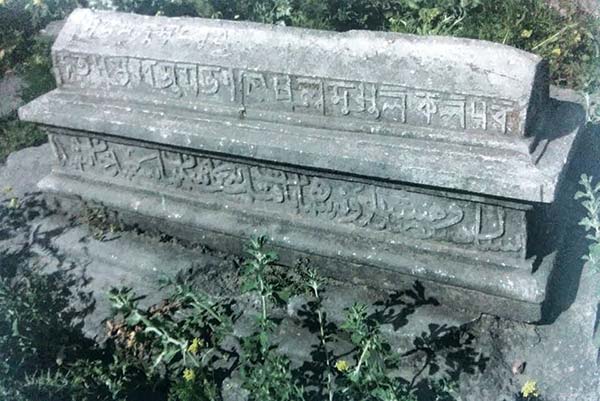
(Arabic and Sharda inscription on the grave of Seda Khan, next to Ziarat of Bahauddin Sahib, who died in a battle in the reign of Mummad Shah (1484-1537).)

Gaznavids’ returned home from Rajouri as winters set in and failed to wrest Kashmir from Sangramaraja in 1021. “It is, however, possible that some of Mahmud’s soldiers, finding it difficult to cross the mountains towards the plains of India, stayed behind and settled in Kashmir,” historian Abdul Qayoom Rafiqui writes in the UNESCO publication. “It is after these Turkish invasions that Kalhana refers, for the first time, to the presence of Turuskas (Muslim) in Kashmir when describing the reign of Harsa (1089–1111).”

Venetian adventurer Marco Polo is still a widely reliable traveler of that era. He visited Kashmir in 1260. His description of an “idolatrous” Kashmir, then ruled by Laksmanadeva (1273-86) – an “incompetent” ruler “consistently harassed by the Turks and his turbulent nobles”, is brief but interesting.

“They have an astonishing acquaintance with the devilries of enchantment; insomuch that they make their idols to speak,” Polo records in his Travels of Marco Polo. “They can also by their sorceries bring on changes of weather and produce darkness, and do a number of things so extraordinary that no one without seeing them would believe them.”

While terming Kashmir as the “very original source from which Idolatry has spread abroad”, Polo has made the predominant faith clear. But he has made two other observations.

“There are in this country Eremites (after the fashion of those parts), who dwell in seclusion and practise great abstinence in eating and drinking. They observe strict chastity, and keep from all sins forbidden in their law, so that they are regarded by their own folk as very holy persons. They live to a very great age,” goes the first one.

“The people of the province do not kill animals nor spill blood; so if they want to eat meat they get the Saracens who dwell among them to play the butcher,” is the other observation. Saracen is a generic term for Muslims that Christian writers widely used in Europe.

Evidences suggesting Muslim presence in thirteenth century were further corroborated in August 2012 by Qazi brothers – Ashraf and Majid, originally from Khawaja Bazaar. At an exhibition, they displayed full text of the Qur’an calligraphed in 1237 AD on a 25 ft x 2.5 inch scroll paper. “It is part of our heirloom and we had forgotten it on our attic in our old house under the shingled rooftop and nobody touched the two boxes for nearly 150 years,” Ashraf said. “Once we discovered and opened the box, we discovered the treasure.” The rare manuscript, calligraphed by Fatahullah Kashmiri was gifted by Sheikh Hamzah Makhdoom to Khawaja Miram Bazaz, the great grandfather of the Qazis. It carries a certificate of authenticity and transfer with 35 Ulema as witness. Historians did not expect Muslims to be living in Kashmir, then.

Focusing on the ‘court’, Rajatarangini, Kashmir’s oldest historical chronicle skips mentioning social changes in detail. But the first major mention of a social change is during the reign of Lohara dynasty king Harsa (1089-1101). The king says Kalhana, “introduced into the country more elaborate fashions in dress and ornaments and made his courtiers imitate his own taste for extravagance in personal attire.” The ‘new dress code’, an apparent ‘Western Disturbance’ was explained by M A Stein as the “Mohammedan influence”.

This observation is indicative of a social impact though not a religious transformation. But the Kashmir court was never immune to foreign influence. Even Lalitaditya’s had a Turk minister Cankuna. Stein says he was from Badakhshan or its immediately adjoining tracts on the upper Oxus. Besides, Lalitaditya, “as overlord of India”, according to Maharajas’ of India, by Annmorrow Shrishti was “already recruiting regiments from Central Asia.”

Vajraditiya-Bappiyaka, Lalitaditya’s son who ruled Kashmir for seven years, says Kalhana “sold many men to and introduced in the country many Mleccha practice”.

Apparently, Mlecchs were to Hindu scholarship what Saracens were to European writers. A Sanskrit word, Mleccha means “alien in language and manners, uncouth, inferior”. Their presence was felt throughout the reign of Korkotas’, the dynasty that reigned Kashmir between 663 – 855 AD, coinciding with the period when Arab armies were being dispatched to the length and breadth of the world. Even the Bhavaishya Purana, one of the 18 Puranas of ancient Vedic literature dealing with the future, anticipates the rise of prophet of Islam as “the Acharay of Mlecchas”, a desert resident who would be the embodiment of divine qualities. Some Kashmir historians see Ali Kadal as the Mleccha Mar that Rajatarangini refers to.

Husnain is correct in saying that Islam was brought to Kashmir by non-Muslim Rajas. While Karkota king Vajraditya (761– 767) introduced Mleccha practices, Lohara dynasty king Harsa not only employed Turuska commanders but made temple spoliation a state policy. He confiscated idols possessing the valuable metals, they were made of.

A Hindu iconoclast, Harsa was an interesting character. Initially prudent, courageous and lover of art and music, Sufi feels “his mind was rather demented”. Kalhana see him as “a jumble of contraries”, who was bankrupted by extravagances. To manage his kitty, Kalhana says he would loot the temple treasures, especially the metallic idols. An exploitative taxman, he would even levy night soil! Even though famines, bandits and plagues attacked Kashmir, Harsa never exempted his subjects from taxes. Eventually, his nephews led a rebellion, putting his palace afire, roasting his queens alive and slaying his successors. He was perhaps the only Kashmir king who head was sliced after being hunted down and left to be cremated by a wood-dealer “as a naked pauper”.

Stein has explained Harsa differently. “As Kalhana is particular to specify the new metal statues of gods throughout Kashmir which escaped Harsa’s clutches, we cannot doubt the extent and thoroughness of Harsa’s iconoclasm,” Stein writes. “Can the latter have been instigated or encouraged somehow by the steady advance of Mohammadanism in the territories? Kalhana when relating to these shameful confiscations, gives to Harsa the epithet Turuska  i.e; Mohammadan, and later makes reference to Turuska captains being employed in his army and enjoying his favor”.

Having little faith in his people and his soldiery, Harsa had raised a new model for his army. Comprising mostly Ekangas, the royal bodyguards and the Tantrins, the reformed trouble-makers, each group of  hundred soldiers was placed under a Muslim commander, thus making it impossible for soldiers to run away or hatch plots. This was the beginning of Muslim influence in Kashmiri politics. After Harsa, Bhiksacara (1120-21) is understood to have raised a Muslim cavalry for his personal guard, a task they eventually failed in.

Harsa, however, was one of the series of puppet kings who misruled Kashmir for nearly 500 years after Lalitaditya (724-60) when court rivalry would change kings in Kashmir like turbans. In between came Avantivarman (855-883) who tried to put the house in order. Putting foreign conquests at halt, he devoted his attention to his state focusing on development, welfare, and delivery of services. As his son succeeded him, things were back to square one with class-wars and internecine battles triggering the political instability and reducing the kingdom to its old territorial confines.

By the time Jayasimha (1128-1155) took over, Muslim mercenaries had gained so much popularity that the king and his army chief, according to Kalhana, would go “into the camp with Yavanas (Muslims).”

The gradual decay of the state and the society had led to such deterioration, according to Rajatarangini that when Sahadeva (1300-1 to 1319-20 AD) took over, Kashmir had reduced to a kingdom of “drunkards, gamblers and profligate women”. So when Mongol king Karmasena’s commander Dulcha (Zulchu) invaded Kashmir in 1320, the king fled to Kishtwar. Nobody resisted 70,000-strong invaders, who devastated Kashmir for eight months, selling men to Tartar traders, setting afire dwellings and standing crops. But the entire army perished over Devsar Mountains in south Kashmir while fleeing Kashmir winters with thousands of men and women slaves.

Dulcha destruction literally marked the end of a long chaotic Hindu rule. That changed Kashmir forever.

(This is the second in a four part series on advent of Islam in Kashmir. Read the first part Islam’s Kashmir Story.)

source: http://www.kashmirlife.net / Kashmir Life / Home> Faith History / Tuesday – February 16th, 2016

Newly elected AUSU office-bearers take oath

Allahabad, UTTAR PRADESH :

Allahabad :

Allahabad University  returning officer (RO), Prof RK Singh, administered oath of office to the newly-elected office-bearers of the Allahabad University Student Union (AUSU) at the union hall of the university, on Saturday

The results for the AUSU polls were declared late on Friday night.

Rohit Kumar Mishra of Akhil Bhartiya Vidyarthi Parishad (ABVP) bagged the president post, defeating his nearest rival Ajit Kumar Yadav of Samajwadi Chatra Sabha  (SCS) by a margin of 95 votes. Mishra bagged 3,397 votes while Yadav got 3302 votes.

Likewise, for the post of vice-president, Adeel Hamza Sahil  of SCS was declared the winner. Hamza got 1,860 votes, while Ashwani Kumar Maurya of Pratiyogi Chatra Morcha with 1,740 votes came second.

With 2,853 votes, Shivbalak Yadav of Samajwadi Chatra Sabha (SCS) emerged victorious for the post of general secretary. He defeated Ravi Pratap Singh, who bagged 1,856 votes.

Abhishek Kumar Pandey of ABVP won the post of joint secretary with 2,191 votes, while his nearest rival Anirudha Singh Rudra  could manage 1,365 votes.

Maneesh Kumar Saini of Samajwadi Chatra Sabha bagged the post of cultural secretary, securing 1,864 votes.

source: http://www.timesofindia.indiatimes.com / The Times of India / News Home> City News> Allahabad / TNN / October 02nd, 2016

Vice President Hamid Ansari on three-day visit to Kerala

Kolkata, WEST BENGAL / NEW DELHI :

Kerala  :

The Vice President will proceed to Kollam by helicopter to unveil the statue of renowned educationist Dr. M. Sreenivasan at the Sree Narayana College campus.

At a function to be held at the Kanakakkunnu Palace in the evening, the Vice President will formally open the digital library of the P N Panicker Foundation.

Vice President Dr. Hamid Ansari will embark on a three-day visit to Kerala on Monday, where he will attend various programmes in Kollam, Thiruvananthapuram and Ernakulam. Soon after his arrival in the State capital in the afternoon, the Vice President will proceed to Kollam by helicopter to unveil the statue of renowned educationist Dr. M. Sreenivasan at the Sree Narayana College campus.

Later, Ansari will return to the capital city for stay at the Raj Bhavan, where he has two engagements on Tuesday.

In the morning, he will inaugurate the Navathi celebrations of Navajyothi Karunakara Guru at the Santhigiri Ashram.

At a function to be held at the Kanakakkunnu Palace in the evening, the Vice President will formally open the digital library of the P N Panicker Foundation.

The digital library is launched as part of the Foundation’s drive for complete e-literacy. On Wednesday morning, the Vice President will inaugurate the Vidhyadhanam Scheme of the St. Teresa College in Ernakulam, following which he will then return to Delhi.

source: http://www.indianexpress.com / The Indian Express / Home> India> India News / by ANI, New Delhi / August 29th, 2016