Eminent Hindustani classical vocalist Ustad Abdul Rashid Khan performing during an event on August 11, 2013. File photo: Shanker Chakravarty
/ The Hindu
He was as a recipient of Padma Bhushan and Sangeet Natak Akademi award
Kolkata, WEST BENGAL / Rae Bareli, UTTAR PRADESH :
Kolkata :
Eminent Hindustani classical vocalist Ustad Abdul Rashid Khan passed away at a private hospital here today following old-age related ailments, family members said. He was 107.
He fell sick in the morning and was rushed to a hospital where he took his last breath, the family members said.
The body will be flown to Raebareli tomorrow for the burial, they said.
A recipient of Padma Bhushan in 2013 and Sangeet Natak Akademi award, he was a resident guru at the ITC Sangeet Research Academy in the city for the past 20 years
Despite movement restrictions and age-related illness, he used to appear for public performances till recently.
One of his students said that he took a class with his pupils even yesterday.
Condoling his death, West Bengal Chief Minister Mamata Banerjee said, “Saddened at the passing away of veteran vocalist Padma Bhushan Abdul Rashid Khan.
India has lost a great gem in the world of music”, she said in a tweet.
source: http://www.thehindu.com / The Hindu / Home> National> PTI / Kolkata – February 18th, 2016
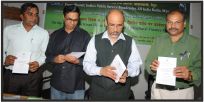
Dr. T.N. Prakash Kammaradi (second from right), Chairman, Karnataka Agriculture Price Commission, Government of Karnataka, Bengaluru, is seen releasing a brochure during the inauguration of workshop in city this morning. Also seen are (from left) AIR Mysuru Programme Executive N. Keshavamurthy, AIR Bengaluru Station Director M.A. Ahmed and AIR Mysuru Programme Head M. Raghavendra.
Mysuru:
A one-day workshop on ‘Agricultural Finance Management’ organised by Prasar Bharati – India’s Public Service Broadcaster, All India Radio (AIR), Mysuru, on the eve of Radio Kisan Divas, began at Central Institute of Indian Languages (CIIL) auditorium, Manasagangotri, this morning.
Speaking after inaugurating the workshop, M.A. Ahmed, Station Director, AIR, Bengaluru, said that AIR Mysuru ‘Kisan Vani’ programme has been a hit among the farming community.
Giving a brief on the objective of observance of Radio Kisan Diwas, Ahmed said that the programme has enabled the farmers to get clarifications for their doubts and problems. He called upon the farming community to maintain a balance between expenses and income and to utilise available resources in a most judicious manner.
Karnataka Agriculture Price Commission Chairman Dr. T.N. Prakash Kammaradi, who delivered the keynote address, explained the meaning, scope and significance of agricultural finance. Pointing out that Agricultural finance deals with the financial aspects of farm business, including macro and micro financial aspects of an agricultural economy, he observed that such workshops, seminars, etc., will help the farming community to improve productivity, increase profitability and fulfil their long term goals.
Since Indian Agriculture is capital intensive, the farmers’ dependence on lending Institutions, such as banks, has considerably risen, Kammaradi said and called upon the lending institutions to come together with society in setting an overall framework in which the individual farmer can appropriately manage his finances.
Noting that natural disasters and other calamities have put the farmers at great risk with crop loss and un-remunerative prices, he expressed displeasure over media’s hyped reporting whenever prices of agricultural and horticultural commodities shoot up and at the same time remaining silent when prices of agricultural produces crash, resulting in great loss to farmers.
He called upon banks and other financial institutions to chalk out the best cash flow analysis that helps the farmers in determining period wise quantum of loans needed and a proper repayment channel that benefits the farming community.
Stating that agricultural production in the country stands at 250 million tonne per year, he called upon the farming community to judiciously use farm savings and not to spend on unproductive assets.
source: http://www.starofmysore.com / Star of Mysore / Home> General News / February 15th, 2016
Educational Multimedia Research Centre (EMRC), attached to University of Mysore, won two national awards for the documentary film titled ‘DGWT – A cause for Concern,’ in the recently held 6th National Science Film Festival organised in Mumbai. The institute won the Silver beaver award which carries a trophy, a citation and Rs. 50,000 cash prize and also the best graphics award carrying a trophy, a citation and Rs. 30,000 cash prize.
The documentary was directed by Syed Kaleem, Senior Producer of EMRC, Mysuru and Former Director of EMRC, Odisha. This is the second National Award won by Syed Kaleem. The first one was in 2001 for the film on the life of Kodava’s titled ‘Kodavas, The highlanders.’
The best graphics award was received by Chandra Kumar, graphic artiste of EMRC, Mysuru. The film was photographed by Keerthi Kumar, sound effects by Badrinarayana and Somashekar was the Technical Director. The narration of the film was done by Beliappa.
The film highlights the grave danger caused due to depletion of ground water and its long time impact on ecology and environment.
source: http://www.starofmysore.com / Star of Mysore / Home> General News / February 15th, 2016
Our six finalists, Basavaraj Rodda, Akkamma Aralikatte, HafizaBegum, Savita Maleda, Iranna Patil and Geeta Basarakod put their best foot forward today in the FINALS of The Most Innovative math Teacher Contest by AksharaFoundation . February 14th, 2016.
Mysore Akashvani, in association with Prasar Bharati and Indian Broadcasting Service, has organised a day-long workshop on Agricultural Finance Management at CIIL on Hunsur Road at 10 am tomorrow (Feb.15).
Bengaluru Akashvani Station Director M.A. Ahmed will inaugurate the workshop.
Mysore Akashvani programme Chief M. Raghavendra will preside.
Karnataka Agricultural Price Commission Chairman Dr. T.N. Prakash Kammaradi will deliver the keynote address.
source: http://www.starofmysore.com / Star of Mysore / Home> In Brief / February 14th, 2016
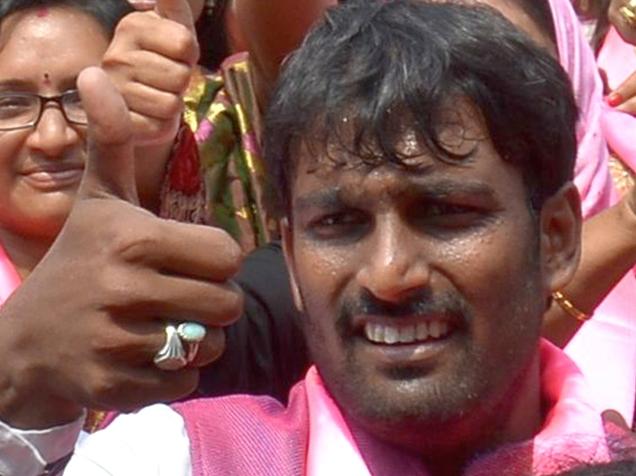
Borabanda Corporator Deputy Mayor, Mohammed Baba Fasiuddin at Gun Park Matyrs’ Memorial in Hyderabad on Thursday. – Photo: Nagara Gopal / The Hindu
Borabanda, Hyderabad:
The newly elected Deputy Mayor Mohammed Baba Fasiuddin represents the Borabanda Ward of Greater Hyderabad Municipal Corporation. He was unanimously elected as Deputy Mayor as only one nomination was filed.
A graduate in Commerce, Mr.Fasiuddin played a key role in the Telangana movement as well as in the student and youth wings of the Telangana Rashtra Samithi. He is a close confidant of Chief Minister K. Chandrashekar Rao. His father is a retired Government employee.
His family hails from Polcharam Mandal in Medak District. He is presently the president of the TRS Student wing of Greater Hyderabad unit. His mother was an employee in Osmania Hospital. Mr. Fasiuddin is married and has a son and a daughter.
source: http://www.thehindu.com / The Hindu / Home> Cities> Hyderabad / R. Ravikanth Reddy / Hyderabad – February 11th, 2016
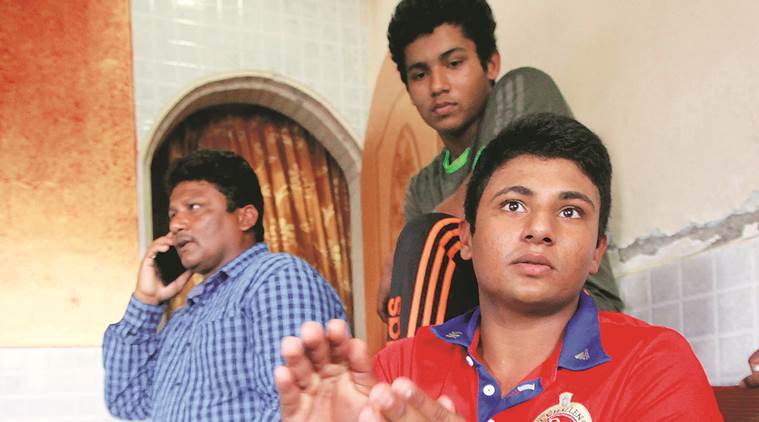
Sarfaraz’s father, Naushad, was stung when Iqbal Abdullah, who he had picked from a UP village and housed at his small home in Mumbai, rejected him.
Despite financial hardships, Naushad always supported his son’s passion.
Mumbai, MAHARASHTRA :
“Abbu, Arjun kitna naseebwala hai na? He’s Sachin sir’s son, and has cars, I-pads, everything.” He didn’t mention it as a lament. Sarfaraz Khan was right though. On the face of it, Arjun Tendulkar was of course more fortunate than many others. And Naushad could do little but nod in agreement.
Like any father, it wasn’t what he wanted to hear from his son, regardless of how true it was. But Sarfaraz never let him mull it over. For, he ran back almost immediately, wrapped himself around Naushad and said as an instantaneous afterthought, “Abbu main usse zyaada naseebwala hoon. Aap din bhar mujhe time dete hai. Uske papa use time hi nahi de paate (I’m more fortunate than him. You can devote the entire day to me. His father is not able to give him any time).”
Recalling that conversation, Naushad’s eyes well up and his generally authoritative voice gets wobbly. Sarfaraz’s words not only meant that the two were on the same page in terms of pursuing their maksad (ultimate goal). They also belied Naushad’s biggest fear. That he was pushing his son too far in his quest to keep up a vow he’d made in the face of a ‘betrayal’ that he never quite came to terms with.
Long before Sarfaraz took steps towards cricketing stardom, Naushad had dreamt the same dream of producing a cricketer at the highest level with Iqbal Abdulla—the star pick among many young, poor kids he’d plucked out from the clutches of poverty and brought to Mumbai. He had even kept the boy from Uttar Pradesh in his 225 sq. ft. Kurla home, getting his wife, Tabassum, to cook and clean for him.
Abdulla, like Sarfaraz has subsequently done, would go onto play the U-19 World Cup for India as well as become an IPL star. But according to Naushad, he would also turn his back on the man who’d been his unrelenting benefactor as soon as it was time to show the necessary gratitude.
It came to a head during their ‘final meeting’ at the same house that Abdulla called home for seven years that would once and for all drive a wedge through their relationship.
“That is when he spoke those unforgettable words, Mere mein kabiliyat thi, main khela. Tumhaare mein talent hai toh apne bachchon ko khilaake dikhao na. (I had the ability, so I played. If you have the talent, then make your son play and show the world,” recalls Naushad, his eyes turning red.
Rather than react with any hostility, Naushad took Abdulla’s challenge up. It lit a fire in his belly, and became a drive to make his own son reach the level that he had brought Abdulla to. It wasn’t that Sarfaraz wouldn’t have made it this far without the two growing apart, but it certainly has been a major motivating factor in his meteoric rise in the last half-a-dozen years. It was also an episode that turned Naushad into a shayar, and he can barely go a few minutes without spewing his shers.
The real force behind it though has been Naushad’s all-encompassing, almost overbearing, grip over his son’s life, both on and off the field. Growing up, the Western Railways’ Class 4 employee was used to odd jobs. The track-pant selling business that he partook with Sarfaraz as his apprentice enhanced the mutual respect between father and son.
“Sarfaraz still starts crying when he talks about those days. There used to be one lot in front of me, one between Sarfaraz and I, and one that he would carry on his shoulders. We would get completely wet on the bike, but still make sure we did enough business on Fashion Street,” says Naushad.
The money made from there was used entirely on running Macho Cricket Club-based on a nickname he earned during his playing days for an acrobatic diving catch at National Cricket Ground-and Abdulla’s finances. The Rs 2,000 he earned from his Railways job would run the house.
The rest of his time was spent in perfecting Sarfaraz’s game.
Naushad would spend hours dishing out throw-downs, paying opposition teams to come play friendly games in which Sarfaraz would bat the whole innings regardless of whether the team lost or not. These days, it’s with his youngest, Musheer. Moeen, the middle son, has been taken off cricket and is now pushing himself to be the Ajit Tendulkar of the family.
Sarfaraz though, would find himself a constant tag of ‘problem child’ — something that didn’t sit well with Naushad. But a meeting with Bharat Arun, present India bowling coach who was in-charge of the U-19 team two years ago, changed Naushad’s own opinion about his son, he reveals.
“He said, ‘have you seen the circus? First comes the lion, everyone claps. Then the elephant comes and plays a few cricket shots. Everyone claps. Then why do you need the joker? Sarfaraz is the one you need when everyone else is shivering and is intimidated by the opposition. Don’t restrict him, that’ll kill him,” recalls Naushad.
And as it’s turned out, Sarfaraz today not only stands on the cusp of being the most valuable player of the U-19 World Cup, he also shares the RCB dressing-room with Abdulla, which in Naushad’s eyes is a sort of denouement to a saga that has dictated his life.
“I don’t see it as a victory. Our ultimate goal is playing for India. It’s like saying we have reached Ratlam en route to Delhi,” he says.
But like he showed last year, Sarfaraz has taken a step up by impressing everyone including AB de Villiers, that reinventor of the batting wheel, in RCB colours, especially playing the scoop shot audaciously even off fast bowlers. But it is a shot that his father had brought into vogue back at a time when nobody had seen it in India.
Unfortunately, like Naushad reveals now, it was too far ahead of his time and cost him a place in the Mumbai Ranji team. He grew up playing cricket in a cowshed, diving around on cow-dung, and like his son is today was a belligerent striker of the ball with a penchant for bravura. But he does regret having turned down offers from other states once Mumbai stopped showing interest in him. A mistake he didn’t make when Sarfaraz found himself in the same spot last year. He immediately moved him to Uttar Pradesh, who he represented this season in the Ranji Trophy.
Aakhon aakhon mein raha,
Dil mein utar kar nahi dekha
Kashti ke musafir ne samundar nahi dekha
Aur jab se main chala hoon, meri manzil pe nazar hai
Aankhon ne kabhi kilometre ka pathhar nahi dekha
This he believes is the sher that captures his life the best. And he can’t help himself but punctuate each line with a dramatic pause. In many ways, Naushad, who also sold toffees and cucumbers in trains, has banked on his own life story to shape Sarfaraz’s career.
No wonder it’s mirrored it in many ways already. But he is aware of the fickleness of the sport he calls his best and only friend. He no longer believes that there is no way back for him and his ambitious family if Sarfaraz doesn’t make it.
Says Naushad, “We came from the slums, used to stand in queues for the toilet where my sons would be slapped and overtaken. We came from nothing and will go back to nothing. Sarfaraz told me the other day, ‘Abbu so what if this doesn’t happen. We can always go back to selling track-pants.”
source: http://www.indianexpress.com / The Indian Express / Home> Sports> Cricket / by Bharat Sundaresan / February 14th, 2016
Fahad Bin Abdul Samad from Uppuguda set a record on Thursday when he became the youngest municipal councillor in the country to take oath.
At 21, Mr. Fahad beat his nearest rival by 4,000 votes on AIMIM ticket to get elected to GHMC’s Council of 150 corproators. He attributes his entrance into politics and early electoral success to his father, a former corporator of the ward, and his party leaders. The minimum age to contest in a local election is 21 years.
“The party was keen on promoting educated youngsters. Doctors, pharmacists and engineers are today among those elected from AIMIM,” said Mr. Fahad, who is pursuing his final year of civil engineering. Entry into politics was a pleasant surprise for the youngster who said he had to drop his plans for education abroad.
“I had planned to pursue masters abroad. But I will now pursue education here,” he said, quickly adding that politics and education will not clash. “Nearly a third of my ward comprises people under poverty line. Besides discharging regular duties of a corporator to ensure civic infrastructure, I want to help the poor get education,” he said.
source: http://www.thehindu.com / The Hindu / Home> Cities> Hyderabad / by Rohit P.S / Hyderabad – February 12th, 2016
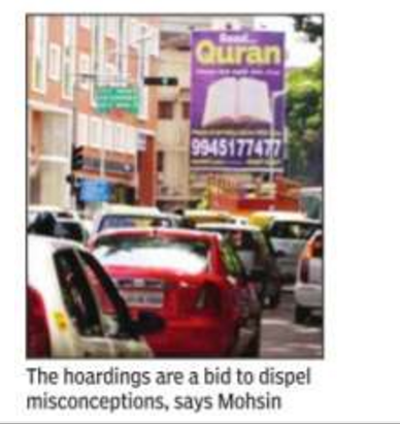
For months now, citizens of Bengaluru, the eastern parts in particular, have been seeing huge billboards at vantage points with the tagline, ‘Islam: Facts Vs Fiction’, offering a free copy of the Quran from the advertiser.
Passers-by wonder who’s leasing out the space and why, and having read the message, move on.
Syed Hamid Mohsin, who runs an outdoor advertising business, was known for his love of cars, buying the latest models of luxury cars every year. Six years ago, he found himself facing serious questions.
“There are more than white, and those seen at dargahs, about love jihad and extremism, and other issues.”
He founded the Salaam Centre in 2008 and turned to dispelling misconceptions about Islam and fostering inter-community harmony through the use of billboards, social media and other channels.
His book on Islam has been translated into Hindi, Kannada, Tamil, Telugu and Marathi.
“The usual question from 100 misconceptions about Islam,” said the 50-year-old.
“I’ve tried to explain the difference between Pakistan’s national flag, which is green and intelligence sleuths and the judiciary and others is:where do I get funds for such work, and for the plush office on Bannerghatta Road?’ Mohsin said.
A Bengaluru business man has got billboards posted at key points across the city to dispel misconceptions about Islam and spread the message of communal harmony .
“Outdoor advertising gives me my bread and butter and the income from it is funnelled here. I have a bungalow and a Mercedes Benz which I haven’t changed in six years. Earlier, I used to have two luxury cars and change these every year . Instead of paying an EMI of Rs 1lakh on cars, I decided to do this. I don’t want to go into philanthropy or give educational scholarships because others are doing this,” says Syed Hamid Mohsin, who runs an outdoor advertising business. “I keep the hoardings for short periods as people get bored,” he said.
source: http://www.timesofindia.indiatimes.com / The Times of India / News Home> City> Bangalore / TNN / February 11th, 2016
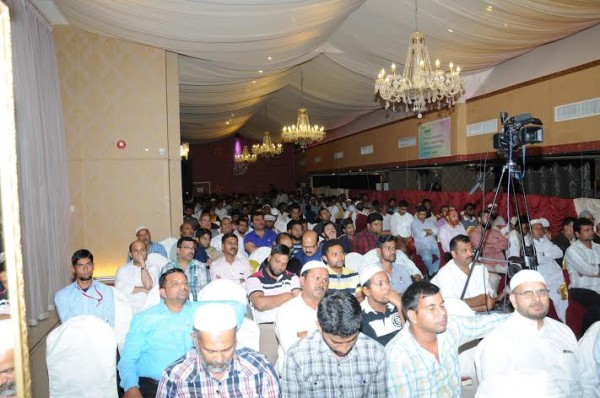
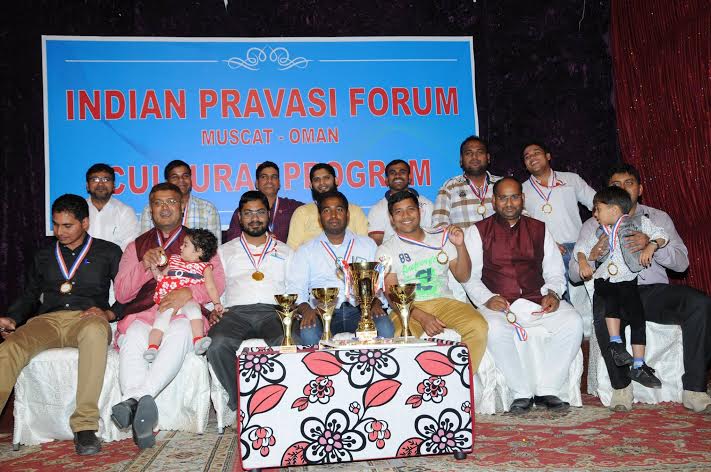
Indian Pravasi Forum Oman Organized “Paigham E Rasool (PBUH) and Children’s Cultural Program-2016 on 22nd Jan at Al Maas Hall in Muscat.
Yusuf Hyder Mukka (President Indian Pravasi Forum Oman, Karnataka Chapter) in his Presidential address emphasized for the unity of community. He stressed the importance of brotherhood.
While addressing the gathering Mufty Haneef Ahrar Qasimi (National Secretary of All India Imam Council), the chief guest of this occasion highlighted “guidelines from life of Prophet (PBUH) in present situation”.He described how the prophet granted the status of women in society.
He also stressed the importance of teachings life style of Prophet Mohammad (PBUH) and explained how he is a role model from all aspect for all mankind and his entire life should be followed Muslims.
The event started with cultural program for children’s under the supervision of Abdul Rahiman Nitte and Noor Mohammed. Over one hundred children participated enthusiastically in cultural program. Suhaib Bailoor group presented “Lavish Life” skit.
A quiz competition was also held for the audience.
While Maqsood Chandavara introduced the guest, Moideen Sunathkere proposed vote of thanks. Haneef Bantwal and Hashim Kundapur were the conveners of the program.///
The program was graced by the presence of Janab Faisal Khan, Janab. Moulana Saheb Zade Mahmood, Janab. Riyaz Gangolli (President of Gangolli Jamath Oman), Janab. Moideen (president of DKSC Oman), Janab. Moideen Shastan (President of SKMWA Oman), Janab. Abdul Shukoor( Vice President of Thonse Jamath Oman), Janab. Anwar Moodabidre (President of Indian Social Forum Oman –Karnataka Chapter), Janab. Noor Mohammad Padubidre (President of Indian Pravasi Forum Ruwi Area), Janab. Irfan Ujire (President of Indian Pravasi Forum Barka Area), Janab. Maksood Chandavara (President of Indian Pravasi Forum North Zone) was on the dais on the occasion.
source: http://www.muslimmirror.com / Muslim Mirror.com / Home> Culture / by Abdul Mubarak Karaje / Muscat – January 27th, 2016