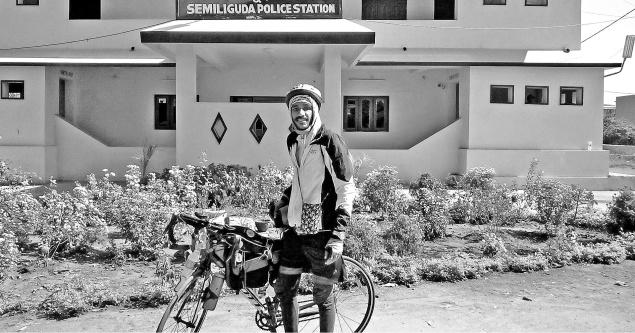
S.S.S. Shameem, Assistant Professor in Computer Application, Manipal Institute of Technology, with his cycle at Semiliguda in Koraput district of Odisha on December 26, 2015.
Manipal (Udipi) , KARNATAKA :
He began his journey on December 18 and concluded it in nine days
S.S.S. Shameem, Assistant Professor, Department of Computer Application, Manipal Institute of Technology (MIT), has just completed the first leg of solo cycle expedition, a passion he has been pursuing since two years, and calls it as “Bharat Bhraman: Ride-4-Pride.”
According to a press release issued by the Manipal University here on Thursday, Prof. Shameem had covered a distance of 1,500 km on a high-end bicycle from Bengaluru to Koraput in Odisha. Mr. Shameem, who is very lanky, proudly says, “I completed it in nine days.”
“Eastern Ghats was a bit tough, otherwise I enjoyed the first leg and plan many more such solo rides. My aim is to see and know the diversity of our country and do whatever I could. Going around the country on a bicycle gives me a great pleasure and satisfaction. Moreover, I will be, when I finish the journey, sit and look back with pride my achievements,” Prof. Shameem said.
“I began my journey from Bengaluru on December 18, 2015, and reached Koraput on December 26, 2015, via Hyderabad, Vijayawada, Vishakapatnam and Salur,” he said.
“I have been preparing for this trip for the last two years. The next cycling trip would be again taken up in December this year,” he said.
Prof. Shameem had to spend a few nights, sleeping at railway stations, police stations and religious places etc. Prof. Shameem, who is also a marathon runner, plans to alternate his cycling expeditions with running.
Therefore, he is planning to do running during summer and cycling in December. Being ambitious, Prof. Shameem is keen to get into Limca Book of Records with half marathon (21.1 km) runs.
Accordingly, he plans to do 111 half marathons in 70 days and is working on that. He calls it, “Bhaag-run Project.” He has sought details from Limca and is in touch with the athletic associations of Udupi and Mangaluru for assistance.
source: http://www.thehindu.com / The Hindu / Home> National> Karnataka / by Ganesh Prabhu / Manipal – January 22nd, 2016
St Joseph’s Convent High School for Girls will observe its quasquicentennial (125 years) jubilee in a grand manner here on Friday. Superior General of the Canossian Daughters of Charity from Italy M. Annamaria Babbini will be present to witness the celebrations.
Addressing a press conference, school principal Thankam Michael said here on Tuesday that the school had been functioning under the management of the Canossian Sisters Congregation since 1891.
It was founded 125 years ago when the British civilian and military officers petitioned the then Archbishop of Goa to establish an English-medium school here.
In response to the request from the Archbishop, Mother Stella of the Canossians in Hong Kong sent five nuns who reached Cochin by ship and then Belgaum (now Belagavi) covering the distance by bullock cart and on foot. Since then the school has shaped the lives of a large number of girl students of Belagavi, Goa and north Karnataka region.
To commemorate the occasion, the school has given a facelift to basic infrastructure and also launched a project, Light a Lamp, to help the poor and deserving girl students. Donors and philanthropists could sponsor a girl child for education.
About 15 former students, including social activist Olive D’silva, Anita Rodrigues, Ruhi Sait, Padmashree award winner Sucheta Dalal, psychiatrist Belinda Viegas Muller, Sadhan Pote, renowned artist and sculptor Veena Chandavarkar and the former Deputy Mayor of Belagavi Asma Tahsildar, who have excelled in various fields, would be honoured.
source: http://www.thehindu.com / The Hindu / Home> National> Karnataka / by Special Correspondent / Belagavi – January 21st, 2016
The Kannada Book Authority (KBA) has instituted the Dr. M.M. Kalburgi Award, which carries a cash prize of Rs. 75,000 and citation, for writers in humanities. This year’s award, in memory of the renowned scholar, has been conferred on historian B. Sheik Ali.
Announcing the awards, KBA chairperson Banjagere Jayaprakash said Prof. Sheik Ali served as Vice-Chancellor of the Mangalore and Goa universities and was responsible for the emergence of a number of History scholars.
Research work
A major share of his research work relates to the period of Hyder Ali and Tipu Sultan. Prof. Sheik Ali has around 40 major works to his credit, including eight in Urdu.
source: http://www.thehindu.com / The Hindu / Home> National> Karnataka / by Muralidhara Khajane / Bengaluru – January 20th, 2016
However, Mansoor Ali Khan, member, board of management of Delhi Public School group, said while their canteens serve healthy food, ensuring that food in lunch boxes is not junk is going to be a challenge. “Children love to eat chips, biscuits, chocolate and other fried food during short breaks. It is also convenient for working parents. All we can do is advise parents. We plan to conduct workshops for them,” he said.
While most parents have welcomed the move, many are struggling to find alternatives.
Sindhu H.D., whose daughter studies in BGS National Public School, said she is trying to replace snacks with vegetable salads, fruits and fresh fruit juices.
Another parent, Latha Rao, wants schools to be lenient on some days. “While we all realise the need for our children to consume healthy food, schools should allow students to eat junk food once a week so that they do not crave for it. It may be difficult for working parents to pack full meals on all days of the week,” she said.
source: http://www.thehindu.com / The Hindu / Home> National> Karnataka / January 19th, 2016
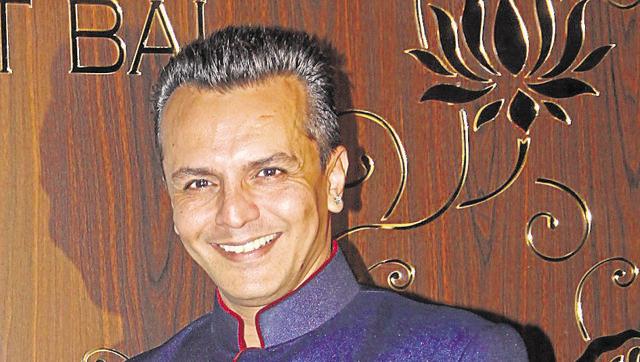
Fashion stylist Imam Siddiqui has always been vocal about his thoughts and when it comes to the popularity he got post participation in the sixth season of Bigg Boss, he is more than happy to talk about it.
“The kind of popularity I got post the reality show has been enormous. I am already signing Hindi films left, right and centre. My film will release in April, in which I play a double role. For heaven’s sake, I am laughing my way to the bank now!!,” says Siddiqui and adds, “My life has changed 180 degrees.”
Siddiqui, who recently participated in the reality show for a week, says the current participants don’t know the worth of the show. “The current lot needs to make better use of the opportunity. They don’t understand the importance of the platform that they have been provided with. The audience does not wish to see just aggression, they also need to give complete entertainment,” he says.
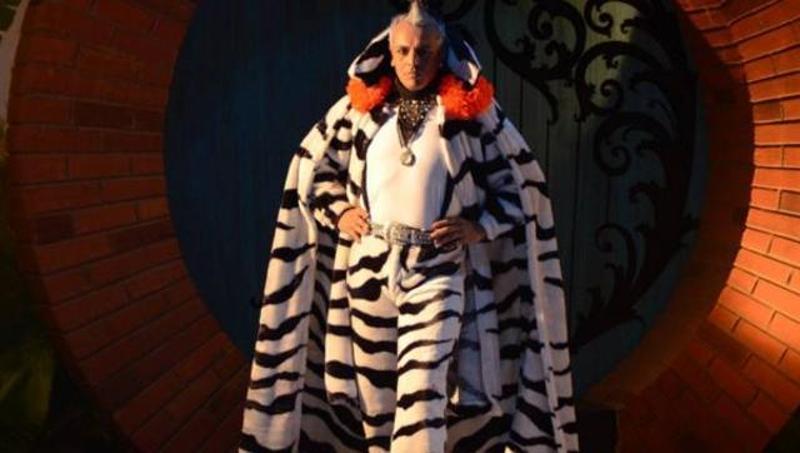
Imam Siddique enters the Bigg Boss house, and that spells trouble for all the contestants, especially Prince Narula! (COLORS)
He does have a word of advice for the participants. “This show can propel their career in the stratosphere like it has done to mine. They must try hard to keep the audience hooked on to them. Otherwise they will lose out on the chance and will regret it,” he says.
source: http://www.hindustantimes.com / Hindustan Times / by Yashika Mathur, Hindustan Times, New Delhi / January 20th, 2016
And though Satish Rai’s own story remains untold – until right now – the Sydney-based documentary filmmaker makes do with telling the tales of others like him, who set out in search of their roots, and stumbled upon cousins and family they never knew existed.
For the uninitiated, Rai is the descendant of girmitiyas – indentured Indian labourers who travelled to Fiji and Caribbean Islands to work on sugar plantations in the early 19th century, upon signing an “agreement” – distorted eventually to be known as ‘girmit’ – with the British Government that promised them to return to India after they completed the term of their contractual agreement for work in Fiji and the Caribbean Islands.
Many contracts were reneged upon, and only a few could return home. And for those like Satish Rai, the real homecoming could only happen nearly a century after his family first left the Indian shores.
Rai’s first visit to India was in 1994 – to Basti district – where his cousins were settled.
A brush with a local rickshaw puller gave him his first brush with his caste – and his roots. “He told me I am a Bhumihar Brahmin. And I didn’t know what that meant,” Rai said.
The first trip yielded little ground.
After two more visits, one in 1995 when a Brahmin priest led him on a wild goose chase, and a second in 2001 when he accompanied a cousin on her quest to find her family, Rai’s own story saw mild progress.
He said, “During that time in Basti, there was a man who helped us and took us to Balrampur. He made me meet some people. Then, three months later, I got an email from him telling me my family had been traced.
In 2004, I went back to Balrampur.” And here’s the twist in Rai’s tale. Satish Rai met his cousin, thrice removed, a man they knew by the name of Naeem Rai. “This was a Muslim name. And I already knew my grandmother was a Hindu. So I knew it couldn’t be the right family,” Rai said.
Whether it was curiosity or sheer desperation that drove him 15km into Balrampur’s belly is unclear. But Rai was on his way the next morning, looking to dig for, and to find his roots. “The first time I saw them, I felt the connection. The resemblance was uncanny,” he said. But how did it happen? After the initial rush of emotion, the mystery unravelled.
Rai’s grandmother was married to a Rai Bahadur, a dominating, violent man, he said. And after suffering many years of domestic violence and abuse, she walked out on the Rai Bahadur. Staying away from the powerful landlord within the village would have been impossible, and Rai’s grandmother took the next best available option; she boarded the ship to Fiji with Rai’s grandfather, a man headed for greener pastures in the faraway lands. When the irate Rai Bahadur found out about her escape, though, he did the only thing that remained in his power to do: issue a diktat that disallowed all Hindu families in the area to wed.
“My grandmother’s cousin at that time had four children. And to escape the bizarre diktat, they all converted to Islam. The family name of Rai, however, stuck.”
For Satish Rai, the family name served as the final missing piece in his quest to find his family. A century after his grandmother boarded that ship to Fiji, Satish hugged his cousin Naeem and celebrated his homecoming.
source: http://www.timesofindia.indiatimes.com / The Times of India / News Home> City> Lucknow / by Swati Mathur / TNN / January 17th, 2016
“Actor’s job is to make audience reflect on social issues bogging society”
Actor Irrfan Khan is seen addressing the gathering during the valedictory of Bahuroopi National Theatre Festival at Kalamandira in city yesterday. Others seen are (from left) former Rangayan Director S.I. Bhavikatti, Columnist Nataraj Huliyar, Irrfan Khan Khan’s wife Sutapa Sikdar, MLA Vasu, former Minister Prof. B.K. Chandrashekar, Rangayan Director H. Janardhan, Theatrist Rameshwari Verma and Bahuroopi Convenor M.C. Krishnaprasad. Picture right shows the artistes of Manipur demonstrating sword fight as part of Bahuroopi Folk Festival yesterday.
by Nandini Srinivasan
Mysore :
“Each one of us needs to find our inner voice and reflect to be able to express without fear and that’s exactly what Bahuroopi’s theme of ‘I sing as I please’ stands for’,” opined well-known theatre and film actor Irrfan Khan.
Speaking at the valedictory of the eight-day theatre repertoire Bahuroopi festival-2016 at Kalamandira, Irrfan Khan said that its only when one’s voice comes from deep within, expressions have an unmatched quality and are heard.
Speaking of his days at National School of Drama (NSD), Irrfan fondly recalled the able guidance of theatre person Prasanna who showed him to the right path to pursue in the field of acting.
Irrfan, who preferred answering questions than delivering a formal speech to express his ideas, took on questions from Journalists, theatre artiste Ramanath and Prof. S.R. Ramesh and spoke at length about films, the tolerant fabric of India and theatre.
Irrfan exuded confidence that India can still be a model for the rest of the world, as we live amidst a vast diversity and yet have no psychopaths who go on shooting sprees like in the so called developed nations!
Responding to a question on the responsibility of actors and their role in real life, Irrfan opined that an actor too is just like any other individual and the role he or she decides to play in real life is completely subjective and personal. Every human being should be responsible, not just actors he said adding that the more evolved an individual is, the lesser the chances of being manipulated.
Life itself is a huge diversity and standardisation of anything is a threat, he said adding we are all so programmed by parents, society and the education system that unless we learn to unplug and think, reflect on our own, reactions too will be standardised and as is happening, we can easily be manipulated in the name of religion, politics and caste.
Talking about the Censor Board and its regulations, Irrfan rued that it is unfortunate that rules formed eons ago are still in place and not changed to suit the current needs. The present set of rules are absolutely redundant, he said.
An actor’s job is to make the audience reflect on several social issues bogging the society, but today he is being asked not to speak and that doesn’t augur well, lamented Irrfan responding to a question on the States’ interference in every field and said Gods, Saints and Sufis are being abducted in the name of politics and even an actor is as vulnerable as others and can become a mere toy!
Black humour isn’t appreciated as much in India as in other countries, probably because the audience finds a lot of subjects very sensitive Irrfan opined referring to his movie ‘Talwar’, and said there isn’t much of a difference between the responses of theatre audience and the movie audience. Its just that in theatre shows, it’s a direct response.
Talking about the changing genre of movies in recent times, Irrfan expressed his happiness over the changing demands of the audience who have become more mature and expect tales that reflect reality and said as an actor, he strongly believes in making his audience think, rather than just entertaining them. “I have acted in roles which have been successful but have only entertained. I’m not happy with only such kind of roles,” he added.
Answering a question on maintaining communal harmony, Irrfan said that unfortunately religion hasn’t been applied rightly to society as it should have been. People have gone into a slumber and only when they are shaken up can things move smoothly.
He recalled his lines in ‘Life of Pi,’ Doubt is kind of essential in faith – When you doubt you seek, when you seek you test and when you test you conclude.
Answering a question from the audience on whether he took up the role of Pan Singh Tomar because he too was an athlete, Irrfan said he being an athlete was irrelevant and what touched him was how a talented athlete turned a dacoit. The movie was a sweet love letter to the system where talent is not being respected, where we don’t care about talent.
Irrfan expressed his happiness about the response of the audience to the festival and said just when you think there’s no hope, the love for theatre, the excitement and interest in the good things of life brings back the rays of hope that everything will be alright.
Irrfan and his wife Sutapa Sikdar were all praise for Mysuru. “Your city has a kind of rhythm and lifestyle that the so called developed cities lack. Please keep it that way,” he said.
Earlier, columnist Nataraj Huliyar, in his address, said that this year’s Bahuroopi saw a record audience of 12,000 with more than 600 artistes performing in various events.
Rameshwari Verma, a well-known theatre artiste, who was one of the chief guests, fondly recollected her connections with Rangayana ever since its inception and said, it was heartening to see the increasing number of theatre lovers thronging such festivals. The crowd which was limited to around 300 in the early years has swelled to more than 1,000 and that speaks volumes for the work Rangayana has been doing, she said.
Former Minister Prof. B.K. Chandrashekar, who also spoke, said that like the natyashastra says, drama is the fifth Veda which tells us more about life. He recalled the words of late Prof. H. Narasimhaiah who had a big question mark framed and hung behind his table and said the central purpose of any education is to question.
Rangayana Deputy Director S.I. Bhavikatte welcomed the gathering. Earlier, Folk teams from different States entertained the audience.
source: http://www.starofmysore.com / Star of Mysore / Home> General News / Thursday – January 21st, 2016
Sarkar Mehaboob Subhani Foundation, Laskhar Mohalla, has organised Juloos-e-Ghousia (procession) and Jhasne Ghouse Azam celebration on Jan. 22 at 2.45 pm.
The procession, which starts at Masjid-e-Azam, passes through Ashoka Road and concludes at Meelad Bagh Circle.
Mass feeding will be arranged before and after procession at Masjid-e-Azam.
At 6.35 pm, Moulana Hafiz Khari Naseer Hussain Razvi, Deputy Lecturer, Darul-Uloom Sha Jamath, Hassan and other Sunny Ulmas will deliver speak on the occasion.
For details, call: 99012-70392.
source: http://www.starofmysore.com / Star of Mysore / Home> In Brief / Thursday – January 21st, 2016
“I will remove politics from education, if I become the Minister for Education,” said Babar Ali, who is said to be youngest headmaster in the world, here on Monday.
Mr. Ali, who runs a free-school at Murshidabad in West Bengal for poor students, was participating in an interactive session with the students of BGS PU College here.
During the interactive session, one of the students asked Mr. Ali what he would like to do if he were to become a Minister for Education. Welcoming the question with a smile, Mr. Ali said, “First thing I want to do is to remove politics from educational sector. Nowadays, if a person wants to get appointed as a teacher in a primary school in my State, he or she does not require merit. The applicant should have political influence and money,” he said.
At the college level, students were involved in activities of various unions that were affiliated to different political parties. “Intervention of politics dilutes the essence of education. The second area I will stress on will be to make the teachers responsible for the growth of their students,” he said.
Medium of isntruction
To another question on the medium of instruction in primary schools, Mr. Ali said that children should be taught in their mother tongue. “In West Bengal, children should be taught in Bengali and similarly, in Karnataka the medium of instruction should be Kannada. Children understand the lessons better if they are taught in their mother tongue. I have understood this through my experience,” he said.
In response to another question, Mr. Ali said that all government officials should send their children to government schools so that government schools could improve.
G. Chandrashekhar, principal of the college, told The Hindu, “We are all impressed by Mr. Ali’s achievements. At a young age, he started his own school and has been teaching poor students for free. For students, it is a rare experience to meet such a great person.”
source: http://www.thehindu.com / The Hindu / Home> National> Karnataka / by Staff Correspondent / Hassan – January 19th, 2016
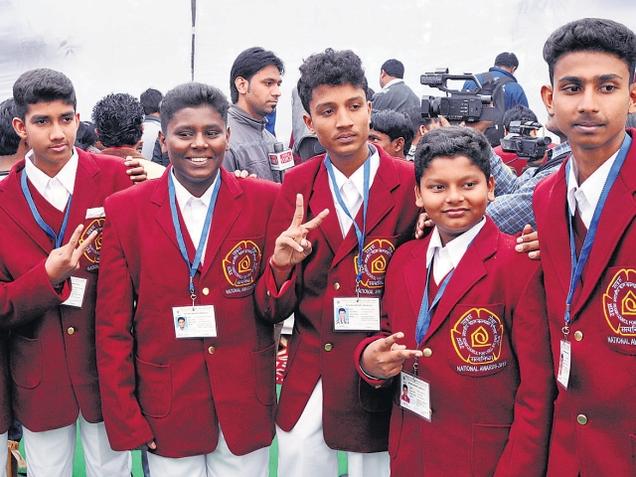
Children from the State who will be conferred with the National Bravery Awards 2016, at an interaction with the media in New Delhi on Monday. (From left) Beedhovan and Muhammad Shamnad (Kozhikode), Nithin Philip Mathew and Anandu Dileep (Kottayam), Aromal S.M. (Neyyattinkara), and Abhijith K.V. (Kannur). —PHOTO: SHANKER CHAKRAVARTY
Eight children from the southern part of the country, including six from Kerala and two from Telangana, are among the 25 National Bravery award winners this year.
The winners will receive the award, a medal, a certificate and cash price from Prime Minister Narendra Modi at his residence on January 24. The award recipients will also participate in the Republic Day parade on January 26.
One of the six winners from Kerala is Aromal SM (12), who saved two children from drowning in a 14-feet deep pond. Aromal has been honoured with the Bapu Gaidhani award.
Another winner from Kerala is Nithin Philip Mathew (13), who braved fire to save his neighbour’s family after their house caught fire in a cylinder blast.
“When I saw that my neighbour’s family was stuck inside their house because of a fire, I broke open the door and entered with the help of others to save their family,” said Nithin, who wants to become an IAS officer.
Beedhovan (14), who saved a boy from electrocution, is also one of the six winners from Kerala. Other winners from the State are Anandu Dileep (14), Abhijith K.V. (15) and Muhammad Shamnad (14) who saved people drowning. The winners from Telangana are eight-year-old Shivampet Ruchitha and 14-year-old Sai Krishna Akhil Kilambi.
source: http://www.thehindu.com / The Hindu / Home> National> Kerala / by Staff Reporter / New Delhi – January 19th, 2016