“The Hardayal library is an important signpost of our city’s history. We need to ensure that it is restored to its erstwhile glory,” said Jung.
In a meeting on Friday, Lieutenant Governor Najeeb Jung approved a Rs 3-crore grant for the restoration of the ailing Hardayal municipal public library in Chandni Chowk.
The meeting was attended by Commissioner (North corporation) representatives from the South and East corporations, the secretary and librarian and senior government officers.
“The Delhi Urban Heritage Foundation (DUHF) will look into the restoring the library’s outer and inner structure. A joint inspection shall be undertaken immediately to chart out the course to be taken and for removal of encroachments. Work shall also be undertaken to help digitise rare and old books in the library’s collection,” stated the Lt-Governor.
“The Hardayal library is an important signpost of our city’s history. We need to ensure that it is restored to its erstwhile glory,” said Jung.
Established in 1862, the library is more than 150 years old and is presumably the oldest one in Delhi. It has a collection of extremely rare and precious books, including books dating back to the 16th century.
It has a collection of more than 1,70,000 books in different languages, with 8,000 of these in the rare category section. It has 28 branches which are spread all across the three municipalities of Delhi.
source: http://www.indianexpress.com / The Indian Express / Home> Cities> Delhi / by Express News Service / New Delhi – August 29th, 2015
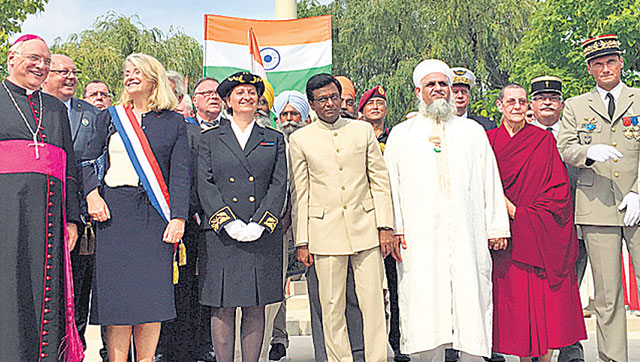
The Indian ambassador to France, Dr Mohan Kumar (centre), was also present at the ceremony to pay tribute to the Indian soldiers who fought in the First World War. (HT photo)
An interfaith commemoration for Indian soldiers who died in the First World War was held at the Indian memorial in France on Sunday. This year also marks the 100th anniversary of the battle of Neuve Chapelle (March 10-13, 1915) which was the Indian Corps first major action in the war as a single unit.
Organised by the Indian Interfaith association and the local French administration at the Neuve Chapelle memorial, the event was attended by more than 1,300 Indians of different religious groups and about 300 French guests, the organisers told HT.
The memorial commemorates over 4,700 soldiers and labourers from British India who lost their lives on the Western Front during the First World War and have no known graves.
“Many come to pay homage to the Indian soldiers here, but we wanted to read their last prayers as this had never been done” said Ramesh Chandar Vohra, President of the Interfaith association.
A local band played the Indian and French national anthems as well as the last post, the final salute to fallen soldiers.
Pradeep Kumar Singh, a business executive said, “Back home, we tend to forget about these thousands of people who travelled thousands of kilometres to fight in unfamiliar territory and unfamiliar climate for a cause and for enemies that were not theirs”
The event took on a nationalist flavor, with Indian flags being waved and slogans of “Jai Hind” and “Indo-France ki Jai” greeting the prayers read by Muslim, Hindu, Christian, Sikh and Buddhist religious leaders.
The Indian ambassador to France, Dr Mohan Kumar, told HT, “We should appreciate the fact that the relationship between India and France goes back not just 40-50 years but a whole century.”
source: http://www.hindustantimes.com / Hindustan Times / Home> World / by Noopur Tiwari, Hindustan Times, Neuve Chapelle / September 02nd, 2015
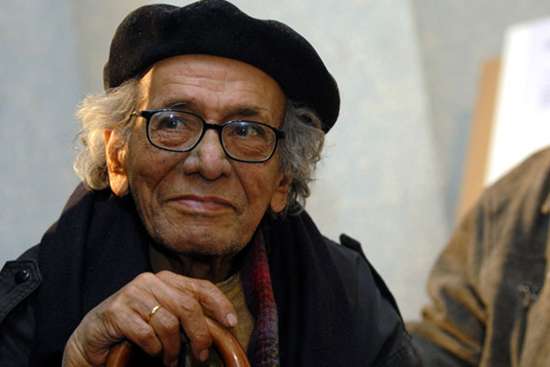
On the 92nd birth anniversary of the man the likes of whom are hardly around in Indian theatre any more. by Danish Husain
I have a habit of reaching places late. I got to work with Habib Tanvir only in the last 5 years of his life. And this has been one of my big regrets; I often wish my association with him had started earlier. I would have learnt more—about theatre, arts, culture and even life. His death deprived me of all this.
He was perpetually on the lookout for new faces. I was working with M.S. Sathyu in Dara Shikoh when a fellow actor Humayun Abbasi, a family acquaintance of Habib Saab, introduced me to him. I eventually got to work with him in Agra Bazaar. But my first meeting with him was much earlier as a manager in the Standard Chartered Bank. He was standing in the queue at the counter one day when I spotted him. Of course I recognised him, immediately pulled him out of the queue, escorted him to my desk, and sorted out his queries. Later when I narrated the incident to him, he remembered it. Since 2004-05, I became a regular member of the Agra Bazaar troupe.
The most amazing thing about Habib Saab was that he had multiple backup plans for any situation. He would never be perturbed by any news, however problematic. Even 10 minutes before a show, if there were last minute changes to be made, he would calmly go about making them. He could chop and edit a play at a minute’s notice and yet it would come together as a whole, complete in itself. The show wouldn’t stop ever. He would improvise as and when required.
At times his plays had 45-50 actors on stage, a pan-India cast with actors travelling from all over the country. They could be a logistical nightmare, but not for him. He would have multiple actors work on multiple roles so anybody could take over from anyone else in case of an emergency. He would call me “stepney”. “Jahan chaahe laga do” he would say. So I played many big and small roles—shayar, shohda, patangwala, even a crowd member in Agra Bazaar.
He had an eye on everything, every aspect of the play, from lighting to music to costumes, props, sets, you name it. He had an eye for detail. There was a sense of rootedness in his works. The texts were anchored in a defined sensibility, culture, ethos and zubaan. His understanding of his material was immaculate. The enormity and nuance of it would sink only after multiple performances. Bahut badaa mayajaal tha unka but you would understand the big picture when you figured out how the smallest of the components operated.
Each of his plays had this layering and subtlety which hit you and stayed with you much after you had watched the play. The play demanded to be seen again and again. One had to revisit it to absorb and savour it. Each time you viewed a specific play a new window of meaning opened on you.
He had once referred to himself as a “benign dictator”. I remember hearing that in one of the documentaries made on him. He never wielded a hammer during rehearsals. He would sit with a pipe in a corner and intervene only when someone went off tune. He had this ambivalent relationship with the Chattisgarhi actors. They were idiosyncratic and difficult to handle. In fact, the character of policewala in Charandas Chor was Habib Saab himself, metaphorically, constantly chasing and steering his actors. It was about his own struggles as a director. The actors, on the other hand, would have problems with him yet could not live without him. He could steer and keep the herd together because he had a fine understanding of human nature. The actors would often get drunk and riled up post performance and would misbehave with him but he would just sit calmly and hear them out. Next day, when the hullabaloo would be over, the actors would tremble, wait for a reaction from him. But he wouldn’t react, he’d be silent and use it effectively. It intrigued and worried them and they would come around. He managed to take them all along. They would fight, leave and come back. But things kept moving. They wouldn’t halt. No wonder then why there were instances of three generations of actors working with Naya Theatre.
His grounding, thoughts and understanding are missing now. Naya Theatre was self funded through invited shows. The grants were not very huge. One hears that the land allotted to him for the repertory also got usurped. Yet he kept Naya Theatre going for 50 years, it has survived six years after he is gone. If things are not seeming bright it’s also because of the government’s failure to recognise true artistes and what fosters a culture. He was a true visionary, a one in a century kind of man, the likes of whom are hardly around in Indian theatre any more.
source : http://www.outlookindia.com / Outook / Home> Arts & Entertainment – Opinion / by Danish Husain / September 01st, 2015
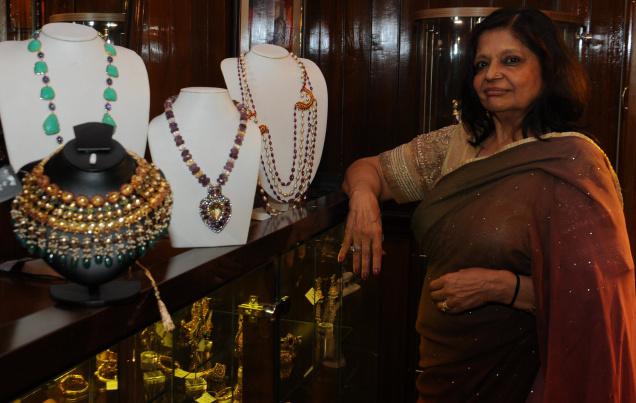
Former minister Nafees Fazal has launched her own jewellery studio
Nafees Fazal, a former minister for Medical Education and Science and Technology, in Karnataka “loves politics and jewellery. I have a passion for beautiful things,” explains the lady herself. Dressed in an elegant sari, she is not wearing any jewellery herself. “I don’t like to look like a Christmas tree all the time. A lovely sari, draped well, is enough to get me through the day,” she beams.
Nafees is now in the news as she launched her own jewellery studio called The Private Collection by Nafees Fazal. She has converted a room in her bungalow into the studio. “Having a studio at home helps me cut the overheads,” she explains.
As of now she has a limited range of jewellery called the “Naf Collection”. “Naf is short for my name,” she says, and dons the role of a model as she stylishly demonstrates how a particular piece of jewellery must be worn or carried in style.
“I am itching to get back into politics. But what do I do in the meantime? I can’t play housewife all the time. I decided to travel, and curate this collection for women. Who doesn’t love jewellery?” asks Nafees. The collection, currently on display, starts at Rs. 4,000. It is collected from Tanjavur, Rajasthan, and Delhi over the “last four months”. It offers designs in precious and semi-precious stones, antique pieces from Trivandrum, “which are bought at the princely sales”. Then there are jhumkis, large earrings, kangans, neck pieces and so on.
From bridal wear, to party wear or just making a style statment, the collection has something for every occasion. “They are created in silver, plated with gold, and come with kundan in polki and other hand works. Hence, it brings the cost down drastically. The aim is to offer the traditional with a touch of modernity. Part of the proceeds will go towards my Kare Foundation, which was started to help poor patients in 2009,” states the former minister.
She adds that she is “passionate to help the poor”. “I do not have crores but am all game to help those in need.”
Will she get into designing as well? Pat comes the reply, “No! I am not into manufacturing but only curating. I need to get back into politics. This is just a hobby. The studio will continue. I assure you that there is something stylish for everybody here.”
source: http://www.thehindu.com / The Hindu / Home> Features> MetroPlus> Fashion / by Shilpa Sebastian R / Bengaluru – August 31st, 2015
For international rock and metal bands, India is on the top of their bucket list. Members of the music fraternity share their opinion.
‘Metallica’ a Heavy Metal Band performing a live concert at Palace Grounds, in Bangalore on October 30, 2011. Photo: K. Bhagya Prakash
Most of us spent our growing up years listening to iconic bands such as Iron Maiden, Metallica, Megadeth, Lamb of God, Mr. Big, Michael Learns To Rock and Cannibal Corpse among other legends on our walkmans and CD players. Much of our time went into memorising the lyrics and for the aspiring musician in us, learning and practising the riffs and beats. But none of us would have ever imagined getting to watch these childhood heroes perform live in our own country.
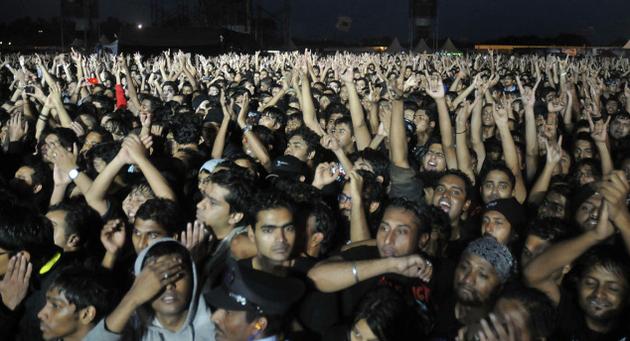
Fans during ‘Metallica’, the heavy Metal band’s live concert at Palace Grounds in Bangalore on October 30, 2011. Photo: K. Bhagya Prakash
Today, international bands are not only pulling in massive crowds to their gigs but also opening doors to discovering new audiences. India, particularly Bengaluru, has turned into a must-visit destination for international bands and in the last decade alone, a plethora of international acts have ticked India on their bucket list, some more than once. Here is what some of the country’s musicians have to say about the trend.
What set it off
Tony Das from ‘Peepal Tree’ says one thing that played a pivotal role in this rush of bands is that we were starved of them for quite a while.
“So when the time came, the fans of the slightly older bands that were around for a long time, jumped at the opportunity. Until recently, shows by international acts were random, erratic and rare. I guess they found a way to make it profitable especially with fans waiting for so long. Also, over time, people have developed a slightly more serious taste for music. People really love their music here and are willing to pay any amount to attend shows. My dream band to perform in India is American rock band Extreme since I’m a huge fan of frontman and lead guitarist Nuno Bettencourt.” Rajeev Rajagopal from ‘Thermal And A Quarter’ agrees that it is no surprise international bands head to India, and specially metro cities.
Role of language
“Among most metros, English is quite widely used. Also, the people in the country have developed a taste for international music from the Brit hangover here. It’s an international language and the audiences here listened to a lot of music. Hence, the reputation of a place really picks up. International bands know they will get an audience here. My dream band is American jazz band Steely Dan.”
Freelance musician and principal of Wings School of Music Ashley Joseph admits that India has always been a potential market for big bands with its big festivals. “The festivals are not only specific to one genre and there are a lot of blues and jazz artistes who also come down. There is an audience for everything here. India, in general, caters a wide range of audiences across genres. Artistes from here also have a significant audience abroad. My favourite band that must visit India is Rage Against The Machine/Audioslave.
Salman U. Syed, the promoter of the Bangalore Open Air metal festival, says India is also a new market since bands have been touring the States and Europe from the 80s itself. “Asia and India have always been a new market for these bands since they are a newer audience. My dream band that definitely needs to make a pit-stop iin India is British heavy metal band Judas Priest.”
Nathan Lee Harris from ‘Galeej Gurus’ points out that a lot of bands are now aware that there is an audience for their music. “These are mainly the newer bands, exploring third world countries before their music fizzles out. But I don’t have the same opinion for older bands. I believe that when they come to the Indian market, which they avoided 20-30 years ago, it is only to make a quick buck and go back. It’s quite obvious. Also on the flip side, these bands are now slightly more affordable. At the peak of their careers, we could not have afforded to bring them down. Now, since they are not at the peak of their careers, it’s easier to raise a sponsorship without feeling the pinch. My dream band, and most other musicians will also approve, is legendary Irish rock band U2.”
Jagadeesh M.R from ‘Moonarra’ says: “For bands from Europe and the States, India is affordable and has rapidly turned into a hotspot. The audience are quite varied and awareness of international music happens all the time through social media and the Internet. Musically, we are much more eclectic and even though Bollywood has a strong presence, other forms of music also survive and thrive, especially with alternate music culture. My dream artist will be Stevie Wonder.”
source: http://www.thehindu.com / The Hindu / Home> News> Cities. Bengaluru / by Allan Moses Rodricks / August 31st, 2015
A group photo of the prize winners with the guests and organisers.
Mysuru :
GRS Junior Talent Star-2015 contest, sponsored by GRS Fantasy Park, Mysuru, for the 5th year, was held at Jaganmohan Palace in city recently for students from 5th to 7th stds (both Kannada and English medium). The events included pick and speak, collage-making, handwriting and solo dance. In all, 1200 students from 94 State, CBSE and ICSE schools participated.
Subaraya Baliga, Chairman, Baliga Investments Pvt.Ltd., was the chief guest. Director Yogesh Dange welcomed. Directors Pushpalatha Baliga, Dayananda Kudava and Manjunath Nayak were present on the occasion. The event organisers were Ananda Ram, Geethalatha, Gunaranjan and Adithya of Agee’s Events.
Winners of collage-making:
P. Surya, S. Keerthi, S. Sanketh, Faiza, Rohan Lobo, Diya Crystal Menezes, Rakshita D. Shastry, D. Anushya, K. Chandra Kanth, Mir Khayum Shauddin, M. Prarthana Sharon and Syeda Ammarah.
Pick & Speak:
B. Suraj, Adil Ameen, Tejonidhi S. Dixith, U. Parvitha;
Handwriting :
V. Deeksha, V. Kusum, V. Manoj Kumar and S. Spoorthi;
Solo dance:
K.N. Naman Patel and Anan S. Gowda.
source: http://www.starofmysore.com / Star of Mysore / Home> General News / Saturday – August 29th, 2015
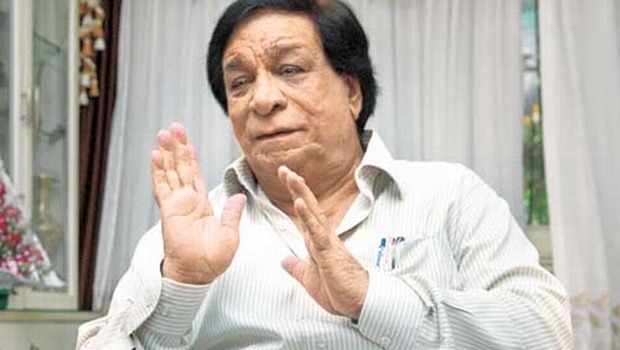
Versatile actor-writer Kader Khan has said that after his illness, producers and directors were unwilling to take him in their films.
Kader Khan, who was present at the trailer launch of his upcoming comedy “Hogaya Dimaagh Ka Dahi”, was clearly having difficulty in talking and walking.
“Some people refused to keep me with them. I was a little unwell. And people refused to take me back into their films,” he told the media.
But Kader Khan is pleased with the conduct of director Fauzia Arshi.
“It is only Fauzia who took good care of me, kept on motivating me. There was freedom from Fauzia right from the first meeting. She is an outstanding director,” he said.
Om Puri, Rajpal Yadav, Sanjay Mishra also star in the film, and Kader Khan termed them ‘thespians’ and expressed delight at getting the opportunity to work with all of them together.
“When there is ‘Dimaagh Ka Dahi’ (extreme irritation), the person gets distanced from oneself. When I got distanced from my films, I got distanced from myself.”
Kader Khan was known for his work as a writer for numerous films with noted directors like Manmohan Desai and Prakash Mehra, as well as dialogues and screenplay for Amitabh Bachchan’s films.
“There has been a difference in the level of writing. As a writer, I feel that I should come back. I’ll try my best to bring the earlier ‘zubaan’ (language) back and people are definitely going to enjoy talking in that ‘zubaan’.”
Kader Khan said he wishes to remake his production “Shama” and is writing a script on his “Parchai”.
source: http://www.newindianexpress.com / The New Indian Express / Home> Entertainment> Hindi / by IANS / August 28th, 2015
President Pratibha Patil has issued an order on Sep 23, appointing state Lokayukta’s additional registrar Moosa Kunhi Nayarmoole as a judicial member of the Karnataka Administrative Tribunal (KAT). He has served as additional registrar since 2009.
Born of Haji Moidin Kutty and Fatima Hajuma in Nayarmoole, Manila in Bantwal taluk in 1952, he pursued primary education in Pakalakunja HP School and high school education in government high school in Paivalike.
After completing B Sc in Vivekananda College, Puttur, he later studied Law in Udupi and secured sixth rank in the final examination. He began practice as junior to advocates, the late T Yusuf Hyder and M Seetaram Shetty in Mangalore.
He made his entry into the judicial service by being appointed as munsiff and first class magistrate in 1983. In 1992, he was upgraded as civil and chief magistrate and in 2000 as district civil judge.
He has served as city civil and sessions judge, chairman of Karnataka Waqf Tribunal, additional director of Karnataka Judicial Academy, secretary to the chief justice of state high court, additional secretary to state law, justice and human rights department and immediately before the present appointment as additional registrar at the Lokayukta.
source: http://www.mangalorean.com / Mangalorean.com / Home / by Team Mangalorean / October 04th, 2011
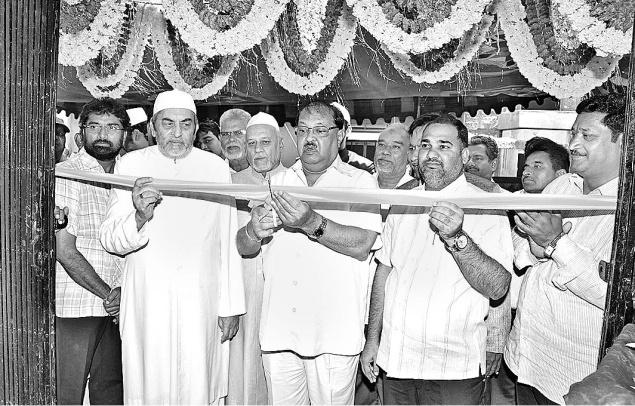
Municipal Administration Minister Qamarul Islam inaugurating the newly constructed toilet and bathroom block at the Khaja Banda Nawaz Dargahin Kalaburagi on Tuesday.— PHOTO: ARUN KULKARNI
New toilets, bathrooms will be open 24 hours for pilgrims visiting the shrine
The famous Khaja Banda Nawaz Dargah, frequented by thousands of pilgrims every day, now has a modern multi-purpose block consisting of kitchen-cum-dining hall with store room, exclusive toilets and bathrooms for the pilgrims visiting the dargah.
Up until now, the dargah had limited toilets and bathrooms which remained always overcrowded due to the heavy flow of pilgrims. At the time of the annual Urs, the situation used to become very difficult.
The new block constructed at a cost of Rs. 2.25 crore is entirely funded by the Karnataka Urban Infrastructure Development Finance Corporation-North Karnataka Urban Sector Investment Programme (KUIFDFC-NKUSIP) with the Asian Development Bank (ADB).
The multipurpose block has 125 toilets and 39 bathrooms, with exclusive bathroom and toilets for the physically challenged persons.
The kitchen facility has six cubicles, a tone room and a slaughter room also. The entire block is constructed on 1,098 square meters and this would be maintained by Sulab International. Inaugurating the new facility on the dargah premises, Municipal Administration and Minority Affairs Minister Qamarul Islam said that the long felt need of the pilgrims has been fulfilled.
Another toilet block constructed at a cost of Rs. 40 lakh has been completed and handed over to the authorities, he said.
Mr. Qamarul said that the multipurpose block would be available for the use of the general public and the pilgrims visiting the dargah for 24 hours.
The annual urs of the Khaja Banda Nawaz Dargah is scheduled to begin on August 30.
Sajjada Nasheen of the Khaja Banda Nawaz Darga Dr. Syed Shah Khusroo Hussaini, in his brief address, thanked the State government and the former Union Minister M. Mallikarjun Kharge for sanctioning the multipurpose block to the dargah.
source: http://www.thehindu.com / The Hindu / Home> National /by T.V. Sivanandan / Kalaburagi – August 26th, 2015
The Government of India is planning to set up a venture capital scheme to promote start-ups in the pharmaceutical sector.
Addressing a Roundtable session on Bio-Pharma 2015, M Aziz Ahammed, Joint Secretary, Department of Pharmaceuticals, said the scenario of drug discovery is changing as more start-ups are involved in the discovery of new molecules, which are later acquired by bigger companies.
₹1,000-cr corpus
Ahammed said the Centre is formulating a Venture Capital scheme that would benefit young entrepreneurs. The scheme with a proposed corpus of ₹1,000 crore, which is under formulation, will aid the start-ups in new drug discovery.
Ahammed said, “Only when India invests in drug discovery, the prices will come down, which will benefit Indians as well as entire humanity.” To encourage drug discovery and innovations, National Institute of Pharmaceutical Education and Research (NIPER) has been established in Guwahati, Ahmedabad, Lucknow, Kolkata, Hyderabad, Patna and Punjab.
Campus at Madurai
A new campus will be built in Madurai at a cost of ₹500 crore.
P Shanmuga Sundaram, Managing Director, Tamil Nadu Industrial Developmental Corporation (TIDCO) and TICEL, said TICEL Bio Park I and II, which provides lab infrastructure facilities for bio-pharmaceutical industries, houses 30 such incubators.
Bio parks planned
TICEL Biopark III that is proposed to be built in the Anna University campus, Somayampalayam village, Coimbatore at the cost of ₹55 crore, will focus on agro-food processing and poultry vaccine.
Sundaram said the aim of bio parks is to encourage research and development of new drugs and vaccines.
source: http://www.thehindubusinessline.com / Business Line / Home> Economy> Policy / by The Hindu Bureau / Chennai – August 26th, 2015