Not many know that Bhagat Singh, who was hanged to death on March 23, 1931, by the British government for the murder of police officer John Saunders, stayed in Agra for months after committing the murder. Though locals have made something of a monument at the spot, the district administration has shown little interest in conserving the site, besides passing a bill to name Noori Darwaza after Bhagat Singh in 1962.
According to historians, when Bhagat Singh and Bijoy Kumar Sinha were chalking out their course of action after murdering Saunders, they held a meeting in Delhi. There, they decided to go for mass awakening, protests, and also changed the name of the party from Hindustan Republican Association to Hindustan Socialist Republican Association.
“They also decided that the organization should be broadly divided into two groups, mainly the active group and the sympathizers. They also decided to setup the new party’s headquarter,” informed SP Singh, head of the history department at Christ Church College, Kanpur.
He added that the team of revolutionaries decided to keep the party headquarters in Jhansi but later it was changed to Agra. They reached Agra in 1929, took two houses on rent and started training their supporters. With his ever increasing zest for study, Bhagat Singh began to build up a small library in Agra. With this purpose he roamed around, begging for books from sympathizers. In a short time, a distinctive though small library grew up here and the most important section among the books were of course, Economics.
However, currently no library exists here at Noori Darwaza whose official name should have been Shaheed Bhagat Singh Marg, according to the local petha makers. The house where he lived for three months is lying in a dilapidated state.
Former ward corporator Ratan Bharti said that the decision of changing Noori Darwaza’s name to Bhagat Singh Marg was taken in 1962.
“The civic body of Agra had its first elections in 1959 and in the third annual session of municipal corporation, it was decided that Noori Darwaza would be renamed to Shaheed Bhagat Singh Marg. A bill was passed but it remained confined to paper only. The locality is still called Noori Darwaza,” added Ratan Bharti.
Even the voter IDs of the locals says Noori Darwaza instead of Shaheed Bhagat Singh Marg.
“It is shameful that the government and its representatives are least bothered about preserving history and its evidence in Agra. It was only after a prolonged struggle that locals managed to build a statue of Bhagat Singh in 1970. We would also have an annual fair in the name of Bhagat Singh for years, starting from 1978 till 1983,” said Vijay Sharma, a social activist and member of Indian People Theatre Association (IPTA) who used to organize the fair in the name of Bhagat Singh.
He added, “Many attempts were made to ask the administration why they are not renaming the locality as Bhagat Singh Marg to which they said they haven’t received any official confirmation for renaming Noori Darwaza, from the civic body.”
source: http://www.timesofindia.indiatimes.com / The Times of India / Home> City> Agra / by Ishita Mishra, TNN / March 23rd, 2015
Wake up your buds A typical Mappila feast, biriyani, parottas and suleimani tea / by Sivaram V
Malappuram, carved out for a religion, now holds a key to Kerala
SIgnboards with the ‘Al’ prefix are the second indicator that you are in Mappila (Kerala Muslim) country, the first, of course, being a sartorial style that you cannot miss. This is Malappuram district in north Kerala. Once considered a basket case for its economic, educational and social backwardness, the landscape now bristles with confidence, one that only prosperity, political prowess and education can bring. Malappuram, with over 60 per cent Muslims, was carved out from the districts of Kozhikode and Palakkad way back in 1969 by the then chief minister, the Communist E.M.S. Namboodiripad. It was a political move to appease the Left government’s coalition partner—the Indian Union Muslim League (IUML)—who had demanded a district for the Muslims. Interestingly, it was a first time for the IUML in government. Today, its clout in the Congress-led UDF regime has jumped manifold. With five ministers and crucial portfolios, the IUML can even claim they are in charge of the ‘Kerala sarkar’.
But beyond the sleepy boundaries of Malappuram, there are other forces at play now. A new brand of nationalism seeks to divide rather than unite, one where patriotism hinges on one’s religious identity. Questions have also been asked of Malappuram—is it a “mini Pakistan”, is there a rise in religious fundamentalism there? The district authorities says Malappuram is a peaceful district, that there is absolute communal harmony. But one has just to trawl the net to see the fear-mongering being drummed up—reports of the Hindu minority’s struggle to exist here and further, about the love jehadis roaming the streets of Malappuram on the lookout for Hindu girls to convert to Islam. A website (www.hinduexistence.org) even harks back to 1921 and the Mappila rebellion to remind people of the “devastating revolts and massacres”—described as “killing lakhs of innocent Hindus overnight”.
In order to verify this “account of history”, we travel further north from Malappuram town to Parappanangadi. We cross the angry, muddy Kadalundi river in full spate and zig-zag through roads lined with giant ‘Gulf houses’, each trying to garishly outdo the other (some six lakh people from the district work in the Gulf today.) We pass the historical town of Tirurangadi known for its major revolts against the British and arrive in Parappanangadi to meet with historian M. Gangadharan, who’s authored a book on the revolts of the region, The Malabar Rebellion. Gangadharan, 80, refutes the argument that the Mappila rebellion was any sort of vendetta against the Hindus. He says, “The Mappila resistance was against the British political set-up that had imposed high taxes and empowered the janmis (usually from the Hindu high castes) to exploit the Mappila tenants. They did not attack the Hindus indiscriminately but the violence did frighten them and many did leave the area.”
The Muslim grievances and the revolts were successfully harnessed by Gandhiji during the freedom struggle. Says Gangadharan, “In the second decade of the 20th century, when the Mappilas organised themselves, they received support from the nationalist movement that cleverly linked this rebellion to the Khilafat agitation…. Trade ties between India and the Arab countries meant that the Khilafat movement affected Kerala’s Mappilas. Initially, the movement wasn’t violent but the British oppression and tortures forced the hand of Mappilas. Today, the Hindu fundamentalists are trying to change the narrative to suit their own needs.” On a personal level, Gangadharan says he’s never felt insecure living in a Muslim-dominated area.
This predilection for protests is seen even today. In Parappanangadi town, we witness a silent procession of schoolchildren marching against the Israel attacks in Gaza. K.T. Jaleel, independent MLA (Left-backed) from Thavanur, says Malappuram partakes of Kerala’s anti-imperialistic streak, “We saw protests when Saddam Hussein was killed and we continue to see protests against imperialistic powers. But we are not communal, even post-Babri Masjid there were no clashes here. The Muslims in Malappuram are secular and progressive and have merged with the mainstream.” At the same time, a sullen withdrawal has often been ascribed to them too, as is a tendency to adopt the visible gestures and cues of a modern pan-Islamism, especially in response to inimical global and domestic politics.
Photograph by Sivaram V.
There is an underlying, historical delicacy too. Many Muslim political leaders of Malabar had supported the Partition, crowding out nationalist Muslims who didn’t—their grievance was that India’s mainstream leaders did not come to their aid during the Mappila rebellion. So the creation of a district for Muslims was always viewed with some diffidence by non-Muslims. There are few complaints in the district itself though. “They are secular and progressive,” says Manamboor Rajan Babu, who’s lived in Kuttinangadi for the past 39 years. Rajan Babu is an ex-policeman, novelist and editor of Innu, an inland magazine. “I live in the midst of three Mohammeds,” he jokes. “The neighbours are caring folks. I settled here because of my Muslim friends. The majority do not accept the fundamentalist views of the fringe elements, which is why it doesn’t get much traction in Malappuram.” And anyway, the IUML is in the political business here and they won’t allow the fringe to grow, he feels.
The IUML itself is a curious entity, as corrupt as any other Indian party (if media reports are to be believed), but without any overt fundamentalist agenda. A small reformist group called Aikya Sangham was created in the 1920s to ameliorate the lot of Muslims and harmoniously settle land disputes between Hindus and Muslims. From this stock arose the Muslim League in Kerala and that morphed into the IUML. The League supported the formation of Pakistan so after independence they were sidelined by the nationalist parties. Says political analyst and advocate A. Jayashankar, “After the ems regime fell in 1969, they joined the Congress and ever since have been a major factor in UDF governments, especially since 2001 when the number of their ministers went up to four. At present, they have five. The fifth ministerial berth going to an IUML MLA from Malappuram created a furore in Kerala. The Nairs (NSS) and Ezhavas (SNDP) have felt insecure ever since. The rise in the BJP voteshare in Kerala can be attributed to the flexing of muscles by the Muslims in the ‘minority’ government in Kerala.”
The delimitation based on area population after the 2011 census gave a further boost to the IUML. Most districts in Kerala showed negative growth, but Malappuram registered a decadal population growth of 13.45 per cent since the census. The number of legislative constituencies was increased in the district from 12 to 16 in the last polls. “The Muslim-dominated areas of Kozhikode, Kannur and Palakkad also benefited with an increase in one seat while the Christian-dominated belt of Kottayam, Thrissur and Pathanamthitta lost four seats due to a decline in population,” says Jayashankar. In the 2011 assembly polls, the IUML took 12 of the 16 seats in Malappuram and became the third largest party in the state after the Congress and CPI(M) with 20 seats.
Historian M. Gangadharan at home. (Photograph by Sivaram V.
Kerala’s coalition politics depends on a delicate sharing of spoils, and competition is intense. The recent muscle-flexing by the IUML has not gone down well with the state’s other major religious lobbies. Again and again, the references return to an obsession with population figures and what is seen as increasing control over power stakes. Says political watcher P. Rajan: “Creating a district based on religion was not a wise decision. A district should be created for topographical and geographical reasons. The League benefited politically from the differential in population figures too. But to demand a fifth ministerial berth in the UDF government was not a good move. The Nairs and the SNDP have been highly insecure and the ramifications were seen in the Neyyatinkara byelection, with the BJP coming a close third. In the next state elections, the BJP will be a force to reckon with if the IUML continues with its brazen ways. The Congress has been nervous ever since the Lok Sabha polls. Their voteshare has dipped in many of the Thiruvananthapuram assembly seats.”
Jaleel, who left the IUML and supports the Left, says, “I left the IUML because it’s very corrupt. I questioned the use of funds that they had raised for various issues. The people of Malappuram aren’t always faithful to the IUML. In the 2006 assembly polls, the CPI(M) and the IUML got five (of the 12) seats each, some of the IUML ministers even lost by huge margins. This event can’t be underestimated…people here a more progressive lot.”
Indeed, in the midst of all the fear of growing radicalism, of non-native signs like the skull cap and the burqa, the Malappuram Muslim has been changing—yes, somewhat radically—in other ways too. It’s no longer the backwaters. Decades of remittances have created a more globalised second generation. The number of educational institutions has increased. It has caught up with the rest of Kerala; even rank-holders have emerged from the district. S. Irudayarajan of the Centre for Development Studies, Thiruvananthapuram, says, “About 25 years ago, Malappuram was Kerala’s most backward district. Between 1990 to 2000, unskilled workers came from Malappuram, from 2000 to 2010 there was a rise of semi-skilled workers; 2010 on, even high-skilled workers have been migrating from there.” The natural corollary of swelling remittances—it gets the largest share—ensures that, whichever coalition governs the state, its political fortunes will depend quite a bit on the electorate of Malappuram.
source: http://www.outlookindia.com / Outlook / Magazine> Society / by Minu Ittyipe / Special Independence Day Issue / August 25th, 2014
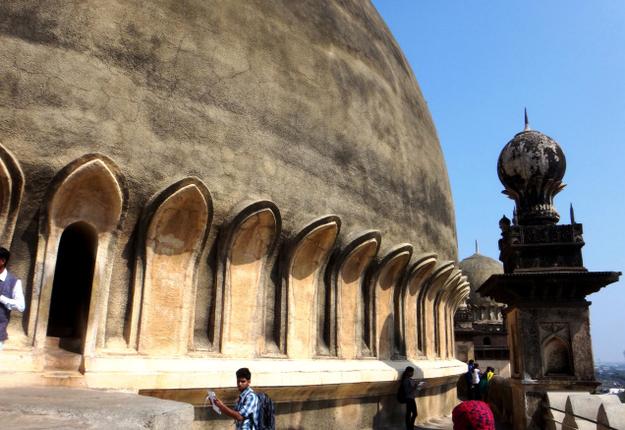
Gol Gumbaz, an elegant edifice located in a sprawling 70-acre manicured estate in Bijapur, deserves much more attention from tourists than what it is getting.
Considered the most beautiful building in the world, Taj Mahal nonchalantly dismisses other ancient constructions across the Indian subcontinent. This was evident as I recently ventured into the hinterlands of southern India to discover a magnificent medieval monument. Dominating the landscape of Bijapur in the Deccan plateau of Karnataka is India’s largest antiquated but amazing dome that is aptly called Gol Gumbaz.
Once upon a time Gol Gumbaz was the only major structure visible on the horizon of ancient Bijapur but today it is sheltered in a sprawling 70 acre manicured estate. It is passionately preserved by a small army of gardeners, guards, horticulturists and archaeologists.
Gol Gumbad at Bijapur / by Special Arrangement
Constructed with diligent dexterity this mammoth monument has a dramatic dome that snugly sits atop an equally colossal tomb. With an age tag of nearly 357 years, Gol Gumbaz is a unique mega structure of incredible India. It is a must-see for every admirer of olden-golden era of our country.
The elegant edifice equating a seven storied structure is befittingly surrounded by lush lawns under the surveillance of the Archaeology Survey of India (ASI). While some historians reckon that Gol Gumbaz is the second largest dome in the world, others deem it to be the biggest in Asia with a robust history.
Despite the disputed status it is worth admiring not merely for its sheer size but the mighty effort of translating tons of raw materials into a desirable structure. In the bygone days when mechanical paraphernalia was non-existent, pure horsepower and manpower was shrewdly applied to erect such an enduring edifice. It took away my breath as I energetically ascended the spiralling narrow stairway that can make the faint hearted pant and rant. Once on the uppermost balcony abutting the outer dome, the views of the tiny town all-round were spectacular and the inside of the dome was even more enchanting.
Curiously Gol Gumbaz (1627) and the Taj Mahal (1632) began construction during the same period by two different sultans governing independent swathes of land. Taj being in the north and the other in southern India separated by 1500 km, obviously were not aware of each other’s strategy. Although Gol Gumbaz took 29 years to complete, the Taj Mahal took 22 years to finish and the former is almost double the size with massive measurements. I pondered whether Taj Mahal has a feminine fetish, while the Gol Gumbaz is geometrically masculine. At any given time more than three million tourists visit the Taj Mahal in a year, which is double the current population of Agra. Comparatively very few travellers visit Gol Gumbaz just because it is not on the regular tourist trail and also not adequately publicised.
Gol Gumbaz is actually a mausoleum of the seventh Sultan of the Adil Shahi dynasty, his two wives, mistress Rambha, daughter and a grandson. Being an architecture marvel it is not only known for its astounding dimensions but also unique acoustic features. This edifice, without doubt, ranks among the most imposing ones in India.
The foundation of this tomb is exceptionally engineered to rest on bedrock which has prevented any unequal settlement. The width of each of the sides is equal to the height at 200 feet. The exterior diameter of the top dome is 144 feet while the interior of the structure is a single large hall, one of the largest ever built, measuring 135 feet across and 178 feet high. The four tall twirling minarets at the corners of the mega tomb are actually a series of steps leading to the top. The inside balcony is called the ‘Whispering Gallery’, because even the faintest whisper or rustle gets magnified like an echo and is truly fascinating.
Bijapur is effortlessly approachable from far and wide because of admirable driving roads. It is nearest from Sholapur at 100 km; Goa at 340 km and 530 km northwest of Bangalore but I preferred to self drive 380 km west of Hyderabad in a friend’s car and explore the town of tombs and domes. Avoiding the highways I romanced the rural roads, stopping once in a while to be smitten by wild water birds frolicking in pristine lakes and experience the rustic atmosphere.
Geographically Bijapur district consists of plain land devoid of any hills and dales. However the Deccan plateau provides enough rocky terrain to excavate stone material for construction. In an introduction to “Architecture at Beejapoor” published in 1866, Philip Meadows Taylor, an Anglo-Indian with a voracious appetite for Indian culture wrote: “Palaces, arches, tombs, cisterns, gateways, and minarets …all carved from the rich basalt rock of the locality, garlanded by creepers, broken and disjointed by peepul trees, each in its turn is a gem of art and the whole a treasury.”
I was so impressed with the Gol Gumbaz that I lingered all day walking all around for different perspectives and ruminating of its past glory. As Bijapur is still strewn with more than 300 mosques, mausoleums, tombs, domes and many ruins, I made up my mind to revisit.
Only a full week of meandering among the other monuments, which are also splendid specimens, would satisfy my hunger for relishing relics and remnants. Meanwhile the Gol Gumbaz deserves to be on the coveted list of world heritage sites and the government is making all efforts to accomplish that.
source: http://www.thehindu.com / The Hindu / Home> Features> MetroPlus / by M. Shiva Kumar / March 29th, 2015
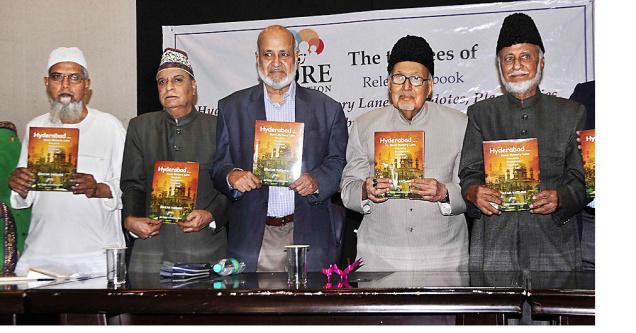
(From L to R) J.S. Ifthekhar, the translator of the book, Rafiuddin Qaudri, president of Dr. Zore Foundation, Mohd Ziauddin Ahmed Shakeb, noted scholar, M.M. Taqi Khan, professor of Chemistry, and Ghulam Yazdani, author of the book, Hyderabad … down memory lane , at the function.- Photo: G. Ramakrishna
Once Makhdoom went to a hotel late in the night and placed order for ‘khushka-salan’. Pat came the reply, ‘khallas’ (meaning finished).
‘Khorma-sheermal?’
‘Khallas’ was the reply again.
Makhdoom was naturally upset when he reeled out names of few other dishes and got the same reply – ‘khallas’.
In an irate tone he asked, ‘Is it a hotel or Makhdoom’s house?”
That was the pitiable situation noted poet Makhdoom Mohiuddin found himself in. Sample this one.
Famous Urdu poet Faiz Ahmed Faiz was being welcomed at the Urdu Hall in Hyderabad.
In her speech, a playful Zeenat Sajida, remarked, “Faiz sahib writes poetry in Urdu but romances in English.”
Those present in the hall broke into uncontrolled laughter as everyone knew Faiz had married an English woman.
These are some of the little known things to be found in senior advocate, Ghulam Yazdani’s bookHyderabad … down memory lane released here on Saturday evening. The book, an English version ofKuch Yadeyn Kuch Bateyn is translated by J.S. Ifthekhar.
The 216-page book published on art paper is a collector’s item. It covers a wide range of subjects right from royalty to literature, culture, cuisine, architecture. Mr. Yazdani finds an interesting angle in all these things to tickle the funny bone.
“You can read it from anywhere and yet enjoy it,” remarked Dr. Mohd Ziauddin Ahmed Shakeb, noted scholar about the book, published by Dr. Zore Foundation.
Well-known scientist M.M. Taqi Khan released the book.
Deputy Chief Minister Mohd Mahmood Ali, who was to have released the book didn’t turn up.
Mr. Yazdani said after the success of his Urdu book released last year, many persons unfamiliar with the language, felt disappointed.
Therefore, he decided to get it translated into English for wider readership.
Prof. Fatima Parveen, general secretary, Zore Foundation, welcomed the gathering.
As Dr. Fatima Shenaz put it, the book captures the spirit of Hyderabad and its socio-literary culture.
source: http://www.thehindu.com / The Hindu / Home> News> Cities> Hyderabad / by J. S. Ifthekhar / Hyderabad – March 30th, 2015
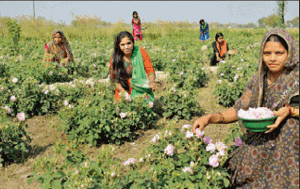
At Khitoli village, Hasayn, Hathras district, mid-March is when the process for extracting rose essence (ruh) begins. The process will go on till the end of April, over a period of 40 days. There is a big rose mandi here. Ask farmers what the secret of the rich aroma of the roses of this region is, and the answer is unanimous – human poop.
The rose of this region is called “Noorjehan” – jewel of the world — after the wife of Mughal emperor Jahangir. The air in the village at this time year is laden with the aroma of roses.
Workers are seen plucking roses early in the morning, while dewdrops are still on the buds. They measure the roses, add bunches of them into water to steam in a large copper container called degh to extract ruh. About 250 kg of flowers yield just 40 gm of ruh.
Work on the floriculture crop begins in October each year, with the sowing of seeds.
“The good yield of the rose is because of fertile land – and if you are thinking what makes the soil here especially fertile, it is human poop,” says Mahesh Pal Singh, former pradhan of the village whose father Veer Pal Singh started the work of rose essence extraction some 65 years ago in Khatoli. Veer Pal Singh died at the age of 108 last week.
“The farmer is also a scientist,” Singh says. “He knows what is good, what is not. Most of us avoid cow dung and prefer human poop in our fields as manure. Almost 95% of our villagers don’t have toilets at home. All the men, women and children answer the call of nature in the fields. That is why the produce in the village is far better than what is grown in farms away from human habitation.”
One cannot then help wonder if toilets in village homes is at all a good idea then, in this part of Hathras district.
“The toilets are only part of the big houses here. Just about five village homes here have toilets – the rest go to the field. That is what is best, not just for the rose crop, but also for potatoes. We need bijli (electricity) and sadak (roads) rather more urgently that toilets. It would save us the bother of going out of the way to transport our produce,” farmer Bahadur Singh says.
“And what when every house has a toilet?”
“There will be no roses then,” the farmer says, with quiet conviction.
The essence extracted from the rose is later used in tobacco, perfume and soap manufacturing.
Horticulture officer Kaushal Kumar of Aligarh says, “Yes, there is truth to the belief that human excrement is good manure – there is a good quantity of micro-nutrients in excrement, as well as nitrogen, potassium and potash. But for the sake of hygiene, it should first be treated well.”
It is human poop that also breeds earthworms, farmers say. “They make the land fertile, dig the ground and make soil breathe,” Bahadur Singh says.
Kaushal, however, said it was not as if there was a direct link between foul-smelling human excrement and sweet-smelling roses: “The excrement makes the land fertile and aids in growth. Without it, some nutrients would be lost to the soil. Even the farmers are aware that the transition is no direct one, he says.
Besides poop and earthworms, the rose crop also needs moisture-laden easterly winds at the beginning of the growing season – rain in that time could damage the crop, farmers say.
source: http://www.timesofindia.indiatimes.com / The Times of India / Home> City> Agra / by Eram Agha, TNN / March 29th, 2015
When Intizar Hussain writes, everyone pays attention. The India-born-Pakistani writer, well-known even beyond the boundaries of the sub-continent, recently wrote about the Jashn-e-Rekhta — the two-day Urdu literary festival held in Delhi earlier this month.
He said: “I am returning (to Pakistan) after witnessing the biggest literary festival. This festival of Urdu was celebrated under the title Jashn-e-Rekhta and held at the India International Center, a central place in the Indian capital.”
He added: “Friends and others believed that the tradition of Urdu has come to an end in Delhi. Oh! no. This is not the case. Like the sun, Urdu went down here and has reemerged there. It is the magic of Urdu that is mesmerizing the public. Such big gathering; such big crowds might not have been seen at the India International Centre before. The crowd was not that of the traditional Urdu audience that are seen at mushairas trying to bring down the roof with their wah wah, subhanalla and repetition demand. This crowd was that of the sons and daughters of Delhi who have got introduced to the thrill of Urdu through Hindi and English.”
Clearly, from the tone of his two-part article published by a Pakistani daily, it is certain that the Man Booker nominee of 2013 was suitably impressed with the language gathering new admirers.
A Hyderabad-based academic Shams Imran who attended the festival is baffled at the response the event received. “While there is no denying the fact that hordes of people from Gen X are flocking to Urdu for its emotional quotient, the event became a roaring success not merely because of the celebrity participants but because of the imaginative public-friendly planning,” he said.
But why name it Jashn-e-Rekhta (a name that preceded Urdu, the language as it is known today) and not Jashn-e-Urdu?
While the answer could be there in the tombs of information available on the popular Rekhta website, what comes to mind on hearing it is the history of Urdu, the language that represents one of the finest examples of the fusion of Indo-Islamic cultures.
According to some scholars, the first seeds of Urdu were sown with the arrival of Muslim groups from Arabia to India some 1,300 years ago, who brought with them the Arabic language. The later groups came from Afghanistan and Central Asia who carried with them the Persian language and Turkic dialects. It took a distinct form during the last phase of the Sultanate that coincides with the era of Amir Khusrau who used a language that had words from Sanskrit, Bhasha, Persian, Turkish, Arabic and Persian. As Persian or Farsi was taking roots during the Mughal era in Delhi, down in the Deccan, Mohammed Quli Qutb Shah was writing poetry-Piya baaj pyala piya jayena…It was called Deccani in the South then.
The Rekhta or an initial variant of Urdu was still not considered a language to pen poetry. It was merely the lingo of the common folk in bazaars, streets and lanes. Two men from the Deccan, Wali Deccani and Siraj Aurangabadi, discovered the potential of Rektha to be used as the medium of poetry. The popularity of their poetry reached the doorsteps of the North, especially Delhi. Rekhta was no more a language that could be looked down upon. Meer, Sauda and later Ghalib began writing in this language and in the process created a treasure trove of new words, compound words and adage. But by then, Rekhta had graduated to be called Urdu.
So Rektha, according to some, has returned as the language of all those who had felt some connection with Urdu.
The question here is this: When Hyderabad organised a literary festival with Urdu as the language in focus in January, only two months before Jashn-e-Rekhta in Delhi, why it did not click?
According to some observers the reason lies in the fact that except for Javed Akhtar and Rakshanda Jaleel, there were hardly any other popular names in the festival that could help in attracting crowds. The organisers had not even bothered to invite the two award winning writers from within Hyderabad–Padmashri Jeelani Bano and Padmashree Mujhtaba Hussain.
Guess the organisers back home need to take a leaf out of Sanjiv Saraf’s book – the man who made Jashn-e-Rekhta such a huge success.’
source: http://www.timesofindia.indiatimes.com / The Times of India / Home> City> Hyderabad / by Mir Ayoob Ali Khan, TNN / March 29th, 2015
A five-member team, including a woman, that has been paddling their fibre kayaks for six days on the scenic Gulf of Mannar Sea completed their expedition here on Sunday, doing so with the satisfaction that they have been able to educate at least some coastal communities on the need to keep beaches free of pollution and littering.
Jehan Driver, Arjun Motha, Rizwan Gani, John Suganth and Charmine Pereira from Quest Expeditions and Aqua Outback had set off from Kuntakal near Rameswaram in Ramanathapuram district on Tuesday, flagged off by Ramanathapuram district collector, K Nandakumar. They were received here by Coastal Security Group (Marine Police). The team paddled for 49km a day and camped in some beach at night. “We stopped at coastal villages and talked with local people. We told them how important it was to keep their coastal environment clean and protect their resources for sustained living,” said RizwanGani. Jehan Driver, who led the team, explained that the objective of the expedition was to create awareness about the vast natural reserves Tamil Nadu has to offer and the sustainable practices that will keep it pristine. The expedition also aimed to promote Kayaking as a sport and let people know the importance of preserving the natural environment of the marine biosphere to encourage other sportsmen and sportswomen to practice and enjoy their non-motorised sports.
“Gulf of Mannar is a marine eco-system in the country that has remained clean till now and it should be protected. We could share this message among the people we met in the coast during our paddling. We collected more information on the beaches, besides watching pristine islets to check if there are any poaching activities. We could see that marine life is still flourishing in the region and we should protect them together,” Driver said. The team also expressed their concern about untreated sewage mixing in Gulf of Mannar waters. Based on their findings, they will prepare a report which they will submit to concerned government agencies, they said. Government agencies like Indian Coast Guard and Coastal Security Group and additional director general of police, C Sylendra Babu were of great help, they said. Having succeeded in their first venture, they plan to turn this into an annual event to keep the tradition alive.
source: http://www.timesofindia.indiatimes.com / The Times of India / Home> City> Madurai / TNN / March 30th, 2015
Panambur Beach in Mangaluru will witness Indian Open of Surfing (IOS), national surfing event by Surfing Federation of India (SFI), from May 29 to 31.
International surfers from Australia and cricketer Jonty Rhodes, who is the International Surfing Ambassador of India, are expected to take part as judges for the event. IOS is being organised for the first time in Karnataka. More than 100 surfers from various states of the nation are expected to take part in four categories of Stand up Paddle Board surfing championship to be held in three days. Added attraction during the event will be demonstrations on kite surfing and wind surfing by expert surfers of SFI.
SFI vice-president Ram Mohan Paranjape said that the IOS event will be held in association with Karnataka tourism department, Dakshina Kannada district administration, Panambur Beach Tourism Development Project (PBTDP), Mantra Surf Club of Mulky, New Mangalore Port Trust and corporate sponsors. “We have made a presentation to tourism minister R V Deshpande and he has agreed to provide government support. Main objectives of SFI are promoting surfing and thereby provide platform for young talents. Surfing will be held in four categories – under 16 years, 17 – 22 years, 23 – 28 years and above 28,” he said.
While it will require nearly Rs 25 lakh for the conduct of the event, Rs 6 lakh will be reserved for prize money for winners in all categories, Ram said. “We will make all necessary arrangements including transportation, food and accommodation for surfers and judges during their stay in Mangaluru. All necessary arrangements will also be made to take care of the safety aspects of surfers. Lifeguards, on spot medical team, ambulance and professional surfers will be deputed for the safety of surfers,” he added.
Deputy commissioner A B Ibrahim said the district administration will extend all support for the success of the event.
source: http://www.timesofindia.indiatimes.com / The Times of India / Home> City> Mangalore / by Vinobha K T, TNN / March 30th, 2015
Campaign by Team Yuva saves a huge old banyan tree from the axe at Bidar fort
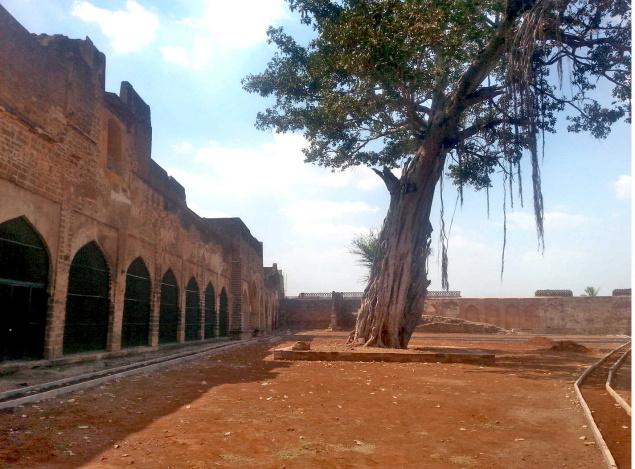
Campaigns to save trees are aplenty, but the one taken up by a group of youngsters in Bidar is unique because it is linked to history and a particularly quirky detail of history at that. At the centre of a campaign by Team Yuva is a banyan tree inside the Bidar fort, in front of the Rangeen Mahal. The Archaeological Survey of India (AIS) is rethinking its proposal to cut the tree thanks to this campaign.
The historical importance of the tree dates back to the time of Nawab Nasir Ud Daula Bahadur, the Governor of Bidar appointed by the Hyderabad Nizam. He had created a “department of monkeys” and appointed “monkey inspectors” (Daroga-E-Bandaran). They were supposed to keep a count of the langurs and feed them. Every day at noon, the guards fed the monkeys rotis, fruits and jaggery. This unusual ritual often happened under this tree, says Ghulam Yazdani in the book ‘Bidar: Its History and Monuments’.
The grants given by the Nizam for this purpose, started in early 19th century, continued till Independence.
“Losing the tree is like losing a part of our heritage. We have petitioned the State government, district administration and the ASI,” said Vinay Malge, secretary of Team Yuva. The team has asked ASI to include the tree in their landscaping plans.
Mouneshwar Kuruvatti, Conservation Assistant of ASI at Bidar, said they had asked the Forest Department to assess the health of the tree as it was old and could fall on tourists. “We will take steps to preserve the tree, after consultation,” he said.
Deputy Conservator of Forests S. Dhananjay said the ASI had earlier submitted a requisition to cut down the tree.
“However, we will assess the condition of the tree to see if it poses danger to passersby or nearby buildings. If it can be saved by pruning or by supporting, we will take those steps,” he said.
source: http://www.thehindu.com / The Hindu / Home> News> National> Telangana / by Rishikesh Bahadur Desai / Bidar – March 30th, 2015
With Mani Ratnam, there are many-layered feelings, according to the maestro. / by Special Arrangement
A.R. Rahman talks about his trendsetting musical journey, his forays into other areas of filmmaking and the inexorable charm of being himself
Allah Rakha Rahman is relaxed, worried and anxious — all at the same time.
As a composer, he’s happy; his Mental Manadhil from O Kadhal Kanmani (OKK)is doing well and the rest of the album will be out on April 1. As a son, he’s concerned; his mother took ill recently and is still recuperating. As a producer, he’s eager; things are neatly falling into place with his first project.
When I catch up with him on Thursday evening at his Kodambakkam studio, a few hours after India has lost to Australia in the cricket World Cup, he’s a picture of poise. In an hour-long interview, the musician — clad in a simple brown kurta and jeans — opens up on upcoming releases, working for the famed Iranian director Majid Majidi, his relationship with Ilaiyaraaja and life so far.
‘Mental Manadhil’, from his upcoming O Kadhal Kanmani, is a light-hearted song, he says. / by Special Arrangement
Your latest release, Mental Manadhil, which you’ve written, composed and sung is almost a sensation. How does it feel?
It’s supposed to be a light-hearted song. Lyricist Vairamuthu was off on a holiday and Mani wanted a song immediately. The two of us had already written Endrendrum Punnagai in Alaipayuthe and so, we plunged into that zone again.
What is it about Mani Ratnam that brings out the best in you?
With him, there are many-layered feelings. He introduced me to films, as you all know, but now, the three of us — Mani, Vairamuthu and me — have become a brand. Even if we want to be complacent, we cannot because of people’s expectations. It works like a trigger. We have done our bit in the last few years, but because people expect so much, we want to give them what they we want.
I was told that the three of you even have serious disagreements during composing sessions. Elaborate on that with respect to OKK…
I don’t like certain things. Sometimes, you have to compromise words for the sound — the sound is very important, it de-clutters from the words. People don’t have as much bandwidth as before; we have to catch their attention immediately.
In one of the songs in OKK (Naane Varuvaen), we had an antara that was beautiful but had very complicated words. So, instead of that, we came up with repetitive lyrics. The word (chinnanchiru) repeats itself again and again. It’s like the formula used in traditional performing arts. Take thumris, for example. They have the same thing again and again…. because the tunes get complicated, the words cannot. In songs like Yaad Piya and More Sajni, we keep hearing the same line because it’s easier for the mind to concentrate.
You’re writing a screenplay, producing a Hindi film… why are you branching out into areas other than music?
I want to see if my growth as an artiste can fill the void that I feel is missing in India. Mostly, our industry is driven by what’s going to click commercially. When something clicks, it is replicated. Very few people do it for the art. I do not want to be both — I want to find that balance between what people like and the lost flavour in our music. I’ve been working on it for four years to see if we’ve covered it in all aspects.
How disappointed are you when your films don’t do as well as expected? We hadKaaviya Thalaivan and Lingaa last year…
See, I made a mistake by doing too many films. I should have said no to some of them. As a team, our backs were broken. There was intense pressure, sleepless nights — I feel it’s just not worth anymore. Life has given me something that what I’m drawn to like naturally… when you’re overworked with too many demands and deadlines, it’s not a good thing.
So, you’re admitting that Lingaa was one of them?
We had to finish things fast to match the film’s release on Superstar’s birthday. People know exactly what happened with respect to that film. We had to deliver in three languages — Tamil, Telugu and Hindi — check the sound mixes, do the background score and everything. Simultaneously, I was also doing Kaaviya Thalaivan. It all happened came at once… it was so unfortunate.
There are a group of people who feel say your music now isn’t as good as it was in the 90s…
I am flattered; at least they like something of me! (laughs)
When you hear such comments, what goes through your mind?
As a creative person, I have to move on. There are fans for what I did then, and there are fans for what I’m doing now. You cannot go to a yesteryear actress and say, ‘I don’t like you anymore’, can you?
You worked with Vasanthabalan recently. You’re working with Vikram Kumar this year. Why are you going for newer combinations while you can safely opt for time-tested ones?
After a while, we take some people for granted. This is a good and a bad thing. With people like Mani or Ashutosh Gowarikar or Shankar, it’s never a bad thing because they present new challenges and anyway do movies once in two years. New directors give me the option of discovering something afresh.
What’s the status on Muhammad, your Iranian film, and why did you take that up?
It’s still a work in progress because the movie needs to be edited. I’ve been a big fan of Iranian films, especially Majid Majidi’s. Suddenly, one day, Imtiaz Ali called me to say that UTV got a message from Majidi that he wanted me for his project. I was like, ‘Wow’. It will be one of the most ambitious in the history of cinema.
But it wouldn’t have been easy…
His expectations were very, very high. In a way, it was good because I wanted to learn their school of thought. I wanted to know how they produce, how they way they write their scenes. I’ve been to Iran twice for two trips and it was an amazing experience.
You’re busy travelling all over the world, are you able to spend enough time with your three children?
We watch a lot of movies together, especially 3D animation films.
Is your mother still your emotional anchor?
That’s what you learn from life… where your priorities ought to be and why you should respect every family member. Amma has just recovered from a serious illness — she’s better now, but still, it’s not like before….
From being just a boy from Habibullah Road, Madras, to an international composer… how have you changed to fit the bill?
When climate and time zones change, everything changes. There, I’ve three more layers of clothing. The ease of resources, with respect to studios, we have here isn’t available there at times. All the musical notes need to be prepared in advance, not like how it works here. But then, you adapt. It took me 10 years to get used to all that.
It’s well-known that you played for Ilaiyaraaja before branching out individually. Are you still in touch with him?
The last I met him was at a music function. See, when I’m abroad, I bump into other composers all the time — at screenings or events. It’s unfortunate that Chennai isn’t that much of a social place for me; I’m usually caught up in my own work. And then, there’s family, the school… there’s not much social time. We have the respect in our hearts.
Do you read a lot?
(Thinks for a while) The last book that I read was… the screenplays of The Hundred Foot Journey andPele. Those are books anyway.
Coming back to music, there are several exciting new composers. There’s Santhosh Narayan, whom you’ve spoken highly of, and Anirudh and G.V. Prakash. In Hindi, there are many others. Would you say music is in safe hands?
There’s much more to explore in music. The demands should not be to make just hit songs. Each composer has to set a rule for himself to create timeless music. Why do we love works of the past? Because some of them are timeless; audiences still have a connection with them. That’s what I try to do and that’s what I’d like younger composers to do too.
There’s much more to explore in music, says Rahman. The demands should not be to make just hit songs. / by Special Arrangement
Your school, KM Music Conservatory, has come a long way since its inception. What are your future plans for it?
It was a huge task for us to have a new building and now we have that. It seems to be a great place to hang out and study music. Sometimes, I feel jealous of the kids studying in the school because I never had such a place while growing up. We want the students to serve in the entertainment business with a unique identity… and yes, make people smile.
You say you’re always running against time, but still do your daily namaaz (prayers)…
That’s my oxygen.
So, everyday life must be a balance…
You have to keep everything you do in multi-tracks. There’s no ‘I will do that tomorrow’. That’s what I’ve realised of late. I don’t say ‘I’ll do my prayers tomorrow, compose for this beautiful idea tomorrow, or say I love you tomorrow…’ If you want to do something, do it now.
source: http://www.thehindu.com / The Hindu / Home> Features> MetroPlus / by Srinivasa Ramanujam / March 27th, 2015