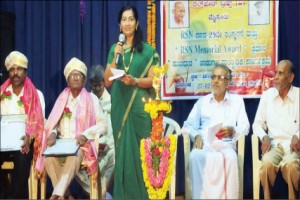
Zoo Authority of Karnataka (ZAK) Chairperson Rehana Banu is seen delivering inaugural address during the award function organised by R.S. Naidu Art and Cultural Welfare Trust in memory of Freedom Fighter R.S. Naidu at Nadabrahma Sangeetha Sabha in city recently as Sanjhi Artist S.F. Huseni, Freedom Fighter M.R. Ramashesh, Brahmana Association Chairman Raghuram and R.S. Naidu Trust President P.Y. Venkatadri look on.
Mysuru :
Freedom fighter M.R. Ramashesh and Sanjhi Artist S.F. Huseni were conferred with ‘RSN Memorial Award’ at a programme organised by R.S. Naidu Art and Cultural Welfare Trust in memory of freedom fighter R.S. Naidu at Nadabrahma Sangeetha Sabha in city recently.
Speaking after inaugurating the programme, Zoo Authority of Karnataka (ZAK) Chairperson Rehana Banu said, “Many artists across the country have contributed in their respective fields despite lack of encouragement and recognition. They should be lauded for their commitment and passion. We should encourage the artists through felicitation programmes.”
After the award function, Indu Shekhar and Troupe presented a musical programme.
Renowned artists of Mysuru and Bengaluru sang the old film songs sung by P.B. Sreenivas, S.P. Balasubramanyam, P. Susheela, S. Janaki and others. They even sang the songs from the movies of Dr. Rajkumar, Dr. Vishnuvardhan and Puttanna Kanagal.
The following songs were sung on the occasion: ‘Hindusthanu endu mareyada…’ from the movie Amrutha Ghalige, ‘Snehada kadalalli…’, ‘Aseya bhava olavina jeeva’, ‘Karunada thayi’, ‘Haadu haleyadaadarenu’, ‘Jeeva veene needu midithada sangeetha’, which made the audience to travel down the memory lane.
Mike Chandru compered the musical programme.
Singers including Indrani Anantharam, CFTRI Krishnamurthy, KEB Gangadhar, Srinivas Hemanth, Vijayanand, Joyce Peters, Anantharam, Kiran Kumar, Geethalakshmi Keni, Vijay Manasa and others took part in the function.
R.S. Naidu Art and Cultural Welfare Trust President P.Y. Venkatadri and Trustee M.K. Ramesh; K. Raghuram, Chairman, Brahmana Association; Mysuru Anand and Parthasarathy were present on the occasion.
source: http://www.starofmysore.com / Star of Mysore / Home> General News / Wednesday – March 04th, 2015
For Mohammad Shami, who destroyed the West Indies top order at the Western Australia Cricket Ground (WACA) on Friday, it was a great moment. Former Indian captain Sourav Ganguly, who had played a vital role in his success, was watching him perform from the commentary box.
Shami, whose parents hail from the north Indian state of Uttar Pradesh, got selected into the Bengal team in 2010 due to Ganguly’s initiative. It was Shami’s dream to be at the nets and bowl to Ganguly and on Friday, he had Ganguly praising the strapping seam bowler for his haul of three for 35.
Many couldn’t believe that it was an Indian pacer who was making West Indies batsmen struggle when Shami kept beating them repeatedly with tight line and movement. The fact that he was returning from an injury was not at all visible in his bowling. In fact, he recovered in time for the match with an ultrasound-guided injection.
Speaking to BCCI tv, Shami revealed how difficult it was not be carried away by the bounce of the WACA wicket and hit the right spots. “It was really important not to get carried away by the bounce. Since the wicket had so much of bounce on it, the pacers tried to bang a lot of deliveries short and in the bargain couldn’t help but give away wides. In our case, we were getting a lot of wickets by bowling short and we wanted to use the bounce. We would not have wanted to give that many away but we were getting wickets off those bouncers,” he said.
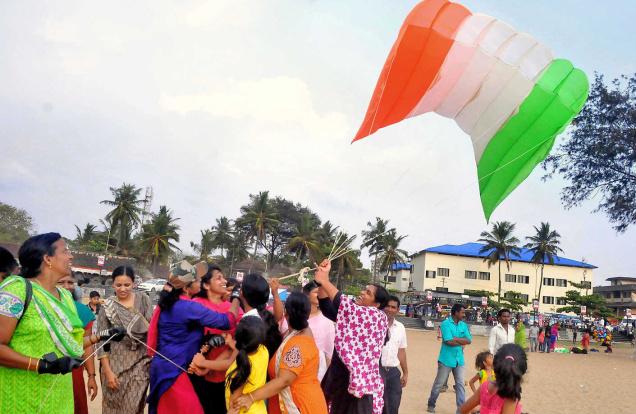
Women, who participated in the kite flying training programme on Sunday on Kozhikode beach, trying to control a kite.— Photo: K. Ragesh
It takes eight to 10 men to control the 1,000-kg circular kite of the One India Kite team. Founder of the team Abdulla Maliyekkal was quite apprehensive when he gave the reins of the kite to a group of women . His apprehension was not misplaced considering how the women struggled with it initially, but it gave way to happiness watching the first professional all-women kite team in the country take form.
The team named ‘Incredible India’ was launched on the Kozhikode beach on Sunday, on the occasion of International Women’s Day.
Training in style
Supported by their parent group One India Kite Team, the women who have undergone training in the nuances of kite flying, took off in style flying the Circular kite and the Kathakali kite amidst the curious Sunday crowd on the beach. “This is the most relaxing experience I have ever had. Controlling a kite is not child’s play. It takes great coordination and team work. Hence while flying the kites, we forget everything else,” said Mini Nair, team captain.
The team now plans to take part in kite festivals across the country and abroad where they plan to present some kites of their own.
As part of the launch of the women’s team, the One India Kite Team, in association with the women’s wing of Junior Chamber International, Calicut, had organised a kite-flying training programme for women, which was attended by 25 women. “The training was given by expert kite flyers Abdulla Maliyekkal,Hashim Kadakkalakam and Shyam Padman.
source: http:// www.thehindu.com / The Hindu / Home> News> National> Kerala / by Aabha Anoop / March 09th, 2015
Nine months ago, Teer Gran in Meerut was in the news for all the wrong reasons – communal clashes had broken out, claiming one life. Several people were injured. Few are aware, however, that Teer Gran is home to the Muslim families that make the colourful Holikas that Hindu communities traditionally burn on Holi eve. This locality is also called ‘Holi Mohalla’.
Around 25 Muslim families here make more than a 1,000 Holikas which find their way to various west UP cities besides Meerut. Mohd Yunus, 50, has a small shop near the lane leading to Bhairon Temple. On Tuesday, there were numerous life-size effigies, decked up and colourful, with feminine features, lining his shop.
“Holika symbolizes victory of good over evil. Hindu legend has it that after demon king Hiranyakashipu demanded that he be worshipped, his son Prahlad remained defiant, and said he would only worship Lord Vishnu. The king’s sister Holika, on instructions from her brother, attempted to burn Prahlad alive by taking him in her lap and sitting on a pyre. Holika had a magic shawl with which she could save herself from burning. She hoped her nephew would be reduced to cinders. When the fire was set, however, the shawl flew and enveloped Prahlad instead. Holika was burnt to death. Prahlad escaped unhurt,” Yunus explains.
For generations, Yunus’ family has been making effigies of Holika that are burnt on the eve of Holi festivities.
“We have no records, but for hundreds of years our family has been making these effigies.” There are about 25 Muslim families that make Holikas in Holi Mohalla. The effigies are made with waste paper, masks and colours.
Shaukat Ali, another resident of the area, said, “We need to make about 1,000 Holikas every year. These travel to Muzaffarnagar, Baghpat and Muradnagar.”
The Holika effigies are the work of entire families. With time, interestingly, volumes have grown. Mohd Wasim, an effigy maker, said, “Earlier, communities would select one place to burn the Holika, which was made on order, and would be quite tall and expensive – we have made effigies 20 feet tall, costing about Rs 2,000, at least. Now, as cities have expanded, even small colonies have their own Holika burning ceremony. Volumes have grown, but the size of each Holikas has shrunk. These days, we make Holikas about five feet tall, costing about Rs 250 each, at most.”
While the Muslim families here make Holikas ahead of Holi, they also make effigies of Ravana ahead of Dusshera. “The Ravanas are rather more difficult to make. For the rest of the year, we make decorations for temples and mosques,” Wasim said.
Asked of his experience during the riots last year, Yunus said, “Buddhi bhrasht ho jaati hai logon ki (people go out of their minds) in time of riots. No one wants riots. These are all politically motivated, and everyone only suffers a loss. Thankfully for us, every time communal tension happens here, Hindu friends ask me to move to a safer place and take responsibility for my shop.
source: http://www.timesofindia.indiatimes.com / The Times of India / Home> City> Meerut / by Sandeep Rai / March 03rd, 2015
Back in the 1950s, when Bangalore was like something out of a F. Scott Fitzgerald bok, Whitefield was a small township on the outskirts of the city. On arriving at the railway station, one took a horse-drawn carriage home through the small, winding streets. It wasn’t long, however, before development put paid to much of that old world charm.
The Sommer House, a colonial bungalow that has been restored to its former beauty by long-time resident Sulaiman Jamal, aims to recreate some of that old world charm. Thrown open to the public on Monday evening, as a community center that gives senior citizens and retired army officials that long lost society whirl, Jamal, whose association with the area began when he set up his factory there said: “We have lived in Whitefield for ten years now, but when I first visited, it was a pretty wild place, Every six months, another bungalow would be torn down.”
The two-bedroom gabled roof Sommer House, bought two years ago by Jamal, replete with antique furniture, is home to a piano that belonged, back in the day, to the Defence Services Cinema. The cottage, sits surrounded by a garden, with restored vintage cars dotting the property.
Jamal would like the House to host programmes like piano nights, dancing, catered dinners and plays. Most importantly, it will also have a free catered dinner every month for senior citizens.
Beth Chapman, President, Overseas Women’s Club, has helped put Sulaiman’s ideas in motion.
“I’m always looking for old bungalows and the stories that surround them,” she said.
“The house is opposite Forum Value Mall and people expected a superstructure here,” Sulaiman explained. “They wonder what the catch is, but there is none. We want the people of Whitefield to feel a sense of belonging with what is now a community center.”
source: http://www.deccanchronicle.com / Deccan Chronicle / Home> News> Current Affairs / DC / Darshana Ramdev / June 18th, 2013
Hazrath Moulana Mohammed Zaka Ulla and Corporator K.C. Shoukath Pasha were unanimously elected as President and General Secretary respectively of All India Milli Council, Mysuru District Unit, at a meeting held recently at Madrasa-e-Ashraf Ul Uloom in Kesare here.
The meeting was held under the supervision of Hazrath Moulana Qadeer Ahmed, President, All India Milli Council (AIMC), Karnataka State Unit; Hazrath Moulana Mufthi Baqar Arshad, Vice-President, AIMC, Karnataka State Unit and Syed Shahid Ahmed, General Secretary, AIMC, Karnataka State Unit.
Hazrath Moulana Mohammed Zaka Ulla is also the President of Majlis Ul Ulema and Khateeb & Imam, Masjid-e-Firdose, Bannimantap while Corporator Shoukath Pasha is also the member of District Planning Committee. This is the second term of Pasha as General Secretary of AIMC, Mysuru.
Both the newly elected office- bearers were felicitated on the occasion.
Hazrath Moulana Mohammed Usman Shariff, Sir Khazi of Mysore, Taj Mohammed Khan, Member, AIMC, Karnataka State Unit, Hazrath Moulana Mohammed Naseem, outgoing President, AIMC, Mysuru, Hazrath Moulana Ahmed Khan Rishadi, Moulana Mohammed Ibrahim, former Mayor and Corporator Ayub Khan, Corporator Suhail Baig, JD (S) leader Azeez Ulla, Syed Zaheer Ahmed, General Secretary, Central Muslim Welfare Council, Mohammed Zaheer Ul Haq, Mohammed Mumtaz Ahmed, Secretary, Mysuru District Relief Committee, Syed Akram Pasha, Syed Jalal, Secretary, Muslim Boys Orphanage and others were present on the occasion.
source: http://www.starofmysore.com / Star of Mysore / Home> General News / Monday – March 02nd, 2015
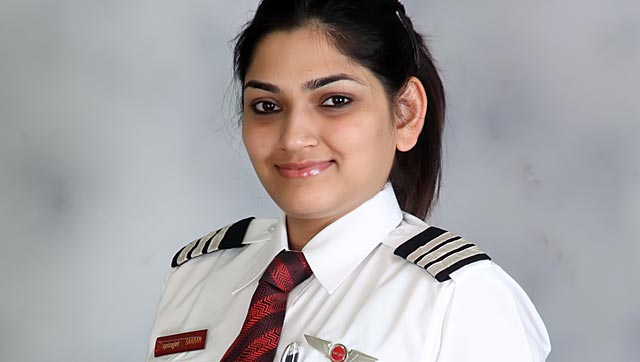
Saarah Hameed Ahmed, India’s only Muslim woman pilot
“People initially think I’m Christian and then gawk when I tell them my full name,” laughs Saarah Hameed Ahmed (25) the Bengaluru girl who is the only known Muslim among the 600-odd women pilots employed in the Indian aviation sector. “I just love the look on people’s faces when they discover I am Muslim.”
People’s reaction to her choice of profession is a constant source of entertainment for Saarah. Many want to know how a girl can handle a machine that’s many times her size, she says as she cracks up again. “Poor things; they don’t know that my fingers are all I need to fly,” she says twiddling her thumbs.
Of course, the reactions are not always amusing or sensitive. Saarah says she too has had to face the brunt of Islamophobia that gripped the world post 9/11. But each time she has managed to win people over with a combination of humour and tact, she says.
However, Saarah’s first battles were fought at home and within the community. She says that she still faces taunts from people who believe a girl’s only job is to get married and produce children.
“Initially none of us encouraged her. In our community girls don’t usually take up professions where they have to stay away from home and live in hotels without an escort,” confesses her father Hameed Hussain Ahmed, a professional photographer. When Saarah showed no signs of relenting, he spoke to his friend Atif Fareed, who is a senior pilot in the US.
“Fareed told me that I should consider myself lucky because most Muslim girls don’t even dream of flying. If he hadn’t convinced me, I might have made the blunder of killing Saarah’s dreams,” he says.
In 2007, when she was just 18, Saarah enrolled with a flying school in the US. “Those days most Muslim students were being denied US Visas. When she got the Visa without any trouble I saw it as a final message from God,” says the deeply religious Ahmed.
Saarah’s mother, Naseema Ahmed, says she never had any doubts about sending her to the US. Her proudest moment, she says, was when a group of Muslim girls surrounded Saarah at a wedding and started asking her for tips to become a pilot.
Saarah has other dreams too. “I really want to get married and have children,” she says. But finding the right man is proving to be tough. “I don’t understand people who just look at my photo and want to get their sons married to me. Don’t they want to know what I have studied or where I work?”
Many of her suitors have either wanted her to quit her job or move cities. “My father has shooed away people asking them to get their sons to quit his job and move cities,” Saarah says letting out another blast of laughter.
She also has a Women’s Day message for Muslim girls like herself: “Don’t fret over what the community thinks of you. And don’t let them kill your dreams.” And what is she planning on women’s day? “Fly, of course! My airline [Spicejet] is very keen that I fly on Women’s Day.”
Waiting in the wings
Ayesha Aziz, 18, is another aspiring pilot. A native of Baramulla, Kashmir, she has already obtained a basic flying licence.
Fatima Salva Syeda, 26, is a licenced commercial pilot. But she has to qualify additional training before she can be a professional pilot.
source: http://www.hindustantimes.com / Hindustan Times / Home> India / by Sudipto Mondal – Hindustan Times, Bengaluru / March 08th, 2015
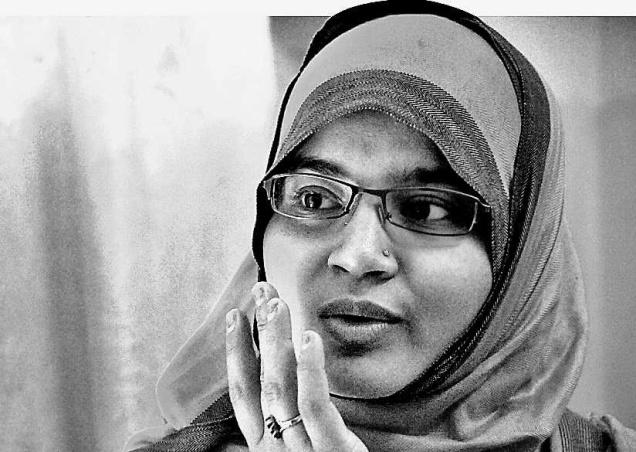
Capt. Fatima, the only Muslim woman in India to hold commercial pilot’s licence, needs financial help for additional training
She looks the typical Muslim woman next door – plain, timid and hesitant. It will be a surprise if she can drive a four-wheeler. Hold your breath – she can even fly an aircraft. Meet Capt. Syeda Salva Fatima, the only Muslim woman in India to hold the commercial pilot’s licence.
She is the shining example of Muslim women’s empowerment. What makes her ascent interesting is that she hails from the poverty-stricken old city of Hyderabad where life is a continuous struggle. Even more surprising is her decision to step into a domain which is predominantly male. But her black burqa and red scarf doesn’t betray her accomplishments.
Right from her school days, Fatima used to collect newspaper articles about aviation and pour over pictures of aircraft for hours. Her father, Syed Ashfaq Ahmed, a bakery worker, never imagined that his daughter would become a pilot one day. The dice was cast when she took admission in an institute which offered free EAMCET coaching. “What would you like to become,” the instructor asked. Pat came the reply, “Pilot”. It was a pleasant surprise to everyone present, more so to her father who struggled to make the ends meet. Seeing her determination, Zahid Ali Khan, Editor, Siasat daily, who was present at the time, asked Fatima to meet him later. “I couldn’t believe my ears when he offered to support me financially to undertake the pilot training,” recalls an overwhelmed Fatima.
After five years of rigorous training at the Andhra Pradesh Aviation Academy, Fatima obtained Commercial Pilot’s Licence, Private Pilot’s Licence and Flight Radio Telephone Operator Licence on March 11, 2013. She has logged in a total of 200 hours of flying on Cessna 152 and172, including 123 hours of solo flight. Now she has hit a rough weather. She needs to undergo Type Rating, an additional training beyond the scope of the initial licence and aircraft class training, on Air Bus A-320 or Boeing to be able to fly any aircraft. The training costs about Rs. 30 lakh which the 26-year-old couldn’t think of. But having come this far, she doesn’t want to give up. The Captain courageous has sent an SOS to the Civil Aviation Minister, Ashok Gajapathi Raju. She can be reached on: 9966073368.
Capt. Fatima, the only Muslim woman in India to hold a commercial pilot’s licence, needs financial help for additional training
source: http://www.thehindu.com / The Hindu / Home> News> Cities> Hyderabad / by Swathi V / Hyderabad – March 07th, 2015
India advanced to the quarterfinals of the World Cup after prevailing over West Indies by four wickets here on Friday. Set a target of 183, M.S. Dhoni’s men stumbled, losing frequent wickets. It was left to the captain and R. Ashwin to wrap it up.
Against good fast bowling on a pitch reputed to be the quickest in the world, India’s toporder floundered. Virat Kohli made 33, looking fluent until he fell to a short-pitched delivery. India needed 49 runs when the sixth wicket fell. But Dhoni pulled the chestnuts out of the fire with an unbeaten 45. The foundation for the win was laid by Mohammed Shami and Umesh Yadav, who subdued West Indies with a fantastic exhibition of hostile fast bowling.
‘Captain Cool’ delivers
The Indian juggernaut wobbled and juddered but pulled through all right. M.S. Dhoni’s steady hand saw his team home in a nervous run-chase at the WACA ground here on Friday, as India defeated West Indies by four wickets to book a spot in the quarterfinals of the World Cup.
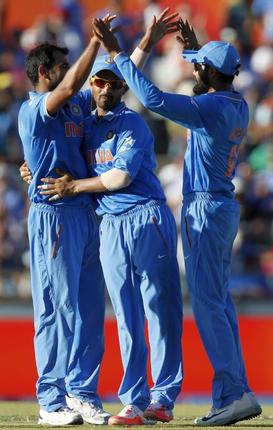
Mohammed Shami is congratulated by teammates after taking the wicket of West Indies batsman Darren Sammy in Perth on Friday./ AP
Mohammed Shami, later declared ‘man-of-the-match, and Umesh Yadav put on a demonstration of blistering fast bowling to help limit West Indies to 182. In pursuit, India had sunk to 134 for six when Dhoni and R. Ashwin were united at the crease. The pair added 51 runs in an unbroken seventh-wicket partnership to take the team home.
Jerome Taylor’s opening spell made it clear India’s run-chase was not going to be straightforward. He hurtled in from around the wicket at Shikhar Dhawan, bowling seriously fast and leaving him little room.
Dhawan soon pushed at one and was consumed in the slips. Rohit Sharma received a marvellous out-swinger, bowled at just the right length to draw him forward, and he fell for 7. Virat Kohli then briefly batted as if the difficulties of those before him had been some sort of mirage. He hit two firm drives and whipped Taylor off his pads for successive boundaries. But when Kohli chose to pull Andre Russell (of the Mr. T hairstyle) from outside the off-stump, he dragged it down the throat of the long-leg fielder.
The size of the target meant the game was never going to be won by containing the chasing side. It helped to have another speed-merchant in Kemar Roach, who replaced the spinner Suleiman Benn in the team.
Roach was wayward at first but he struck in his fifth over, having Ajinkya Rahane caught behind. The batsman reviewed the decision but replays proved inconclusive.
India lurched to 78 for four, when Suresh Raina walked out. He was predictably met with a barrage of short-pitched deliveries but it was eventually Dwayne Smith’s gentle medium-pace that did for him. When Ravindra Jadeja departed, also playing the pull shot, India still needed 49 runs for victory.
M.S. Dhoni, though, found a competent ally in Ashwin. The two mostly steered clear of the shots that had claimed some of their predecessors — although Dhoni did scythe Russell over third-man for six. The captain remained unbeaten on 45, scoring the winning runs in full, headgear-less glory.
In the dull heat of the afternoon, India produced an hour of the most irrepressible, furious fast bowling. Yadav and Shami bowled quick, bowled short, and generally put it where the batsman didn’t want it.
They moved the ball lightly in the air, and off the pitch, and beat the bat as a matter of routine. Smith was struggling against Shami and he soon nicked off, trying to cut a short ball that was too close.
Shami welcomed Marlon Samuels with one that whizzed past his nose; Gayle got another in the same region.
Discomfiting pace
That Yadav worked up a discomfiting pace — steadily in the high 140s — was no surprise. That he did it with accuracy early on was; Gayle was forced to play out a maiden over and the West Indian innings was crawling.
The exit of Samuels, who was run-out chasing a single his partner had no interest in, seemed to spark Gayle into action. He swung freely — that two edges flew in the direction of third-man and were dropped did not bother him — and sent a ball from Yadav sailing over the long-on boundary. But India had no reason to be worried by this approach.
Gayle soon top-edged a rising delivery from Shami and was caught at mid-wicket.
Thereafter, the West Indians batted as if they were in a rush to catch the last ferry to Fremantle (which leaves the Barrack Street jetty at 5.30 p.m.). They sank to 124 for eight, Shami taking a third, and it was only the intervention of Jason Holder that dragged the total to 182. The ball had grown older now and there was none of the menace of the opening period, but the young captain batted admirably to make 57.
It couldn’t stop India, though, from marching into the last eight with two Group B games in hand.
source: http://www.thehindu.com / The Hindu / Home> Sport> Cricket> World Cup / by Shreedutta Chidananda / Perth – March 06th, 2015
Radha Viswanathan re-lives moments of living and performing with an icon, to Ranjani Govind.
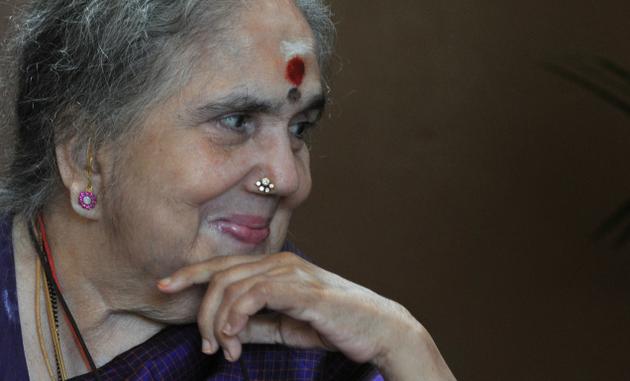
“It’s comforting to see my grand-daughter Aishwarya become a serious performer. I remember the days when I would wonder whether there would be anyone in the family to carry the legacy forward. My prayers seem to be answered,” says the 80-year-old Radha Viswanathan, daughter of M.S. Subbulakshmi, during a recent interview in Bengaluru.
Radha was recently honoured during the release of an album of a nearly 40-year-old soundtrack of MS and hers, in Bengaluru, with veteran mridangam vidwan T.K. Murthy and former ISRO chairman K. Radhakrishnan participating. The album was recorded in Mumbai by the National Centre of Performing Arts (NCPA) and is now being brought out in association with Sony Music.
Radha is happy that the rare gems from the 1970s, was now being shared with rasikas. “It is a historic occasion for our family.”
Radha, who accompanied her mother for over 60 years, be it at live concerts or recordings, cherishes every memory of the time she spent with her iconic mother. “I was blessed to have a mother who was an embodiment of compassion,” she says, as she gets nostalgic. Radha’s mobility might have been restricted to a wheelchair owing to several health issues, but her zest for life, passion for music and elephantine memory keep her as youthful as ever. She can leave you stumped with her recollection of events, rolling back to instances when as a four-year-old she remembered the time when MS entered her family.
Talking about her computer-like memory, Radha says, “Storing information is inherent to my persona. Every time I sang a kriti leant instantly at class, Semmangudi mama would say, ‘You have a camphor-like brain, catching everything instantly!’” recalls Radha, who always made notations of the trickiest of sangatis.
Looking settled in her son V. Shrinivasan’s home, the contentment is apparent on her still radiant face. “It’s rewarding to have taught Aishwarya nearly 500 kritis. Do you realise that it is authentic Semmangudi, Musiri and T. Brinda schooling that I have passed on? My younger grand-daughter Saundarya too is catching up,” she says.
But why didn’t MS train other students? “My mother was too busy an artist to teach. She was incredibly humble and used to continuously learn from others and considered herself a student all her life,” says Radha. There were instances when Radha learnt from Semmangudi Srinivasa Iyer as MS was too busy. Radha would later sing what she had learnt to her mother. “In fact, we practised together to get the nuances right,” she remembers.
Radha stepped on to the music platform as a four-year-old, singing tail-enders or the so-called ‘tukkadas.’ “That was the beginning of my musical journey. But later I learnt from Mayavaram Krishna Iyer and GNB’s sishya, T.R Balu,” she says. Once when MS was unwell, Musiri came visiting. Radha had then sung ‘Saraseeruha’ in Nattai and ‘Sudhamayi’ in Amruthavarshini. Fourteen years later, when the same kritis were presented at the Central College of Music where Musiri was the principal, he remembered, “I recall Radha singing these kritis as a six-year-old. Even then, I knew she would go a long way.”
It was Musiri who had advised them about the importance of ‘voice synchrony;’ he had told Radha, “Your voice should blend with MS’s and sound like a single, integrated tenor.” No wonder their Vishnu Sahasranamam recording is known for this quality! “In the line, “Amaaani Maanado Maanyo,” when MS briefly stopped to take a breath, it had to be re-recorded, but Amma insisted it be left alone. ‘Let people know that Radha sang along,’ Amma said.”
What was special as far as their voice experimentation was concerned were the lessons that MS and Radha got from T. Brinda and T. Muktha, who had by then set a trend in high-and low-octave singing. Kritis such as ‘Janani Ninnuvina’ in Ritigowla, ‘Raave Himagiri’ in Thodi and ‘Teera teeyaga raada’ in Gowlipantu that saw MS taking to the base and Radha singing in the higher octaves, became a rage with audiences.
Father Sadasivam’s love for dance saw Radha and Anandi (daughter of Kalki Krishnamurthy) team up and learn Bharatanatyam from Vazhuvoor Ramaiah Pillai. Her ability to learn and absorb was so amazing that Radha had her arangetram, along with Anandi, as an 11-year-old! They performed to packed audiences, effortlessly. “Even here, Amma would sing padams for us. Who can forget the rave reviews that the two got for their superb pairing in ‘Maalai Pozhudinilae’ and ‘Thayae Yashoda’?
Says Radha’s son, Shrinivasan, “In 2010, when my mother was asked to do abhinaya at the Cleveland Tyagaraja Aradhana, she obliged and left the the audiences in tears. And mind you, she was sitting all the while!”
It was her love for song and dance that Radha saw act as the young Bharatan in ‘Shakuntalai’ in 1940 and as Bala Meera in ‘Meera’ in 1946. “By the time, the Hindi version came, I had grown taller and so I did not act in it,” she says. When Radha was13, she had led the chorus in ‘Meera’ and had the music director Bhattacharya refer to her as ‘my boss.’
Born in 1934, December 11, in Gobichettipalayam, Radha was married to Viswanathan and went to Ahmedabad. But Radha’s passion for music and MS’s need for a vocal support soon brought them together and they travelled the world and became ambassadors of Carnatic music.
From Radha’s memory bank
* MS always advised me and my sister Vijaya to have a smile on our faces while singing.
* We took classes from Semmangudi, Musiri, Brinda-Muktha, K.V. Narayanaswamy, Siddeshwari Devi in Hindustani, Sandhyavandanam Srinivasa Rao and Meera bhajans from Dilip Kumar Roy.
* Radha still remembers the first concert at The Music Academy. Prime Minister Nehru was to inaugurate. The Udaipur Maharaja, mesmerised by our Kalyani rendering, had offered MS his kingdom!
* She recalls MS’s ‘never-question’ attitude towards her father Sadasivam’s ‘concert listing’ as a mark of respect for his knowledge and intuitive knack of planning.
* Once, Radha danced in front of Mahatma Gandhi with MS singing ‘Ghana Shyam Aaaye Re’ at the Birla House in Delhi. “And Gandhiji really enjoyed my performance!”
From the NCPA archives
The CD with 16 songs of M.S. Subbulakshmi and Radha Vishwanathan that Sony Music has released in association with the National Centre of Performing Arts (NCPA), is part of “Masters Works” series,” which was recorded in the 1970s.
Shridhar Subramaniam, president, Sony Music said, “Two more live concerts of MS and Radha, with Karaikkudi Mani on the mridangam will be released in two months. Also in the pipeline is one with Alla Rakha and Zakir Hussain on the tabla.”
NCPA had 5000 hours of live and studio-recordings in several genres mainly done in Mumbai from 1971 for their archival and academic purposes and directed towards student-researchers. Soon, recordings of Pandit Jasraj, Ustad Bismillah Khan, Ustad Rashid Khan, Gangubai Hangal, Dr. M. Balamuralikrishna and M. L. Vasanthakumari, were released by Sony Music.
source: http://www.thehindu.com / The Hindu / Home> Features> Friday Review / by Ranjan Govind / February 26th, 2015