This is in response to Prof. A.V. Narasimha Murthy’s write-up on Gandhiji’s visit to Bangalore in SOM dated Sept. 7. This is to share one more information with the readers.
The bungalow that Gandhiji stayed in Bangalore was the Kumarakrupa. Gandhiji also made a visit to look up Mir Hamza Hussain, the former Inspector General of Police and the member of the Council of the Princely State of Mysore, at his Binfield residence, No. 87, Richmond Road, Bangalore -25. This was a visit to look up Hamza Hussain who was unwell at that time.
Sajjad Hussain, the grandson of Mir Hamza Hussain, recalls the visit. The family had placed a chair next to the patient’s bed for Gandhiji. But he chose to sit on the bed. The topic of discussion was the Dalit movement which was in its peak.
Mrs. Hamza Hussain handed over the gold bangles she was wearing to Gandhiji for the cause. The grandson also told me that his father, Mir Iqbal Hussain, who was the Chief Justice of the High Court of Karnataka, had written about this in the Deccan Herald long ago.
Prof. Shakira Khan, Teacher Fellow, Department of Political Science, Kuvempu University, Shimoga
14.9.2014
source: http://www.starofmysore.com / Star of Mysore / Home> Voice of the Reader / September 17th, 2014
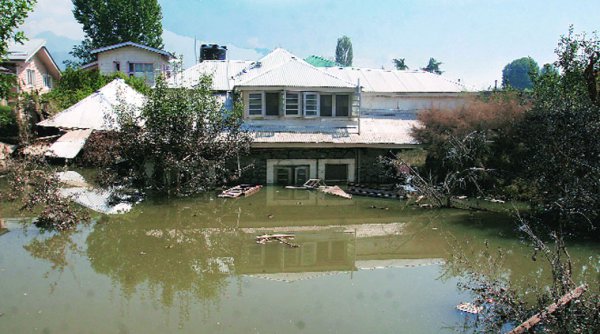
Agha Shahid Ali’s submerged house in Srinagar’s Rajbagh. ( Source: Express photo by Shuaib Masoodi )
The Jhelum flowed through many of Kashmiri poet Agha Shahid Ali’s poems. “When I return, the colours won’t be so brilliant, the Jhelum’s waters so clean, so ultramarine. My love so overexposed”, he wrote. Shahid’s home, his wooden desk, a rocking chair, books and papers are now under Jhelum waters.
This hut of a house of two floors, lower than the nearby road, and nestled in a wild garden in Rajbagh had become the international address for Kashmir’s literary scene. Shahid, who brought into focus Kashmir’s tumult through his poems, grew up here. He later kept returning from the US where he taught at Amherst College till his death in 2001.
A piece of old architecture, this house was Shahid’s last memory in his home city. Its rooms and the hundreds of documents, photographs and books they contained were a reminder of the poet who introduced the ghazal form to English. Today all is submerged and probably destroyed. When Shahid’s father Agha Ashraf Ali was rescued from the house in a rush, nothing else could be saved.
While the deluge has ravaged Srinagar’s roads, buildings and homes, it has also taken away something more precious — invaluable parts of Kashmir’s history and culture. Flood waters have entered the government archives, cultural academy, the building housing Srinagar’s museum and several other libraries. The flood has also destroyed scores of private collections of texts, rare religious manuscripts, letters and other important connection to Kashmir’s past.
A mile from Shahid’s home, the Valley’s best known artist Masood Hussain said he could only save his latest work: seven paintings based on Shahid’s seven couplets that he had promised the poet before his death. “When the flood came, it submerged everything in my neighbourhood,’’ Hussain said. “My brother had two rubber boats but in those hours of crisis, I forgot everything and helped rescue some 40 people. Several houses around my home collapsed.”
A Kashmiri journalist had a 250-year-old copy of the Quran that had been passed from generations in his family. He could not take it out when the flood rushed into his house in Rajbagh. A resident of Tulsibagh had letters from 1890, documenting those times, preserved in his home. They are gone too.
Idrees Kanth, who is researching Kashmir’s social history for his PhD at Leiden University in Amsterdam, said the loss is irreparable. “Many people in Kashmir had private archives. The sudden onset of flood left them no chance to save the precious material, Kanth said. “It’s not just lives and property we have lost, we have lost a part of our history too.”
He said he was praying the government’s archives are safe. “There are 20 lakh files in the archives, which aren’t even indexed. We may never know what has been lost in these floods.”
Director of archives, Mohammad Shafi Zahid told The Indian Express, that the archives are safe. “The flood water has submerged the low lying building but not the one where our archives are housed,’’ he said. “The papers are all safe.”
The archives house old Kashmiri, Persian and Arabic manuscripts which are important for their religious, philosophical and literary value. The building also houses old land records, state subject documents, bureaucratic correspondence of J&K State since the Maharaja’s times among other papers. However, Saima Iqbal of Indian National Trust For Art and Cultural Heritage said she was not allowed into the archives to check.
source: http://www.indianexpress.com / The Indian Express / Home> India> India-Others / by Muzamil Jaleel / Srinagar – September 23rd, 2014
Bikers compete at the MRF MoGrip-FMSCI National Supercross championship at Technical Institute Grounds on Avinashi Road, Coimbatore on Sunday. (Photo:VIGNESH.B)
Coimbatore :
Punctuated with gravity-defying jumps and breakneck drifts on a tailor-made obstacle course, Supercross is one of the most awe-inspiring forms of motorsports. The fourth round of the MRF MoGrip National Supercross championship, held at the Hindustan Institute grounds here Sunday had thousands of fans on their feet.
More than 95 riders from across the country showcased their skills in different categories and it turned out to be a feast for the fans. The event was dominated by TVS Racing and the newly launched Hero 9T9. Harith Noah of TVS reigned supreme in SX1, the showpiece category, while Hero 9T9 made a clean sweep of the class 6 for private experts.
However, the highlight of the weekend was ‘Locals’ class, a category instituted for the host city. Coimbatore’s Jagadish Kumar of Hero 9T9 emerged ahead of his city-mates A. Anand and Mohammed Rafiq. Another local boy, S. Azaruddin, caught the eye with an impressive showing.
The capacity crowd was in for a bigger surprise when junior ‘daredevils’ took the centrestage. The U-15 riders of JR SX class were greeted with a standing ovation.
source: http://www.deccanchronicle.com / Deccan Chronicle / Home> Nation> Current Affairs / DC Correspondent / September 22nd, 2014
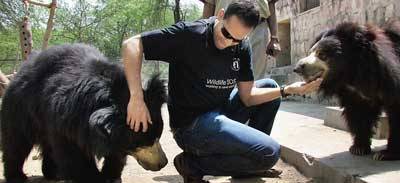
The cricketer, who whacks the ball around the stadium ruthlessly, is extremely gentle while dealing with animals. Pathan works with the NGO Gujarat Society for Prevention of Cruelty to Animals
The brutality with which he smacks a cricket ball makes Yusuf Pathan appear ruthless. There’s little or no expression on his face as he wields his willow. But under it all, there is a very soft spot. The one he reserves for animals.
Yusuf accepted our invitation to supper at Port Elizabeth, where India was playing a one-day international against South Africa. With Discovery Channel running in the background, he started talking about his favourite animal – the lion.
When the word ajeeb — perhaps not the most accurate one — was used to describe the king of beasts, he subjected us to a terse lecture. “How can you use the word ajeeb? Have you taken a close look at it? It’s truly a wonderful creation of Allah,” he thundered. Yusuf then went on to describe his encounter with a lion inside Johannesburg’s Lion’s Park.
“We were following this really magnificent creature. Suddenly, it turned and pounced on the car, stood on the jeep’s bonnet and stared at us through the windscreen. Its face with the full mane was awesome.
As it opened its mouth and roared, I could only think of the prey it must have devoured. The lion stood on the vehicle for three minutes and those three minutes were like three hours for us.” The calm Yusuf brings to the crease and the instinct that takes over him when he’s attacking bowlers are perhaps traits he shares in common with the animal he so loves.
This incident was an insight into the man’s love for his environment. He said he inherited his passion from an uncle. “My late maamu, Azizul Islam, was really fond of wildlife. Whenever possible, I would tag along with him on his excursions into forests.
That is how I got hooked,” he says. Initially, Yusuf says, his abba didn’t approve of him bringing animals home. But gradually, he too started loving them. “Now, when I’m not around, he takes care of them.”
The life of an Indian cricketer alternates between various stadiums around the world and the plush environs of multi-starrer hotels.
The first thing Yusuf does when he gets into his hotel room is surf for Animal Planet, which needless to say, is his favourite channel. “I don’t like watching movies. Animal Planet or Discovery is all I want in my spare time,” he says.
Whenever he tours abroad he shops for items that come in handy for a night out in the jungle. “I’ve spent nights out in deep forests and it is the most wonderful of experiences. I usually carry three to four pairs of clothes, a small tent and a torch.
To be honest, I’ve managed to spot only a few wild cats in Gujarat till now. The moment I find time, I will be off to Ranthambore or Gir to see the big cats,” he says.
But his love for animals is not confined to watching wildlife. Snehal Bhatt Bhavsar, who works with the Gujarat Society for Prevention of Cruelty to Animals (GSPCA), is full of tales of the work Yusuf does with her NGO. She says that even before Yusuf became a household name, he would often volunteer for GSPCA and take great interest in rescuing animals, even taking them home to nurse them back to health.
“He has answered our calls in the middle of night and driven around with us to rescue abused animals. It doesn’t matter if it’s a dog, a chicken, a goat, a horse, a pigeon or a baby owl. He’s always there.
He takes the animals to his farm house outside Baroda, treats them and then releases them. He currently has a couple of horses there and really loves them although he has been kicked hard by one of them once,” she says.
Bhavsar says that when chickens were being culled mercilessly during the bird flu, Yusuf was so disturbed that he would plead with people to stop the killing. “When I visited his old house, there was an open air chicken shop on the same lane.
I couldn’t stand the ghastly sight. I pointed out to Yusuf that this was happening right outside his house even though he cared so much for animals. The next time I went there, the shop had disappeared,” Bhavsar adds.
Yusuf says, “I love all animals. Like us, Allah has given them life. What I really like about them is their wafaadari (loyalty). If you give them love, despite their inability to speak, they reciprocate in their own ways. It is so touching and tells you about the greatness of God and how he has balanced things so wonderfully in this world. It’s only we humans who don’t understand.”
source: http://www.punemirror.in / Pune Mirror / Home> Others> Sunday Read / by Ehtesham Hasan / February 06th, 2011
From knowing zilch about crops, Zainab Husain is now one of Jalgaon and Barwani’s most prosperous farmers.
To find a Dawoodi Bohra agriculturist in the interiors of Madhya Pradesh is not everyday. But that’s not the only reason 33-year-old Zainab Husain merits a story. One of Barwani district’s most prosperous farmers today, Husain inherited her father, Sabir Husain’s 52-acre farm and pesticide and fertiliser business more as liability.
His sudden demise when she was 27, left her, his only child, in charge of the land that yielded cotton, chillies, wheat and bananas. Running the agro-products business was the true challenge, Husain realised, when she discovered that farmers owed her late father Rs 90 lakh.
To sell out, and get her married is the most practical solution, suggested her father’s family. Husain, a post-graduate in chemical science, hadn’t dirtied her hands in the fields.
Neither had she dabbled in business or chased debtors. Based in Jalgaon, a seven-hour drive from Mumbai, Husain had moved there as a child to live with her grandparents since the industrialised city offered the bright student better schooling prospects.
The farm was a good 210 kms from her home, and the family wasn’t moneyed (“We took a Rs 10,000 loan from the jamaat so that we could treat my father in Mumbai,” she says). How would she manage the farm via remote control or dare to sit months at the Barwani trading store? Just when the sale looked most feasible, a contrarian spoke up. Husain herself.
The extended family threw a fit, and just like it sometimes happens, an unlikely game-changer appeared on the scene. It was the goodwill her father had garnered over the years.
“When farmers or farm hands were in trouble,” says Husain, “he’d quietly help them with agrochemical supplies against long credit which they’d repay during the following harvest.
If they needed health assistance, my father would fund the treatment.” When Husain turned up at her store to ferret the list of debtors, she found unlikely allies. “They accompanied me from home to home, farm to farm, requesting the debtors to pay up.”
Sixty per cent of the outstanding was recovered; the family could breathe again. The early months were gruelling — negotiating the eight-hour Jalgaon-Barwani circuit while changing four bus routes; spending three months on the trot in unknown territory; communicating with 50 farm hands to enhance her insight into costing, irrigation potential and cropping patterns, and imploring the general manager of a lending bank in Mumbai to defer instalments. For someone who has been a farmer six years, Husain has a fair report.
Her cotton yields have trebled to 25 quintals per acre, she has more than doubled farm revenues, got into a positive capex cycle with tractor purchase and has plans to set up a back-ended nursery. Success gave her enough confidence to dabble in construction, building bungalows and apartments in Jalgaon. “The construction business provided us advances and perennial revenues, which we could use to fund the seasonal business of agriculture,” she says.
Over the last year, she has ploughed surplus funds into organic manure manufacture (100 tonnes per month, which has proved profitable from year one), forayed into the business of writing education support software, and is widening the construction portfolio to commercial properties.
And, she won’t stop learning. The soft-spoken lady, who could be a small time case study, is pursuing a PhD in agricultural extension.
source: http://www.punemirror.com / Pune Mirror / Home> Others>Sunday Read / May 25th, 2014
Former Billiards and Snooker Federation of India (BSFI) vice-president Haji Jaffer died here Sunday, according to a press release from the Karnataka Billiards and Snooker Association (KBSA).
Jaffer, a widower and an advocate by profession, was 88 and is survived by two daughters and a son.
“During his tenure as the BSFI vice-president, Jaffer moved a resolution to include cue sport in the Asian Games and it was thanks to his efforts that India won 15 medals, including five gold, four silver and six bronze medals,” said BSFI secretary S. Balasubramaniam.
Cue sports made its Asian Games debut in 1998 Bangkok and was part of the quadrennial event until 2010 after which it was dropped from the programme.
Associated with cue sports since 1952, Jaffer played a key role in the KSBA securing its own premises that also houses a club house and guest rooms besides billiards tables.
Jaffer was also instrumental in shifting the venue of the National Championship from Kolkata, then the headquarters of the BSFI, to other parts of India on a rotation basis.
At Jaffer’s insistence, the BSFI agreed to introduce a National Championship for Women and the inaugural event was conducted by the KSBA in 1989.
source: http://www.business-standard.com / Business Standard / Home> Sports> IANS / Bangalore – September 21st, 2014
Veteran sports administrator and patron Haji Jaffer passed away here on Sunday.
He was 88.
Jaffer, an advocate by profession, was associated with cue sports and racing in a big way in Bangalore. He played a key role in the development of the Karnataka State Billiards Association and was its patron from 1991.
He also served the Bangalore Turf Club as the assistant judge and as first judge, besides making his mark as a commentator. Billiards fraternity benefitted immensely from the presence of Jaffer, who after joining the brigade of M Chenniappan, the founder of the KSBA, worked tirelessly to promote the sport.
It was Jaffer who mooted the idea of Women’s Nationals, successfully conducting the first edition in 1989. Jaffer, who was also the vice-president of the Billiards and Snooker Federation of India, also worked for the inclusion of cue sports in the Asian Games.
He leaves behind two daughters and a son. The KSBA has condoled his demise.
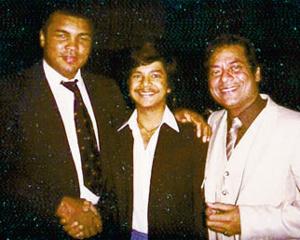
Producer Naved Jafri on meeting heavyweight champion Muhammad Ali
This picture was taken in 1981. I was 13 years old and accompanied dad on a trip to Abu Dhabi. The Sheikh had organised a fundraiser in order to build mosques in the area. The chief guest for the night was former American professional boxer Muhammad Ali, whom I was excited to meet.
Bollywood celebrities like Rishi Kapoor and Asha Sachdev were there to attend the event as well. For entertainment’s sake, my father and Ali had a friendly match. It was hilarious to see my dad and the heavyweight boxing champion, who stood at 6 ft 3 in, in the same ring.
For comic effect, dad even scampered around as Ali pretended to pound him. The crowd seemed to love it and everyone was cheering. After the fundraiser, which was a great success, a bunch of us went out for dinner with Ali. It was an elaborate dinner in a five star hotel. But one thing that struck me about that night was Ali’s sharp sense of humour.
When saying our goodbyes, he shook my hand. It was an impressive handshake, especially since his hand was three times the size of my little fist.
source: http://www.punemirror.in / Pune Mirror / Home> Others> Leisure / by Yolande D’Mello / July 20th, 2014
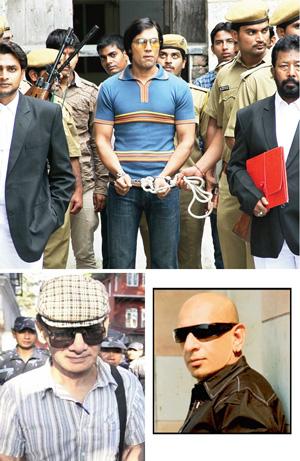
still from Main Aur Charles (top); Charles Sobhraj (Left) & Salim Asgarally (Inset)
BACKSTAGE PASS
FILM:Main Aur Charles
Fashion designer Salim Asgarally doesn’t normally agree to do costumes for films, but transforming Bollywood actor Randeep Hooda into Charles Sobhraj, the Bikini Killer of the 1970s, was an irresistible lure. Charles, who was convicted and jailed for 12 murders between 1976 and 1997, and is currently serving a sentence of life imprisonment in Nepal, was a dapper dresser.
“He is an intriguing character whose journey spans different eras. I was ready for the challenge that Prawaal Raman’s film, Main Aur Charles, offered,” explains Salim. Three months of intensive research yielded several different looks to experiment with.
Charles moves from Bangkok to Delhi and on to Mumbai and Goa with a tenure in the Tihar jail in between. Salim promises a new look for the con man in every city.
“In Bangkok, he’s urbane in trench coats, which make way for suits and blazers in subdued checks teamed with’70s style ties, his trademark beret and designer glasses when he’s trying to pass himself off as a moneyed gentleman in Delhi,” explains the stylist. Salim points out that even when he was jailed, till he was convicted, Charles was allowed to throw Christmas parties, give interviews to the international press and wear his own clothes.
“So, among the prison uniforms was this intelligent, widely travelled, conman with a suave front. The continuity had to be retained even when he fled to Mumbai after a daring jail break. But once in Goa, he turns into a carefree hippie in swimming trunks and shorts,” says Salam, who wanted the clothes to become an aid in storytelling while making Randeep look good on screen.
Usually Hindi films don’t bother with authentic depiction of period styles or the colour palette, but for Salim they were the basic parameters. When designing for Charles, he stuck to muted hues like sky blues, coffee browns and olive green.
And to ensure that everything was in sync, he ordered vintage frames and borrowed costumes from Nepal’s royalty. The ‘Main’ in the title is Amod Kant, the investigating officer on the case, whose observations the film is based on.
Adil Hussain, who plays the character, is mostly seen in his cop’s uniform, but when with the family, he’s a typical middle-class civilian in trousers and bush shirts, a distinct contrast to the flashy Charles.
There are other characters too, like Richard Thomas, the British hitchhiker Charles meets, whom Salim dressed up in casual denims, and Mira, the Delhi law student, who Richa Chadha brings to life on screen. Mira is togged up in Indo- Western wear and junk jewellery from the Janpath market. Smiles Salim, “Main Aur Charles wasn’t an easy film, but it was a satisfying project.”
source: http://www.punemirror.in / Pune Mirror / Home> Others> Leisure / by Roshmila Bhattacharya / July 06th, 2014
Mir Osman Ali Khan receives Prime Minister Lal Bahadur Shastri at Begumpet airport. Responding to Shastri’s appeal, the Nizam donated 5000 kg of gold to the National Defence Fund
OF POWER AND POISON
British Residents in Hyderabad spoke of the mutual antipathy that apparently existed between the Nizam’s eldest wife Dulhan Pasha and her sons Prince Azam Jah and Prince Moazzam Jah.
The mother of the two Sahebzadas was keen to marry them to her nieces, described by the Resident, Lt. Col. T.H. Keyes, as “two half-starved little Hyderabadi girls”. She had even been involved in a public slanging match with the Nizam on the issue of her sons’ marriage, and was supposed by British officials to be not fond of her sons.
To illustrate the discord between the mother and sons, Keyes recalled what Prince Moazzam Jah used to reveal to his guests. The younger Sahebzada claimed that his mother wanted to become the regent on the Nizam’s death. “When someone takes the cue and asks how she could be regent when his brother and he are of age, he replies: ‘We won’t be here. Mother is always experimenting with poisons, and there are no cats left in King Kothi’.”
…The rumours of poisoning in 1932 also led to revival of allegations that Sir Salar Jung I had been poisoned by the Nizam’s zenana as he had been insisting on Mahbub Ali Pasha being sent to Europe for education.
TONNES OF GOLD FOR WAR EFFORT
Mir Osman Ali Khan, Nizam VII, may have delayed his decision on merging Hyderabad State with the Indian Union after Britain left the country in August 1947, but he created a record when he responded to the call of Prime Minister Lal Bahadur Shastri in 1965. The PM visited Hyderabad and requested the Nizam to contribute generously to the National Defence Fund, set up in the wake of the Indo-Chinese skirmish. Without a second thought, Mir Osman Ali announced that he would contribute five tonnes of gold to augment the war fund. In monetary terms, the Nizam’s contribution was about Rs 75 lakh, or about three-fourth of the annual Privy Purse he received from the Centre. In terms of today’s gold price in the international market, this donation translates to a whopping Rs 1,500 crore.
The Nizam’s donation of 5,000 kg of gold to the National Defence Fund in 1965 was the biggest ever contribution by any individual or organisation in India and remains unsurpassed till today.
However, known for his wit and frugality, Mir Osman Ali Khan did not hesitate to seek the return of the empty iron boxes once the gold coins and bars were offloaded in Delhi. “I am donating the gold and not the iron boxes. Do not forget to return them,” the Nizam told the officials even as his son-in-law and confidant Ali Pasha carried trays of gold coins from the Nazri Bagh Palace. The empty boxes were duly returned.
ALBERT ABID AND THE SILK SOCKS
Hyderabad’s history is full of fables about foreigners who gave Hyderabad a new meaning and purpose. Albert Abid Evans, a Jew from Armenia, gave Hyderabadis their first department store and a new name to an otherwise abandoned locality.
Abid’s, one of the busiest business centres of Hyderabad, owes its name to Albert Abid, who set up a shop that served the needs of Hyderabadis from needle to grains and stationery to clothes.
…As a valet of the Nizam, Abid looked after Mir Mahbub Ali Khan’s wardrobe, the biggest of its kind in the world. It is rumoured that Nizam VI did not like to repeat his silk socks and the enterprising Abid would put the used socks back in the packet they came in and recycle them while his trusting master kept paying for new socks! If rumours are to be believed Abid also helped himself to the rings from his ruler’s fingers when his ruler was in a stupor and promptly thanked the Nizam very profusely the next morning for gifting him the jewellery.
AN UNHAPPY PRINCESS
Niloufer Khanum Sultana, who was called the world’s most beautiful woman, was pained by the fact that she was unable to produce an heir and felt that she had failed in her duty as a princess. It was especially upsetting for her that her cousin Princess Durru Shehvar had given birth to two lovely boys, Prince Mukarram Jah and Prince Muffakham Jah.
On a particular occasion, when Princess Niloufer was in England in response to her mother’s distress call about her financial and social health, Prince Moazzam Jah decided to let everyone know that it was not he who was responsible for their childless marriage. He brought a lady of doubtful repute into his home, and was apparently able to demonstrate his virility. Princess Niloufer returned from England to learn of this treachery and never shared a room with her husband again.
Her husband’s betrayal was not the only fact that pained her. She also returned to find that her personal maid, of whom she was very fond, had died in childbirth. This moved her to open a hospital for children and women. The Niloufer Hospital is still a sought-after medical institution today.
This gesture of the childless princess earned her a place in the hearts of Hyderabadis.
BORN TO RULE
Prince Mukarram Jah had the best of education — Doon, Harrow, Cambridge and LSE. He also trained at the Sandhurst Military Academy in England. …During a visit to Hyderabad, his first wife Princess Esra said he was a bright young man when she married him but was overwhelmed by the fast-paced political developments at home.
In 1969, the Indira Gandhi government decided to discontinue the annual purse to descendants of former rulers of princely states, who numbered around 600. The land bank vanished with the Land Ceiling Act. Mukarram found himself at a complete loss when he lost his privy purse and was compelled to sell off his assets. He would dispose invaluable jewellery to meet his immediate needs without verifying the value of the gems he offered for sale. Not surprisingly, he was taken for a ride by everyone, while the list of those dependent on him kept expanding. This list had grown to include the legion of relatives (14,792), servants (14,000), grandfather’s concubines (42) and children (hundreds of them).
Despairing of the circumstances he found himself in after the demise of his grandfather, this last true blue Nizam protested, “I was taught to be a soldier, not an administrator.”
Given the title of the eighth Nizam and brought up as an imperial prince of the Ottoman Empire, he was not wrong when he once confessed, “I was born to rule. That was the only thing I was prepared for.” Some believe it was the burden of having to deal with so many trusts and their beneficiaries that caused Mukarram Jah to leave for Australia.
3,000 WIVES?
In June 1936, the India Office received a letter from one Irene Cowen from Sheffield, asking how many wives the Nizam had and how many children. “A Hyderabadi had given a lecture on the Nizam’s government and in that had mentioned that the Nizam had over 3,000 wives, but he did not know the exact number, and had described him as having ‘a good many children’,” she wrote. …The Foreign Office sent Miss Cowen this reply: “The statement made by your lecturer is, on (the) face of it, incredible. Nor is any record of the kind suggested maintained in this office.”
The Nizam, however, did have over 100 women in his zenana and was even accused of kidnapping some. As for his progeny, it is claimed that Osman Ali Pasha sired over 147 children. A more modest estimate puts this figure at 28 daughters and 44 sons. However, like most stories about the Nizam, this claim is often exaggerated.
According to his daughter Basheerunissa Begum, it was impossible even for the family to keep track of everyone in the palace as each wife of the Nizam and her children had separate living quarters within the palace and had numbered badges to help the palace guards keep track of their security and identity.
source: http://www.deccanchronicle.com / Deccan Chronicle / Home> Lifestyle> Offbeat / DC Correspondent / June 01st, 2014