The first ever intra departmental debating competition conducted by the Forum for Information Technology, Department of Computer Science at Loyola College proved to be a resounding success.
The competition was initiated with a small briefing about the rules and regulations to be followed during the debate, to the participants.
With topics such as ‘Has technology given more harm than use?’, ‘Are cameras a boon in public places or an invasion of privacy?’ and ‘Are social media and international communication mediums becoming a reason for international warfare?’, the competition provided a perfect platform for the students to put forth their views.
The debating rounds were adjudicated by the faculty of the English department of Loyola College. This was followed by the welcoming of the chief adjudicators for the finals. The adjudicators for the finals were Dr K S Antony Samy, coordinator, WEPRO, Loyola College, and Archana Ram, Director, Smart Training Resources Pvt Ltd. The winning team comprised Adithya of I BSc, Varun, II BCA, Lloyd, I BSc and Md Jaffer, II BCA .
source: http://www.newindianexpress.com / The New Indian Express / Home> Cities> Chennai / by Express News Service / September 10th, 2014
This former Sepoy of the Royal Indian Service Corps, did not join Netaji’s Army as he had taken an oath to be loyal to the outfit he served
Honour and loyalty are known to be the mark of a perfect soldier. And World War II veteran, Rasool Khan, a resident of Chanchalguda in Hyderabad, fits the bill notwithstanding his age at over 90 years.
This former Sepoy of the Royal Indian Service Corps, a British Army unit active in the Burmese front during WW II, had even denied himself the chance to enrol in Netaji Subhash Chandra Bose’s Indian National Army as he had taken an oath to be loyal to the outfit he served.
“We were excited when we got an offer to join Netaji’s force but were bound by our oath,” says the ex-soldier, referring to the days when feelers were sent to Indian personnel in the British Army in Burma to desert their units. “We came out of the War with honour,” he adds as he throws light on the crucial period in World history.
The veteran was talking to The Hindu after being honoured at the ex-servicemen rally, which he came to attend in Adilabad, on Sunday. However, he observes, “The uncertainty of those times was quite an experience.”
Born on September 9 1923, Rasool Khan had enrolled in the British outfit in Secunderabad in 1939 at the tender age of 16. He was trained in a military training facility in Allahabad before being shifted to the Burmese front in an anti-aircraft gunnery unit.
“We never got a chance to use the anti-aircraft guns during all the six years I served on the front. Life in the trenches and open jungles, however, taught me to be tough,” says the nonagenarian ex-solider, who has remained single.
The fast paced events associated with the country’s independence made people forget about WW II and its veterans, which had Rasool Khan live a life of virtual seclusion. “Humku koi bhi nai puchte the,” he says in a typical Hyderabadi accent as he talks about the condition of WW II veterans in the wake of independence.
Later in life nevertheless, the ex-soldier was given employment in the Army Supply Corps (Maintenance and Transport) at Ramagundam. He is thankful for the support given by the Army.
source: http://www.thehindu.com / The Hindu / Home> News> Cities> Hyderabad / by S. Harpal Singh / Adilabad – September 15th, 2014
Scores of Haj pilgrims across the world traveling to Mecca prefer to apply ‘Bareilly-wala surma’ (kohl manufactured in Bareilly) rather than the kohl prepared in other Asian and Arab countries.
A city-based manufacturer claimed that the demand for Bareilly’s surma increases by over 30% during Haj time as compared to other seasons.
The USP of Bareilly’s surma is that it is finely grinded and instantly provides cool comfort to the eyes, he says.
“While preparing surma, other manufacturers based in India and other countries use a grinder and other modern appliances for crushing the semi and precious stones. However, we still stick to our traditional method of using baton stone (sil batta) which helps us finely crush the metal or stone,” said M Haseen Hashmi (67), the manufacturer of Bareilly’s surma.
He claimed that it was his ancestors who made surma popular in the country after setting up their firm in 1794. Since then, generation after generation of Hashmi’s family has been producing surma. At present, hundreds of people in Bareilly work under him.
Even the baton stone used in the preparation of surma is unique. “The stone is black and it is available in Jaipur. The black stone crushes the metal into fine pieces but metal is unable to grind the black stone,” said Hashmi, as he recalled that it was the same black stone with which Shahjahan wanted to build a black Taj Mahal.
He added, “The main ingredient of Bareilly’s surma is the stone of Kohetoor mountain which is located in Egypt. From there, it is exported to India and we purchase it from traders.”
Shabbu Miyan, who is the manager of Khanquah-e-Niyaziya and younger brother of Sajjadanasheen, said, “It is mentioned in the holy Quran that applying surma extracted from the Kohetoor mountain is pious and good for eye-sight. Even Prophet Mohammed used to apply surma made from Kohetoor stone before going for prayers and sleeping.”
Though surma prepared in Bareilly is available in more than 80 varieties, a majority of Haj pilgrims from all over the world opt for surma gulab. “It is a general surma and can be applied by anyone,” said Hashmi. Apart from this, pilgrims prefer to apply ‘surma mamira 777’ and ‘sadi kajal’. ‘Surma mamira 777’ actually causes irritation in the eyes, but cleans all impurities, he claimed.
Sadi Kajal is for women and enhances the beauty of their eyes. The other popular variants help in curing diseases related to eye-sight like red spot in sclera (white area of eyes), eyes pain and also help in improving eye-sight, Hashmi claimed.
The manufacturer provides Bareilly’s surma to agents in Mumbai and Delhi who later export it to Arab countries. As pilgrims offer prayers at Mecca on Eid-ul-Adha or Bakri-Eid, the demand for the city-based surma soars by 30% three months before the festival.
Masqood Hasan, a timber businessman who will be leaving for Haj soon, said, “Applying surma is following Prophet Mohammed. As people across the country are attracted to Bareilly’s surma, I always get surma packed to gift it to my relatives and friends whom we meet during Haj.” Another Haj pilgrim, Shahida Mahmood (42) said, “Bareilly’s surma not only provides comfort but also protects the eyes from all diseases.”
source: http://www.timesofindia.indiatimes.com / The Times of India / Home> City> Bareilly / by Priyangi Agarwal, TNN / September 08th, 2014
It was Urdu that astronaut Rakesh Sharma used when he was asked by Prime Minister Indira Gandhi to describe how India looked from space. “He said, ‘Saare jahaan se achcha Hindustan hamara’ using poet Muhammad Iqbal’s poetry,” said Fathima Muzaffar of the Indian Union Muslim League. That is enough reason to take pride in the language and promote it, she told a gathering of Urdu scholars and poets at a function here on Tuesday.
She said non-speakers tend to dismiss it as a language used for mushairas, qawwalis and ghazals. But it is a rich language with a literature of its own. “There is a mistaken belief that learning Urdu may hinder one’s economic prospects. But everywhere in the world mother tongue is respected. In European countries, children learn in their native language,” she said. She urged R. Thandavan, Vice-Chancellor of the University of Madras, who inaugurated a seminar on Sardar Jaffri – life and contributions’, to create more job opportunities for Urdu speakers.
University of Madras Vice Chancellor R Thandavan (right) presents an award to Md. Ubaidur Rehman (left), head, Department of Urdu, The New College. —PHOTO: K.V. SRINIVASAN / The Hindu
Dr. Thandavan said he had high regard for the language though he did not understand it as well as Hindi. He launched five books and distributed awards to Urdu scholars and personalities who had contributed to the language and the community.
Syed Sajjad Husain, head of the Department of Arabic, Persian and Urdu, which organised the seminar, said 25 eminent scholars, poets and personalities were honoured for their contributions.
source: http://www.thehindu.com / The Hindu / Home> National> Tamil Nadu / by Special Correspondent / Chennai – January 01st, 2014
Zishan’s photographs documenting his grandfather / The Hindu
PHOTOGRAPHY Watching Zishan Akbar Latif’s exhibition was an experience in itself leaving many feeling cathartic
In this deluge of exhibitions, there are a few which can’t escape attention. Mumbai-based photographer Zishan Akbar Latif’s first ever show “95 Mani Villa” was one of those. First, I wanted to see it because of professional requirements. Importantly, I wanted to see it for myself.
For last couple of years, I have been toying with the idea of recording my grandmother with the intention of documenting the beautiful traditional songs that have been passed on from one generation to another in this family of Madhya Pradesh. The region’s cuisine, its peculiar customs, that I have got a glimpse of while growing up were other aspects I sought to record through my nani who is in her 70s, now.
The project in my mind was merely anthropological until I saw Zishan’s just concluded exhibition, which inspired me to give it a spin and explore the personal world of both my grandparents. Not just my nani’s songs, the sole picture of my grandparents together after they got married in 1951, my grandmother’s colourful hairclips, her bright glass bangles, the paan box they open after every meal, the memories of their dead son and daughter the old couple have clung to, the letters my grandfather writes every single day to the Prime Minister, the President, various political parties and ministries, his poetry and the stories of the various wars he fought in as an army person. I also wish to make my 85-year-old grandfather relive the life in D-20, Delhi Cantt, where I would return to post school every day to play with his hand-made toys in an unimaginably huge garden that he single-handedly maintained…his handcrafted tables, chairs…
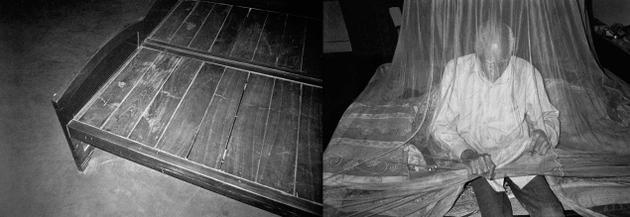
95 Mani Villa, brilliantly curated by Amit Mehra, is a similar navigation of memories although with a different approach. It starts with a young photographer setting out to document the last few years of his grandfather Dhanji Anklesaria in 95 Mani Villa in Jhansi. In a pitch dark room, Zishan lets the viewer into his intimate world through the backlit black and white images of his late grandfather.
Shot on film, Zishan captured the last two years of Dhanji’s life trying to understand him better. “It was because of him that my mom had eloped with my father. He reconciled to the fact late. Then he had an estranged relationship with his son, who married a divorcee, a non-parsi, having kids at the age of 53. While he had reconciled with my mother marrying a Muslim, he couldn’t accept his son…I wanted to know him better,” says Zishan.
Frequenting 95 Mani Villa to spend time with his ailing grandfather, Zishan captured his last birthday, his routine, his phone – his only connect to the outside world, his harmonium, his dog, a constant companion and his loneliness. “I wanted to create a surreal space which would enable people to experience and identify with it. It wouldn’t have had the same effect if I had shown just simply displayed prints. And I always wanted to have an AV in the show. The darkness was also intended to prevent the viewer from getting distracted.”
While such personal work could have gone into cliches, Zishan’s work eschews all of them. The subtle, aesthetic shots weave a poignant narrative of inter-personal relationships, memory and familial bonds. “When I started shooting him in 2010, I was shooting to document him, not for a show. But everyone who saw the pictures asked, ‘Where is the grandson?’ There was a distance. By the end of it, everything came together, I as a photographer and I as a grandson.”
SHAILAJA TRIPATHI
source: http://www.thehindu.com / The Hindu / Home> Features> MetroPlus / by Shailaja Tripathi / December 14th, 2013
Fervour marks annual sandal and Urs of Hazarath Gulam Rasool Baba Dargah
The 72nd annual sandal and Urs of Hazarath Gulam Rasool Baba Dargah of Chittoor commenced on Saturday amidst religious fervour, with the performing of sandal in the evening, followed by Urus.
The annual event draws huge crowds from all sections of people in Chittoor division, while the Dargah is seen as an epitome of Hindu-Muslim unity since seven decades. Local belief is that the Hazarath while wayfaring down South had settled in Chittoor a century ago. His presence was said to have brought copious rains in the region, driving away the perennial drought conditions. As a mark of respect for the Hazarath, the people of Chittoor built a Dargah. Earlier, the traditional ritual of carrying sandal commenced in the afternoon through the arterial junctions. After performing Fathiha ritual, the Dargah heads distributed the sandal to the gathering. Poor feeding was performed from evening till late night.
source: http://www.thehindu.com / The Hindu / Home> National> Andhra Pradesh / by Staff Reporter / Chittoor – December 15th, 2013
Poets from five States participated in a poetry fest organised in Bidar on Monday night by several literary organisations.
Poets used Shayari couplets, Ghazals and Tarannums to send a message to society. The issues they chose ranged from love, heartbreak, mother’s love, the life of the Prophet Mohammad to the recent carnage in Muzaffarnagar.
B. Narayan Rao, former Zilla Panchayat member, who inaugurated the Mushayira, lamented that Urdu was being limited to Muslims. Urdu is the language that binds India together. “While millions of non-Muslims speak Urdu, millions of Muslims in several States don’t understand the language,” he said.
Tanveer Ahmed Salman, who anchored the Mushayira, said Bidar was the city where the first Urdu book “Masnabi Padamrao Kadamrao” was published in the 14th century. This remains a matter of pride for us, he said. It has produced poets of global repute like Hazrath Ishqui in the 18th century and modern day favourites like Rashid Ahmed Rashid and Suleiman Khatib.
Deputy Commissioner P.C. Jaffer released six books. He said though the number of people who spoke Urdu was increasing, the number of those who could read and write the language was decreasing. “This is the problem with most Indian languages. We should make concerted efforts to preserve Urdu and other Indian languages,” Mr. Jaffer said.
The books that were released included Bidar Ke Asare Kadima, a note on the monuments of Bidar, by Abdul Samad Bharati; Tazkara Mahamud Gawan and Jahan-e-Kaleem by Nissar Ahmed Kaleem; Nashrah and Saad by Ameeroddin Amir and Ghanti by Hameed Saleem.
Poets from Karnataka, Andhra, Maharashtra, Uttar Pradesh and Orissa participated. They included Misbaq Azmi, Akram Nakkash, Saifuddin Saif Ghori, Naveed Abdul Jaleel and Nooruddin Noor.
Poets from Bidar like Mohammad Yousuf Raheem Bidri, Mukhtadir Taj, Nissar Ahmed Kaleem, Basit Khan Sufi, Ameeroddin Amir and Rehana Begum participated.
The surprise package was the singing of two ghazals by Deputy Conservator Forests Sunil Panwar. “A native of Uttarakhand, he learnt to read and write Urdu after being posted to Bidar,” Mr. Bidri, who was a member of the organising committee, said.
‘Bidar has produced poets of global repute like Hazrath Ishqui, Rashid Ahmed Rashid and Suleiman Khatib’
We should make concerted efforts to preserve Urdu and other Indian languages: P.C. Jaffer
source: http://www.thehindu.com / The Hindu / Home> National> Karnataka / by Special Correspondent / Bidar – December 10th, 2013
Clubs belonging to Lions District 324A1 have installed solar power plants at 35 schools run by the State government and Chennai Corporation. / Photo: M. Srinath / The Hindu
The Government Hobart Higher Secondary School for Muslim Girls, Royapettah, recently got a 1.5 KV solar power plant. Students of classes VII, VIII and IX will benefit from the plant that can power 10 lights and seven ceiling fans.
Imtiaz Fathima Wadood, president of the parent-teachers association of the school, said the supply from the plant could also be used to power the examination hall, which has a seating capacity of 100 students, when tests are conducted.
“We have to thank the Lions Club of Periamet for providing the facility worth Rs. 2.5 lakh to the school, which has 300 children from poor families from Triplicane and Royapettah studying,” she said. The Club will maintain the facility for five years.
Clubs belonging to Lions District 324A1 have also installed solar power plants at 35 schools run by Chennai Corporation and the State government.
According to G. Ahmed Sharif, advisor, district 324A1, who is also the project chairman, said a total of 19 government and 11 Corporation schools had been covered under the project this year. “It is the suggestion of the district governor D. Balachandra Reddy that all the clubs are following. The district provides Rs. 50,000 per plant and the clubs have to bear the rest of the cost. Many classrooms are poorly lit and need such solar plants. In the long run, it will also help reduce the schools’ power bills,” he said, adding that more clubs were coming forward to install such plants.
source: http://www.thehindu.com / The Hindu / Home> News> Cities> Chennai / by Special Correspondent / Chennai – December 26th, 2013
People entering Taj Mahal complex for prayers on Fridays will now have to carry identity documents, according to a directive issued by Archaeological Survey of India (ASI) following a complaint that non-Indians were also entering the mosque despite it being closed for visitors.
The directive, issued by ASI’s Agra unit superintending archaeologist N.K. Pathak on Thursday, has, however, received criticism from Taj Mahal’s Mosque Committee which has said that no Muslim, irrespective of nationality, can be stopped from offering prayers at the mosque.
The local ASI unit had received a complaint that an Indian Muslim had allegedly brought five Bangladeshi nationals along with him to Taj Mahal’s mosque last Friday, leading to a row over as to who all should be allowed inside the mosque.
The ASI authorities claim that the body’s Director General has ruled that only Indians should be allowed to enter the mosque to offer prayers on Fridays, when the monument is closed for visitors.
The Taj Mahal Mosque Committee President Ibrahim Hussain Zaidi, however, criticised the directive and said Muslims should not be discriminated on the basis of nationality.
“The Gazette notification of January 1, 2001 issued by Government of India states that Muslims will be allowed to offer prayers at the Taj mosque on Fridays even though it is closed for visitors. Nowhere does it say that Muslims of other nationality should not be allowed,” he said.
Reacting to Zaidi’s criticism, ASI caretaker at Taj Mahal Syed Muazzar Ali said that the mosque committee has no locus standi on the matter.
source: http://www.thehindu.com / The Hindu / Home> News> National> Other States / PTI / Agra – December 27th, 2014
COMMUNITY CHRONICLE The wedding invitation of Wajid Ali Shah’s son, a fatwa by a pundit, nikahnamas embossed in gold, a judgement by Akbar Allahabadi…Khalid Sabir’s house in New Delhi’s Shaheen Bagh preserves remnants of yesteryear Awadh
With age, nostalgia becomes a hobby for many. One of its probable side effects is the fascination for most things old — they become a token of the times that were, appealing for the stories they hold, don’t they?
But with New Delhi’s Shaheen Bagh resident Khalid Sabir, young age never became a deterrent in evoking nostalgia for an age his forefathers belonged to, and he began collecting — and collecting — so many things from the past that most of his two-storey house is now packed with an assortment of things that are clearly rare, precious and deserve space in a museum.
The transformation of Sabir, now 62, into being a hardcore collector rather sprang from a strong sense of documenting history that caught his imagination in his school days in Allahabad. Sipping tea, surrounded by things from his valuable collection spread over a bed, an effervescent Sabir reels back to his first venture at collecting things. “My uncle Ahmad Sabir was the still photographer for Mughal-e-Azam . When the film got released, he came to Allahabad and took the entire family to watch it. It was he who gave me a couple of posters of the film. That triggered in me the urge to collect film posters. Over the years, I had an amazing collection but all got burnt during a fire in the house some years ago.”
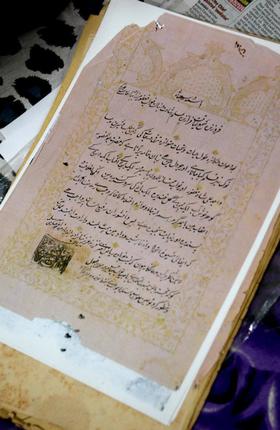
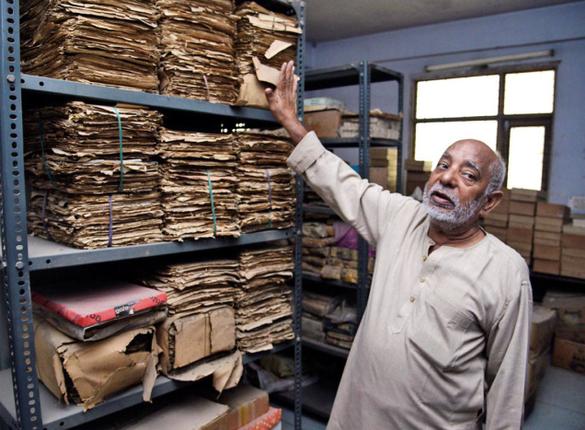
Collector’s items(From left) Khalid reading out from a royal nikahnama; in a room with old documents; an issue of Urdu daily Nawal Kishore Photos: S. Subramanium
Much later, in the early ’80s, work took Sabir to the U.K. but the urge remained. During visits to his home State Uttar Pradesh — to towns like Allahabad, Lucknow, Rampur, etc. — he would check out on the local scrap collectors, the kabari-wallahs. Each time, he would hit upon a treasure from the past. “I have collected most of my things from kabari-wallahs,” says Sabir, displaying for this reporter a judgement given by the famed Akbar Allahabadi, a silk map of Lucknow dated 1884, an invitation sent out by Nawab Wajid Ali Shah for one of his son’s weddings, a judgement by Sir Lawrence Peel dated 1865 in a case involving Bahu Begum of Faizabad; a fatwa proclaimed by a Hindu pandit in 1800, a pre-1857 nikahnama of a princess written in gold with mehr worth 12 lakhs, among other prized catches culled out from the dump yards. Holding the copy of the fatwa, he points out, “Like the maulanas, Hindu pundits also used to declare fatwa. Urdu was the language of the times, so it was used in them. Every fatwa refers to a hadith, so this one also begins with one written in Urdu by a maulana. It is followed by a pandit answering the maulana by referring to a shloka from the Ramayana in Devnagiri before pronouncing the judgement.” Indicating the date written on top of the fatwa, he says laughing, “This one is before Ghalib.”
Sabir reads out from the wedding invitation of Wajid Ali Shah — known for his love for poetry — prodding you to listen carefully to the language. “It was a time when Urdu was emerging from Persian. You can see the mix here,” he says with relish. That marriage went into trouble, leading to the return of the bride’s dowry. Interestingly, Sabir has letters of the fight between the bride and the groom, also the list of her dowry.
Carefully taking out from a plastic envelope a clasp of yellowed papers a judgement given by the famed poet and judge Akbar Allahabadi in 1862, Sabir says, “Read this, not for nothing there is an old saying in U.P. that what is left in Allahabad apart from Akbar and amrud trees.”
In rows of steel almirahs and shelves covering five rooms of his house, there are stacks of old land deeds of thousands of families across U.P., receipts of property tax issued during the British rule, nikahnamas of Hindu nawabs, initial editions of Urdu dailies like Nawal Kishore , Haqiqat , Awadh Akhbar , personal letters of English couples living in that region among other things. “I have the third issue of the Lucknow newspaper The Pioneer too, which I don’t think the company itself has,” he adds.
A compulsive collector that Sabir is, he also has a roomful of postage stamps from across the world collected since his school days. And another room where stacked to its ceiling are old editions of Indian magazines and press clippings on 400 topics. “I have published 13 books after compiling these press clippings on different subjects,” he informs. Till a while ago, Sabir says, he used to subscribe to 30 newspapers across different languages. “I had employed four people to help me out in preserving my collection. But I have slowed down after a heart attack sometime ago,” he says.
So what does he plan to do with this priceless collection? “I had approached Jamia Millia Islamia, Aligarh Muslim University, Rampur Raza Library, all the important places that you might think would be interested in keeping this Awadhi treasure. But none seem to be really so. I have spent a lot of money and time on this collection, don’t want it to go waste. So I am saving money, planning to start a museum on my own,” he says. Meanwhile, he has just returned from Dubai “after giving photocopies of some old newspaper papers for digitisation to a Dubai-based organisation. It digitises for free old Arabic, Persian and Urdu documents.”
I had approached Jamia Millia Islamia, AMU, Rampur Raza Library to preserve this Awadhi treasure. But none seem to be really interested
source: http;//www.thehindu.com / The Hindu / Home> Features> MetroPlus / by Sangeeta Barooah Pisharoty / September 08th, 2014