Farewell, Pataudi – Tiger rests by parents’ side

Sharmila, Kareena, Saba and Soha watch from the balcony as Pataudi is taken for burial on Friday. Picture by Rajesh Kumar

Pataudi :

Clouds of dust shrouded the grounds of the palace here obscuring the view of the women who looked from the balcony as Mansur Ali Khan of Pataudi was carried to the burial ground at the far end of the garden.

Moments earlier, when his body was on a cot in the chandeliered but sparse central hall of Pataudi Palace, some 70km from Delhi, the women had been led upstairs by Sharmila Tagore after a sermon by a maulana.

“Nothing in the world is against His (Allah’s) wishes,” the bearded cleric told a quiet audience of women seated on the floor and men standing around the hall.

Sharmila greeted visitors, not quite the distraught widow in public, and occasionally looked to Saif to enquire if the visitors would not be intimidated by the crowd outside. Saif looked to Mohammad Saad Bin Jung, his cousin and Tiger Pataudi’s nephew, a former Ranji Trophy batsman for Hyderabad himself, who was overseeing arrangements.

“And, so, friends,” the maulana continued, “it is with such knowledge that we today grieve for a dear departed. Nawabsaheb never did anything just for himself alone or to show off; but what he did brought honour to his country and himself; the achievements were his but they made others happy. But everyone has to leave the world one day and when we go, we go empty-handed.”

Sermon over, the maulana and the ulema who were reading passages from the Quran, seated by the body of Mansur Ali Khan, left the building. It was closer to the appointed hour for the final namaaz and the burial. There is a belief that those who are buried after the Friday namaaz have lived fruitful lives.

The footfalls that kicked so much dust over the Pataudi Palace grounds this afternoon were of the celebrity and the “subjects”. In Pataudi, where the market was closed in honour of the man, they still refer to him as “Nawabsaheb”.

The estate sprawls over 10 acres. The gates are rarely opened to the public.

Sirajul from Basgaon recalls he was among a crowd that had gathered to see the Nawabsaheb when he was appearing at a court near here after being charged with killing a black buck in 2005.

The palace, a white mansion longer than it is wider, has high-ceilinged halls. It is run as a “non-hotel hotel” by a well-known Delhi-based chain. The gates warn explicitly that “non-residents are not allowed”. Its managers clearly did not imagine the scene here today after the death of the nawab who bore the name of this urbanised village.

There is but one portrait of Mansur Ali Khan in royal regalia — on a wall in a corridor you step across to enter the central hall. Otherwise, the black-and-white photographs are of his father, Iftikhar Ali Khan, and his (Iftikhar’s) brother Major General “nawabzada” Sher Ali Khan, who moved to Pakistan (and whose son, Isfandiyar Ali, a cousin of Mansur Ali Khan, is among its military top brass today).

The yellowing photographs show them as members of the Oxford cricket and hockey teams. Also in the corridor is a large canvas of the city of Bhopal seen from the fort. The late India captain’s mother was “Begum of Bhopal”.

A black-and-white frame captures Mansur Ali Khan with Frank Worrell, the West Indian captain, and Richie Benaud, the Australian, in a pub, presumably in England. They are having a great laugh. Pataudi holds a cigarette between his fore and middle fingers. The other two are nursing mugs of beer.

If the photograph was taken after Pataudi had met with the accident in England that injured his eye, it does not show. For here the eyes are intense and dark and sharp. Doctors at the Gangaram Hospital, where he died on Thursday of a lung ailment, said they had “harvested” his one good eye because he had told his family he wanted to donate it.

As the maulana finished his sermon and left, the Haryana police commandos let in a larger crowd.

Kareena Kapoor, Saif Ali Khan’s girlfriend, who had now got up from the floor because she had just received a phone call, walked up to Saif. The actor told the nearest police officer to clear the way and took Kareena and his mother along to the entrance.

They received Karisma, Kareena’s sister, and Malaika Arora, even as a shout went up from the crowd outside because of the fleeting glance they afforded. Sarod player Amjad Ali Khan and filmmaker Muzaffar Ali stepped out to placate the crowd.

Sharmila embraced Karisma and Malaika and guided them up a flight of stairs to the first floor after a glimpse of the body.

Mansur Ali Khan spent a long time in hospital. His face was unshaven and his mop of hair had fallen back as he faced the ceiling, eyes shut and unseeing. Only the face was exposed. A white cotton sheet covered the body so used to jackets and sherwanis of the finest cut. Wreaths rested on the floor around his cot.

Kapil Dev, who was also in Vasant Vihar, accompanied the body and the family to Pataudi. He was probably the best-known cricketer among the mourners, who included Abbas Ali Baig, Ajay Jadeja and Atul Wassan.

Pataudi’s body was lowered into the grave a little after 2.30pm on the grounds of his palace. The grave next to his is his father’s. The grave next to his father’s is his mother’s.

After the burial, Tiger Pataudi’s grave was unmarked but for little patterns in the sand formed by the thousands of fists emptying over them.

The sand added to the clouds of dust through which you could see the white-shrouded figures of the women in the balcony: Sharmila, his begum, their daughters Soha and Saba and their son’s girlfriend, Kareena, stood frozen and stared at the crowds around the grave in unspoken companionship.

source: http://www.telegraphindia.com / The Telegraph – Calcutta / Front Page> Story / by Sujan Dutta / Pataudi – September 23rd, 2011
Sania meets PM following US Open victory

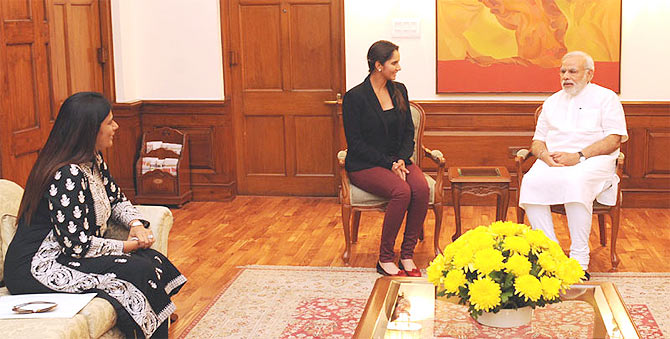
Sania Mirza speaks with Prime Minister Narendra Modi, while her mother, Naseema, looks on, during a courtesy visit on Friday. Photograph: PIB

Indian tennis star Sania Mirza called on Prime Minister Narendra Modi on Friday after her victory in the US Open mixed doubles last week.

Sania met the Prime Minister in a courtesy visit. She was accompanied by her mother Naseema Mirza.

“Indian tennis player and winner of the 2014 US Open Mixed Doubles Event, Ms Sania Mirza, called on the Prime Minister, Shri Narendra Modi, today,” a PIB release said.

Partnering Bruno Soares of Brazil, Sania clinched her third mixed doubles Grand Slam title last week.

Modi had also congratulated Sania just after her victory.

“Congratulations to Sania Mirza for the victory in the US Open Mixed Doubles Finals. We are very proud of the achievement @MirzaSania,” the PMO had tweeted.

On Wednesday, Sania met Telangana Chief Minister K Chandrasekhar Rao in Hyderabad. She is the brand ambassador of the newly-formed state.

source: http://www.rediff.com / Rediff.com / Home> Sports / September 12th, 2014

Kathak doyen’s abode housed in hellish neglect

Lucknow :

The house in which founder of Kathak Kendra of UP and winner President’s award Pandit Lachchhu Maharaj was born lies in a state of shocking neglect. Famous as Kalka Bindadin Maharaj ji ki Dyodi (Jhaulal ka Pul), the house where the legendary Kathak dancer and choreographer was born is in a miserable state, though the government once promised to turn it into a museum.

He hailed from an illustrious family of Kathak exponents in Lucknow (1907-1978), recipient of the prestigious President’s and Sangeet Natak Akademi award Lachhu Maharaj and also the founder director of the Kathak Kendra of Uttar Pradesh, the government of Uttar Pradesh has done absolutely nothing to keep his memories alive. Even the promise of turning his house into a museum made by the state government remains unfulfilled.

Kathak doyen’s nephew Pandit Birju Maharaj too said he had been trying hard to get the house converted into a tourist place but so far he has only received false promises from the parties in power.

“This year, I have requested the Chief Minister to consider with priority the proposal of preserving the house as a museum. I hope some positive results come out soon,” said Pandit Birju Maharaj.

Lachhu Maharaj’s first disciple in Lucknow, Kumkum Adarsh, a popular city-based Kathak dancer and the maestro’s niece Rameshwari Mishra too have been championing the cause. Speaking to TOI, Rameshwari Mishra, who lives in another portion of the same house, said “It gives me immense pain to see the pathetic condition of the house of the legendary artiste who contributed so much to the field of Awadh’s culture.”

She said around 15 years back, during its previous regime, Samajwadi Party mooted the idea of creating a museum in his name but nothing has been done so far.

“If you visit the government flat of Gulistan colony in which Lachchhu Maharaj breathed his last, you will find a rusted ‘sarkari taala’ on the door,” she added.

Kumkum Adarsh, who has been organising an award function in memory of her favorite mentor on his birth anniversary September 1 since 1998, feels her ustad has not been given the recognition he deserved in his home state.

“I am disappointed that no one has actually done anything to keep his memories alive and the pitiable state of the portion of the house he was born and lived in shows the government’s callous attitude,” she rued.

Besides his family and disciples, city-based historian Yogesh Pravin and short-story writer Aisha Siddiqui are also of the view that it is high time people came forward and took up the issue. “Even today there are hundreds of fans of Lachchhu Maharaj across the globe. I still recall how students who came from all over the country would say ‘hum maharaj ji ki dyodi ko choomna chahte hain”, said Yogesh Pravin. “The government must preserve the memories of legendary artists not only as a form of honour to the person but also so that the future generation remains attached to the city’s rich culture and heritage,” said Aisha Siddiqui.

source: http://www.timesofindia.indiatimes.com / The Times of India / Home> India / by Uzma Talha, TNN / September 01st, 2014

Women power to man this Dasara !

In these days of gender-equality, achieved after defying the much loathed gender-discrimination, our city seems to pioneer a new trend beginning this Dasara with an All-Women Team, except for some space for men too, well geared to conduct this year’s Dasara and the District administration as well. Here is how and why.—Ed

Women power will be at the helm of affairs this Dasara as they will share the responsibility of organising and monitoring the Dasara events that begins in city from Sept.25.

The officers in-charge are Deputy Commissioner C. Shikha, who is also the Dasara Special Officer, Mysore In-charge Secretary and Principal Secretary to Government, Department of Women and Child Development and Empowerment of Differently-Abled and Senior Citizens Dr. Amita Prasad, Regional Commissioner Rashmi V. Mahesh, Additional Deputy Commissioner M.S. Archana, Assistant Commissioner Syeda Ayesha, ACP (K.R. Sub-Division) B.T. Kavitha. This apart, ZP President Dr. B. Pushpa Amarnath and Mayor N.M. Rajeshwari Somu will also be an integral part of the Dasara celebrations.

DC Shikha, who has the experience of organising Dasara 2013, is expected to conduct this year’s festival with ease. Shikha was also lauded by the general public for successful conduct of 2013 Assembly Elections and 2014 General Elections in Mysore. She previously worked as Managing Director of CESC in Mysore.

Deputy Commissioner Shikha being the Special Officer for the Dasara celebrations will have the responsibility of co-ordinating with various committees and Ministers while planning this year’s festivities.

It is not only her; Shikha will have the guidance of senior IAS officer Dr. Amita Prasad, who is currently the Mysore In-charge Secretary. Having held the post for five years, Amita Prasad has been lending her valuable suggestions to the officials on conducting Dasara activities. Another officer who would be a part of Dasara festivities is Regional Commissioner Rashmi V. Mahesh. A 1996 batch IAS officer, Rashmi passed her IAS examination at the age of 22 years. She has the previous experience of working as Assistant Commissioner in Hassan, Mysore ZP CEO, Bangalore Urban Deputy Commissioner, Joint Commissioner of Excise Department, Secretary, Department of Rural Development and Panchayat Raj and also in Department of Medical Education. She has now replaced M.V. Jayanthi as the Regional Commissioner of Mysore Division.

This apart, Deputy Commissioner C. Shikha will be supported by Additional Deputy Commissioner M.S. Archana and Assistant Commissioner Syeda Ayesha, both native of Mysore. While, the officers take charge of the overall activities, ACP (K.R. Sub-Division) B.T. Kavitha, will be in-charge of monitoring the security while the Dasara events take place at various venues.

Adding to the list of women who will be at the helm of affairs this Dasara will be Mysore Zilla Panchayat President Dr. B. Pushpa Amarnath, who has been given the charge of organising Raitha Dasara and Grameena Dasara. This apart, she will also be leading the green campaign during Dasara festivities. Chief Minister Siddharamaiah considering her suggestion has banned the use of flowers and bouquets to welcome the guests during the 10-day festival. Instead, the guests would be greeted with saplings.

Mayor N.M. Rajeshwari Somu will also play a vital role in Dasara, being a member of the Dasara Reception Sub-Committee. Dasara being the festival that revolves around Goddess Chamundeshwari and women being entrusted the job of organising the 10-day extravaganza, this year’s Dasara is all set to celebrate the women in power.

source: http://www.starofmysore.com / Star of Mysore / Home> General News  / September 09th,  2014

Nazrulgeeti legend passes away

Kolkata :

Nazrulgeeti exponent Firoza Begum, who was to be honoured with ‘Banga Bibhushan’ by the state government later this month, passed away in Dhaka on Tuesday evening. The 84-year-old was suffering from heart and kidney disease.

“She breathed her last around 8.15pm,” Bangladeshi media reports said. She had been undergoing treatment at the ICU of a private hospital. She was fitted with a pacemaker on Monday.
Mamata Banerjee grieved on social media as the news reached her on Tuesday night. “I am very sad to learn that the legendary Firoza Begum has just breathed her last. Her passing away will certainly create a huge void in the world of music and culture,” she posted.

 
The CM said her government had planned to confer the state’s highest civilian honour on her. “We had decided to honour her with ‘Banga Bibhusan’. She had also agreed to come to Kolkata to receive the award. But, now it’s all over,” she mourned.
Mamata recounted her last interaction with the legend by saying: “Hardly 10 days ago, we talked to each other. To me, her passing away is indeed a great personal loss. She used to treat me as a member of her family. On the last occasion of our meeting, she told me: ‘Ar ki dekha hobe? (Will we meet again?)’ Today, these words keep ringing in my ears,” the chief minister said.

source: http://www.timesofindia.indiatimes.com / The Times of India / Home> City> Kolkata / TNN / September 10th, 2014

61 Mughal-era silver coins found in Kanpur

Representational Image RNA Research & Archives

A total of sixty-one Mughal-era silver coins  with Arabic inscriptions imprinted on them have been found from an earthen pot near the bank of river Ganga in Cantonment area in Kanpur .

The coins  were found last evening when a few kids had gone to the river Ganga’s wharf in Cantonment area to take bath where they found an earthen pot filled with shining coins in it, police said.

Ram Kishan Das, a priest at the wharf, after knowing the incident, informed police and Army officials which then took the relics under its authority and has informed Archaeological Survey of India about the coins, Major CP Bhadola said.

ASI has conducted a search at the site and sent a preliminary report to their Lucknow office, an official said.

“The coins have some inscriptions on it in Arabic script, we are guessing that these might belong to the Mughal era,” ASI officer Manoj Verma said.

source: http://www.dnaindia.com / DNA / Home> News> India / Place: Kanpur, Agency: PTI / Saturday – September 13th, 2014

Ambassador Islam Siddiqui to deliver Keynote address at Aligarh Alumni Event in USA

by TCN News,

San Francisco:

Hundreds of thousands of students, alumni, and well-wishers of Aligarh Muslim University (one of the oldest and famous seats of learning in Asia) around the world will celebrate Founder’s Day, popularly known as ‘Sir Syed Day’ around this time of the year. In Bay area this event is organized by Aligarh Alumni Association of Northern California on September 20th at India Community Center in Milpitas, CA

Ambassador Islam A. Siddiqui, Senior advisor at the Center for Strategic and International Studies (Former Chief Agriculture Negotiator in the office of the U.S Trade Representative in Obama Administration) will give keynote addresses at the 17th annual Sir Syed Day.

Sir Syed Ahmad Khan

Sir Syed Ahmed Khan, the founder of AMU was born on October 17, 1817. Sir Syed, the famous 19th century scholar, historian and social reformer spent most of his time on promotion of social, economic and educational conditions of Indian Muslims.

Today, AMU symbolizes on the one hand the secular ideals of the Republic of India and on the other the aspirations of more than 150 million Muslims in India. The AMU, which Sir Syed planted as a sapling in British India, has now grown into a blossoming tree.

The Aligarh alumni are spread in large numbers all over the world with the majority being in the sub-continent. Prominent personalities in all walks of life including statesmen such as Dr. Zakir Husain – former president of India, Ayub Khan – former president of Pakistan, and M. Hamid Ansari – current vice president of India.

Dr. Islam Siddiqui

Dr. Shaheer Khan, one of the organizers of the event said, “The Aligarh alumni and present students are proud inheritors of Sir Syed’s legacy of open hearted tolerance, modern enlightened thinking, a love for scholarship, peaceful coexistence and above all a rational approach to our beliefs and our problems.” More than ever, it is time that the ‘Sir Syed Model’ gains wider currency in the Muslim World, Dr. Khan added.

This year’s event will also include the Annual International Mushaira. Many famous Urdu poets from India and Pakistan, along with poets from North America are expected to participate. AMUAA’s annual Mushairas are well recognized and widely acclaimed as the most sophisticated and popular in North America and attract almost 400-500 enthusiasts and admirers of Urdu poetry in the Bay Area.

For more information, visit: http://www.amualumni.org

source: http://www.twocircles.net / TwoCircles.net / Home / by TCN News / September 13th, 2014

Sania’s gesture to young talent

Former National tennis champion Shaikh Jafreen (in the hearing impaired category) was in for a pleasant surprise at the Sania Mirza Tennis Academy in Hyderabad on Friday morning when the three-time Grand Slam winner Sania Mirza walked across to present a cheque of Rs. 5 lakhs to the former to help her prepare for the major events lined up over the next few months.

The 17-year-old Jafreen shifted her base to Hyderabad at the initiative of Sania Mirza and joined the SMTA last year. Ever since, she has been given free coaching and also being mentored personally by the star tennis player.

Only on Thursday, Telangana State Chief Minister K. Chandrasekhara Rao presented a cheque of Rs. 1 crore to Sania, who is brand ambassador of the State Government, as incentive for winning the US Open mixed doubles title.

source: http://www.thehindu.com / The Hindu / Home> Miscellaneous> Others / by Special Correspondent / Hyderabad – September 13th, 2014

Reviving the dying art of Arabic calligraphy

Bhopal :

She wields her set of ‘pen of reeds’ like an inspired chef. The mixture in jars she stirs so energetically, knowing well that like Urdu language, which was once highly respected and flourishing, the art of Arabic calligraphy too faces an uncertain future. Roohy Khan, a science post graduate in her 20s, provides a rare glimpse into the dying art of Arabic calligraphy in the country.

Organized by Archaeological Survey of India (ASI), the exhibition-cum workshop on Arabic calligraphy is being held at Rani Kamlapati Palace.

Roohy’s treatise contains a fascinating description of all letters. For example, she draws Alif, which to the uninitiated is a simple line, in an angular pattern using Koofi script. Her Alif, gets circular in Sulus script, remains steadfast in more common Naksh script (easy to read much like Urdu). For the more formal documents, she uses Khat-e-deewani for shooter strokes.

This is Roohy’s fourth exhibition. “Arabic script is the prime art of Islam and it is a little misunderstood. Here, we are inviting all to come learn calligraphy, in the language of your liking. It is so Indian now and needs to be preserved,” she said.

The art of calligraphy or Khushnawisi or kitahat is said to be more than 5,500 years old. Calligraphy is profession in which handful of artistes are flooded with work, that in many cases is mediocre at best.

Her pen of reeds, made out of canewood and similar material is cut exactly 1.5 inches from the top to give its nib the desired shape. “The angle of writing is most important. The rhythm, layout and interweaving patterns come naturally,” she said. Her work cannot be read so much so as visually sensed.

source: http://www.timesofindia.indiatimes.com / The Times of India / Home> City> Bhopal / by Jamal Ayub, TNN / August 31st, 2014

G.B. Pant University honors U.S. Chief Agricultural Negotiator Ambassador Islam A. Siddiqui

The G. B. Pant University of Agriculture and Technology in Pantnagar, Uttarakhand, today honored its former student, United States Chief Agricultural Negotiator Ambassador Islam A. Siddiqui, with an honorary degree of Doctor of Science. The degree was conferred upon Ambassador Siddiqui in recognition of his contributions to agricultural research and development, as well as agricultural trade policy development and his work’s influence on world agriculture.

“I feel humbled and honored at the same time to be receiving this honorary degree of Doctor of Science. Thousands of agricultural scientists, engineers, and veterinarians graduating from Pantnagar and sister universities provided the foot soldiers to make the Green Revolution a reality. This massive technology transfer of modern agricultural practices – combining education, research, and extension — turned India from a net food importing country to a food exporting nation. As a student of the first batch of this great institution when it opened its doors 51 years ago, I had not imagined in my wildest dreams that one day I would receive this prestigious award.”

Ambassador Siddiqui was born in Haldwani, Uttar Pradesh and attended G.B. Pant University before taking a scholarship at the University of Illinois in the United States. Throughout his career, he has advocated for international cooperation, technology transfer, capacity building, and new technology development to achieve food security in the 21st century.

source: http://www.newdelhi.usembassy.gov / Embassy of the United States, New Delhi, India / Home> News & Events> Press Releases / New Delhi – May 20th, 2011