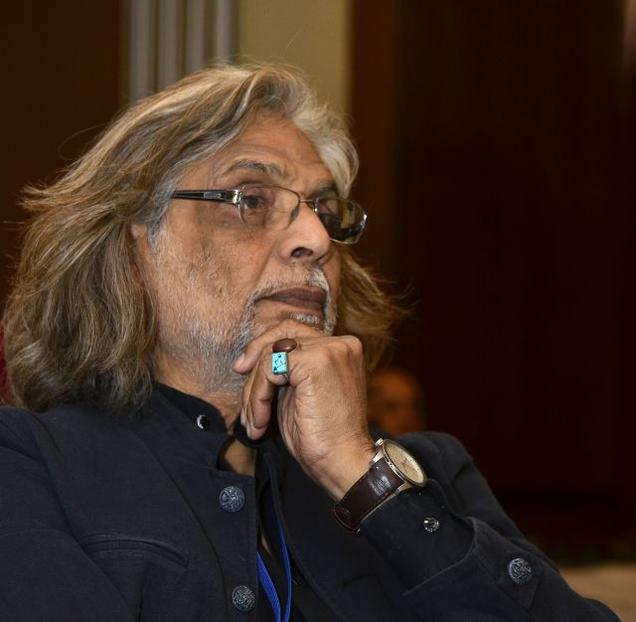
Renowned filmmaker Muzaffar Ali. / File photo: Shiv Kumar Pushpakar / The Hindu
Noted filmmaker Muzaffar Ali, who had directed the Bollywood classic “Umrao Jaan”, has been selected for Rajiv Gandhi National Sadbhavana Award for his outstanding contribution towards the promotion of communal harmony, peace and goodwill.
It carries a citation and cash award of Rs 5 lakh.
The decision to honour the 69-year-old film maker, social worker and sufi poet was taken at a meeting of the Advisory Committee of the Rajiv Gandhi National Sadbhavana Award yesterday.
Born in Lucknow, Ali also directed over one-and-a-half dozen movies including “Gaman” and “Khizan”. He was awarded Padma Shri in 2005.
This will be the 22nd edition of the Sadbhavana award, which will be presented at a special ceremony at Jawahar Bhavan on August 20, the birthday of late Prime Minister Rajiv Gandhi.
Congress president Sonia Gandhi has been presenting the award ever since it was constituted.
It was instituted to commemorate the contribution made by him to promote peace, communal harmony and fight against violence.
Recipients of the award include Mother Teresa, K.R. Narayanan, Ustad Bismillah Khan, Lata Mangeshkar, Sunil Dutt, Dilip Kumar, Ustad Amjad Ali Khan and Maulana Wahiduddin Khan.
Others who got it were Jagan Nath Kaul, Mohd Yunus, Hiteswar Saikia and Subhadra Joshi (jointly), Kapila Vatsyayan, Teesta Setalvad and Harsh Mander (jointly), S N Subbarao, Swami Agnivesh and Madari Moideen (jointly), Nirmala Deshpande, Hem Dutta, N Radhakrishnan, Gautam Bhai, SPIC MACAY and D R Mehta.
source: http://www.thehindu.com / The Hindu / Home> Features> CinemaPlus / PTI / New Delhi – August 01st, 2014
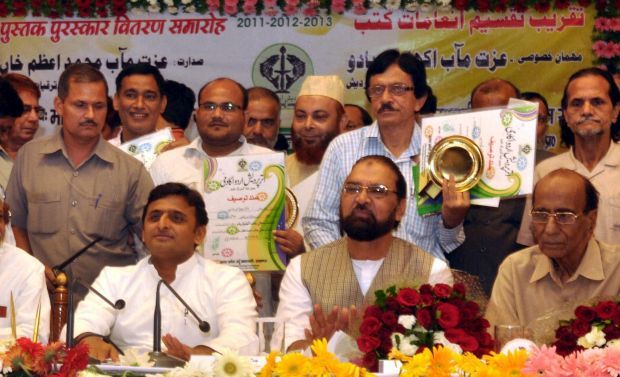
Lucknow: Uttar Pradesh Chief Minister Akhilesh Yadav during the prize distribution ceremony of Urdu Academy at Chief Minister House in Lucknow on Monday (Photo: PTI)
Lucknow:
Uttar Pradesh Chief Minister Akhilesh Yadav today said that Urdu has always connected hearts and when the language is used, it reflects love and affection. Speaking on the occasion of a book prize distribution ceremony of Uttar Pradesh Urdu Academy at his official residence, Yadav said a message of love and brotherhood would reach the society through this event.
Emphasising on importance of languages for the mutual understanding among masses, the Chief Minister said Hindi and Urdu were being used to take the society forward. He said it was the intention of the SP government that both the languages get promoted and compete with English. Referring to the efforts made by the SP government to promote Indian languages, he said the government has started felicitating Hindi, Urdu and Sanskrit scholars.
source: http://www.deccanchronicle.com / Deccan Chronicle / Home> Nation> Politics / Press Trust of India / August 05th, 2014
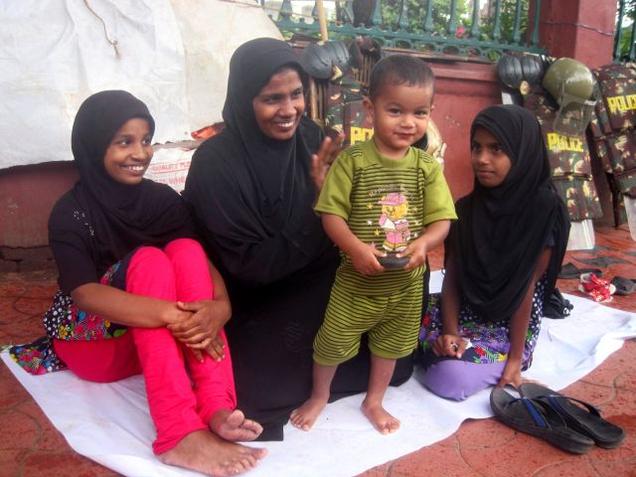
Jazeera along with her children protesting in front of the Secretariat in Thiruvananthapuram. Photo: Kaavya Pradeep Kumar / The Hindu
Jazeera is on a silent campaign, in defence of the Neerozhukkumchal beach in Kannur
The so-called sand mafia of a little taluk in Kannur rues the day Jazeera returned home. Dismissed as an insignificant voice of protest against the rampant exploitation of a stretch of shoreline near Pazhayangadi town, this woman has soon come to be known as a force to be reckoned with. All the way from the northern district of Kannur, she has brought her silent campaign to the State capital, as she sits in front of the Secretariat with her three children — protesting without loud sloganeering or politically coloured flags or leaflets.
Entering the fifth day, Jazeera’s protest has thus far been eclipsed by a far more populous Left protest.
Now that they have left, the presence of this family has become more conspicuous, leading the Chief Minister to meet them briefly on Monday afternoon on the issue of sand-mining in her hometown. For Jazeera, the cause is intensely personal, as the Neerozhukkumchal beach is the canvas all her childhood memories are painted upon.
She is an autorickshaw driver, a profession she has struggled to be part of, in a conservative society. She does not let herself to be affected by such taboos and continued working until after her marriage in 2004, when she moved to Kottayam with her husband.
She has found the new district far more accepting. It was only one and a half years ago, when she returned home during the final month of her third pregnancy, did she see to her shock the daylight robbery of a natural landscape.
Countless visits to the Kannur collectorate and police stations have proved futile.
And for the past one and a half years, her silent protest has involved a sit-in, along with her daughters Rizwana, Shifana and her son Mohammed. The two girls, aged 12 and 10, know everything about the case and have flanked their mother every step. Her husband, Abdul Salaam, is a teacher at a madrasa in Kochi.
While he has not been a visible part of Jazeera’s protest, his support, despite pressure various quarters, has been a huge boon for her.
She is clear about her objective despite the obstacles strewn before her in terms of muscle and money power. Even the police, she says, have pleaded with her to give up. “Their greed is despicable. In broad daylight they commit this heinous crime of emptying our lands, oblivious to the fact that there are so many creatures that depend on it. The sudden depth of water is dangerous as well,” she says.
She is glad to have met the Chief Minister personally and she said he assured her that he would ensure that the vehicles carting away the sand would be immediately dealt with.
She will leave once she obtains something in print promising a complete halt of the activities.
source: http://www.thehindu.com / The Hindu / Home> News> National> Kerala / by Kaavya Pradeep Kumar / Thiruvananthapuram – August 08th, 2013
Sakina khatun with the bronze medal she won at the Commonwealth Games in Glasgow. / The Hindu
Her success is all down to her hard work: coach
Life has not been kind to Sakina Khatun, who won a bronze medal at the Commonwealth Games on Saturday.
In Glasgow’s Clyde Auditorium, the 25-year-old Bangalore-based para-athlete lifted a weight of 88.2 kg to finish third in the women’s powerlifting event (Lightweight Group A). It was a success that came after prolonged hardship.
“My parents cried when I broke the news to them on the phone,” she told The Hindu from Glasgow.
Her coach and mentor Farman Basha, who also competed at the Games, faltered in his event on account of an injury, but his delight was enormous. “She has been through a lot. So I’m very happy for her,” he said.
Sakina hails from Basirhat in West Bengal’s North 24 Parganas district. Her mother is a farm labourer while her father, ailing with a serious back condition, is unable to work. “He can’t even walk,” Sakina said. “We don’t have the money for his treatment.”
Afflicted with polio at a young age, she took up swimming on her doctor’s suggestion, learning in ponds in her village before a teacher in school noticed she had an aptitude for it. “Despite steady success at the national level, I was ignored for the 2010 Commonwealth Games team. It left me disheartened and I quit the sport,” she said.
Sakina switched over to powerlifting on the advice of one of her swimming coaches, and in 2010 was directed to Basha. “She wanted to come over to Bangalore to be trained by me,” he said. “She had no money and I couldn’t afford to spend a rupee on her.”
But Sakina found a benefactor in Dilip Majumdar, a businessman who volunteered to support her training. “I’m a girl and my parents were against my leaving home,” she recalled. “But my sponsor managed to convince them.”
“At first, she could only lift around 25 kg,” recalled Basha. “But gradually she improved. Her success is all down to her hard work.”
source: http://www.thehindu.com / The Hindu / Home> News> Citis> Bangalore / by Shreedutta Chidananda / Bangalore – August 04th, 2014
Mr. Mohammed Zaheeruddin resident of Bandapally, Kortla reached Siasat office and thanked Mr. Zahed Ali Khan Siasat editor.
On the occasion he told that he is greatly obliged to Siasat daily, because due to the encouragement of Mr. Amer Ali Khan news editor his nephew Shaikh Junaid passed SSC with 553 marks from Naunehal School Urdu Medium, Kortla.
He has topped the Urdu medium schools of the state.
He was presented Abid Ali Khan gold medal by Siasat editor Mr. Zahed Ali Khan and is now pursuing B.Tech from Muffakham Jah College Hyderabad with the cooperation of Siasat. He passed B.Tech 2nd year exam with 88 pc marks.
Siasat editor Mr. Zahed Ali Khan, news editor Mr. Amer Ali Khan congratulated him for his excellent performance.
source: http://www.siasat.com / The Daily Siasat / Home> Hyderabad / Sunday – August 03rd, 2014
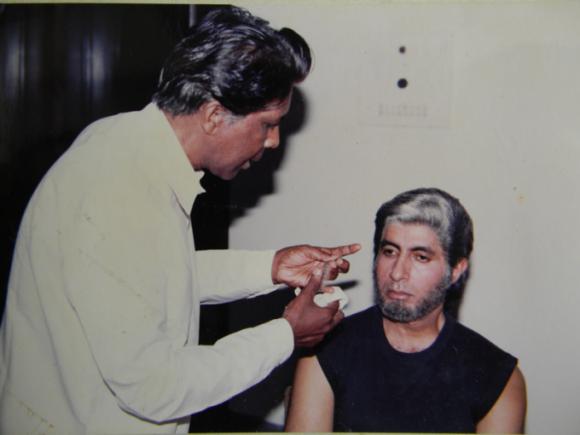
Kabir created hairpieces for many major stars, including Amitabh Bachchan in the 1988 action film Shahenshah / Photo: S Kabir / Siraj Sheikh
SURENDRA’S NATURAL HAIR STUDIO isn’t easy to find. But for the wigged wooden heads marking the entrance, this workshop in a grimy alley off Mumbai’s SV Road looks just like any other. Inside, however, it becomes clear that the studio belongs to one of Hindi cinema’s most sought-after wig makers, Surendra Salvi. The foyer walls are lined with photos of Salvi with actors—everyone from Salman Khan to Prem Chopra—sporting his toupees, beards and moustaches.
Salvi ushered me into a workshop where five uniformed employees created mesh bases for new wigs, and wove hairpieces and hair extensions. Almost all of Salvi’s wigs are made of natural hair, but he uses various amounts of synthetic material for those on tight budgets. “Natural hair is expensive,” he explained. Even-length, pre-sorted hair can cost up to Rs 70,000 per kilogram.
Salvi, a Mumbai native, told me he always wanted to be part of the film industry, though it took some time to break into the business. “First I did clerical work,” he said, “then I fitted car lamps for an auto company. Then I worked in a talcum powder factory. Then I had enough.” In the early 1980s, he started assisting the makeup duo of brothers Anil and Pradeep Pemgirikar by making wigs and beards for extras and body doubles. Over the following decades, he made it big on his own. His hairpieces have been used by Boman Irani in 3 Idiots, Shahrukh Khan in Ra.One, Akshay Kumar in Action Replayy, and many other superstars. When I visited two months ago, Salvi was fashioning wigs for director Anurag Kashyap’s upcoming Bombay Velvet. He also does work for regional films, television commercials, and individual clients.
Pradeep Pemgirikar, Salvi’s mentor, oversaw makeup, wigs and prosthetics for the films of director Manmohan Desai in the 1980s. He now runs Mod Wig Centre from his humble three-room house in Dadar, taking whatever work he gets from the Marathi and south Indian film industries. Pemgirikar, who said his best work was on the 1992 film Khuda Gawah, rued changing trends in the movie business. “Everyone wants a natural look now,” he said, “but in those days, every third character in a Manmohan Desai film had a wig.”
If the 1980s and 1990s had the Pemgirikars, the 1960s and 1970s—when bouffants, pompadours and beehives were all the rage—had S Kabir and Victor Pereira. Kabir came to Mumbai from Kolkata in the 1950s to assist his older brother S Amin, who was then already a makeup man and wig maker of repute. Kabir worked with almost all the leading men of the time, his son Siraj told me, and made wigs for such classics as China Town, Mirza Ghalib, Aandhi, Padosan, Sholay, Shahenshah and Kalicharan. But his most illustrious client was Pran, whose memorable get-ups from Upkar and Zanjeer to Amar Akbar Anthony and Don cemented his reputation as one of Hindi cinema’s greatest character actors.
Kabir passed away in 1994. Siraj is keen to keep his father’s legacy alive, and, with his brother Farooque, now runs the wig studio S Kabir & Sons, established by Kabir in the late 1950s, in Andheri East. “Wig making is an art, but it never gets the respect it deserves,” he said. “Even personal drivers and spot boys who serve chai to actors get mentioned in film credits. We often don’t.” An online search showed S Kabir credited for his work on only three movies, though Siraj claimed he actually worked on between seven and eight hundred films. Siraj also lamented the end of the era when prevailing fashions meant greater demand and profits, and more time to craft great wigs. He remembered being called on to make a hairpiece for Amitabh Bachchan several years ago. “They wanted it in three days,” he scoffed. “Is three days enough time to make a wig?” Sorting hair bought from wholesalers is a gruelling process, and the average wig requires at least five to seven days of work.
Victor Pereira, S Kabir’s contemporary, now lives in Mangalore, near his home town of Moodabidri. Although no longer associated with the film industry, he was happy to talk about his glory days over the phone. Having learned his trade in Mumbai from S Amin, Kabir’s brother, Pereira got his break on the 1969 film The Killers, starring Dara Singh and Helen. Although the film was a dud, he went on to craft all of Helen’s wigs from then on, putting his stamp on her looks in song videos such as ‘Piya tu ab toh aaja’ and ‘Mehbooba mehbooba,’ and films such as The Train and Don. Victor also worked, among others, with Hema Malini, Vyjayanthimala, Sharmila Tagore, Mala Sinha and Rekha. His most challenging project, he said, was director Kamal Amrohi’s 1983 release Razia Sultan. “Kamal Amrohi was such a stickler. Woh ek ek baal dekhte the (He used to check each strand of hair). He told me, ‘Hema Malini rani hai (Hema Malini is a queen). I want the best. Nothing else will do.’”
source: http://www.caravanmagazine.in / The Caravan / Home> Reporting & Essays / The Lede / by Roshini Nair / July 01st, 2014
Anything that glitters: Though Anisa Sayyed had to be content with silver the 25m pistol shooter has no regrets as she prepares for the season ahead. / The Hindu
Defending champion Anisa Sayyed may have swapped her Commonwealth Games gold for silver with compatriot Rahi Sarnobat this time around but that has not affected the 33-year-old’s enthusiasm.
Back from Glasgow, Anisa is focused on making the most of a hectic upcoming season that includes the Asian Games and the World Championships.
The 25m pistol shooter has no regrets.
“Of course, it would have been great if I had retained the gold, so a little disappointment is natural. But there are no regrets. My main target is the World Championships (Granada, Spain, September 6-20), where there will be quota places available for the Rio Olympics. The CWG was a practice competition, an important tune-up event ahead of the big test. We used it to fine-tune our techniques and work out the kinks,” Anisa said after reaching home.
Anisa insisted there was no competition with Rahi. The only thing that mattered was the Indian national anthem being played after the event.
All about control
“If we start thinking of competition, we will not be able to control our mind, body or technique.
“Shooting is all about control and competing with yourself. Before competition, no one speaks much to anyone. But it’s different after the event. In fact, I love being with Rahi on tours because there are not too many Maharashtrians around and it is a huge relief to talk to someone in your mother tongue in a foreign land,” she laughed. Pune-born Anisa, earlier employed with Indian Railways, is now hoping to land a job with the Haryana government since she has been staying in Faridabad after marriage. Her application has been under process for almost four years.
Supported by the Anglian Medal Hunt Company since last year, Anisa admits it was tough to balance marriage and shooting early on.
“In fact, I even thought of not getting married till I was into active sports but everything happens for the best.
“In six years since marriage, my in-laws have given me full freedom and support to pursue my passion.
“Now, if only I manage to get a job, things will get a lot easier,” she said.
source: http://www.thehindu.com / The Hindu / Home> Sport> Other Sports / Uthra Ganesan / New Delhi – August 02nd, 2014
Mughal carving, as the name suggests, is a tradition that traces back to Persia and was aimed at royal palaces. / By Special Arrangement / The Hindu
Hapur-based Sardar Hussain lends freshness to Mughal wood carving.
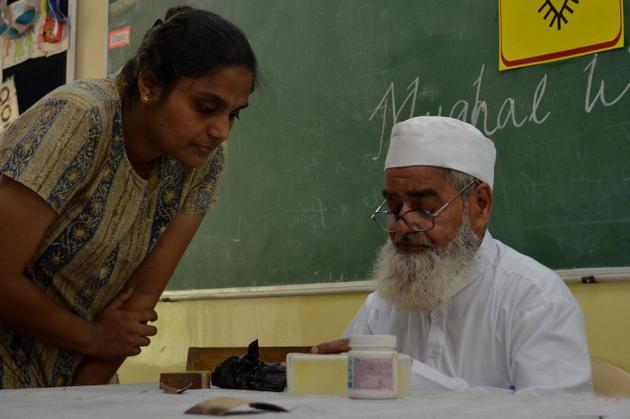
Surrounded by eager participants who show off their handiwork, Sardar Hussain has a beatific smile on his weather-beaten, bearded face as he patiently explains the nuances to the youngsters at one of the intensives at the recent SPIC MACAY’s International Convention. That the shilpa guru is the fourth generation craftsman who has mastered the Mughal technique of wood carving and is the recipient of many a National and international recognition (UNESCO Seal Of Excellence Award) for his craft sits easy on his fragile shoulders.
Mughal carving, as the name suggests, is a tradition that traces back to Persia and was aimed at royal palaces. So, the work itself is a smooth marriage of intricate floral patterns on a grand scale. Sardar Hussain’s family began small but over generations, things have changed. He came into prominence when he was conferred the National Award for making wooden blocks in 1981. He says, “Traditionally, we made blocks but soon we realised that it was not a perennial source of income. So, I reinvented the craft by exploring and expanding the vocabulary during the Golden Age Exhibit at the Festival of India in 1985. I manufactured a wooden box and a round block. I used that block as a lid. I tried a similar thing with square boxes and blocks. What I also did is to use brass inlay on the carved works. And viola! a new craft was born.”
Sardar Hussain has a beatific smile on his weather-beaten, bearded face as he patiently explains the nuances to the youngsters at one of the intensives at the recent SPIC MACAY’s International Convention. / by Special Arrangement / The Hindu
Today, Sardar Hussain runs a thriving export business called Sajawat Handicrafts in his hometown in Chhipiwara, Hapur District of Uttar Pradesh. He is assisted by his sons, both also National Award winners. And among their clients are Fab India and CCI. Says Hussain, “We work with designers from these outlets and create articles according to their requirements. That way we are sure of our work reaching customers.” Taking about the craft itself, he says, “The most important aspect here is the finish. The end product is a reflection of your skill and unless that is in places, the piece falls flat.” The wood used is mostly sheesham but the artisan also uses mango wood these days. “The advantage of mango wood is that its texture allows for it t be painted in different colours.”
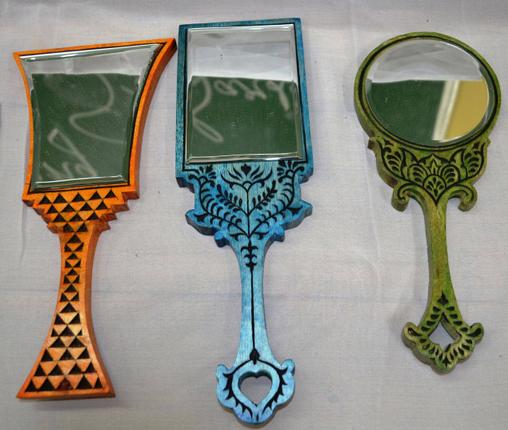
Today, Sardar Hussain’s oeuvre includes jewellery boxes, pen stands, brightly hued hand mirrors, bangle boxes, wall hangings, photo frames and of course, blocks. Though he does workshops off and on, he feels “What is needed today is for the youngsters to take to a craft with sustained interest. And keep at it till they perfect it. That is somehow lacking today.”
And yes, the wizened craftsman has kept pace with technology, thanks to his children. His entrepreneurial venture is accessible on the Internet (sajawathandicraft.com) and he can be contacted at sajawat.handictaft@gmail.com
source: http://www.thehindu.com / The Hindu / Home> Features> Friday Review / by Savitha Gautam / New Delhi – July 31st, 2014
Ajai Appachu, Nadia Haridass, Fouad Mirza and Silva Storai
Bangalore :
Three of Karnataka’s excellent show jumpers from Embassy International Riding School, Bangalore, will make their way to Incheon, Korea for the 17th Asian Games to be held from September 19 to October 4.
Ajai Appachu and Nadia Haridass will represent the country for the second time in the Asian Games, while Fouad Mirza will make his debut. In 2010, Ajai was selected for Asian Games, but did not make it due to technical issues.
Equestrian has featured in the Asian Games ever since it was first staged in New Delhi in 1982. To date, Japan leads in the number of accolades collected at the Asian Games followed by South Korea and India.
Appachu, Mirza and Haridass train at Bangalore’s premier horse riding school, Embassy International Riding School (EIRS). They have meticulously trained under reputed instructors.
Appachu has earned several accolades at events across the world. Recently, he stood second at the renowned Hopetoun Commonwealth Cup in Scotland.
At 22, Mirza has performed splendidly, having won over 50 regional and international championship medals. He stood fourth at the Hopetoun Commonwealth Cup.
Nadia, a dressage specialist, has been a consistent performer in the category and has gained recognition in equestrian circles by winning many laurels and representing the country at both national and international platforms.
“I think we stand a good chance of winning in South Korea as we have the best horses. In the run-up to the Asian Games, we have been training hard in Europe and also participating in tough competitions,” said Appachu. Nadia, who trains under Olympian Hubertus Schmidt in Dusseldorf, Germany, said: “Competing against the world’s best riders in the qualifying rounds of Asian Games has infused confidence in me ahead of the big event. Qatar has spent a huge amount of money to prepare for the race and they can be tough opponents.”
“I am optimistic about winning a medal in the team event. Overall, the championship will be tough as Korea, Japan and Qatar have invested heavily on buying a good breed of horses,” said Oxfordshire-based Fouad.
“Nowadays, more parents want their children to pursue the sport and I hope we have some good performances at Asian Games,” said EIRS director Silva Storai, who was a professional rider herself, not too long ago.
source: http://www.thenewindianexpress.com / The New Indian Express / Home> Cities> Bangalore / by S.S. Shreekumar / July 29th, 2014
Ajai Appachu, Fouaad Mirza and Nadia Haridass, three of Karnataka’s senior show jumpers, would take part in the equestrian event of the 17th Asian Games to be held in Incheon, South Korea, from September 19 to October 4.
Appachu, Mirza and Haridass train in Bangalore’s Embassy International Riding School (EIRS) and have qualified through five trials, qualifiers and competitions which were held from October last year to April this year, said a media release today.
There were five jury members involved in making the selections for each of the competition’s disciplines – jumping, dressage and eventing.
Appachu has earned several equestrian accolades at events world-wide and recently placed second at the Hopetoun Commonwealth Cup in Scotland and is also the chief instructor for budding equestrians at the school.
Mirza, 22, placed fourth at the Hopetoun Commonwealth Cup earlier this year while Nadia has been a consistent performer in the dressage category – representing the country at international meets, the release said.
The equestrian sport has been featured in the pan-Asian sports spectacle since the New Delhi Games in 1982 and to date, Japan leads the honours list, followed by South Korea and India in that order.
source: http://www.business-standard.com / Business Standard / Home> PTI Stories> National> News / Press Trust of India / Mumbai – July 24th, 2014