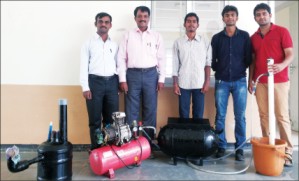
The 8th Semester students of ATME College of Engineering — Syed SuhailKadri, Pradeep and Suhas of Mechanical Engineering Department — under the guidance of K. Srinivasa, Head of the Department and Raghu, Asst. Professor, Department of Mechanical Engineering, have developed a technology to convert Raw Biogas to Enriched biogas, which has the potential to replace Compressed Natural Gas (CNG).
In present times, it is necessary to pay attention towards renewable energy sources such as solar energy, wind energy, biogas etc., due to fast depletion of conventional fuels like petrol, diesel and coal. In this regard, number of research works are going on in development of biogas technology. Biogas consists of 50-60% of methane and 20-30% of carbon dioxide. Due to this high percentage of carbon dioxide, the calorific value of fuel decreases and also affects the environmental pollution. In this project, the technology of enriching of biogas involves increasing the methane content in biogas from 50-60% to 70-80% by reducing the carbon dioxide content using Water Scrubbing process. On doing this, the calorific value of the fuel increases and environmental pollution reduces. This technology can be used for CNG also.
The students thanked the college for their support and facilities provided. The students were congratulated by Chairman of the institution, L. Arun Kumar, college Principal Dr. L. Basavaraj and teaching, non-teaching and management staffs.
source: http://www.starofmysore.com / Star of Mysore / Home> General News / July 17th, 2014
Chairman of Visakhapatnam Port Trust M.T. Krishna Babu with trainees of Sports Authority of India’s STC at Port stadium, Visakhapatnam Shashikala (on his right) and Nikhat Zareen who won gold medals in the Golden Gloves international youth men and women boxing meet in Serbia on Monday./ The Hindu
Two girls, who are trainees of the Sports Authority of India’s Sports Training Centre at the Port stadium here, won a gold medal each and helped India finish as runner-up in the Golden Gloves international youth women boxing meet held in Serbia from July 9 to 14. Twenty five teams participated in the meet.
Nikhat Zareen and Shashi Kala have participated in the international events in the past and the former has a few medals to her credit. Nikhat, hailing from Nizamabad district claimed the 54 kg category gold medal and Shashi Kala, a native of Himachal Pradesh won the 69 kg gold medal in the Serbia meet. Their coach, I. Venkateswara Rao, a Dronacharya awardee, is also from the port city.
The medal winners and their coach were congratulated by Chairman of Visakhapatnam Port Trust M.T. Krishna Babu on Wednesday. Deputy Chairman G.V.L. Satya Kumar, Sports Officer and former Olympian M.V. Manikyalu, Administrative Officer of SAI STC T. Kishor Kumar and general secretary of AP Boxing Federation G.V. Raviraju were also present.
source: http://www.thehindu.com / The Hindu / Home> News> Cities> Visakhapatnam / by Special Correspondent / Visakhapatnam – July 17th, 2014
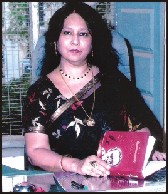
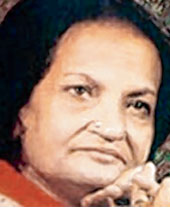
Dr. Maha Jabeen, Administrative Officer, Yuvaraja’s (Autonomous) College, has been appointed as the Principal of the University College of Fine Arts.
She earlier served as Associate Professor and as the Head of Department of Urdu, Maharaja College before being appointed as administrative officer of Yuvaraja College. She is also a renowned Urdu writer and poetess. Dr. Maha Jabeen has represented University of Mysore in numerous seminars and workshops held across the world.
She has authored five books in Urdu language of which one has won the National Award by Government of Uttar Pradesh.
source: http://www.starofmysore.com / Star of Mysore / Home> General News / July 16th, 2014
Twenty decadent facts from the life and times of India’s last ‘nawab’
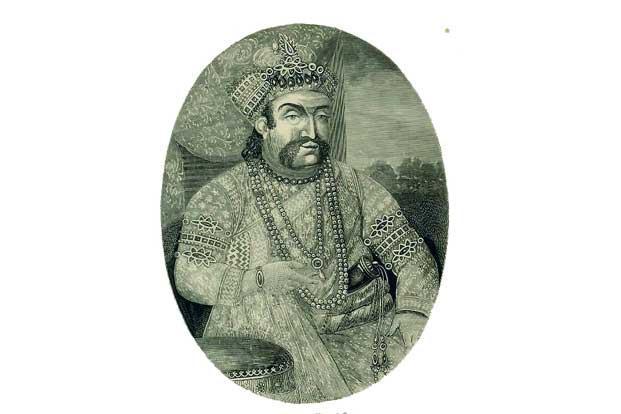
A portrait of Wajid Ali Shah. Photo: Wikimedia Commons.
The poet-ruler Wajid Ali Shah (1822-87) was the last nawab of the north Indian state of Oudh. Deposed by the British, he spent the last 30 years of his life in a riverside mansion near Calcutta (now Kolkata), where he languished in a mock-kingdom with 6,000 subjects. It was a make-believe world. Many of the exiled king’s high-ranking officials held on to their old titles. To the extent that it was possible, Wajid Ali Shah, whose actual reign lasted only nine years, continued the customs of the court.
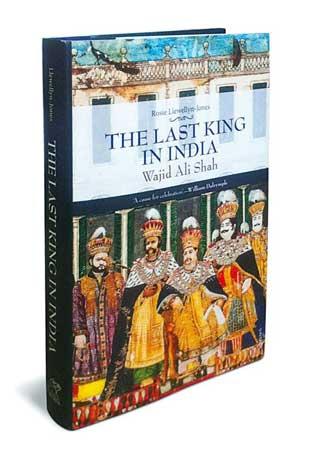
In The Last King In India: Wajid Ali Shah, British historian Rosie Llewellyn-Jones resurrects the nawab with all his tasteful eccentricities. “Holed up in his new palaces, dreaming of love, music and drama,” Llewellyn-Jones writes, “his lack of enterprise only increased the distance between the bubble-like atmosphere of the Court and the reality of peasant life outside the city.”
Days after finishing the book, I mostly remember the following aspects of its hero:
1. Wajid Ali Shah’s famous portrait (at the Hussainabad Picture Gallery in Lucknow) shows him as a well-fed man wearing a lavishly embroidered tunic. His sash has four rows of large pearls. His left breast and nipple are artistically exposed between the gold borders of his dress.
2. He married (approximately) 375 women.
3. At 15, he was married, for the first time, to Khas Mahal, the granddaughter of an Anglo-Indian woman called Sally Begam. Like her husband, Khas Mahal was a poet.
4. He had three kinds of wives—the mahals, who gave birth to his children and were veiled; the begams, who did not give birth and went unveiled; and the khilawatis, who performed menial household jobs.
The Last King in India—Wajid Ali Shah: Random House, 314 pages, Rs 599
5. His autobiography was dreamily titled Pari Khana (House Of Fairies).
6. His poetic pen name was Akhtar, meaning “star” in Persian.
7. At 22, he wrote the play Radha Kanhaiya Ka Qissa—a rare instance of a would-be Muslim king creatively engaging with Hinduism.
8. He had a soft corner for dark-skinned women. One of his brides, Yasmin Mahal, “is clearly of African origin with her short curly hair and un-Indian features”.
9. His personal bodyguards consisted of female African soldiers dressed in red jackets and tight-fitting, rose-coloured silk trousers.
10. His mother Janab-i Aliyyah, who died during a visit to Europe, lies buried in Père Lachaise, the largest cemetery in Paris, which is also the resting ground of musician Jim Morrison and author Oscar Wilde.
11. He ascended the throne in 1847; by then he was fairly notorious. Two years earlier, John Shakespear, an East India Company bureaucrat (he was recently described as the great-great-great- great grandfather of British Prime Minister David Cameron), complained to the governor general that “The Heir Apparent’s character holds out no promise of good. By all accounts his temper is capricious and fickle, his days and nights are passed in the female apartments and he appears to have resigned himself to debauchery, dissipation and low pursuits”.
12. By the time he became king, he had written two lengthy romantic narrative poems—Darya-i-Ta’ashshuq (The River Of Love) and Bahr-e ‘Ishq (The Ocean Of Affection)
13. Wajid Ali Shah marked the beginning of his reign by building Qaisarbagh Palace—it happened to be Lucknow’s last palace. One of the structures was given the poetic name of Jalpari Darwaza, or The Mermaid Gate, which no longer exists. The palace also had a spiral staircase that led nowhere. In 1955, British architecture critic John Terry saw in the palace “the full horror of the impact of stucco and European baroque”.
14. After being compelled to move from Lucknow to Bengal in 1856, the deposed nawab was settled by the British in Garden Reach, an area south-west of Calcutta that had opulent villas along the Hooghly river.
15. The Garden Reach estate comprised three buildings. One of them was Azud Manzil. It was the royal menagerie and had 20,000 birds, beasts, snakes and “every conceivable variety of freshwater fish that can live in a hot climate”. The pigeons, of every variety and colour, numbered 18,000 . There was also a collection of cobras. One morning in 1879, a tigress escaped, severely wounding a German man and an Indian lance corporal (it also killed two cows before being shot dead by the Howrah magistrate).
16. The nawab’s evenings during his years in exile were chiefly spent in the company of musicians and dancing girls.
17. In his later life, he was carried all over on a sedan chair. He is said to have been afflicted with an anal fistula that forced him to spend many agonizing hours in the toilet.
18. On his death, the nawab’s survivors—his wives, children and their servers—numbered about a thousand.
19. At his funeral procession, a military band played Dead March from Saul, the oratorio by German composer George Frederic Handel that was also performed in the funerals of US president Abraham Lincoln and British prime minister Winston Churchill.
20. Throughout his life, Wajid Ali Shah remained a teetotaller.
source: http://www.livemint.com / Live Mint & The Wall Street Journal / Home> Lounge> Business of Life> Indulge – Leisure / Book Review / by Mayank Austen Soofi / Saturday – July 19th, 2014
Grey clouds hover over Russell Square. They growl menacingly and then spit out fat raindrops. I take cover at the newspaper stall next to Luna Sweets.
A group of men sit on wooden benches outside a chai shop, sipping hot tea. They complain that Shivajinagar is definitely dirtier and more crowded than before. Prasad, the news stall owner tells me that it affects business.” It was not like this in earlier times” recollects a grey haired Syed Anwar.
“The Shivajinagar Bus Terminus used to be a football field called the Chota Maidan in the late 40’s. At the corner of the Square opposite St.Mary’s Basilica was a petrol bunk and in the middle was a large public toilet and well.” They begin to swap stories and I am included in the reminiscences.
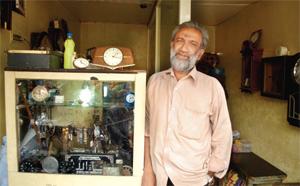
“When my father moved his business here in 1957, military officers and Europeans from the Cantonment came to get watches fixed.” says a bespectacled Syed Mahmood. I peek into his shop; the Paris Watch Company.
It is filled with timepieces; grandfather clocks hang on the wall and squat little brass vintage alarm clocks tick merrily inside a tiny work cabin. “Our earlier shop, the Pearl Watch Company (present Mota Chambers) was on Brigade Road. Business was good there.” The shop shifted to Shivajinagar in 1957.
“My family was originally from Chikmagalur where my grandfather had a circus. He was good with animals but it ran at a loss so he shifted to fixing watches.” My eyes widen. I have unexpectedly come across astory on this rainy evening in Bangalore.Perhaps the city speaks only when we stop to listen.
Syed Mahmood’s father, Syed Jaffer,was a respected horologist, well known amongst vintage watch collectors in the city. “One day in the late 70’s, Dr. Ajaz Ahmad, a Unani specialist from Mysore called him about a very important job.
Watchmakers across the country and beyond had failed at it since the three missing parts were irreplaceable. My father manufactured the parts,re-assembled the clock in 30 days and took it to Delhi where he presented the working Mantel Clock to its owner, the Prime Minister, Mrs. Indira Gandhi. He charged only `3000 for the job” says Syed Mahmood “but Mrs.Gandhi gave him `10,000.”
Syed Jaffer refused to teach his son the craft through books. “I learnt how to repair and assemble watches standing beside him all day.” His eyes grow moist. “He was a very fine man.”
Syed Jaffer was returning from weekly prayers at a mosque in Kumbarpet when he was unknowingly caught in police firing on MG Road in December 1986, duringa protest over a fictional story in a local newspaper. The stray bullet damaged his voice and his vocation. His shaking hands never fixed a watch again till his demise two years later.
The shop fills with sadness. Syed Mahmood wipes his eyes.
The clouds pass and the stories end. The men discuss world events. Paris Watch Company goes back to work. Syed Mahmood hunches over a dial and scrutinises it carefully.He fixes all kinds of clocks and watches including new ones, but the vintage French mantel clocks are a personal favourite. “Like the English clocks, they are almost impossible to replicate.”
Customers arrive to pick up their resurrected Omega or Rolex watches. They tell me that his skill and dedication too, are equally irreplaceable.The shop’s reputation remains unaltered by time.
The writer is a cultural documentarian and blogs at aturquoisecloud.wordpress.com
source: http://www.bangaloremirror.com / Bangalore Mirror / Home> Columns> Others / by Bangalore Mirror Bureau /July 14th, 2014
Railway Minister Sadananda Gowda, yesterday, said that his Ministry has worked out a plan to lay a second track in the Mysore-Bangalore sector without disturbing the 225-year-old Tipu armoury near Srirangapatna Station.
Refusing to disclose details of the plan, he said that Railway Engineers had chalked out a plan and the track-doubling work would be completed by March, 2015 and maintained “If I disclose the plans now, there will be unnecessary hurdles as this is a sensitive issue and there is no dearth of people who want to rake up controversies.”
The work had hit a road block as the track was expected to pass through Tipu’s armoury. A proposal to relocate the armoury was met with opposition which resulted in the delay, he added.
Funds
Speaking about the funds for other projects in the State, the Railway Minister said that Rs.1,543 crore had been allotted for works that are underway in Karnataka and declared that there was no question of shelving any project initiated by his predecessorMallikarjuna Kharge.
source: http://www.starofmysore.com / Star of Mysore / Home> General News / July 14th, 2014
– no hitch in grave renovation despite faizabad clashes
Lucknow :
Call it the power of music. Death has struck twice in this spiral of violence but hasn’t been able to cast its shadow on a tomb being “rescued”.
Admirers of Begum Akhtar are gearing to rediscover her legacy by restoring her grave in Lucknow at a time Faizabad, where the ghazal singer was born nearly a hundred years ago, is simmering under curfew even three days after riots left two persons dead and hundreds injured.
The violence broke out last week following a clash over an immersion procession.
Inspector-general (Lucknow range) Subhas Chandra said jawans were marching through the streets of Faizabad to restore law and order in the Uttar Pradesh town barely 10km from Ayodhya, the flashpoint of the 1992 Babri riots.
No such tinderbox emotions raged in Lucknow, 125km away, where followers of the ghazal and thumri singer prepared to mark her 38th death anniversary with a series of events starting tomorrow.
The events will culminate next month with her grave being rededicated to the city, where the “queen of melodies” came to live later in life.
The grave is located in a squalid, congested area in old Lucknow where shanties have sprung up. “The singer’s grave needs to be rescued from obscurity and squalor and put on the historical map of Lucknow,” said Salim Kidwai, a Lucknow-based writer who is working on a book on Akhtar.
“Begum Akhtar’s ghazals are suddenly being played by her admirers everywhere,” said a member of Lucknow’s former royal family.
Work on renovating the grave began two months back when artisans from Agra applied their expertise to restore its Pietra dura design — an Italian technique through which semi-precious stones are embedded in monuments. The resetting is complete and a green ring has been constructed around the grave.
Delhi-based architect Ashish Thapar, who volunteered for the project, has been supervising the renovation.
“The Government of India’s culture department has released a grant for the project,” said Madhvi Kukreja, director of Sanatkada, an NGO in Lucknow, which is working on the renovation. “We have approached the state government for funds for maintenance.”
Begum Akhtari Faizabadi, later renamed Begum Akhtar, was born in 1914 in Baradarwaja in Faizabad. Trained under Ustad Imdad Khan, a sarengi exponent in Calcutta, and later by classical singers like Abdul Wahid Khan in Lahore, she first performed at the age of 15.
In 1945, already famous as a singer of national repute, she married a Lucknow-based barrister, Ishtiak Ahmed Abbasi.
She received the Sangeet Natak Akademi Award and was awarded the Padma Shri and the Padma Bhushan (posthumously) by the Indian government and also bestowed the title “Mallika-e-Ghazal” (queen of melodies). She died on October 30, 1974.
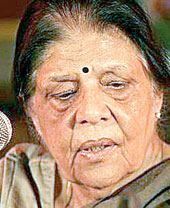
“It is my good fortune that I am involved in strengthening the legacy of my dear Ammi, who is still my guru,” said Shanti Hiranand, a septuagenarian ghazal singer who not only learnt singing from Begum Akhtar but also wrote a book on her, Story of my Ammi”.
Hiranand, herself a Padma awardee, would lead a concert on November 7, after which the new-look mazar would be opened to the public. A documentary, Hai Akhtari, by art critic S. Kalidas, will also be shown that day.
In Lucknow, a number of workshops have been organised in Begum Akhtar’s memory in various parts of the city.
Some 125km away, people in Faizabad were still seething in anger over the destruction of dozens of shops and vehicles in the violence that broke out on October 26.
Police officer Subhas Chandra said the administration had taken measures to check the movement of criminal elements.
source: http://www.telegraphindia.com / The Telegraph, Calcutta / Front Page> Nation> Story / by Tapas Chakraborty / Lucknow, Tuesday – October 30th, 2012
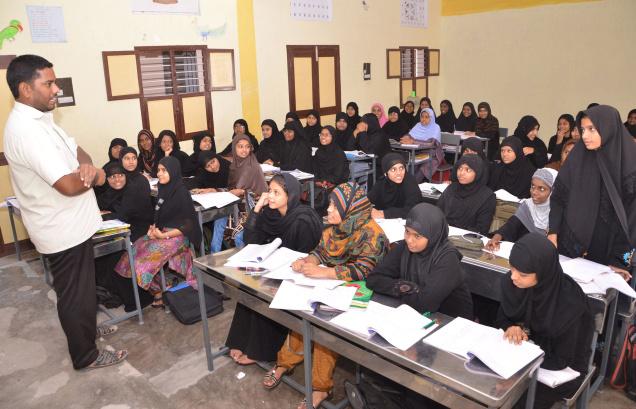
Muslim students getting a special coaching at Islamia Matriculation Higher Secondary School at Kilakarai in Ramanathapuram district./ Photo: L. Balachandar / The Hindu
Islamic Literacy Movement of India shows the way for their development
Having scored 491 out of 500 marks in the SSLC examinations this year, S. A. Mohammed Ameer Suhail was at a crossroads after the sudden death of his father in March, when Islamic Literacy Movement of India (ILMI) showed him the way.
Today, Suhail is one of the 98 Muslim students selected for a special coaching at Islamia Matriculation Higher Secondary School here, the only centre in the State to have been established by the Union Ministry of Minority Affairs.
(The Ministry’s ‘New component of special coaching and allied scheme’ helps minority students from poor families to pass Plus Two examinations with high marks and join professional courses.)
Suhail stood helpless when his father, who was running a fancy store at Ilampillai in Salem, died of heart attack. He learnt about the facility through ILMI’s announcement in the local mosque. “Besides the best coaching, I am getting everything free here and I am confident of cherishing my dream of becoming a doctor,” he says.
For K.S. Shahid Mohiyadeen, whose father is a casual labourer, S. Faridha Banu, whose father is a daily wage worker, and Naurin Nasser, who had lost her father while in class IX, the centre is a dream come true. All of them aspire to become doctors. Most of the students selected for special coaching hail from rural areas and economically weaker families.
They are delighted to get the best coaching by a team of faculty, which has served in Namakkal schools, famous for producing State toppers.
After K.N. Basha, Judge, Madras High Court, inaugurated the centre on June 22, two officials from the Ministry inspected it and were satisfied with the facilities and faculty members, Principal H. Mabel Austus said.
The government had announced a subsidy of Rs.1 crore for 100 students per year, but the school, run by the local Educational Development Committee, would be spending at least Rs.50 lakh more as it provided free uniforms, shoes and stationery, its correspondent M. M. K. Mohideen Ibrahim said. The additional expenditure would be equally borne by the committee and the ILMI.
More than 1,400 students had applied for the coaching and the selected candidates had scored 96 to 99 per cent, ILMI founder Maulana S. Shamsudeen Qasimi said. The ILMI created awareness of the facility through 8,000 mosques in the State, he added.
source: http://www.thehindu.com / The Hindu / Home> News> Cities> Madurai / by D. J. Walter Scott / Kilakarai – July 18th, 2014
The Yatch Club of Hyderabad members Rishab Prabhakar, Shivaram, Nikhil, Rajnikant, Yacht Club of Hyderabad president Suheim Sheik with Laser Yatch in Hyderabad. Photo: By Arrangement. / The Hindu
The fact that some boys are from the economically underprivileged section shows that the sport is gradually losing its elite tag. Suheim Sheik, president of the Yacht Club of Hyderabad, has been coaching schoolchildren, some of who come from poor families and these boys seem have taken to the sport like a duck to water.
Although Hyderabad is located far away from the coastline, thanks to the presence of the Hussainsagar lake, the city has produced several talented sailors who have fetched medals for India in international competitions.
The most noteworthy among them are Arjuna awardees – C.S Pradipak and Rajesh Choudhary (originally from Bihar but learnt sailing on the Hussainsagar waters), and A.A. Basith, who represented India at the Munich Olympics.
Fortunately the flow of talent still continues and now there are a bunch of youngsters who are looking to follow in the footsteps of these achievers. The fact that some of the boys are from the economically underprivileged section of society shows that the sport is gradually losing its elite tag.
Suheim Sheik, president of the Yacht Club of Hyderabad, has been coaching schoolchildren, some of who come from poor families and these boys seem have taken to the sport like a duck to water.
Nikhil Kumar, whose mother is in the fish selling business, showed so much promise that he was sent for an advanced level coaching course conducted by Polish coach Marek Nostitz Kackowski in Hong Kong.
Ragi Rajnikanth is another young lad with tremendous potential. He has bagged the bronze in Topper class national championships twice. “Hussainsagar lake is a very good sailing venue in many ways,” says Lt. Col. M.P. Jaggi (retd), a former sailor.
“The lake has the requisite length and breadth to lay a full sized course. Two internationals were conducted here – the Four Square International in 1990 and the Asia Pacific Laser Regatta in 1991. Moreover, it is located in the middle of the city, which means less hassle in the transportation of boats, sailors and maintenance crew. Also, it allows more people to view the events. All these factors give Hyderabad an advantage and we are hopeful that this city will produce more top level sailors,” he says.
source: http://www.thehindu.com / The Hindu / Home> News> Cities> Hyderabad / by Abijit Sen Gupta / Hyderabad – July 18th, 2014
V.S. Hari Krishna, winner of the youth boys title at the recent St. Paul’s Stag TT Academy state ranking tournament. / by Special Arrangement / The Hindu
Playing with senior players has helped paddler Hari Krishna chalk up victories
V.S. Hari Krishna preferred to punch above his weight right from an early age. Unlike several children who fake their dates of birth to play against younger rivals, he showed a penchant to take on tougher, if not older, opponents.
Such an approach stood him in good stead as the 14-year-old, who should be playing in the junior category, clinched the youth boys (under 21 years) title of the St. Paul’s Stag Table Tennis Academy state ranking tournament recently. All those training sessions at the aforementioned academy with former international G. Jitender and Shreyas Jagirdar, another senior player, had paid off.
Hari attributes his recent success to the 45-day national camp held at Lucknow in summer, where he learnt new techniques from the German coach Peter Angel. “This outing gave me a lot of experience and confidence,” says the youngster.
Setting out in the sport as an eight-year-old, the class X student of Gitanjali Devashray built up an impressive body of achievement. In March, he clinched a bronze double in the International Table Tennis Federation (ITTF) Global Junior Circuit tournament at Panaji, Goa. After claiming the cadet singles bronze, he joined hands with another Hyderabad lad, Snehit Fidel Rohit, to corner the doubles bronze.
“It was a dream come true to wear India colours and play before the home crowd,” the teenager said of the Goa experience. Hari finished fifth in the Table Tennis Federation of India’s (TTFI) 2013 sub-junior boys rankings. In the singles of the said section, he claimed bronze at the National ranking championship at Ajmer in December last year.
With Chinese paddler Zhang Jike for role model, Hari embarked on the table tennis journey under the tutelage of Maduri Venugopal and is currently coached by Ibrahim Khan and P. Nagender Reddy.
source: http://www.thehindu.com / The Hindu / Home> Features> MetroPlus / by A. Joseph Anthony / Hyderabad – July 16th, 2014