Region’s earliest interface with Islam was here

Madurai :

The wide Kazimar Street, which branches off from the busy TPK Road near Periyar Bus stand, is one of the oldest settlements of Muslims in Madurai. Historical legends state that Hazrat Kazi Syed Tajuddin came to Madurai from Oman in the 13th century and established the Kazimar Big Mosque on a land given to him by a Pandya monarch.

Till date, the descendants of Syed Tajuddin, who is believed to be a descendant of Prophet Mohammed, live on the Kazimar Street. They are hereditarily elected as the town kazis.

Syed Ahja Mueenudeen, the current town kazi, said that the Kazimar Big Mosque, which was constructed by Tajuddin as a thatched structure initially, was the first place of worship for Muslims in Madurai. The street has had Muslims settlement for over 700 years, he said. Thus, Islam arrived in Madurai even before Malik Kafur’s invasion of Madurai in the 14th century.

History professor R Venkataraman opines King Maravarman Sundarapandian might have been the contemporary of Tajuddin. Even before the advent of Islam, Arabs maintained trade links with South India, especially for the pearls Madurai Pandya Kingdom was famous for. “Sufis, Muslim saints, started coming to Tamil Nadu by 900 AD. The entry of Islam to the region was peaceful as Sufis conceived God as love,” he said.

The short-lived Madurai Sultanate and Islamic influence did have their impact on the city, especially on warfare and town planning. “Muslim rulers introduced arch construction they learnt from the Romans. It changed the style of architecture here in a significant way,” Venkataraman remarked.

The Big Mosque, which is an architectural attraction, accommodates Madurai Maqbara which is the dargah of sufi saints Hazrat Meer Ahamad Ibrahim, Hazrat Meer Amjad Ibrahim and Hazrat Syed Abdus Salaam Ibrahim Rahmatullahi Alaihim.

Syed Ali Hussaini, the renowned Chennai-based stunt artist, is originally from Kazimar Street. Recalling the legend of Tajuddin, he said: “It is believed that Tajuddin came from Arabia to Kerala and reached Madurai where he established a mosque. He became popular for divine healing powers. The Pandya king was irked with his fame, but Tajuddin cured the king himself when he suffered from a stomach ailment. The king gave away a land for mosque in gratitude,” he said. “Even today Tajuddin’s descendents, numbering more than 2,000, are annually given a customary nominal share of the income from the waqf lands originally donated by the king,” he added.

Till the 1980s, the residents of the street were engaged in rearing horses, rams, cocks and pigeons. “People were crazy about horses and many raised them. Rekla or bull cart race and pigeon racing were popular when I grew up in the area in the 1960s,” Hussaini recalled.

However, the face of the area has changed since then with many moving out for education and jobs, he said.

source: http://www.timesofindia.indiatimes.com / The Times of India / Home> City> Madurai / by J. Arockiaraj, TNN / April 27th, 2014

Remembering a titan of Hyderabad’s heritage

Remembering a titan of Hyderabad’s heritage

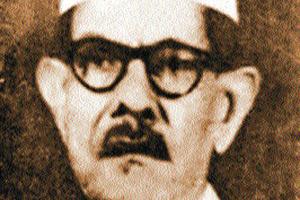
He played cricket and football for St Stephen’s Delhi with distinction. He did his masters in English as well as Arabic and he topped Punjab University in Persian. And if you are to name a saviour of the cave art of Ajanta and Ellora it is him:   Ghulam Yazdani,   a Padma Bhushan awardee as well as a recipient of OBE (Order of British Empire). 

As the Archaeology Department of Andhra Pradesh marks its 100 years the coming Friday, it is time to remember the man who created the department out of nothing.

If Hyderabad has a vestige of its heritage left, it is thanks to him. Deputed to Hyderabad as a Superintendent in 1914, he brought with him his expertise, energy and accountability. Not for him the claptrap of archaeology department doing the job of cataloguing and executing conservation work, Yazdani was a hands on man who got a road laid between Hyderabad and Bidar to protect the Bahamani heritage of Bidar and also between Toli Masjid and Golconda.

A man of sharp wit, he dismisses the decorative motifs of Toli Masjid as: “The impression made by such buildings overloaded with decorations is like the impression left by the ostentatious and lavish display of personal adornment, generally favoured by lowly persons suddenly become rich.”

For the restoration of the Ellora cave art, he tried to get Luigi Cavenaghi, the man linked to restoration of Leonardo’s Last Supper, to work on the paintings. Unfortunately, he could get only Lorenzo Cecconi, who applied shellac on the paintings, ruining them further. Ghulam Yazdani published a series of photographs and reproductions of the cave art with his explanations.

And by the way, Ghulam Yazdani’s salary was ` 560 per month. And just recently, the Archeology Department found it fit to name its museum after YS Rajasekhara Reddy!

source: http://www.timesofindia.indiatimes.com / The Times of India / Home> Life & Style> People / by Serish Nanisetti, TNN / April 21st, 2014

First Muslim Woman to Enter Civil Services Awarded Padma Shri

She broke the glass ceiling many a times, from being the first woman to enter any Class-I civil service to becoming the first IRS officer to be appointed a UPSC member and to being the only woman to have worked in the Central Narcotics Department.

After donning multiple hats during her long career, it was another proud moment for Parveen Talha, when she was conferred the Padma Shri award on Saturday for her contribution to the Civil Services.

But the road to success wasn’t that easy for Talha and the biggest hurdle was to overcome the anti-women mindset of her bosses at the initial stages of her career.

“It is indeed a proud moment for me but I am grateful to my bosses too. Though I had to initially deal with their anti-women mindset when I joined services 45 years ago, after a few years I was able to prove that I could handle the tricky jobs as efficiently as my male colleagues,” Talha told PTI.

70-year-old Talha joined Indian Revenue Service (Customs and Central Excise) in 1969 where she worked for 35 years and was then picked up as a member of the Union Public Service Commission (UPSC) in 2004.

“Once my bosses began to trust in my capabilities, I started getting challenging assignments including posting as Deputy Narcotics Commissioner in Uttar Pradesh,” she said.

“There was a large-scale leakage of opium going on in UP then. While I tried my best to play a stringent officer dealing with certain illegal channels, poppy cultivators were surprised too because they had never seen a woman at that level,” she added.

By halting for days in the cultivation areas and delving deep into all processes of poppy cultivation from sowing to lancing and harvesting, she gathered foolproof intelligence which was put to good use by her hand-picked preventive parties.

During her posting in UP and Bihar in 1990s, she attached illegally acquired property worth millions of rupees belonging to smugglers and drug traffickers at the risk of her life.

While she was posted as Director General Training in 2002, Talha provided strategic vision to the Department of Customs and Central Excise in evolving comprehensive packages of programmers for technical capacity building of all cadres and service providers.

Talha, who was honoured with the President Award for “Specially distinguished record of service” in 2000, also has a penchant for writing.

She has written ‘Fida-e-Lucknow’, a collection of 22 short stories, besides writing the dialogues for the serial ‘Husn-e-Jana’ directed by Muzaffar Ali.

“I find there are stories in every nook and corner that are waiting to be told. So I will pursue my passion for writing now that I am a retired person,” she said.

source: http://www.newindianexpress.com / The New Indian Express / Home> Nation / by PTI –  New Delhi / April 27th, 2014

Insight receives International School Award, bags two gold medals

Hyderabad:

Insight International School, Hyderabad has bagged three prestigious awards, International School Award by British Council, School Brilliance Award by Bangalore-based IBCI, and Eduranet Intellectual Olympiad.

A graduation and awards celebration ceremony was organized at Hotel NKM Grand in Banjara Hills, Hyderabad on April 18 to felicitate students who secured state ranks in the Eduranet competition.

InsightMPOs26Apr2014

In Eduranet 9th Intellectual Olympiad 2013-14, Insighters secured state ranks in categories such as Advanced Mathematics Skills, and Science and Research Skills. They bagged two Gold, three Silver and two Bronze awards in the competition.

Fourth class student Abdul Rahman and fifth class student Sidhrah Quadri Syeda won gold medals, while Afifa Hasnath of sixth standard, Syed Raaid Azzam Husaini of third standard and MD Abdul Qayyum of fifth standard won silver medals.

Speaking at the event as chief guest, Mir Ayub Ali Khan, Editor – Special Affairs, Times of India, congratulated all students and the staff members for their hard work and achievements.

Mr. Khan said: “Education is aimed at making us better human being and also a good Muslim. Education is also aimed at giving us relevant skills which are required for a gainful living.”

He remarked about two noted personalities of the Muslim community – Shah Faisal Award winning economist Nejatullah Siddiqui, and Mr. Zainul Abedeen. Mr. Siddiqui studied in madrasa and also at university level, hence a good inspiration for students, he said.

Insight International School principal Syeda Khadeja expressed joy at the achievements of her school and students. She said it reflects hard work of both the students and staff members.

“In Insight, we try to nurture curiosity among students. We are following a task-oriented curriculum for the benefit of the students. And we are evolving into a learning oriented school,” she added.

source: http://www.twocircles.net / TwoCircles.net / Home / by SM Fasiullah / April 20th, 2014

University of Hyderabad Making Efforts to Preserve Gunjala Gondi Script

Kotnak Jangu, one of the few who can read the Gondi script, at a Gunjala Gondi script reading programme held in Hyderabad on Friday on the occasion of World Heritage Day. Veteran journalist Potturi Venkateswara Rao (left) and UoH vice-chancellor Ramakrishna Ramaswamy seem relishing the dialect. | RVK RAO

Contrary to what everybody believes as established fact that first freedom struggle in India took place in 1857, a Gondi king with the help of Muslims fought against the British in 1730 and even sent a minister to bring army from Afghanistan.

“Britishers hanged about 300 people for revolting, all this we got to know after reading Gunjala Gondi manuscripts,’’ said V Krishna, professor, Centre for Dalit and Adivasi Studies and Translation, University of Hyderabad (UoH) on Friday at the recitation programme of Gunjala Gondi Script organised on the occasion of World Heritage Day at Potti Sriramulu Telugu University.

He said when manuscripts written in Gondi script were found in Gunjala village, Adilabad district, only four people were left who were able to read the script. “With the intention of preserving the script for posterity, we are going to document the script in audio and video format,” said Krishna.

At the programme, Kotnak Jangu, one of the few who can read the script recited a few phrases from the manuscripts. “I have written my biography in the script and teaching it to youngsters of the village,” said Kotnak.

With a very few people left who can read the script, efforts are being made to teach it to the current generation. It will be taught at 15 schools in Adilabad district, said Jayadhir Tirumal Rao, visiting professor at CDAST who has been working on revival of the script for the past couple of years adding that Integrated Tribal Development Agency (ITDA) is providing funds for research on the script and came forward to establish a research centre for the script.

Appreciating the efforts of the centre in preserving the script, Ramakrishna Ramaswamy, vice chancellor, UoH said that though scripts were excavated at Mohenjo-daro, no body was equipped to read and understand them. “Now with this work of the professors, Gondi script can be integrated with its culture and sounds of the language,” said Ramaswamy. “In the future, we will teach the script to Koya, Khond, Andh tribes also. We request the government to introduce the script in all the scheduled areas,” appealed Tirumal Rao.

source: http://www.newindianexpress.com / The New Indian Express / Home> Cities> Hyderabad / by Express News Service – Hyderabad / April 19th, 2014

MELANGE : At home in Peelamedu

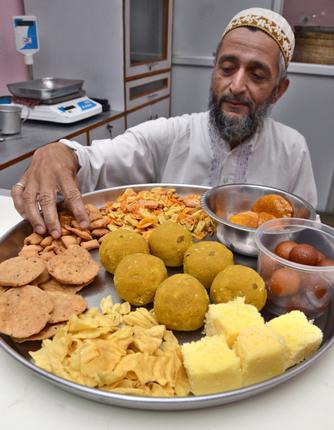
A taste for community spirit: Saifuddin, the mithai wallah./ Photos: M. Periasamy / The Hindu

The Dawoodi Bohra Muslim Community, originally from Gujarat, has made Coimbatore its own, yet it retains its distinctive cultural and culinary identity

Evening Namaz has just ended. Men in topis and flowing white kurtas emerge from the mosque. Women in colourful gowns zip through the lanes on their two wheelers. The smell of hot khakras wafts from the nearby sweet shop. Children returning from their evening Arabic and Quran classes, buy savouries from there and run home. The conversation one overhears in a language that sounds like a mix of Urdu, Gujarati and Persian. It is called Lisanud-Dawat. Sound of laughter comes out of a home. The Burhani colony of Coimbatore in Peelamedu wakes up to its night life.

“Many of us have settled here for generations since the time of our great grandfathers,” says Alifiya M Mamoowala who has volunteered to be my guide for the day. “There are around 392 families here. And, we have become a part of this city.”

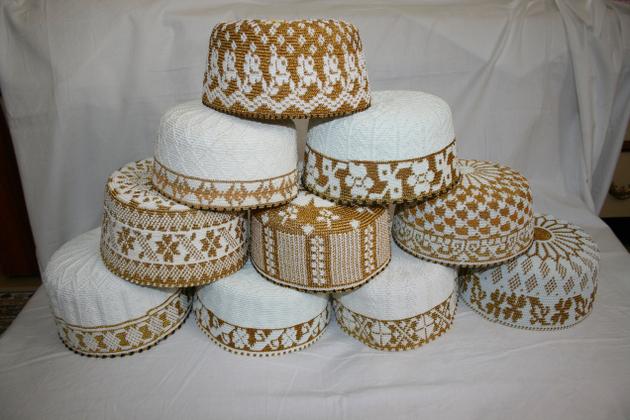
Topis worn by Bohra men./ The Hindu

At the same time we hold onto our tradition,” adds Feroz Y Dak, as he leads me to the office of Aamil Saheb, the community’s religious and administrative head.Aamil Saheb hails from Madhya Pradesh and has been holding this office for the last two years. “The community settled in Coimbatore in the early 1930s. We originate from the Khambat district in Gujarat,” he explains. And they believe they must abide by the law of the land where they live, says Aamil. “I am learning Tamil. And, my children go to a Tamil medium school,” he smiles.

Next, I visit the burhani mithai stall, where Saifuddin Bhai Ahmedabadwala fries hot mathris. His shelves are laden with laarvas, a typical burhani laddoo made of besan and stuffed with raisins. His sweet puris drip sugar syrup and I am told they are a must during Shab-e-barat. But Saifuddin’s road to fame is his gulab jamuns, made with khoya. “Even the locals love it,” he says with pride.

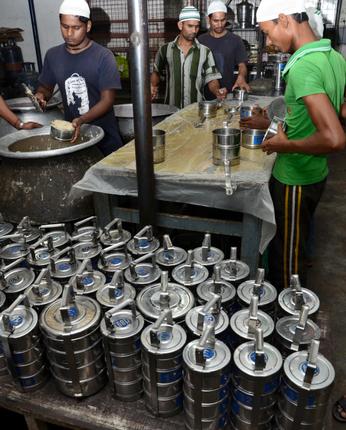
I meet another Saifuddin who is head chef at the Community Food Hall. “I have worked across India I have learnt other recipes by working with the local chefs.” “At the Community Food Hall they prepare free dinners for all the houses in the colony. This is one way of making sure that the ladies of the community get some free time to do what they want,” says Feroz.

The food hall./ The Hindu

“Looks like it is biryani today,” says Feroz as we sniff appreciatively. Inside, there are huge davaras of chicken biryani. Hundreds of tiffin boxes are neatly arranged on the floor. They will be despatched along with rose lassi and raitha. “Each tiffin box carries a number allocated to a house. So, no one uses the vessel used by the others,” says Feroz. Residents can either collect their tiffin boxes at the hall or get them delivered at their door steps. As dusk falls, lights pop on in the kitchens. At Alifiya’s house, Gulshan Y Mamoowala has whipped up a grand meal. As soon as we enter, she welcomes us with a bowl of crystal sugar. “That’s the bohra custom of welcoming the guests with a sweet note,” says Yunus Bhai Mamoowala, her husband. Gulshan’s lemon yellow skirt and a blouse that she wears with a pretty shawl is called jori. “We wear these inside the house. The burqas are called ridas and are worn outside,” says Alifiya.

“Ridas and joris have become a big style statement,” adds Munira Gheewala, who has dropped in to apply mehendi on Alifiya’s daughter’s hands. “During weddings women wear ridas with zardozis and elaborate embroidery, floral panelling and tatting.” Bohra weddings are grand, says Munira. “We apply mehendi on the entire arm of the bride! Our designs are mostly Arabic motifs, featuring creepers and flowers.”

ThaalMPOs26apr2014

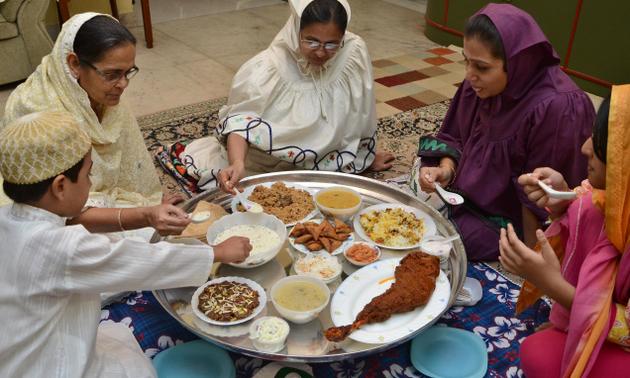
Conversation ceases as Gulshan brings the huge thaal and places it on a stool. The entire family sits around the thaal. “The whole point is to drive home the message of togetherness,” says Feroz. “This strengthens our bond.”

The first thing I am offered is a pinch of salt! “It opens your taste-buds,” says Gulshan. And in bohra cuisine, desserts come first, says Alifiya. Sodena (sweet rice and badam) and Shir khurma, (something like semiya payasam) kick start the fare. The main course has a shoulder of lamb hot from the tandoor, dal chawal palidu and rotis with khichda (haleem). “The signature dish in a burhani cusine is the simple dal, rice and palidu combination. Palidu is a little like rasam. It is cooked with tuvar dal stock, drum stick and regular spices,” explains Gulshan.

We round off the sumptuous meal with sweet paan. As we sit back on the cushions, Yunus shows me the pictures of their ancestral home at Sidhpur, Gujarat. Magnificent havelis, with a dozen windows, mark the bohra colony. “All the traders used to live here. Each house is built close to each other to create community spirit,” says Yunus. “Our family came to Coimbatore 25 years ago to set up business here. We still go back there once in a year,” says Yunus.

As I bid farewell to the Mamoowala family, Gulshan sprays attar on my hands and tells me to rub it on my clothes. “This is for you to always remember the beautiful memories of the evening you spent with us,” she says.

I smell my hand again and smile as the fragrance recreates in my mind the lanes of Sidhpur and its airy havelis.

source: http://www.thehindu.com / The Hindu / Home> Features> MetroPlus> Melanage / by Parshathy J. Nath / Coimbatore – April 25th, 2014

Facelift for Abdul Wahab tomb

Grandiose plans:The 400-year-old tomb in Kurnool is set to be developed as a tourist spot.-Photo U.Subramanyam / The Hindu

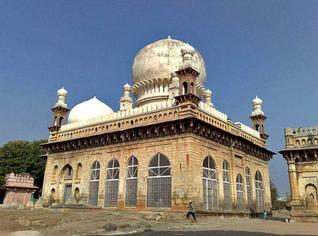
Abdul Wahab tomb, popularly known as Gol Gummaz, located near Osmania College here will soon get a facelift under the Special Tourism package. Financial assistance was given under Archaeological Survey of India (ASI) and Central Tourism package.

The Union Tourism Ministry sanctioned an amount of Rs 4.30 crore for development of Gol Gummaz, Kondareddy Fort, Vijayavanam as landscape and Rupala Sangameswara temple.

Special focus was laid on the 400-year-old tomb for development as tourist spot along with three other places, which will form a tourism circuit. Gol Gummaz has a special place in the history of Kurnool city. The tomb of Abdul Wahab, the military commander of Bijapur army and first Muslim ruler of Kurnool was believed to have been constructed in 1618 after the death of Wahab. After successful invasion of the Kurnool fort, Bijapur Sultan Adil Shah declared Wahab as its chieftain. His successors ruled the fort until another dynasty headed Davud Khan was installed as rulers of Kurnool fort.

The monument with a large dome was constructed in typical Bijapur style of architecture. The Archeological Survey of India (ASI) notified the structure as monument and took all measures to protect its ambience. However, with the latest decision of developing it as a tourist centre, every care was being taken to preserve the originality of the monument, said Krishna Chaitanya of ASI.

source: http://www.thehindu.com / The Hindu / Home> National> Andhra Pradesh / by  D. Sreenivasulu / Kurnool – March 19th, 2014

A Jeelani Twist to the Old

JeelaniDiariesMPOs22apr2014

When you think Hyderabad, you think Nizam and by extension you think biryani. To satiate that palate yet give a new twist to the old, Viva at Vivanta by Taj, Begumpet, has launched the Jeelani Diaries, a unique pairing of Nizami food with cocktails.

The four course menu is prepared by Chef Jeelani, who spent the better part of his childhood in the Nizam’s kitchen along with his father who was an assistant in the royal kitchens. With typical specialities like the Dum biriyani almost considered ‘ghar ka khana’  (homemade food) for the chef who has always been preparing and specialising in the Hyderabadi-Nizam cuisine, the spread is promising.

Besides the chef, what makes the Jeelani Diaries even more of a mouthful is the careful cocktail pairing. Served with the starters, each comes with a choice of two cocktails that complement and enhance the flavours.

For instance, the menu opens with a selection of signature favourites such as the kale chane ke kebab that comes with a serving of falak or pudina while the aloo shikampoor is teamed with mild firangi nariyal or vodka shikanji.

The idea is sip on the drink while you eat, so make sure you don’t down yours before you finish off your kebabs; the elaborate pairing that has gone into the process to improve the flavour will be lost.

Besides a colourful array on your platter, the chefs have ensured a colourful array of the cocktails as well.

Other authentic dishes find their way to the menu, including Bhagara Baigan, Charra Aloo Choti Methi and Jungli Murghi ka Salan. But make sure you end your meal with their rather interesting choice of desserts —  Palak ka halwa, Mirchi ka halwa and Gosht ka halwa.The Jeelani Diaries is open for lunch and dinner at Viva from 12:30 to 3 pm, and 7:30 to 11 pm.

For reservations, contact 040 6725 3642.

source: http://www.newindianexpress.com / The New Indian Express / Home> Cities> Hyderabad / by Express Features – Hyderabad / April 11th, 2014

Geared up

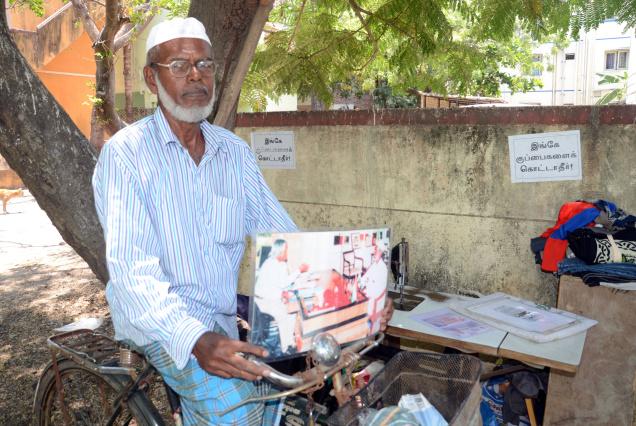
Mission on wheels: While cycling to Delhi from Chennai, S. Nagoor Meeran made many friends./  Photo: M. Karunakaran / The Hindu
Mission on wheels: While cycling to Delhi from Chennai, S. Nagoor Meeran made many friends./ Photo: M. Karunakaran / The Hindu

Nagoor Meeran, a tailor, cycled to Delhi to meet Abdul Kalam. Vipasha Sinha on his feat

Neither the merciless weather nor the bumpy roads could stop S. Nagoor Meeran from meeting the APJ Abdul Kalam in 2003. At that time, Kalam was the President of India.

Nagoor started his journey to the capital by cycle from Tenkasi. In 35 days, he rode through Chennai, Hyderabad, Nagpur, Bhopal, Agra. It was commendable for a 57-year old to perform such a feat.

Ten years later, Nagoor shares the story of that journey and talks of his love for cycling.

“The Lion’s Club was planning to do an event to promote world peace. They had different ideas in mind but I suggested that I could cycle all the way to Delhi and meet the president,” says Nagoor, who is a tailor by the day and watchman by the night.

It was an Imam from his town who suggested to him the idea long ago and this seemed like a perfect opportunity. He had also met Kalam’s brother in Rameshwaram and expressed his interest in meeting the head of the country.

“However, when I reached Delhi I was told I could not meet the President. Yet I was hopeful. I wrote about my journey and the purpose of the meeting and left the request in a glass box kept for people who wish to meet the President. Reading it, he agreed to meet me. I quickly changed my clothes ahead of the meeting. Mr. Kalam was kind enough to have lunch with me. We spoke about three things – the need to promote peace and communal harmony, development in his native town of Tenkasi, and my desire to visit Mecca. I also presented a letter appreciating him,” says Nagoor.

He also got a chance meet other ministers and personalities. All that he carried for the journey on a basic Hercules cycle was a small bag and a bottle of water. He says there were many people who helped him complete his quest along the way.

“I would start in the morning and by six in the evening, I would look for a temple or a police station or a forest department office where I could spend the night. Some people would offer food and water. Between Agra and Delhi come these humungous soft drink outlets, I went there and they gave me two big bottles of cool drinks for the journey. Since water was a major problem, I would befriend the truck and lorry drivers on the highway, and they would erect tents where they could rest. I would use their water tanks to clean my clothes and take a bath. There were times when I would go without a bath for days. I also maintained a diary with the signature and names of all the people who helped me during the journey,” says Nagoor, who has to spend around Rs. 10,000 for this trip, which was partially sponsored by Lions Club and Sun Tv.

Completing his mission, he took a train back to Chennai. Now, he carries in his small bag a photo taken with Kalam and few newspaper clippings lauding his feat. Ask him why he took that journey, he says: “It was just for the love of cycling.”

source: http://www.thehindu.com / The Hindu / Home> Features> Down Town / by Vipasha Sinha / Chennai – March 29th, 2014

Confluence of ragas


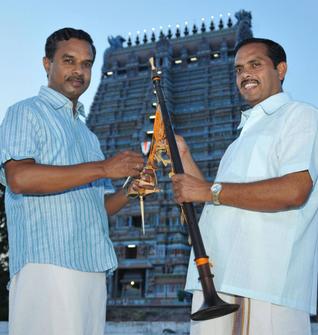
S. Kasim and S. Babu, Nadhaswaram vidwans and grandsons of the legendary nadhaswaram exponent Sheikh Chinna Moulana, feel there is no place for ego in music. / Photo: M. Moorthy / The Hindu

Kasim and Babu are the inheritors of nadhaswaram exponent Sheik Chinna Moulana’s musical legacy in more ways than one. Nahla Nainar listens to their story

Grandsons or disciples? “Before we are grandsons of Sangeetha Kalanidhi Sheik Chinna Moulana, we are his disciples,” asserts Subhan Kasim. Speaking about his maternal grandfather and acclaimed nadhaswaram exponent is clearly a matter of great pride for Kasim, who with his younger brother Babu, was handpicked by the maestro to continue the family’s musical legacy.

Kasim and Babu meet visitors at ‘Alaphana’, the 1950s-era house in Srirangam that was formerly Sheik Chinna Moulana’s residence and is now Kasim’s home. A hot breeze stirs up the dry leaves outside, but the mood inside is one of quiet reflection. It will be 15 years this week since Sheik Chinna Moulana died at the age of 74.

“From 1982, after I graduated from college, until Thatha’s last concert in 1999 in Chennai’s Music Academy, where he was awarded the Sangeetha Kalanidhi title, I was performing with him,” recalls Kasim. “Thatha never had a retirement phase, he just kept working, or teaching.”

The Dr. Chinnamoulana Memorial Trust set up by Kasim and Babu will be hosting its 15th Shradhanjali (commemorative gathering) at Tiruchi this week.

Music in the veins

Originally from Karavadi in Andhra Pradesh, the family has over three centuries of experience in playing the nadhaswaram. “Thatha belonged to the Chilakaluripet school of music,” says Kasim, naming the town in Guntur district. “Among his gurus were his own father, Sheik Kasim Sahib, and later, Sheik Adam Sahib.”

Despite emerging as a noted performer in the Andhra style of Carnatic music, Sheik Chinna Moulana decided to explore the Thanjavur ‘bhani’ (school) which allows for greater variations in presenting ragas. “From an early age, Thatha was influenced by the recordings of T.N. Rajarathinam Pillai (1898-1956). He migrated to Tamil Nadu to get trained in the Thanjavur style of playing by the Rajam-Duraikannu brothers of Nachiarkovil for four to five years,” says Kasim.

Sheik Chinna Moulana’s career took off in the early 1960s, and Kasim believes it was the exposure to the Thanjavur ‘bhani’ that helped immensely. The maestro decided to make the pilgrimage town of Srirangam his home. Kasim, who accompanied his grandfather to Tamil Nadu early on, studied at the Srirangam Boys High School, and went on to graduate in Physics, at St. Joseph’s College, Tiruchi, while getting his music education at home.

Babu joined the in-house gurukul in his teenage years, and was educated up to Standard 8 in Andhra Pradesh. “We started our training with smaller versions of the nadhaswaram,” says Babu in halting Tamil, “Then, as we became older and and our hands grew accustomed to reaching all the fingering holes, we were given the regular-size instruments.”

The nadhaswaram, together with the ‘thavil’ drum, are often referred to as ‘mangala vadyam’ or auspicious instruments, showing their importance to sacred music in southern India.

The nadhaswaram’s use as a solely temple-based instrument for daily prayers and processions was slowly introduced to a more public and secular platform by royal families and later, the landed gentry.

“Nadhaswaram is an integral part of our society,” says Kasim. “Few occasions – weddings, housewarming ceremonies or prayers – are complete without its music.”

The days of concerts that would start late and go on past midnight are well and truly gone, says Kasim. “Artists today have learned to compress what was being done in four hours, to two-and-a-half. Most of the concerts these days are held from 7 to 9.30 p.m., which is a good duration. It allows more women to attend as well,” he says.

Concert exposure is as important to the artist as getting practical instruction, says Kasim. “I learned a lot about presentation and public relations while performing with Thatha,” he says. “These days, with overseas assignments, the artists must be prepared to interact with people of other nationalities too.”

Above all barriers

Kasim and Babu maintain an extensive audio-visual archive of their grandfather’s music concerts at home. Some video samples, such as Sheik Chinna Moulana and shehnai virtuoso Ustad Bismillah Khan exchanging ideas on fingering techniques on the two instruments, are shown to students of the Saradha Nadaswara Sangeetha Ashram, a school established by Sheik Chinna Moulana and today run by his family in Srirangam.

A typical day for the brothers starts off with breathing exercises (pranayama), and is followed by practice sessions on the nadhaswaram. Afternoons are reserved for vocal music lessons for the students, followed by instrument training in the evenings. “We spend the rest of the day in updating ourselves,” says Kasim. “Unlike before, there are hundreds of compositions being brought out these days, so as active performing artists, we must be familiar with what is going on in the arena.”

As to whether there’s any sibling rivalry during concerts, Kasim replies: “I support my brother when he takes the lead, and he supports me when I take the lead. There is no place for ego in music.”

The success of Muslim artists like Sheik Chinna Moulana and Bismillah Khan in a sometimes exclusively Hindu cultural sphere is a great example of India’s syncretism. Both the brothers, presently the special nadhaswaram artists of the Tirumala Tirupati Devasthanams, feel that music is above matters of faith.

“Thatha often used to say ‘music is my religion; perfection is my aim.’ In northern India, most of the doyens of classical music are Muslims. You have the Kirana gharana, Bade Ghulam Ali, Roshanara Begum and so on. Those who speak of religion cannot ignore the contribution of the Mughal dynasty to the field; ragas like Malkauns, Amir Kalyani and Darbari Kanada all have an Islamic origin. Only those who are ignorant about music object to Muslims in the field,” smiles Kasim.

What is more pertinent is institutional support for classical music in India, he says. “The temple’s day begins and ends with nadhaswaram music. But increasingly, even big temples are doing without these musicians. The government should step in by paying exponents a decent salary and encouraging their employment,” says Kasim. “The backing of sabhas is crucial as well, because it helps in the musicians’ professional growth.”

Tribute to the maestro

The Dr. Chinnamoulana Memorial Trust, set up in 1999 by his grandsons Subhan Kasim and Subhan Babu, will be hosting its 15th ‘Shradhanjali’ (commemorative gathering) at Hotel Sangam on April 13 and 14.

At the event, the trust will be presenting nadhaswaram instruments to six deserving students this year, and for the first time, ‘thavil’ drums to three pupils, as part of the corporate social responsibility initiative of Bharat Heavy Electricals Limited (BHEL). In addition to this, a purse and citation each will be presented to senior artists Pandhanallur P.K. Ramalingam Pillai (nadhaswaram) and Needamangalam C. T. Kannappa Pillai (thavil).

Concert performances include a vocal recital by T.K. Krishna on April 13, and a nadhaswaram rendering by M. Sivadivel the next day. The event is being organised in co-operation with Rasika Ranjana Sabha, Tiruchi.

source: http://www.thehindu.com / The Hindu / Home> Features> MetroPlus / by Nahla Nainar / Tiruchirapalli – April 11th, 2014